







Portal:Aviation
| Main page | Categories & Main topics |
|
Tasks and Projects |
The Aviation Portal

Aviation includes the activities surrounding mechanical flight and the aircraft industry. Aircraft include fixed-wing and rotary-wing types, morphable wings, wing-less lifting bodies, as well as lighter-than-air aircraft such as hot air balloons and airships.
Aviation began in the 18th century with the development of the hot air balloon, an apparatus capable of atmospheric displacement through buoyancy. Clément Ader built the "Ader Éole" in France and made an uncontrolled, powered hop in 1890. This was the first powered aircraft, although it did not achieve controlled flight. Some of the most significant advancements in aviation technology came with the controlled gliding flying of Otto Lilienthal in 1896. A major leap followed with the construction of the Wright Flyer, the first powered airplane by the Wright brothers in the early 1900s.
Since that time, aviation has been technologically revolutionized by the introduction of the jet engine which enabled aviation to become a major form of transport throughout the world. In 2024, there were 9.5 billion passengers worldwide according to the ICAO. As of 2018, estimates suggest that 11% of the world's population traveled by air, with up to 4% taking international flights. (Full article...)
Selected article

A hot air balloon consists of a bag called the envelope that is capable of containing heated air. Suspended beneath is the gondola or wicker basket (in some long-distance or high-altitude balloons, a capsule) which carries the passengers and a source of heat. The heated air inside the envelope makes it buoyant since it has a lower density than the relatively cold air outside the envelope. Unlike gas balloons, the envelope does not have to be sealed at the bottom since the air near the bottom of the envelope is at the same pressure as the surrounding air. In today's sport balloons the envelope is generally made from nylon fabric and the mouth of the balloon (closest to the burner flame) is made from fire resistant material such as Nomex.
Recently, balloon envelopes have been made in all kinds of shapes, such as hot dogs, rocket ships, and the shapes of commercial products. Hot air balloons that can be propelled through the air rather than just being pushed along by the wind are known as airships or, more specifically, thermal airships. (Full article...)
Selected image

Did you know
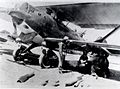
..that an aircraft's pitot-static system allows a pilot to monitor airspeed, Mach number, altitude, and altitude trend? ...that Wing Commander Stanley Goble and Flying Officer Ivor McIntyre, piloting a single-engined seaplane (pictured), became the first men to circumnavigate Australia by air in 1924? ... that the PZL SM-4 Łątka never flew, because its engine was not approved for use in flight?
General images -
-
-
-
-
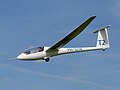
 A Boeing 787 Dreamliner of United Airlines landing at Beijing Capital International Airport in December 2018 (from Wide-body aircraft)
 -
-
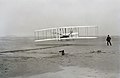 The Wright Flyer: the first sustained flight with a powered, controlled aircraft (from History of aviation)
 -
-
-
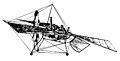
 The Biot-Massia glider, restored and on display in the Musee de l'Air (from History of aviation)
 -
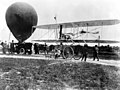 The Wright Military Flyer aboard a wagon in 1908 (from History of aviation)
 -

-
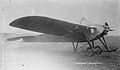 Nieuport IV, operated by most of the world's air forces before WW1 for reconnaissance and bombing, including during the Italian-Turkish war (from History of aviation)
 -
 An Airbus A380 of Qantas. The A380 is the world's largest passenger airliner. (from Wide-body aircraft)
 -
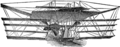 Maxim's flying machine (from History of aviation)
 -
 Jean-Marie Le Bris and his flying machine, Albatros II, 1868 (from History of aviation)
 -

-
 Often published as a photo of Santos-Dumont during the prize-winning flight, this is actually an earlier attempt using his "Number 5" (from History of aviation)
 -
 First failure of Langley's manned Aerodrome on the Potomac River, 7 October 1903 (from History of aviation)
 -
 Woodcut print of a kite from John Bate's 1635 book The Mysteryes of Nature and Art (from History of aviation)
 -
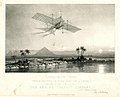 1843 artist's impression of John Stringfellow's plane Ariel flying over the Nile (from History of aviation)
 -
 Concorde, G-BOAB, in storage at London Heathrow Airport following the end of all Concorde flying. This aircraft flew for 22,296 hours between its first flight in 1976 and final flight in 2000 (from History of aviation)
 -
 An Airbus A321 of Vietravel Airlines parking next to a Vietnam Airlines Airbus A350-900 and a Cargolux Boeing 747-400 widebodies, highlighting their size differences. (from Wide-body aircraft)
 -
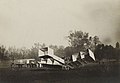 The 14-bis, or Oiseau de proie (from History of aviation)
 -
 Flagg biplane from 1933 (from History of aviation)
 -
 "Map of Air Routes and Landing Places in Great Britain, as temporarily arranged by the Air Ministry for civilian flying", published in 1919, showing Hounslow, near London, as the hub (from History of aviation)
 -
 Apollo 11 lifts off on its mission to land a man on the Moon (from History of aviation)
 -
 Alberto Santos-Dumont flying the Demoiselle over Paris (from History of aviation)
 -
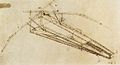
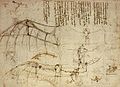 One of Leonardo's sketches (from History of aviation)
 -
 "Governable parachute" design of 1852 (from History of aviation)
 -
 Otto Lilienthal, 29 May 1895 (from History of aviation)
 -
 French reconnaissance balloon L'Intrépide of 1796, the oldest existing flying device, in the Heeresgeschichtliches Museum, Vienna (from History of aviation)
 -
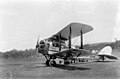 Qantas De Havilland biplane, c. 1930 (from History of aviation)
 -
 Me 262, world first operational jet fighter (from History of aviation)
 -
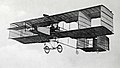 Early Voisin biplane (from History of aviation)
 -
 1928 issue of Popular Aviation (now Flying magazine), which became the largest aviation magazine with a circulation of 100,000. (from History of aviation)
 -

-

-
 Map of record breaking flights of the 1920s (from History of aviation)
 -
 Clément Ader Avion III (1897 photograph) (from History of aviation)
 -

-
 Experimental helicopter by Enrico Forlanini (1877), exposed at the Museo nazionale della scienza e della tecnologia Leonardo da Vinci of Milan, Italy (from History of aviation)
 -
 La France flying in 1885 (from History of aviation)
 -
-
 The Aeroplane of Victor Tatin, 1879. (from History of aviation)
 -
 D.H. Comet, the world's first jet airliner. As in this picture, it also saw RAF service (from History of aviation)
 -
 Planophore model aeroplane by Alphonse Pénaud, 1871 (from History of aviation)
.jpg)


.jpg)


.jpg)

.jpg)


.png)
.jpg)


.jpg)

.jpg)


.jpg)


.jpg)


In the news

- May 29: Austrian Airlines cancels Moscow-bound flight after Russia refuses a reroute outside Belarusian airspace
- August 8: Passenger flight crashes upon landing at Calicut airport in India
- June 4: Power firm helicopter strikes cables, crashes near Fairfield, California
- January 29: Former basketball player Kobe Bryant dies in helicopter crash, aged 41
- January 13: Iran admits downing Ukrainian jet, cites 'human error'
- January 10: Fire erupts in parking structure at Sola Airport, Norway
- October 27: US announces restrictions on flying to Cuba
- October 3: World War II era plane crashes in Connecticut, US, killing at least seven
- September 10: Nevada prop plane crash near Las Vegas leaves two dead, three injured
- August 6: French inventor Franky Zapata successfully crosses English Channel on jet-powered hoverboard
Related portals

Associated Wikimedia
The following Wikimedia Foundation sister projects provide more on this subject:
-
 Commons
Free media repository -
 Wikibooks
Free textbooks and manuals -
 Wikidata
Free knowledge base -
 Wikinews
Free-content news -
 Wikiquote
Collection of quotations -
 Wikisource
Free-content library -
 Wikiversity
Free learning tools -
 Wikivoyage
Free travel guide -
 Wiktionary
Dictionary and thesaurus
Selected biography
.jpg)
Mitchell deployed to France in 1917 when the United States entered World War I. While there he was promoted to brigadier general and placed in command American combat air units in France. After the war Mitchell was appointed the deputy director of the Air Service became a passionate advocate of air power. In 1921 he set up a demonstration to show the capability of airpower against naval vessels. During the course of the demonstrations aircraft successfully sank a captured German destroyer, the light crusier Frankfurt, and the battleship Ostfriesland.
Mitchell regularly sparred with his superiors over the role of airpower in the military. In 1925 he was reverted to his permanent rank of colonel and was transferred to San Antonio, Texas. Later that year, after a series of aviation accidents he accused Army and Navy leadership of incompetence and "almost treasonable administration of the national defense." In response he was court-martialed for insubordination, found guilty, and sentenced to a five-year suspension from active duty. Mitchell resigned on 1 February 1926 in lieu of serving the sentence. He continued to advocate airpower as a civilian until his death in 1936. In 1942 President Franklin Roosevelt posthumously promoted Mitchell to major general in recognition of his contributions to air power.
Selected Aircraft

The Airbus A380 is a double-deck, four-engined airliner manufactured by Airbus S.A.S. It first flew on 27 April 2005 from Toulouse–Blagnac Airport. Commercial flights began in late 2007 after months of testing, with the delivery of the first aircraft to launch customer Singapore Airlines. During much of its development phase, the aircraft was known as the Airbus A3XX, and the nickname Superjumbo has also become associated with the A380.
The A380 is double decked, with the upper deck extending along the entire length of the fuselage. This allows for a spacious cabin, with the A380 in standard three-class configuration to seat 555 people, up to maximum of 853 in full economy class configuration. Only one model of the A380 was available: The A380-800, the passenger model. It is the largest passenger airliner in the world superseding the Boeing 747. The other launch model, the A380-800F freighter, was canceled and did not join the ranks of the largest freight aircraft such as the Antonov An-225, An-124, and the C-5 Galaxy.
- Span: 79.8 m (261 ft 10 in)
- Length: 73 m (239 ft 6 in)
- Height: 24.1 m (79 ft 1 in)
- Engines: 4 * Rolls-Royce Trent 900 or Engine Alliance GP7200 (311 kN or 69,916 lbf)
- Cruising Speed: 0.85 Mach (approx 1,050 km/h or 652 mph or 567 kn)
- First Flight: 27 April 2005
- Number built: 254 (including 3 prototypes)
Today in Aviation
- 2003 – 2003 Iran Ilyushin Il-76 crash; an Islamic Revolutionary Guards Corps Ilyushin Il-76MD, 15-2280, c/n 0063471155, formerly registered YI-AND, crashes into a mountain in poor weather near Shahdad, Iran. All 18 crew and 284 passengers on board were killed.
- 2002 – First flight of the Embraer E-170, a Brazilian narrow-body, twin-engine, medium-range, jet airliner.
- 2002 – NASA’s Mars Odyssey space probe begins to map the surface of Mars using its thermal emission imaging system.
- 1991 – Iraqi antiaircraft artillery shoots down a U. S. Air Force OA-10 A Thunderbolt II airborne forward air control aircraft over Kuwait.
- 1990 – First flight of the Scaled Composites ARES, an American demonstrator aircraft built by the company Scaled Composites. ARES is an acronym for Agile Responsive Effective Support.
- 1989 – Flying Tiger Line Flight 66, a Boeing 747-247 F cargo aircraft, crashes near Kuala Lumpur, Malaysia, killing the entire crew of four.
- 1988 – First flight of the Boeing 737-400
- 1986 – Launch: Mir, a Soviet and later Russian space station.
- 1985 – China Airlines Flight 006, a Boeing 747SP, suffers an engine flameout off the coast of California and dives 30,000 feet (9,100 m) before regaining control and landing safely in San Francisco.
- 1985 – Iberia Airlines Flight 610, a Boeing 727, crashed into a television antenna installed on the summit of Monte Oiz while landing in Bilbao, Spain. All 141 passengers and 7 crew died in the crash.
- 1982 – First flight of the Boeing 757
- 1978 – Egyptian forces raid Larnaca International Airport in an attempt to intervene in a hijacking, without authorization from the Republic of Cyprus authorities. The Cypriot National Guard and Police forces kill 15 Egyptian commandos and destroy the Egyptian C-130 transport plane in open combat.
- 1977 – Death of George Montague Cox, British WWI flying ace.
- 1972 – Lockheed C-130E Hercules 62-1813, c.n. 3775, of the 16th Tactical Airlift Training Squadron, mid-air collision with Cessna T-37 from Biggs AFB, Texas, 6 km NE of Little Rock, Arkansas – four killed on Hercules. Two Tweet pilots eject safely.
- 1965 – Lufthansa signs up as the first customer for the forthcoming Boeing 737
- 1965 – U. S. Air Force B-57 Canberra bombers become the first American aircraft to provide direct support to South Vietnamese Army ground units in combat.
- 1965 – First flight of the Cessna 188, an American light agricultural aircraft.
- 1959 – Last flight of Arrow 201 and the end of the Arrow Program which was ended the next day.
- 1956 – Birth of George David Low, American aerospace executive and NASA astronaut.
- 1955 – TWA Flight 260, a Martin 4-0-4, crashes into the Sandia Mountains near Albuquerque, New Mexico, killing all 16 on board.
- 1952 – Rodolfo Neri Vela, Mexican astronaut, was born. Vela became the first Mexican to fly in space when he was a Payload Specialist aboard the STS-61-B Atlantis mission, from November 26 to December 3, 1985.
- 1952 – A Fairey Firefly of 816 Squadron RAN goes missing, and is believed to have crashed into the sea near Moruya, New South Wales. Lieutenant Brian Wall and Sub Lieutenant Douglas Saunders are both lost.
- 1949 – A British European Airways Douglas Dakota collides with a RAF Avro Anson over Exhall, Warwickshire, killing all 14 on board both aircraft.
- 1948 – Birth of Byron Kurt Lichtenberg, Sc. D., American engineer, fighter pilot and Nasa Astronaut.
- 1945 – U. S. Marine Corps forces invade Iwo Jima, beginning the Iwo Jima campaign
- 1944 – (19–20) In support of a U. S. Army offensive at the Anzio beachhead, Allied tactical aircraft drop 972 tons (881,793 kg) of bombs, and Allied strategic bombers attack Grottaferrata, Albano Laziale, Genzano di Roma, and Velletri, Italy.
- 1943 – Chief of Naval Operations Admiral Ernest J. King places the responsibility for the development of the helicopter in the United States Department of the Navy under the United States Coast Guard.
- 1942 – “Pearl Harbor of Australia”, largest attack ever mounted by a foreign power against Australia. Nearly 250 Japanese warplanes attack the northern Australian city of Darwin killing 243 people.
- 1941 – First flight of the Airspeed Cambridge
- 1936 – Death of William Lendrum “Billy” Mitchell, US Army general who is regarded as the father of the U. S. Air Force.
- 1936 – Death of Malcolm Charles McGregor, New Zealand WWI flying ace, Aviation Pioneer and air racer, director of Union Airlines of New Zealand, Killed in a crash at the Wellington airport whilst trying to land during a gale.
- 1934 – First flight of the Supermarine Type 224, a British prototype fighter, open-cockpit monoplane with bulky gull-wings and a large fixed, spatted undercarriage issued from Supermarine seaplane racers.
- 1934 – The Douglas DC-1 makes record coast-to-coast flight, Los Angeles to Newark, N. J., 13 hours, 4 min.
- 1934 – The United States Army Air Corps begins flying US airmail after the government cancels all existing airmail contracts due to alleged improprieties by the previous administration during the negotiations of those contracts.
- 1933 – First flight of the Vultee V-1.
- 1932 – Birth of Joseph Peter Kerwin, M. D., American physician and former NASA astronaut.
- 1926 – First flight of the Kawasaki Ka 87.
- 1930 – Ralph O’Neil starts the first mail service of America airline New York, Rio and Buenos Aires Line (NYRBA) between Buenos Aires and New York. He takes off for the inaugural flight with a Sikorsky S-38 From Buenos Aires to Miami.
- 1919 – Death of Arthur Frederick Britton, British WWI flying ace.
- 1918 – The Dornier Rs.III, German large four-engined monoplane flying boat set off for 7-hour non-stop delivery flight from Friedrichshafen to Norderney.
- 1917 – First recorded casualty evacuation flight is carried out by the Royal Flying Corps (RFC), when a wounded trooper of the Imperial Camel Corps is flown from Bir-el-Hassana in the Sinai Desert to the airfield at Kilo 143 in an Royal Flying Corps aircraft. This would have been a three-day journey by the available surface transport, but the flight took 45 min.
- 1916 – Death of Ernst Mach, Austrian physicist and philosopher, noted for his contributions to physics such as the Mach number and the study of shock waves.
- 1916 – First flight of the Mann & Grimmer M.1, a British two-seat biplane fighter.
- 1912 – One of the most successful pre-World War I airship operations begins with the first flight of the Zeppelin LZ II, Victoria Louise, and its introduction into service with the German airship company DELAG.
- 1906 – Birth of Louis Massotte, French aviator, Blériot chief pilot and record setter.
- 1901 – Birth of John Nelson Boothman KCB KBE DFC AFC RAF, WWII Royal Air Force officer and Schneider trophy winner.
- 1899 – Birth of Cecil Frederick King, British WWI fighter ace.
- 1897 – Birth of John Geoffrey Sadler Candy, British WWI flying ace who also served during WWII.
- 1891 – Birth of Auguste Joseph Marie Lahoulle, French WWI flying ace, WWII French Air force high-ranking officer.
References
- Shortcuts to this page: Portal:Airplanes • P:AVIA