









Portal:Amphibians
The Amphibian Portal


Amphibians are ectothermic, anamniotic, four-limbed vertebrate animals that constitute the class Amphibia. In its broadest sense, it is a paraphyletic group encompassing all tetrapods, but excluding the amniotes (tetrapods with an amniotic membrane, such as modern reptiles, birds and mammals). All extant (living) amphibians belong to the monophyletic subclass Lissamphibia, with three living orders: Anura (frogs and toads), Urodela (salamanders), and Gymnophiona (caecilians). Evolved to be mostly semiaquatic, amphibians have adapted to inhabit a wide variety of habitats, with most species living in freshwater, wetland or terrestrial ecosystems (such as riparian woodland, fossorial and even arboreal habitats). Their life cycle typically starts out as aquatic larvae with gills known as tadpoles, but some species have developed behavioural adaptations to bypass this.
Young amphibians generally undergo metamorphosis from an aquatic larval form with gills to an air-breathing adult form with lungs. Amphibians use their skin as a secondary respiratory interface, and some small terrestrial salamanders and frogs even lack lungs and rely entirely on their skin. They are superficially similar to reptiles like lizards, but unlike reptiles and other amniotes, require access to water bodies to breed. With their complex reproductive needs and permeable skins, amphibians are often ecological indicators to habitat conditions; in recent decades there has been a dramatic decline in amphibian populations for many species around the globe.
The earliest amphibians evolved in the Devonian period from tetrapodomorph sarcopterygians (lobe-finned fish with articulated limb-like fins) that evolved primitive lungs, which were helpful in adapting to dry land. They diversified and became ecologically dominant during the Carboniferous and Permian periods, but were later displaced in terrestrial environments by early reptiles and basal synapsids (predecessors of mammals). The origin of modern lissamphibians, which first appeared during the Early Triassic, around 250 million years ago, has long been contentious. The most popular hypothesis is that they likely originated from temnospondyls, the most diverse group of prehistoric amphibians, during the Permian period. Another hypothesis is that they emerged from lepospondyls. A fourth group of lissamphibians, the Albanerpetontidae, became extinct around 2 million years ago. (Full article...)
Selected frog article

The Petropedetidae are a family of frogs containing two genera and 11 species. They are found in sub-Saharan tropical Africa and are sometimes known under common name African torrent frogs.
They are inhabitants of the splash-water zone of clear-running streams predominantly in forests. Tadpoles are either semiterrestrial in the spray zone or fully aquatic in zones of the strongest currents. Some species guard their clutches. They are medium- to large-sized frogs (Arthroleptides and Petropedetes). (Full article...)
Selected salamander article

The Salamandroidea are a suborder of salamanders, referred to as advanced salamanders. The members of the suborder are found worldwide except for Antarctica, sub-Saharan Africa, and Oceania. They differ from suborder Cryptobranchoidea as the angular and prearticular bones in their lower jaws are fused, their trunk ribs are bicapitate, and all members use internal fertilization. The female is fertilized by means of a spermatophore, a sperm-containing cap placed by the male in her cloaca. The sperm is stored in spermathecae on the roof of the cloaca until it is needed at the time of oviposition.
The earliest known salamandroid fossils remain contested. Some studies suggest that the earliest salamandroids are represented by specimens of the species Beiyanerpeton jianpingensis and Qinglongtriton gangouensis from the Tiaojishan Formation of Inner Mongolia, China, dated to the Late Jurassic about 157 million years ago. Alternative analyses suggest that Beiyanerpeton jianpingensis and Qinglongtriton gangouensis are stem salamanders and that the oldest known certain salamandroid is Valdotriton gracilis from the Early Cretaceous of Spain, about 127 Ma. (Full article...)
List of selected salamander articles
|
|---|
Did you know? –

- ... that the caecilians Chthonerpeton indistinctum and Typhlonectes compressicauda (pictured) both give birth to live young?
- ...that the Desert Tree Frog is one of Australia's most widely distributed frogs?
- ... that eggs of the greenhouse frog are laid on land and have been found under a flower pot?
- ... that the black jumping salamander, the dwarf false brook salamander, the admirable false brook salamander, the Smith's false brook salamander and Thorius pennatulus are all endemic to Mexico, and critically endangered?
- ... that the male polkadot poison frog guards the eggs laid by the female and carries the newly hatched tadpoles to water?
Selected amphibian type

Salamanders are a group of amphibians typically characterized by their lizard-like appearance, with slender bodies, blunt snouts, short limbs projecting at right angles to the body, and the presence of a tail in both larvae and adults. All ten extant salamander families are grouped together under the order Urodela, the sole surviving order from the group Caudata. Urodela is a scientific Latin term based on the Ancient Greek οὐρά δήλη: ourà dēlē "conspicuous tail". Caudata is the Latin for "tailed ones", from cauda: "tail".
Salamander diversity is highest in eastern North America, especially in the Appalachian Mountains; most species are found in the Holarctic realm, with some species present in the Neotropical realm. Salamanders never have more than four toes on their front legs and five on their rear legs, but some species have fewer digits and others lack hind limbs. Their permeable skin usually makes them reliant on habitats in or near water or other cool, damp places. Some salamander species are fully aquatic throughout their lives, some take to the water intermittently, and others are entirely terrestrial as adults.
This group of amphibians is capable of regenerating lost limbs as well as other damaged parts of their bodies. Researchers hope to reverse engineer the regenerative processes for potential human medical applications, such as brain and spinal cord injury treatment or preventing harmful scarring during heart surgery recovery. The remarkable ability of salamanders to regenerate is not just limited to limbs but extends to vital organs such as the heart, jaw, and parts of the spinal cord, showing their uniqueness compared to different types of vertebrates. This ability is most remarkable for occurring without any type of scarring. This has made salamanders an invaluable model organism in scientific research aimed at understanding and achieving regenerative processes for medical advancements in human and animal biology. (Full article...)
Selected images
-
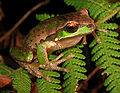 Photo credit: LiquidGhoulThe New England Tree Frog (Litoria subglandulosa) is a species of frog native to the streams of the New England Tablelands, New South Wales, Australia.
 -
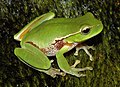 Photo credit: FroggydarbA specimen from the "hybrid zone" of the Leaf Green Tree Frog (Litoria phyllochroa) and the Southern Leaf Green Tree Frog (L. nudidigitus), showing physical characteristics of both species. These small stream-dwelling frogs (averaging only 40mm in length), are native to eastern Australia and occur together south of Sydney. The two species are differentiated only by distribution, call and slight differences in flank markings.
 -
 Photograph credit: RushenbWallace's flying frog (Rhacophorus nigropalmatus) is a moss frog found in tropical southeastern Asia. It is named after the British naturalist Alfred R. Wallace, who collected the first known specimen of the species. It lives almost exclusively in trees, and when threatened, or in search of prey, will leap from a branch and splay its four webbed feet; the membranes between its toes and the loose skin flaps on its sides catch the air as it falls, helping it to glide. This individual was photographed in Khao Sok National Park, Thailand.
 -
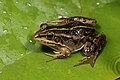 Photograph: Benny TrappThe Albanian water frog (Pelophylax shqipericus) is a species of true frog in the family Ranidae. It is native to Albania and Montenegro, where it lives in aquatic environments. The frogs are medium-sized. Males sometimes bear a distinctive bright green stripe down the length of the backbone, but otherwise are green to light brown in overall colouring with large black or dark brown spots. Females are olive green or light brown in colour and also bear brown or black large spots. The species is endangered and known populations are currently in decline.
 -
 Photo credit: LiquidGhoulThe Red-eyed Tree Frog (Litoria chloris) is a species of tree frog native to eastern Australia; ranging from north of Sydney to Proserpine in mid-northern Queensland. These frogs typically reach a size of 65 millimetres (2.6 in). Its skin secretions have been found to destroy HIV, without harming healthy T cells.
 -
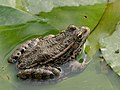 Photo: Marie-Lan NguyenThe marsh frog (Pelophylax ridibundus) is a species of true frog and the largest frog native to Europe; females of this sexually dimorphic species may be up to 17 centimetres (6.7 in) long. The marsh frog feeds mainly on insects, but it also eats smaller amphibians, fish, and rodents.
 -
 The edible frog (Pelophylax kl. esculentus) is a fertile hybrid of the pool and marsh frogs which is commonly found in Europe. The species is commonly used in food, including the French delicacy frog legs.
 -
 Photograph: Benny TrappThe Iberian midwife toad (Alytes cisternasii) is a species of frog in the family Alytidae found in Portugal and western Spain. Its natural habitats are temperate forests and shrubland, Mediterranean-type shrubby vegetation, intermittent rivers and freshwater marshes, pastureland, and aquaculture ponds. The species is affected by habitat loss, and the IUCN lists it as being "Near Threatened".
 -
 The emerald-eyed tree frog (Rana platanera) is a species of frog in the family Hylidae found in South America.
 -
 A male Dendropsophus microcephalus frog, displaying its vocal sac—membranes of skin under the throat or on the corner of the mouth that distend to amplify its call. The species lives in moist areas in most of Central America and northern South America.
 -
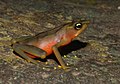 Photograph: Brian GratwickeA female limosa harlequin frog (Atelopus limosus) in Panama. This endangered species of toad in the family Bufonidae inhabits stream banks in tropical moist lowland forests and rivers of the Chagres watershed. It is found in two colour forms, one in lowlands and one in uplands.
 -
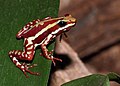 Photograph: H. KrispThe phantasmal poison frog (Epipedobates tricolor) is a species of poison dart frog endemic to Ecuador. First described by George Albert Boulenger in 1899, this endangered species is found only in rainforests on the slopes of the Andes.
 -
 Photo: QuartlDendrobates azureus, commonly known as the blue poison dart frog or okopipi, is a poison dart frog found in the forests surrounded by the Sipaliwini Savanna in southern Suriname. Authorities have recently treated it as a variant of Dendrobates tinctorius rather than a distinct species as before.
 -
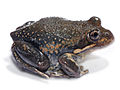 Photo credit: Fir0002The Eastern Banjo Frog (Limnodynastes dumerilli) is native to eastern Australia and has been introduced to New Zealand. The frog is also commonly called the pobblebonk after its distinctive "bonk" call, which is likened to a banjo string being plucked. Adults are roughly seven to eight cm long.
 -
 Photo: Benny TrappAn Italian tree frog (Hyla intermedia) with an inflated vocal sac. Vocal sacs, flexible membranes of skin possessed by most male frogs, are generally used to amplify mating or advertisement calls. However, some species in the family Rhinodermatidae may also use the sac to store or transport their tadpoles.


.jpg)


Selected toad article
.jpg)
The natterjack toad (Epidalea calamita) is a toad native to sandy and heathland areas of Europe including the United Kingdom. Adults are 60–70 mm (2.4–2.8 in) in length, and are distinguished from common toads by a yellow line down the middle of the back and parallel paratoid glands. They have relatively short legs, which gives them a distinctive gait, contrasting with the hopping movement of many other toad species.
Natterjacks have a very loud and distinctive mating call amplified by the single vocal sac found under the chin of the male. (Full article...)
Selected caecilian article

Nectocaecilia petersii is a species of semiaquatic amphibian in the family Typhlonectidae. It belongs to the monotypic genus Nectocaecilia. This species is found in Venezuela and Brazil, and possibly Colombia and Peru. Its natural habitats are subtropical or tropical moist lowland forests and rivers, where it tends to live by the banks of streams. It lives in eel burrows and the roots of floating vegetation. It is threatened by habitat loss. This species has a number of distinct traits that illustrate that it is a burrowing vertebrate, including its very small eyes and long, thin body. (Full article...)
Need help?
Do you have a question about Amphibians that you can't find the answer to?
Consider asking it at the Wikipedia reference desk.
Topics
Subcategories

Related portals
_Ranomafana.jpg)


Associated Wikimedia
The following Wikimedia Foundation sister projects provide more on this subject:
-
 Commons
Free media repository -
 Wikibooks
Free textbooks and manuals -
 Wikidata
Free knowledge base -
 Wikinews
Free-content news -
 Wikiquote
Collection of quotations -
 Wikisource
Free-content library -
 Wikiversity
Free learning tools -
 Wiktionary
Dictionary and thesaurus
-

-

-

-

-

-

-

-

-

-

-
 Random portal
 -


