








Wapello County, Iowa
Wapello County, Iowa | |
|---|---|
 The courthouse in Ottumwa | |
 Location within the U.S. state of Iowa | |
| Coordinates: 41°01′46″N 92°24′32″W / 41.029444444444°N 92.408888888889°W | |
| Country |  United States United States |
| State |  Iowa Iowa |
| Founded | 1843 |
| Named after | Wapello |
| Seat | Ottumwa |
| Largest city | Ottumwa |
| Area | |
• Total | 436 sq mi (1,130 km2) |
| • Land | 432 sq mi (1,120 km2) |
| • Water | 4.2 sq mi (11 km2) 1.0% |
| Population (2020) | |
• Total | 35,437 |
• Estimate (2024) | 35,681  |
| • Density | 82.0/sq mi (31.7/km2) |
| Time zone | UTC−6 (Central) |
| • Summer (DST) | UTC−5 (CDT) |
| Congressional district | 3rd |
| Website | www |
| |

Wapello County is a county located in the U.S. state of Iowa. As of the 2020 census, the population was 35,437.[2] The county seat and the largest city is Ottumwa.[3] The county was formed on February 17, 1843, and named for Wapello, a Meskwaki chief.[4]
Wapello County is included in the Ottumwa, IA Micropolitan statistical area.
Geography
According to the United States Census Bureau, the county has a total area of 436 square miles (1,130 km2), of which 432 square miles (1,120 km2) is land and 4.2 square miles (11 km2) (1.0%) is water.[5]
Major highways


Transit
Adjacent counties
- Mahaska County (northwest)
- Keokuk County (northeast)
- Jefferson County (east)
- Davis County (south)
- Monroe County (west)
Demographics
| Census | Pop. | Note | %± |
|---|---|---|---|
| 1850 | 8,471 | — | |
| 1860 | 14,518 | 71.4% | |
| 1870 | 22,346 | 53.9% | |
| 1880 | 25,285 | 13.2% | |
| 1890 | 30,426 | 20.3% | |
| 1900 | 35,426 | 16.4% | |
| 1910 | 37,743 | 6.5% | |
| 1920 | 37,937 | 0.5% | |
| 1930 | 40,480 | 6.7% | |
| 1940 | 44,280 | 9.4% | |
| 1950 | 47,397 | 7.0% | |
| 1960 | 46,126 | −2.7% | |
| 1970 | 42,149 | −8.6% | |
| 1980 | 40,241 | −4.5% | |
| 1990 | 35,696 | −11.3% | |
| 2000 | 36,051 | 1.0% | |
| 2010 | 35,625 | −1.2% | |
| 2020 | 35,437 | −0.5% | |
| 2024 (est.) | 35,681 | [6] | 0.7% |
| U.S. Decennial Census[7] 1790–1960[8] 1900–1990[9] 1990–2000[10] 2010–2020[11] | |||
2020 census

As of the 2020 census, the county had a population of 35,437 and a population density of 81.2/sq mi (31.4/km2).[12]
The median age was 39.1 years, with 24.0% of residents under the age of 18 and 18.7% aged 65 or older. For every 100 females there were 99.3 males, and for every 100 females age 18 and over there were 96.6 males.[12]
The racial makeup of the county was 79.5% White, 4.1% Black or African American, 0.7% American Indian and Alaska Native, 1.8% Asian, 1.5% Native Hawaiian and Pacific Islander, 6.7% from some other race, and 5.7% from two or more races. Hispanic or Latino residents of any race comprised 12.2% of the population.[13]
| Race | Number | Percent |
|---|---|---|
| White (NH) | 27,295 | 77.02% |
| Black or African American (NH) | 1,443 | 4.1% |
| Native American (NH) | 66 | 0.2% |
| Asian (NH) | 622 | 1.8% |
| Pacific Islander (NH) | 518 | 1.5% |
| Other/Mixed (NH) | 1,161 | 3.3% |
| Hispanic or Latino | 4,332 | 12.22% |
70.6% of residents lived in urban areas, while 29.4% lived in rural areas.[15]
There were 14,167 households in the county, of which 29.3% had children under the age of 18 living in them. Of all households, 44.8% were married-couple households, 20.0% were households with a male householder and no spouse or partner present, and 27.4% were households with a female householder and no spouse or partner present. About 30.9% of all households were made up of individuals and 14.6% had someone living alone who was 65 years of age or older.[12]
There were 15,734 housing units, of which 14,167 were occupied, leaving a 10.0% vacancy rate. Among occupied housing units, 69.7% were owner-occupied and 30.3% were renter-occupied. The homeowner vacancy rate was 1.9% and the rental vacancy rate was 11.3%.[12]
2010 census
As of the 2010 census recorded a population of 35,625 in the county, with a population density of 82.5/sq mi (31.9/km2). There were 16,098 housing units, of which 14,552 were occupied.[16]
2000 census
As of the 2000 census, there were 36,051 people, 14,784 households, and 9,801 families residing in the county. The population density was 84 people per square mile (32 people/km2). There were 15,873 housing units at an average density of 37 units per square mile (14 units/km2). The racial makeup of the county was 96.28% White, 0.93% Black or African American, 0.28% Native American, 0.65% Asian, 0.02% Pacific Islander, 1.05% from other races, and 0.79% from two or more races. 2.22% of the population were Hispanic or Latino of any race.
There were 14,784 households, out of which 28.80% had children under the age of 18 living with them, 52.70% were married couples living together, 9.90% had a female householder with no husband present, and 33.70% were non-families. 28.20% of all households were made up of individuals, and 13.40% had someone living alone who was 65 years of age or older. The average household size was 2.37 and the average family size was 2.89.
In the county, the population was spread out, with 23.30% under the age of 18, 9.70% from 18 to 24, 26.00% from 25 to 44, 23.30% from 45 to 64, and 17.80% who were 65 years of age or older. The median age was 39 years. For every 100 females there were 94.80 males. For every 100 females age 18 and over, there were 91.70 males.
The median income for a household in the county was $32,188, and the median income for a family was $39,224. Males had a median income of $31,346 versus $21,286 for females. The per capita income for the county was $16,500. About 9.40% of families and 13.20% of the population were below the poverty line, including 18.00% of those under age 18 and 7.90% of those age 65 or over.
Communities
Cities
Unincorporated communities
- Ashland
- Bidwell
- Bladensburg
- Cliffland
- Dahlonega
- Dudley
- Farson
- Munterville
- Phillips
- Pickwick
- Ottumwa Junction
- Rutledge
- Willard
- Yampa
Townships
Population ranking
The population ranking of the following table is based on the 2020 census of Wapello County.[2]
† county seat
| Rank | City/Town/etc. | Municipal type | Population (2020 Census) |
|---|---|---|---|
| 1 | † Ottumwa | City | 25,529 |
| 2 | Eddyville (partially in Mahaska and Monroe Counties) | City | 970 |
| 3 | Eldon | City | 783 |
| 4 | Agency | City | 620 |
| 5 | Blakesburg | City | 274 |
| 6 | Kirkville | City | 157 |
| 7 | Chillicothe | City | 76 |
Politics
Between 1864 and 1928, Wapello County backed the Republican candidate in every election except 1912, when former Republican Theodore Roosevelt ran as the Progressive candidate, fracturing the Republican party and allowing Democrat Woodrow Wilson to take the county with a plurality of the vote of less than 37%. From 1932 to 2012, the county voted Democratic in every election except two, the nationwide Republican landslides of Dwight D. Eisenhower in 1952 and Richard Nixon in 1972. So Democratic was the county that it was the only county in Iowa to give Jimmy Carter an outright majority of its votes in his 1980 landslide loss. Beginning in 2016, Wapello County has shifted back to the Republican column, as Donald Trump carried the county in each of his three runs, winning by a margin of over 20% in 2016 and over 23% in 2020, and over 31% in 2024. Also in 2024, Trump became the first candidate from any party to obtain at least 65% of the county's vote since Lyndon B. Johnson in 1964, and the first Republican to do so since Herbert Hoover in 1928.
| Year | Republican | Democratic | Third party(ies) | |||
|---|---|---|---|---|---|---|
| No. | % | No. | % | No. | % | |
| 1896 | 4,319 | 50.75% | 4,041 | 47.49% | 150 | 1.76% |
| 1900 | 4,742 | 53.21% | 3,902 | 43.78% | 268 | 3.01% |
| 1904 | 4,912 | 60.60% | 2,473 | 30.51% | 720 | 8.88% |
| 1908 | 4,541 | 50.69% | 3,724 | 41.57% | 694 | 7.75% |
| 1912 | 2,755 | 32.53% | 3,102 | 36.62% | 2,613 | 30.85% |
| 1916 | 4,398 | 47.65% | 3,994 | 43.28% | 837 | 9.07% |
| 1920 | 9,884 | 67.99% | 4,131 | 28.42% | 522 | 3.59% |
| 1924 | 9,870 | 56.96% | 3,039 | 17.54% | 4,420 | 25.51% |
| 1928 | 11,586 | 66.10% | 5,793 | 33.05% | 149 | 0.85% |
| 1932 | 7,256 | 42.49% | 9,504 | 55.66% | 316 | 1.85% |
| 1936 | 7,647 | 41.31% | 10,578 | 57.14% | 287 | 1.55% |
| 1940 | 9,039 | 43.03% | 11,880 | 56.56% | 87 | 0.41% |
| 1944 | 8,244 | 43.19% | 10,732 | 56.22% | 113 | 0.59% |
| 1948 | 7,875 | 41.50% | 10,841 | 57.13% | 260 | 1.37% |
| 1952 | 11,571 | 52.24% | 10,449 | 47.17% | 130 | 0.59% |
| 1956 | 10,401 | 48.65% | 10,960 | 51.26% | 20 | 0.09% |
| 1960 | 11,036 | 49.79% | 11,116 | 50.15% | 15 | 0.07% |
| 1964 | 5,524 | 28.26% | 13,971 | 71.48% | 51 | 0.26% |
| 1968 | 7,825 | 41.96% | 9,375 | 50.28% | 1,447 | 7.76% |
| 1972 | 9,301 | 51.19% | 8,348 | 45.94% | 522 | 2.87% |
| 1976 | 6,786 | 39.30% | 10,249 | 59.35% | 233 | 1.35% |
| 1980 | 7,475 | 42.31% | 8,923 | 50.50% | 1,270 | 7.19% |
| 1984 | 7,098 | 39.88% | 10,545 | 59.24% | 157 | 0.88% |
| 1988 | 5,350 | 34.14% | 10,177 | 64.93% | 146 | 0.93% |
| 1992 | 4,852 | 30.17% | 8,670 | 53.91% | 2,561 | 15.92% |
| 1996 | 4,828 | 32.69% | 8,437 | 57.12% | 1,505 | 10.19% |
| 2000 | 6,313 | 41.70% | 8,355 | 55.19% | 471 | 3.11% |
| 2004 | 7,403 | 44.31% | 9,125 | 54.62% | 179 | 1.07% |
| 2008 | 6,663 | 41.80% | 8,820 | 55.33% | 457 | 2.87% |
| 2012 | 6,789 | 43.05% | 8,663 | 54.93% | 318 | 2.02% |
| 2016 | 8,715 | 57.53% | 5,594 | 36.93% | 840 | 5.54% |
| 2020 | 9,516 | 60.87% | 5,821 | 37.24% | 296 | 1.89% |
| 2024 | 9,479 | 65.00% | 4,896 | 33.57% | 208 | 1.43% |
Education
School districts include:[18]
- Cardinal Community School District
- Eddyville-Blakesburg-Fremont Community School District - Formed on July 1, 2012.[19]
- Fairfield Community School District
- Ottumwa Community School District
- Pekin Community School District
Former school districts:
- Eddyville-Blakesburg Community School District[20] - Merged into Eddyville-Blakesburg-Fremont on July 1, 2012.[19]
- Fremont Community School District[20] - Merged into Eddyville-Blakesburg-Fremont on July 1, 2012.[19]
See also
- Big 4 Fair Art Hall, located at the Wapello County Fairgrounds
- Wapello County Courthouse
- National Register of Historic Places listings in Wapello County, Iowa
References
- ^ "Iowa County Names and Numbers". Iowa Department of Administrative Services. Retrieved February 19, 2026.
- ^ a b "2020 Census State Redistricting Data". census.gov. United states Census Bureau. Retrieved August 12, 2021.
- ^ "Find a County". National Association of Counties. Retrieved February 19, 2026.
- ^ "Wapello County". Archived from the original on April 26, 2007. Retrieved January 20, 2008.
- ^ "US Gazetteer files: 2010, 2000, and 1990". United States Census Bureau. February 12, 2011. Retrieved April 23, 2011.
- ^ "County Population Totals and Components of Change: 2020-2024". Retrieved July 24, 2025.
- ^ "U.S. Decennial Census". United States Census Bureau. Retrieved January 7, 2014.
- ^ "Historical Census Browser". University of Virginia Library. 2007. Archived from the original on December 12, 2009. Retrieved January 7, 2014.
- ^ Forstall, Richard L. (April 20, 1995). "Population of Counties by Decennial Census: 1900 to 1990". United States Census Bureau. Archived from the original on February 19, 1999. Retrieved January 7, 2014.
- ^ "Census 2000 PHC-T-4. Ranking Tables for Counties: 1990 and 2000" (PDF). United States Census Bureau. Archived (PDF) from the original on March 27, 2010. Retrieved January 7, 2014.
- ^ "U.S. Census Bureau QuickFacts: Wapello County, Iowa". www.census.gov. Retrieved February 19, 2026.
- ^ a b c d "2020 Decennial Census Demographic Profile (DP1)". United States Census Bureau. 2021. Retrieved December 25, 2025.
- ^ "2020 Decennial Census Redistricting Data (Public Law 94-171)". United States Census Bureau. 2021. Retrieved December 25, 2025.
- ^ "P2 HISPANIC OR LATINO, AND NOT HISPANIC OR LATINO BY RACE – 2020: DEC Redistricting Data (PL 94-171) – Wapello County, Iowa".
- ^ "2020 Decennial Census Demographic and Housing Characteristics (DHC)". United States Census Bureau. 2023. Retrieved December 25, 2025.
- ^ "Population & Housing Occupancy Status 2010" (PDF). United States Census Bureau American FactFinder. Archived (PDF) from the original on October 16, 2020. Retrieved August 15, 2022.
- ^ Leip, David. "Dave Leip's Atlas of U.S. Presidential Elections". uselectionatlas.org. Retrieved April 28, 2018.
- ^ Geography Division (December 18, 2020). 2020 Census - School District Reference Map: Wappelo County, IA (PDF) (Map). United States Census Bureau. Retrieved August 30, 2025. - Text list
- ^ a b c "Reorganization and Dissolution Action Since 1965-66". Iowa Department of Education. Retrieved September 30, 2025.
- ^ a b Geography Division (November 28, 2010). 2010 Census - School District Reference Map: Wapello County, IA (PDF) (Map). United States Census Bureau. Retrieved September 30, 2025. - Text list
External links
Places adjacent to Wapello County, Iowa | ||||||||||||||||
|---|---|---|---|---|---|---|---|---|---|---|---|---|---|---|---|---|
| ||||||||||||||||


Municipalities and communities of Wapello County, Iowa, United States | ||
|---|---|---|
| Cities | 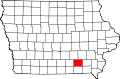 | |
| Townships | ||
| Unincorporated communities | ||
| Footnotes | ‡This populated place also has portions in an adjacent county or counties | |
| International | |
|---|---|
| National | |
| Other | |
