


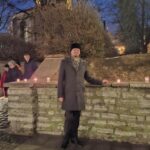

Jan van den Brink
Jan van den Brink | |
|---|---|
 Van den Brink in 1948 | |
| Minister of Economic Affairs | |
| In office 21 January 1948 – 2 September 1952 | |
| Cabinet | |
| Preceded by | Gerardus Huysmans |
| Succeeded by | Jelle Zijlstra |
| Member of the Senate | |
| In office 20 November 1945 – 19 January 1948 27 July 1948 – 11 August 1948 | |
| Personal details | |
| Born | Johannes Roelof Maria van den Brink 12 April 1915 Laren, Netherlands |
| Died | 19 July 2006 (aged 91) Hilversum, Netherlands |
| Party |
|
| Spouse |
Anneke Vermeulen (m. 1943) |
| Children | 7 |
| Alma mater | Tilburg University |
| Occupation |
|
Johannes Roelof Maria "Jan" van den Brink[1] (Dutch: [ˈjɑɱ vɑn də(m) ˈbrɪŋk]; 12 April 1915 – 19 July 2006) was a Dutch politician and banker. He was minister of economic affairs in three successive cabinets.
Early life and career
Born in Laren, North Holland in 1915, he received his doctorate in economics from Tilburg University in 1942. He worked as a civil servant, and he became a professor at Radboud University Nijmegen in December 1945. Van den Brink started serving in the Senate in November 1945 as a member of the Roman Catholic State Party (RKSP), which continued as the Catholic People's Party (KVP) the following month.[2] He was sworn in as Minister of Economic Affairs as part of the first Beel cabinet on 21 January 1948, becoming the youngest minister in Dutch political history. He stayed on in his position in the Drees–Van Schaik and first Drees cabinets, contributing to the post-World War II economic reconstruction of the Netherlands.[2][3]
Van den Brink's last term as economic affairs minister ended on 2 September 1952, and he became and advisor of the Amsterdamsche Bank.[2] He was a member of the board of directors of the bank between 1954 and 1964 and of the AMRO Bank until 1978, following the merger of the Amsterdamsche Bank and the Rotterdamsche Bank. After his departure from politics, he turned down several positions, including as prime minister.[2][3] Van den Brink was an artist after his retirement, and he died in Hilversum in 2006 at the age of 91.[3]
Personal life
He married Anneke Vermeulen in May 1943, and he had seven children.[2]
Decorations
| Ribbon bar | Honour | Country | Date | Comment |
|---|---|---|---|---|

|
Grand Cross of the Order of the Crown | Belgium | 6 May 1949[4] | |

|
Knight Commander with Star of the Order of St. Gregory the Great | Holy See | 29 December 1951[5] | |

|
Grand Cross of the Legion of Honour | France | 9 April 1952[6] | |

|
Grand Officer of the Order of Orange-Nassau | Netherlands | 21 March 1978[7] | Elevated from Commander (30 September 1952)[2] |

|
Knight of the Order of the Holy Sepulchre | Holy See | 20 October 1990[8] |
References
- ^ Banning, Cees (20 July 2006). "Minister van wederopbouw" [Minister of reconstruction]. NRC Handelsblad (in Dutch). Retrieved 5 January 2026.
- ^ a b c d e f "Dr. J.R.M. (Jan) van den Brink". Parlement.com (in Dutch). Retrieved 5 January 2025.
- ^ a b c "J. v.d. Brink (1915-2006)". Reformatorisch Dagblad (in Dutch). 20 July 2006. Retrieved 5 January 2025 – via Digibron.
- ^ "Minister Van den Brink onderscheiden" [Minister Van den Brink honoured]. Algemeen Handelsblad (in Dutch). 6 May 1949. p. 3. Retrieved 6 January 2026 – via Delpher.
- ^ "Z.H. de Paus riddert comité Anno Santo" [His Holiness the Pope knights Anno Santo committee]. de Volkskrant (in Dutch). KNP. 31 December 1951. p. 3. Retrieved 7 January 2026 – via Delpher.
- ^ "Hoge Franse onderscheiden" [High French decoration]. Het Parool (in Dutch). 10 April 1952. p. 4. Retrieved 7 January 2026 – via Delpher.
- ^ "Topman Amrobank onderscheiden" [Amrobank executive decorated]. Algemeen Dagblad (in Dutch). 22 March 1978. p. 21. Retrieved 6 January 2026 – via Delpher.
- ^ "Vooraanstaande katholieken tot ridder geslagen" [Prominent Catholic knighted]. Limburgsch Dagblad (in Dutch). 22 October 1990. p. 5. Retrieved 7 January 2026 – via Delpher.
External links
 Media related to Jan van den Brink at Wikimedia Commons


| International | |
|---|---|
| National | |
| Artists | |
| People | |
| Other | |
