







Monastery of Iviron
 Monastery as seen from a nearby trail | |
  Location within Mount Athos | |
| Monastery information | |
|---|---|
| Denomination | Eastern Orthodoxy |
| Established | between 980-983 |
| Dedicated to | Dormition of the Theotokos |
| Archdiocese | Constantinople (Stavropegial) |
| People | |
| Founders | John the Iberian and John Tornike |
| Abbot | Archimandrite Nathanael |
| Archbishop | Ecumenical Patriarch Bartholomew of Constantinople |
| Important associated figures | George of Athos, John Tornike, John the Iberian, Gabriel the Iberian Euthymius of Athos, Archimandrite Averchie |
| Architecture | |
| Status | Open and functioning |
| Heritage designation | UNESCO World Heritage Site |
| Designated date | 1988 |
| Site | |
| Location | Mount Athos |
| Country | Greece |
| Coordinates | 40°14′44″N 24°17′05″E / 40.2455°N 24.2848°E |
| Public access | Men only, with an access permit (διαμονητήριον) |
| Website | Iveron at the Mount Athos website |
The Monastery of Iviron (Georgian: ათონის ივერთა მონასტერი, romanized: atonis iverta monast'eri ; Greek: Μονή Ιβήρων, romanized: Monḗ Ivirōn) is an Eastern Orthodox monastery in the monastic community of Mount Athos in northern Greece. The monastery was founded by two Georgian monks, John the Iberian and John Tornike, between AD 980–983. It is regarded as the historic Georgian monastery on Mount Athos and was traditionally inhabited by Georgian Orthodox monks for nearly a millennium, until the mid-20th century.[1][2] It is home to the famous Panagia Portaitissa icon of Virgin Mary.
History

Center of medieval Georgian scholarship
The monastery was founded by Georgian monks, John the Iberian and John Tornike between AD 980–83 to serve as a center of scholarship for Georgian clergy and priests. John the Iberian was appointed as the abbot of the newly founded monastery in 980. In 1005, Euthymius the Iberian became the secondary abbot of Iviron Monastery.[3] In Greek, Iviron means "of the Iberians", referring to the core Georgian kingdom, a demonym used to describe Georgians in historical and literary contexts.

In the Middle Ages, the monastery became a center of Georgian religious culture. A large group of Georgian scholars and calligraphers was active at the monastery. Among them was George the Hagiorite and under their guidance, extensive cultural and creative activities flourished: original works were composed, and significant Byzantine theological texts were translated into Georgian. The monastery received substantial financial support from Georgian monarchs and other Georgian donors. It was reportedly so well-endowed that it distributed some of the funds donated by wealthy Georgians to other monasteries on Mount Athos to alleviate any resentment.[4]
However, as the Kingdom of Georgia weakened, the Greeks gradually supplanted Georgians and took possession of the monastery, with Georgians being reduced to a minority after 1357.[5] This Greek takeover of the monastery culminated several centuries of lingering concerns among Georgians that their Byzantine counterparts sought to usurp Georgia's overseas possessions throughout the Balkans.[6] Despite the collapse of the Georgian Kingdom and subsequent Greek takeover, the monastery continued to rely on Georgians for patronage and support beyond the 17th century.[7]
Attempts at Georgian-Russian cooperation
In the 19th century, following the annexation of Georgia by the Russian Empire, Georgians sought to reassert their presence at Iviron, at times assisted by the Russians, who were also increasingly at odds with the Greeks. The monastery was visited by the likes of Platon Ioseliani to survey remaining Georgian heritage and manuscripts. In the 1860s, an injection of 35,000 rubles collected by a Georgian donor and the arrival of 40 new Georgian monks was met with resistance from the Greeks, who did not want to see Georgian presence expanded. Russians from the St. Panteleimon Monastery assisted Georgians by providing them with building materials. The Greeks ultimately demolished the buildings and gardens constructed by Georgians and did not allow them back into the monastery. The involvement of Russians in support of Georgians further strained relations between Greek and Russian monastic communities.[8] During this is period, "Athos Russian clergy, using all the methods, tried to gain support of Georgian monks persecuted by Greeks and collaborate with them".[9] Spreading Russian authority over the historically Georgian monastery would have had the potential to increase Russia's authority in the Christian world.[10]
In 1879, nobility of Georgia petitioned the Russian Imperial government to use its influence in restoring the Georgian character of the Iviron monastery. However, the Tsarist authorities, who did not want to further strain relations with the Greeks, declined official assistance, claiming that they could not take responsibility for the protection of monks who were abroad. Though the Russian Ambassador to the Ottoman Empire maintained that the Georgian monks at Iviron should have the same rights as Greek ones, overall it was decreed that "The embassy considers inconvenient to assume taking care on Georgians."[11] Instead, Russia prioritized building the New Athos Monastery on the Black Sea coast of Georgia, which was meant to accommodate Russian monks who, at the time, feared being expelled from the original Mount Athos due to continued enmity between Russia and the Ottoman Empire.
Modern period
Despite the aforementioned challenges, "a Georgian minority survived at Iviron until the mid 20th century, and the monastery continued to turn to Georgia for assistance in time of stress", securing its place in the cultural and spiritual memory of the Georgian people.[12][13] The monastery ranks third in the Athonite hierarchy of 20 sovereign monasteries.[14] As of the 21st century, Monastery of Iviron is mainly inhabited by Greek monks.
Notable people
- John Tornike (died 985)
- John the Iberian (died c. 1002)
- Gabriel the Iberian (c. 10th century)
- Euthymius of Athos (c. 955-1028)
- George the Hagiorite (1009-1065)
- Archimandrite Averchie (1806/1818–?), Aromanian monk and schoolteacher
Gallery
-
 View of the main monastery complex
 -
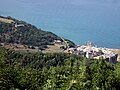 View of the sea


References
- ^ Graham Speake.The Enlighteners of Georgia. In: A History of the Athonite Commonwealth: The Spiritual and Cultural Diaspora of Mount Athos. Cambridge University Press: 2018, p.63 Quote: "Nonetheless a Georgian minority survived at Iviron until the mid twentieth century, and the monastery continued to turn to Georgia for assistance in time of stress. Even today, when there are no Georgian monks there at all, and precious few elsewhere on the mountain, Iviron remains a powerful symbol in the cultural and spiritual memory of the Georgian people."
- ^ Leonty, Hieromonk (Kozlov); V. I. Silogava; V. G. Chentsova (2009). "Iveron Monastery". Orthodox Encyclopedia (in Russian). Vol. 21. Moscow: Pravoslavnaya Entsiklopediya. pp. 24–60. ISBN 978-5-89572-038-7.
- ^ Speake, Graham (2014). Mount Athos: renewal in paradise. Limni, Evia, Greece: Denise Harvey. pp. 52–53. ISBN 978-960-7120-34-2. OCLC 903320491.
- ^ Graham Speake.The Enlighteners of Georgia. In: A History of the Athonite Commonwealth: The Spiritual and Cultural Diaspora of Mount Athos. Cambridge University Press: 2018, pp. 54-63. Page 56. Quote: "...Iviron continued to receive large sums of money from wealthy Georgians and by the end of the century was distributing it to other houses on Athos including the Protaton, the Lavra, and the Amalfitan monastery..."
- ^ Ines Angeli Murzaku. Monasticism in Eastern Europe and the Former Soviet Republics. Taylor & Francis, 205. Quote: "But gradually the monastery was infiltrated by Greek monks; by the twelfth century it contained two distinct communities; and in 1357 the Georgians finally lost control of it, remaining as a small and insignificant minority..."
- ^ Antony Eastmond. Eastern Approaches to Byzantium: Papers from the Thirty-third Spring Symposium of Byzantine Studies, University of Warwick, Coventry, March 1999. Quote: "Indeed, Grigol Bakurianisdze's typikon for Bačkovo, which was written in 1083 notes that: 'the Greeks are oppressors, covetous, scheming and unreliable. They used to take advantage of the Georgians' innocence and open-heartedness and strive to seize our monasteries.' As a result, the inclusion of Greek monks, except a notarion, in the Georgian monastery was prohibited"
- ^ Livanos, Nikolaos. The Iviron Monastery of Mount Athos from Its Georgian Origins until Its Modern Times Dependency in the Caucasus: New Light on an Old Relationship. National Hellenic Research Foundation: 2015, [1]
- ^ Nicholas Fennell. Russian Monks on Mount Athos: The Thousand Year History of St Panteleimon's. Holy Trinity Seminary Press: 2021. Quote: "...the brotherhood was joined by forty other Georgians. A bitter struggle ensued. The Georgians attempted to convert the kellion into a large cenobium; Iviron pulled down part of the new buildings, and dug up vegetable gardens, paths, and approach roads. The St Panteleomon Russians supplied the Georgians with building materials, which they somehow managed to deliver...none of [the Georgian] brotherhood was allowed back into Iviron...The involvement of the St Panteleimon Russians did nothing to ease tension between the Greek and Russian Athonite communities."
- ^ Journal of Kartvelological Studies, Issues 15-16, Centre for East European Studies: Warsaw University, 2007, p. 81
- ^ Journal of Kartvelological Studies, Issues 15-16, Centre for East European Studies: Warsaw University, 2007, p. 84
- ^ Journal of Kartvelological Studies, Issues 15-16, Centre for East European Studies: Warsaw University, 2007, p. 82
- ^ Graham Speake.The Enlighteners of Georgia. In: A History of the Athonite Commonwealth: The Spiritual and Cultural Diaspora of Mount Athos. Cambridge University Press: 2018, p.63 Quote: "Nonetheless a Georgian minority survived at Iviron until the mid twentieth century, and the monastery continued to turn to Georgia for assistance in time of stress. Even today, when there are no Georgian monks there at all, and precious few elsewhere on the mountain, Iviron remains a powerful symbol in the cultural and spiritual memory of the Georgian people."
- ^ At the beginning of the 20th century, there were still 48 Georgian monks at Iviron according to Encyclopedia "Georgia". Vol. 1. Tbilisi. 1997. p. 368. Retrieved 2025-12-02.
{{cite book}}: CS1 maint: location missing publisher (link) - ^ "The administration of Mount Athos". Archived from the original on 2016-03-11. Retrieved 2016-04-06.
External links
| Monasteries (by precedence) |  | |
|---|---|---|
| Sketes |
| |
| Settlements | ||
| Geography | ||
| Relics and icons | ||
| Other topics | ||

