
Igor Ivanov
Igor Ivanov | |
|---|---|
Игорь Иванов | |
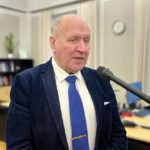
 Ivanov in 2014 | |
| Secretary of the Security Council of Russia | |
| In office 9 March 2004 – 17 June 2007 | |
| President | Vladimir Putin |
| Preceded by | Vladimir Rushailo |
| Succeeded by | Valentin Sobolev (acting) Nikolai Patrushev |
| Minister of Foreign Affairs | |
| In office 30 September 1998 – 24 February 2004 | |
| President | Boris Yeltsin Vladimir Putin |
| Preceded by | Yevgeny Primakov |
| Succeeded by | Sergey Lavrov |
| Personal details | |
| Born | 23 September 1945 Moscow, Russian SFSR, Soviet Union |
| Alma mater | Moscow State Linguistic University |
| Awards |   |
Igor Sergeyevich Ivanov (Russian: И́горь Серге́евич Ивано́в; born 23 September 1945) is a Russian politician and diplomat who was Foreign Minister of Russia from 1998 to 2004 under both the Yeltsin and the Putin administrations.
Early life
Ivanov was born in 1945 in Moscow to a Russian father and a Georgian mother (Elena Sagirashvili).[1] In 1969 he graduated at the Maurice Thorez Moscow Institute of Foreign Languages (Moscow State Linguistic University). He joined the Soviet Foreign Ministry in 1973 and spent a decade in Spain. He returned to the Soviet Union in 1983. In 1991 he became the ambassador in Madrid.
Minister of Foreign Affairs
He was appointed Minister of Foreign Affairs on September 11, 1998. As Russian foreign minister, Ivanov was an opponent of NATO's action in Yugoslavia. He was also an opponent of the U.S. invasion of Iraq. Ivanov played a key role in mediating a deal between Georgian President Eduard Shevardnadze and opposition parties during Georgia's "Rose Revolution" in 2003.
Later career
Ivanov was succeeded by Sergey Lavrov as foreign minister in 2004, and appointed by President Vladimir Putin to the post of Secretary of the Russian Security Council. On 9 July 2007, he submitted his resignation,[2] which was accepted by President Putin on 18 July.
Ivanov is the president of the Russian International Affairs Council (RIAC),[3] and is a professor at the Moscow State Institute of International Relations (MGIMO-University), a member of the Supervisory Council of the International Luxembourg Forum on Preventing Nuclear Catastrophe, and a member of the European Council on Tolerance and Reconciliation.
In 2011, Ivanov became a member of the Advisory Council of The Hague Institute for Global Justice, and in 2014 worked for The Moscow Times.[4] In recent years, he appears to be staying out of the limelight and not getting involved in politics and public activities proactively.
Honours and awards
- Hero of the Russian Federation (October 27, 1999)[5]
- Order “For Merit to the Fatherland,” 2nd Class (1999)[6]
- Order “For Merit to the Fatherland,” 3rd Class (2005) [7]
- Order “For Merit to the Fatherland,” 4th Class (1996) [8]
- Commendation of the President of the Russian Federation (1995, 1996, 1997, 1998, 1999, June 12, 2002)[9][10]
- Grand Cross of the Order of San Carlos (2001, Colombia) [11]
- Order of Friendship (2001, Vietnam) [12][13]
- Order of Dostyk (Friendship), 1st Class (December 10, 2001, Kazakhstan) — for a significant contribution to strengthening peace, friendship, and cooperation between states and peoples, and in connection with the 10th anniversary of the Republic’s independence [14]
- A. M. Gorchakov Commemorative Medal (2005, Ministry of Foreign Affairs of Russia) [15]
- International Award for Outstanding Contribution to Nuclear Non-Proliferation (2015, Carnegie Foundation) [16]
- “Person of the Year” Award Laureate (1999) [17]
- Order of Saint Vladimir, Equal-to-the-Apostles, 2nd Class (2003, Russian Orthodox Church) [18]
- Certificate of Honor of the Commonwealth of Independent States (June 1, 2001) — for active work in strengthening and developing the Commonwealth of Independent States[19]
See also
References
- ^ Foreign Policy Bulletin (2000), 11 : pp 41-94, Copyright © Cambridge University Press 2000
- ^ Andrew E. Kramer (10 July 2007). "Russia: Security Council Official Resigns". The New York Times. Archived from the original on 26 July 2014.
- ^ "RIAC: Presidium". russiancouncil.ru. Retrieved 25 October 2016.
- ^ "Igor Ivanov". The Moscow Times. Archived from the original on 27 July 2014. Retrieved 26 July 2014.
- ^ Большая Российская Энциклопедия. Главный редактор Ю. С. Осипов. — М.: Научное издательство «Большая Российская энциклопедия», 2008. — Том 10, «Железное дерево» — «Излучение». — С. 642.
- ^ "Ельцин дал Игорю Иванову орден".
- ^ "Биография И. С. Иванова в Справочнике Российского совета по международным делам".
- ^ "Указ Президента Российской Федерации № 1026 от 12 июля 1996 года".
- ^ "Распоряжение Президента Российской Федерации от 12.06.2002 г. № 283-рп". Президент России (in Russian). Retrieved 2026-03-03.
- ^ "sibghk". www.sibghk.ru. Retrieved 2026-03-03.
- ^ "Игоря Иванова наградили орденом «Сан Карлоса»".
- ^ "Труд: ВСТРЕЧАЛИ "НА УРА"". www.trud.ru (in Russian). 2001-03-03. Retrieved 2026-03-03.
- ^ "3 марта 2001 года. Обзор СМИ".
- ^ "О награждении государственными наградами республики казахстан". kazakhstan.news-city.info (in Russian). Archived from the original on 2017-09-12. Retrieved 2026-03-03.
- ^ "Лавров вручил памятную медаль А. М. Горчакова Игорю Иванову".
- ^ "Бывший глава МИД РФ Игорь Иванов получил награду в области ядерного нераспространения".
- ^ Иванов, Игорь Сергеевич // Большая русская биографическая энциклопедия (электронное издание). — Версия 3.0. — М.: Бизнессофт, ИДДК, 2007.
- ^ "Мир Религий // События // Глава РПЦ посетил МИД России". www.religio.ru. Archived from the original on 2007-09-29. Retrieved 2026-03-03.
- ^ "Протокольное решение о награждении Грамотой Содружества Независимых Государств". www.cis.minsk.by (in Russian). Archived from the original on 2016-04-22. Retrieved 2026-03-03.
External links
- Appearances on C-SPAN
- Personal data sheet: Igor Ivanov
- "Igor Ivanov", TIME magazine, 13 September 1999;
- Bridget Kendall interview with Ivanov, BBC, 5 March 2003
- Igor Ivanov: cheery and direct, BBC NEWS
- Igor Ivanov
| International | |
|---|---|
| National | |
| Academics | |
| People | |
| Other | |
