








National seals of South Korea
| National Seal of the Republic of Korea 대한민국의 국새 | |
|---|---|
 | |
| Armiger |  South Korea South Korea |
| Adopted | 25 October 2011 |
| Motto | 대한민국 (Republic of Korea) |
The National Seal of the South Korea (Korean: 대한민국의 국새; Hanja: 大韓民國의 國璽; MR: Taehanmin'gugŭi kuksae) is a governmental seal used for purposes of state in South Korea.[1][2] The seal is carved with characters called injang.[1]
Since the late 20th century, the seal's design consists of South Korea's official name written in hangeul inside of a square; during the mid-20th century hanja in Seal Script were used.
History
Following the establishment of the South Korean state in August 1948, its government adopted on 5 May 1949 a new state seal, or guksae (Korean: 국새). It is used in promulgation of constitutions, designation of cabinet members and ambassadors, conference of national orders and important diplomatic documents.[3][4]
The seal's design has been modified multiple times over the years. The first version of the seal, used until the early 1960s, used Hanja characters 大韓民國之璽[a], it was made of silver, and topped by a sapsali for knob.[3][5] Later, the lettering was changed to use only Hangeul characters, and the knob was redesigned as turtle. The third seal the knob was designed as two phoenixes and a hibiscus syriacus, and made of gold. The fourth seal featured phoenix only for knob. The fifth seal again featured two phoenixes and a hibiscus syriacus at the top.[3][6][7]
The current seal is the fifth version and was designed in September 2011, being adopted in October 2011.[3]
Guksae
A guksae (국새) or oksae (옥새) is an official seal made for use in lieu of signatures in personal documents, office paperwork, contracts, art, or any item requiring acknowledgment or authorship in South Korea.[8][9] Guksae is carved with characters called injang.[8] With the establishment of the South Korean state in 1948, its government created a new state seal, or guksae (국새, 國璽). It is used in promulgation of constitution, designation of cabinet members and ambassadors, conference of national orders and important diplomatic documents.
In the past guksae was called oksae which was used as a symbol of the legitimacy of the king and the country. The term guksae began to be used during the reign of Gongmin from the Goryeo Dynasty (reigned 1351-1374). During the Joseon Dynasty (1397-1910), oksae was used as a symbol of royal authority and to authenticate official documents. Whenever a king ascends the throne, the handing over of oksae is a formal event that symbolizes the transfer of power. During the ceremonial procession, oksae are placed in the place of the procession to symbolize the power of the king.
-
 Seal of the Korean Empire
 -
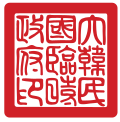 Seal of the Provisional Government of the Republic of Korea
 -
 Seal of South Korea


Gallery
-
 Historical seal of Goryeo (AD 1370–1392)
 -
 First national seal (1949–1962)
 -
 Second national seal (1963–1999)
 -
 Third national seal (1999–2008, 2010–2011)
 -
 Fourth national seal (2008–2010)
 -
Fifth national seal (since 2011)

.svg)
.svg)
.svg)
.svg)
-
 Seal knob of the first national seal
 -
 Seal knob of the second national seal
 -
 Seal knob of the third national seal
 -
 Seal knob of the fourth national seal
 -
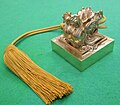 Seal knob of the fifth national seal
.jpg)
.jpg)
.jpg)
.jpg)
.jpg)
Other seals
Other officials also have their own seals, including the president, prime minister, and ministers.
-
 Seal of the president of South Korea
 -
 Seal of the prime minister of South Korea
 -
 The national, presidential, and a ministerial seal seen on a certificate awarding the Order of Merit for National Foundation
 -
 The presidential seal seen on a certificate awarding the Presidential Commendation Award (대통령표창) to Song Oh-kyun


See also

- Imperial Seal of China
- Cash seal (China)
- National Seals of the Republic of China
- Seal of the State Council of the People's Republic of China
- Privy Seal of Japan
- State Seal of Japan
- Seal script
- Seal cutting (art)
- Seal engraving (art)
Notes
References
- ^ a b Cheon, Jingi (Summer 2008). "Guksae (State Seal) Consummate Work of Korea's Master Craftsmen" (PDF). Koreana. 22. Archived from the original (PDF) on 22 July 2011.
- ^ "Pembuatan Segel Nasional Korea Selatan yang baru" [The Making of a new South Korea National Seal] (in Indonesian). KBS World (Indonesian TV channel). 14 February 2006. Archived from the original on 6 March 2012. Retrieved 2 June 2010.
- ^ a b c d National Symbols of the Republic of Korea: Uniting People and Elevating National Pride. Seoul: Ministry of the Interior of the Republic of Korea. 2017. pp. 12–13. Archived from the original on 2017-08-06. Retrieved 6 August 2017.
- ^ "국가상징" (in Korean). Ministry of the Interior of the Republic of Korea. Retrieved 2024-08-02.
- ^ "사라진 대한민국 첫 국새 찾아라" (in Korean). Presidential Archives. 2005-10-28. Retrieved 2024-07-28.
- ^ "3대 국새 둘러보기" (in Korean). National Archives of Korea. Retrieved 2024-08-08.
- ^ "'대한민국 국새' 경남 산청서 시험 날인" (in Korean). KBS. 2007-12-03. Retrieved 2024-08-08.
- ^ a b Cheon, Jingi (Summer 2008). "Guksae (State Seal) Consummate Work of Korea's Master Craftsmen" (PDF). Koreana. 22.
- ^ (in Indonesian)Pembuatan Segel Nasional Korea Selatan yang baru Archived 2012-03-06 at the Wayback Machine, kbs. Diakses pada 2 Juni 2010.
_-_East_Asian_and_Vietnamese_seal_sample_(2021)_01.png)