







Forsyth County, North Carolina
Forsyth County, North Carolina | |
|---|---|
.jpg) Forsyth County Courthouse in Winston-Salem | |
 Flag  Seal  Logo | |
 Location within the U.S. state of North Carolina | |
 Interactive map of Forsyth County, North Carolina | |
| Coordinates: 36°08′N 80°16′W / 36.13°N 80.26°W | |
| Country |  United States United States |
| State |  North Carolina North Carolina |
| Founded | 1849 |
| Named after | Benjamin Forsyth |
| Seat | Winston-Salem |
| Largest community | Winston-Salem |
| Area | |
• Total | 412.35 sq mi (1,068.0 km2) |
| • Land | 407.85 sq mi (1,056.3 km2) |
| • Water | 4.50 sq mi (11.7 km2) 1.09% |
| Population (2020) | |
• Total | 382,590 |
• Estimate (2024) | 398,143  |
| • Density | 937.7/sq mi (362.0/km2) |
| Time zone | UTC−5 (Eastern) |
| • Summer (DST) | UTC−4 (EDT) |
| Congressional districts | 6th, 10th |
| Website | www |
Forsyth County (/foʊrˈsaɪθ/ fohr-SYTH)[1][2] is a county located in the northwest Piedmont of the U.S. state of North Carolina. As of the 2020 census, the population was 382,590,[3] making it the fourth-most populous county in North Carolina. Its county seat is Winston-Salem.[4] Forsyth County is part of the Winston-Salem, NC, Metropolitan Statistical Area, which is also included in the Greensboro–Winston-Salem–High Point, NC, Combined Statistical Area. Portions of Forsyth County are in the Yadkin Valley wine region.
History
The county was formed in 1849 from Stokes County. It was named for Colonel Benjamin Forsyth, who was killed in the War of 1812.[5]
Geography
According to the U.S. Census Bureau, the county is in the outer Appalachian Mountains, and has a total area of 412.35 square miles (1,068.0 km2), of which 407.85 square miles (1,056.3 km2) is land and 4.50 square miles (11.7 km2) (1.09%) is water.[6]
The northeast section of Forsyth County, including Belews Creek and parts of Rural Hall, Walkertown, and Kernersville, is drained by tributaries of the Dan River. A small portion of Kernersville is in the Cape Fear River basin.[7] Most of the county is drained by tributaries of the Yadkin River, which forms the western boundary of the county. The lowest elevation in the county is 660 feet, on the Yadkin River at the southwest corner of the county.[8] The highest is 1100 feet, at a point just off Jefferson Church Road on the outskirts of King, immediately south of the county line.
State and local protected areas and sites
- Cascades Preserve (part)
- Emily Allen Wildflower Preserve
- Historic Bethabara Park
- Kaleideum
- Old Salem Museums & Gardens
- Shell-Shaped Shell Station
- Tanglewood Park
Major water bodies
- Abbotts Creek
- Belews Creek
- Belews Lake
- Beaver Dam Creek
- Brushy Creek
- Blanket Creek
- Buffalo Creek
- Crooked Run Creek
- Lick Creek
- Little Creek
- Little Yadkin River
- Mill Creek
- Muddy Creek
- Old Field Creek
- Reedy Fork
- Salem Creek
- Silas Creek
- South Fork Muddy Creek
- Yadkin River
Adjacent counties
- Stokes County – north
- Rockingham County – northeast
- Guilford County – east
- Davidson County – south
- Davie County – southwest
- Yadkin County – west
- Surry County – northwest
Major highways
 I-40
I-40
 I-74 / Future I-74 (designated section from I-40 to county line with Guilford County)
 Future I-274 (future loop around Winston-Salem)
 I-285
I-285 Future I-685
 US 52
US 52 US 158
 US 311
 US 421
 NC 8
NC 8 NC 65
NC 65 NC 66
NC 66 NC 67
NC 67 NC 74 (temporary highway designation for I-74)
 NC 109
 NC 150
 NC 192 (future designation between I-40 and I-74)
 NC 452 (future temporary highway designation for I-274)
Major infrastructure
- Amtrak Thruway (Winston-Salem)
- Smith Reynolds Airport
Demographics
| Census | Pop. | Note | %± |
|---|---|---|---|
| 1850 | 11,168 | — | |
| 1860 | 12,692 | 13.6% | |
| 1870 | 13,050 | 2.8% | |
| 1880 | 18,070 | 38.5% | |
| 1890 | 28,434 | 57.4% | |
| 1900 | 35,261 | 24.0% | |
| 1910 | 47,311 | 34.2% | |
| 1920 | 77,269 | 63.3% | |
| 1930 | 111,681 | 44.5% | |
| 1940 | 126,475 | 13.2% | |
| 1950 | 146,135 | 15.5% | |
| 1960 | 189,428 | 29.6% | |
| 1970 | 214,348 | 13.2% | |
| 1980 | 243,683 | 13.7% | |
| 1990 | 265,878 | 9.1% | |
| 2000 | 306,067 | 15.1% | |
| 2010 | 350,670 | 14.6% | |
| 2020 | 382,590 | 9.1% | |
| 2024 (est.) | 398,143 | [9] | 4.1% |
| U.S. Decennial Census[10] 1790–1960[11] 1900–1990[12] 1990–2000[13] 2010[14] 2020[3] | |||
2020 census
| Race / Ethnicity (NH = Non-Hispanic) | Pop 1980[15] | Pop 1990[16] | Pop 2000[17] | Pop 2010[18] | Pop 2020[19] | % 1980 | % 1990 | % 2000 | % 2010 | % 2020 |
|---|---|---|---|---|---|---|---|---|---|---|
| White alone (NH) | 181,724 | 195,660 | 202,338 | 205,934 | 208,126 | 74.57% | 73.59% | 66.11% | 58.73% | 54.40% |
| Black or African American alone (NH) | 58,938 | 65,858 | 77,041 | 89,533 | 93,738 | 24.19% | 24.77% | 25.17% | 25.53% | 24.50% |
| Native American or Alaska Native alone (NH) | 452 | 535 | 783 | 894 | 978 | 0.19% | 0.20% | 0.26% | 0.25% | 0.26% |
| Asian alone (NH) | 660 | 1,639 | 3,133 | 6,427 | 9,179 | 0.27% | 0.62% | 1.02% | 1.83% | 2.40% |
| Native Hawaiian or Pacific Islander alone (NH) | x [20] | x [21] | 70 | 156 | 233 | x | x | 0.02% | 0.04% | 0.06% |
| Other race alone (NH) | 334 | 84 | 397 | 696 | 1,623 | 0.14% | 0.03% | 0.13% | 0.20% | 0.42% |
| Mixed race or Multiracial (NH) | x [22] | x [23] | 2,728 | 5,255 | 14,025 | x | x | 0.89% | 1.50% | 3.67% |
| Hispanic or Latino (any race) | 1,575 | 2,102 | 19,577 | 41,775 | 54,688 | 0.65% | 0.79% | 6.40% | 11.91% | 14.29% |
| Total | 243,683 | 265,878 | 306,067 | 350,670 | 382,590 | 100.00% | 100.00% | 100.00% | 100.00% | 100.00% |
As of the 2020 census, there were 382,590 people, 156,635 households, and 90,837 families residing in the county. The median age was 38.8 years, with 22.3% of residents under the age of 18 and 17.1% 65 years of age or older. For every 100 females there were 89.8 males, and for every 100 females age 18 and over there were 86.3 males.[24][25]
The racial makeup of the county was 56.2% White, 24.9% Black or African American, 0.7% American Indian and Alaska Native, 2.4% Asian, 0.1% Native Hawaiian and Pacific Islander, 8.4% from some other race, and 7.3% from two or more races. Hispanic or Latino residents of any race comprised 14.3% of the population.[25]
92.4% of residents lived in urban areas, while 7.6% lived in rural areas.[26]
There were 156,635 households in the county, of which 28.9% had children under the age of 18 living in them. Of all households, 42.2% were married-couple households, 18.8% were households with a male householder and no spouse or partner present, and 32.8% were households with a female householder and no spouse or partner present. About 31.7% of all households were made up of individuals and 12.2% had someone living alone who was 65 years of age or older.[24]
There were 170,176 housing units, of which 8.0% were vacant. Among occupied housing units, 60.6% were owner-occupied and 39.4% were renter-occupied. The homeowner vacancy rate was 1.6% and the rental vacancy rate was 9.0%.[24]
2000 census
At the 2000 census,[27] there were 306,067 people, 123,851 households, and 81,741 families residing in the county. The population density was 747 people per square mile (288 people/km2). There were 133,093 housing units, at an average density of 325 units per square mile (125 units/km2). The racial makeup was 68.47% White, 25.61% Black or African American, 0.30% Native American, 1.04% Asian, 0.03% Pacific Islander, 3.25% from other races, and 1.30% from two or more races. 6.40% of the population were Hispanic or Latino of any race.
There were 123,851 households, out of which 30.50% had children under the age of 18 living with them, 48.90% were married couples living together, 13.50% had a female householder with no husband present, and 34.00% were non-families. 28.90% of all households were made up of individuals, and 9.30% had someone living alone who was 65 years of age or older. The average household size was 2.39, and the average family size was 2.94.

Non-Hispanic White 30–40%40–50%50–60%60–70%70–80%80–90%90%+Black or African American 30–40%40–50%50–60%60–70%70–80%80–90%Hispanic or Latino40–50%
The median age was 36 years, with 23.90% under the age of 18, 9.60% from 18 to 24, 31.10% from 25 to 44, 22.80% from 45 to 64, and 12.60% who were 65 years of age or older. For every 100 females there were 91.50 males. For every 100 females age 18 and over, there were 87.40 males.
The median household income was $42,097, and the median family income was $52,032. Males had a median income of $36,158, versus $27,319 for females. The per capita income was $23,023. About 7.90% of families and 11.00% of the population were below the poverty line, including 15.10% of those under age 18 and 9.70% of those age 65 or over.
Law and government

The Forsyth County Government Center is located at 201 North Chestnut Street in Downtown Winston-Salem. Forsyth County is a member of the regional Northwest Piedmont Council of Governments.
The Forsyth County Public Library, founded in 1906, is free for residents of Forsyth and surrounding counties, while all others must pay a small yearly fee for a library card. The library runs Adult, Children's, and Hispanic Outreach programs. Its main "Central Library" is in downtown Winston-Salem, with branches all across the county.[28]
Forsyth County Public Library is part of NC Cardinal, a consortium of many other library systems in North Carolina.
The Forsyth County Department of Public Health is located at 799 North Highland Avenue near downtown Winston-Salem.
Politics
Forsyth County typically favors Democratic candidates in national elections, though Republicans remain competitive in local races.[29]
| Year | Republican | Democratic | Third party(ies) | |||
|---|---|---|---|---|---|---|
| No. | % | No. | % | No. | % | |
| 1880 | 1,791 | 49.42% | 1,778 | 49.06% | 55 | 1.52% |
| 1884 | 1,941 | 48.46% | 2,060 | 51.44% | 4 | 0.10% |
| 1888 | 2,613 | 53.28% | 2,238 | 45.64% | 53 | 1.08% |
| 1892 | 2,447 | 42.13% | 2,880 | 49.59% | 481 | 8.28% |
| 1896 | 3,888 | 57.85% | 2,778 | 41.33% | 55 | 0.82% |
| 1900 | 2,588 | 50.77% | 2,482 | 48.70% | 27 | 0.53% |
| 1904 | 2,209 | 47.94% | 2,301 | 49.93% | 98 | 2.13% |
| 1908 | 2,876 | 52.28% | 2,472 | 44.94% | 153 | 2.78% |
| 1912 | 1,689 | 26.72% | 3,042 | 48.12% | 1,591 | 25.17% |
| 1916 | 3,585 | 45.16% | 4,115 | 51.84% | 238 | 3.00% |
| 1920 | 6,792 | 45.54% | 8,123 | 54.46% | 0 | 0.00% |
| 1924 | 5,315 | 40.33% | 7,404 | 56.18% | 459 | 3.48% |
| 1928 | 13,258 | 66.63% | 6,639 | 33.37% | 0 | 0.00% |
| 1932 | 5,727 | 28.49% | 14,016 | 69.73% | 357 | 1.78% |
| 1936 | 5,256 | 21.91% | 18,734 | 78.09% | 0 | 0.00% |
| 1940 | 7,125 | 25.64% | 20,664 | 74.36% | 0 | 0.00% |
| 1944 | 10,014 | 37.93% | 16,390 | 62.07% | 0 | 0.00% |
| 1948 | 10,147 | 41.04% | 12,201 | 49.35% | 2,377 | 9.61% |
| 1952 | 26,436 | 51.86% | 24,535 | 48.14% | 0 | 0.00% |
| 1956 | 29,368 | 64.99% | 15,819 | 35.01% | 0 | 0.00% |
| 1960 | 33,374 | 58.13% | 24,035 | 41.87% | 0 | 0.00% |
| 1964 | 30,276 | 48.92% | 31,615 | 51.08% | 0 | 0.00% |
| 1968 | 31,623 | 46.79% | 20,281 | 30.01% | 15,681 | 23.20% |
| 1972 | 46,415 | 67.69% | 20,928 | 30.52% | 1,226 | 1.79% |
| 1976 | 38,886 | 49.34% | 39,561 | 50.20% | 361 | 0.46% |
| 1980 | 42,389 | 49.99% | 38,870 | 45.84% | 3,539 | 4.17% |
| 1984 | 59,208 | 61.54% | 36,814 | 38.26% | 189 | 0.20% |
| 1988 | 57,688 | 59.02% | 39,726 | 40.65% | 321 | 0.33% |
| 1992 | 52,787 | 45.40% | 49,006 | 42.15% | 14,481 | 12.45% |
| 1996 | 59,160 | 52.81% | 46,543 | 41.54% | 6,330 | 5.65% |
| 2000 | 67,700 | 55.98% | 52,457 | 43.37% | 785 | 0.65% |
| 2004 | 75,294 | 54.12% | 63,340 | 45.53% | 491 | 0.35% |
| 2008 | 73,674 | 44.35% | 91,085 | 54.83% | 1,374 | 0.83% |
| 2012 | 79,768 | 45.83% | 92,323 | 53.04% | 1,978 | 1.14% |
| 2016 | 75,975 | 42.61% | 94,464 | 52.98% | 7,873 | 4.42% |
| 2020 | 85,064 | 42.26% | 113,033 | 56.16% | 3,173 | 1.58% |
| 2024 | 87,292 | 42.64% | 114,145 | 55.76% | 3,289 | 1.61% |
Education
Forsyth County is served by the Winston-Salem/Forsyth County Schools School district.
Communities

Cities
- Winston-Salem (county seat and largest community)
- High Point (mostly in Guilford County; also in Randolph County and Davidson County)
- King (mostly in Stokes County)
Towns
- Bethania
- Kernersville (partially in Guilford County)
- Lewisville
- Rural Hall
- Stokesdale (mostly in Guilford County)
- Walkertown
Villages
- Clemmons
- Tobaccoville (also in Stokes County)
Townships
Former township
- Middle Fork Township was split into Middle Fork I Township and Middle Fork II Township in 2003.[31]
Census-designated place
Unincorporated communities
See also
- List of counties in North Carolina
- National Register of Historic Places listings in Forsyth County, North Carolina
- Arts Council of Winston-Salem Forsyth County
- Adelaide Fries, author of the 1898 book, Forsyth County
References
- ^ "NC Pronunciation Guide". WRAL. November 3, 2011. Retrieved August 16, 2023.
- ^ Talk Like a Tarheel Archived June 22, 2013, at the Wayback Machine, from the North Carolina Collection website at the University of North Carolina at Chapel Hill. Retrieved August 16, 2023.
- ^ a b "QuickFacts: Forsyth County, North Carolina". United States Census Bureau. Retrieved March 21, 2024.
- ^ "Find a County". National Association of Counties. Archived from the original on May 31, 2011. Retrieved June 7, 2011.
- ^ Gannett, Henry (1905). The Origin of Certain Place Names in the United States. Govt. Print. Off. pp. 128.
- ^ "2020 County Gazetteer Files – North Carolina". United States Census Bureau. August 23, 2022. Retrieved September 9, 2023.
- ^ Haw River, North Carolina, American Rivers, Washington, DC. Retrieved December 22, 2021.
- ^ Clemmons Topo Map in Forsyth County, NC, TopoZone, Locality, LLC. Retrieved December 22, 2021.
- ^ "County Population Totals and Components of Change: 2020-2024". United States Census Bureau. Retrieved August 21, 2025.
- ^ "U.S. Decennial Census". United States Census Bureau. Retrieved January 14, 2015.
- ^ "Historical Census Browser". University of Virginia Library. Retrieved January 14, 2015.
- ^ Forstall, Richard L., ed. (March 27, 1995). "Population of Counties by Decennial Census: 1900 to 1990". United States Census Bureau. Retrieved January 14, 2015.
- ^ "Census 2000 PHC-T-4. Ranking Tables for Counties: 1990 and 2000" (PDF). United States Census Bureau. April 2, 2001. Archived (PDF) from the original on March 27, 2010. Retrieved January 14, 2015.
- ^ "State & County QuickFacts". United States Census Bureau. Retrieved February 15, 2022.
- ^ "1980 Census of Population - General Social and Economic Characteristics - North Carolina - Table 15 - Persons by Race: 1980 and Table 16 - Persons by Spanish Origin, Race, and Sex: 1980" (PDF). United States Census Bureau. p. 14-25. Archived from the original (PDF) on February 28, 2025 – via WayBack Machine.
- ^ "1990 Census of Population - General Population Characteristics - North Carolina: Table 3 - Race and Hispanic Origin" (PDF). United States Census Bureau. p. 15-64. Archived from the original (PDF) on March 20, 2025 – via WayBack Machine.
- ^ "P004: Hispanic or Latino, and Not Hispanic or Latino by Race – 2000: DEC Summary File 1 – Forsyth County, North Carolina". United States Census Bureau.
- ^ "P2: Hispanic or Latino, and Not Hispanic or Latino by Race – 2010: DEC Redistricting Data (PL 94-171) – Forsyth County, North Carolina". United States Census Bureau.
- ^ "P2: Hispanic or Latino, and Not Hispanic or Latino by Race – 2020: DEC Redistricting Data (PL 94-171) – Forsyth County, North Carolina". United States Census Bureau.
- ^ included in the Asian category in the 1980 Census
- ^ included in the Asian category in the 1990 Census
- ^ not an option in the 1980 Census
- ^ not an option in the 1990 Census
- ^ a b c "2020 Decennial Census Demographic Profile (DP1)". United States Census Bureau. 2021. Retrieved December 26, 2025.
- ^ a b "2020 Decennial Census Redistricting Data (Public Law 94-171)". United States Census Bureau. 2021. Retrieved December 26, 2025.
- ^ "2020 Decennial Census Demographic and Housing Characteristics (DHC)". United States Census Bureau. 2023. Retrieved December 26, 2025.
- ^ "U.S. Census website". United States Census Bureau. Retrieved January 31, 2008.
- ^ "Locations". Forsyth County Public Library website. Forsyth County. Retrieved June 6, 2012.
- ^ Gordon, Brian (April 25, 2022). "Why do conservative WNC counties keep electing Democrats?". The Fayetteville Observer. Retrieved November 9, 2023.
- ^ Leip, David. "Dave Leip's Atlas of U.S. Presidential Elections". uselectionatlas.org. Retrieved March 15, 2018.
- ^ "Middle Fork Township". Geographic Names Information System. United States Geological Survey, United States Department of the Interior.
Further reading
- "Forsythe County", Branson's North Carolina Business Directory...1867-68, Raleigh, NC: Branson & Jones, p. 42 – via hathitrust.org
- "Forsyth County", Branson's North Carolina Business Directory, 1896, Raleigh, NC: Levi Branson, 1884, p. 264 – via archive.org
- "Forsyth County", North Carolina Year Book and Business Directory, 1916, Raleigh, N.C.: News and Observer Publishing Company – via hathitrust.org
External links
 Geographic data related to Forsyth County, North Carolina at OpenStreetMap
- Official website
- Digital Forsyth, collaborative digitization project of historic images
- NCGenWeb Forsyth County, genealogy resources for the county
- Forsyth County Genealogical Society
Places adjacent to Forsyth County, North Carolina | ||||||||||||||||
|---|---|---|---|---|---|---|---|---|---|---|---|---|---|---|---|---|
| ||||||||||||||||


Municipalities and communities of Forsyth County, North Carolina, United States | ||
|---|---|---|
| Cities | 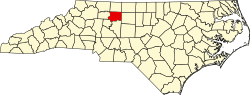 | |
| Towns | ||
| Villages | ||
| Townships | ||
| CDP | ||
| Unincorporated communities | ||
| Footnotes | ‡This populated place also has portions in an adjacent county or counties | |
| International | |
|---|---|
| National | |
| Geographic | |
| Other | |
