








Erytholus
| Erytholus Temporal range:
| |
|---|---|

| |
| Crack-out specimen of Erytholus globosus from the Middle Cambrian, Moodlatana Formation, of the Flinders ranges, South Australia | |
Scientific classification 
| |
| Domain: | incertae sedis |
| Genus: | †Erytholus Retallack 2011 |
| Species | |
| |
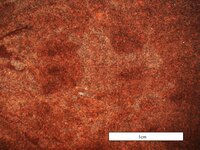

Erytholus is a form genus for problematic alleged fossils of Cambrian age in South Australia. It has been of special interest because of its morphological similarity with the Ediacaran fossil Ventogyrus, and may have been a late surviving vendobiont. It could be a slime mold.[1] Other authors have doubted whether it represents a fossil[2]
Description
Erytholus was claimed by its describer, Gregory Retallack, to be a globose, chambered fossil, with associated vertical tubular structures. Retallack considered its preservation in sandstone is similar to the Ediacaran type preservation of the vendobiont Ventogyrus. It is found at depths of 20–30 centimetres (7.9–11.8 in) within paleosols. Its affinities are uncertain, although it bears a general resemblance to truffles.[1] In a rebuttal published in 2011, four other authors contested the idea that Erytholus was a fossil at all, stating that it was likely merely a "broken section of a poorly sorted ferruginous, muddy sandstone with deformed laminae".[2]
References
- ^ a b Retallack, G.J. (2011). "Problematic megafossils in Cambrian paleosols of South Australia". Palaeontology. 54 (6): 1223–1242. Bibcode:2011Palgy..54.1223R. doi:10.1111/j.1475-4983.2011.01099.x. S2CID 130692406.
- ^ a b Jago, James B.; Gehling, James G.; Paterson, John R.; Brock, Glenn A. (July 2012). "Comments on Retallack, G. J. 2011: Problematic megafossils in Cambrian Palaeosols of South Australia". Palaeontology. 55 (4): 913–917. doi:10.1111/j.1475-4983.2012.01173.x. ISSN 0031-0239.