
The normalized difference red edge index (NDRE) is a metric that can be used to analyse whether images obtained from multi-spectral image sensors contain healthy vegetation or not.[1] It does this by measuring the amount of chlorophyll in a plant.[2]
It is similar to Normalized Difference Vegetation Index (NDVI) but uses the ratio of Near-Infrared and the edge of Red as follows:[3]
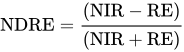
The red edge is the part of the spectrum centered around 715 nm.
The Index will give a value between -1.0 to +1.0, with a higher value showing a healthy plant environment.[3]
See also
References
- ↑ Barnes, E. M., Clarke, T. R., Richards, S. E., Colaizzi, P. D., Haberland, J., Kostrzewski, M., ... & Lascano, R. J. (2000, July). Coincident detection of crop water stress, nitrogen status and canopy density using ground based multispectral data. In Proceedings of the Fifth International Conference on Precision Agriculture, Bloomington, MN, USA[rdp-wiki-embed url='https://et.wikipedia.org/wiki/Ameerika_%C3%9Chendriigid'] More (Vol. 1619).
- ↑
External links
- IEE Explore website, Normalized Difference Red-Edge Estimation With Modified DiscoGAN Model, article by Hyeon-Beom Choi, Kwon-Hee Han and Jeongwook Seo (2006)
- Spectral Reflectance Changes Associated with Autumn Senescence of Aesculus hippocastanum L. and Acer platanoides L. Leaves. Spectral Features and Relation to Chlorophyll Estimation
- Chlorophyll Absorption
- Barnes, T.R., Clarke, S.E. Richards et. al. 2000. Coincident Detection of Crop Water Stress, Nitrogen Status and Canopy Density using Ground-Based Multispectral Data. Proceedings of the Fifth International Conference on Precision Agriculture