
Najaf[a] is the capital city of the eponymous Najaf Governorate in central Iraq, about 160 km (99 mi) south of Baghdad. Its estimated population in 2024 was about 1.41 million people.[2] The city holds the Imam Ali Shrine, the burial place of Muhammad's cousin and son-in-law, the first Shia Imam and the fourth Sunni Rashidun caliph. The shrine is considered by Shia Muslims as the holiest site in Islam after Mecca, Medina, and Al-Aqsa.[3][4][5][6][7][8]
Every year, millions of pilgrims visit the shrine, with attendance peaking during Arba'in, the largest peaceful gathering in the world.[9] The city is one of Iraq's spiritual capitals, as well as the country's center of Shia political power.[10][11][12][13][14] The world's largest cemetery, Wadi-us-Salaam, and the world's oldest Shia Islamic seminary, Hawza of Najaf, are also located in Najaf.
Etymology
According to Ibn Manzur, the word, "najaf" (نجف), literally means a high and rectangular place around which water is accumulated, although the water does not go above its level.[15] Al-Shaykh al-Saduq appeals to a hadith from Ja'far al-Sadiq, claiming that "Najaf" comes from the phrase, "nay jaff" which means "the nay sea has dried".[16]
"Najaf" is usually accompanied by the adjective "al-Ashraf" (the dignified). According to the author of al-Hawza al-'ilmiyya fi l-Najaf al-ashraf, this is because 'Ali, one of the most dignified persons, is buried in the city.
Al-Ghari or al-Ghariyyan, Hadd al-'Adhra', al-Hiwar, al-Judi, Wadi l-Salam, al-Zahr, Zahr al-Kufa (behind Kufa), al-Rabwa, Baniqiya, and Mashhad are other names for this land.[17]
History
The area of An-Najaf is located 30 km (19 mi) south of the ancient city of Babylon, and 400 km (248 mi) north of the ancient city of Ur. The city itself was founded in 791 AD, by the Abbasid Caliph Harūn ar-Rashīd, as a shrine to ‘Alī bin Abī Ṭālib.[18]
Prehistoric and ancient times

Archaeological discoveries show the existence of a people in the present-day Najaf dating back to the 1st century BC. Najaf possesses one of the largest burial grounds in the vicinity for Christians. Discoveries in the following centuries point toward the city's multicultural and diverse religious history. Mohammed al-Mayali, director of Inspectorate Effects of the province of Najaf, states, "the excavation on the graves, which we have been working on for years, confirm that "Najaf" contains the largest Christian cemetery in Iraq, with a cemetery area of 1416 acres. We have found indications of Christianity on the graves through representations of crosses and stones with Christ-like engravings. There are also relics that date back to the Sassanid period. Also discovered in the excavation was proof of a thriving glass industry. Pots were decorated with the cross, as well as Hebrew writings, indicating a community of religious coexistence."[citation needed]
Wadi-us-Salaam in Najaf was once a holy cemetery for Jews and was then called Baniqia, which could be the first recorded name for the area.[19] [20]
The name Baniqia also was found in some texts which state that Abraham once visited and stayed in this village before continuing his journey from Mesopotamia to Arabia.[21][22]
In Islam, the city is considered to have started with Ali who instructed that his burial place should remain a secret, as he had many enemies and he feared that his body might be subjected to some indignity. According to legend, the body of Ali was placed on a camel which was driven from Kufah. The camel stopped a few miles west of the city where the body was secretly buried.[23] No tomb was raised and nobody knew of the burial place except for a few trusted people. It is narrated that more than a hundred years later the Abbasid Caliph, Harun al-Rashid, went deer hunting outside Kufah, and the deer sought sanctuary at a place where the hounds would not pursue it. On inquiry as to why the place was a sanctuary, he was told that it was the burial place of ‘Ali. Harūn ar-Rashīd ordered a mausoleum to be built on the spot and in due course the town of Najaf grew around the mausoleum.[24]
Medieval and modern history
In early 14th century, Sheikh Ibn Battuta visited the burial site of Ali ibn Abi Talib during his travels in Iraq after his pilgrimage to Mecca. During this period, Najaf was called Meshhed Ali. As Translated by Samuel Lee, Ibn Battuta in his Arabic Rihla relates:[25]
Modern period

The Ottomans were expelled in an uprising in 1915, following which the city fell under the rule of the British Empire. The sheikhs of Najaf including Sayyed Mahdi Al-Awadi rebelled in 1918, killing the British governor of the city, and cutting off grain supplies to the Anazzah, a tribe allied with the British. In retaliation the British besieged the city and cut off its water supply. The rebellion was put down and the rule of the sheikhs was forcibly ended. A great number of the Shi‘i ‘Ulema’ were expelled into Persia, where they set the foundations for the rise of the city of Qom as the center of the Shi‘ite learning and authority, in lieu of Najaf. Najaf lost its religious primacy to Qom, and was not to regain it until the 21st century, during the establishment of a Shī‘ī-majority government in Iraq after 2003.
In the 20th century, much of the Old City was rebuilt in a series of modernization initiatives. Beginning in the 1950s, many historic buildings and monuments, including those adjoining the shrine, were demolished for the construction of Sadeq, Zainulabidin, Rasool and Tousi streets. In 1958, the city wall was torn down and replaced with a ring road. In the 1980s, the entire area between the shrine and the city's western edge was demolished, and the residents resettled outside the city, in what locals perceived as a government reprisal for the Shia uprising under the leadership of Muhammad Baqir al-Sadr, who was based in the neighborhood.[29]
During the 2003 U.S. invasion of Iraq, Najaf was a key target of the invading United States Armed Forces. The city was encircled during heavy fighting on 26 March 2003 and was captured on 3 April 2003 (Battle of Najaf). The clerical authorities of the Shī‘ī enclave of Sadr City in Baghdad, which claimed autonomy in April 2003, after the fall of Baghdad, claimed to be taking their orders from senior clerics in Najaf.
On 4 April 2004, the Mahdi Army attacked the Spanish-Salvadoran-ALARNG base (Camp Golf, later renamed Camp Baker) in An Najaf, part of a coordinated uprising across central and southern Iraq in an apparent attempt to seize control of the country ahead of the 30 June 2004 handover of power to a new Iraqi government. This uprising led to the American troops arriving in the city in the wake of the Spanish withdrawal. In August 2004, heavy fighting broke out again between U.S. forces and Al-Sadr's Mahdi Army.[30] The battle lasted three weeks and ended when senior Iraqi cleric Grand Ayatollah Ali al-Sistani negotiated an end to the battle.[31]
In 2012, Najaf was named the Cultural Centre of the Arab World.[32] On 6 March 2021, Pope Francis visited Najaf during his historic papal visit to Iraq and held an interfaith dialogue with al-Sistani, where he expressed a message of peaceful coexistence between Muslims and Christians in the country.[33] During the ISIS war, Najaf Shiites launched solidarity initiative with Sunni areas affected by ISIS.[34] Many Iraqis including religious minorities such as Christians from the north, as well as Lebanese Shia have found safe haven in the city.[35][36]
Geography
Climate
Najaf has a hot desert climate, BWh in the Köppen climate classification, with long, very hot summers and mild winters. The average annual temperature is 23.6 °C (74.5 °F). The rainfall averages 69 mm (2.71 in).
| Climate data for Najaf (1991–2020) | |||||||||||||
|---|---|---|---|---|---|---|---|---|---|---|---|---|---|
| Month | Jan | Feb | Mar | Apr | May | Jun | Jul | Aug | Sep | Oct | Nov | Dec | Year |
| Record high °C (°F) | 26.0 (78.8) |
32.5 (90.5) |
41.7 (107.1) |
43.0 (109.4) |
48.3 (118.9) |
51.4 (124.5) |
51.5 (124.7) |
51.0 (123.8) |
49.2 (120.6) |
43.7 (110.7) |
34.5 (94.1) |
29.4 (84.9) |
51.5 (124.7) |
| Mean daily maximum °C (°F) | 17.1 (62.8) |
20.2 (68.4) |
25.6 (78.1) |
31.6 (88.9) |
38.5 (101.3) |
43.2 (109.8) |
45.4 (113.7) |
45.2 (113.4) |
41.4 (106.5) |
34.8 (94.6) |
24.6 (76.3) |
18.7 (65.7) |
32.2 (90.0) |
| Daily mean °C (°F) | 11.2 (52.2) |
14.0 (57.2) |
18.8 (65.8) |
24.9 (76.8) |
31.3 (88.3) |
35.8 (96.4) |
38.1 (100.6) |
37.6 (99.7) |
33.4 (92.1) |
28.5 (83.3) |
18.0 (64.4) |
12.8 (55.0) |
25.4 (77.7) |
| Mean daily minimum °C (°F) | 6.3 (43.3) |
8.3 (46.9) |
12.6 (54.7) |
18.2 (64.8) |
23.9 (75.0) |
27.7 (81.9) |
29.9 (85.8) |
29.4 (84.9) |
25.8 (78.4) |
20.4 (68.7) |
12.6 (54.7) |
7.8 (46.0) |
18.6 (65.5) |
| Record low °C (°F) | −7.2 (19.0) |
−4.5 (23.9) |
2.2 (36.0) |
7.0 (44.6) |
13.0 (55.4) |
17.0 (62.6) |
19.4 (66.9) |
22.2 (72.0) |
18.3 (64.9) |
7.0 (44.6) |
0.2 (32.4) |
−2.5 (27.5) |
−7.2 (19.0) |
| Average precipitation mm (inches) | 16.4 (0.65) |
10.7 (0.42) |
9.1 (0.36) |
14.4 (0.57) |
3.4 (0.13) |
0.0 (0.0) |
0.0 (0.0) |
0.0 (0.0) |
0.0 (0.0) |
6.3 (0.25) |
19.6 (0.77) |
12.9 (0.51) |
92.8 (3.65) |
| Average relative humidity (%) | 67.0 | 57.6 | 47.4 | 41.1 | 31.4 | 24.5 | 22.6 | 23.7 | 28.8 | 39.9 | 56.5 | 65.3 | 42.2 |
| Source: NOAA,[37][38] Meteomanz(record high since 2009[39]) | |||||||||||||
Religious significance
An-Najaf is considered sacred by Shi'a Muslims. An-Najaf is renowned as the site of the burial place of Muhammad's son-in-law and cousin, ‘Alī ibn Abī Tālib. The city is now a center of pilgrimage throughout the Shi'ite Islamic world. It is estimated that only Mecca and Medina receive more Muslim pilgrims. As the burial site of one of Shi'a Islam's most important figure,[40] the Imam Ali Mosque is considered by Shiites as the third holiest Islamic site.[40][41][42][43][44][45][46][47][48]
The Imam ‘Ali Mosque is housed in a grand structure with a gold gilded dome and many precious objects in the walls. Nearby is the Wadi-us-Salaam cemetery, the largest in the world.[49] It contains the tombs of several prophets and many of the devout from around the world aspire to be buried there, to be raised from the dead with Imām ‘Alī on Judgement Day. Over the centuries, numerous hospices, schools, libraries and convents were built around the shrine to make the city the center of Shīʻa learning and theology.
The An-Najaf seminary, or Hawza Najaf, is one of the most important teaching centres in the Islamic world. Ayatollah Khomeini lectured there from 1965 to 1978.[50] Many of the leading figures of the new Islamic movement that emerged in Iraq, Iran and Lebanon in the 1970s had studied at Najaf.[51] As of 2014, it was estimated to have about 13,000 students.[52]
Economy
The fall of the Ba'athist regime ended restrictions on Shi'ite pilgrimage, which led to a pilgrimage boom in Najaf and increased demand for facilities and infrastructure.[29][53] In 2006, the government sponsored reconstruction of the previously demolished western area of the city as the City of Pilgrims project.[29] Najaf, alongside Karbala, is considered a thriving pilgrimage destination for Shia Muslims and the pilgrimage industry in the city boomed after the end of Saddam Hussein's rule.[53] However, due to the U.S. sanctions on Iran, the number of Iranian pilgrims dropped significantly.[54]
Since the end of the 2003–2011 war, numerous projects have been proposed for Najaf. The city has become a model for development in Iraq. Najaf have been experiencing economic boom, along with political events.[55] In 2008, over 50% of about licensed 200 investment projects totaling $8 billion were under construction in Najaf Governorate, with most development coming in the housing and tourism sectors.[56] Najaf has been described as a strategically important city with a stable investment environment and available skilled manpower.[57] The city has experienced an increase in investment.[58] Saudi Arabian firm ACWA Power is in process to construct a 1,000 MW solar power plant in Najaf.[59]
The government proposed to build 15 housing complexes in Najaf, with a cost of $7 billion as a part of 240 projects.[60] It also includes development of two industrial parks.[60] In 2024, prime minister Mohammed Shia' Al Sudani announced several projects in the city, during his visit to Najaf.[61] The projects proposed by Al-Sudani included the Holy shrine's carpet-washing factory project will cost 3.46 billion.[61] A cement bag factory covering an area of 75,000 square meters with a production capacity of 240 million bags per year, is being constructed in Najaf.[55] Another project is a glass production factory, which will have a net profit of 32% in the first year of operation because the Najaf desert region has high-quality raw materials for this factory.[55]
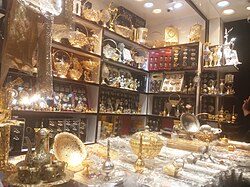
- Markets in Najaf



Culture
Religious tourism
Najaf being home to the Sanctuary of Imam Ali (considered the patriarch and the first of the Twelve Imams) is the destination of large numbers of Shi’i religious pilgrims annually hailing from around the world.
Sports
The city of Najaf is home to Al-Najaf SC and Naft Al-Wasat SC that play in the second tier Iraqi Premier Division League.
Najaf has two football stadiums, the An-Najaf Stadium (also referred to as the old stadium) with a capacity of 12,000 spectators, and the newer Al-Najaf International Stadium with a capacity of 30,000. The latter stadium is the home of the Stars League club Al-Najaf as well as Naft Al-Wasat, whilst the former is the home stadium of the neighbouring Al-Kufa SC.
Education
Universities
Some of the universities located in Najaf include:
- Al-Furat Al-Awsat Technical University
- Islamic University College
- University of Alkafeel
- Jabir Ibn Hayyan Medical University
- Altoosi University College
Najaf Seminary
The Hawza of Najaf has been a centre of traditional Shia Islamic education since the 11th century CE. It was possibly established in the 9th century CE, making it the oldest Shi’i seminary among those still active, and many prominent Shi’i Islamic scholars have studied in the Najaf Seminary, including Murtadha al-Ansari, and Ali al-Sistani.
Infrastructure

Najaf International Airport is an important logistical hub that plays a pivotal role in facilitating transportation, particularly for religious tourism. Annually, it oversees the transit of over 3 million passengers, predominantly pilgrims visiting the holy sites in Najaf. It is situated in the eastern part of Najaf, approximately 6 kilometres from the city center.
In February 2024, the Iraqi National Investment Commission (NIC) unveiled a project to construct an inter-city high-speed rail connecting the cities of Najaf and Karbala. Once finished, it is set to accommodate up to 25,000 passengers per hour.[62][63]
The construction of a road between Iraq and Saudi Arabia around the region of Najaf is about to complete.[64]
International relations
Sister cities
As of 2024, Najaf has three sister cities:
 Minneapolis, United States[65][66]
 Najafabad, Iran[67]
See also

Notes
References
- ↑ An-Najaf (Central Subdistrict, Iraq)
- 1 2 "Iraq: Governorates & Cities".
- ↑ "Never Again!". Shia News. Archived from the original on 2007-08-05.
- ↑ "Iran Diary, Part 2: Knocking on heaven's door". Asia Times Online. Archived from the original on June 3, 2002.
- ↑ "Muslim Shia's Saint Imam Ali Holy Shrine". Cultural Heritage Photo Agency. Archived from the original (16 images) on 2010-09-05.
- ↑ "The tragic martyrdom of Ayatollah Al Hakim calls for a stance". Modarresi News. September 4, 2003. Archived from the original on 2010-09-18.
- ↑ "Title required". Zaman Online. August 13, 2004. Archived from the original on October 28, 2006.
- ↑ "Why 2003 is not 1991". The Guardian. April 1, 2003.
- ↑ Al-Monitor, 2019. "Why the Arba'in pilgrimage is bigger than the Hajj".
- ↑ Cordesman, Anthony H.; Khazai, Sam (4 Jun 2014). Iraq in Crisis. Rowman & Littlefield. p. 319. ISBN 9781442228566.
- ↑ Cockburn, Patrick (8 Apr 2008). Muqtada: Muqtada al-Sadr, the Shia Revival, and the Struggle for Iraq (illustrated ed.). Simon and Schuster. p. 146. ISBN 9781416593744.
- ↑ Pollack, Kenneth M.; Alkadiri, Raad; J. Scott Carpenter; Kagan, Frederick W.; Kane, Sean (2011). Unfinished Business: An American Strategy for Iraq Moving Forward. Brookings Institution Press. p. 103. ISBN 9780815721666.
- ↑ Robinson, Linda (2005). Masters of Chaos: The Secret History of the Special Forces (illustrated, reprint ed.). PublicAffairs. p. 260. ISBN 9781586483524.
- ↑ "Ali al-Sistani is Iraq's best hope of curbing Iranian influence. But he is 85 and has no obvious successor". The Economist. 5 December 2015. Retrieved 6 December 2015.
- ↑ Ibn Manẓūr, Lisān al-ʿArab, under the word "Najaf".
- ↑ Ṣadūq, ʿIlal al-sharāʾiʿ, vol. 1, p. 31.
- ↑ "مقدمة تاريخية عن مدينة النجفة الكوفة و النجف الاشرف : الفصل الاول". www.uokufa.edu.iq. Retrieved 2025-10-20.
- ↑ Ring, Trudy (1996). International Dictionary of Historic Places: Middle East and Africa. Taylor & Francis. ISBN 9781884964039. Retrieved 2009-09-13.
- ↑ A'haron Oppenheimer; Oppenheimer, Nili (2005). Between Rome and Babylon: Studies in Jewish Leadership and Society. Mohr Siebeck. p. 351. ISBN 9783161485145.
- ↑ Bryan Hill. ["Wadi Al-Salam: Magnificent Ancient Cemetery in Iraq is Largest in the World"], Ancient Origins, 23 July 2018.
- ↑ Brendan Koerner. ["Why Is Najaf So Holy?"], Slate, 27 April 2004.
- ↑ Imam Ali Holy Shrine. ["Baniqia Article ID 4648"], Imam Ali Network.
- ↑ Farag, George (2007). Diaspora and Transitional Administration: Shiite Iraqi Diaspora and the Administration of Post-Saddam Hussein Iraq. pp. 133–4. ISBN 9780549410034.
- ↑ "ظهور القبر الشريف". العتبة العلوية المقدسة (in Arabic). Archived from the original on 2025-06-20. Retrieved 2025-10-20.
- ↑ Batuta, Ibn; Lee, Samuel (1829). The travels of Ibn Batūta;. London, Printed for the Oriental translation committee, and sold by J. Murray [etc.] pp. 31–33. Retrieved 11 June 2018 – via Internet Archive.
- ↑ Nakash, Yitzhak (2003). The Shi'is of Iraq. Princeton University Press. ISBN 0691115753. Retrieved 2009-09-13.
- ↑ Yitzhak Nakash, The Shi'as of Iraq (Princeton: Princeton University Press, 1994) p. 16
- ↑ Husain, Faisal (October 2014). "In the Bellies of the Marshes: Water and Power in the Countryside of Ottoman Baghdad". Environmental History. 19 (4): 638–664. doi:10.1093/envhis/emu067.
- 1 2 3 4 Farhan, Sabeeh; Akef, Venus; Nasar, Zuhair (December 2020). "The transformation of the inherited historical urban and architectural characteristics of Al-Najaf's Old City and possible preservation insights". Frontiers of Architectural Research. 9 (4): 820–836. doi:10.1016/j.foar.2020.07.005. ISSN 2095-2635.
- ↑ "US troops kill 300 in Najaf raid". TheGuardian.com. 6 August 2004.
- ↑ "End of the siege: The smoke clears in Najaf". Christian Science Monitor. 30 August 2004.
- ↑ "Najaf, Iraq".
- ↑ "Pope Francis meets Iraq's Shia leader al-Sistani". Al Jazeera. Al Jazeera Media Network. 6 March 2021. Retrieved 31 March 2021.
- ↑ "Najaf Shiites launch solidarity initiative with Sunni areas - AL-Monitor: The Middle Eastʼs leading independent news source since 2012". www.al-monitor.com. Retrieved 2025-02-21.
- ↑ "Iraq's holy city of Karbala becomes a haven from sectarian fighting". Los Angeles Times. 2015-01-03. Retrieved 2025-02-21.
- ↑ "HUSAIN: Fleeing Iraqi Christians find safe haven at the Shrine of Imam Ali". The Washington Times. Retrieved 2025-02-21.
- ↑ "World Meteorological Organization Climate Normals for 1991-2020 — Najaf". National Oceanic and Atmospheric Administration. Retrieved January 1, 2024.
- ↑ "Iraq Climatological Data - NOAA Central Library". Archived from the original on 2017-10-10. Retrieved 2016-01-03.
- ↑ "NAJAF - Weather data by month". meteomanz. Retrieved 28 June 2024.
- 1 2 Never Again! Archived 2007-08-05 at the Wayback Machine ShiaNews.com
- ↑ Iran Diary, Part 2: Knocking on heaven's door Asia Times Online
- ↑ Muslim Shiites Saint Imam Ali Holy Shrine - 16 Images Archived 2010-09-05 at the Wayback Machine Cultural Heritage Photo Agency
- ↑ The tragic martyrdom of Ayatollah Al Hakim calls for a stance Modarresi News, September 4, 2003
- ↑ Zaman Online, August 13, 2004 Archived October 28, 2006, at the Wayback Machine
- ↑ Why 2003 is not 1991 The Guardian, April 1, 2003
- ↑ Iraqi forces in Najaf take cover in important Shia shrine, The Boston Globe, April 2, 2003. "For the world's nearly 120 million Muslim Shiites, Najaf is the third holiest city behind Mecca and Medina in Saudi Arabia."
- ↑ Religious rivalries and political overtones in Iraq CNN.com, April 23, 2003
- ↑ Godlas, Alan. "Muslims, Islam, and Iraq". www.uga.edu. Archived from the original on 2011-10-06. Retrieved 2010-10-15.
- ↑ Hala Mundhir Fattah; Caso, Frank (2009). A brief history of Iraq. Infobase Publishing. p. 140. ISBN 978-0-8160-5767-2. Retrieved 2010-10-18.
- ↑ Ring, Trudy (1996). "Najaf". Global Security. Retrieved 2009-09-13.
- ↑ Mallat, Chibli (2004). The Renewal of Islamic Law: Muhammad Baqer As-Sadr, Najaf and the Shi'i International. Cambridge University Press. ISBN 9780521531221. Retrieved 2009-09-13.
- ↑ Mamouri, Ali (8 April 2014). "Najaf's Shiite seminaries enter 21st century". Al-Monitor. Retrieved 18 July 2023.
- 1 2 "Iraq's holy cities enjoy boom in religious tourism". Al Arabiya. 4 April 2013.
- ↑ "Iraq's city of Najaf suffers as Iranian tourist numbers drop". The National. 20 February 2019.
- 1 2 3 "Iraq: 10 major investment projects for Najaf Ashraf – Shafaqna India | Indian Shia News Agency". india.shafaqna.com. Retrieved 2024-08-14.
- ↑ Serena Chaudhry; Aseel Kami (2012-05-04). "Can-do Najaf offers hope for Iraq investment boom". Reuters.
- ↑ "The USAID-TIJARA Provincial Economic Growth Program - Investor Guide of Najaf" (PDF). USAID. Archived from the original (PDF) on December 21, 2016.
- ↑ "Can-do Najaf offers hope for Iraq investment boom". Reuters.
- ↑ "ACWA Power to develop 1,000 MW solar plant in Iraq". Arab News. 2023-04-17. Retrieved 2024-08-14.
- 1 2 Staff Writer; Projects, Zawya. "Iraq to build 15 housing complexes in Najaf". www.zawya.com. Retrieved 2024-08-14.
- 1 2 "From Najaf, the prime minister announces the approval of a number of significant projects".
- ↑ "Iraqi government opens two rail project tenders". Railway Technology. 14 February 2024.
- ↑ "Work on high-speed train project linking Holy Karbala to Holy Najaf to begin soon, ministry says". ShiaWaves. 11 February 2024.
- ↑ Arooj (2023-11-12). "Construction work of Iraq-Saudi Arabia Road reaches advanced stages". Shia Waves. Retrieved 2024-08-14.
- ↑ "Najaf, Iraq". minneapolis.org. City of Minneapolis. Retrieved 2020-06-22.
- ↑ "Minneapolis celebrates its ties to 12 "sister cities"". cbsnews. 17 July 2022.
- ↑ "خواهر خواندگی شهرهای نجف آباد ونجف اشرف". isfahan.irib.ir. Isfahan IRIB. 2015-04-02. Archived from the original on 2021-09-11. Retrieved 2020-06-22.
Further reading
- Published in the 19th-20th centuries
- Charles Wilson, ed. (1895), "Nejef", Handbook for Travellers in Asia Minor, Transcaucasia, Persia, etc., London: John Murray, ISBN 9780524062142, OCLC 8979039
{{citation}}: ISBN / Date incompatibility (help) - Peters, John Punnett (1911). . In Chisholm, Hugh (ed.). Encyclopædia Britannica. Vol. 19 (11th ed.). Cambridge University Press. p. 352.
- Published in the 21st century
- C. Edmund Bosworth, ed. (2007). "Najaf". Historic Cities of the Islamic World. Leiden: Koninklijke Brill. ISBN 978-9004153882.
- Michael R. T. Dumper; Bruce E. Stanley, eds. (2007), "Najaf", Cities of the Middle East and North Africa, Santa Barbara, Calif.: ABC-CLIO (published 2008), ISBN 978-1576079195
External links

| International | |
|---|---|
| National | |
| Other | |
