

Entertainment is a form of activity that holds the attention and interest of an audience or gives pleasure and delight. It can be an idea or a task, but it is more commonly one of the activities or events developed over thousands of years specifically to engage an audience.
Although people's attention is captured by different things due to individual preferences, most forms of entertainment are recognisable and familiar. Storytelling, music, drama, dance, and various kinds of performance exist in all cultures, were supported in royal courts, and developed into sophisticated forms over time, eventually becoming available to the general public. Modern times have accelerated this process through an entertainment industry that records and sells entertainment products. Entertainment can be adapted to suit any scale, ranging from an individual choosing private entertainment from an enormous array of pre-recorded products, to a banquet for two, to parties of any size with music and dance, to performances for thousands, and even global audiences.
The experience of being entertained is strongly associated with amusement, so one common understanding is fun and laughter, although many entertainments serve serious purposes. This can occur in various forms of ceremony, celebration, religious festival, or satire. Therefore, what appears as entertainment may also be a means of achieving insight or intellectual growth.
A key aspect of entertainment is the audience, which transforms a private recreation or leisure activity into entertainment. The audience may have a passive role, as in people watching a play, opera, television show, or film; or an active role, as in games, where participant and audience roles can interchange. Entertainment can be public or private, involving formal, scripted performances such as theatre or concerts, or unscripted and spontaneous, as with children's games. Most forms of entertainment have persisted for centuries, evolving due to cultural, technological, and fashion changes, as seen with stage magic. Films and video games, though using newer media, continue to tell stories, present drama, and play music. Festivals devoted to music, film, or dance entertain audiences over consecutive days.
Some entertainment, such as public executions, is now illegal in most countries. Activities like fencing or archery, once used in hunting or war, have become spectator sports. Similarly, other activities, such as cooking, have evolved into performances among professionals, staged as global competitions, and broadcast for entertainment. What is entertaining for one group or individual may be considered work or cruelty by another.
Familiar forms of entertainment can cross over into different media and have demonstrated seemingly unlimited potential for creative remix, ensuring the continuity and longevity of many themes, images, and structures.
Etymology
The Oxford English Dictionary gives Latin and French origins for the word "entertain", including inter (among) + tenir (to hold) as derivations, giving translations of "to hold mutually" or "to hold intertwined" and "to engage, keep occupied, the attention, thoughts, or time (of a person)". It also provides words like "merry-making", "pleasure", and "delight", as well as "to receive as a guest and show hospitality to". It cites a 1490 usage by William Caxton.[1]
Psychology and philosophy
Entertainment can be distinguished from other activities such as education and marketing even though they have learned how to use the appeal of entertainment to achieve their different goals. Sometimes entertainment can be a mixture for both. The importance and impact of entertainment is recognised by scholars[2][3] and its increasing sophistication has influenced practices in other fields such as museology.[4][5]

Psychologists say the function of media entertainment is "the attainment of gratification".[6] No other results or measurable benefits are usually expected from it (except perhaps the final score in a sporting entertainment). This is in contrast to education (which is designed with the purpose of developing understanding or helping people to learn) and marketing (which aims to encourage people to purchase commercial products). However, the distinctions become blurred when education seeks to be more "entertaining" and entertainment or marketing seek to be more "educational". Such mixtures are often known by the neologisms "edutainment" or "infotainment". The psychology of entertainment as well as of learning has been applied to all these fields.[7] Some education-entertainment is a serious attempt to combine the best features of the two.[8][9] Some people are entertained by others' pain or the idea of their unhappiness (schadenfreude).[10]
An entertainment might go beyond gratification and produce some insight in its audience. Entertainment may skilfully consider universal philosophical questions such as: "What does it mean to be human?"; "What is the right thing to do?"; or "How do I know what I know?". "The meaning of life", for example, is the subject in a wide range of entertainment forms, including film, music and literature. Questions such as these drive many narratives and dramas, whether they are presented in the form of a story, film, play, poem, book, dance, comic, or game. Dramatic examples include Shakespeare's influential play Hamlet, whose hero articulates these concerns in poetry; and films, such as The Matrix, which explores the nature of knowledge[11] and was released worldwide.[12] Novels give great scope for investigating these themes while they entertain their readers.[13] An example of a creative work that considers philosophical questions so entertainingly that it has been presented in a very wide range of forms is The Hitchhiker's Guide to the Galaxy. Originally a radio comedy, this story became so popular that it has also appeared as a novel, film, television series, stage show, comic, audiobook, LP record, adventure game and online game, its ideas became popular references (see Phrases from The Hitchhiker's Guide to the Galaxy) and has been translated into many languages.[14] Its themes encompass the meaning of life, as well as "the ethics of entertainment, artificial intelligence, multiple worlds, God, and philosophical method".[15]
History


The "ancient craft of communicating events and experiences, using words, images, sounds and gestures" by telling a story[16] is not only the means by which people passed on their cultural values and traditions and history from one generation to another, it has been an important part of most forms of entertainment ever since the earliest times. Stories are still told in the early forms, for example, around a fire while camping, or when listening to the stories of another culture as a tourist. "The earliest storytelling sequences we possess, now of course, committed to writing, were undoubtedly originally a speaking from mouth to ear and their force as entertainment derived from the very same elements we today enjoy in films and novels."[17] Storytelling is an activity that has evolved and developed "toward variety".[17] Many entertainments, including storytelling but especially music and drama, remain familiar but have developed into a wide variety of form to suit a very wide range of personal preferences and cultural expression. Many types are blended or supported by other forms. For example, drama, stories and banqueting (or dining) are commonly enhanced by music; sport and games are incorporated into other activities to increase appeal. Some may have evolved from serious or necessary activities (such as running and jumping) into competition and then become entertainment. It is said, for example, that pole vaulting "may have originated in the Netherlands, where people used long poles to vault over wide canals rather than wear out their clogs walking miles to the nearest bridge. Others maintain that pole vaulting was used in warfare to vault over fortress walls during battle."[18] The equipment for such sports has become increasingly sophisticated. Vaulting poles, for example, were originally made from woods such as ash, hickory or hazel; in the 19th century bamboo was used and in the 21st century poles can be made of carbon fibre.[18] Other activities, such as walking on stilts, are still seen in circus performances in the 21st century. Gladiatorial combats, also known as "gladiatorial games", popular during Roman times, provide a good example of an activity that is a combination of sport, punishment, and entertainment.[19][20]
Changes to what is regarded as entertainment can occur in response to cultural or historical shifts. Hunting wild animals, for example, was introduced into the Roman Empire from Carthage and became a popular public entertainment and spectacle, supporting an international trade in wild animals.[21]
Entertainment also evolved into different forms and expressions as a result of social upheavals such as wars and revolutions. During the Chinese Cultural Revolution, for example, Revolutionary opera was sanctioned by the Communist party and World War I, the Great Depression and the Russian Revolution all affected entertainment.[22][23][24][25][26]
Relatively minor changes to the form and venue of an entertainment continue to come and go as they are affected by the period, fashion, culture, technology, and economics. For example, a story told in dramatic form can be presented in an open-air theatre, a music hall, a cinema, a multiplex, or as technological possibilities advanced, via a personal electronic device such as a tablet computer. Entertainment is provided for mass audiences in purpose-built structures such as a theatre, auditorium, or stadium. One of the most famous venues in the Western world, the Colosseum, "dedicated AD 80 with a hundred days of games, held fifty thousand spectators," and in it audiences "enjoyed blood sport with the trappings of stage shows".[27] Spectacles, competitions, races, and sports were once presented in this purpose-built arena as public entertainment. New stadia continue to be built to suit the ever more sophisticated requirements of global audiences.[citation needed]
Court entertainment


Imperial and royal courts have provided training grounds and support for professional entertainers, with different cultures using palaces, castles and forts in different ways. In the Maya city states, for example, "spectacles often took place in large plazas in front of palaces; the crowds gathered either there or in designated places from which they could watch at a distance."[28] Court entertainments also crossed cultures. For example, the durbar was introduced to India by the Mughals, and passed onto the British Empire, which then followed Indian tradition: "institutions, titles, customs, ceremonies by which a Maharaja or Nawab were installed ... the exchange of official presents ... the order of precedence", for example, were "all inherited from ... the Emperors of Delhi".[29] In Korea, the "court entertainment dance" was "originally performed in the palace for entertainment at court banquets."[30]
Court entertainment often moved from being associated with the court to more general use among commoners. This was the case with "masked dance-dramas" in Korea, which "originated in conjunction with village shaman rituals and eventually became largely an entertainment form for commoners".[31] Nautch dancers in the Mughal Empire performed in Indian courts and palaces. Another evolution, similar to that from courtly entertainment to common practice, was the transition from religious ritual to secular entertainment, such as happened during the Goryeo dynasty with the Narye festival. Originally "solely religious or ritualistic, a secular component was added at the conclusion".[32] Former courtly entertainments, such as jousting, often also survived in children's games.
In some courts, such as those during the Byzantine Empire, the genders were segregated among the upper classes, so that "at least before the period of the Komnenoi" (1081–1185) men were separated from women at ceremonies where there was entertainment such as receptions and banquets.[33]
Court ceremonies, palace banquets and the spectacles associated with them, have been used not only to entertain but also to demonstrate wealth and power. Such events reinforce the relationship between ruler and ruled; between those with power and those without, serving to "dramatise the differences between ordinary families and that of the ruler".[34] This is the case as much as for traditional courts as it is for contemporary ceremonials, such as the Hong Kong handover ceremony in 1997, at which an array of entertainments (including a banquet, a parade, fireworks, a festival performance and an art spectacle) were put to the service of highlighting a change in political power. Court entertainments were typically performed for royalty and courtiers as well as "for the pleasure of local and visiting dignitaries".[35] Royal courts, such as the Korean one, also supported traditional dances.[35] In Sudan, musical instruments such as the so-called "slit" or "talking" drums, once "part of the court orchestra of a powerful chief", had multiple purposes: they were used to make music; "speak" at ceremonies; mark community events; send long-distance messages; and call men to hunt or war.[36][37][38]
Courtly entertainments also demonstrate the complex relationship between entertainer and spectator: individuals may be either an entertainer or part of the audience, or they may swap roles even during the course of one entertainment. In the court at the Palace of Versailles, "thousands of courtiers, including men and women who inhabited its apartments, acted as both performers and spectators in daily rituals that reinforced the status hierarchy".[34]
Like court entertainment, royal occasions such as coronations and weddings provided opportunities to entertain both the aristocracy and the people. For example, the splendid 1595 Accession Day celebrations of Queen Elizabeth I offered tournaments and jousting and other events performed "not only before the assembled court, in all their finery, but also before thousands of Londoners eager for a good day's entertainment. Entry for the day's events at the Tiltyard in Whitehall was set at 12d".[39]
Public punishment

Although most forms of entertainment have evolved and continued over time, some once-popular forms are no longer as acceptable. For example, during earlier centuries in Europe, watching or participating in the punishment of criminals or social outcasts was an accepted and popular form of entertainment. Many forms of public humiliation also offered local entertainment in the past. Even capital punishment such as hanging and beheading, offered to the public as a warning, were also regarded partly as entertainment. Capital punishments that lasted longer, such as stoning and drawing and quartering, afforded a greater public spectacle. "A hanging was a carnival that diverted not merely the unemployed but the unemployable. Good bourgeois or curious aristocrats who could afford it watched it from a carriage or rented a room."[40] Public punishment as entertainment lasted until the 19th century by which time "the awesome event of a public hanging aroused the[ir] loathing of writers and philosophers".[40] Both Dickens and Thackeray wrote about a hanging in Newgate Prison in 1840, and "taught an even wider public that executions are obscene entertainments".[40]
Children

Children's entertainment is centred on play and is significant for their growth. It often mimics adult activities, such as watching performances (on television); prepares them for adult responsibilities, such as child rearing or social interaction (through dolls, pets and group games); or develops skills such as motor skills (such as a game of marbles), needed for sports and music. In the modern day, it often involves sedentary engagement with television or tablet computer.
Entertainment is also provided to children or taught to them by adults. A children's entertainer or performer is a professional whose job it is to entertain children. The term can be used to describe a children's musician or television presenter,[41][42] but encompasses a wide range of specializations, including magicians, costumed performers, puppeteers and party princesses.[43][44] Many activities that appeal to children such as puppets, clowns, pantomimes and cartoons are also enjoyed by adults.[45][46]
Children have always played games. It is accepted that as well as being entertaining, playing games helps children's development. One of the most famous visual accounts of children's games is a painting by Pieter Bruegel the Elder called Children's Games, painted in 1560. It depicts children playing a range of games that presumably were typical of the time. Many of these games, such as marbles, hide-and-seek, blowing soap bubbles and piggyback riding continue to be played.

Most forms of entertainment can be or are modified to suit children's needs and interests. During the 20th century, starting with the often criticised but nonetheless important work of G. Stanley Hall, who "promoted the link between the study of development and the 'new' laboratory psychology",[47] and especially with the work of Jean Piaget, who "saw cognitive development as being analogous to biological development",[48] it became understood that the psychological development of children occurs in stages and that their capacities differ from adults. Hence, stories and activities, whether in books, film, or video games were developed specifically for child audiences. Countries have responded to the special needs of children and the rise of digital entertainment by developing systems such as television content rating systems, to guide the public and the entertainment industry.
In the 21st century, as with adult products, much entertainment is available for children on the internet for private use. This constitutes a significant change from earlier times. The amount of time expended by children indoors on screen-based entertainment and the "remarkable collapse of children's engagement with nature" has drawn criticism for its negative effects on imagination, adult cognition and psychological well-being.[49][50][51]
- Types of children's entertainment
 Toy Coldstream Guards soldiers (19th century)
 Doll of a newborn baby
 Children being entertained by a dog (19th century painting)
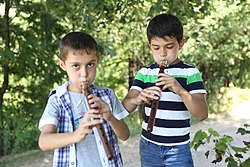 Boys play recorders
 Girl in a swimming pool
 Children in a group game
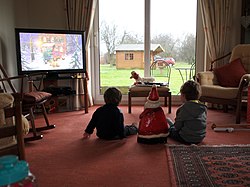 Boys watch children's TV
 Toddler using a tablet computer


Forms
Banquets
Banquets have been a venue for amusement, entertainment or pleasure since ancient times,[52] continuing into the modern era.[53] until the 21st century when they are still being used for many of their original purposes – to impress visitors, especially important ones; to show hospitality; as an occasion to showcase supporting entertainments such as music or dancing, or both. They were an integral part of court entertainments and helped entertainers develop their skills. They are also important components of celebrations such as coronations, weddings, birthdays civic or political achievements, military engagements or victories as well as religious obligations, one of the most famous being the Banqueting House, Whitehall in London.[54][55] In modern times, banquets are available privately, or commercially in restaurants, sometimes combined with a dramatic performance in dinner theatres.[56] Cooking by professional chefs has also become a form of entertainment as part of global competitions such as the Bocuse d'Or.[57]
- Banquets across centuries and cultures
 A banquet scene from Ancient Egypt (from a wall painting in Thebes)
 Byzantine banquet showing musicians and various musical instruments (1204–1453)
 Jean Fouquet, Banquet for Charles V of France (1455–1460)

 Victory banquet by Emperor Qianlong to greet the officers who attended the campaign against Taiwan (late 18th century)
 Landlords coming to the peasants' wedding banquet (late 18th century)
 The banquet hall in the palace of King Sahle Selassie painting from a photo, Ethiopia (1852)
 Coronation banquet of George IV in Westminster Hall (1821)
 Chinese banquet in a banquet hall given as a birthday celebration (2012)


Music

Music is a supporting component of many kinds of entertainment and most kinds of performance. For example, it is used to enhance storytelling,[58] it is indispensable in dance and opera,[59][60] and is usually incorporated into dramatic film or theatre productions.[61][62][63]
Music is also a universal and popular type of entertainment on its own, constituting an entire performance such as when concerts are given. Depending on the rhythm, instrument, performance and style, music is divided into many genres, such as classical, jazz, folk, rock, pop music or traditional.[64][65] Since the 20th century, performed music, once available only to those who could pay for the performers, has been available cheaply to individuals by the entertainment industry, which broadcasts it or pre-records it for sale.[66]
The wide variety of musical performances, whether or not they are artificially amplified, all provide entertainment irrespective of whether the performance is from soloists, choral or orchestral groups, or ensemble. Live performances use specialised venues, which might be small or large; indoors or outdoors; free or expensive.[67] The audiences have different expectations of the performers as well as of their own role in the performance. For example, some audiences expect to listen silently and are entertained by the excellence of the music, its rendition or its interpretation.[68] Other audiences of live performances are entertained by the ambience and the chance to participate. Even more listeners are entertained by pre-recorded music and listen privately.
The instruments used in musical entertainment are either solely the human voice or solely instrumental or some combination of the two.[69] Whether the performance is given by vocalists or instrumentalists, the performers may be soloists or part of a small or large group, in turn entertaining an audience that might be individual, passing by, small or large.[70] Singing is generally accompanied by instruments although some forms, notably a cappella and overtone singing, are unaccompanied. Modern concerts often use various special effects and other theatrics to accompany performances of singing and dancing.[67][71]
- Types of audience engagement with musical entertainment
 Traditional instruments used to accompany dance (Tibet, 1949)
 Children's choir providing musical entertainment (Soviet Union, 1979)
 Ensemble entertains travellers in the Paris Metro (2002)
 Drummer playing Boduberu (Maldives, 2010)
 Choir and orchestra in ecclesiastical setting (Italy, 2008)
 Contemporary audience in ancient outdoor stadium (Greece, 2009)
 A concert with a 3D enhanced stage (Singapore, 2010)
 Concert hall audience (Netherlands, 2010)
 Crowd surfing at a concert (France, 2011)
 Woman listening privately to music through headphones (Russia, 2010)


Games
Games are played for entertainment – sometimes purely for recreation, sometimes for achievement or reward as well. They can be played alone, in teams, or online; by amateurs or by professionals. The players may have an audience of non-players, such as when people are entertained by watching a chess championship. On the other hand, players in a game may constitute their own audience as they take their turn to play. Often, part of the entertainment for children playing a game is deciding who is part of their audience and who is a player.
Equipment varies with the game. Board games, such as Go, Monopoly or backgammon need a board and markers. One of the oldest known board games is Senet, a game played in Ancient Egypt, enjoyed by the pharaoh Tutankhamun.[72] Card games, such as whist, poker and Bridge have long been played as evening entertainment among friends. For these games, all that is needed is a deck of playing cards. Other games, such as bingo, played with numerous strangers, have been organised to involve the participation of non-players via gambling. Many are geared for children, and can be played outdoors, including hopscotch, hide and seek, or Blind man's bluff. The list of ball games is quite extensive. It includes, for example, croquet, lawn bowling and paintball as well as many sports using various forms of balls. The options cater to a wide range of skill and fitness levels. Physical games can develop agility and competence in motor skills. Number games such as Sudoku and puzzle games like the Rubik's Cube can develop mental prowess.
Video games are played using a controller to create results on a screen. They can also be played online with participants joining in remotely. In the second half of the 20th century and in the 21st century the number of such games increased enormously, providing a wide variety of entertainment to players around the world.[73][74] Video games are popular across the world.
- Games


 Televised match of StarCraft (2006) South Korea
An electronic game


Literature
French poet Louise Labé (1520/1522–1566) wrote "a profound and timeless insight into reading's innate power".
The past gives us pleasure and is of more service than the present; but the delight of what we once felt is dimly lost never to return and its memory is as distressing as the events themselves were then delectable ... But when we happen to put our thoughts in writing, how easily, later on, does our mind race through an infinity of events, incessantly alive, so that a long time afterwards when we take up those written pages we can return to the same place and to the same disposition in which we once found ourselves.
quote from and commentary by Fischer (2003)[75]
The young Saint Teresa of Ávila (1515–1582) read chivalrous novels and wrote about the "rapture" that books provided.
I became accustomed to reading [novels] and that small fault made me cool my desire and will to do other tasks. I thought nothing of spending many hours a day and night in this vain exercise, hidden from my father. My rapture in this was so great, that unless I had a new book to read, it seemed to me that I could not be happy.
quoted in Fischer (2003)[76]
Reading has been a source of entertainment for a very long time, especially when other forms, such as performance entertainments, were (or are) either unavailable or too costly. Even when the primary purpose of the writing is to inform or instruct, reading is well known for its capacity to distract from everyday worries. Both stories and information have been passed on through the tradition of orality and oral traditions survive in the form of performance poetry for example. However, they have drastically declined. "Once literacy had arrived in strength, there was no return to the oral prerogative."[77] The advent of printing, the reduction in costs of books and an increasing literacy all served to enhance the mass appeal of reading. Furthermore, as fonts were standardised and texts became clearer, "reading ceased being a painful process of decipherment and became an act of pure pleasure".[78] By the 16th century in Europe, the appeal of reading for entertainment was well established.
Among literature's many genres are some designed, in whole or in part, purely for entertainment. Limericks, for example, use verse in a strict, predictable rhyme and rhythm to create humour and to amuse an audience of listeners or readers. Interactive books such as "choose your own adventure" can make literary entertainment more participatory.

Comics and editorial cartoons are literary genres that use drawings or graphics, usually in combination with text, to convey an entertaining narrative.[79] Many contemporary comics have elements of fantasy and are produced by companies that are part of the entertainment industry. Others have unique authors who offer a more personal, philosophical view of the world and the problems people face. Comics about superheroes such as Superman are of the first type.[80] Examples of the second sort include the individual work over 50 years of Charles M. Schulz[81] who produced a popular comic called Peanuts[82] about the relationships among a cast of child characters;[83] and Michael Leunig who entertains by producing whimsical cartoons that also incorporate social criticism. The Japanese Manga style differs from the western approach in that it encompasses a wide range of genres and themes for a readership of all ages. Caricature uses a kind of graphic entertainment for purposes ranging from merely putting a smile on the viewer's face, to raising social awareness, to highlighting the moral characteristics of a person being caricatured.
Comedy

Comedy is both a genre of entertainment and a component of it, providing laughter and amusement, whether the comedy is the sole purpose or used as a form of contrast in an otherwise serious piece. It is a valued contributor to many forms of entertainment, including in literature, theatre, opera, film and games.[84][85] In royal courts, such as in the Byzantine court, and presumably, also in its wealthy households, "mimes were the focus of orchestrated humour, expected or obliged to make fun of all at court, not even excepting the emperor and members of the imperial family. This highly structured role of jester consisted of verbal humour, including teasing, jests, insult, ridicule, and obscenity and non-verbal humour such as slapstick and horseplay in the presence of an audience."[33] In medieval times, all comic types – the buffoon, jester, hunchback, dwarf, jokester, were all "considered to be essentially of one comic type: the fool", who while not necessarily funny, represented "the shortcomings of the individual".[86][87]
Shakespeare wrote seventeen comedies that incorporate many techniques still used by performers and writers of comedy – such as jokes, puns, parody, wit, observational humour, or the unexpected effect of irony.[88][89] One-liner jokes and satire are also used to comedic effect in literature. In farce, the comedy is a primary purpose.
The meaning of the word "comedy" and the audience's expectations of it have changed over time and vary according to culture.[90] Simple physical comedy such as slapstick is entertaining to a broad range of people of all ages. However, as cultures become more sophisticated, national nuances appear in the style and references so that what is amusing in one culture may be unintelligible in another.[91]
Performance
Live performances before an audience constitute a major form of entertainment, especially before the invention of audio and video recording. Performance takes a wide range of forms, including theatre, music and drama. In the 16th and 17th centuries, European royal courts presented masques that were complex theatrical entertainments involving dancing, singing and acting. Opera is a similarly demanding performance style that remains popular. It also encompass all three forms, demanding a high level of musical and dramatic skill, collaboration and like the masque, production expertise as well.

Audiences generally show their appreciation of an entertaining performance with applause. However, all performers run the risk of failing to hold their audience's attention and thus, failing to entertain. Audience dissatisfaction is often brutally honest and direct.
Sport


Sporting competitions have always provided entertainment for crowds. To distinguish the players from the audience, the latter are often known as spectators. Developments in stadium and auditorium design, as well as in recording and broadcast technology, have allowed off-site spectators to watch sport, with the result that the size of the audience has grown ever larger and spectator sport has become increasingly popular. Two of the most popular sports with global appeal are association football and cricket. Their ultimate international competitions, the FIFA World Cup and the Cricket World Cup, are broadcast around the world. Beyond the very large numbers involved in playing these sports, they are notable for being a major source of entertainment for many millions of non-players worldwide.[162] A comparable multi-stage, long-form sport with global appeal is the Tour de France, unusual in that it takes place outside of special stadia, being run instead in the countryside.[163]
Aside from sports that have worldwide appeal and competitions, such as the Olympic Games, the entertainment value of a sport depends on the culture and country where people play it. For example, in the United States, baseball and basketball games are popular forms of entertainment; in Bhutan, the national sport is archery; in New Zealand, it is rugby union; in Iran, it is freestyle wrestling. Japan's unique sumo wrestling contains ritual elements that derive from its long history.[164] In some cases, such as the international running group Hash House Harriers, participants create a blend of sport and entertainment for themselves, largely independent of spectator involvement, where the social component is more important than the competitive.
The evolution of an activity into a sport and then an entertainment is also affected by the local climate and conditions. For example, the modern sport of surfing is associated with Hawaii and that of snow skiing probably evolved in Scandinavia. While these sports and the entertainment they offer to spectators have spread around the world, people in the two originating countries remain well known for their prowess. Sometimes the climate offers a chance to adapt another sport such as in the case of ice hockey – an important entertainment in Canada.
Fairs, expositions, shopping
Fairs and exhibitions have existed since ancient and medieval times, displaying wealth, innovations and objects for trade and offering specific entertainments as well as being places of entertainment in themselves.[165] Whether in a medieval market or a small shop, "shopping always offered forms of exhilaration that took one away from the everyday".[166] However, in the modern world, "merchandising has become entertainment: spinning signs, flashing signs, thumping music ... video screens, interactive computer kiosks, day care .. cafés".[166]
By the 19th century, "expos" that encouraged arts, manufactures and commerce had become international. They were not only hugely popular but affected international ideas. For example, the 1878 Paris Exposition facilitated international cooperation about ideas, innovations and standards. From London 1851 to Paris 1900, "in excess of 200 million visitors had entered the turnstiles in London, Paris, Vienna, Philadelphia, Chicago and a myriad of smaller shows around the world."[165][167] Since World War II "well over 500 million visits have been recorded through world expo turnstiles".[168] As a form of spectacle and entertainment, expositions influenced "everything from architecture, to patterns of globalisation, to fundamental matters of human identity"[168] and in the process established the close relationship between "fairs, the rise of department stores and art museums",[169] the modern world of mass consumption and the entertainment industry.
- Entertainment in expositions and shops
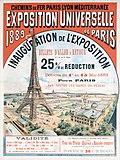 Advertisement for 1889 Paris Universal Exposition
 Audience queuing for Qatar's World Exposition Pavilion at the 2010 Shanghai World Expo
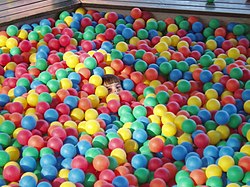 Ball pit of the type provided for children's entertainment in shopping malls


Safety
Some entertainments, such as at large festivals (whether religious or secular), concerts, clubs, parties and celebrations, involve big crowds. From earliest times, crowds at an entertainment have associated hazards and dangers, especially when combined with the recreational consumption of intoxicants such as alcohol. The Ancient Greeks had Dionysian Mysteries, for example, and the Romans had Saturnalia. The consequence of excess and crowds can produce breaches of social norms of behaviour, sometimes causing injury or even death, such as for example, at the Altamont Free Concert, an outdoor rock festival. The list of serious incidents at nightclubs includes those caused by crowd crush; terrorism, such as the 2002 Bali bombings that targeted a nightclub; and especially fire. Investigations, such as that carried out in the US after The Station nightclub fire often demonstrate that lessons learned "regarding fire safety in nightclubs" from earlier events such as the Cocoanut Grove fire do "not necessarily result in lasting effective change".[170] Efforts to prevent such incidents include appointing special officers, such as the medieval Lord of Misrule or, in modern times, security officers who control access; and also ongoing improvement of relevant standards such as those for building safety. The tourism industry now regards safety and security at entertainment venues as an important management task.[171]
Industry
Entertainment is big business, especially in the United States,[172] but ubiquitous in all cultures. Although kings, rulers and powerful people have always been able to pay for entertainment to be provided for them and in many cases have paid for public entertainment, people generally have made their own entertainment or when possible, attended a live performance. Technological developments in the 20th century, especially in the area of mass media, meant that entertainment could be produced independently of the audience, packaged and sold on a commercial basis by an entertainment industry.[172][173] Sometimes referred to as show business, the industry relies on business models to produce, market, broadcast or otherwise distribute many of its traditional forms, including performances of all types.[174] The industry became so sophisticated that its economics became a separate area of academic study.[175]
The film industry is a part of the entertainment industry. Components of it include the Hollywood[176] and Bollywood[177] film industries, as well as the cinema of the United Kingdom and all the cinemas of Europe, including France, Germany, Spain, Italy and others.[178] The sex industry is another component of the entertainment industry, applying the same forms and media (for example, film, books, dance and other performances) to the development, marketing and sale of sex products on a commercial basis.
Amusement parks entertain paying guests with rides, such as roller coasters, ridable miniature railways, water rides, and dark rides, as well as other events and associated attractions. The parks are built on a large area subdivided into themed areas named "lands". Sometimes the whole amusement park is based on one theme, such as the various SeaWorld parks that focus on the theme of sea life.
One of the consequences of the development of the entertainment industry has been the creation of new types of employment. While jobs such as writer, musician and composer exist as they always have, people doing this work are likely to be employed by a company rather than a patron as they once would have been. New jobs have appeared, such as gaffer or special effects supervisor in the film industry, and attendants in an amusement park.
Prestigious awards are given by the industry for excellence in the various types of entertainment. For example, there are awards for music, games (including video games), comics, theatre, television, film, dance and magical arts. Sporting awards are made for the results and skill, rather than for the entertainment value.
- The entertainment industry
 Packaged entertainment
35mm film reels in boxes Choosing music from a record store (West Germany, 1988)
 Ticket showing electronic barcode (Valencia, 2005)


Architecture
Architecture for entertainment
Purpose-built structures as venues for entertainment that accommodate audiences have produced many famous and innovative buildings, among the most recognisable of which are theatre structures.[179] For the ancient Greeks, "the architectural importance of the theatre is a reflection of their importance to the community, made apparent in their monumentality, in the effort put into their design, and in the care put into their detail."[180] The Romans subsequently developed the stadium in an oval form known as a circus. In modern times, some of the grandest buildings for entertainment have brought fame to their cities as well as their designers. The Sydney Opera House, for example, is a World Heritage Site and The O2 in London is an entertainment precinct that contains an indoor arena, a music club, a cinema and exhibition space. The Bayreuth Festspielhaus in Germany is a theatre designed and built for performances of one specific musical composition.
Two of the chief architectural concerns for the design of venues for mass audiences are speed of egress and safety. The speed at which the venue empty is important both for amenity and safety, because large crowds take a long time to disperse from a badly designed venue, which creates a safety risk. The Hillsborough disaster is an example of how poor aspects of building design can contribute to audience deaths. Sightlines and acoustics are also important design considerations in most theatrical venues.
In the 21st century, entertainment venues, especially stadia, are "likely to figure among the leading architectural genres".[181] However, they require "a whole new approach" to design, because they need to be "sophisticated entertainment centres, multi-experience venues, capable of being enjoyed in many diverse ways".[182] Hence, architects now have to design "with two distinct functions in mind, as sports and entertainment centres playing host to live audiences, and as sports and entertainment studios serving the viewing and listening requirements of the remote audience".[182]
- Architecture for entertainment
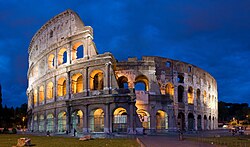 Colosseum, Rome (70–80 AD), Roman venue for mass entertainment
 The Grand Foyer in the Palais Garnier, Paris (1875), influenced architecture around the world.
 Maracanã, Rio de Janeiro, at inauguration (1950) the world's largest stadium by capacity
 Flamingo Entertainment Centre, Vantaa (2008), includes a variety of entertainment activities (e.g. a cinema, spa, bowling, laser games, virtual experiences), 40 different stores and a hotel.[183]


Architecture as entertainment

Architects who push the boundaries of design or construction sometimes create buildings that are entertaining because they exceed the expectations of the public and the client and are aesthetically outstanding. Buildings such as Guggenheim Museum Bilbao, designed by Frank Gehry, are of this type, becoming a tourist attraction as well as a significant international museum. Other apparently usable buildings are really follies, deliberately constructed for a decorative purpose and never intended to be practical.
On the other hand, sometimes architecture is entertainment, while pretending to be functional. The tourism industry, for example, creates or renovates buildings as "attractions" that have either never been used or can never be used for their ostensible purpose. They are instead re-purposed to entertain visitors often by simulating cultural experiences. Buildings, history and sacred spaces are thus made into commodities for purchase. Such intentional tourist attractions divorce buildings from the past so that "the difference between historical authenticity and contemporary entertainment venues/theme parks becomes hard to define".[184] Examples include "the preservation of the Alcázar of Toledo, with its grim Civil War History, the conversion of slave dungeons into tourist attractions in Ghana, [such as, for example, Cape Coast Castle] and the presentation of indigenous culture in Libya".[185] The specially constructed buildings in amusement parks represent the park's theme and are usually neither authentic nor completely functional.
Effects of developments in electronic media
Globalisation
By the second half of the 20th century, developments in electronic media made possible the delivery of entertainment products to mass audiences across the globe. The technology enabled people to see, hear and participate in all the familiar forms – stories, theatre, music, dance – wherever they live. The rapid development of entertainment technology was assisted by improvements in data storage devices such as cassette tapes or compact discs, along with increasing miniaturisation. Computerisation and the development of barcodes also made ticketing easier, faster and global.
Obsolescence


In the 1940s, radio was the electronic medium for family entertainment and information.[186][187][188] In the 1950s, it was television that was the new medium and it rapidly became global, bringing visual entertainment, first in black and white, then in colour, to the world.[189] By the 1970s, games could be played electronically, then hand-held devices provided mobile entertainment, and by the last decade of the 20th century, via networked play. In combination with products from the entertainment industry, all the traditional forms of entertainment became available personally. People could not only select an entertainment product such as a piece of music, film or game, they could choose the time and place to use it. The "proliferation of portable media players and the emphasis on the computer as a site for film consumption" together have significantly changed how audiences encounter films.[190] One of the most notable consequences of the rise of electronic entertainment has been the rapid obsolescence of the various recording and storage methods. As an example of speed of change driven by electronic media, over the course of one generation, television as a medium for receiving standardised entertainment products went from unknown, to novel, to ubiquitous and finally to superseded.[191] One estimate was that by 2011 over 30 per cent of households in the US would own a Wii console, "about the same percentage that owned a television in 1953".[192] Some expected that halfway through the second decade of the 21st century, online entertainment would have completely replaced television – which did not happen. The so-called "digital revolution" has produced an increasingly transnational marketplace that has caused difficulties for governments, business, industries, and individuals, as they all try to keep up.[193][194][195][196] Even the sports stadium of the future will increasingly compete with television viewing "...in terms of comfort, safety and the constant flow of audio-visual information and entertainment available."[197] Other flow on effects of the shift are likely to include those on public architecture such as hospitals and nursing homes, where television, regarded as an essential entertainment service for patients and residents, will need to be replaced by access to the internet. At the same time, the ongoing need for entertainers as "professional engagers" shows the continuity of traditional entertainment.[198]
Convergence
By the second decade of the 21st century, analogue recording was being replaced by digital recording and all forms of electronic entertainment began to converge.[199] For example, convergence is challenging standard practices in the film industry: whereas "success or failure used to be determined by the first weekend of its run. Today, ... a series of exhibition 'windows', such as DVD, pay-per-view, and fibre-optic video-on-demand are used to maximise profits."[200] Part of the industry's adjustment is its release of new commercial product directly via video hosting services. Media convergence is said to be more than technological: the convergence is cultural as well.[201] It is also "the result of a deliberate effort to protect the interests of business entities, policy institutions and other groups".[190] Globalisation and cultural imperialism are two of the cultural consequences of convergence.[202] Others include fandom and interactive storytelling as well as the way that single franchises are distributed through and affect a range of delivery methods.[203] The "greater diversity in the ways that signals may be received and packaged for the viewer, via terrestrial, satellite or cable television, and of course, via the Internet" also affects entertainment venues, such as sports stadia, which now need to be designed so that both live and remote audiences can interact in increasingly sophisticated ways – for example, audiences can "watch highlights, call up statistics", "order tickets and merchandise" and generally "tap into the stadium's resources at any time of the day or night".[182]
The introduction of television altered the availability, cost, variety and quality of entertainment products for the public and the convergence of online entertainment is having a similar effect. For example, the possibility and popularity of user-generated content, as distinct from commercial product, creates a "networked audience model [that] makes programming obsolete".[204] Individuals and corporations use video hosting services to broadcast content that is equally accepted by the public as legitimate entertainment.
While technology increases demand for entertainment products and offers increased speed of delivery, the forms that make up the content are in themselves, relatively stable. Storytelling, music, theatre, dance and games are recognisably the same as in earlier centuries.
See also
References
- ↑ The Oxford English Dictionary (Oxford University Press, 1971, Vol 1 pp. 213–214)
- ↑ For example, the application of psychological models and theories to entertainment is discussed in Part III of Bryant, Jennings; Vorderer, Peter (2006). Psychology of Entertainment. Mahwah, NJ: Lawrence Erlbaum Associates, Inc. pp. 367–434. ISBN 978-0-8058-5238-7.
- ↑ Sayre, Shay; King, Cynthia (2010). Entertainment and Society: Influences, Impacts, and Innovations (Google eBook) (2nd ed.). Oxon; New York: Routledge. ISBN 978-0-415-99806-2. p. 22.
- ↑ Frost, Warwick, ed. (2011). Conservation, Education, Entertainment?. Channel View Publication. ISBN 978-1-84541-164-0.
- ↑ Macleod, Suzanne; Watson, Sheila (2007). Knell, Simon J. (ed.). Museum Revolutions. Oxon; New York: Routledge. ISBN 978-0-203-93264-3.
- ↑ Zillmann, Dolf; Vorderer, Peter (2000). Media Entertainment – the psychology of its appeal. Mahwah, NJ: Lawrence Erlbaum Associates, Inc. Taylor & Francis e-library. p. vii. ISBN 978-0-8058-3324-9.
- ↑ For example, marketers mix commercial messages with non-commercial messages in entertainments on radio, television, films, videos and games. Shrum, L.J.J. (2012). The Psychology of Entertainment Media (2nd ed.). Routledge. ISBN 978-1-84872-944-5.
- ↑ Singhal, Arvind; Cody, Michael J.; Rogers, Everett; Sabido, Miguel, eds. (2008). Entertainment-Education and Social Change: History, Research, and Practice. Taylor & Francis. ISBN 978-1-4106-0959-5.
- ↑ de Freitas, Sara; Maharg, Paul, eds. (2011). Digital Games and Learning. London; New York: Continuum International Publishing Group. ISBN 978-1-4411-9870-9.
- ↑ "Schadenfreude: Why Do We Like To See Others Suffer?". Science ABC. 18 February 2020. Archived from the original on 20 October 2021. Retrieved 2 May 2022.
- ↑ Irwin, William, ed. (2002). The Matrix and Philosophy. Peru, IL: Carus Publishing Company. p. 196. ISBN 978-0-8126-9502-1.
- ↑ "IMDb The Matrix worldwide release dates". IMDb. Archived from the original on 9 May 2019. Retrieved 30 June 2018.
- ↑ Jones, Peter (1975). Philosophy and the Novel. Oxford, Clarendon: Oxford University Press, Incorporated.
- ↑ Simpson, M.J. (2005). The Pocket Essential Hitchhiker's Guide (2nd ed.). Pocket Essentials. p. 120. ISBN 978-1-904048-46-6.
- ↑ Joll, Nicholas, ed. (2012). Philosophy and The Hitchhiker's Guide to the Galaxy. Houndmills, Basingstoke, Hampshire; New York: Palgrave Macmillan. ISBN 978-0-230-29112-6.
- ↑ Gakhar, Sonia (2007). The influence of storytelling on pre-service students' attitudes and intentions (MSc Thesis). Iowa State University.
- 1 2 3 Kuhns, Richard Francis (2005). Decameron and the Philosophy of Storytelling: Author as Midwife and Pimp. New York; Chichester West Sussex: Columbia University Press. p. 7. ISBN 978-0-231-13608-2.
- 1 2 Carlsen, Spike (2009). A Splintered History of Wood. New York: Harper Perennial. p. 170. ISBN 978-0-06-137356-5.
- ↑ Dunkle, Roger (2008). Gladiators: violence and spectacle in ancient Rome. Harlow, England; New York: Pearson/Longman. ISBN 978-1-4058-0739-5.
- ↑ Wiseman, Douglas C. (1977). Medieval Sport: Quest for Survival. Distributed by ERIC Clearinghouse Microfiche.
- ↑ Potter, David Stone; Mattingly, David J. (1999). Life, Death, and Entertainment in the Roman Empire. University of Michigan Press. p. 308. ISBN 978-0-472-10924-1.
- ↑ Roshwald, Aviel; Stites, Richard (2002). European Culture in the Great War: The Arts, Entertainment and Propaganda, 1914–1918. Cambridge University Press. ISBN 978-0-521-57015-2.
- ↑ Heinrich, Anselm (2007). Meech, Tony (ed.). Heinrich, Entertainment, propaganda, education: regional theatre in Germany and Britain between 1918 and 1945. Hatfield, England: University of Hertfordshire Press. ISBN 978-1-902806-74-7.
- ↑ Arthur, Max (2001). When this bloody war is over: soldiers' songs from the First World War. London: Piatkus. ISBN 978-0-7499-2252-8.
- ↑ Laing, Dave; Oliver, Paul; Wicke, Peter (2003). Horn, David (ed.). Continuum Encyclopedia of Popular Music of the World Part 1 Media, Industry, Society. Continuum. ISBN 978-0-8264-6321-0.
- ↑ McReynolds, Louise (2003). Russia at Play: Leisure Activities at the End of the Tsarist Era. Cornell University. ISBN 978-0-8014-4027-4.
- ↑ McDonald Walton (2007), p. 51.
- ↑ Walthall, Anne, ed. (2008). Servants of the Dynasty: Palace Women in World History. London: University of California Press. ISBN 978-0-520-25443-5. pp. 4–5.
- ↑ Allen, Charles; Dwivedi, Sharada (1984). Lives of the Indian Princes. London: Century Publishing. p. 210. ISBN 978-0-7126-0910-4.
- ↑ Van Zile, Judy (2001). Perspectives on Korean Dance. Middletown, CN: Wesleyan University Press. ISBN 978-0-8195-6494-8. p. 36.
- ↑ Van Zile (2001), p. 9.
- ↑ Van Zile (2001), p. 69.
- 1 2 Garland, Lynda, ed. (2006). Byzantine Women: Varieties of Experience 800–1200. Aldershot, Hampshire: Ashgate Publishing Limited. pp. 177–178. ISBN 978-0-7546-5737-8.
- 1 2 Walthall (2008).
- 1 2 Van Zile (2001), p. 6.
- ↑ McGregor, Neil. "Episode 94: Sudanese Slit Drum (Transcript)". History of the World in 100 Objects. BBC Radio 4/British Museum. Archived from the original on 15 June 2013. Retrieved 6 February 2013.
- ↑ McGregor, Neil (2010). A History of the World in 100 objects. London: Allen Lane. pp. 613–. ISBN 978-1-84614-413-4.
- ↑ "British Museum catalogue image of Sudanese slit drum". Archived from the original on 27 December 2019. Retrieved 20 December 2019.
- ↑ Holbrook, Peter (1998). Bevington, David (ed.). The Politics of the Stuart Court Masque. Cambridge University Press. pp. 42–43. ISBN 978-0-521-59436-3.
- 1 2 3 Gay, Peter (2002). Schnitzler's Century – The making of middle-class culture 1815–1914. New York; London: W.W. Norton & Co. p. 121. ISBN 978-0-393-32363-4.
- ↑ Nay, Isaac Phan (28 May 2024). "Children's entertainer Fred Penner still resonates with families". CBC. Retrieved 28 August 2024.
- ↑ "Ron 'Buck Shot' Barge, longtime Calgary children's TV star, dies at 87". CBC. 18 August 2024. Retrieved 28 August 2024.
- ↑ Seal, Rebecca (26 March 2022). "Kids' entertainers on the tricks of their trade: 'My years in the police were very useful'". the Guardian. Retrieved 28 August 2024.
- ↑ Ghazali, Rahmah (14 August 2024). "BBC star and renowned puppeteer dies at 73 after battle with pneumonia". NationalWorld. Retrieved 28 August 2024.
- ↑ O'Brien, John (2004). Harlequin Britain: Pantomime and Entertainment, 1690–1760. Baltimore: The Johns Hopkins University Press. ISBN 978-0-8018-7910-4.
- ↑ Geipel, John (1972). The cartoon: a short history of graphic comedy and satire. Newton Abbot: David & Charles. ISBN 978-0-7153-5328-8.
- ↑ Thompson, Dennis; Hogan, John D.; Clark, Philip M. (2012). Developmental Psychology in Historical Perspective. Malden, MA; Oxford: Wiley-Blackwell. p. 18. ISBN 978-1-4051-6747-5.
- ↑ Thompson, Hogan & Clark (2012), p. 114.
- ↑ Cobb, Edith (1977). The ecology of imagination in childhood. New York: Columbia University Press. ISBN 978-0-231-03870-6.
- ↑ Louv, Richard (2005). Last Child in the Woods: saving our children from nature-deficit disorder. Chapel Hill, NC: Algonquin Books of Chapel Hill. ISBN 978-1-56512-391-5.
- ↑ Monbiot, George (19 November 2012). "If children lose contact with nature they won't fight for it". The Guardian. Archived from the original on 25 September 2013. Retrieved 29 November 2012.
- ↑ Martin, Sandra Romano (2013). "Banqueting Gods in Valerius Flaccus Arg. 5.690–5". Mnemosyne. 66 (4–5): 666–681. doi:10.1163/156852512X617641. ISSN 0026-7074.
- ↑ Carson, Cary (2013). "Banqueting Houses and the "Need of Society" among Slave-Owning Planters in the Chesapeake Colonies". The William and Mary Quarterly. 70 (4). Williamsburg: The William and Mary quarterly, 2013, Vol. 70 (4) The Omohundro Institute of Early American History and Culture: 725–780. doi:10.5309/willmaryquar.70.4.0725. ISSN 0043-5597.
- ↑ Charlton, John (1964). The Banqueting House, Whitehall. London: Her Majesty's Stationery Office. ISBN 978-0-11-671099-4.
{{cite book}}: ISBN / Date incompatibility (help) - ↑ Palme, Per (1957). Triumph of peace : a study of the Whitehall Banqueting House. London: Thames and Hudson.
- ↑ Solomon, Charmaine (1993). Oriental banquets. Port Melbourne: Hamlyn. ISBN 978-0-947334-46-8.
- ↑ Graham, Joan M. (1991). Cooking for competition: what the judges are looking for. Richmond, Victoria: Ercildourne. ISBN 978-0-646-05369-1.
- ↑ Bullock, Jon E. (2022). Broadcasting the Nation: The Importance of Radio in Kurdish Music History. VWB – Verlag für Wissenschaft und Bildung. ISSN 0043-8774.
- ↑ Newman, Ernest. The stories of the great operas, with music : the stories and descriptive analysis of the music. London: Geo Newnes.
- ↑ Lowe, Geoff; Chong, Su-Lyn (2008). Opera and music theatre resource book. North Ryde, N.S.W.: McGraw-Hill. ISBN 978-0-07-013796-7.
- ↑ Griffiths, Paul (2006). A concise history of western music. New York: Cambridge University Press. ISBN 978-0-521-84294-5.
- ↑ Prendergast, Roy M. (1992). Film music : a neglected art : a critical study of music in films (2nd ed.). New York: W.W. Norton. ISBN 978-0-393-02988-8.
- ↑ DesJardins, Christian (2006). Inside film music: composers speak. Los Angeles: Silman-James Press. ISBN 978-1-879505-88-9.
- ↑ Buck, P.C., ed. (1929–1938). The Oxford history of music (2nd ed.). London: Oxford University Press, 1929–38.
- ↑ Gray, Cecil (1931). The history of music (2nd revised ed.). London, New York: London: Kegan Paul, Trench, Trubner; New York : Knopf.
- ↑ Chase, Gilbert (1946). Music in radio broadcasting : [a symposium]. New York: McGraw-Hill.
- 1 2 Kronenburg, Robert (2012). Live architecture: popular music venues, stages, and arenas. Abingdon, Oxford; New York: Abingdon, Oxon [England]; New York, NY : Routledge. ISBN 978-0-415-56192-1.
- ↑ Dingle, Christopher (2019). Dingle, Christopher (ed.). The Cambridge History of Music Criticism. Cambridge, UK: Cambridge University Press. doi:10.1017/9781139795425. ISBN 978-1-139-79542-5. S2CID 241762186.
- ↑ Miller, Hugh Milton (1960). History of music (3rd ed.). New York: Barnes & Noble.
- ↑ New Oxford history of music 1954–1990. London; New York: Oxford University Press, 1954–1990. 1954–1990.
- ↑ Burrows, Tim (2009). From CBGB to the Roundhouse : music venues through the years. London; New York: Marion Boyars Publishers. ISBN 978-0-7145-3162-5.
- ↑ Botermans, Jack (2008). The Book of Games: Strategy, Tactics & History. Sterling Pub Co Inc. ISBN 978-1-4027-4221-7.
- ↑ Bryce, Jo (2006). Rutter, Jason (ed.). Understanding Digital Games. London; California; New Delhi: Sage Publications. ISBN 978-1-4129-0033-1.
- ↑ Newman, James (2004). Videogames. London; New York: Routledge. ISBN 978-0-203-64290-0.
- ↑ Fischer, Steven Roger (2003). A history of reading. London: Reaktion Books. p. 236. ISBN 978-1-86189-160-0.
- ↑ Fischer (2003), pp. 234–235.
- ↑ Fischer (2003), p. 215.
- ↑ Fischer (2003), p. 212.
- ↑ Chapman, James (2011). British comics: a cultural history. London: Reaktion Books. ISBN 978-1-86189-855-5.
- ↑ Benton, Mike (1992). Superhero comics of the Golden Age: the illustrated history. Dallas, TX: Taylor Publishing. ISBN 978-0-87833-808-5.
- ↑ ""Charles M. Schulz on Cartooning", Hogan's Alley #1, 1994". Archived from the original on 3 June 2015. Retrieved 14 March 2013.
- ↑ Films have been made of the Peanuts cartoons, including one released in 2015 to celebrate the 65th anniversary of the comic strip.
- ↑ The philosophical and theological implications of Schulz's work were explored in: Short, Robert L. (1965). The Gospel According to Peanuts. Westminster: John Knox Press. ISBN 978-0-664-22222-2.
- ↑ Roston, Murray (2011). The comic mode in English literature: from the Middle Ages to today. London: Continuum. ISBN 978-1-4411-9588-3.
- ↑ Grindon, Leger (2011). The Hollywood romantic comedy: conventions, history, controversies. Malden, M: Wiley-Blackwell. ISBN 978-1-4051-8266-9.
- ↑ Hokenson, Jan Walsh (2006). The Idea of Comedy: History, Theory, Critique. Cranbury, NJ: Rosemont Publishing and Printing Corp. pp. 150–151. ISBN 978-0-8386-4096-8.
- ↑ Hornback, Robert (2009). The English clown tradition from the middle ages to Shakespeare. Woodbridge Suffolk, Rochester, New York: D.S. Brewer. ISBN 978-1-84384-200-2.
- ↑ Gay, Penny (2008). The Cambridge introduction to Shakespeare's comedies. Cambridge; New York: Cambridge University Press. ISBN 978-0-521-85668-3.
- ↑ Ellis, David (2007). Shakespeare's practical jokes: an introduction to the comic in his work. Lewisburg, PA: Bucknell University Press. ISBN 978-0-8387-5680-5.
- ↑ Thorpe, Ashley (2007). The role of the chou ("clown") in traditional Chinese drama: comedy, criticism, and cosmology on the Chinese stage. Lewiston, New York: Edwin Mellen Press. ISBN 978-0-7734-5303-6.
- ↑ Charney, Maurice, ed. (2005). Comedy: A Geographic and Historical Guide. Greenwood Publishing Group. ISBN 0-313-32706-8.
- ↑ McGonagall, William (1992). "Reminiscences" in Collected Poems. Edinburgh: Birlinn. p. 13. ISBN 978-1-874744-01-6.
- ↑ Watanabe, Masako (2011). Storytelling in Japanese Art. New York: Metropolitan Museum of Art. ISBN 978-0-300-17590-5.
- ↑ Yamanaka, Yuriko; Nishio, Tetsuo (2006). The Arabian nights and orientalism: perspectives from East & West. London; New York: I.B. Tauris.
- ↑ Sir Richard Francis Burton (1958). Arabian nights. A plain and literal translation of the Arabian nights' entertainments: now entitled The book of the thousand and one nights. London: Barker.
- ↑ Caracciolo, Peter L., ed. (1988). The Arabian nights in English literature : studies in the reception of The thousand and one nights into British culture. Houndmills, Basingstoke, Hampshire: Macmillan. ISBN 978-0-333-36693-6.
- ↑ Rankin, Walter (2007). Grimm pictures: fairy tale archetypes in eight horror and suspense films. Jefferson, NC: McFarland & Co. ISBN 978-0-7864-3174-8.
- ↑ The epic of Gilgamesh: the Babylonian epic poem and other texts in Akkadian and Sumerian (English – translated from Akkadian and Sumerian by Andrew George). London: Allen Lane. 1999. ISBN 978-0-7139-9196-3.
- ↑ Thompson, Vivian Laubach; Kahalewai, Marilyn (1966). Hawaiian Myths of Earth, Sea, and Sky. University of Hawaii Press. ISBN 978-0-8248-1171-6.
- ↑ McDonald, Marianne; Walton, J. Michael, eds. (2007). The Cambridge companion to Greek and Roman theatre. Cambridge; New York: Cambridge University Press. p. 26. ISBN 978-0-521-83456-8.
- ↑ McDonald & Walton (2007), p. 93.
- ↑ McDonald & Walton (2007), p. 26.
- ↑ Milling, Jane; Donohue, Joseph W.; Thomson, Peter, eds. (2005). The Cambridge History of British Theatre. Cambridge University Press (3 volumes). ISBN 978-0-521-82790-4.
- ↑ Kenrick, John (2008). Musical theatre: a history. London: Continuum. ISBN 978-0-8264-2860-8.
- ↑ Ackroyd, Peter (2000). London: The Biography. New York: Anchor Books. ISBN 978-0-385-49771-8. p. 620.
- ↑ Frame, Murray (2000). The St. Petersburg Imperial Theaters: Stage and State in Revolutionary Russia, 1900–1920. McFarland & Co, Inc. Publishers. ISBN 978-0-7864-4330-7. pp. 65–66.
- 1 2 3 Frame (2000).
- ↑ Bailey, Peter (1998). Popular Culture and Performance in the Victorian City. Cambridge University Press. ISBN 978-0-521-57417-4.
- ↑ Mordden, Ethan (2007). All that glittered: the golden age of drama on Broadway. New York: St. Martin's Press. ISBN 978-0-312-33898-5.
- ↑ Stempel, Larry (2010). Showtime: a history of the Broadway musical theater. New York: W.W. Norton & Co. ISBN 978-0-393-06715-6.
- ↑ Robinson, Peter M. (2010). The dance of the comedians: the people, the president, and the performance of political standup comedy in America. Amherst: University of Massachusetts Press. ISBN 978-1-55849-733-7.
- ↑ Wyver, John (1989). The Moving Image: An International History of Film, Television, and Video. John Wiley & Sons, Limited. ISBN 978-0-631-16821-8.
- 1 2 3 Paris, Michael, ed. (1999). The First World War and popular Cinema. Edinburgh: Edinburgh University Press. ISBN 978-0-8135-2824-3. p. 9.
- ↑ Paris (1999), p. 115.
- ↑ Cavalier, Stephen (2011). The world history of animation. Berkeley: University of California Press. ISBN 978-0-520-26112-9.
- ↑ Byrnes, Paul (28 March 2014). "Pompeii, Noah and Exodus: The sword giveth again". The Sydney Morning Herald. Archived from the original on 30 March 2014. Retrieved 30 March 2014.
- ↑ Byrnes, Paul (12 December 2015). "Losing the plot". The Sydney Morning Herald. pp. 12–13.
- 1 2 Maddox, Garry (28 March 2014). "The Lego Movie: Hit off the old block". The Sydney Morning Herald. Archived from the original on 30 March 2014. Retrieved 30 March 2014.
- ↑ Rothwell, Kenneth S. (1999). A History of Shakespeare on Screen: A Century of Film and Television. Cambridge; New York: Cambridge University Press. ISBN 978-0-521-59404-2.
- ↑ Paris (1999), p. 17.
- ↑ Byrnes, Paul (27 March 2014). "Noah review: Moments of brilliance but can't shake sinking feeling". The Sydney Morning Herald. Archived from the original on 30 March 2014. Retrieved 30 March 2014.
- ↑ Albright, Ann Cooper (2001). Dils, Ann (ed.). Moving History/Dancing Cultures: A Dance History Reader. Durham, NC: Wesleyan University Press. ISBN 978-0-8195-6412-2. p. xviii.
- 1 2 Dils & Albright (2001), p. 96.
- ↑ Dils & Albright (2001), p. 34.
- ↑ Clarke, Mary (1981). The history of dance. New York: Crown Publishers. ISBN 978-0-517-54282-8. p. 98.
- ↑ Clarke (1981), p. 97.
- ↑ Wilson, Thomas (1808). An Analysis of Country Dancing. W. Calvert.
- ↑ Fullerton, Susannah; Le Faye, Deirdre (2012). A Dance with Jane Austen: How a Novelist and Her Characters Went to the Ball. Pgw. ISBN 978-0-7112-3245-7.
- ↑ Wilson, Thomas (1816). The Treasures of Terpsichore: or, A Companion for the Ball-Room. London: Sherwood, Neely and Jones.
- 1 2 Wulff, Helena (2007). Dancing at the Crossroads: Memory and Mobility in Ireland. Berghahn Books. p. 137. ISBN 978-1-84545-328-2.
- ↑ Dils & Albright (2001), p. 142.
- ↑ van Nieuwkerk, Karin. "Changing Images and Shifting Identities: Female Performers in Egypt" in Dils & Albright (2001). p. 141.
- ↑ Karina, Lilian; Kant, Marion (1999). Hitler's Dancers: German Modern Dance and the Third Reich. Translated by Jonathan Steinberg (English ed.). Berghahn Books. p. 174. ISBN 978-1-57181-300-8.
- ↑ Field, Andrew David (2010). Shanghai's Dancing World: Cabaret Culture and Urban Politics, 1919–1954. Sha Tin, Hong Kong: The Chinese University of Hong Kong. p. 169. ISBN 978-962-996-373-6.
- ↑ Butters, Gerald R. (2007). Banned in Kansas: Motion Picture Censorship, 1915–1966. Columbia: University of Missouri Press. p. 230. ISBN 978-0-8262-1749-3.
- ↑ Pruter, Robert (1991). Chicago Soul. University of Illinois. p. 191. ISBN 978-0-252-06259-9.
- ↑ Hill, Constance Valis (2010). Tap Dancing America: A Cultural History. New York: Oxford University Press. p. 12. ISBN 978-0-19-539082-7.
- ↑ St Leon, Mark (2011). Circus: the Australian story. Melbourne: Melbourne Books. p. 3. ISBN 978-1-877096-50-1.
- ↑ Hancocks, David (2001). A different nature: the paradoxical world of zoos and their uncertain future. Berkeley: University of California Press. ISBN 978-0-520-23676-9.
- ↑ An extensive discussion of the legal and cultural issues can be found in Bronner, Simon J. (2008). Killing Tradition: Inside Hunting and Animal Rights Controversies. The University Press of Kentucky. ISBN 978-0-8131-2528-2.
- ↑ Examples include: The League against Cruel Sports, UK Archived 8 February 2011 at the Wayback Machine; People for the Ethical Treatment of Animals (PETA), multinational Archived 9 June 2015 at the Wayback Machine; and Showing Animals Respect and Kindness (SHARK), US Archived 2 January 2014 at the Wayback Machine.
- ↑ Bronner 2008.
- 1 2 Stoddart, Helen (2000). Rings of Desire: Circus History and Representation. Manchester, UK & New York: Manchester University Press. p. 13. ISBN 978-0-7190-5233-0.
- ↑ Diamond, Michael (2003). Victorian sensation, or, The spectacular, the shocking, and the scandalous in nineteenth-century Britain. London: Anthem Press. ISBN 978-1-84331-076-1.
- ↑ St Leon (2011).
- ↑ Lévi, Éliphas (2001). The History of Magic (originally published in 1860 as Histoire de la Magie English edition, translated by A.E. Waite in 1913). Boston, MA: Red Wheel/Weiser. ISBN 978-0-87728-929-6.
- ↑ Gresham, William Lindsay (1959). Houdini: the man who walked through walls. Holt.
- ↑ Epstein, Beryl; Epstein, Sam (1971). The Great Houdini: magician extraordinary. Folkestone: Bailey Brothers and Swinfen (Reprint. Originally published: New York : Dutton, c. 1920). ISBN 978-0-561-00094-7.
- ↑ Houdini, Harry (1981). Miracle mongers and their methods: a complete exposé. Buffalo, NY: Prometheus Books. ISBN 978-0-87975-143-2. (Reprint. Originally published: New York: Dutton, c1920)
- ↑ "Rowling 'makes £5 every second'". BBC News. 3 October 2008. Archived from the original on 11 March 2009. Retrieved 27 February 2013.
- ↑ "Harry Potter series to be sold as e-books". BBC News. 23 June 2011. Archived from the original on 19 July 2011. Retrieved 27 February 2013.
- ↑ Cohen, David; Greenwood, Ben (1981). The buskers: a history of street entertainment. Newton Abbot; North Pomfret, Vermont: David & Charles. ISBN 978-0-7153-8026-0.
- ↑ Ackroyd (2000), p. 346 (caption to plate following text pages).
- ↑ For example, 2012 Coffs Harbour International Buskers and Comedy Festival Archived 7 February 2007 at the Wayback Machine.
- ↑ Gurval, Robert Alan (1995). Actium and Augustus: The Politics and Emotions of Civil War. University of Michigan. p. 20. ISBN 978-0-472-10590-8.
- ↑ Maclean, Kama (2008). Pilgrimage and Power: The Kumbh Mela in Allahabad, 1765–1954. New York: Oxford University Press. p. 52. ISBN 978-0-19-533894-2.
- ↑ Casanova, Giacomo Chevalier de Seingalt (1997). History of My Life, Volumes 9–10 Vol 10. Baltimore, MD; London: Johns Hopkins University Press. p. 333. ISBN 978-0-8018-5666-2.
- ↑ Kelly, Jack (2005). Gunpowder: Alchemy, Bombards, and Pyrotechnics: The History of the Explosive that Changed the World. Basic Books. ISBN 978-0-465-03722-3.
- ↑ Sagarra, Eda (2003). A Social History of Germany 1648–1914. Transaction Publishers. p. 31. ISBN 978-0-7658-0982-7.
- ↑ Hogwood, Christopher (2005). Handel: Water Music and Music for the Royal Fireworks. Cambridge University Press. p. 80. ISBN 978-0-521-83636-4.
- ↑ Varadpande, Manohar Laxman (1992). History of Indian Theatre (vol. 2). New Delhi: Shakti Malik Abhinav Publications. p. 286. ISBN 978-81-7017-278-9.
- ↑ Hardy, Stephen; Sutton, William Anthony (2007). Mullin, Bernard James (ed.). Sport Marketing. Human Kinetics. ISBN 978-0-7360-6052-3.
- ↑ Thompson, Christopher S. (2008). The Tour de France: A Cultural History. Berkeley & Los Angeles; London: University of California Press. ISBN 978-0-520-25630-9.
- ↑ Kubota, Makoto (1999). Sumo. Chronicle Books Llc. ISBN 978-0-8118-2548-1.
- 1 2 Wilson, Robert (2007). Great Exhibitions: The World Fairs 1851–1937. National Gallery of Victoria. pp. 10–11. ISBN 978-0-7241-0284-6.
- 1 2 Moss, Mark Howard (2007). Shopping as an Entertainment Experience. Lanham, Maryland; Plymouth, UK: Lexington Books. p. 3. ISBN 978-0-7391-1680-7.
- ↑ "World's Colombian Exposition of 1893". Chicago Illinois Institute of Technology. Archived from the original on 10 November 2012. Retrieved 15 November 2012.
- 1 2 Rydell, Robert; Boisseau, T.J.; Markwyn, Abigail M.; Rydell, Robert W. (2010). Boisseau, T.J. (ed.). Gendering the Fair: Histories of Women and Gender at World's Fairs. Chicago: University of Illinois. p. viii. ISBN 978-0-252-03558-6.
- ↑ Rydell, Robert W. (1993). World of Fairs: The Century-of-Progress Expositions. Chicago: University of Chicago Press. p. 15. ISBN 978-0-226-73236-7.
- ↑ Tubbs, Jeffrey; Meacham, Brian (2007). Egress Design Solutions: A Guide to Evacuation and Crowd Management Planning. Hoboken, NJ: John Wiley & Sons. p. 83. ISBN 978-0-471-71956-4.
- ↑ Mansfeld, Yoel; Pizam, Abraham (2006). Tourism, security and safety: from theory to practice. Burlington, MA: Elsevier Butterworth-Heinemann. ISBN 978-0-7506-7898-8.
- 1 2 Stein, Andi; Evans, Beth Bingham (2009). An introduction to the entertainment industry. New York: Peter Lang. ISBN 978-1-4331-0340-7. OCLC 244177225.
- ↑ Walmsley, Ben, ed. (2011). Key issues in the arts and entertainment industry. Woodeaton, Oxford: Goodfellow Publishers. ISBN 978-1-906884-20-8.
- ↑ Sickels, Robert C. The Business of Entertainment. Greenwood Publishing (Three Volumes).
- ↑ Vogel, Harold L. (2007). Entertainment industry economics: a guide for financial analysis (7th ed.). Cambridge; New York: Cambridge University Press. ISBN 978-0-521-87485-4.
- ↑ "Hollywood News". Mid Day. Archived from the original on 29 April 2014. Retrieved 28 April 2014.
- ↑ "Bollywood News". Mid Day. Archived from the original on 29 April 2014. Retrieved 28 April 2014.
- ↑ Casper, Drew (2007). Postwar Hollywood, 1946–1962. Oxford: Blackwell. ISBN 978-1-4051-5074-3.
- ↑ Newhouse, Victoria (2012). Site and sound: the architecture and acoustics of new opera houses and concert halls. New York: Monacelli Press. ISBN 978-1-58093-281-3.
- ↑ Green, J.R. "The Theatre of Paphos and the Theatre of Alexandria: Some First Thoughts" in MacLeod, Roy, ed. (2002). The Library of Alexandria. Cairo: The American University in Cairo Press. ISBN 978-977-424-710-1. p. 115.
- ↑ Sheard, Rod (2001). Sports Architecture. London: Spon Press. ISBN 978-0-419-21220-1. p. xvi.
- 1 2 3 Sheard (2001), p. xvi.
- ↑ "Kauppakeskukset: Finnish Shopping Centers 2013" (PDF). Kauppakeskusyhdistys. Suomen Kauppakeskusyhdistys ry. 12 February 2013. Archived from the original (PDF) on 16 October 2013. Retrieved 15 June 2020.
- ↑ Lasansky, D. Medina; McLaren, Brian (2004). Architecture and Tourism: Perception, Performance and Place (English ed.). Berg Publishers. ISBN 978-1-85973-709-5. p. xvii.
- ↑ Lasansky (2004), p. xvii, Part II, Ch. 4, 5, 6.
- ↑ Garratt, G.R.M. (1994). The early history of radio: from Faraday to Marconi. London: Institution of Electrical Engineers, in association with the Science Museum. ISBN 978-0-85296-845-1.
- ↑ Hilmes, Michele; Loviglio, Jason, eds. (2002). Radio reader: essays in the cultural history of radio. New York: Routledge. ISBN 978-0-415-92820-5.
- ↑ Cox, Jim (2007). The great radio sitcoms. Jefferson, NC: McFarland & Co. ISBN 978-0-7864-3146-5.
- ↑ Spigel, Lynn (1992). Make room for TV: television and the family ideal in postwar America. Chicago: University of Chicago Press. ISBN 978-0-226-76966-0.
- 1 2 Tryon, Chuck (2009). Reinventing Cinema: Movies in the Age of Media Convergence. Rutgers University Press. pp. 6, 9. ISBN 978-0-8135-4546-2.
- ↑ Spigel, Lynn; Olsson, Jan, eds. (2004). Television after TV: Essays on a Medium in Transition. Duke University Press. ISBN 978-0-8223-3383-8.
- ↑ Cogburn, Jon; Silcox, Mark (2002). Philosophy Through Video Games. New York: Routledge. p. i. ISBN 978-0-415-98857-5.
- ↑ Doyle, Gillian (2002). Media Ownership: The Economics and Politics of Convergence and Concentration in the UK and European Media (Google eBook). Sage. ISBN 978-0-7619-6680-7.
- ↑ Ellis, John (January 2000). "Scheduling: the last creative act in television?". Media, Culture & Society. Bournemouth University/Large Door Productions. 22 (1): 25–38. doi:10.1177/016344300022001002. S2CID 143788028.
- ↑ For example, in the UK: Tryhorn, Chris (21 December 2007). "Government thinktank to tackle media convergence issues". The Guardian. Archived from the original on 21 November 2012. Retrieved 22 November 2012.
- ↑ And for example, in Australia: "Convergence Review". Australian Government: Department of Broadband, Communications and the Digital Economy. 30 April 2012. Archived from the original on 21 November 2012. Retrieved 23 November 2012.
- ↑ Sheard (2001), p. 49.
- ↑ Power, Julie (3 August 2013). "Laughter and music better than drugs for dementia patients". The Sydney Morning Herald. Archived from the original on 4 August 2013. Retrieved 3 August 2013.
- ↑ Dwyer, Tim (2010). Media Convergence. Maidenhead, Berkshire, England and New York: Open University Press McGraw-Hill Education. ISBN 978-0-335-22873-7.
- ↑ Sayre & King (2010), p. 156.
- ↑ Sayre & King (2010), pp. 22, 30 ff.
- ↑ Sayre & King (2010), p. 30.
- ↑ Jenkins, Henry (2006). Convergence culture: where old and new media collide. New York: New York University Press. ISBN 978-0-8147-4281-5.
- ↑ Sayre & King (2010), p. 536.
External links
 Quotations related to Entertainment at Wikiquote

