




7 (New York City Subway service): Difference between revisions
→External links: cat dab to distinguish services vs lines |
68.193.167.214 (talk) No edit summary |
||
| Line 13: | Line 13: | ||
Because the [[Pennsylvania Railroad]] planned to build a very large station at 32nd and 33rd Streets on the [[West Side, New York|West Side]], and also planned to tunnel under the [[Hudson River|Hudson]] and East rivers, the motive power for the tunnels was changed to trolley cars. However, because of the low clearance of the tunnels, use of the typical trolley wire could not be used; instead, overhead "third rail" was hung from the roof of the tunnel using special brackets. The [[Van Alst Avenue (New York Subway)|Van Alst Avenue]] station was originally on a loop at the end of a 50 foot radius curve and was located near 50th Avenue and Van Alst Avenue. At [[Grand Central Station]] there was another loop located under Park Avenue and East 42nd Street. The official opening was [[24 September]] for Belmont, the Mayor and other officials. |
Because the [[Pennsylvania Railroad]] planned to build a very large station at 32nd and 33rd Streets on the [[West Side, New York|West Side]], and also planned to tunnel under the [[Hudson River|Hudson]] and East rivers, the motive power for the tunnels was changed to trolley cars. However, because of the low clearance of the tunnels, use of the typical trolley wire could not be used; instead, overhead "third rail" was hung from the roof of the tunnel using special brackets. The [[Van Alst Avenue (New York Subway)|Van Alst Avenue]] station was originally on a loop at the end of a 50 foot radius curve and was located near 50th Avenue and Van Alst Avenue. At [[Grand Central Station]] there was another loop located under Park Avenue and East 42nd Street. The official opening was [[24 September]] for Belmont, the Mayor and other officials. |
||
However, because Mr Belmont did not have a franchise to operate the line, and a company to run it (because of litigation with New York City), Belmont was forced to board up the tunnel. From [[23 October]] 1907 until [[1915]], the completed tunnel was idle of traffic! On [[3 April]] [[1913]], the City of New York purchased the tunnels from Belmont as part of the [[Dual Contracts]] for $3 million, and the tunnels were placed under Interborough Rapid Transit operation. With "minor" modifications, the tunnel could accommodate subway trains. Because of the steep grade of the tunnels, special "Steinway" cars were built to run on the line. With the conversion to rapid transit, the loops on both ends of the Steinway tunnels were abandoned. No vestiges of the Queens loop remain today as the Hunterpoint station occupies the site. Remnants of the Manhattan loop still exist, but are not accessible by passengers, since these remnants are occupied by machinery. The Manhattan loop is just west of the current Grand Central Station stop on the 7 line. Subway service began on this section of the line on [[ |
However, because Mr Belmont did not have a franchise to operate the line, and a company to run it (because of litigation with New York City), Belmont was forced to board up the tunnel. From [[23 October]] 1907 until [[1915]], the completed tunnel was idle of traffic! On [[3 April]] [[1913]], the City of New York purchased the tunnels from Belmont as part of the [[Dual Contracts]] for $3 million, and the tunnels were placed under Interborough Rapid Transit operation. With "minor" modifications, the tunnel could accommodate subway trains. Because of the steep grade of the tunnels, special "Steinway" cars were built to run on the line. With the conversion to rapid transit, the loops on both ends of the Steinway tunnels were abandoned. No vestiges of the Queens loop remain today as the Hunterpoint station occupies the site. Remnants of the Manhattan loop still exist, but are not accessible by passengers, since these remnants are occupied by machinery. The Manhattan loop is just west of the current Grand Central Station stop on the 7 line. Subway service began on this section of the line on [[20 April]] [[1917]]. |
||
The line was extended to [[Times Square (7-Flushing)|Times Square]] with a stop at [[5th Avenue-Bryant Park (7-Flushing)|5th Avenue-Bryant Park]]. The line runs under the [[42nd Street Shuttle]] and ends at the lower level Interborough Rapid Transit's [[Times Square (7-Flushing)|Times Square]] station's east wall. The [[5th Avenue-Bryant Park (7-Flushing)|5th Avenue-Bryant Park station]] opened [[22 March]] [[1926]], and Times Square opened [[14 March]] [[1927]]. |
The line was extended to [[Times Square (7-Flushing)|Times Square]] with a stop at [[5th Avenue-Bryant Park (7-Flushing)|5th Avenue-Bryant Park]]. The line runs under the [[42nd Street Shuttle]] and ends at the lower level Interborough Rapid Transit's [[Times Square (7-Flushing)|Times Square]] station's east wall. The [[5th Avenue-Bryant Park (7-Flushing)|5th Avenue-Bryant Park station]] opened [[22 March]] [[1926]], and Times Square opened [[14 March]] [[1927]]. |
||
| Line 21: | Line 21: | ||
In 1938, an order of all-new World's Fair cars was placed with the [[St. Louis Car Company]]. These cars broke from Interborough Rapid Transit "tradition" in that they did not have vestibules at each car end. In addition, because the Interborough Rapid Transit was bankrupt at the time, the cars were built as single ended cars, with train controls for the motorman on one side and doorcontrols for the conductor on the other. These cars spent their last days on the [[3rd Avenue El]] in [[the Bronx]]. |
In 1938, an order of all-new World's Fair cars was placed with the [[St. Louis Car Company]]. These cars broke from Interborough Rapid Transit "tradition" in that they did not have vestibules at each car end. In addition, because the Interborough Rapid Transit was bankrupt at the time, the cars were built as single ended cars, with train controls for the motorman on one side and doorcontrols for the conductor on the other. These cars spent their last days on the [[3rd Avenue El]] in [[the Bronx]]. |
||
Not to be outdone, the Brooklyn-Manhattan Transit Corporation rebuilt 90 open gate cars into closed-end cars that became known as the "Q" Types. The Brooklyn-Manhattan Transit Corporation showcase cars, the 67 foot standards, D-types and multi-sectioned cars, could not run on this part of the subway because the Flushing Line was still jointly served by the Brooklyn-Manhattan Transit Corporation and the Interborough Rapid Transit, with equipment that had to be manufactured to Interborough Rapid Transit standards. The Q Types were built as three car sets, and only the cars at the ends were fitted with traction motors and motorman controls. The equipment was repainted in the now famous blue and orange, the World's Fair colors. Nine years after the closing of the Fair, in [[1949]], the BMT "Q" Types were moved to the 3rd Ave El in Manhattan using old IRT Composite car trucks, and ran only as expresses, because their weight was still a bit too high for the older, local tracks. So the last Brooklyn-Manhattan Transit Corporation designed car ran on the last Interborough Rapid Transit elevated in Manhattan |
Not to be outdone, the Brooklyn-Manhattan Transit Corporation rebuilt 90 open gate cars into closed-end cars that became known as the "Q" Types. The Brooklyn-Manhattan Transit Corporation showcase cars, the 67 foot standards, D-types and multi-sectioned cars, could not run on this part of the subway because the Flushing Line was still jointly served by the Brooklyn-Manhattan Transit Corporation and the Interborough Rapid Transit, with equipment that had to be manufactured to Interborough Rapid Transit standards. The Q Types were built as three car sets, and only the cars at the ends were fitted with traction motors and motorman controls. The equipment was repainted in the now famous blue and orange, the World's Fair colors. Nine years after the closing of the Fair, in [[1949]], the BMT "Q" Types were moved to the 3rd Ave El in Manhattan using old IRT Composite car trucks, and ran only as expresses, because their weight was still a bit too high for the older, local tracks. So the last Brooklyn-Manhattan Transit Corporation designed car ran on the last Interborough Rapid Transit elevated in Manhattan. |
||
Like Brooklyn Manhattan Transit Corporation Q-types replacing the older gate cars that rode on the line for the opening of the [[1939 New York World's Fair]], the procedure would be repeated again when, in [[1964]], the picture window [[R36 World's Fair]] cars replaced the older [[R15]]'s for the [[1964 New York World's Fair]]. In 1942, when [[Second Avenue El]] service ended, major overhauls for the Corona fleet were transferred to the Coney Island shop. In addition, free transfers to the [[3rd Avenue El]] were offered at [[Grand Central (7-Flushing)|Grand Central]] from |
Like Brooklyn Manhattan Transit Corporation Q-types replacing the older gate cars that rode on the line for the opening of the [[1939 New York World's Fair]], the procedure would be repeated again when, in [[1964]], the picture window [[R36 World's Fair|R36]] cars replaced the older [[R15]]'s for the [[1964 New York World's Fair]]. In 1942, when [[Second Avenue El]] service ended, major overhauls for the Corona fleet were transferred to the Coney Island shop. In addition, free transfers to the [[3rd Avenue El]] were offered at [[Grand Central (7-Flushing)|Grand Central]] from June 13, 1942 (when 2nd Ave El service ended) until May 12 1955 (when 3rd Ave El service ended). In the fall of 1949, the joint Brooklyn-Manhattan Transit Corporation/Interborough Rapid Transit service arrangement ended. The Flushing Line became the responsibility of the Interborough Rapid Transit, and the [[Astoria Line]] had its platforms shaved back, and became an extension of the Brooklyn-Manhattan Transit. Because of this, routes through the (then) 8 track [[Queensboro Plaza (7-Flushing)|Queensborough Plaza station]] were consolidated and the northern half of the structure was torn down. Evidence of where the torn-down platforms were, as well as the trackways which approached this area, can still be seen in the ironwork at the station. |
||
The [[Flushing-Main Street (7-Flushing)|Main Street-Flushing station]] was never meant to be the terminal of the line. The Public Service Commission, in June |
The [[Flushing-Main Street (7-Flushing)|Main Street-Flushing station]] was never meant to be the terminal of the line. The Public Service Commission, in June 1913, was actively engaged in considering extensions of the line beyond Main Street-Flushing, but it never came to pass. It has still never come to pass. |
||
R36 cars have served the 7 exclusively since [[1964]]. However, most have been scrapped and placed in the [[Atlantic Ocean]] as artficial barrier and coral [[reef]]s. As of [[2004]], most of the 7 Train fleet consists of [[R62A]] cars built in [[1986]]. |
R36 cars have served the 7 exclusively since [[1964]]. However, most have been scrapped and placed in the [[Atlantic Ocean]] as artficial barrier and coral [[reef]]s. As of [[2004]], most of the 7 Train fleet consists of [[R62A]] cars built in [[1986]]. |
||
Revision as of 21:36, 30 January 2005
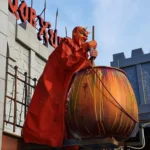
7 (Flushing Local) (also know also IRT Flushing or IRT Queensboro) is a IRT train line in the New York Subway. It runs from Flushing in Queens to Times Square in Manhattan. This 12.87 km (8 mile) line runs through some of the most ethnically diverse areas in the world. The line's Flushing terminus in large Chinatown and Koreatown areas has earned it the nickname of the Orient Express, after the famed Paris-Istanbul train. It is also famous for being the official train of the New York Mets and the US Open (tennis) as both are located at Willets Point-Shea Stadium station.
History
The Flushing Local was originally called the Woodside and Corona Line and one of two lines of the New York subway to have been operated jointly by two different divisions: the Interborough Rapid Transit and the Brooklyn-Manhattan Transit Corporation. The line, built by New York City, started construction on 1 April 1917 with Interborough Rapid Transit trains running between Grand Central and Alburtis Avenue, while joint operation with the Brooklyn-Manhattan Transit Corporation began in 1923. The line reached Flushing-Main Street, on 21 January 1928. Elevated Brooklyn-Manhattan Transit Corporation trains had to be used on this line because platform clearances were built to Interborough Rapid Transit specifications east of Queensboro Plaza. Brooklyn-Manhattan Transit Corporation wooden cars and Interborough Rapid Transit steel cars terminated at the underground Flushing terminal.
Even though subway service started in 1916, the portion of the line that ran under the East River was originally started by the East River Tunnel Railroad on 25 February 1885. The original intent of the line was to connect the Long Island Railroad and the New York Central Railroads. Other than an engineering survey of the East River at the tunnel site, nothing else was done, and in 1887, the company reorganized as the New York and Long Island Railroad Company. The tunnel was planned to run from approximately West 42nd Street and 10th Avenue, under 42nd St, then under the East River, to Van Alst Avenue. The rest of the line in Queens would be on private right of way, and various mappings were planned and revised for this section of route.
Various problems occurred causing extensive delays and cost overruns. William Steinway, founder of the Steinway & Sons Piano Co is who the tunnel is named after, became involved in 1890. He felt that controlling operations of the tunnel company would boost the value of his real estate and envisioned operating the tunnels using electricity. On 3 June 1892, ground-breaking occurred at 50th Avenue between Vernon and Jackson Avenues in Queens. However, a series of mishaps took place, such as an underground water spring that hampered debris removal, followed by lawsuits by property owners along the line forced the tunnel to be boarded up on 2 February 1893. Various attempts to restart the project between 1893 and 1896 (when Steinway died), and proposals to extend the line into New Jersey, all failed.
In February 1902, August Belmont, Jr. became interested in the project, which became known as the "Belmont Tunnels", although Belmont preferred the project be known as the "Steinway Tunnels". By 16 May 1907, the North tube was broken through, and the south tunnel was broken through on 7 August of the same year. The landfill from the tunnel excavations had been used to construct nearby Belmont, or, as later called, U Thant Island on an existing outcrop in the East River.
Because the Pennsylvania Railroad planned to build a very large station at 32nd and 33rd Streets on the West Side, and also planned to tunnel under the Hudson and East rivers, the motive power for the tunnels was changed to trolley cars. However, because of the low clearance of the tunnels, use of the typical trolley wire could not be used; instead, overhead "third rail" was hung from the roof of the tunnel using special brackets. The Van Alst Avenue station was originally on a loop at the end of a 50 foot radius curve and was located near 50th Avenue and Van Alst Avenue. At Grand Central Station there was another loop located under Park Avenue and East 42nd Street. The official opening was 24 September for Belmont, the Mayor and other officials.
However, because Mr Belmont did not have a franchise to operate the line, and a company to run it (because of litigation with New York City), Belmont was forced to board up the tunnel. From 23 October 1907 until 1915, the completed tunnel was idle of traffic! On 3 April 1913, the City of New York purchased the tunnels from Belmont as part of the Dual Contracts for $3 million, and the tunnels were placed under Interborough Rapid Transit operation. With "minor" modifications, the tunnel could accommodate subway trains. Because of the steep grade of the tunnels, special "Steinway" cars were built to run on the line. With the conversion to rapid transit, the loops on both ends of the Steinway tunnels were abandoned. No vestiges of the Queens loop remain today as the Hunterpoint station occupies the site. Remnants of the Manhattan loop still exist, but are not accessible by passengers, since these remnants are occupied by machinery. The Manhattan loop is just west of the current Grand Central Station stop on the 7 line. Subway service began on this section of the line on 20 April 1917.
The line was extended to Times Square with a stop at 5th Avenue-Bryant Park. The line runs under the 42nd Street Shuttle and ends at the lower level Interborough Rapid Transit's Times Square station's east wall. The 5th Avenue-Bryant Park station opened 22 March 1926, and Times Square opened 14 March 1927.
For the 1939 New York World's Fair, the Willets Point-Shea Stadium station was rebuilt, centered on 123rd Street, just west of where the station used to be. Some remnants of the old station are still visible: ironwork tends to indicate where the older outside-platform stations were, and the remains of the fare entry area can be seen east of the current station. The original Willets Point Boulevard station was a "minor" stop on the Flushing Line; it had only two stairways and short station canopies at platform level. It was rebuilt into the much larger station seen today, and the ramp used during two World's Fairs is still in existence, but is currently not used. Express service to the World's Fair began on the Flushing Line on 24 April 1939.
In 1938, an order of all-new World's Fair cars was placed with the St. Louis Car Company. These cars broke from Interborough Rapid Transit "tradition" in that they did not have vestibules at each car end. In addition, because the Interborough Rapid Transit was bankrupt at the time, the cars were built as single ended cars, with train controls for the motorman on one side and doorcontrols for the conductor on the other. These cars spent their last days on the 3rd Avenue El in the Bronx.
Not to be outdone, the Brooklyn-Manhattan Transit Corporation rebuilt 90 open gate cars into closed-end cars that became known as the "Q" Types. The Brooklyn-Manhattan Transit Corporation showcase cars, the 67 foot standards, D-types and multi-sectioned cars, could not run on this part of the subway because the Flushing Line was still jointly served by the Brooklyn-Manhattan Transit Corporation and the Interborough Rapid Transit, with equipment that had to be manufactured to Interborough Rapid Transit standards. The Q Types were built as three car sets, and only the cars at the ends were fitted with traction motors and motorman controls. The equipment was repainted in the now famous blue and orange, the World's Fair colors. Nine years after the closing of the Fair, in 1949, the BMT "Q" Types were moved to the 3rd Ave El in Manhattan using old IRT Composite car trucks, and ran only as expresses, because their weight was still a bit too high for the older, local tracks. So the last Brooklyn-Manhattan Transit Corporation designed car ran on the last Interborough Rapid Transit elevated in Manhattan.
Like Brooklyn Manhattan Transit Corporation Q-types replacing the older gate cars that rode on the line for the opening of the 1939 New York World's Fair, the procedure would be repeated again when, in 1964, the picture window R36 cars replaced the older R15's for the 1964 New York World's Fair. In 1942, when Second Avenue El service ended, major overhauls for the Corona fleet were transferred to the Coney Island shop. In addition, free transfers to the 3rd Avenue El were offered at Grand Central from June 13, 1942 (when 2nd Ave El service ended) until May 12 1955 (when 3rd Ave El service ended). In the fall of 1949, the joint Brooklyn-Manhattan Transit Corporation/Interborough Rapid Transit service arrangement ended. The Flushing Line became the responsibility of the Interborough Rapid Transit, and the Astoria Line had its platforms shaved back, and became an extension of the Brooklyn-Manhattan Transit. Because of this, routes through the (then) 8 track Queensborough Plaza station were consolidated and the northern half of the structure was torn down. Evidence of where the torn-down platforms were, as well as the trackways which approached this area, can still be seen in the ironwork at the station.
The Main Street-Flushing station was never meant to be the terminal of the line. The Public Service Commission, in June 1913, was actively engaged in considering extensions of the line beyond Main Street-Flushing, but it never came to pass. It has still never come to pass.
R36 cars have served the 7 exclusively since 1964. However, most have been scrapped and placed in the Atlantic Ocean as artficial barrier and coral reefs. As of 2004, most of the 7 Train fleet consists of R62A cars built in 1986.
In 1999, the 7 train route was designated a National Millennium Trail (along with the Appalachian Trail and 14 others) by a joint program of the White House Millennium Council, the United States Department of Transportation, and the Rails-to-Trails Conservancy. It was chosen as a representative of the immigrant experience, and because the approximate path of the Flushing line has been in continuous use as a transportation route since the 17th century.
In 2000, Atlanta Braves baseball pitcher John Rocker was quoted by Sports Illustrated to have said "It's [New York City] the most hectic, nerve-racking city. Imagine having to take the 7 train to the ballpark, looking like you're riding through Beirut next to some kid with purple hair next to some queer with AIDS right next to some dude who just got out of jail for the fourth time right next to some 20-year-old mom with four kids. It's depressing." When it became clear that Rocker was serious, Mets fans — and fans nationwide — booed Rocker so consistently that it affected his performance. After brief stints with other teams, he was out of the majors.
The route has 3-track express service. The express runs to Manhattan in the morning and from Manhattan in the afternoon. Some express trains are run especially for Mets and US Open games.
Architecture
The 7 has been known for its various styles of architecture along the line, which range from steel girder elevated lines to European-style concrete viaducts. The 7's underground stations have some unique designs as well, such as Hunters Point Avenue, which is in an Italianate style and 42nd Street-Grand Central, which is a single round tube similar to a London Underground station.
Extension
Plans are under way to extend the 7 to Manhattan's West Side in time for the 2012 Summer Olympics. A stadium and sport complex are being developed there. New cars with Automatic Train Operation (ATO) may be purchased as well.