






Portal:Wales: Difference between revisions
updating recognized content |
The Transhumanist (talk | contribs) Make editing easier, by changing {{PAGENAME}} to {{subst:PAGENAME}}. Yep, Help:Magic words#Variables can be substituted! (For def, see WP:SUBST). Tag: AWB |
||
| Line 8: | Line 8: | ||
{{Box-header colour|Introduction| colour= | mode= }} <!-- |
{{Box-header colour|Introduction| colour= | mode= }} <!-- |
||
{{Portal image banner|}}--> |
{{Portal image banner|}}--> |
||
{{Transclude lead excerpt|{{#titleparts: |
{{Transclude lead excerpt|{{#titleparts:Wales}}| paragraphs=1-2 | files=1}} |
||
{{Box-footer|[[ |
{{Box-footer|[[Wales|Read more...]]}} |
||
{{Purge link portals}} |
{{Purge link portals}} |
||
| Line 17: | Line 17: | ||
{{Box-header colour|Selected general articles}} |
{{Box-header colour|Selected general articles}} |
||
{{Transclude list item excerpts as random slideshow | paragraphs=1-2 | files=1 | more= |
{{Transclude list item excerpts as random slideshow | paragraphs=1-2 | files=1 | more= |
||
| Template: |
| Template:Wales topics |
||
| |
| |
||
}} |
}} |
||
{{Box-footer}} |
{{Box-footer}} |
||
<!--CONDITIONAL DID YOU KNOW? SECTION - ONLY SHOWS UP WHEN THERE ARE ENTRIES TO DISPLAY--> |
<!--CONDITIONAL DID YOU KNOW? SECTION - ONLY SHOWS UP WHEN THERE ARE ENTRIES TO DISPLAY--> |
||
{{Transclude selected recent additions | |
{{Transclude selected recent additions | Wales | months=36 | header={{Box-header colour|Did you know... }}|max=6}} |
||
<!--END OF DID YOU KNOW? SECTION--> |
<!--END OF DID YOU KNOW? SECTION--> |
||
{{Box-header colour | Need help?}} |
{{Box-header colour | Need help?}} |
||
Do you have a question about |
Do you have a question about Wales that you can't find the answer to? |
||
Consider asking it at the [[Wikipedia:Reference desk|Wikipedia reference desk]]. |
Consider asking it at the [[Wikipedia:Reference desk|Wikipedia reference desk]]. |
||
{{Box-footer}} |
{{Box-footer}} |
||
{{#ifexist: Wikipedia:WikiProject |
{{#ifexist: Wikipedia:WikiProject Wales |
||
| {{Box-header colour | Get involved}} |
| {{Box-header colour | Get involved}} |
||
For editor resources and to collaborate with other editors on improving Wikipedia's |
For editor resources and to collaborate with other editors on improving Wikipedia's Wales-related articles, see [[Wikipedia:WikiProject Wales|WikiProject Wales]]. |
||
{{Box-footer}} |
{{Box-footer}} |
||
| |
| |
||
| Line 38: | Line 38: | ||
{{Box-header colour|Selected images}} |
{{Box-header colour|Selected images}} |
||
{{Transclude files as random slideshow |
{{Transclude files as random slideshow |
||
| Wales |
|||
| {{PAGENAME}} |
|||
| |
| |
||
| |
| |
||
| Line 44: | Line 44: | ||
{{Box-footer}} |
{{Box-footer}} |
||
<!--CONDITIONAL NEWS SECTION - ONLY SHOWS UP WHEN THERE IS NEWS TO DISPLAY --> |
<!--CONDITIONAL NEWS SECTION - ONLY SHOWS UP WHEN THERE IS NEWS TO DISPLAY --> |
||
{{Transclude selected current events | |
{{Transclude selected current events | Wales | days=45 | header={{Box-header colour|In the news }}|max=6}} |
||
<!--END OF NEWS SECTION--> |
<!--END OF NEWS SECTION--> |
||
{{Box-header colour|Subcategories}} |
{{Box-header colour|Subcategories}} |
||
| Line 50: | Line 50: | ||
:<small>Select [►] to view subcategories</small> |
:<small>Select [►] to view subcategories</small> |
||
{{div col|colwidth=15em}} |
{{div col|colwidth=15em}} |
||
{{#tag:categorytree| |
{{#tag:categorytree|Wales}} |
||
{{div col end}} |
{{div col end}} |
||
{{Box-footer}} |
{{Box-footer}} |
||
| Line 56: | Line 56: | ||
<div class="nomobile" style="clear:both; width:100%"> |
<div class="nomobile" style="clear:both; width:100%"> |
||
{{Box-header colour|Subtopics}} |
{{Box-header colour|Subtopics}} |
||
{{Plain navboxes|content= {{Template: |
{{Plain navboxes|content= {{Template:Wales topics|state=expanded}} }} |
||
{{Box-footer}} |
{{Box-footer}} |
||
</div> |
</div> |
||
<div style="clear:both; width:100%"> |
<div style="clear:both; width:100%"> |
||
{{#ifexist: Wikipedia:WikiProject |
{{#ifexist: Wikipedia:WikiProject Wales |
||
| {{Box-header colour | Recognized content}} |
| {{Box-header colour | Recognized content}} |
||
{{User:JL-Bot/Project content |
{{User:JL-Bot/Project content |
||
Revision as of 22:40, 7 February 2019

Introduction

Wales (Welsh: Cymru [ˈkəmrɨ] ⓘ) is a country that is part of the United Kingdom. Located on the island of Great Britain, it is bordered by the Irish Sea to the north and west, England to the east, the Bristol Channel to the south, and the Celtic Sea to the south-west. As of 2021, it had a population of 3.2 million. It has a total area of 21,218 square kilometres (8,192 sq mi) and over 2,700 kilometres (1,680 mi) of coastline. It is largely mountainous with its higher peaks in the north and central areas, including Snowdon (Yr Wyddfa), its highest summit. The country lies within the north temperate zone and has a changeable, maritime climate. Its capital and largest city is Cardiff.
A distinct Welsh culture emerged among the Celtic Britons after the Roman withdrawal from Britain in the 5th century, and Wales was briefly united under Gruffudd ap Llywelyn in 1055. After over 200 years of war, the conquest of Wales was completed by King Edward I of England in 1283, though Owain Glyndŵr led the Welsh Revolt against English rule in the early 15th century, and briefly re-established an independent Welsh state with its own national parliament (Welsh: senedd). In the 16th century the whole of Wales was annexed by England and incorporated within the English legal system under the Laws in Wales Acts 1535 and 1542. Distinctive Welsh politics developed in the 19th century. Welsh Liberalism, exemplified in the late 19th and early 20th century by David Lloyd George, was displaced by the growth of socialism and the Labour Party. Welsh national feeling grew over the century: a nationalist party, Plaid Cymru, was formed in 1925, and the Welsh Language Society in 1962. A governing system of Welsh devolution is employed in Wales, of which the most major step was the formation of the Senedd (Welsh Parliament, formerly the National Assembly for Wales) in 1998, responsible for a range of devolved policy matters. (Full article...)
Selected general articles
-

The following outline is provided as an overview of and topical guide to Wales:
Wales – a country that is part of the United Kingdom, bordered by England to its east and the Atlantic Ocean and Irish Sea to its west. It has an estimated population of three million and the Welsh and English languages are both official languages. The Welsh language is an important element of Welsh culture. Its decline has reversed over recent years, with Welsh speakers estimated to be around 20 per cent of the population of Wales. (Full article...) -
Buddhism in Wales is followed by 0.3% of the Welsh population, according to the 2021 Census. Buddhism has a relatively short history, having only really established a presence in the country in the 20th Century. 10,075 people in Wales declared themselves Buddhist in the 2021 Census, representing a number of Buddhist traditions. (Full article...)
-
Bando is a team sport – related to field hockey, hurling, shinty, and bandy – which was first recorded in Wales in the eighteenth century.
A bando game is played on a large level field between teams of up to thirty players each of them equipped with a bando: a curve-ended stick resembling that used in field hockey. Although no formal rules are known, the objective of the game was to strike a ball between two marks which served as goals at either end of the pitch. Popular in Glamorgan in the nineteenth century, the sport all but vanished by the end of the century. (Full article...) -
Local government in Wales is primarily undertaken by the twenty-two principal councils. The councils are unitary authorities, meaning they are responsible for providing local government services within their principal area, including education, social work, environmental protection, and most highway maintenance. The principal areas are divided into communities, most of which have an elected community council. The services provided by community councils vary, but they will typically maintain public spaces and facilities. Local councils in Wales are elected; the most recent local elections in Wales took place in 2022, and the next are due to take place in 2027. (Full article...)
-
There are four types of elections in Wales: elections to the House of Commons of the United Kingdom, elections to the devolved Senedd (Welsh Parliament; Welsh: Senedd Cymru), local elections to community councils and the 22 principal areas, and the police and crime commissioner elections. In addition there are by-elections for each aforementioned election. Elections are held on Election Day, which is conventionally a Thursday. Three of these four types of elections are held after fixed periods; the exception is UK general elections, the timing of which is at the discretion of the prime minister of the United Kingdom. Senedd elections may be postponed to avoid elections to the UK parliament and Senedd coinciding with each other.
The two electoral systems used for elections in Wales are: first-past-the-post (for UK elections, police and crime commissioner elections and local elections, though individual local authorities are able to move to STV under recent Welsh legislation) and the Closed Lists (for Senedd elections). The supplementary vote system was previously used for police and crime commissioner elections, until the system was switched for those elections to first-past-the-post under provision made by the Elections Act 2022. The previous Additional Members System for the Senedd was replaced for Closed list by the Senedd Cymru (Members and Elections) Act 2024. (Full article...) -
Bara brith (Welsh: [ˈba(ː)ra briːθ]) is a traditional Welsh tea bread flavoured with tea, dried fruits and spices. It is similar to fruitcake.
It has been championed as a symbol of Welsh cookery by celebrity chefs such as Bryn Williams, especially in response to a decline in popularity in recent decades. In 2007, a survey showed that 36% of teenagers in Wales had never tried it, though far fewer were unaware of it, suggesting it still had a place of cultural significance even though supermarket chain Morrisons had removed their range from shelves a year earlier. (Full article...) -
This list of Welsh writers is an incomplete alphabetical list of writers from Wales.
It includes writers in all literary genres, writing in English, Welsh, Latin, or any other language, who have a Wikipedia page. Description as a writer precedes other occupations. It is a subsidiary to the List of Welsh people. See also List of Welsh-language authors, List of Welsh women writers and List of Welsh-language poets (6th century to c. 1600). Abbreviations: c. = about, fl. = active; B = writing in Brythonic, C = writing in Chinese, E = writing in English (including Middle English), F = writing in French, G = writing in German, L = writing in Latin, sl = writing in sign language, W = writing in Welsh (including Middle Welsh). (Full article...) -

Laverbread and toast
Laverbread (/ˈleɪvər-, ˈlɑːvər-/; Welsh: bara lafwr or bara lawr; Irish: sleabhac) is a food product made from laver, an edible seaweed (littoral alga) consumed mainly in Wales as part of local traditional cuisine. The seaweed is commonly found around the west coast of Great Britain, and the coasts of Ireland, where it is known as sleabhac. It is smooth in texture and forms delicate, sheetlike thalli, often clinging to rocks. The principal variety is Porphyra umbilicalis, a red alga which tends to be a brownish colour, but boils down to a dark green pulp when prepared. Laver seaweed has a high content of dietary minerals, particularly iodine and iron. The high iodine content gives the seaweed a distinctive flavour in common with olives and oysters.
Laver seaweed has been cultivated as a food in Wales since at least the 17th century. It is prepared by repeated washings and then boiling until it becomes the soft purée-like product known as laverbread. The gelatinous paste that results can then be sold as it is or rolled in oatmeal. It is sometimes also coated with oatmeal prior to frying. Laverbread is traditionally eaten fried with bacon and cockles as part of a Welsh breakfast or, in the southwest of England, with hog's pudding. (Full article...) -
Deheubarth (Welsh pronunciation: [dɛˈhəɨbarθ]; lit. 'Right-hand Part', thus 'the South') was a regional name for the realms of south Wales, particularly as opposed to Gwynedd (Latin: Venedotia). It is now used as a shorthand for the various realms united under the House of Dinefwr, but that Deheubarth itself was not considered a proper kingdom on the model of Gwynedd, Powys, or Dyfed is shown by its rendering in Latin as dextralis pars or as Britonnes dexterales ("the Southern Britons") and not as a named land. In the oldest British writers, Deheubarth was used for all of modern Wales to distinguish it from Hen Ogledd (Y Gogledd), the northern lands whence Cunedda originated. (Full article...) -

.jpg)


The national parks of Wales (Welsh: parciau cenedlaethol Cymru) are managed areas of outstanding landscape in Wales, United Kingdom where some forms of development are restricted to preserve the landscape and natural environment. Together, they cover 20% of the land surface of Wales and have a resident population of over 80,000 people. Each National Park Authority is a free-standing body within the local government framework.
At present, Wales has three national parks: Snowdonia (Eryri), created in 1951, Pembrokeshire Coast, created in 1952, and the Brecon Beacons (Bannau Brycheiniog), created in 1957, as well as five areas of outstanding natural beauty (AONB), which form some of the protected areas of Wales. One of the AONBs, the Clwydian Range and Dee Valley has been proposed to be replaced by a new national park, which would become Wales' fourth national park. (Full article...)

The Welsh, unlike other migrant groups from the British Isles, are not as numerous as their Welsh Australian counterparts. However, their contribution was notable. Most Welshmen who arrived in New Zealand were gold and coal miners. (Full article...)

Welsh cakes (Welsh: picau ar y maen, pice bach, cacennau cri or teisennau gradell), also known as bakestones, griddle cakes, or pics, are a traditional sweet bread from Wales. They are small, round, spiced cakes that are cooked on a griddle or bakestone rather than baked in an oven, giving them a distinctive texture between a biscuit, scone, and pancake.
Welsh cakes have been popular since the late 19th century and emerged from the addition of fat, sugar, and dried fruit to traditional flatbread recipes that were already being cooked on griddles. They became particularly associated with the South Wales coalfield during the height of the Welsh coal mining industry, when they served as portable, nutritious food for miners to take underground. Food historian Carwyn Graves notes in his scholarly analysis that Welsh cakes represent "a heritage both of griddle cakes" that formed part of Wales's distinctive grain culture, positioned at "the intersection of a 'Celtic' oat-based tradition and a northern European wheat/barley/rye tradition." (Full article...)

Healthcare in Wales is mainly provided by the Welsh public health service, NHS Wales. NHS Wales provides healthcare to all permanent residents that is free at the point of need and paid for from general taxation. Health is a matter that is devolved, and considerable differences are now developing between the public healthcare systems in the different countries of the United Kingdom, collectively the National Health Service (NHS). Though the public system dominates healthcare provision, private health care and a wide variety of alternative and complementary treatments are available for those willing to pay.
The largest hospital in the country is usually the University Hospital of Wales hospital, however the temporary Dragon's Heart Hospital set up in response to the COVID-19 pandemic in Wales was larger, and is the second largest hospital in the United Kingdom. (Full article...)

The England–Wales border, sometimes referred to as the Wales–England border or the Anglo-Welsh border, runs for 160 miles (260 km) from the Dee estuary, in the north, to the Severn estuary in the south, separating England and Wales.
It has followed broadly the same line since the 8th century, and in part that of Offa's Dyke; the modern boundary was fixed in 1536, when the former marcher lordships which occupied the border area were abolished and new county boundaries were created. The administrative boundary of Wales was confirmed in the Local Government Act 1972. Whether Monmouthshire was part of Wales, or an English county treated for most purposes as though it were Welsh, was also settled by the 1972 Act, which included it in Wales. (Full article...)
_(32306541014).jpg)
Centuries: 1st • 2nd • 3rd • 4th • 5th • 6th • 7th • 8th • 9th • 10th • 11th • 12th • 13th • 14th • 15th • 16th • 17th • 18th • 19th • 20th • 21st
References • Sources

The Statute of Rhuddlan (Welsh: Statud Rhuddlan), also known as the Statutes of Wales (Latin: Statuta Walliae or Valliae) or as the Statute of Wales (Latin: Statutum Walliae or Valliae), was a royal ordinance by Edward I of England, which gave the constitutional basis for the government of the Principality of Wales from 1284 until 1536.
The statute followed the Conquest of Wales by Edward I and the killing of the last Welsh prince to rule the whole Principality, Llywelyn ap Gruffudd in 1282. The statute introduced English common law to Wales, but also permitted the continuance of Welsh legal practices within the Principality. The statute also introduced the English shire system to the Principality of Wales. Prior to the statute, the Welsh principalities were ruled by Welsh law and the native Princes of Wales. (Full article...)

David (Welsh: Dewi Sant; Latin: Davidus; c. 500 – c. 589) was a Welsh Christian prelate who served as Bishop of Mynyw during the 6th century. He is the patron saint of Wales.
David was a native of Wales, and tradition has preserved a large amount of detail about his life. His birth date, however, is uncertain: suggestions range from 462 to 512. He is traditionally believed to be the son of Non and the grandson of Ceredig ap Cunedda, king of Ceredigion. The Welsh annals placed his death 569 years after the birth of Christ, but Phillimore's dating revised this to 601. (Full article...)

Gorsedd Cymru (Welsh pronunciation: [ˈɡɔrsɛð ˈkəmrɨ, -ri]), or simply the Gorsedd (Welsh: yr Orsedd), is a society of Welsh-language poets, writers, musicians and others who have contributed to the Welsh language and to public life in Wales. Its aim is to honour such individuals and help develop and promote their fields in addition to maintaining relationships with other Celtic nations and Y Wladfa in Patagonia. The Gorsedd is most prominent at the National Eisteddfod of Wales where it is responsible for the main ceremonies held. (Full article...)

British Sign Language (BSL) is a sign language used in the United Kingdom and is the first or preferred language among the deaf community in the UK. Based on the percentage of people who reported 'using British Sign Language at home' on the 2011 Scottish Census, the British Deaf Association estimates there are 151,000 BSL users in the UK, of whom 87,000 are Deaf. People who are not deaf may also use BSL, as hearing relatives of deaf people, sign language interpreters or as a result of other contact with the British Deaf community. The language makes use of space and involves movement of the hands, body, face and head. (Full article...)
.jpg)
The Wales Office (Welsh: Swyddfa Cymru), known as the Office of the Secretary of State for Wales (Welsh: Swyddfa Ysgrifennydd Gwladol Cymru) between 2017 and 2024, is a department of His Majesty's Government. It replaced the former Welsh Office, which had extensive responsibility for governing Wales prior to Welsh devolution in 1999. (Full article...)
Except in constitutional matters, committed to the Supreme Court of the United Kingdom, the United Kingdom does not generally have a single unified legal system—England and Wales have one system, Scotland another, and Northern Ireland a third. There are additional exceptions to this rule; for example, in immigration law, the Asylum and Immigration Tribunal's jurisdiction covers the whole of the United Kingdom, while in employment law, there is a single system of employment tribunals for England, Wales, and Scotland but not Northern Ireland. Additionally, the Military Court Service has jurisdiction over all members of the armed forces of the United Kingdom in relation to offences against military law. (Full article...)
Did you know...
- ... that the Campanile, a bell tower in Portmeirion, north Wales, was built in 1928 using stone from a nearby 12th-century castle?
- ... that after Dolwyddelan Castle was captured in January 1283, its new garrison was equipped with winter camouflage of white material and stockings?
- ... that Welsh-language activist Joseff Gnagbo came to Wales as a refugee from Ivory Coast?
- ... that Australia-born rugby union player Jason Jones-Hughes was the subject of a protracted legal battle over his international eligibility after Wales called him up for the 1999 Rugby World Cup?
- ... that approximately 85 per cent of Welsh children were not in school in 1821?
- ... that Wales's first Commonwealth Games medallist in shooting walked off the podium when the wrong national anthem was played?
Need help?
Do you have a question about Wales that you can't find the answer to?
Consider asking it at the Wikipedia reference desk.
Get involved
For editor resources and to collaborate with other editors on improving Wikipedia's Wales-related articles, see WikiProject Wales.
Selected images
-
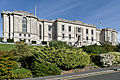
 St. David's Building, Lampeter campus, University of Wales, Trinity Saint David (Prifysgol Cymru, Y Drindod Dewi Sant). Founded in 1822, it is the oldest degree-awarding institution in Wales. (from Wales)
 -
 The Old Court House, Ruthin, Denbighshire, built 1401, following Owain Glyndŵr's attack on the town
 -
 First Minister Mark Drakeford meets with First Minister of Scotland Humza Yousaf in Edinburgh, 2023 (from Wales)
 -
 Welsh dancer at the Senedd building (from Wales)
 -
 A Red kite, considered one of the national symbols of Wales and voted the nation's favourite bird (from Wales)
 -
 Rail network of Wales, 2021 (from Wales)
 -

-
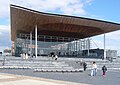
-

-
 Illustration of a Welsh judge from the Laws of Hywel Dda (from Wales)
 -
 A profile of the economy of Wales in 2012 (from Wales)
 -

-

-

-
 University Hospital of Wales, Cardiff (from Wales)
 -
 St. David's Cathedral, Pembrokeshire (from Wales)
 -

-
 Singer Shirley Bassey (from Wales)
 -
 Millennium Stadium, Cardiff (from Wales)
 -

-
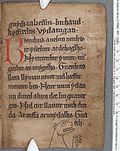 Welsh poetry from the 13th-century Black Book of Carmarthen. (from Wales)
 -
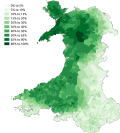 The proportion of respondents in the 2011 census who said they could speak Welsh (from Wales)
 -
 Dowlais Ironworks (1840) by George Childs (1798–1875) (from Wales)
 -
-

-

-
 The red dragon, a popular symbol in Wales. (from Wales)
 -
 A number of BBC productions, such as Doctor Who and Torchwood, have been filmed in Wales. (from Wales)


.jpg)
.jpg)


_Judge_cropped.jpg)


_King_Hywel_cropped.jpg)
.jpg)


.jpg)
.jpg)
.jpg)
_from_Crib_Goch,_Parc_Cenedlaethol_Eryri_National_Park,_Cymru_(Wales)_09.jpg)
.jpg)


.jpg)
.svg)
.jpg)
In the news
- 26 February 2026 – 2026 Gorton and Denton by-election
- Green Party candidate Hannah Spencer wins the constituency of Gorton and Denton in Greater Manchester, England, in the party's first by-election win. (The New York Times) (The Washington Post)
- 9 February 2026 – Australia–Israel relations, Gaza war protests in Australia
- Protests against Israeli president Isaac Herzog's state visit, following the 2025 Bondi Beach shooting, are held in cities across Australia. In Sydney, protests occurred amid a ban by the state government on hate speech grounds, resulting in police making 27 arrests and deploying pepper spray. (ABC News Australia)
- 6 February 2026 – Ipswich serial murders
- English serial killer Steven Wright, who killed five women in 2006, receives another life sentence after he admitted to murdering a 17-year-old girl in 1999. (Reuters via CTV News)
Subcategories

- Select [►] to view subcategories
Subtopics
Wales articles | |||||||
|---|---|---|---|---|---|---|---|
| History | |||||||
| Geography | |||||||
| Politics |
| ||||||
| Economy | |||||||
| Society |
| ||||||

Recognized content
Featured articles
- Aberfan disaster
- King Arthur
- Asser
- Castell Coch
- William Cragh
- Russell T Davies
- S. O. Davies
- Arthur Gould (rugby union)
- Rhys ap Gruffydd
- House of Plantagenet
- Monnow Bridge
- Tom Pryce
- Old Church of St Nidan, Llanidan
- Sasha (DJ)
- Senghenydd colliery disaster
- Slate industry in Wales
- St Donat's Castle
- Talyllyn Railway
- Wales national rugby union team
- Alfred Russel Wallace
- Catherine Zeta-Jones
Featured lists
- List of county court venues in England and Wales
- Roald Dahl bibliography
- Friends of Friendless Churches
- List of clergy educated at Jesus College, Oxford
- List of alumni of Jesus College, Oxford
- List of mathematicians, physicians, and scientists educated at Jesus College, Oxford
- List of politicians, lawyers, and civil servants educated at Jesus College, Oxford
- List of founding Fellows, Scholars and Commissioners of Jesus College, Oxford
- List of Honorary Fellows of Jesus College, Oxford
- List of Principals and Fellows of Jesus College, Oxford
- List of Cardiff City F.C. players
- List of Cardiff City F.C. seasons
- List of Wales international footballers
- List of Wales national football team hat-tricks
- List of Welsh Premier League clubs
- List of former county courts in Wales
- List of new churches by John Douglas
- List of roles and awards of Catherine Zeta-Jones
Good articles
- A4061 road
- A4232 road
- 1876 Scotland v Wales football match
- 1927 FA Cup Final
- 1927 FA Charity Shield
- Aberdaron
- HMS Active (1911)
- Active-class cruiser
- Adrift (Torchwood)
- Agriculture in Wales
- Mark Aizlewood
- HMS Ajax (1880)
- Ivor Allchurch
- Our Lady Star of the Sea and St Winefride, Amlwch
- HMS Amphion (1911)
- HMS Andromeda (1897)
- Anglesey Central Railway
- HMS Anson (1886)
- HMS Aurora (1887)
- Rakie Ayola
- Emilia Baeyertz
- Barmouth Bridge
- Rachel Barrett
- Barry Docks
- Beaumaris Castle
- HMS Bellona (1909)
- Norman Biggs
- HMS Blanche (1909)
- HMS Blonde (1910)
- Blonde-class cruiser
- HMS Boadicea (1908)
- Boadicea-class cruiser
- Bullet for My Valentine
- Caernarfon Castle
- Caernarfon town walls
- Caerphilly Castle
- Caffo
- HMS Cambrian (1916)
- Martha Hughes Cannon
- Capel Lligwy
- HMS Caradoc (D60)
- HMS Cardiff (D58)
- Cardiff Arms Park
- Cardiff Castle
- Cardiff City F.C.
- Carmarthenshire
- HMS Carysfort (1914)
- Castell y Bere
- Castles and Town Walls of King Edward in Gwynedd
- Catatonia (band)
- Ceredigion
- The Checkers (restaurant)
- Clwyd
- HMS Collingwood (1882)
- Constantine (Briton)
- Conwy Castle
- Conwy town walls
- Gwen Cooper
- HMS Cordelia (1914)
- HMS Cornwall (1902)
- Kyle Critchell
- Andrew Crofts (footballer)
- The Whitebrook
- Cwm, Llanrothal
- Cynfarwy
- HMS Denbigh Castle (K696)
- Dolbadarn Castle
- (Drawing) Rings Around the World
- HMS Dreadnought (1875)
- Fred Dyer
- East and West Blockhouses
- Ebbw Valley Railway
- Huw Edwards (conductor)
- Eidyn
- HMS Essex (1901)
- Ched Evans
- Timothy Everest
- HMS Fearless (1912)
- Feeder (band)
- Flat Holm
- HMS Flint Castle (K383)
- Dion Fortune
- Richard Garnons Williams
- Billy Geen
- Geography of Wales
- Julia Gillard
- Glamorgan sausage
- Mary Dilys Glynne
- Golden Retriever (song)
- Grosmont Castle
- Harlech Castle
- Hay Castle
- Hello Sunshine
- Humphrey de Bohun, 3rd Earl of Hereford
- Hilston Park
- The Holy Bible (album)
- HMS Howe (1885)
- HMS Inconstant (1868)
- HMS Iron Duke (1870)
- It's Not the End of the World?
- Herbert Armitage James
- Barry John
- Gethin Jones
- Brian Josephson
- Juxtapozed with U
- Kidwelly and Llanelly Canal
- Alex Lawless
- Llandaff Cathedral
- Llanishen Reservoir
- St Llibio's Church, Llanllibio
- Llantwit Major
- St Enghenedl's Church, Llanynghenedl
- Loughor Castle
- Levi Mackin
- Mari Lwyd
- Marina and the Diamonds
- John McFall (athlete)
- Meat (Torchwood)
- Milford Haven
- Millennium Stadium
- Monmouth School
- Mwng
- Neath and Tennant Canal
- Sibyl de Neufmarché
- Newton House, Llandeilo
- Nidan
- HMS Nile (1888)
- Ninian Park
- HMS Nottingham (1913)
- O'er the Gloomy Hills of Darkness
- Old Bridge, Pontypridd
- Parc Cwm long cairn
- Park Hall (football ground)
- Joseph Parry
- Danny Parslow
- Pembrokeshire
- HMS Penelope (1867)
- Penmon
- Thomas Pennant
- Pennard Castle
- Phantom Phorce
- Phantom Power (Super Furry Animals album)
- Plas Mawr
- Pont-y-Cafnau
- HMS Prince of Wales (1902)
- Jonathan Pryce
- Guto Puw
- Radyr
- Raglan Castle
- Elizabeth Randles
- Rhondda
- Jazz Richards
- Rings Around the World
- St Beuno's Church, Aberffraw
- St Beuno's Church, Trefdraeth
- St Caffo's Church, Llangaffo
- St Caian's Church, Tregaian
- St Ceidio's Church, Rhodogeidio
- St Ceinwen's Church, Cerrigceinwen
- St Cristiolus's Church, Llangristiolus
- St Cwyllog's Church, Llangwyllog
- St Cynfarwy's Church, Llechgynfarwy
- St Deiniol's Church, Llanddaniel Fab
- St Dona's Church, Llanddona
- St Edern's Church, Bodedern
- St Edwen's Church, Llanedwen
- St Eleth's Church, Amlwch
- St Eugrad's Church, Llaneugrad
- St Ffinan's Church, Llanffinan
- St Fflewin's Church, Llanfflewin
- St Gallgo's Church, Llanallgo
- St Gwenllwyfo's Church
- Old Church of St Gwenllwyfo, Llanwenllwyfo
- St Iestyn's Church, Llaniestyn
- St Mary's Church, Bodewryd
- St Mary's Church, Llanfair Mathafarn Eithaf
- St Mary's Church, Llanfair-yn-y-Cwmwd
- St Mary's Church, Llanfair-yng-Nghornwy
- St Mary's Church, Pentraeth
- St Mary's Church, Rhodogeidio
- St Mary's Church, Tal-y-llyn
- St Michael's Church, Llanfihangel Ysgeifiog
- St Mihangel's Church, Llanfihangel yn Nhowyn
- St Nidan's Church, Llanidan
- St Pabo's Church, Llanbabo
- St Peirio's Church, Rhosbeirio
- St Peter's Church, Llanbedrgoch
- St Peulan's Church, Llanbeulan
- St Twrog's Church, Bodwrog
- St Tyfrydog's Church, Llandyfrydog
- Sealyham Terrier
- Senedd
- Michael Sheen
- Sherlock (TV series)
- Shrewsbury Drapers Company
- Skenfrith Castle
- Slow Life
- Snowdon
- Something Borrowed (Torchwood)
- The Tale of the Flopsy Bunnies
- HMS Thisbe (1824)
- Dylan Thomas
- Three Castles
- HMS Thunderer (1872)
- To the Last Man (Torchwood)
- John Toshack
- Goronwy ap Tudur Hen
- Tudur Hen
- Hilda Vaughan
- Wales Millennium Centre
- Wales
- David Watts Morgan
- Welsh Corgi
- Welsh cuisine
- Welsh National Opera
- Welsh Pony and Cob
- Welsh Springer Spaniel
- White Castle, Monmouthshire
- Johnny Williams (rugby player, born 1882)
- Rhys Williams (Torchwood)
- Women's suffrage in Wales
- Woollen industry in Wales
- Y Gododdin
Associated Wikimedia
The following Wikimedia Foundation sister projects provide more on this subject:
-
 Commons
Free media repository -
 Wikibooks
Free textbooks and manuals -
 Wikidata
Free knowledge base -
 Wikinews
Free-content news -
 Wikiquote
Collection of quotations -
 Wikisource
Free-content library -
 Wikiversity
Free learning tools -
 Wiktionary
Dictionary and thesaurus