







Talk:Sasanian Empire: Difference between revisions
85.210.56.141 (talk) |
Larry Dunn (talk | contribs) No edit summary |
||
| Line 256: | Line 256: | ||
What is going on? What happened to Shapur II picture? The image was used on so many pages that now it's removed, all those pages look empty. anyone have an idea of what happened? Thanks [[User:Arad|Arad]] 03:15, 28 August 2006 (UTC) |
What is going on? What happened to Shapur II picture? The image was used on so many pages that now it's removed, all those pages look empty. anyone have an idea of what happened? Thanks [[User:Arad|Arad]] 03:15, 28 August 2006 (UTC) |
||
== Sassanid "knights" as origin or Arab or European Knighthood == |
|||
These provisions are inaccurate, and have been deleted. The primary weapon of the Sassanid clibanarii was the bow. This weapon was used to "shower shoot" arrows into beaten zones, as described in Roman sources. Arab heavy cavalry developed from the bedouin tradition of light horsemen, who fought using a controlled series of charges with a lance. The Arab cavalry in Spain did not even carry a bow at all. |
|||
Arab light cavalry became increasingly heavy as the conquest continued, due to plunder and increasing resources. The Sassanid empire had many influences on the Arabs, but the composition of cavalry types was not one of them. When the Arabs wanted armoured horse archers, they had to hire them from the turkic people beyond the frontier -- the ''Ghilmen''. |
|||
The connection to Western chivalry is even less relevant. European knighthood developed out of Germanic warrior society and the changes to that warrior aristocracy due to the expansion of Germanc Europe under Charlemagne's conquests, and the long period of anarchy that followed, had nothing whatsoever to do with Persia. |
|||
Suggestions otherwise seem highly POV.[[User:Larry Dunn|Larry Dunn]] 18:46, 12 October 2006 (UTC) |
|||
Revision as of 18:46, 12 October 2006
Template:Featured article is only for Wikipedia:Featured articles.
 | Iran | ||||||
| |||||||

Sassanid Dynasty is NOT an empire
Sassanid dynasty was a dynasty under the Persian Empire, not an Empire! Its childish, empire within an empire??? Persian Empire was the Empire which the Sassanid Dynasty ruled. Please correcct the title and all relevant links from Sassanid empire to Sassanid Dynasty.
spelling
this is a minor point regarding spelling. it seems that spelling 'sassanid' is more prevalent than 'sasanid' but instances of 'sasanian' outnumber that of 'sassanian.' i would tend towards using 'sasanid' and 'sasanian' myself as these spellings better represent the correct pronunciation. i'm asking for insights into the matter or opinions before i move the page and change other occurances of these terms on wikipedia. indeed this is a minor point. --Aria Parsi 2.8.06
some guy's comment
Mr Zereshk I ask you sincerely stop wikifying my articles ! let the Wikipedia itself wikify photos .So dont worry , ok ?
References
In the german article is a good overview with regard to sourcesa and secondary works. Why not here?
"barbaric"
"Near the end of the 5th century a new enemy, the barbaric Hephthalites, or "White Huns," attacked Persia [...]" I don't like the word barbaric, it has a negative (cultural) connotation and as such shouldn't be used in a historical article. 'Nomadic' might be a better choice. Karoschne 11:26, Jun 26, 2005 (UTC)
Kudos
Spectacular images with this article! The map, too, is a very practical touch. I'm always surprised by the frequency with which articles about early history assume that the reader is familiar with the many place names, none existing on modern maps. Here, you provide a useful tool. Well done! --Philopedia 22:49, 14 July 2005 (UTC)
- ...but the copyright status is quite dubious.
the Umayyad weren't the ones who ended the Sassanid Empire
it says in the article that Umayyad ended the the sassanid Empire which is worng, the Sassanids were ended under Caliph Umar who was one of the four rightoness Caliphs before the rise of the Ummayads for many years.
Amir85's edits
Some of your edits seem to be written in a hazy language and they are not sourced (which could you please do? It would be very helpful). For instance "The Manichaeism was favoured by Shapur, he protected Mani." is not really a sentence and while I understand the idea of it it should be put into context. That whole section also remains pretty choppy. I'm afraid I don't know this well and since I have no source I'd need you to supply yours. Thanks. gren グレン 07:07, 20 October 2005 (UTC)
- I'm afraid that Amir is cutting and pasting, so that chunks of good English copied elsewhere are clumsily joined by his English-as-a-second-language. I found one source for the copyvios: [1]. I think there must be other sources too, but I haven't mounted a concerted google to find them. Most of the articles that Amir adds are created this way. I keep meaning to go down his list of contribs and work on the copyvios but I just haven't had time. I wish he wouldn't do this, as it makes extra work for everyone else. I suppose we could just roll back to the latest version before he started working on the article. Zora 12:24, 4 November 2005 (UTC)
- following paragraph appears to be incorporated from a machine translation of an unsourced german text. which, i think, may be a copyright violation; and, i am sure, of bad taste:
The Manichaeism was favoured by Shapur, he protected Mani. Under Shapur's successors Bahram I (273-276) and Bahram II (276-293) the Manichaeism, which found also in the Roman realm was pursued . Otherwise above all relating to domestic affairs Shapurs quite intensive city politics stood out. In the cities created by Shapur there were settlers from the western terretories, which included some Christians, who could exercise their faith there, were settled. He attacked the Romans, but after defeating the emperor Galerius near Callinicum on the Euphrates in 296 was completely defeated in 297 King Narseh (293-302) attacked the Romans, but after defeating the emperor Galerius near Callinicum on the Euphrates in 296 was completely defeated in 297, some areas in Mesopotamien were lost to Romans. However the Sassanids, like Romans had not to only fight at a front, the new Persian realm had to set itself against intruders form other fronts, the passports of the Caucasus had to be likewise defended like the always endangered northeast border, where the Sassaniden had to fight first against the Kushans, later against the White huns and the Turks. These peoples did not show themselves rarely as serious threat for the Sassanids.
Khazars and Romans
The Khazars were allied with the Romans in the persian-roman war of 602-629, that is true. But they didn´t travel south with Heraclius 627!!!! Read W.E. Kaegi, Heraclius, 2003, or Ostrogrski etc. --84.135.177.159 10:58, 8 November 2005 (UTC) ps: the list of rulers isn´t correct: Boran had a sister (Azarmidukht), who ruled for a few moths, but who isn´t mentioned in the list (see the Prosopography of the Later Roman Empire or the Encyclopaedia Iranica).
Sassanid edits
Yes my edits have their own drawbacks, sometimes dubious in terms of copyright (I've included all the sources and references in the end of the article), but I will correct them (this is not of my clumsiness, about the German translation I didnt have time to correct it but I will defintely pay more attention next time) About my major contribution in this article intially the article was in copy-paste style (but not copyvio, I'd acquired their permission through contacts) but then I put a lot study about Sassanids and with help of a UCLA teacher right now I'm trying to enrich and expand the article. All the relating articles except Sassanid army and Sassanid architecture are fruits of this extensive research. Amir85 1:12, 14 November 2005 (UTC)
- Amir85, since you have a long history of copvio, and since people who WROTE articles you copied have complained, loudly, there is no reason to believe that you have permission to copy. If you can't rewrite it, then don't copy it! It's easy enough to rewrite. Sometimes when I work on articles, I use cut-and-paste, offline. I paste all the sources I can find into a document, break them into chunks and rearrange them, and then rewrite completely. That's OK; just plain copying is dishonest. Zora 02:18, 14 November 2005 (UTC)
- The part "Early history (224-310)" is partially copied ans translated from the (featured) german article - but without the necessary references to the copied source extract (this is copyright protected).
- That part is a monumental inscription, Whatever the source is, all sources refer to a same translation of the inscription for your knowledge. Stop editing blindly. Amir85 12:09, 18 November 2005 (UTC)
- Amir: it is the res gestae saporis - and your translation is a translations of a german translation of the greek text (the inscription is in greek, partian and middle-persian). Do not fool us...
- That part is a monumental inscription, Whatever the source is, all sources refer to a same translation of the inscription for your knowledge. Stop editing blindly. Amir85 12:09, 18 November 2005 (UTC)
- First of all I dont know whom I'm talking to, so whoever you are, Yes it is a german translation of the greek inscription, but no matter what language it is, its a monumental inscription, as you know it remains the same for any language its been translated to !
Remains the same? Well, no. There are some words that are not easily translated. A one word concept like, say, "satyagraha, may require a whole para to convey fully in English. Some translations are better than others. A Babelfish translation of a foreign text is highly unlikely to be a good translation! Also, you copied more than just the inscription. Zora 23:19, 20 November 2005 (UTC)
Oh so you care about inscription remains intact? I didnt know that, very good , so how are going to help expanding the article (not just filling the discussion page), and if you dont know this is the wikipedia copyright policy including German wikipedia:
- The license Wikipedia uses grants free access to our content in the same sense as free software is licensed freely. This principle is known as copyleft. That is to say, Wikipedia content can be copied, modified, and redistributed so long as the new version grants the same freedoms to others and acknowledges the authors of the Wikipedia article used (a direct link back to the article satisfies our author credit requirement). Wikipedia articles therefore will remain free forever and can be used by anybody subject to certain restrictions, most of which serve to ensure that freedom.
I know what are your intentions so I dont think there is any point continuing this argument. Good luck Amir85
Map
The map displays not the Sasanid Empire in the time of Shapur II, but the temporally conquests of Shapur I. Shapur II never, i repeat, never advanced so far west. The Sasanids and the Romans fought in Mesopotamia, in the area of Amida for example (cf. Ammianus Marcellinus, or The Cambridge History of Iran, vol 3.1, pp. 137ff.). Shapur I, on the other side, penetrated into Cappadocia and Syria - of course, the success was only temporally, Cappadocia and Syria were not conquered. The map could be from Iran Chamber or Britannica (both used it, if i remember right), but the legend of the map is totally wrong! If you want incorrect informations - then keep the old version.
Listen, I think there is some confusion on the map, it is meant to show sasanid dynasty at its peak. At its peak during Shapur I era, Persia had temporarily conquered areas of both Syria and Turkey, these were also battle destinations.
Pushing to FA
- This is in response to a question Amir asked me on my talk page
The article is sort of in an in between zone at the moment. On the one hand, factual content and references are getting to be top notch, definitely FA quality. Writing quality isn't uniformly high just yet, but that's something that I and other copyeditors can improve as it goes along, so that's not a big concern.
The issue that needs serious work before we can think about FAC is the overall layout of the article, and the question of what facts to include. Certain things, most notably the issue of religious toleration, come up over and over again in the article; it would be better if that subject was discussed all in one section, rather than talking about it a little in a bunch of different places.
My recommendation for how to go forward with this would be to draw up a "grand plan" of what the finished product is going to look like, and then move and reorganize sections to fit that plan. Based on what I'm seeing in the article, here's what I would recommend:
- Lead (which, by the way, is very good right now).
- History (this section is also very good)
- Foreign relations
- Relations with China
- Relations with India
- Relations with Barbarian tribes
- Relations with Rome (new section)
- Government and Society
- Sassanid government
- Sassanid military
- Sassanid social system
- Sassanid art and architecture
- Religion
- Sassanid government
Obviously, you know more about the Sassanids then me, so you may be able to come up with a better structure; the point is, there needs to be a coherent plan for how the article is going to present its facts.
Once this is taken care of, it will be time to sort out which facts go where, and to expand or shrink few sections. I think the religion section could probably be shrunk a bit, since most of what's said there is also covered at the Zoroastrianism main article. The Sassanid military section, on the other hand, needs to be expanded. I'd drop the Ammianus quote--it doesn't say much about the military as a whole--and add a larger discussion of the military's structure and tactics. I'm not a big fan of the "in modern media" section; I think it would fit in better in the article about the video game. Remember, things in this article should be things that say something notable about the Sassanids.
For the art and architecture section, I'd like to see a paragraph added about Sassanid painting, since that isn't really covered yet. Perhaps something about other forms of art, such as sculpture or metalworking, could be added as well? Again, you're the one who knows the subject matter; just make sure the section is a good summary of Sassanid art for someone unfamiliar with the subject.
The biggest trick to this will be making sure that the article gives the right level of detail on all its subjects--which is tricky when you're covering a massive topic like this. Digressions on minor points should be saved for daughter articles. Remember that the article is a summary, designed to be used by readers unfamiliar with the topic, and select your material accordingly.
You've been doing good work so far, and although its not there yet, I think this can be a top-quality FA if a coherent plan for organizing the article is implemented.
I'll be away from my computer for a few weeks, starting tomorrow; I'll give the article a last going over before I go. If you're looking for a final pre-FAC copyedit before I get back, you could try asking Tony1 or Jengod; they're both excellent copyeditors, and I've seen them do work on PR/FAC articles before.
Good work so far, and good luck! RobthTalk 21:29, 3 March 2006 (UTC)
was it the first islamic empire ?
--TuzsuzDeliBekir 17:40, 5 March 2006 (UTC)
- I don't think you are Iranian. No, Sassanid Empire was not Islamic. The state religion was Zoroastrianism. Anyways, I'm glad you want to know about this. (The One We Call God 21:41, 14 March 2006 (UTC))
Please support
Please support this article for featured article candidate. I think it's a great article and it deserves to be approved as a featured article. Thank You. (The One We Call God 21:44, 14 March 2006 (UTC))
Congratulations!
Great job! Wow, you guys finally made it to featured article and I'm glad. Only 0,1% of articles make it here. Good Job ;-)
- Thanks man. Amir85 20:34, 26 March 2006 (UTC)
Corrections
First of all, if we are considering academic accuracy, then the Sasanian Empire was not the 'third' Persian Empire, but the second one after the Achaemenids. Parthian/Arsacid Empire was an Iranian Empire, but not a Persian one.
Then, please include the original name of Firouzabad. It was called Ardashir-Khwarrah.
Sasanians never called their domain Eran. Eran means "Iranians" while as mentioned, Eranshahr (Old Iranian *aeryanem-khshathra) indeed means "the dominion of the Iranians" and was used in the Sasanid texts.
I haven't gotten beyond the introduction yet. I will get back to you on this.Khodadad-- 01:47, 28 March 2006 (UTC)
A couple problems with the introduction to the section on Sassanid culture: the second sentence says that "The amount of scientific and intellectual exchange between the two empires [Byzantium and the Sassanids] is witness to the competition and cooperation of these ancient cradles of civilization." Cooperation? The entire article has talked about fighting between Byzantium and Persia. And could these be called "ancient cradles of civilization," particularly during the period in question? Also, the following sentence goes on about the "striking difference between Parthian and Sassanid society . . " What happened to the previously mentioned Byzantines?
- I hate people who can't just understand that Persia is the name used by the west for Iran. Parthians and Sassanians are both Iranian (Persian). (The One We Call God 01:48, 13 April 2006 (UTC))
- I also hate people who hate people for correcting the issue that Persian doen NOT equal Iranian! At least in the academic study of the pre-Islamic history of Iran (of which Sasanians are a component), the word Persian means something quite different from what modern political biases have created of it. In the pre-Islamic history of Iran, Persian and Parthians, both part of the greater Iranian socio-lingual group, are distinct. Parthians were not a Persian Empire, but they were an Iranian Empire. --Khodadad 21:14, 25 April 2006 (UTC)
Yes, Iranians might not be Persians, but unfortunately Greeks used Persians (Persia) to describe the whole land of Iran and Iranian people. This is true that Persians , Parthians, Medes, Kurds, etc,etc, they all live in Iran and they are all Iranian, but in the west, they wrongly use Persia for the name of Iran (and if Reza Shah hadn't changed the name, we wouldn't have to talk about these things today). But I'll correct the thing, so both me and you will be happy. The Unknown 23:17, 28 April 2006 (UTC)
- You can go and see it your self in the Persian Empire Article that Sassanid Empire is the third Persian Empire.
Also this is from the Persian Empire article:
Persia has long been used by the West to describe the nation of Iran, its people, and its ancient empire. It derives from the ancient Greek name for Iran's maritime province, called Fars in the modern Persian language and Pars in Middle Persian. Persis is the Hellenized form of Pars, and through the Latinized word Persia, the other European nations came to use this word for the region.
So the word Persia means Iran and Persians means Iranians (although, I know that in the real definition Persians are just a part of Iranian people but we can't change the fact that the west use Persia as Iran) The Unknown 23:22, 28 April 2006 (UTC)
Even assuming that the word "Persian" empire is used in the sense of an Iranian Empire, still Sasanids would not be the third ones. We should then count the Medes at least, even if we imagine that Elamites were not part of the Iranians and Seleucids should be forgotten. We would need to count Medes, Achaemenids, Arsacids, and Sasanians, making them the fourth Iranian (or if you will Persian) Empire. However, since we are talking here. We should consider the fact that this is an encyclopaedia article, not a piece in a popular magazine. If it is in an encyclopaedia, we need to keep it academic and on-par with the latest scholarship. I can say for myself as a gradutate student of history that if today I write anything like "The Sasanids were the third/fourth Persian Empire", my professor will give me a big, fat zero. So, I am suggesting that we try to deviate from the popular culture and aim for a higher audience. Despite what the Greeks called Iran and what it was known as for thousands of years, academically now the collectivity of the place is Iran and its various Indo-European languages are grouped under the term Iranian Languages and its people are called Iranian. Academically we are then obliged to seperate Persian and Parthian and Median and Kurdish and etc. from Iran and don't mix it. --Khodadad 10:12, 8 May 2006 (UTC)
- Change it if you like, but I think they hadn't told you that Seleucid Empire was not Iranian, nor Persian. Which makes Sassanids the third native empire of Iran. 66.36.151.167 17:22, 11 May 2006 (UTC)
Correct dating format
Whoever wrote the article, you did a bad job writing the dates. Please write the dates in the correct format, add links to them, and date them properly by writing BC after each date, ex: 225 BC.Zmmz 01:33, 2 April 2006 (UTC)
- So Sassanids ruled before christ ? interesting ! Amir85 09:52, 4 April 2006 (UTC)
Headline text
Great picture and description.
Thank you for putting the picture of Tagh-e-Kasra and it's great description.
Impartiality
I don't see any problems with doing a survey of cultural influences of the Sasanians in an appropriate section. But I think the second paragraph of the article about the far reaching influence of the Sasanians takes much off of its character as an academic, encyclopaedic article. I am not removing it, but would others let me know if they agree to removing this paragraph or moving it somewhere else?--Khodadad 04:14, 7 May 2006 (UTC)
- Agree but with a small portion of its influence remaining in the place (makes it more appealing to international reader) however we have to insert a decent paragraph in its stead. Amir85 08:11, 7 May 2006 (UTC)
Third Empire
Sassanids where third NATIVE IRANIAN EMPIRE. 66.36.142.7 00:37, 13 May 2006 (UTC) The Sassanian dynasty is armenian.
- Ok, I accept they are THIRD (3) Iranian EMPIRE not civilization (because many civilizations ruled Iran before). BUT they weren't ARMENIAN. They are 100% Persian. As they tried to follow the path of Achaemenid dynasty. I got nothing again Armenians, thy are nice people but Sassanids were NOT Armenians. Persian Savant 03:19, 30 June 2006 (UTC)
ehem
We could make this clearer taking the Achaemenids and Sasanians as the first and second iranian "civilized, nation-like" empires, respectively. The Parthians were tribal-like, and are not involved with the old Achaemenids, we should say that this is not the case with the Sasanians, and by the way, as far as I know the Sasanian dynasty started with ardashir I, in a kingdom of afganistan wich is the ardashir's place of origin.
- What are you saying dude? Parthians were actually very civilized Empire. Yes they were nomads until they settled up but they were very civilized and a big challenge to Roman Empire. Actually Roman Empire learned it's tactics from Parthians in war and they had a big respect for them. Persian Savant 03:22, 30 June 2006 (UTC)
Another thing, if your born in Texas, can't you be American? Afghanistan was a part of Persian Empire for a long time. If he was born in Afghanistan, he can still be Persian by blood. Today afghans are a lot different from old Afghans since today they are very mixed with Indian, Chinese and specially Mongols. Persian Savant 03:26, 30 June 2006 (UTC)
neutrality?
The academy of gundishaupur article directly contradicts what is said here re: looting.
Custom Map Needed for the Empire
The maps currently online do not show the greatest extent of the Sassanid Empire. The Sassanid Empire at its height controlled all of egypt, palestine, yemen, syria, and large parts of anatolia on top of the regions shown on the current picture. Should we make a custom map? so basically, the territorial extent was the same as the achaemenid empire except for parts of anatolia and thrace. (note, the empire's territorial height was between 602 to 629)Khosrow II 18:38, 22 July 2006 (UTC)
- Wikipedia is becoming very ***. I mean come on, the map was alright, they just want to delet it and we got no map for this article. Please find a map and put it here as soon as possible. Thanks. 66.36.144.77 05:02, 3 August 2006 (UTC)
- ok, i put in the custom map that I created. it shows the sassanid empire at its greatest extent (almost the same as the achamenid empire except the sassanids couldnt get thrace) Khosrow II 05:05, 3 August 2006 (UTC)
- why did you take my map out?Khosrow II 05:07, 3 August 2006 (UTC)
I took it out and I put it on the header. It's better i think. 66.36.148.139 18:43, 5 August 2006 (UTC)
- Dear Khosrow, your map ruins the proportion of the article and it's best fit on the top of the page. We don't need a map twice on the same page. Your map is greatly appreciated since the old map is erased and we needed another one for the introduction. Thank you. Arad 18:45, 5 August 2006 (UTC)
- yea i realised that, thanks.Khosrow II 18:50, 5 August 2006 (UTC)
The greatest extent of the Sassanian empire did not last for very long. The border with modern-day Yemen is also not entirely accurate. I strongly suggest keeping the previous map which was a more accurate reflection to the area that was longest under Sassanian influence, which better explains the long-term cultural influences on those areas by the Sassanians. Alternatively, the constructed map could be featured within the article. Nakhoda84 20:13, 14 August 2006 (UTC)
- i have the date down concerning how long it was under sassanid rule, we are not trying to mislead anyone. yes, the borders are not completely correct, but its better than nothing. the other map had copyright issues.Khosrow II 20:14, 14 August 2006 (UTC)
- I changed all the maps of the Sassanid Empire to this:
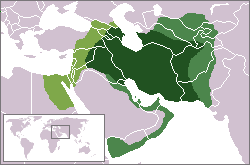
- I changed all the maps of the Sassanid Empire to this:

- Its seems as though someone made a better looking version of the map i made before, so I replaced it. This one looks better, but its the same thing.Khosrow II 23:06, 17 August 2006 (UTC)
Hello Khosrow II,
  I am very much an ardent reader of Sassanid history and military achievements, but I do have some questions regarding the map. Specifically, the entire Gujarat region in India is added to the dominion of the Sassanid empire as per the current map. Given that during the period you refer to (the early 600s) that region was a part of Harsha Vardhana's Empire, I was wondering: on what sources are these additions based? If not at this time, please inform me of what other time this conquests would have taken place.
  While the Sassanids are credited with claiming overlordship over the Kushans of that period, one should note that the Kushan empire at that time consisted essentially of parts of Afghanistan and northwestern Pakistan (not Gujarat). Accordingly, throught the fifth century and most of the sixth, Gujarat was under the rule of the Guptas (whose secondary capital was at Vallabhi). Please refer me to the sources that were used to base this inclusion, as I would be interested in reading them. Otherwise, could we consider altering the map to account for this? Thanks.
Regards,
Devanampriya
- My source was another map. Also, it is very possible that the state you are talking about was a vassal or part of the indo-Sassanid empire.Khosrow II 13:37, 3 September 2006 (UTC)
Hello Khosrow II,
Thanks for your response. Would you be able to direct me to the map that was used so that I can examine its sources? My concern is that there may be no record of any Sassanid conquest in Gujarat. The territories that the Sassanids (indo-sassanids) gained in India were in the Punjab. The only Indian dynasty that was recorded to be a vassal was the Kushan empire, which at that point, ruled in the western Punjab and Southern Afghanistan (this is accurately displayed on your map). If we can find reliable sources that verify successful campaigning in Gujarat, then I have no concern with the map. However, this may not be the case, since Harsha ruled Gujarat during that period and the Maitrakas soon after. Are there any museum/history book maps that we could scan and upload instead? Again, I am an admirer of the Sassanids, so my concern here is accuracy and not diminishment of their legacy. I would appreciate it if you or anyone else could refer me to the map you used as reference. Thanks.
Best Regards,
Devanampriya
Your welcome. Here is the map I used to determine the eastern borders of the empire (the western borders I determined using Will Durant's description): [2] I believe the map was origionally created by the Iranian Chamber society, which is a reputable source.Khosrow II 04:14, 6 September 2006 (UTC)
Hello Khosrow II,
Thanks for your help. The western borders make sense to me as the Sassanids controlled those regions until the campaign of Heraclius (in any event, the Story of Civilization is an excellent source). I'll do some research and let you know what I find about their holdings in the East. Thanks again.
Regards,
Devanampriya
Image of Shapur II
What is going on? What happened to Shapur II picture? The image was used on so many pages that now it's removed, all those pages look empty. anyone have an idea of what happened? Thanks Arad 03:15, 28 August 2006 (UTC)
Sassanid "knights" as origin or Arab or European Knighthood
These provisions are inaccurate, and have been deleted. The primary weapon of the Sassanid clibanarii was the bow. This weapon was used to "shower shoot" arrows into beaten zones, as described in Roman sources. Arab heavy cavalry developed from the bedouin tradition of light horsemen, who fought using a controlled series of charges with a lance. The Arab cavalry in Spain did not even carry a bow at all.
Arab light cavalry became increasingly heavy as the conquest continued, due to plunder and increasing resources. The Sassanid empire had many influences on the Arabs, but the composition of cavalry types was not one of them. When the Arabs wanted armoured horse archers, they had to hire them from the turkic people beyond the frontier -- the Ghilmen.
The connection to Western chivalry is even less relevant. European knighthood developed out of Germanic warrior society and the changes to that warrior aristocracy due to the expansion of Germanc Europe under Charlemagne's conquests, and the long period of anarchy that followed, had nothing whatsoever to do with Persia.
Suggestions otherwise seem highly POV.Larry Dunn 18:46, 12 October 2006 (UTC)