




7 (New York City Subway service): Difference between revisions
Taikoguide (talk | contribs) No edit summary |
50.14.142.33 (talk) No edit summary |
||
| Line 5: | Line 5: | ||
| name = Flushing Local and Express |
| name = Flushing Local and Express |
||
| north term = [[Flushing – Main Street (IRT Flushing Line)|Flushing – Main Street]] |
| north term = [[Flushing – Main Street (IRT Flushing Line)|Flushing – Main Street]] |
||
| south term = [[Times Square (IRT Flushing Line)|Times Square]] |
| south term = [[Times Square (IRT Flushing Line)|Times Square]] (current)<br>[[34th Street (IRT Flushing Line)|34th Street]] (future) |
||
| terminals = |
| terminals = |
||
| stations = 21 (local service)<br>11 (express service) |
| stations = 21 (local service)<br>11 (express service) |
||
Revision as of 00:43, 30 August 2014
  Flushing Local and Express | |
 | |
| Northern end | Flushing – Main Street |
|---|---|
| Southern end | Times Square (current) 34th Street (future) |
| Stations | 21 (local service) 11 (express service) |
| Rolling stock | R188[1][2] (Rolling stock assignments subject to change) |
The 7 Flushing Local and <7> Flushing Express are two rapid transit services in the A Division of the New York City Subway, providing local and express services along the full length of the IRT Flushing Line. The logo is colored purple on station signs, route signs and the official subway map with local service denoted by a circular 7, express service by a 7 in diamond-shape. Both services operate between Main Street in Flushing, Queens and Times Square in Midtown Manhattan.
Local service operates at all times. Express service runs only during rush hours and early evenings in the peak direction. "Super Express" service to Manhattan is also provided after New York Mets games weeknights and weekends at Citi Field and US Open (tennis) games: starting at Mets – Willets Point and operating express to Times Square, also bypassing Junction Boulevard, Hunters Point Avenue and Vernon Boulevard – Jackson Avenue.[3]
The 7 is nicknamed the "International Express,"[4][5] in part because it travels through several different ethnic neighborhoods populated by U.S. immigrants, especially along Roosevelt Avenue, and in part because it was the principal line that served the 1964-65 New York World's Fair. This name is not official, nor is the title used in day-to-day operations.
Service history
On June 13, 1915, the first test train on the IRT Flushing Line ran between Grand Central and Vernon Boulevard – Jackson Avenue, followed by the start of revenue service on June 22. Over the next thirteen years, the line was extended piece by piece to its current form between Times Square and Flushing – Main Street.
The 7 designation has been assigned to its current route since the introduction of front rollsigns on the R12 in 1948.
From May 13, 1985 to August 21, 1989, the IRT Flushing Line was overhauled for improvements, including the installation of new track, repair of station structures and to improve line infrastructure. The major element was the replacement of rails on the Queens Boulevard viaduct. Express service was suspended for the duration of the project; however, extra service was provided for Mets games and Flushing Meadows Park events. Upon the completion of the project, express service was restored, but express trains bypassed 61st Street – Woodside because the Transit Authority was concerned about passengers transferring between local and express trains at that station. The stop was added a few months later after pressure from community opposition.[6]
In the mid-1990s, the MTA discovered that the Queens Boulevard viaduct structure was unstable, as rocks that were used to support the tracks as ballast became loose due to poor drainage, which, in turn, affected the integrity of the concrete structure overall. Express service was suspended between 61st Street – Woodside and Queensboro Plaza; temporary platforms were installed to access the express track in the four intermediate stations.[7] The work began in April 1993. When the viaduct reconstruction finished on March 31, 1997, full express service was reinstated.[8]
In 1999, express service was expanded from rush hours only to weekdays from 6:30 a.m. to 10:00 p.m. However, this expansion was cut back in 2009 due to frequent midday construction.
Work has been underway since 2008 to convert the 7 service to accommodate CBTC. Expected to cost $585.9 million, CBTC will allow two additional trains per hour as well as two additional trains for the 7 Subway Extension, providing a 7% increase in capacity.[9] (Currently, service on the 7 is currently limited to 27 trains per hour (tph) as a result of the bumper blocks at Times Square. A new terminal at 34th Street has tail tracks to store rush-hour trains and will increase the service frequency to 29 tph.[9]) New cars on order for the A Division (the R188 contract) are compatible with CBTC. Installation of CBTC and delivery of the trains will both be completed in 2016.[9]
The 7 Subway Extension southwest to 34th Street – 11th Avenue, near the Jacob K. Javits Convention Center, is currently under construction and is scheduled to be completed in late summer or early fall 2014, but will not be opened by November 2014.[10] Before the opening was pushed back three times, it was scheduled to open in December 2013. The 34th Street station's construction project itself will not be completed until the end of 2015.[11][12]
On November 16, 2010, New York City officials announced they are considering a further extension of the service across the Hudson River to the Secaucus Junction train station in New Jersey.[13] As of October 26, 2011 tentative support for the extension has been given by New York City Mayor Michael Bloomberg as well as New Jersey Governor Chris Christie in comments to the press.[14][15] However, in April 2013, MTA former chairman Joseph Lhota announced that the 7 train would not be extended to New Jersey due to the high costs of the project, which included constructing a subway yard and a subway tunnel in New Jersey. Instead, Lhota put his support behind Amtrak’s Gateway Tunnel project which entails a new tunnel to Manhattan for Amtrak and NJ Transit trains.[16]
Fleet
The 7 operates with 11-car sets; the number of cars in a single 7 train set is more than in any other New York City Subway service. These trains are not the longest in the system, since a train of 11 "A" Division cars is only 561 feet (171 m) long, while a standard B Division train, which consists of ten 60-foot cars or eight 75-foot cars, is 600 feet (180 m) long.
Low-Vs
The Steinway Low-V was built between 1915 and 1925 specifically for use on the current 7 train. They had special gear ratios to climb the steep grades (4.5%) in the Steinway Tunnels, something standard Interborough equipment could not do.[17]
Q-Types
In 1938, an order of all-new World's Fair cars was placed with the St. Louis Car Company. These cars broke from IRT "tradition" in that they did not have vestibules at each car end. In addition, because the IRT was bankrupt at the time, the cars were built as single ended cars, with train controls for the motorman on one side and door controls for the conductor on the other. These cars spent their last days on the elevated IRT Third Avenue Line in The Bronx.
R33/R36 WFs
In 1964, the picture window R33/R36 World's Fair cars replaced the older R15s for the 1964 New York World's Fair. The 7 was the last stronghold for the "Redbird" cars. Until December 2001, the entire fleet was dominated by the R33/R36 WF "Bluebird" cars. In 2001, with the arrival of the R142/R142A cars, the Transit Authority announced the retirement of all Redbird cars. From January 2002 to November 2003, the Bombardier-built R62A cars formerly used on the 3 and 6 trains gradually replaced all of the R33/36 WF cars on the 7. On November 3, 2003, the last Redbird train made its final trip on this route, making all stops between Times Square and the then-named Willets Point – Shea Stadium.[18]
Several Redbird cars running on this service were decorated with Mets logos and colors during the 2000 Subway Series against the New York Yankees, as the Flushing Line runs adjacent to Citi Field and the former location of Shea Stadium. Some R33/R36 WFs remain in Corona Yard, adjacent to Flushing Meadows Corona Park and Citi Field.
R62As
Currently, all of the R62As on the 7 have been upgraded with LED lighted signs to distinguish between express and local trains. These signs are located on the rollsigns that are found on the side of each car. The local is a green circle around the 7 service bullet while the express is a red diamond. Previously, the rollsigns showed either a 7 (within a circle) or a <7> (within a diamond) with the word "Express" underneath it. They will be replaced by R188 subway cars through 2016, and the displaced R62As will most likely be placed on either the 4, 5, or 6 services.[19][20]
R188s
By 2016, R188 cars equipped with communications-based train control (CBTC) will run on the 7, outfitted for the automation equipment for the Flushing Line. The first train of R188 cars began operating in passenger service on November 9, 2013.[21][22]
In addition to providing six extra 11-car trains for the 7 Subway Extension, the R188s will allow twenty R62A expansion cars to be freed up for the other seven IRT services.
Gallery
-
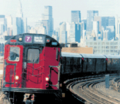 An R36 7 local northbound at 33rd Street–Rawson Street. The 7 train's fleet consisted entirely of these cars (called "Redbirds") before their retirement in 2003.
 -
 Manhattan-bound 7 train of R62As, which comprise the current 7 train fleet, at Mets – Willets Point
 -
 Green circle denotes a Template:NYCS-bull-small local train.
 -
 Red diamond denotes an Template:NYCS-bull-small express train.
 -
 Train of R188 cars departs the 52nd Street station. The R188s will displace the 7 train's current R62A fleet.


Route
Service pattern
The following table shows the line used by the 7 and <7> trains, with shaded boxes indicating the route at the specified times:
| Line | From | To | Tracks | Times | ||
|---|---|---|---|---|---|---|

|

| |||||
| rush peak | all times | |||||
| IRT Flushing Line | Flushing – Main Street | 33rd Street – Rawson Street | express | |||
| local | ||||||
| Queensboro Plaza | Times Square | all | ||||
Stations
For a more detailed station listing, see IRT Flushing Line.
| Station service legend | |
|---|---|

|
Stops 24 hours a day |

|
Stops every day during daytime hours only |

|
Stops during weekday daytime hours only |

|
Station closed |

|
Stops rush hours/weekdays in the peak direction only |
| Time period details | |

|
Station is compliant with the Americans with Disabilities Act |
| ↑
|
Station is compliant with the Americans with Disabilities Act in the indicated direction only |
| ↓
| |

|
Elevator access to mezzanine only |
- Express service runs weekdays from 6:30 to 10:00 a.m. going to Times Square and 3:00 to 9:30 p.m. (15:00 to 21:30) going to Flushing – Main Street as well as after games at Citi Field.
References
- ^ 'Subdivision 'A' Car Assignment Effective December 23, 2023'. New York City Transit, Operations Planning. December 23, 2023.
- ^ "Subdivision 'A' Car Assignments: Cars Required December 23, 2023" (PDF). The Bulletin. 67 (2). Electric Railroaders' Association. February 2024. Retrieved March 22, 2024.
- ^ Take the Train to See the Mets and Yankees
- ^ "The International Express: Around the World on the 7 Train". Queens Tribune. Retrieved May 15, 2009.
- ^ Cohen, Billie (January 14, 2008). "No. 7 Train From Flushing-Main Street to Times Square". The New York Times. Retrieved May 15, 2009.
- ^ Feinman, Mark S. (December 8, 2004). "The New York City Transit Authority in the 1980s". nycsubway.org. Retrieved May 15, 2009.
- ^ Pérez-Peńa, Richard (October 9, 1995). "Along the Subway, a Feat in Concrete". The New York Times. Retrieved May 15, 2009.
- ^ Onishi, Norimitsu (February 16, 1997). "On the No. 7 Subway Line in Queens, It's an Underground United Nations". The New York Times. Retrieved May 15, 2009.
- ^ a b c MTA's Q&A on Capital Program 2010-2014
- ^ a b Kabak, Benjamin (February 27, 2014). "7 line extension opening now projected for November". Second Avenue Sagas. Retrieved March 5, 2014.
- ^ "MTA's 7 Line Extension Project Pushed Back Six Months". NY1. June 5, 2012. Retrieved 2012-06-05.
- ^ Cuozzo, Steve (June 5, 2012). "No. 7 train 6 mos. late". New York Post. Retrieved 2012-06-05.
- ^ NYC Subway Line May Continue Into N.J.
- ^ Bloomberg wants to extend 7 train to NJ
- ^ Christie Endorses Extension of New York Subway to New Jersey
- ^ No chance of No. 7 train extending to New Jersey
- ^ Sansone, Gene (2004). New York Subways. JHU Press. p. 84. ISBN 0-8018-7922-1.
- ^ Luo, Michael (November 4, 2003). "Let Go, Straphangers. The Ride Is Over". The New York Times. Retrieved 2011-10-02.
- ^ Rubinstein, Dana (2012-09-05). "M.T.A. to upgrade 7 line by trading old cars to Lexington Avenue". Capital New York. Retrieved 2014-05-15.
- ^ http://library.rpa.org/pdf/RPA-Moving-Forward.pdf Page 47
- ^ Mann, Ted. "MTA Tests New Subway Trains on Flushing Line". The Wall Street Journal. Retrieved 19 November 2013.
- ^ New Subway Cars Being Put to the Test
- ^ Only the Flushing-bound local side platform is wheelchair-accessible. Trains operate on this platform only during New York Mets games and other special events.
- ^ "Mets - Willets Point Station: Accessibility on game days and special events only". New York Metropolitan Transportation Authority. Archived from the original on 22 April 2009. Retrieved May 15, 2009.
{{cite web}}: Unknown parameter|deadurl=ignored (|url-status=suggested) (help)
External links
| External videos | |
|---|---|
 A Weekend at Work: Flushing Line May 2011, Metropolitan Transportation Authority; July 21, 2011; 3:42 YouTube video clip A Weekend at Work: Flushing Line May 2011, Metropolitan Transportation Authority; July 21, 2011; 3:42 YouTube video clip |
- MTA New York City Transit – 7 Flushing Local
- MTA New York City Transit – 7 Flushing Express
- "7 Subway Timetable, Effective June 23, 2025". Metropolitan Transportation Authority. Retrieved November 10, 2025.
- Safari 7 – Tour of Urban Wildlife along the 7 train
- Template:PDFlink
- City Raises $2 Billion In Bonds For No. 7 Train Extension - NY1 local news channel (retrieved on 12/07/2006)
- Once Upon A Time In Queens: Number 7 Train Provides Real Connection To History - NY1 local news channel (retrieved on 05/25/2010)
| Current services |
| ||||||||||||
|---|---|---|---|---|---|---|---|---|---|---|---|---|---|
| Defunct services |
| ||||||||||||
| Stations (List) |
| ||||||||||||
| Divisions | |||||||||||||
| Other lists | |||||||||||||
| History |
| ||||||||||||
| Infrastructure |
| ||||||||||||
| Arts and culture | |||||||||||||
| Miscellaneous | |||||||||||||
| Other rapid transit in NYC |
| ||||||||||||


