







User:Benjah-bmm27/degree/2: Difference between revisions
Benjah-bmm27 (talk | contribs) →Boron–phosphorus chemistry: rearrange images |
|||
| Line 405: | Line 405: | ||
* [[Chemical thermodynamics]], [[thermochemistry]] |
* [[Chemical thermodynamics]], [[thermochemistry]] |
||
* [[Specific heat capacity]] |
* [[Specific heat capacity]] |
||
* [[enthalpy]] |
|||
* [[entropy]] |
|||
* [[Van 't Hoff equation]] |
* [[Van 't Hoff equation]] |
||
* [[Clausius-Clapeyron relation]] |
* [[Clausius-Clapeyron relation]] |
||
| Line 410: | Line 412: | ||
* [[Gibbs–Duhem equation]] |
* [[Gibbs–Duhem equation]] |
||
* [[Third law of thermodynamics]]: the entropy of all perfect crystals at 0 K is zero, i.e. ''S''<sub>0</sub> = 0, [[residual entropy]] in non-perfect crystals |
* [[Third law of thermodynamics]]: the entropy of all perfect crystals at 0 K is zero, i.e. ''S''<sub>0</sub> = 0, [[residual entropy]] in non-perfect crystals |
||
* [[chemical potential]] |
|||
* [[Raoult's law]] |
|||
* [[Henry's law]] |
|||
* [[Boiling-point elevation]] |
|||
* [[Freezing-point depression]] |
|||
* [[Osmotic pressure]] |
|||
===Photochemistry, AJOE=== |
===Photochemistry, AJOE=== |
||
Revision as of 13:11, 22 April 2009

Level 2
Organic
Monocarbonyls, TCG
"Monofunctional Carbonyl Compounds and Carbanion Chemistry"
- Carbanions
- Organolithium reagents e.g. BuLi, LDA
- Grignard reagents
- Enol, enolate anion
- Keto-enol tautomerism
- Silyl enol ether (from Me3SiCl with Et3N), enamines, aza-enolates
- Aldol reaction, incl. silyl enol ether aldol reactions
- Reformatsky reaction
- Henry reaction (nitro aldol)
- Claisen condensation
- Mannich reaction and Mannich bases
- Haloform reaction
- E1cB elimination reaction
Dicarbonyls, PJW
"Difunctional Carbonyl Compounds"
- Diketone
- Hard and soft nucleophiles and electrophiles
- Michael reaction, nucleophilic conjugate addition, Gilman reagents
- Dithianes (hard nucleophile at carbonyl carbon)
- Claisen condensation
- Nef reaction
- McMurry reaction
- Darzens reaction
- Benzoin condensation
- Acyloin condensation
- Pinacol coupling reaction
- Robinson annulation: ChemTube3D animation
- OsO4: Upjohn dihydroxylation
Aromatics and amines, TJS
"Aromatic Compounds and Amines"
- CLW for amines: Gabriel synthesis, sodium azide amine synthesis, reductive amination (with NaBH3CN), Hofmann rearrangement, nitrosation
- Electrophilic aromatic substitution
- Activating group. deactivating groups
- Arene substitution patterns
- Inductive effect, mesomeric effect
- Friedel-Crafts reaction (alkylation and acylation)
- Gattermann-Koch reaction
- Wolff-Kishner reduction (KOH, N2H4)
- Clemmensen reduction (Zn, HCl)
- Nitrosation of aryl amines to diazonium salts
- Baeyer-Villiger oxidation
- Naphthalene EAS
- Birch reduction
- Claisen rearrangement
- Fries rearrangement
Heterocycles, KIBM
"Heterocyclic Compounds"
- Heterocyclic chemistry
- Pyrrole, furan, thiophene
- Vilsmeier reaction
- Cycloaddition
- Paal-Knorr synthesis
- Knorr pyrrole synthesis
- Feist-Benary synthesis
- Chichibabin reaction
- Pyridine-N-oxides
- Picolines
- Pyridinium salts
- Hantzsch pyridine synthesis
- Guareschi-Thorpe synthesis
Retrosynthesis, CLW
"Organic Synthesis"
Books:
- Chris Willis and Martin Wills, Organic Synthesis (Oxford Chemistry Primer) (1995) (on Amazon.co.uk)
- Stuart Warren and Paul Wyatt, Organic Synthesis: The Disconnection Approach (2008) (on Amazon.co.uk)
- Stuart Warren, Organic Synthesis: The Disconnection Approach (1983) (on Amazon.co.uk)
Stereochemistry, APD
"Stereochemistry and Conformation"
- Stereochemistry
- Cahn–Ingold–Prelog priority rules
- Chirality (chemistry)
- Absolute configuration
- Enantiomer
- Diastereomer
- Molecular configuration
- Conformational isomerism
- Alkane stereochemistry
- Bürgi-Dunitz angle
- Baeyer strain
- Pitzer strain
- Cycloalkanes
- Cyclopropanes - planar by definition
- Cyclobutanes - puckered to avoid eclipsing interactions
- Cyclopentanes - envelope conformation
- Cyclohexane conformation - chair form, boat form, twist boat, twist chair
- Anomeric effect
- Steric effects
Rearrangements, CPB
"Rearrangements involving Carbocationic or Polar Intermediates"
ylamide-anion-anion-rearrangement-mechanism-2D.png)
- Carbocations
- Carbon radicals (e.g. Ph3C·)
- Carbenes
- Carbanions
- Inductive effect
- Mesomeric effect (e.g. allyl, benzyl C+)
- Hyperconjugation, Beta-silicon effect
- Non-classical ions
- Synchronicity of mechanisms: stepwise reaction, concerted reaction, reaction intermediate,
- Rearrangement reaction
- 1,2-rearrangement
- Pinacol rearrangement
- Demjanov rearrangement
- Wagner-Meerwein rearrangement
- Arndt-Eistert synthesis
- Hofmann rearrangement
- Curtius rearrangement
- Lossen rearrangement
- Schmidt reaction
- Beckmann rearrangement
Proteins, DNW
"Amino Acids, Peptides and Proteins: Chemistry, Structure and Function"
- Nylon (polyamides) from condensation polymerisation, e.g.
- nH2N-(CH2)6-NH2 + nClOC-(CH2)4-COCl → (-HN-(CH2)6-NH-CO-(CH2)4-CO-)n (nylon 6,6 with amide bond in bold) + 2nHCl
- Aramids e.g. Kevlar
- Amino acids
- Peptide bonds
- Peptides
- Proteins
- Hormones, signaling molecules
- Peptide synthesis, Protein synthesis, Protein biosynthesis
- Protein structure, Protein folding, Protein structure prediction, Membrane protein
- Keratin
- π-π stacking interactions
- Ubiquitin (PDB 1UBQ ubiquitin), Proteasomes
- Chemical polarity of amino acids: FAMILYVW - hydrophobic, DEHKNQRST - polar, GPC - special
- Proline (Pro, P) is special:
- It's a secondary amino acid (AKA imino acids, although this nomenclature is disputed)
- It's conformationally locked (backbone dihedral angle φ fixed to about −75°) → very rigid, loses less conformational entropy upon folding, found in turns
- Protein structure:
- Primary structure: sequence of amino acid backbone (plus cross-linking such as disulfide bonds)
- Secondary structure: alpha helices, beta strands (plus rare others)
- Tertiary structure: three-dimensional structure (full set of atomic coordinates in 3D space) - determined by protein crystallography or protein NMR
- Quaternary structure: arrangement of multiple folded protein molecules in a multi-subunit complex - XRD again
- Ramachandran plot
- UV-Vis spectroscopy can be used to determine protein concentration - aromatic amino acid side chains (K, Y, W, H) absorb UV
- Supersecondary structure:
- Plastocyanins - Cu redox centre converts between Cu(I) and Cu(II), coordination geometry of Cu is not optimal for either oxidation state, making neither favoured and thus interconversion facile. Structures: PDB 3BQV, PDB 1PNC.
-
 Ribbon diagram of plastocyanin
 -
 Residues coordinating Cu in plastocyanin
 -
 Cu coordination geometry


- EF hand - chiral, right-handed enantiomer only (with one exception). Aspartic acid residues bind Ca2+ (important in calcium signaling) in loop between two alpha helices.
- Beta hairpin - major structural unit, two beta strands antiparallel
- βαβ motif - two beta strands parallel, chiral (alpha helix either above or below plane of beta strands), only right-handed enantiomer found in nature
- Coiled coil - left-handed(!) - HPPHPPP repeat gives 3.5 not 3.6 residues per turn, so hydrophobic seam slowly curves - myosin, keratin
- Polyproline helix?
- Collagen helix?
- Tertiary structure:
- all α-structures (αα) - buffers, triggers, allostery
- calbindin - (2 × EF hand) mops up loose Ca2+
- myoglobin - baby brother of haemoglobin - 8 helices, haem group binds Fe and thus O2
- all β-structures (ββ) - hard-as-nails brick walls → rigidity
- viral capsids
- plastocyanin
- antibodies
- all α-structures (αα) - buffers, triggers, allostery
- TIM barrel
OCPCs
- RJC: Organic redox reactions
- Manganese dioxide oxidation of isopropanol to acetone
- Dess-Martin periodinane
- Baeyer-Villiger oxidation
- Swern oxidation
- Jones oxidation
- pyridinium chlorochromate oxidation
- ozonolysis
- epoxidation of olefins
- osmium tetroxide dihydroxylation
- hydrogenation
- NaBH4 and LiAlH4 reductions
- DIBAL-H reduction
- hydroboration-oxidation
- Birch reduction
- PJW: Reversibility in reactions
- KIBM: Planning organic synthesis
- MCG: Protecting groups
- VKA: Mechanism
- Acetal formation
- RJC: Why reactions go wrong
Inorganic
NMR, CJA
"Introduction to NMR Spectroscopy"
- Nuclear magnetic resonance
- NMR spectroscopy
- Gyromagnetic ratio
- Proton NMR
- Carbon-13 NMR
- Chemical shift
- J-coupling
- Chemical equivalence, magnetic equivalence
- Berry pseudorotation
- Relaxation (NMR)
- Karplus equation
Main group 1, NCN
"Chemistry of the Main Group Elements, Part 1"
- Ionization potentials (of the elements)
- Inert pair effect
- Electronegativity
- Coordination geometry
- Coordination number
- Ionic radius
- Covalent radius
- Allotropes of phosphorus
Chlorides
| group → period ↓ |
13 | 14 | 15 | 16 | 17 |
|---|---|---|---|---|---|
| 2 | B B2Cl4 BCl3 |
C C2Cl4 CCl4 |
N - NCl3 |
O - - |
F - - |
| 3 | Al - AlCl3 |
Si - SiCl4 |
P PCl3 PCl5 |
S S2Cl2 SCl2 |
Cl - - |
| 4 | Ga GaCl Ga3Cl7, GaCl2 GaCl3 |
Ge - GeCl2 GeCl4 |
As - AsCl3 AsCl5 |
Se Se2Cl2 SeCl4 - |
Br BrCl - - |
| 5 | In InCl In5Cl9, In2Cl3, In7Cl9 InCl3 |
Sn - SnCl2 SnCl4 |
Sb - SbCl3 SbCl5 |
Te Te2Cl, TeCl2 Te3Cl2 TeCl4 |
I ICl ICl3 - |
| 6 | Tl TlCl TlCl2, Tl2Cl3 TlCl3 |
Pb - PbCl2 PbCl4 |
Bi - BiCl3 - |
Po PoCl2 PoCl4 - |
At ? - - |
Oxides
| group → period ↓ |
13 | 14 | 15 | 16 | 17 |
|---|---|---|---|---|---|
| 2 | B B2O3 B6O |
C COx CO CO2 CO3 C3O2 C2O |
N NOx N2O NO NO2 N2O4 N2O3 N2O5 |
O O2 O3 |
F F2O F2O2 |
| 3 | Al Al2O3 |
Si SiO2 SiO |
P P2O5 P2O3 |
S SOx SO2 SO3 |
Cl ClOx ClO2 Cl2O7 Cl2O Cl2O3 Cl2O6 |
| 4 | Ga Ga2O3 - |
Ge GeO GeO |
As As2O5 As2O3 |
Se SeO2 SeO3 |
Br - - |
| 5 | In In2O3 - |
Sn SnO SnO2 |
Sb Sb2O5 Sb2O3 |
Te TeO2 TeO3 |
I IOx I2O4 I2O5 I4O9 |
| 6 | Tl TlO2 Tl2O Tl2O3 - |
Pb PbOx PbO PbO2 Pb3O4 |
Bi Bi2O3 - |
Po PoO2 PoO3 |
At - - |
Organometallics, DFW
"Organo-Transition Metal Chemistry" http://www.ilpi.com/organomet/
- Organometallic chemistry
- d electron count, electron counting
- 18-Electron rule
- Fluxionality
- Metal carbonyl
- Mond process
- π backbonding: Dewar-Chatt-Duncanson model
- Beta-hydride elimination
- Zeise's salt
- 1,3-Butadiene as a ligand

Transition metals 1, CAR
"Coordination Chemistry of the Transition Metals, Part 1"
Solid state, SRH
- Close-packing of spheres, HCP, CCP
- Unit cell, Miller indices
- Common structure types: Cubic diamond, NaCl, CsCl, NiAs, β-ZnS, α-ZnS, CdCl2, CdI2, TiO2, CaF2, CaTiO3, ReO3
- Molybdenum disulfide
- Lattice energy: Born-Landé equation, Madelung constant, Kapustinskii equation
- Cation-anion radius ratio, Pauling's rules
- Solid-state synthesis: ceramic method (heat and beat, shake and bake)
- Free electron model, Density of states
- Band theory
- Fermi energy, Fermi level
- Coprecipitation, Solid-state reaction, fr:Chimie douce, Redox, Comproportionation, Electrolysis
- Intercalation: potassium graphite
- Ionic conductivity: fast ion conductors
- Lattice defects: Schottky defects
- Atomic wires - cyanoplatinates
- Electron magnetic dipole moment
- Magnetic structure: magnet, diamagnetism, paramagnetism, magnetic susceptibility, Curie–Weiss law, ferromagnetism, antiferromagnetism, ferrimagnetism, antiferrimagnetism, Néel temperature
- Other magnetism stuff: spin glass, photomagnetism, metamagnetism, superparamagnetism
- Superexchange: MnO, FeO, CoO, NiO;
- Superconductivity: zero resistance + Meissner effect, Heike Kamerlingh Onnes, high-temperature superconductivity, yttrium barium copper oxide
Transition metals 2, FCM
"Co-ordination Chemistry of the Transition Metals, Part 2"
- Trans effect
- Eigen-Wilkins mechanism (de:Eigen-Wilkins-Mechanismus, Manfred Eigen and R. G. Wilkins)
- Associative, dissociative and interchange reaction mechanisms: Dissociative substitution, Associative substitution, Sn1CB mechanism
- Marcus theory
- Eyring equation
- Electron transfer: Inner sphere electron transfer, Outer sphere electron transfer
Main group 2, IM
"Chemistry of the Main Group Elements, Part 2: Rings, Chains and Macromolecules, Based on Main Group Elements"
Boron–nitrogen chemistry
- Boron nitride
- Amine-borane complexes, e.g. H3N→BH3 ammonia borane
- Aminoboranes
- Iminoboranes: tBu-B≡N-tBu Chem. Ber. (1984) 117, 1089-1102 (Shelf 20 in library)
- Borazine
-side-3D-balls.png)
-top-3D-balls.png)


borane-resonance-2D.png)
borane-from-xtal-1983-3D-balls.png)
Boron–phosphorus chemistry
- Phosphine-borane adducts
- Phosphinoboranes, e.g. [Ph2P-BH2]4
- Boraphosphabenzenes, e.g. cyclo-(BMes)3(PCy)3
- Polyphosphinoboranes, e.g. (PHPh-BH2)n


Boron–oxygen chemistry
- B2O3
- Borosilicate glass
- Borates
- Molecular B-O species, e.g. hydrolysis of chlorosilanes leading to boronic acids RB(OH)2, and boroxines
Silicon–oxygen chemistry
- Silicon dioxide – α-quartz
- Siloxanes and polysiloxanes, e.g. PDMS, Rochow-Müller process, silicone gum, silicone rubber, thermal anionic ring-opening polymerization


Organosilicon chemistry
- Organosilicon chemistry
- Hexamethyldisilane
- Polysilanes, sigma delocalisation c.f. polyacetylene, lithography
- Polysilynes
- Polycarbosilanes
- Disilenes: Adv. Organomet. Chem. (2006) 54, 73-148 (review, including π-σ* mixing MO diagram accounting for pyramidalization of Si)
- First disilene, tetramesityldisilene (R. West, 1981): Organometallics (1984) 3, 793–800, Heteroat. Chem. (1990) 1, 1-7
- Recent calculated structures of disilene itself, Si2H4: Chem. Phys. Lett. (2008) 466, 11-15, Jmol structure

Phosphorus–nitrogen chemistry


Phosphorus–oxygen chemistry
- Phosphoric acid, pyrophosphoric acid, phosphorus trioxide, phosphorus pentoxide, tripolyphosphoric acid, sodium tripolyphosphate, polynucleotides


Sulfur–oxygen chemistry
- Catenated sulfur: Cyclooctasulfur, S8 and plastic sulfur, Sn
- Sulfur oxides: SO2, SO3 (monomer, trimer and polymer)
- Sulfuric acid and other sulfur oxoacids: disulfuric acid


Sulfur–nitrogen chemistry


Physical
Thermodynamics, PWM
"Chemical Energy II"
- Chemical energy
- Chemical thermodynamics, thermochemistry
- Specific heat capacity
- enthalpy
- entropy
- Van 't Hoff equation
- Clausius-Clapeyron relation
- Trouton's rule
- Gibbs–Duhem equation
- Third law of thermodynamics: the entropy of all perfect crystals at 0 K is zero, i.e. S0 = 0, residual entropy in non-perfect crystals
- chemical potential
- Raoult's law
- Henry's law
- Boiling-point elevation
- Freezing-point depression
- Osmotic pressure
Photochemistry, AJOE
"Introduction to Photochemistry"
- Photochemistry
- Atomic spectroscopy
- Spin multiplicity
- Quantum number
- Clebsch–Gordan coefficients
- Grotrian diagram
- Jablonski diagram
- Fluorescence
- Phosphorescence
- Intersystem crossing
- Internal conversion
- Quenching (fluorescence)
- Quantum yields
Chemical interactions, DMS
"Chemical Interactions"
- Lennard-Jones potential
- Ideal gas
- Perfect gas
- Gibbs' phase rule
- Phase equilibria
- Phase diagram
- Azeotrope
- Triple point
Interfaces, JPR
"Interfaces"
- Interface (chemistry)
- Colloid
- Surfactants
- Detergency
- Critical micelle concentration
- Surface tension, Surface energy
- Contact angle
- spreading coefficient
- Young-Dupre equation
- Capillary rise
- Surface roughness
- Adhesional wetting
- Critical radius
- Emulsion
- Bancroft rule
- Vapor pressure, Kelvin equation, Supersaturation, Nucleation
Kinetics, DES
"Kinetics"
- Chemical kinetics
- Reaction rate
- Rate equation
- Elementary reaction
- Reaction rate constant
- Rate-determining step
- Activation energy
- Arrhenius equation
- Lindemann mechanism
- Collision theory (rubbish)
- Transition state theory
- Molecularity?
- Enzyme catalysis, Michaelis–Menten kinetics
Equilibria, PB
"Equilibria"
Equilibrium electrochemistry, DJF
"Equilibrium Electrochemistry"
- Category:Electrochemistry
- Electrochemistry
- Chemical potential
- Fundamental equation of chemical thermodynamics (see PWM):

- Electrochemical potential
- Activity of ions in solution
- Faraday constant
- Volta potential
- Galvani potential
- Liquid junction potential
- Electrochemical cell
- Half cell
- Galvanic cell
- Redox electrode
- Absolute electrode potential
- Reference electrode
- Standard hydrogen electrode
- Silver chloride electrode
- Potentiometric titration
- Glass electrodes
- Ion selective electrodes
- Batteries: Leclanché cell, Alkaline battery, Lead-acid battery, Nickel-cadmium battery, Lithium-ion battery (e.g. Lithium cobalt oxide-Graphite),
- Fuel cells
- Double layer (interfacial) / Electrical double layer: Helmholtz model, Gouy-Chapman model, Stern model, IUPAC definition of diffuse layer
- Supercapacitors
- Potential at the point of zero charge (p.z.c.): IUPAC definition of pzc, Point of zero charge
- Molecular dynamics simulations
- News reports:
Macromolecules, JSvD
"Macromolecules"
- Macromolecules
- Osmotic pressure
- Phase separation
- Polyelectrolyte (light scattering)
- Polymer synthesis
- Copolymerisation
- Step-growth polymerization
- Ionic polymerisation (e.g. anionic addition polymerization)
- Biopolymers
- Flory–Huggins solution theory
Theoretical
Quantum mechanics, FRM
"Quantum Concepts"
- Molecular structure
- Reactivity
- Quantum chemistry
- Nuclei much heavier than electrons ∴ molecules have structure
- Electrostatics, internuclear repulsion
- Zero-point energy
- Born-Oppenheimer approximation
- Potential energy surfaces: minima correspond to stable structures, saddle points correspond to transition states, reaction pathways correspond to mechanisms
- Conformation of ethane, nitrogen inversion
- de Broglie wavelength
- Schrödinger equation
- Hamiltonian operator
- Wavefunctions
- Particle in a box
- Boundary conditions
- Heisenberg uncertainty principle
- Hydrogen atom
- Spherical polar coordinates
- Electron spin: Stern-Gerlach experiment suggested electrons have intrinsic, quantized spin angular momentum. It is now known that the spin angular momentum quantum number s = ½, and the spin projection quantum number, ms = ±½.
- Molecular Schrödinger equation
- Molecular orbital approximation, molecular orbital theory (ignores electronic correlation)
- Normalization of wavefunctions
- Orthogonality:
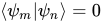
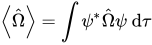
In quantum mechanics, two eigenstates of a wavefunction, and , are orthogonal if they correspond to different eigenvalues. This means, in Dirac notation, that unless and correspond to the same eigenvalue. This follows from the fact that Schrödinger's equation is a Sturm–Liouville equation (in Schrödinger's formulation) or that observables are given by hermitian operators (in Heisenberg's formulation). - Expectation value (quantum mechanics):
- Variational principle
- Linear combination of atomic orbitals molecular orbital method
- Vibrational spectroscopy: molecular vibration, harmonic approximation cf. classical oscillator
- Quantum tunnelling
- Kinetic isotope effect, e.g. in amine dehydrogenase
- Reaction coordinate
- Transition state theory
- Morse potential


Molecular orbitals, NLA
"Understanding Structure and Reactivity, Part 1"
- Octet rule (and its failure)
- Born-Oppenheimer approximation
- Orbital
- Wavefunction
- Electron density
- Schrödinger equation
- Potential energy curve
- Simple harmonic oscillator, quantum harmonic oscillator
- Zero-point energy
- Valence-bond theory
- Molecular orbital theory
- Linear combination of atomic orbitals molecular orbital method
- Normalisation
- Variational principle
- Bond order
- Franck-Condon Principle
- Koopmans' theorem
- Kapustinskii equation
- Born-Haber cycles
- Alkalides
Hückel, AJM
"Understanding Structure and Reactivity, Part 2": http://www.chm.bris.ac.uk/pt/ajm/sb04/
- Secular equations - see Quantum Concepts lectures by FRM's predecessor Prof. Balint-Kurti: GGBK lecture 6
- Hückel method
- Hückel's rule: aromaticity and antiaromaticity
- Pericyclic reactions: ChemTube3D - Jmol animations of pericyclic reactions
- Came up in the exam: the non-Kekulé molecule trimethylenemethane
Environmental
Geochemistry, RPE
"Origin and Fate of Organic Matter in the Geosphere"
- Biogeochemistry
- Oxygen evolution and history of life on Earth:
- 3700-2000 Ma - banded iron formations (alternating Fe3O4/Fe2O3 and silicate (chert) layers) due to early marine photosynthesis: O2 causes Fe2+ → Fe3+
- 2000 Ma - Great Oxidation Event - O2 started to evolve from cyanobacteria in the oceans into the atmosphere
- 2000 Ma-present - Continental Red Beds - widespread oxidation at Earth's surface
- 1500 Ma - Gypsum formation: atmospheric SO2 + O2 → SO42−, then + Ca2+ → CaSO4
- Isotope geochemistry
- Isotope ratio mass spectrometry
- from Peedee belemnite
- Carbon cycle
- Biosphere:
- Photosynthesis: CO2 + H2O → CH2O + O2
- Respiration: CH2O + O2 → CO2 + H2O
- Exchange of CO2 with oceans
- Biosphere:
- Keeling Curve
![{\displaystyle \delta ^{13}{\text{C}}=\left[{{\frac {R_{\text{sample}}}{R_{\text{standard}}}}-1}\right]\times 1000{\text{ permil}}}](https://wikimedia.org/api/rest_v1/media/math/render/svg/cc7a0c35952ac40fc41f2bab5786d02695bd188e)


- Methane CH4:
- Sources:
- Natural: wetlands (habitat for methanogenic bacteria), termites, oceans, methane hydrates
- Methane catastrophes, e.g. Permian–Triassic extinction event 250 Ma
- Anthropogenic: energy, ruminants, rice paddies, landfills, biomass burning (biofuel), waste
- Natural: wetlands (habitat for methanogenic bacteria), termites, oceans, methane hydrates
- Arctic methane release, methane clathrates
- Sinks: tropospheric destruction, loss to stratosphere, soils (consumed by methanotrophs)
- Low affinity (high capacity) methanotrophs - live in methanogenic environments, reoxidise ~90% of CH4 to CO2 before it escapes, adapted to [CH4] up to 40 ppm
- Sources:
| formula | CH4 | → | CH3OH | → | HCHO | → | HCO2H | → | CO2 |
|---|---|---|---|---|---|---|---|---|---|
| molecule | methane | methanol | formaldehyde | formic acid | carbon dioxide | ||||
| C-O bonds | 0 | 1 | 2 | 3 | 4 |
- High affinity (low capacity) methanotrophs - live in well aerated soils (upland, forests, grasslands, farmland), adapted to [CH4] up to 12 ppm
- Investigate high affinity methanotrophs by following their characteristic PFLAs. Analyse 13CH4-fed methanotroph colonies for 13C-rich PFLAs to find out which PFLAs are characteristic.
- Methanotrophs cannot do their job if their habitats are destroyed - woodland → agricultural land means [N] ↑ so methanotrophs inhibited
- Need to use land correctly to protect methanotrophs and allow them to help prevent [CH4] ↑
- Biochemicals:
- Carbohydrates for structure and energy storage, e.g. cellulose, polymer of ~10000 glucose monomers
- Lignins for structure of cell walls in higher plants, high m.w. polyphenolic heteropolymers of coumaryl alcohol, coniferyl alcohol, sinapyl alcohol
- Proteins for structure, catalysis (enzymes), storage - biopolymers of amino acids, 1-500 kDa
- Lipids - all biochemicals that are insoluble in water but soluble in organic solvents, <1000 Da, often fully saturated chains and rings - e.g. alkanes, wax esters, triglycerides, sterols:
- straight-chain lipids - n-alkanes (odd numbers predominate, C13-23 in algae, C23-33 in higher plants), n-fatty acids and n-fatty alcohols (even numbers predominate, C16 and C18 everywhere, while C20 and C30 found in higher plant leaf waxes
- branched-chain fatty acids (phospholipids) characteristic of bacteria, esp. C15, C17, plus corresponding alcohols and alkanes; acyclic isoprenoids (e.g. phytol) based on C5 isoprene
- sterols and hopanols are diagnostic of particular organisms - hormones and membrane rigidifiers, e.g. C27 cholesterol in animals, C28 campesterol and C29 sitosterol in higher plants, C28 ergosterol in fungi, C30 dinosterol in algae and bacteriohopanetetrol in bacteria (which cannot make sterols)
- C3 and C4 plants:
- C3 carbon fixation: C3 plants adapted to moderate climates, use Calvin cycle to fix CO2 as 3-phosphoglycerate, δ13C = −28 to −34 ‰ in alkanes (bulk tissue still −26 ‰)
- C4 carbon fixation: C4 plants adapted to hot or dry climates, use Hatch-Slack pathway to fix CO2 as oxaloacetate, δ13C = −20 to −24 ‰ in alkanes (bulk tissue still −26 ‰)
- Bengal fan - an alluvial fan: may be contaminated, but very good temporal resolution. Palaesol and ocean sediment carbon isotope records match and suggest a shift from C3 to C4, starting 9 Ma, peaking 4 Ma, and now returning towards C3 values.
- Paleosols: in situ, so less contamination, but poor temporal resolution because mixing occurs
- Biomarkers of terrestrial vegetation, e.g. C27, C29, C31, C33 n-alkanes
Marine chemistry, RDP
"Marine Chemistry"
- Physical oceanography
- Chemical oceanography
- Seawater, salinity: conservative ions (99.8% of ocean solutes) are nacklecamgsok: Na+, Cl−, Ca2+, Mg2+, SO42−, K+
- Ocean current, hydrothermal circulation
- Thermohaline circulation: halocline, thermocline, pycnocline, sea surface temperature
- Upwelling
- Carbon cycle
- Redfield–Richards ratio in marine plankton – C:H:P – 106:16:1
- Nitrification, Anammox, Sulfur assimilation, Denitrification, Methanogenesis
- Remineralisation
- Biological pump - faecal pellet packaging (particulate) and downwelling (dissolved) transport organic carbon from the surface to the deep ocean
- Paleocene–Eocene Thermal Maximum
- Methane clathrate
- Archaeol
- Sulfate-reducing bacteria
- Dissolved inorganic carbon: CO2, CO32−, HCO3−, H2CO3, CaCO3
- Lysocline, Carbonate Compensation Depth
- Ocean acidification, UNESCO ocean acidification FAQ
- Biomarkers, haptophytes, dinoflagellates, diatoms, maitotoxin
- Methanogens and methanotrophs are archaea and have ether lipid membranes
- they probably developed in warm conditions, so needed lipids resistant to acid hydrolysis – an ester lipid would not do
- ether lipids are used to trace methanogenic and methanotrophic archaea
Isorenieratene
- Anoxygenic photosynthesis by Chlorobium (green sulfur bacteria):
- H2S + CO2 + hν → SO42− + organic C
- needs reduced sulfur so strictly anaerobic, but also needs light – rare combination of conditions, found in very stratified water columns (constrained basin with fresh water flowing in to achieve sharp density gradient), e.g. the Black Sea
- Lives ~100 m depth, so wavelength of sunlight is altered, ∴ uses its own special light harvesting pigment, isorenieratene:

- Brocks & Summons, Nature 437, 866-870: "Biomarker evidence for green and purple sulphur bacteria in a stratified Palaeoproterozoic sea"
- Indicator of photic zone anoxia (Isorenieratene Biosynthesis in Green Sulfur Bacteria (2008))
- Anoxic event

Anammox
- Also from the anoxic Black Sea – anammox:
- NH4+ + NO2− → (intermediates: N2H4, NH2OH) → N2 + 2H2O
- Membrane lipids of planctomycetes: ladderanes e.g. pentacycloanammoxic acid from Brocadia anammoxidans, stack flat making an impermeable membrane to keep toxic intermediates isolated inside anammoxosome
- NH4+ + NO2− → (intermediates: N2H4, NH2OH) → N2 + 2H2O
Alkenones
E. huxleyi (a haptophyte) uses alkenones as membrane lipids:
- In colder seas, it makes more triunsaturated alkenone (37:3) which is more kinked as so remains fluid at low temperatures
- In warmer seas, it makes for diunsaturated alkenone (37:2), which is less kinked and would solidify in the cold
- Use ratio of the two alkenones as a proxy for sea surface temperature:
- First work on alkenones for SST done in Bristol in the 1980s:
- Br. Phycol. J. (1980) 19, 2619-2622
- Phys. Chem. Earth (1980) 12, 219-227
- Nature (1986) 320, 129-133
- Org. Geochem. (1988) 13, 727-734 – C37 alkenones unexpectedly have all-trans (E) stereochemistry
- Further reading:
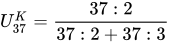
37:2 (15E,22E)-heptatriaconta-15,22-dien-2-one, C37H70O:


37:3 (8E,15E,22E)-heptatriaconta-8,15,22-trien-2-one, C37H68O:


Tetraether lipids
- Pelagic crenarchaea use tetraether lipids, which they adapt to different temperatures:
- more rings help membranes stack at stay well-ordered at high temperatures
- fewer rings help disorder membranes, so they don't freeze at low temperatures
News reports
- Nature's own acidic ocean, BBC News Online, 10 March 2009
- Threats from ocean acidification, BBC News Online, 11 March 2009
Atmospheric chemistry, DES
"Chemistry of the Atmosphere"
- Earth's atmosphere
- Atmospheric chemistry
- Instrumental temperature record
- Ozone-oxygen cycle (Chapman mechanism):
- O2 + hν → 2O
- O + O2 + M → O3 + M
- O3 + hν → O2 + O (highly exothermic)
- O + O3 → 2O2
- Ozone layer
- Ozone depletion
- Dobson unit
- Photochemical smog
- Tropospheric ozone depletion events
- Polar vortex, Polar night
- Polar stratospheric clouds
- Ozone depletion potential:

- Hydroxyl radical, HO2 radical:
- Oxidation of hydrocarbons and carbon monoxide by ozone, catalysed by the OH radical, normally keeps tropospheric ozone very low:
- CO + OH → CO2 + H
- H + O2 + M → HO2 + M
- HO2 + O3 → OH + 2O2
- CO + O3 → CO2 + O2 (net)
- Volatile organic compounds
- Montreal Protocol
- Global warming
- News reports:
Techniques
"Techniques for Chemists"
- Scientific writing
- Chemometrics, principal components analysis
- Molecular modelling
- Gas chromatography
- NMR spectroscopy: Correlation spectroscopy, Nuclear Overhauser effect?, J-coupling
- Typical coupling constants:
- Benzene rings: Jortho ≈ 8 Hz, Jmeta ≈ 2 Hz, Jpara ≈ 0 Hz
- Alkenes: Jcis ≈ x Hz, Jtrans ≈ x Hz, Jgem ≈ x Hz
- Typical coupling constants:
Labs
Experiment 1 - The benzoin reaction - preparation of benzoin: Benzoin condensation
Experiment 2 - The preparation of fenbufen: Fenbufen
Experiment 3 - The Wittig reaction: Wittig reaction, Horner-Wadsworth-Emmons reaction, Peterson olefination, Julia olefination, Tebbe olefination, Petasis reagent
Experiment 4 - Cycloaddition reactions and their mechanisms: Cycloaddition, Tetracyanoethylene
Experiment 5 - The Robinson annulation: Robinson annulation
Experiment 6 - Synthesis of 4,6-diphenyl[2,2']bipyridine: Hantzsch pyridine synthesis
Experiment 7 - The preparation and use of a Wilkinson's catalyst: Wilkinson's catalyst
Experiment 8 - Chromatography in action: Chromatography, Thin layer chromatography, Retardation factor (Rf value), gas chromatography,
Experiment 9 - An electrochemical glucose sensor: Glucose meter, Glucose oxidase, Nernst equation, Cyclic voltammetry, Ferrocene
Experiment 10 - IR spectroscopy of cigarette smoke: Rovibrational coupling
Experiment 11 - Absorption and fluorescence of dye molecules: Nile Blue
Experiment 12 - Determination of mean aggregation number of a micellar system: Micelle
Experiment 13 - Kinetics of ionic reactions
Experiment 14 - Polymer-surfactant interactions: Sodium dodecyl sulfate
Experiment 15 - The solution properties of polyelectrolytes: Polyelectrolyte
Experiment 16 - Absorption spectroscopy and the uptake of acetic acid at the gas-liquid surface
Experiment 17 - The Ni catalysed isomerisation of 1-heptene: Linear alpha olefin, Isomerisation, Shell higher olefin process, Olefin metathesis,
Experiment 18 - Silicone polymers: Siloxane, Silicone, Diphenylsilanediol
Experiment 19 - Monomeric and polymeric transition metal oxides: Polyoxometallate, WO3, Na2MoO4, Na2WO4, [nBu4N]2[W6O19]
Experiment 20 - Metal carbonyl complexes: Metal carbonyl
Experiment 21 - The application of liquefied gases as non-aqueous media: Ammonia, Inorganic nonaqueous solvent
Experiment 22 - Analysis of caffeine in soft drinks: Caffeine, Decaffeination, High performance liquid chromatography
Experiment 23 - Ferrocene: synthesis and reactivity: Ferrocene
Experiment 24 - Preparation of a luminescent Cu(I) complex
Experiment 25 - Modelling Real Reactions: Intramolecular Lactonisation: Iodolactonisation, Curtin-Hammett principle
Experiment 26 - Databases and Datamining: Crystallographic database, Cambridge Structural Database, Cambridge Crystallographic Data Centre, Data mining
Links
- User:Benjah-bmm27/degree/1 - Level 1 (first year)