






User:Benjah-bmm27/degree/2: Difference between revisions
137.222.14.134 (talk) |
137.222.14.134 (talk) |
||
| Line 432: | Line 432: | ||
* [[Isotope ratio mass spectrometry]] |
* [[Isotope ratio mass spectrometry]] |
||
* [[C3 carbon fixation]], [[C4 carbon fixation]] |
* [[C3 carbon fixation]], [[C4 carbon fixation]] |
||
* [[Carbon |
* [[Carbon Cycle]] |
||
* [[Methanotroph]] |
|||
===Marine chemistry, RDP=== |
===Marine chemistry, RDP=== |
||
Revision as of 15:56, 11 March 2009

Level 2
Organic
Monocarbonyls, TCG
"Monofunctional Carbonyl Compounds and Carbanion Chemistry"
- Carbanions
- Organolithium reagents e.g. BuLi, LDA
- Grignard reagents
- Enol, enolate anion
- Keto-enol tautomerism
- Silyl enol ether (from Me3SiCl with Et3N), enamines, aza-enolates
- Aldol reaction
- Reformatsky reaction
- Henry reaction (nitro aldol)
- Claisen condensation
- Mannich reaction
- Haloform reaction
- E1cB elimination reaction
Dicarbonyls, PJW
"Difunctional Carbonyl Compounds"
- Diketone
- Hard and soft nucleophiles and electrophiles
- Michael reaction, nucleophilic conjugate addition, Gilman reagents
- Dithianes (hard nucleophile at carbonyl carbon)
- Claisen condensation
- Nef reaction
- McMurry reaction
- Darzens reaction
- Benzoin condensation
- Acyloin condensation
- Pinacol coupling reaction
Aromatics and amines, TJS
"Aromatic Compounds and Amines"
- CLW for amines: Gabriel synthesis, sodium azide amine synthesis, reductive amination (with NaBH3CN), Hofmann rearrangement, nitrosation
- Electrophilic aromatic substitution
- Activating group. deactivating groups
- Arene substitution patterns
- Inductive effect, mesomeric effect
- Friedel-Crafts reaction (alkylation and acylation)
- Gattermann-Koch reaction
- Wolff-Kishner reduction (KOH, N2H4)
- Clemmensen reduction (Zn, HCl)
- Nitrosation of aryl amines to diazonium salts
- Baeyer-Villiger oxidation
- Naphthalene EAS
- Birch reduction
- Claisen rearrangement
- Fries rearrangement
Heterocycles, KIBM
"Heterocyclic Compounds"
- Heterocyclic chemistry
- Pyrrole, furan, thiophene
- Vilsmeier reaction
- Cycloaddition
- Paal-Knorr synthesis
- Knorr pyrrole synthesis
- Feist-Benary synthesis
- Chichibabin reaction
- Pyridine-N-oxides
- Picolines
- Pyridinium salts
- Hantzsch pyridine synthesis
- Guareschi-Thorpe synthesis
Retrosynthesis, CLW
"Organic Synthesis"
Stereochemistry, APD
"Stereochemistry and Conformation"
- Stereochemistry
- Chirality (chemistry)
- Absolute configuration
- Enantiomer
- Diastereomer
- Molecular configuration
- Conformational isomerism
- Alkane stereochemistry
- Bürgi-Dunitz angle
- Baeyer strain
- Pitzer strain
- Cycloalkanes
- Cyclopropanes - planar by definition
- Cyclobutanes - puckered to avoid eclipsing interactions
- Cyclopentanes - envelope conformation
- Cyclohexane conformation - chair form, boat form, twist boat, twist chair
- Anomeric effect
- Steric effects
Rearrangements, CPB
"Rearrangements involving Carbocationic or Polar Intermediates"
ylamide-anion-anion-rearrangement-mechanism-2D.png)
- Carbocations
- Carbon radicals (e.g. Ph3C·)
- Carbenes
- Carbanions
- Inductive effect
- Mesomeric effect (e.g. allyl, benzyl C+)
- Hyperconjugation, Beta-silicon effect
- Non-classical ions
- Synchronicity of mechanisms: stepwise reaction, concerted reaction, reaction intermediate,
- Rearrangement reaction
- 1,2-rearrangement
- Pinacol rearrangement
- Demjanov rearrangement
- Wagner-Meerwein rearrangement
- Arndt-Eistert synthesis
- Hofmann rearrangement
- Curtius rearrangement
- Lossen rearrangement
- Schmidt reaction
- Beckmann rearrangement
Proteins, DNW
"Amino Acids, Peptides and Proteins: Chemistry, Structure and Function"
- Nylon (polyamides) from condensation polymerisation, e.g.
- nH2N-(CH2)6-NH2 + nClOC-(CH2)4-COCl → (-HN-(CH2)6-NH-CO-(CH2)4-CO-)n (nylon 6,6 with amide bond in bold) + 2nHCl
- Aramids e.g. Kevlar
- Amino acids
- Peptide bonds
- Peptides
- Proteins
- Hormones, signaling molecules
- Peptide synthesis, Protein synthesis, Protein biosynthesis
- Protein structure, Protein folding, Protein structure prediction, Membrane protein
- Keratin
- π-π stacking interactions
- Ubiquitin, Proteasomes
- Chemical polarity of amino acids: FAMILYVW - hydrophobic, DEHKNQRST - polar, GPC - special
- Proline (Pro, P) is special:
- It's a secondary amino acid (AKA imino acids, although this nomenclature is disputed)
- It's conformationally locked (backbone dihedral angle φ fixed to about −75°) → very rigid, loses less conformational entropy upon folding, found in turns
- Protein structure:
- Primary structure: sequence of amino acid backbone (plus cross-linking such as disulfide bonds)
- Secondary structure: alpha helices, beta strands (plus rare others)
- Tertiary structure: three-dimensional structure (full set of atomic coordinates in 3D space) - determined by protein crystallography or protein NMR
- Quaternary structure: arrangement of multiple folded protein molecules in a multi-subunit complex - XRD again
- Ramachandran plot
- UV-Vis spectroscopy can be used to determine protein concentration - aromatic amino acid side chains (K, Y, W, H) absorb UV
- Supersecondary structure:
- Plastocyanins - Cu redox centre converts between Cu(I) and Cu(II), coordination geometry of Cu is not optimal for either oxidation state, making neither favoured and thus interconversion facile. Structures: PDB 3BQV, PDB 1PNC.
-
 Ribbon diagram of plastocyanin
 -
 Residues coordinating Cu in plastocyanin
 -
 Cu coordination geometry


- EF hand - chiral, right-handed enantiomer only (with one exception). Aspartic acid residues bind Ca2+ (important in calcium signaling) in loop between two alpha helices.
- Beta hairpin - major structural unit, two beta strands antiparallel
- βαβ motif - two beta strands parallel, chiral (alpha helix either above or below plane of beta strands), only right-handed enantiomer found in nature
- Coiled coil - HPPHPPP repeat gives 3.5 not 3.6 residues per turn, so hydrophobic seam slowly curves - myosin, keratin
- Polyproline helix?
- Collagen helix?
- Tertiary structure:
- all α-structures (αα) - buffers, triggers, allostery
- calbindin - (2 × EF hand) mops up loose Ca2+
- myosin - baby brother of haemoglobin - 8 helices, haem group binds Fe and thus O2
- all β-structures (ββ) - hard-as-nails brick walls → rigidity
- viral capsids
- plastocyanin
- antibodies
- all α-structures (αα) - buffers, triggers, allostery
Inorganic
NMR, CJA
"Introduction to NMR Spectroscopy"
- Nuclear magnetic resonance
- NMR spectroscopy
- Gyromagnetic ratio
- Proton NMR
- Carbon-13 NMR
- Chemical shift
- J-coupling
- Chemical equivalence, magnetic equivalence
- Berry pseudorotation
- Relaxation (NMR)
- Karplus equation
Main group 1, NCN
"Chemistry of the Main Group Elements, Part 1"
- Ionization potential (of the elements)
- Inert pair effect
- Electronegativity
- Coordination geometry
- Coordination number
- Ionic radius
- Covalent radius
- Allotropes of phosphorus
Organometallics, DFW
"Organo-Transition Metal Chemistry" http://www.ilpi.com/organomet/
- Organometallic chemistry
- d electron count, electron counting
- 18-Electron rule
- Fluxionality
- Metal carbonyl
- Mond process
- Ferrocene
Transition metals 1, CAR
"Coordination Chemistry of the Transition Metals, Part 1"
Solid state, SRH
- Unit cell
- Lattice energy: Born-Landé equation, Madelung constant, Kapustinskii equation
- Pauling's rules
- Solid-state synthesis: ceramic method (heat and beat, shake and bake)
- Free electron model
- Band theory
- Fermi energy
- Lattice defects
- Magnetic structure: magnet, diamagnetism, paramagnetism, ferromagnetism, antiferromagnetism, ferrimagnetism, antiferrimagnetism, Néel temperature
- Superconductivity
- Atomic wires - cyanoplatinates
- Fast ion conductors?
- Semiconductors
Transition metals 2, FCM
"Co-ordination Chemistry of the Transition Metals, Part 2"
- Trans effect
- Eigen-Wilkins mechanism (de:Eigen-Wilkins-Mechanismus)
- Associative, dissociative and interchange reaction mechanisms
- Marcus theory
- Eyring equation
- Electron transfer: Inner sphere electron transfer, Outer sphere electron transfer
Main group 2, IM
"Chemistry of the Main Group Elements, Part 2: Rings, Chains and Macromolecules, Based on Main Group Elements"
- Amine-borane complexes, e.g. H3N→BH3 ammonia borane
- Aminoboranes
- Iminoboranes: tBu-B≡N-tBu Chem. Ber. (1984) 117, 1089-1102 (Shelf 20 in library)
- Borazine
- Siloxanes
Physical
Thermodynamics, PWM
"Chemical Energy II"
- Chemical energy
- Chemical thermodynamics, thermochemistry
- Van 't Hoff equation
- Clausius-Clapeyron relation
- Trouton's rule
Photochemistry, AJOE
"Introduction to Photochemistry"
- Photochemistry
- Atomic spectroscopy
- Grotrian diagram
- Jablonski diagram
- Fluorescence
- Phosphorescence
- Intersystem crossing
- Internal conversion
- Quantum yields
Chemical interactions, DMS
"Chemical Interactions"
- Lennard-Jones potential
- Ideal gas
- Perfect gas
- Gibbs' phase rule
- Phase equilibria
- Phase diagram
- Azeotrope
- Triple point
Interfaces, JPR
"Interfaces"
- Interface (chemistry)
- Colloid
- Surfactants
- Detergency
- Critical micelle concentration
- Surface tension, Surface energy
- Contact angle
- spreading coefficient
- Young-Dupre equation
- Capillary rise
- Surface roughness
- Adhesional wetting
- Critical radius
- Emulsion
- Bancroft rule
- Vapor pressure, Kelvin equation, Supersaturation, Nucleation
Kinetics, DES
"Kinetics"
- Chemical kinetics
- Reaction rate
- Rate equation
- Elementary reaction
- Reaction rate constant
- Rate-determining step
- Activation energy
- Arrhenius equation
- Lindemann mechanism
- Collision theory (rubbish)
- Transition state theory
- Molecularity?
- Enzyme catalysis, Michaelis–Menten kinetics
Equilibria, PB
"Equilibria"
Equilibrium electrochemistry, DJF
"Equilibrium Electrochemistry"
- Category:Electrochemistry
- Electrochemistry
- Chemical potential
- Fundamental equation of chemical thermodynamics (see PWM):

- Electrochemical potential
- Activity of ions in solution
- Faraday constant
- Volta potential
- Galvani potential
- Liquid junction potential
- Electrochemical cell
- Half cell
- Galvanic cell
- Redox electrode
- Absolute electrode potential
- Reference electrode
- Standard hydrogen electrode
- Silver chloride electrode
- Potentiometric titration
- Glass electrodes
- Ion selective electrodes
- Batteries: Leclanché cell, Alkaline battery, Lead-acid battery, Nickel-cadmium battery, Lithium-ion battery (e.g. Lithium cobalt oxide-Graphite),
- Fuel cells
- Double layer (interfacial) / Electrical double layer: Helmholtz model, Gouy-Chapman model, Stern model, IUPAC definition of diffuse layer
- Supercapacitors
- Potential at the point of zero charge (p.z.c.): IUPAC definition of pzc, Point of zero charge
- Molecular dynamics simulations
Macromolecules, JSvD
"Macromolecules"
- Macromolecules
- Osmotic pressure
- Phase separation
- Polyelectrolyte (light scattering)
- Polymer synthesis
- Copolymerisation
- Ionic polymerisation (e.g. anionic addition polymerization)
- Biopolymers
- Flory–Huggins solution theory
Theoretical
FRM
"Quantum Concepts"
- Molecular structure
- Reactivity
- Quantum chemistry
- Nuclei much heavier than electrons ∴ molecules have structure
- Electrostatics, internuclear repulsion
- Zero-point energy
- Born-Oppenheimer approximation
- Potential energy surfaces: minima correspond to stable structures, saddle points correspond to transition states, reaction pathways correspond to mechanisms
- Conformation of ethane, nitrogen inversion
- de Broglie wavelength
- Schrödinger equation
- Hamiltonian operator
- Wavefunctions
- Particle in a box
- Boundary conditions
- Heisenberg uncertainty principle
- Hydrogen atom
- Spherical polar coordinates
- Electron spin: Stern-Gerlach experiment
- Molecular Schrödinger equation
- Molecular orbital approximation, molecular orbital theory (ignores electronic correlation)
- Normalization of wavefunctions
- Orthogonality:
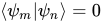
In quantum mechanics, two eigenstates of a wavefunction, and , are orthogonal if they correspond to different eigenvalues. This means, in Dirac notation, that unless and correspond to the same eigenvalue. This follows from the fact that Schrödinger's equation is a Sturm–Liouville equation (in Schrödinger's formulation) or that observables are given by hermitian operators (in Heisenberg's formulation). - Expectation value (quantum mechanics)
- Variational principle
- Linear combination of atomic orbitals molecular orbital method
- Vibrational spectroscopy: molecular vibration, harmonic approximation cf. classical oscillator
- Quantum tunnelling
- Kinetic isotope effect, e.g. in amine dehydrogenase
- Reaction coordinate
- Transition state theory
- Morse potential


Molecular orbitals, NLA
"Understanding Structure and Reactivity, Part 1"
- Octet rule (and its failure)
- Born-Oppenheimer approximation
- Orbital
- Wavefunction
- Electron density
- Schrödinger equation
- Potential energy curve
- Simple harmonic oscillator, quantum harmonic oscillator
- Zero-point energy
- Valence-bond theory
- Molecular orbital theory
- Linear combination of atomic orbitals molecular orbital method
- Normalisation
- Variational principle
- Bond order
- Koopmans' theorem
- Born-Haber cycles
- Alkalides
- Franck-Condon Principle
Hückel, AJM
"Understanding Structure and Reactivity, Part 2": http://www.chm.bris.ac.uk/pt/ajm/sb04/
Environmental
Geochemistry, RPE
"Origin and Fate of Organic Matter in the Geosphere"
- Biogeochemistry
- Keeling Curve
- Isotope geochemistry
- Isotope ratio mass spectrometry
- C3 carbon fixation, C4 carbon fixation
- Carbon Cycle
- Methanotroph
Marine chemistry, RDP
"Marine Chemistry"
- Physical oceanography
- Chemical oceanography
- Seawater, salinity
- Ocean current, hydrothermal circulation
- Thermohaline circulation: halocline, thermocline, pycnocline, sea surface temperature
- Upwelling
- Carbon cycle
- Nitrification, Anammox, Sulfur assimilation, Denitrification, Methanogenesis
- Remineralisation
- Paleocene–Eocene Thermal Maximum
- Methane clathrate
- Archaeol
- Sulfate-reducing bacteria
- Carbon dioxide, carbonate, bicarbonate, carbonic acid, calcium carbonate
- Lysocline, Carbonate Compensation Depth
- Ocean acidification
- Biomarkers, haptophytes, dinoflagellates, diatoms, E. huxleyi, alkenones, maitotoxin, Chlorobium
- Isorenieratene - indicator of photic zone anoxia (File:Isorenieratene-2D-skeletal.png, Isorenieratene Biosynthesis in Green Sulfur Bacteria (2008))
- Anoxic event
- Planctomycetes
- Pelagic crenarchaea
- Tetraether lipids
- News reports:
Atmospheric chemistry, DES
"Chemistry of the Atmosphere"
- Earth's atmosphere
- Atmospheric chemistry
- Instrumental temperature record
- Ozone-oxygen cycle (Chapman mechanism)
- Ozone layer
- Ozone depletion
- Dobson unit
- Photochemical smog
- Tropospheric ozone depletion events
- Polar vortex
- Polar stratospheric clouds
- Ozone depletion
- Hydroxyl radical
- Volatile organic compounds
- Montreal Protocol
- Global warming
Techniques
"Techniques for Chemists"
- Scientific writing
- Chemometrics, principal components analysis
- Molecular modelling
- Gas chromatography
Labs
Experiment 1 - The benzoin reaction - preparation of benzoin: Benzoin condensation
Experiment 2 - The preparation of fenbufen: Fenbufen
Experiment 3 - The Wittig reaction: Wittig reaction, Horner-Wadsworth-Emmons reaction, Peterson olefination, Julia olefination, Tebbe olefination, Petasis reagent
Experiment 4 - Cycloaddition reactions and their mechanisms: Cycloaddition, Tetracyanoethylene
Experiment 5 - The Robinson annulation: Robinson annulation
Experiment 6 - Synthesis of 4,6-diphenyl[2,2']bipyridine: Hantzsch pyridine synthesis
Experiment 7 - The preparation and use of a Wilkinson's catalyst: Wilkinson's catalyst
Experiment 8 - Chromatography in action: Chromatography, Thin layer chromatography, Retardation factor (Rf value), gas chromatography,
Experiment 9 - An electrochemical glucose sensor: Glucose meter, Glucose oxidase, Nernst equation, Cyclic voltammetry, Ferrocene
Experiment 10 - IR spectroscopy of cigarette smoke: Rovibrational coupling
Experiment 11 - Absorption and fluorescence of dye molecules: Nile Blue
Experiment 12 - Determination of mean aggregation number of a micellar system: Micelle
Experiment 13 - Kinetics of ionic reactions
Experiment 14 - Polymer-surfactant interactions: Sodium dodecyl sulfate
Experiment 15 - The solution properties of polyelectrolytes: Polyelectrolyte
Experiment 16 - Absorption spectroscopy and the uptake of acetic acid at the gas-liquid surface
Experiment 17 - The Ni catalysed isomerisation of 1-heptene: Linear alpha olefin, Isomerisation, Shell higher olefin process, Olefin metathesis,
Experiment 18 - Silicone polymers: Siloxane, Silicone, Diphenylsilanediol
Experiment 19 - Monomeric and polymeric transition metal oxides: Polyoxometallate, Tungsten trioxide, Sodium molybdate
Experiment 20 - Metal carbonyl complexes: Metal carbonyl
Experiment 21 - The application of liquefied gases as non-aqueous media: Ammonia, Inorganic nonaqueous solvent
Experiment 22 - Analysis of caffeine in soft drinks: Caffeine, Decaffeination, High performance liquid chromatography
Experiment 23 - Ferrocene: synthesis and reactivity: Ferrocene
Experiment 24 - Preparation of a luminescent Cu(I) complex
Experiment 25 - Modelling Real Reactions: Intramolecular Lactonisation: Iodolactonisation, Curtin-Hammett principle
Experiment 26 - Databases and Datamining: Crystallographic database, Cambridge Structural Database, Cambridge Crystallographic Data Centre, Data mining
Links
- User:Benjah-bmm27/degree/1 - Level 1 (first year)