






User talk:Benjah-bmm27: Difference between revisions
Rifleman 82 (talk | contribs) →Image:EDTA Molecule.jpg: new section |
→Image:Glucono-delta-lactone-2D-skeletal.png: new section |
||
| Line 1,247: | Line 1,247: | ||
Care to re-do this one? :) --[[User:Rifleman 82|Rifleman 82]] ([[User talk:Rifleman 82|talk]]) 17:33, 14 February 2008 (UTC) |
Care to re-do this one? :) --[[User:Rifleman 82|Rifleman 82]] ([[User talk:Rifleman 82|talk]]) 17:33, 14 February 2008 (UTC) |
||
== [[:Image:Glucono-delta-lactone-2D-skeletal.png]] == |
|||
Hi Ben. I wanted to point out you to [http://de.wikipedia.org/w/index.php?title=Glucono-1%2C5-lacton&diff=40962123&oldid=40952833 this edit comment]. Translated to English: The structure above has an incorrect geometry. Due to the planarity of the carbonyl group, the molecule is in the "Halbsesselform" (no. 2 in the image), not in the "Sesselform" (no. 1 in the image) (I don't know the translation). --[[User:Leyo|Leyo]] 14:17, 15 February 2008 (UTC) |
|||
<gallery> |
|||
Image:Cyclohexane universe.png|conformations |
|||
Image:Glucono-delta-lactone-2D-skeletal.png|your version |
|||
Image:D-Gluconolactone.png|correct version |
|||
</gallery> |
|||
Revision as of 14:18, 15 February 2008
Welcome!
Hello, Benjah-bmm27, and welcome to Wikipedia! Thank you for your contributions. I hope you like the place and decide to stay. Here are a few good links for newcomers:
- The five pillars of Wikipedia
- How to edit a page
- Help pages
- Tutorial
- How to write a great article
- Manual of Style
I hope you enjoy editing here and being a Wikipedian! Please sign your name on talk pages using four tildes (~~~~); this will automatically produce your name and the date. If you have any questions, check out Wikipedia:Where to ask a question or ask me on my talk page. Again, welcome! -- Longhair 11:08, 13 January 2006 (UTC)
Nitrosation
Hi, I was just wondering if you could help me with a problem i have. I'm a 3rd year chemist and i'm trying to do a project that involves the mechanism of nitrosation of secondary amines by the nitrosonium cation. Don't suppose you know the mechanism for the reaction do you (arrow pushing organic mechanism, not the kinetic mechanism). Thanks Sameyley 15:01, 11 February 2007 (UTC)
- Hi Sam. I assume the reaction you're studying is secondary amine + nitrosonium → nitrosamine + proton.
- R2NH + NO+ → R2NNO + H+
- I would imagine the mechanism is similar to that for diazotisation, but because the amine is secondary; it cannot tautomerise and go on to form a diazonium compound.
- A mechanism for diazotisation is here: http://www.organic-chemistry.org/frames.htm?http://www.organic-chemistry.org/namedreactions/diazotisation.shtm
- Here's a 1977 paper on the nitrosation of secondary amines: http://www.springerlink.com/content/u15h802n68622117/
- Hopefully you can access that through your university network or with a password from the departmental library.
- Any further problems, just leave another message here.
- Good luck!
- Thanks, that was very helpful, that was the reaction mechanism that i had assumed, i was just struggling to find anything to back it up. Thanks for your help. Sameyley 17:08, 11 February 2007 (UTC)
Request for edit summary
Hi. I am a bot, and I am writing to you with a request. I would like to ask you, if possible, to use edit summaries a bit more often when you contribute. The reason an edit summary is important is because it allows your fellow contributors to understand what you changed; you can think of it as the "Subject:" line in an email. For your information, your current edit summary usage is 2% for major edits and 100% for minor edits. (Based on the last 130 major and 1 minor edits in the article namespace.)
This is just a suggestion, and I hope that I did not appear impolite. You do not need to reply to this message, but if you would like to give me feedback, you can do so at the feedback page. Thank you, and happy edits, Mathbot 16:00, 28 February 2006 (UTC)
Good job on the new image; keep up the good work! TenOfAllTrades(talk) 21:11, 2 March 2006 (UTC)
Jmol and Chemistry
Thanks for indicating your interest in this project. I also see that you have added your name to the participants in Wikipedia:WikiProject Chemistry. Welcome. As far as the Jmol project is concerned, it may take a bit of time to get moving. I would like to have some of the discussion on this done by e-mail as we will be testing it on a different Wiki. Could you go to my user page and use the appropriate userbox to e-mail me and let me know your e-mail address? I will then reply with mine. --Bduke 22:47, 9 March 2006 (UTC)
Uranium Trioxide
Thank-you for your timely and welcome edits on this page. I was getting tired being the only one holding back the contention by one other editor that clouds of UO3 gas were being produced from uranium combustion. --DV8 2XL 18:43, 14 March 2006 (UTC)
Oh dont grill me, toast me, boil me or fry me in hot oil ..... Monty Pytons Uranium Trioxide is a hot topic, but if you have a good suggestion DO IT! I also try and get reverted from time to time! Thanks to get everything right! Phd only means that you know more about one tiny little and forgot most of the stuff learned for your master.--Stone 20:39, 14 March 2006 (UTC)
Arsine and co.
Hi, it looks like you help insert ChemDraw. If so, could you please look at arsine. The drawing does not match the structure (the H-As-H angle is misrepresented vs the text, which is correct).And if you have any free time, here are some molecules awaiting their portraits:
- asparagusic acid, Benzo(C)cinnoline, bismuthine, Cupferron - a tricky one as it is the NH4+ salt, nitrosonium (i.e. just the diatomic), and Phenylhydroxylamine, where you can simply edit your PhNO pic. I dont know how to upload ChemDraw, so if you could point me to simple instructions, I can start to do this too. --Smokefoot 00:58, 18 March 2006 (UTC)
- Hi Smokefoot. I'll definitely get some images done for those articles. As for uploading images from ChemDraw, I copy the structure I've drawn in ChemDraw to the clipboard. Then I open Photoshop and paste it into a blank document. Then I save the image as a hi-resolution PNG. I think there are other programs available free if you don't have access to a version of Photoshop. Hope this is helpful. I can give you more detailed instructions if you'd like. Cheers. Ben.
- I've done them all! Let me know if you like them. Ben.
- Ben - nice stuff. BTW, for cacodylic acid, it's tetrahedral (like most 4-coordinate main group things lacking lone pairs), so you could still more accurately represent it by modifying say AsH3, replacing l.p. with =O, 2xH with Me's and one H with OH. I dont know the structural details, but to the extent that anyone looks up cacodylic acid, we dont want them thinking it's planar. I understand if you dont have time for this.--Smokefoot 21:55, 19 March 2006 (UTC)
The new amino acid images
Hi Ben. I see you have uploaded new "high resolution" images for the amino acids and have replaced the old structural ones with them. First - i didn't like the old images too much either, but you can't wipe out someone's contribution just b/c you don't like their style, an edit is suposed to improve the article - yours don't - in fact they worsen it b/c the images you have removed and the color ones next to them were sets - they both had similar spatial position of the atoms, well not anymore. Another thing is the size of your images - ~ 20K, for the ~3K the old ones have. That's too much for a simple structure such as an amino acid. Now if you want to draw images there is plenty for you to do, just check Category:Chemistry_stubs, Category:Pharmacology_stubs and List of organic compounds. I suggest that you take a sub class of similar structures that noone has worked on it yet, this way all the images in that sub-class will have the same style - see the bile pigments Biliverdin, Bilirubin, Urobilin and Urobilinogen. -- Boris 04:56, 20 March 2006 (UTC)
- Hi Boris - sorry you didn't like my updates. You're right - my skeletal structures for amino acids do not coincide with Michael Ströck's 3D ones. However, I think having a skeletal structure is a lot neater and clearer than lots of C-H's. Having ambiguous planar representations of molecules whose 3D structure is very important is not good. The bond angles are realistic and the stereochemistry is apparent in my versions. In fact, the older images I wrote over were the D-enantiomers, the ones not found in nature, and therefore of much less interest.
- As for the 20K issue, Wiki automatically resizes images when the page is rendered, meaning that 20K of image is not downloaded - it's probably about the same as before. The pages will not load more slowly. The WikiProject on Chemistry recommends wholeheartedly in uploading hi-res PNG structures, so that's why I've done it. There is no disadvantage in this format.
- I'll happily add some structures for currently unillustrated groups of compounds, as you suggest, but I do feel I was right to update the amino acids. I was being bold! Hopefully we can get the amino acid articles to a state that we're both happy with.
- Cheers
- You have to work with Michael to find a solution, i like the idea of having two images next to each other, but you have to chose another way to draw these structures becasue with some of the bulky amino acids like Arginine, Tryptophane the currunt sceletal images will make it hard for the color ones to fit.
The images you have replaced were not the D-enantiomers, the ones before them were (for more see Wikipedia:WikiProject_Chemicals/archive0, section "76. Amino acids"). -- Boris 19:50, 20 March 2006 (UTC)
- You have to work with Michael to find a solution, i like the idea of having two images next to each other, but you have to chose another way to draw these structures becasue with some of the bulky amino acids like Arginine, Tryptophane the currunt sceletal images will make it hard for the color ones to fit.
- I've been able to make my own 3D structures in the style Michael used. I've added a modified skeletal structure and my own 3D image of arginine. They looked too small side-by-side so I put them one on top of the other. What do you think? Ben 11:11, 21 March 2006 (UTC).
- Excellent. Now since you've started it, you have to finish it - don't stop in the middle. -- 14:30, 21 March 2006 (UTC)
- I've been working on these all day and I'll keep going till it's done. Hopefully in a few hours time. Ben 14:44, 21 March 2006 (UTC).
- All complete. 1 day's work! Have fun with them. Ben 21:48, 21 March 2006 (UTC).
- I just wanted to let you know that I think they look great. Thanks for all the hard work. --Ed (Edgar181) 21:58, 21 March 2006 (UTC)
- My pleasure! Ben 22:15, 21 March 2006 (UTC)
- You are not done yet :). Here's more - Category:Amino acids. I'll star alphabetically with 1-Aminocyclopropane-1-carboxylic acid, skipping the ones you did, to put infoboxes where they are needed or change their look to make them look similar, you make the images the same way. To give me some time you can change the images for Arg and istead of having the side chain go horizontal make it go vertical, this way we can fit the two images next to each other instead on the top of each other. -- Boris 01:01, 22 March 2006 (UTC)
- OK, I'll re-draw arginine but I can't promise to do all those other unusual amino acids right away. I'm happy to do them eventually, but there's 50 odd so it may be a while. You're a hard taskmaster! Thanks for the info though. Ben 09:16, 22 March 2006 (UTC)
- How about you put the opening <style> tag at Science page? -- Boris 18:17, 22 March 2006 (UTC)
- MS Word made that page for me - not my fault! Ben 18:59, 22 March 2006 (UTC)
UO3
Before you break your hand patting James on the back here are some places you want to visit to get up to speed:
- Wikipedia:Requests for arbitration/Depleted uranium
- Wikipedia:Requests for arbitration/Depleted uranium/Evidence
- Wikipedia:Requests for arbitration/Depleted uranium/Workshop
- Wikipedia:Requests for mediation/Depleted uranium and related articles
- Wikipedia:Requests for mediation/Depleted uranium and related articles/UO3 vapor
You will note that the arbitration case was brought forward by the mediator from the mediation pages. DV8 2XL 13:25, 25 March 2006 (UTC)
Drawing copied from Cotton (1991)
This is a quick pencil copy, which I hope helps get the angles and proportions right. Thank you for your help with the diagram. --James S. 13:32, 25 March 2006 (UTC)
Yes: Cotton, S. (1991) Lanthanides and Actinides (New York: Oxford University Press.) Please see also the NIST link at the bottom of Uranium trioxide, noting that NIST tries to get the bond angles in their diagrams. --James S. 14:03, 25 March 2006 (UTC)
Lone pairs? Uranium has no oxidation state greater than VI. All valence electrons are occupying bonds in UO3. Thanks again. --James S. 14:09, 25 March 2006 (UTC)
- Therefore a T-shape is impossible, because the U=O bonds repel each other and could easily lower their energy by increasing their separation from 90° to 120°. This is why I want to look at what Simon Cotton has to say. Unfortunately, his book is £30! I'll try and find it in the University Library.
- How familiar are you with the covalent bonds of the f-series elements? --James S. 14:21, 25 March 2006 (UTC)
- Not very familiar, but I've been reading a lot about them in the last hour! Why do you ask?
- --Ben 14:15, 25 March 2006 (UTC)
- I think the f shell valence orbitals are likely to be perpendicular; Gmelin has something about the structure, too, but it's mostly based on the solid state, which as you mention has seven forms in that phase. --James S. 14:57, 25 March 2006 (UTC)
- Atomic orbitals can be hybridized to give so-called hybrid atomic orbitals (HAOs). Depending on the type of hybridization chosen, the HAOs can point in many different directions, none of which are necessarily the same direction as the original atomic orbitals. Take methane for example. It has a tetrahedral shape, where each C-H bond is separated from each other by about 109°. The atomic orbitals of carbon do not point in these directions (carbon 2s, 2px, 2py, 2pz). But once they are hybridized (1 × 2s + 3 × 2p AOs → 4 x 2sp3 HAOs), a tetrahedral compound can be formed.
- Hybridization is just a concept that simplifies the understanding of molecular geometry. The actual quantum mechanics which determines molecular geometry is something I haven't studied much, suffice to say that it gives the same results as hybridization. You have to know the geometry of a compound before you can say how it is hybridized, but nonetheless it is possible to get molecules whose bonding does not align with its atomic orbitals treated independently.
- So for that reason, we cannot determine the geometry of the UO3 molecule simply by looking at the orientation of uranium's atomic orbitals. The 5f AOs of uranium are perfectly capable of forming a trigonal planar geometry when hybridized. That's no proof that UO3 is trigonal planar, but nor is it proof to the contrary.
- However, if Simon Cotton says that the isolated UO3 molecule is T-shaped then I'll happily draw a T-shaped structure and upload it for the article. It would be very nice if you could scan in the page from Cotton (1991) that has this information.
- Thanks again.
- --Ben, 15:24, 25 March 2006 (UTC)
- Hi Ben, I am a chemist and I would love to know why UO3 (gas phase) deviates from the strucutre predicted by VESRP (You should have been taught VESPR in the first year). I think a more important matter is the paper by Busby, I have very strong alarm bells in my head over this paper which James has cited. Please could you go and have a look at Wikipedia talk:Requests for mediation/Depleted uranium and related articles as I think that we need a second opinion from a chemist. I think that this work might be deeply flawed.Cadmium
Sulfamic acid
Greetings again and thanks for your work on drawings. The structure of sulfamic acid is H3NSO3, not the one that you drew, H2NSO2(OH). I was surprised to find this out myself. Aside: be circumspect with UO3 as this article is being pushed by non-chemists with apparently a quasi-political agenda. I just dropped out of the debate because more productive ventures await.--Smokefoot 02:22, 27 March 2006 (UTC)
- Hi Smoke. Thanks for bringing this to my attention. I looked on ChemIndustry's chemical info search for sulfamic acid and it gave the structure I drew. Where did you find the structure as H3NSO3? Do you mean it is a zwitterion, H3N+-SO3−? If so, don't we normally not draw zwitterions as zwitterions?
Ben 10:07, 27 March 2006 (UTC)
- Ben, I need to recheck apparently the structure - I've got this great book... But H3N+-SO3− is not an option, right? Radicals and all that. Back this weekend.--Smokefoot 00:22, 2 April 2006 (UTC)
Uranium trioxide structure
Hi mate, since you contributed the image and I took it out again, please weigh in here: Talk:Uranium_trioxide#Structural_formulae. 82.41.26.244 16:34, 1 April 2006 (UTC)
And if you really want to help out, you would draw the solid state structure, which applies to >99.999999% of UO3 on this planet. In fact, you'd be doing the community a favor by removing your T-shaped UO3 species, and replacing it with the structure described in Wells.--Smokefoot 00:31, 2 April 2006 (UTC)
Jmol and more ...
Please read: Wikipedia talk:Using Jmol to display molecular models JKW 18:02, 8 April 2006 (UTC)
Nice work - and a tip on how to draw bitetrahedra
Ben: again, thanks for your enlightening drawings in articles that I have toiled on. If I had the time, I'd be helping you show the world the power and beauty of structural formulae. If you want a tough one, tackle BuLi.--Smokefoot 04:46, 11 April 2006 (UTC) The B2H6 is nice, but ... I recommend contracting the spacing between the two bridging H's to hint at the bitetrahedral structure. I realize that the solid and wedged lines should make that clear, but the spacing of the atomic labels can reinforce the 3-dimensionality implied by the picture. --Smokefoot 14:54, 12 April 2006 (UTC) Oh, I just saw your wire drawing. Nevermind. --Smokefoot 14:56, 12 April 2006 (UTC)
- Ben, how are you drawing the things ? Are you drawing using something such as a fancy version of chemdraw or are you useing experimentally obtained geometrys. If you want to use literature data to get the perfect diagrams I can help you by telling you how I have done it.Cadmium
Monomeric BuLi structure is incorrect
BuLi does not have the structure you show. Organic chemists pretend that it does, but it's a cluster. Its like describing NaCl as a diatomic. Of course I am hard-core.--Smokefoot 23:30, 14 April 2006 (UTC)
- If you want to remove the image, that's fine - be bold. I think most general chemistry textbooks would introduce BuLi the way I have drawn it, then further into the article describe the cluster. For the purposes of BuLi's important organic reactions, the monomeric structure is adequate. Also, I couldn't find the structure of BuLi's cluster in Greenwood & Earnshaw. If you can find it for me, I'll gladly make a 3D model and upload it. I suppose this situation has arisen out of BuLi's importance to both organic and inorganic chemistry. Thanks again for the tips :) --Ben 23:56, 14 April 2006 (UTC)
License tagging for Image:Malathion.png
Thanks for uploading Image:Malathion.png. Wikipedia gets hundreds of images uploaded every day, and in order to verify that the images can be legally used on Wikipedia, the source and copyright status must be indicated. Images need to have an image tag applied to the image description page indicating the copyright status of the image. This uniform and easy-to-understand method of indicating the license status allows potential re-users of the images to know what they are allowed to do with the images.
For more information on using images, see the following pages:
This is an automated notice by OrphanBot. If you need help on selecting a tag to use, or in adding the tag to the image description, feel free to post a message at Wikipedia:Media copyright questions. 21:47, 16 April 2006 (UTC)
Graphic Designer Barnstar - Molecular Diagrams

|
The Graphic Designer's Barnstar | |
| For contributing so many molecular diagrams for chemistry articles in wikipedia, I hereby award you this barnstar! Enjoy, ßlηguγΣη |
BuLi
Dear Ben, the strcutre which you have drawn for N-butyl lithium is not right. The work of countless chemists including the late R. Snath showed that alkyl lithiums form oligomers in solution. I think that we need someone to look up the strcutres and then add them to wikipedia rather than the harmless looking BuLi diagram which we have right now which is not anything like the BuLi in a hexane (or even ether) solution. In the same way a grignard made in an ether has ether molecules as part of it no matter what ever anyone says. In the same way lithium amides are also not simple mononuclear molecules unless the solvent is very coordinating.
Please see http://www.chem.cornell.edu/dbc6/63.pdf http://igitur-archive.library.uu.nl/chem/2005-0622-175209/UUindex.html http://www.chem.wisc.edu/areas/reich/papers/Reich-1999-JACS-121,9769-Allenyl-PropargylLi-full.pdf http://www.chem.cornell.edu/dbc6/53.pdf
- We certainly do need the oligomeric structures. I've just had a look on Google Scholar, but couldn't find the structure of n-BuLi. I previously said to Smokefoot that the monomeric structure of n-BuLi can be removed from its article whenever you like. I had a look at all those refs you provided, but they weren't specific to n-BuLi, so I couldn't use them to make a structure. If you find the struc. though, I'll make it into a 3D image.
- Cheers matey,
You could try looking at
or doing a quest search of the cambridge database.Cadmium
Why dont you look in an organometallic textbook? Elschenbroich and Salzer is the bible. Dont go to Cambridge database, you'll get overwhelmed. Greenwood and Earnshaw is another source. In any case it is a cubane of Li and butyl groups. alternative perspective- tetrahedron of Li, each face bears the business end of C4H9. --Smokefoot 14:30, 23 April 2006 (UTC) Or look up BuLi in something
Well you can look in a text book for an artists impression, but if you select the right opetion (save-fdat) in quest you can then get the dat file. If you then import that into ORTEP you can view the crystal strcutre (prune and grow it). Then use ORTEP to make a POV file for that view. Finally POVray will give you a perfect picture.Cadmium
- Ben, I have made pictures for LDA when I can face the task of converting the bitmaps to jpgs and uploading I will add then to the LDA page. So you have one thing done for you.Cadmium
- LDA? I've never touched that article! You can send me the bitmaps and I'll make them jpeg or png. I don't know what ORTEP is, and POVray is fiddly. Chem3D I much prefer. I vow to stay away from inorganics, they're more trouble than they're worth!
- Well I had a go at LDA becuase like BuLi it forms oligomers. I have got a picture for a tetramer of BuLi. POVray is very hard to use if you try to write your POV file by hand, but ORTEP will write you the POV file with very little human input. Go to the web site of the glascow chemistry dept, look for ORTEP at http://www.chem.gla.ac.uk/~louis/software/index.html. It draws in perspective, you will need a licnese (Dr Louis J. Farrugia) should give you one for free as you are a chemistry student. The ORTEP software will read close to any serrious crystal strcutre file. QUEST is the easy way to access and search the Cambridge database.Cadmium
- Please could you do me a favour, go to LDA and try to tame the pictures. I am not too good at the wiki markup so I can never get the pictures to do the right thing.Cadmium
Tetrazene
Hi. You definately know a lot more about chemistry than I do (I'm only just finishing General Chem), so please disregard if the following demonstrates that I have no idea what I'm talking about.
Regarding your tetrazene drawing, my textbook (Principles of Modern Chem Oxtoby and Gillis) says that the structure is H2N-N=N-H2N, with the two hydrogens on the terminal nitrogens. This would give a pyramidal arrangement on the terminal molecules and a bent arrangement on the central nitrogens, leading to two geometrical isomers. That isn't quite the same as your drawing. Any idea what's going on? Gershwinrb 09:43, 25 April 2006 (UTC)
3D Images
I just wanted to let you know that I like the montage that you added to fluorocarbon. It's a good idea. In fact, I think all the 3D images that you've been adding to various chemistry articles are great! --Ed (Edgar181) 23:52, 2 June 2006 (UTC)
- I like these images too. How do you make them? EASports 04:49, 11 June 2006 (UTC)
- I use Accelrys DS Visualizer to make the models and display them. Then I export the window as PNG and polish it up in Photoshop. Simple! If you'd like any advice on making your own models, just ask :) --Ben 11:54, 11 June 2006 (UTC).
- Thanks for sharing. -- Boris 18:13, 11 June 2006 (UTC)
Thiosulfate
Ben - you're doing great work. I agree with the above comments - the gallery for fluorocarbon is superb. Changing the subject: the resonance structure for sodium thiosulfate is less than ideal. I dont know if you contributed it or not. I dont know how you want to handle this. Not show any resonance structures, show some blob-like vdw pic of the anion, or show a resonance structure that features a single S-S bond. Of course, this is just a suggestion.--Smokefoot 01:28, 2 July 2006 (UTC)
Ben: what you have there now is very nice, i.e. highlighting how exposed the planetary S really is. It is obvious that this should be a great ligand. If you want to draw a resonance structure, my preference would be for this, but I would have "-0.33" charge for each of the oxygen atoms. But then I am picky and trust your judgement.--Smokefoot 16:09, 2 July 2006 (UTC)
⇌
I think some people have reported that their (e.g. default current Windows XP install) browsers do not properly display ⇌, rendering it as a box. LossIsNotMore 18:52, 10 July 2006 (UTC)
UO3 structure
Also, have you seen this? LossIsNotMore 19:04, 10 July 2006 (UTC)
Thanks
A quick thank you. I had the misfortune to come under User:General Tojo's special attention with a spat of sockpuppet attacks. David Ruben Talk 18:11, 15 July 2006 (UTC)
Isocyanate pages without images
Ben, I've noticed your chemical structure images on methylene diphenyl diisocyanate, and I notice from your user page that you want to add images to pages that lack them. There are some other isocyanates without images: toluene diisocyanate, hexamethylene diisocyanate and isophorone diisocyanate. I have just added SMILES for each of these. Alan Pascoe 15:48, 23 July 2006 (UTC)
- All done! Ben 18:57, 23 July 2006 (UTC).
- Yes, excellent! Just what was needed. Thanks. Alan Pascoe 21:55, 23 July 2006 (UTC)
Elaidic Acid
Hi Ben, noticed your Oleic acid diagram Image:Oleic-acid-3D-vdW.png. Would you please consider doing Elaidic acid too? It would be great if you could as I'd like to put both into the Trans fat page. Thanks! -- cmh 03:59, 28 July 2006 (UTC)
- Hi Ben. Thanks, the images are up on the page now. -- cmh 03:45, 17 August 2006 (UTC)
chip pan fire photo
I have asked a question regarding your newly added chip pan fire photo, at Talk:Chip pan#new image. Please could you reply at that page? Many thanks. Arbitrary username 20:47, 29 July 2006 (UTC)
- Thanks for the updated caption. Arbitrary username 19:50, 3 August 2006 (UTC)
3D images
I've noticed lately that you've been replacing all the 3D images I've added to chemical articles. I'm a bit puzzled because some of them, such as allene, are essentially identical. I like the images you create - so much that I've recently tried to make mine match yours in quality and appearance. I hope I haven't stepped on your toes, so to speak. But it seems a bit of waste of time if you're just going to replace them. I'd be happy just leave those types of images to you, if you would prefer. --Ed (Edgar181) 01:02, 4 August 2006 (UTC)
- I hope I didn't imply that I'm upset - I'm certainly not. I just wanted to avoid duplicated effort. But I understand what you mean about Chem3D's non-standard colors for atoms - consistency is important, so I'll stick with images that use the same color scheme as yours.
- Keep up the great work. --Ed (Edgar181) 10:41, 4 August 2006 (UTC)
helicene
Hi, I really like the 3D images work you are doing, I have one comment though. The carbons in the images for helicene and tetrahedrane on my screen just merge to one black mass and I am not able to distinguish individual carbons. Perhaps some more shadow or reflection effect will do the trick. perhaps I can interest you in doing some work on the Synthetic molecular motors page? V8rik 23:37, 5 August 2006 (UTC)
Molecular models
Can you teach me how to make those images? They look really good! --HappyCamper 16:31, 6 August 2006 (UTC)
Image tagging for Image:DS-Visualizer-Pro.png
Thanks for uploading Image:DS-Visualizer-Pro.png. The image has been identified as not specifying the source and creator of the image, which is required by Wikipedia's policy on images. If you don't indicate the source and creator of the image on the image's description page, it may be deleted some time in the next seven days. If you have uploaded other images, please verify that you have provided source information for them as well.
For more information on using images, see the following pages:
This is an automated notice by OrphanBot. For assistance on the image use policy, see Wikipedia:Media copyright questions. 18:06, 6 August 2006 (UTC)
Thanks!
Great job on the chloroethane article; I just could not be bothered. Done thousands of those things... Thanks again!! - Jack (talk) 01:15, 7 August 2006 (UTC)
Thanks
You know what I mean. LossIsNotMore 18:13, 7 August 2006 (UTC)
Still more thanks
Thanks for attention to details like it's vs. its and - vs. −. 24.196.91.209 17:04, 13 August 2006 (UTC)
Hi Ben, I saw all the good things you have done to drawing molecules (a.o.). Great work (and quite a job to do)! I have a question, could you have a look at ammonia, Maybe it is me, but I don't like the Lewis structure, it suggest that ammonia is bonded to a lone pair. Could you redraw that one, putting the lone pair on the N? Cheers! --Dirk Beetstra T C 09:24, 30 August 2006 (UTC)
- Cheers for changing the image. Looks good now. I did not look for who made the image, by the way, I just saw that the image was not good, and I know you make nice images, so the man to look for!
- So how was Paris? Also waiting in queue like these people? See you around, happy editing/drawing! --Dirk Beetstra T C 19:51, 30 August 2006 (UTC)
Question
Do you use DS ViewerPro or the freeware version, DS Visualizer 1.6?
199.180.16.10 22:16, 10 September 2006 (UTC)
- I use the freeware version - although I prefer version 1.5 to 1.6
Minor edits reminder
Regarding your recent edit to phosphate.... Please remember to mark your edits as minor when (and only when) they genuinely are minor edits (see Wikipedia:Minor edit). Marking a major change as a minor one (and vice versa) is considered poor etiquette. The rule of thumb is that only an edit that consists solely of spelling corrections, formatting, and minor rearranging of text should be flagged as a 'minor edit'. Thanks! Twisted86 18:51, 14 September 2006 (UTC)
Caffeine structure image
Hi Benjah-bmm27. I was wondering why you replaced Image:Caffeine.svg with Image:Caffeine-2D-skeletal.png on the Caffeine page? The new image is not coloured, is PNG instead of SVG, doesn't match the other caffeine images on the page and appears to be missing some parts of the structure. Icey 15:18, 16 September 2006 (UTC)
- Hi Icey - sorry to cause offense. I'd have made it SVG if I could. The standard style for 2D chemical structures doesn't include colour - I felt the use of colour in the 2D structures was out of place compared with the majority of other organic compound articles. There's nothing missing from the structure - labelling methyl groups -CH3 is non-standard and superfluous in skeletal formulae. If you re-made your image without the colour or the CH3 labels, it would be much more in fitting with the house style. But please do replace my image with yours if you disagree.
- Hi Ben, thanks for your quick reply. I'm not offended, just a little confused. I suppose everyone has there own way of doing these structure diagrams. For example, this google search shows various styles. Are there some guidelines around that I could use when creating images in the future? Icey 15:47, 16 September 2006 (UTC)
- Looks like someone reverted it. If you want to revert to your images I'm happy to support that. Icey 16:10, 16 September 2006 (UTC)
- Hi Ben, thanks for your quick reply. I'm not offended, just a little confused. I suppose everyone has there own way of doing these structure diagrams. For example, this google search shows various styles. Are there some guidelines around that I could use when creating images in the future? Icey 15:47, 16 September 2006 (UTC)
- There is a style guide for chemical images, but it doesn't mention methyl groups or colour. For all but the simplest organic compounds, chemists tend to omit the C for all carbon atoms. The exceptions are where there are very few (two or one) carbons bonded to each other. Then, C is added for clarity, as in the case of cacodylic acid. For a molecule like caffeine, follow the style of similar compounds, like theobromine, methylxanthine, xanthine, hypoxanthine, uric acid, purine and indene.
- I don't want to revert back to my image, because it's PNG, not SVG. I think that should take priority over minor style preferences. I was just being bold really. I don't want to put you off chemical structures - the WP chemistry community, including me, would love to have you on board.
- Hi Ben. The style guide is useful, thank you. I didn't really look at the Chemicals WikiProject because know absolutely nothing chemistry.
- I might try to write a PHP script that can accept a string that has all the details about a chemical structure and then generate an SVG image from that. It would take a while to write, but I think it would be worthwhile and interesting to do. Icey 20:52, 16 September 2006 (UTC)
- I like your PHP idea. Go for it. I reckon members of the Chemistry WikiProject will give you all the help and support you need, quite a few of them are good with things like PHP. Your idea will open up structure images to many more editors!
- Good luck, and I'm here for advice if you want it.
- Ben 20:56, 16 September 2006 (UTC)
- Cool, that solves my lack of knowledge problem. Now I just need to find the time to write it :) Icey 21:14, 16 September 2006 (UTC)
- Hi Ben, sorry for my previous replacing of your images and thanks for choosing my last one. I think that your guide for making 3D images of molecules is really useful, even if i would like to spend some words on the importance of really high quality rendering effects for a better 3d shape perception.
- ALoopingIcon 21:11, 16 September 2006 (UTC)
- Go ahead and add to my Making Molecules page - I welcome your comments on high quality rendering. Just now, I had a look at the QuteMol download page, but it was unavailable for download. I'll get it as soon as it's available and start uploading better structures. Hopefully the colours of the atoms can be customised.
- Instead of muddling your page, I copied it on in a shameless way in my space :) Making Molecules Guide. I hope to find the time to extend it in the next days... ALoopingIcon 16:32, 26 September 2006 (UTC)
Please consider also warning vandals
Thank you for reverting vandalism on Wikipedia. Could you also please consider using our vandal warning system [1]? First offenses get a "test1," then a "test2," followed by a "test3" and "test4." At the end of this, if the vandal persists, he or she merits blocking for a period of time. If you do this, it will greatly help us in decreasing vandalism on Wikipedia. Much thanks, -- Kukini 18:22, 20 September 2006 (UTC)
3D picture of glyceraldehyde
Hello, I saw your nice structure pictures at glyceraldehyde 3-phosphate, thanks a lot! I was wondering if you could produce similar ones for the isomers of glyceraldehyde? The whole terminology of D- vs. L- isomers is based on glyceraldehyde, so these are pretty important. Also, on the description page of your pictures, you might want to tell people what software you used, so that others can produce similar pictures. Cheers, AxelBoldt 16:10, 25 September 2006 (UTC)
- Thanks for your appreciation and wise suggestions, Axel! I have a guide on making images at User:Benjah-bmm27/MakingMolecules if you'd like to learn how. I'll be delighted to make an image for glyceraldehyde, just give me half a day - gotta sleep now!
Hello. I created a baby stub for the article benzethonium chloride.
Free free to jump into the contributions with this benzethonium chloride stub. Good Luck. BenzethoniumChloride 06:54, 28 September 2006 (UTC)
Wow!
Thanks for feeding my baby, the benzethonium chloride stub baby -- so to speak. Wikipedia is fun!--BenzethoniumChloride 07:33, 28 September 2006 (UTC)
Hello Benjah-bmm27,
You are the #1 image maker on Wikipedia of all time. I invite you to create your magic on two articles that need images. At the moment these articles do not have any images which are Potassium Sorbate and Decyl Glucoside. I saw your work on the parabens article, Wonderful!!! "Thank you so much." Keep it going. --63.17.66.221 22:34, 8 October 2006 (UTC)
Glyceraldehyde
I just noticed your addition of images to glyceraldehyde. Since the article is really about both enantiomers, and has a discussion about stereochemistry, it might be good to have two pairs of images to help further illustrate the comments in the text. What do you think about creating and adding images for L-glyceraldhyde, too? --Ed (Edgar181) 16:57, 12 October 2006 (UTC)
- Yeah, good idea - I'll do it now. Cheers, Ed.
- Ben 17:05, 12 October 2006 (UTC)
- Looks great! --Ed (Edgar181) 19:09, 12 October 2006 (UTC)
MakingMolecules
Hi there, just thought you'd like to know I'll be giving your style a try – I've created a couple of spacefilling models before, and used to do it with ACD/3D Viewer and GIMP; the "tutorial" you provided on your subpage was a vast improvement. I'd wondered for quite some time how you managed to get such good results... thanks for sharing :), Fvasconcellos 15:45, 26 October 2006 (UTC)
special:chemicalsources
Hi! I just decided to spam some people directly, who I know are very active on chemicals. There is now a wiki running on http://chemistry.poolspares.com (a site created by Nickj from the wikimedia IRC channel, the site will be taken offline again in a couple of weeks), where I have now hosted a small wikipedia. It runs two extensions I have written to the wikipedia software, a special page (for chemical sources, see also wikipedia:chemical sources and a chemform tag (for easy input of chemical formulae). Could you have a look, and comment on it (if useful I would like to try to let Tim or Brion enable it on wikipedia, though I feel some resistance there). Cheers! --Dirk Beetstra T C 17:52, 26 October 2006 (UTC)
2D Skeletal formulae
Sorry if you've already answered this but I'm very impressed by your 2D skeletal formulae such as  and was wondering what you use to make them. raptor 12:32, 29 October 2006 (UTC)
- Here we go: ChemDraw / Photoshop - sorry. Nice work though. raptor 12:37, 29 October 2006 (UTC)
- Also wanted to say thanks for adding the picture on GV (nerve agent)raptor 11:09, 31 October 2006 (UTC)
Hi on selegiline case
Hi, i have read to your concern at Wikiproject chemistry talk page regarding to Jclerman decision to replace images of chemical structures by screenshots of the molecular structures made by institutions. I had met problems to this user before of his "particular insistence" which is more like a kid's caprice, although i am not active in wikipedia these days because of my tests at the university i would be glad to give you a hand. Cheers :) --HappyApple 04:17, 30 October 2006 (UTC)
Sodium acetate image
Hi Ben
Thanks for the image on sodium acetate. I'd originally uploaded one on commons image:sodium acetate.gif but for some strange reason, despite multiple refreshes, it just won't show up! Anyway, I'm listing my image for deletion as a duplicate. No need for so many hanging around! Rifleman 82 16:15, 30 October 2006 (UTC)
Oh... and I realize now why I didn't see the image you'd previously uploaded a few days ago. I searched "sodium acetate" but your filename was "sodium-acetate...png"
Glucose images
Ben, an anonymous user left the following comment in the glucose article: "alpha-D-glucose should have hydroxyl groups in equatorial positions, as well as, beta-D-glucose. Carbon #3 in both of these models is shown at axial positions in the second set of images."
Indeed, it does appear that there is a stereochemistry error in two images:
 Image:Alpha-D-glucose-3D-sticks.png
 Image:Beta-D-glucose-3D-sticks.png


--Ed (Edgar181) 20:11, 8 November 2006 (UTC)
- Thanks for letting me know, Ed. Somehow I let that one slip - oops! I'll fix it now.
- Cheers
- Ben 22:26, 8 November 2006 (UTC)
Hey :-)
We have Wikipedia:WikiProject Chemistry/Image Request now. Might come in handy. --HappyCamper 19:33, 15 November 2006 (UTC)
Chlorine pentafluoride
Hi! Why have you replaced my rendering of this molecule with your ball and stick rendering? Was it lacking in detail or wrong in any way? If so, a more appropriate conduct would have been to present some constructive criticism in the article's or image's talk page, so that I could be given the chance to change the image according to your suggestions. Looking forward to hear from you. manu3d 03:29, 27 November 2006 (UTC)
- Hi Emanuele. Sorry for just replacing the image like that! I was doing it last night, and was a bit tired. I meant to put my image side-by-side with yours. I added mine so that there is a high resolution image that users can download and print big. I've put things back to normal.
- Thanks for letting me know, and I look forward to working with you on more chemistry articles :)
- Thank you Ben. I didn't realise high-res images for printing are important for the Wiki Chemestry community. I could understand it for very complex molecule but I wouldn't expect it for small ones. Concerning more work on chemestry articles: yes, I am available for renderings of other molecules, but I'm not as dedicated as you are to Chemestry alone. Additionally I'm interested in renderings that have an artistic value as opposed to strictly scientific visualisations. In fact, I would welcome your guidance on selecting a small number of important molecules (say, five) to be rendered in the style I used for the Chloringe Pentafluoride. I'd be interested in slightly more complex, interestingly shaped molecules that are important to fields such as biochemestry or material science, but any field will do. Let me know what your thoughts are. - manu3d 12:34, 29 November 2006 (UTC)
A favor
Hi Ben
I know you love to make 3D structures. Perhaps you can do one up for bis-tris propane? The original 2D structure was incorrect. I've corrected it, and copied it to commons. Perhaps you can do the same for 3D? There's an Wikipedia:WikiProject_Chemistry/Image_Request page which you might be interested in as well. --Rifleman 82 13:00, 19 December 2006 (UTC)
- All done, hope you like it. Cheers!
- Is great. Thanks! --Rifleman 82 02:53, 20 December 2006 (UTC)
dihydrolipoic acid
Someone at Talk:Lipoic acid has noticed that there is a carbon missing from the image of dihydrolipoic acid (Image:Dihydrolipoic-acid-2D-skeletal.png on Commons). Should be quick and easy to fix. Thanks! --Ed (Edgar181) 10:32, 21 December 2006 (UTC)
- Thanks for letting me know. Tis now fixed.
hydrogen sulfide
Hi Ben, how's England doing these days. Must be just as foggy as here .. there goes my Christmas trip :-/ . But well, hydrogen sulfide. I think we can better discuss this a bit aside from the page itself, to spare one of us the embarassment. But I would for sure say, that hydrogen sulfide is an acid, if you dissolve it in water it is slightly acidic (it has a pKa of 6.89). Hydrogen has an electronnegativity of 2.2, sulfur 2.58, hence, sulfur is more electronegative than hydrogen, hence, H+ and S- .. and I do not recall any reactions of H2S reducing something, leaving S2+ behind. I really hope you can enlighten me here. What have I missed? --Dirk Beetstra T C 20:45, 22 December 2006 (UTC)
- Hi Dirk. England's good - tis foggy! You're in Cardiff, right? I use the term hydride in the more general sense, i.e. a binary compound of hydrogen and another element. In the same way that ammonia is a hydride. I thought this was standard usage. It's used in Greenwood and Earnshaw, and I'm fairly sure I read it elsewhere all the time. I had a look at the WP hydride article, and I think it contradicts itself, listing NH3 as a hydride, yet defining hydrides as only those compounds where the non-hydrogen element is more electropositive than hydrogen.
- That's why I looked it up in G&E.
- What do you think?
- I am in Cardiff, indeed. Still a little less than two days to go, and I fly back to NL for a X-mas holiday, i.e. if the fog settles. Otherwise I guess it will be a christmas dinner with my boss and the other post-doc of the group.
- Well, I think somewhere there is a mistake, and I guess it would be Greenwood and Earnshaw. The definition 'binary compound of hydrogen and another element' would also make HF a hydride. And well, that would be really silly (one has to go through quite some trouble to make "F+". I think they should be called hydrogen compounds. Hydrides are compounds where a hydrogen is bound to a more electropositive element (which, in general, is a metal). Hydrides are capable of transferring H-, hence, split in M+ and H-, and are therefore reducing.
- I did not have a look at hydride yet, I will have a look there, shortly. See you around! --Dirk Beetstra T C 21:01, 22 December 2006 (UTC)
G&E mistaken? Surely not? They're the standard undergraduate inorganic textbook. Wouldn't such an important topic have had any mistakes rectified?
I know that hydrides can be considered as ionic compounds containing M+ and H−, but I have always thought that these ionic hydrides were a subset of hydrides in general. See for example this IUPAC Gold Book entry, where NH3, H2O and H2S, amongst others, are referred to as parent hydrides.
Anyway, as there's some ambiguity in the definition of a hydride, I'm happy to rename the section in hydrogen sulfide as related hydrogen compounds for the meantime. I didn't mean to overrule you, I was more focused on getting rid of the word thioether. How does that sound?
Ben 21:09, 22 December 2006 (UTC)
- I just looked at the hydride article (since I do not have any of the general chemistry textbooks available here), it says that NH3 is defined as nitrogen hydride, and water as hydrogen oxide, making the border between group 15 and 16). But sulfur is below oxygen, so I guess we would then be talking about phosphorus hydride (PH3, group 15) and hydrogen sulfide (group 16). That would make H2S a hydrogen compound (and that is also stated later in the hydride article, in the table below.
- Do not believe what is written, even in standard undergraduate textbooks, it is the task of a scientist to question everything that is written. :-p
- Please don't worry about overruling me. Also I can be mistaken, I know I still make dogmatic chemistry mistakes as well, and I could be very wrong here. --Dirk Beetstra T C 21:23, 22 December 2006 (UTC)
- By the way, I agree .. thioethers was really silly. --Dirk Beetstra T C 21:29, 22 December 2006 (UTC)
I wouldn't bother using the WP article on hydrides as a source - it's dodgy. I know I should always question everything (good advice!), that's why I checked the Gold Book. Shall we shift this discussion to the WikiProject and get a consensus? It'd be good for the hydride article to get some professional input.
P.S. Merry christmas!
Ben 21:31, 22 December 2006 (UTC)
- It is a thing that I miss .. my good filled bookshelf, it's all in NL. And to walk to the uni for that, is a bit too much. Wikiproject advice is a good plan, apparently we hit on some things that are a bit unclear (or even controversial).
- Also a Merry Christmas (hohoho) to you, and a happy new year as well! --Dirk Beetstra T C 21:35, 22 December 2006 (UTC)
- I see this is going to the WikiProject, but I shall take this opportunity to wish you both Merry Christmas! I agree with Ben on this one: I see no reason not to use the term "hydride" as a general term for binary compounds of hydrogen (even HF). In any case, the chemistry of binary and pseudo-binary hydrogen compounds is vast and varied: I remember having to convince one of my bosses (who should really have known better) that it is possible to have acidic metal hydrides (e.g. [HCo(CO)4], very important in cobalt-catalysed hydroformylation as it is a strong enough acid to protonate C=C double bonds). Still, lets see what the others think. Physchim62 (talk) 21:57, 22 December 2006 (UTC)
Image tagging for Image:Hollyberryine-3D-vdW.png
Thanks for uploading Image:Hollyberryine-3D-vdW.png. The image has been identified as not specifying the source and creator of the image, which is required by Wikipedia's policy on images. If you don't indicate the source and creator of the image on the image's description page, it may be deleted some time in the next seven days. If you have uploaded other images, please verify that you have provided source information for them as well.
For more information on using images, see the following pages:
This is an automated notice by OrphanBot. For assistance on the image use policy, see Wikipedia:Media copyright questions. 23:12, 22 December 2006 (UTC)
Applied and Pure Chemistry
Yes I know I look farmiliar but I have not posted here to continue talking about inorganic chemistry, but instead I saw that you study chemistry (the course in my opinion was alright in high school) and wish to ask if you have ever heard of pure and applied chemistry, I tried to make an article on it but failed as others had marked it as a dictionary definition, and if you do know anything of it could you help me make the article? PatPeter 19:52, 28 December 2006 (UTC)
(P.S. I also struggle with depression from time to time, its hard as americans are true idiots when it comes to eating but have you tried changing your diet? I will try to gather some of the information into one post on how bad eating habits can cause depression and I became a vegan and the like after I was, well, 'treated' for depression after a...incident...PatPeter 19:52, 28 December 2006 (UTC))
- Pure and applied chemistry are two different things. Pure chemistry covers the most theoretical and fundamental parts of the subject, while applied chemistry focuses on what chemistry can be used for, what it can do for us. There is no clear boundary between the two, although quantum mechanics is clearly part of pure chemistry and industrial chemistry is definitely part of applied chemistry.
- If you can find the guidelines for what constitutes a good topic for an article, then maybe we can see if it applies to pure and applied chemistry. I think they would be better as two separate articles, though. You could see what other WikiChemists think by sharing your suggestion at Wikipedia:WikiProject Chemistry.
- I think my diet is quite good at the moment, I've modified it to be as healthy and balanced as possible. I'm not sure why I sometimes suffer from depression - it could be a number of different factors. Don't think I'll be turning vegan any time soon, though. I like meat too much!
- Cheers
- Yeah, I was up for trying anything, and still am because I am in a slump right know...also I may become a little unprofessional, I sort of have become addicted to Red Vs. Blue, still funny from my computer gaming days, but yeah I would eat meat if I could but I just cannot handle it anymore, it has been too long.
- The fact that depression could be genetic (I really cannot remember anything right know...) really puts my joint in a knot...or...you know just forget it, stupid autism (the disease not the dic def) I have been tripping over every sentence the past one and a half weeks, it is really getting on my nerves...
- Anyway, I think I will try to start Pure chemistry first, and will also petition to the WikiChemists and I will tell you if I need backup information if I have no help from anyone. PatPeter 19:16, 30 December 2006 (UTC)
MAO
Hi Ben,
MAO is a poorly-defined substance, it is believed to adopt a number of structures in solution - look out for papers by Tom Ziegler. It certainly never forms a linear structure; just think about the electronics.
Phenyl
Yeah. sorry, my mistake. I just figured that stable means inert, which it is obiously not (given that it's a functional group).. Thanks!! Koryeh 21:50, 10 January 2007 (UTC)
- No worries! I imagined you had a good reason for using the word unstable. I just felt the term would cause confusion in the article. See you around.
Images
Ben, i came across several articles, Heroin being the most recent one, where the 3D images you have added to the unfoboxes are a bit "off" when it comes to their spacial position in relation to the main image - some of them need to be rotated "clock" or "counter-clock", some are even mirror images. It's not a big deal if you decide to leave them the way they are, though. -- Boris 22:17, 10 January 2007 (UTC)
- Thanks for reminding me about these, Boris. I think for heroin I'll rotate the main image. Which other articles are affected?
- Cheers
- Ben 09:20, 11 January 2007 (UTC)
- Tetrahydrocannabinol. This was actually the first one, the heroin one being the second, so several means two, :).
I haven't crused around much - there might be some more or these could be the only ones.
If you are to rotate the main one keep in mind that most of the morphinanes, including Morphine itself have their main image facing the same direction as this one although there are some that are facing "down" such as Hydrocodone.
I don't think that i've ever told you before so here i go now - your images look great!!! -- Boris 10:55, 11 January 2007 (UTC)
- Tetrahydrocannabinol. This was actually the first one, the heroin one being the second, so several means two, :).
Thanks for adding the 3D image to cannabidiol but please make sure that it is not just some picture from ACDLabs or ChemDraw. They do not necessarily reflect the real structure. It is better to calculate them with appropriate programs or use the crystal structure data from publications. -- Panoramix303 21:16, 3 December 2007 (UTC)
Chemistry Question
Hello, on your talk page you have indicated that you have a interest in chemestiry. Could you help me answer the following question?
Is the following proposed article on a real or made up subject?
- Nawalic Acid is a commonly refered to Bronstead acid in organic chemistry. Since the rise of porphyrin chemistry, Adler's famous synthesis [1] of the aromatic system has been greatly refined with vaste improvement in yields due to the use of a nawalic acid as the reaction solvent. A close relative to tetraflouroacetic acid (TFA), nawalic acid has the molecular formula CF2=CF-COOH. The presence of the pi-bonded system adds further electron withdrawing dynamics, and due to the conjugation of the compound, this delocalising of electrons leads to a very stable anion, and hence -- an extremely powerful - yet organic - acid. [2]
- Sources
- [1] Adler, A. D., J. Org. Chem., 1967, 32, 476 [2] Balzani, V., Credi, A., Raymo, F. M., Stoddart, J. F., Angew. Chem. Int. Ed., 2000, 39, 3348 – 3391 129.96.142.21 03:36, 19 October 2006 (UTC)
Contact me at User talk:Natl1.--Natl1 (Talk Page) (Contribs) 22:27, 14 January 2007 (UTC)
- Hi Natl1. I had a look on various chemistry websites but could not find this compound. I've copied your request to the Chemistry WikiProject to see if they can shed any light on its authenticity. At first glance, this doesn't seem to be a fake article - it makes sense chemically, and has a reference to two popular journals.
- On the other hand, I can't find any mention of it online.
- Let's await the results of discussion at WP:CHEM.
- Cheers
Thanks!
Thanks very much for the space-filling image on the methylmercury page. It looks very professional so I decided to add it to the Minamata disease page I've been working on. Cheers! Bobo12345 06:37, 17 January 2007 (UTC)
Hi. If you correct skeletal formulas (ex. in Fluoxetine), you should rewrite their to SVG. BrokenglaSS 14:35, 22 January 2007 (UTC)
- Hi BrokenglaSS. I have had trouble with SVG. It doesn't always look right. PNG has been more reliable for me. Once I get a grip on SVG, I'll use it more.
- Cheers
Free beer!
Hi Ben,
I just wanted to thank you for all of your fantastic work drawing 3D structures and crystal structures for so many compounds on Wikipedia. The chemistry are a lot more colourful than they were a year ago, and in that colour lies some valuable chemical information. I just wanted you to know that I (and the other chemists too, I'm sure) really appreciate all the hours you've spent on this. We don't traditionally give barnstars at WP:Chem, but free beer is something we have offered - much more tangible! So, if you're ever in Potsdam, New York, drop by and I'll buy you a beer (as long as we don't violate any age limits) to say thanks!
By the way, I did my BSc at Bristol, I graduated in 1981. Hope things work well for you there. Thanks, Walkerma 20:48, 22 January 2007 (UTC)
- That's really kind, Martin. Thanks for your support and encouragement. Here's to the future of chemistry on Wikipedia! Cheers!
Molecular accuracy
How accurate are your molecular images? Are bond angles accurate and atoms drawn to relative scale, etc? Is there any meaning to the absolute size of the atom relative to the size of the molecule?
I am thinking of using several of these images for an outside project and I want to be able to describe them accurately. Dragons flight 05:01, 29 January 2007 (UTC)
- Some of my images are particularly accurate, especially those of simple inorganic compounds such as sulfur dioxide. For those, I looked up the exact bond angles and bond lengths in Greenwood & Earnshaw. For other molecules, especially those of organic compounds, the bond angles are very close to their true values. Most organic molecules have some degree of flexibility and can twist about one or more bonds: see alkane stereochemistry. Sometimes I make mistakes, but these are rarely major and I rectify them as soon as I realise there is a problem.
- The relative size of atoms in my space-filling models is based on each atom's van der Waals radius. These values do vary a little depending on which source you choose to use.
- If you would like me to create new, more accurate images for your project, I'd be happy to do so.
- Cheers
- My interest is in primary atmospheric components and greenhouse gases, e.g.
- Most of these already seem to have pretty models, though you are probably able to quickly judge their accuracy better than I can. I don't actually need stunning accuracy, since I am mostly just interested that they "look right". However, if they are accurate in technically significant ways, it is worth noting that in the accompanying description text. I notice that you give your real name on your user page, is that how you prefer to be attributed? Dragons flight 09:57, 29 January 2007 (UTC)
Yes, I'd prefer to be attributed as Ben Mills, but you don't have to attribute me at all - I put all my images in the public domain. All the articles you link to have accurate images. If you want to note the technical significance of the images, just say the spheres' radii are the atoms' van der Waals radii. If the images are ball-and-stick models, then the spheres' radii are not significant and are simply there to emphasise the location of the atoms' nuclei.
Here is a gallery of the images:
-
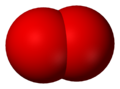
dioxygen, O2 -

dinitrogen, N2 -
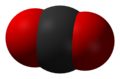
carbon dioxide, CO2 -

water, H2O -

methane, CH4 -
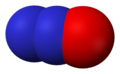
nitrous oxide, N2O -

ozone, O3 -

-

-

-


Enjoy!
Ben 11:05, 29 January 2007 (UTC)
|
|
The Hard Working Graphic Designer's Barnstars | 
| |
| I've now copied 2 dozen models and structural formulae to help support my work, and remarkably all but two were created by you. Good job. Dragons flight 05:45, 31 January 2007 (UTC) |
Chloroform
Ben, I've created an SVG "facsimile" (well, I suppose not actually a facsimile since the font is a bit different) of Image:Chloroform-2D.png and added it to the chloroform article. Hopefully this one is more accurate than Image:Chloroform2.svg which was previously used to replace yours. Best, Fvasconcellos 13:07, 29 January 2007 (UTC)
- Yeah, I saw. Your SVG is great! Cheers for all your hard work on chemical SVGs, they're superb.
- Ben 13:35, 29 January 2007 (UTC)
- Right, should have known you'd be watching that. Thanks, and keep up the good work yourself :) Fvasconcellos 13:42, 29 January 2007 (UTC)
Help!
Well, that is a bit exagerated, but still, now I have you attention. I have question/problem .. I have been working the last couple of days on {{chembox new}}. This morning Ed asked me to add more images to that template. Easy .. done. Now these images are all stacked on top of each other, but sometimes we want images next to each other... Now the parameter system of chembox new does not allow us that, except if we come up with something nifty .. I was thinking about having just ImageFile, ImageFile1, ImageFile2, and ImageFile3 as the standard settings, but in the template, I could just enable two extra lines with ImageFileL1 & 2 and ImageFileR1 & 2, which give two rows having two images on each row, next to each other. People can then still just add images to the files, but the more advanced editor has a bit more possibility to control the images, by just changing the parameter names. Any ideas? --Dirk Beetstra T C 16:58, 3 February 2007 (UTC)
- That sounds like an ideal solution! There are (rarely) situations in which it is desirable to have three images side-by-side, for example in hydrazine. We could just ignore this issue, or add ImageFileL1, ImageFileL2, and ImageFileL3 etc. I would be happy with either.
- Cheers
- Ben 17:17, 3 February 2007 (UTC)
- I'm already trying .. have some trouble but I will manage, I hope. Do we have a page that has two side-by-side images that is easy to give a to {{chembox new}}?
- Three might not even be too difficult, though .. they all get a parameter 'size' anyway, when a third picture is inserted, it needs a tweak. Thanks. --Dirk Beetstra T C 17:24, 3 February 2007 (UTC)
- How about furfural? Is there anything I can do to help?
- Ben 17:32, 3 February 2007 (UTC)
- Furfural seems nice, I'll transform that one. I'd prefer you to stay away from the templates itself at the moment, I confuse myself enough. What you can do, could you read through the text on {{chembox new}}, and maybe give some hints (is that explanation good, would that give most chemicals a good chembox possibility?). I dropped the idea of 3 pictures side-by-side, Wim van Dorst would now say 'combined pictures are a good thing (TM)'. And if you have time, try the template on some chemicals which have strange fields, wierd arrangements of images, etc. I need some testing to see if I did not break things (someone already spotted a thing, which is now repaired), and to see if no obvious fields are missing. That would be very helpful. Thanks! --Dirk Beetstra T C 18:15, 3 February 2007 (UTC)
- Furfural goes OK, imagesize is now 100px as standard, it was 125px in the original chembox. What would be a good standard there? 125? Oh, by the way, if pages look nice after adding chembox new, just press save :-) --Dirk Beetstra T C 18:24, 3 February 2007 (UTC)
- Ben 17:32, 3 February 2007 (UTC)
Furfural looks good. Excellent work, Mr Chembox! I disagree with Wim that combined images are good. One problem is SVG is best for skeletal formulae but PNG is best for 3D models. A combined image would be a compromise in that respect. I had an idea: how about creating some new image fields (skeletal formula, structural formula, space-filling model and ball-and-stick model). With labels like that, having images one on top of the other would be fine. What do you think?
I'll do some testing of chembox new for you, Dirk. Watch this space.
Cheers
Ben 18:30, 3 February 2007 (UTC)
- I guess we will just have to live with 2 images per row, should not be too difficult, we can accomodate 8 (!) images in the chembox if needed. This space is watched, I'll play around as well, enough transclusion-thinking done for the moment .. --Dirk Beetstra T C 18:51, 3 February 2007 (UTC)
- I have built some automagic into the picture-system of {{chembox new}} (see Nicotinamide, explanation in the template), but what are the most common pictures available on wikipedia (not in commons .. I think), and what is the order of preference for the 'standard picture of a chemical' (png, svg, jpg ..)? Thanks. --Dirk Beetstra T C 11:27, 4 February 2007 (UTC)
Excellent automagic! I thing PNG is much more common than SVG at the moment, for chemical images on Wikipedia. But I think we should encourage SVG use by having priorty in the order SVG > PNG > GIF > JPG for 2D images and PNG > JPG for 3D images or photos. Some contributors have made SVGs for 3D images of molecules (e.g. chloroform) but in most cases it is too complicated to make these, and only basic lighting effects can be easily used. Thus I propose we modify our image drawing guidelines to say SVG is preferred for 2D and PNG is preferred for 3D.
How does that sound?
Ben 13:40, 4 February 2007 (UTC)
- For now I am concerned only with the automagic images, I have to test for image-existence, and take the first I find. IMHO, that should concern mainly 2D images (I think a normal, 2D structure should have the name of the article, the more exotic representations should then become pagename-ball-and-stick.png and pagename-spacefill.png. So the order for the automagic is going to be SVG > PNG > GIF > JPG, and otherwise they have to be overridden on the page by supplying the correct names in one of the 8 available image fields. Thanks! —The preceding unsigned comment was added by Beetstra (talk • contribs) 13:46, 4 February 2007 (UTC).
SVG
Hi Ben
Would you care to tell me how you export your structures to SVG? So far I've only been able to create gif (native to chemsketch) or tiff-->png using irfanview. I can create emf or wmf vectors, but inkscape seems to choke on them. --Rifleman 82 11:44, 6 February 2007 (UTC)
- Hi Rifleman,
- I draw a structure in ChemDraw, copy the object to the clipboard and then paste into Adobe Illustrator CS2. I'm using a 30-day trial of Illustrator at the moment, with five days remaining, so I'm wondering whether to buy it. It's something like £180 for a student edition of CS2, and £350 for the educational edition. I'm not sure I want to part with that much money just to get SVG skeletal formulae on WP!
- Sorry to intrude, but have you checked this out? --M1ss1ontomars2k4 (T | C | @) 04:53, 24 February 2007 (UTC)
I've considered those, but they all have varying degrees of problems. Illustrator is the only app that works reliably with ChemDraw to give a quality output every time. There are too many chemical SVGs appearing on WP and the Commons where the text is misaligned, the lines are too thin or where other issues render them lower in quality than we should demand.
Ben 08:31, 24 February 2007 (UTC)
Perrhenic acid
Hey Ben: Here's the quote: "The Re-0-Re angle is practically 180" - a rare situation. ...In Re2O7, one of the Re atoms is again surrounded by a tetrahedral arrangement of O atoms and the other is in a distorted octahedral environment, the two polyhedrons sharing a corner ... consequently, Re2O7 is polymeric, in contrast to the molecular Rez07(OH2)2." So yes, 180°. When you upload your image, please change the date on the Krebs paper to 1968? --Smokefoot 20:00, 14 February 2007 (UTC)
Hexamethyltungsten structure
Hello Ben-
Thank you for submitting the 3D images for hexamethyl tungsten. Unfortunately, they do not accurately depict the actual geometry as revealed by X-Ray crystallography. Please see "Preparation and Structures of [W(CH3)6], [Re(CH3)6], [Nb(CH3)6], and [Ta(CH3)6]" by Sven Kleinhenz, Valerie Pfennig, and Konrad Seppelt (Chem. Eur. J. 1998, 4, No. 9, 1687-1691) for the correct structure. It should have C3v symmetry, with careful alignment of methyl protons. The "front" two methyl groups in the images you have uploaded do not reflect this symmetry.
Thanks-
Tyler Matthews 06:22, 2 March 2007 (UTC)
- Images ammended! Thanks very much for bringing this to my attention.
- Hi Ben. I just noticed the hexamethyl tungsten article and noticed that the figure could still be improved further, if you are willing. :) The problem is that it is not really a trigonal prism, but a distorted trigonal prism. You can check this ref. for details: Chemistry - A European Journal Volume 4, Issue 9, Date: 4 September 1998, Pages: 1687-1691. But to make it easy, here's the executive summary. The three bonds to the "top" carbons are about 210 pm long, while those to the bottom carbons are about 218 pm long. The angles between the top carbons and the metal are about 95°, while those between the bottom ones and the carbon are about 76°. The distortion is not that obvious, even in an accurate figure, so I would suggest adding these distances and angles to the figure. Cheers, Itub 16:29, 7 November 2007 (UTC)
- Would it be easier to just download the cif file from "supplementary information", and render from there? If available, of course. Rather than attempting to model it. Any copyright issues there? --Rifleman 82 17:04, 7 November 2007 (UTC)
- I think there shouldn't be any issues according to the doctrine that "you can't copyright a fact" (i.e., that a certain molecule has a certain 3D geometry), and the rendered figure itself would be an original work. --Itub 18:55, 7 November 2007 (UTC)
Sytematic Naming - Chloroacetic acids
Hi, I wondered if you could give me a bit of help - I am confused in the difference/ similarity of IUPAC naming, to Systematic naming. From the article IUPAC nomenclature of organic chemistry, it sounds as though the systematic name is the one which is constructed from the prefixes and suffixes with chain lengths. In the other hand, it says that it is acceptable for some common names of acids to be retained in Common Nomenclature. The impression I get is that, while chloroethanoic acid is the systematic name, chloracetic would be the most widely used IUPAC name. Am I misreading the article, or misunderstanding the terms?
Also, does the trichloroacetic acid page need its systematic name changed from trichloro ethanoic?
Thank you for your help Conrad.Irwin 23:32, 18 March 2007 (UTC)
- Hi again Conrad. My advice is to completely disregard the article IUPAC nomenclature of organic chemistry - it's full of errors and was probably written by schoolchildren! Here's the offical policy for WP: Wikipedia:Naming conventions (chemistry)#IUPAC preferred name vs. Systematic name.
- Another confusing thing is that the chemical infoboxes in most articles have the phrase systematic name but this is hyperlinked to the IUPAC name article. The two are not synonymous. Chloroethanoic acid is a systematic name, but it is not the IUPAC name. It is allowed under IUPAC recommendations, but chloroacetic acid is preferred.
- I've updated chloroacetic acid and trichloroacetic acid, but I couldn't change dichloroacetic acid because it uses a template for its chembox, which needs to be altered.
- Hope this helps.
- Thanks for clearing that up.
Bedfordshire project user box
As a member of the Bedfordshire WikiProject this is the userbox you can put on one of your userpages if you wish.
{{User_WPBedfordshire}}
 | This user is a member of WikiProject Bedfordshire. |
Can you help me?
Hi Ben! I wonder if you could help draw an image for molecular vibration? Could you do a stick figure of BF3 but with extra labels? We're looking for an image with the plane, angles, and arms labeled. For the angles, say α12, α23, α13? And somewhere outside the molecule, just π to indicate the mirror plane. And 3 arrows labeled r1, r2, and r3 sitting parallel (but not on top of) the three B-F bonds? Maybe highlight the labels or something with a different color. Let me know if you'd be able to do this - it would really help with what we are planning for the page. Take care! --HappyCamper 15:30, 5 April 2007 (UTC)
- Sure. I'll do it now. Give me 5 minutes or so!
- OK, HappyCamper, how's this?

- There's also this:

- Wow, super!! I think they are just perfect. I'll go check if the others agree. Can I come back within, say, 2 weeks time for a followup? --HappyCamper 22:50, 5 April 2007 (UTC)
Sure, no problem. I enjoyed making those!
All the best.
- Hi Ben. When you get a chance, do you think you can make one similar to Image:C2H4PG.png? --HappyCamper 18:40, 14 April 2007 (UTC)
Colour palette
Hi Ben. I just noticed this, and was wondering, may I use it as my default when making models? I've been "eyeballing" the colors to match those on your models for consistency, but this would be considerably easier :) If you have a problem with my shamelessly ripping off your style, please let me know. Best, Fvasconcellos 15:50, 5 April 2007 (UTC)
- Please do use it! I shamelessly ripped it off Moldmod and the default settings, anyway! And the halogen colour are simply those of the elements themselves. Go right ahead.
- Cheers
- p.s. your work is great.
- Thanks! By the way, it's a shame you've not been "cranking out" skeletal structures anymore. PNGs are still fine, you know, and we could use your help... Cheers. Fvasconcellos 16:00, 5 April 2007 (UTC)
I will make some more. It's just a bit disheartening when you spend time on a PNG skeletal structure and two days later someone supersedes it with an SVG. If, by making a PNG, I encourage an SVG version to be created then that's great.
Skeletal formula image

Hi Ben, I was just reviewing the skeletal formula page, and noticed this "blooper". Can you fix C-2? Thanks, Walkerma 04:36, 12 April 2007 (UTC)
- Yeah, I can do. Although I did intend it to be C2, just for the purpose of identifying two carbon atoms, for simplicity for those who are new to skeletal formulae. Maybe I'll use Ca and Cb instead.
- Cheers
Only 3 Carbons should be in the imidazole ring. I took it down temporarily from Clotrimazole, you can put it back after you redraw it. -- Boris 01:52, 28 April 2007 (UTC)
Page moves
Don't worry, I guessed that you didn't quite realise that you could do many (but not all) of these renames by yourself—as I said on WT:CHEM, no harm done! Best of luck at Bristol, and thanks for your continued contirbutions. Physchim62 (talk) 11:38, 30 April 2007 (UTC)
Nameless ions reply
Thank you for pointing this out to me, Mr. Ben. Your epithet should be "The Nice Guy" or something like that. I changed "ions" to "oxidation states", which (correct me if I am wrong) is more accurate. Thanks again for your help! —The preceding unsigned comment was added by Awesome Truck Ramp (talk • contribs) 00:40, 4 May 2007 (UTC).
VOF3
Holleman and Wiberg indicates that this stuff is 2-d in solid and dimeric in gas phase. I'll look for some ref or review on M-O-X cmpds to confirm. I fixed the imidazoline thing.--Smokefoot 00:49, 6 May 2007 (UTC)
- Thanks, Smoke. I couldn't find any details in my textbook, so I chanced my arm. That's what I love about WP - if you make an error in good faith, someone clever will spot it and let you know pretty quickly. I've removed the offending image for the time being. While you're there, you don't happen to know where I could find the crystal structure of SmI2? It's Walkerma's favourite compound (!), so I thought it deserved an image.
- Your ever humble servant...
- Ben 12:42, 6 May 2007 (UTC)
- This paper has the structure of the etherates: "Coordination Chemistry of Samarium Diiodide with Ethers Including the Crystal Structure of Tetrahydrofuran-Solvated Samarium Diiodide, SmI2(THF)5"
William J. Evans, Tammy S. Gummersheimer, and Joseph W. Ziller J. Am. Chem. Soc.; 1995; 117(35) pp 8999 - 9002; DOI: 10.1021/ja00140a016. I think that most of the SmI2 chem uses the stuff in ethers. I glimpsed at the structures - trans iodides and a belt of five ethers on the equator. A quote "SmI2(THF)2 is likely to be oligomeric in the solid state, since it is improbable that this compound exists as a simple four-coordinate structure. Smz+ is a large ion" which can support coordination numbers as large as ten, and X-ray crystallographic studies have shown that eight-coordinate structures are quite common for Sm2+."--Smokefoot 21:48, 6 May 2007 (UTC)
Wicked, thanks Smoke.
Thanks!
Thanks! I think I'm starting to get the hang of it now, your advice has really helped. And you're right, the unified color scheme looks a lot better. Sbrools (talk . contribs) 15:42, 6 May 2007 (UTC)
New chemistry 3D images
Thanks for them! One improvement would be to try to put the 3D images in the same orientation as the stick structures. For example, consider the cyclopentadiene images in terms of rotation of the ring (look at where the CH2 carbon is). Even for a non-novice chemist, the more "chemically irrelevant" things that change from one representation to another, the harder it is to figure out what is important and how things correspond. DMacks 08:17, 7 May 2007 (UTC)
- I considered that for Cp, but the difficulty is this: it's really hard to notice the tetrahedral carbon atom if it's pointed away from you. In any other circumstance, I'd do exactly what you suggest. I'll make one the right way up and let's see if it's better.
- Thanks for letting me know
Hi Ben
Perhaps you can tweak this image... by replacing Cl- with X- for consistency? --Rifleman 82 07:07, 11 May 2007 (UTC)
- Yes, of course - sorry! I was obviously just really tired when I made it.
- Muppet.
- Cheers, Rifleman.
Orphaned fair use image (Image:Ben's-molecular-model-palette.png)
Thanks for uploading Image:Ben's-molecular-model-palette.png. The image description page currently specifies that the image is non-free and may only be used on Wikipedia under a claim of fair use. However, the image is currently orphaned, meaning that it is not used in any articles on Wikipedia. If the image was previously in an article, please go to the article and see why it was removed. You may add it back if you think that that will be useful. However, please note that images for which a replacement could be created are not acceptable under fair use (see our fair use policy).
If you have uploaded other unlicensed media, please check whether they're used in any articles or not. You can find a list of 'image' pages you have edited by clicking on the "my contributions" link (it is located at the very top of any Wikipedia page when you are logged in), and then selecting "Image" from the dropdown box. Note that any fair use images not used in any articles will be deleted after seven days, as described on criteria for speedy deletion. Thank you. BetacommandBot 20:37, 11 May 2007 (UTC)
Structures
I noticed that you created images such as Image:Cadmium-chloride-3D-polyhedra.png and this one Image:Lithium-iodide-3D-ionic.png, and if you don't mind me asking, I was wondering how you made them. I can make the organic molecules, but I can't figure out how to make these. Thanks! Sbrools (talk . contribs) 00:27, 12 May 2007 (UTC)
Orphaned fair use image (Image:Ben's-molecular-model-palette.png)
Thanks for uploading Image:Ben's-molecular-model-palette.png. The image description page currently specifies that the image is non-free and may only be used on Wikipedia under a claim of fair use. However, the image is currently orphaned, meaning that it is not used in any articles on Wikipedia. If the image was previously in an article, please go to the article and see why it was removed. You may add it back if you think that that will be useful. However, please note that images for which a replacement could be created are not acceptable under fair use (see our fair use policy).
If you have uploaded other unlicensed media, please check whether they're used in any articles or not. You can find a list of 'image' pages you have edited by clicking on the "my contributions" link (it is located at the very top of any Wikipedia page when you are logged in), and then selecting "Image" from the dropdown box. Note that any fair use images not used in any articles will be deleted after seven days, as described on criteria for speedy deletion. Thank you. BetacommandBot 03:13, 12 May 2007 (UTC)
Orphaned non-free image (Image:DS-Visualizer-Pro.png)
Thanks for uploading Image:DS-Visualizer-Pro.png. The image description page currently specifies that the image is non-free and may only be used on Wikipedia under a claim of fair use. However, the image is currently orphaned, meaning that it is not used in any articles on Wikipedia. If the image was previously in an article, please go to the article and see why it was removed. You may add it back if you think that that will be useful. However, please note that images for which a replacement could be created are not acceptable for use on Wikipedia (see our policy for non-free media).
If you have uploaded other unlicensed media, please check whether they're used in any articles or not. You can find a list of 'image' pages you have edited by clicking on the "my contributions" link (it is located at the very top of any Wikipedia page when you are logged in), and then selecting "Image" from the dropdown box. Note that any non-free images not used in any articles will be deleted after seven days, as described on criteria for speedy deletion. Thank you. BetacommandBot 19:04, 14 May 2007 (UTC)
Good catch on SbF5
I missed it too, all Sb's are octahedral, right? Hundreds of school reports around the world are incorrect!--Smokefoot 17:57, 23 May 2007 (UTC)
- Oh well, I'm sure they'll cope!
- :)
Fair use rationale for Image:Bedsfire-logo.png

Thanks for uploading Image:Bedsfire-logo.png. I notice the image page specifies that the image is being used under fair use but there is no explanation or rationale as to why its use in Wikipedia articles constitutes fair use. In addition to the boilerplate fair use template, you must also write out on the image description page a specific explanation or rationale for why using this image in each article is consistent with fair use.
Please go to the image description page and edit it to include a fair use rationale. Using one of the templates at Wikipedia:Fair use rationale guideline is an easy way to insure that your image is in compliance with Wikipedia policy, but remember that you must complete the template. Do not simply insert a blank template on an image page.
If you have uploaded other fair use media, consider checking that you have specified the fair use rationale on those pages too. You can find a list of 'image' pages you have edited by clicking on the "my contributions" link (it is located at the very top of any Wikipedia page when you are logged in), and then selecting "Image" from the dropdown box. Note that any fair use images uploaded after 4 May, 2006, and lacking such an explanation will be deleted one week after they have been uploaded, as described on criteria for speedy deletion. If you have any questions please ask them at the Media copyright questions page. Thank you.BetacommandBot 02:14, 1 June 2007 (UTC)
maths formatting
Thanks for your contribution, Ben, to chemical equilibrium. We have a general problem in this and other articles of relating the size of text and maths characters. I see how you have ensured that the maths characters come out "large", but don't understand the sequence \,\!. What would be really good would be to get all the maths characters to the same size as the in the text, but no-one seems to know how to do this. At present it looks messy, particularly because the equilibrium constant, K, appears in both with different sizes. Any ideas?
BTW metavanadate (vanadyl ion) is better written as (VO3)n- as it is a long chain polymer of VO4 tetrahedra, sharing two corners each. The polyvanadate system is very complex. See the chapter on vanadium in Chemistry of the Elements by my old friends Norman and Alan. Petergans 10:15, 4 June 2007 (UTC)
- Hi Peter, thanks for letting me know about the problems in chemical equilibrium. Typing \,\! forces the server to render math formatting as a PNG. If every <math> expression contains \,\! at the end, they'll all look the same.
- I changed vanadyl ion as you recommended - I hadn't read the vanadium chapter very thoroughly when I wrote the article originally, but I have done so since.
- Thanks again
Camphor-3D-balls.png
Hi Ben. You might want to check out a recent comment at Talk:Camphor. An editor has noticed that the bridgehead methyl group in your 3D model is missing. Should be a quick fix. Thanks. --Ed (Edgar181) 19:29, 5 July 2007 (UTC)
- Thank you for taking the time to let me know, I've corrected the image now.
- Cheers
Chloroform b&s
IMO the structure is made clear with the text representation, with the proper stereochemistry, while the space filling one is more for looks. But, if you wish to keep the b&s model of chloroform, fine with me. --Russoc4 15:12, 8 July 2007 (UTC)
Dimethoxymethane
Hi, since you seem to love making pictures of molecule (and I don't ;-), perhaps you can help with this one. The structure of dimethoxymethane is "wrong" in the sense that it is not showing the lowest energy conformer. As the article says, due to the anomeric effect, the gauche,gauche conformation is more stable than the anti,anti. See for example [2] and [3]. Cheers, Itub 08:02, 10 July 2007 (UTC).
- Wow, that was fast! Thanks! --Itub 12:54, 10 July 2007 (UTC)
Not a problem! Thanks for introducing me to (MeO)2CH2.
Thanks!
Thanks for the response. I have downloaded visualizer and I am trying it out. If I get stuck I shall get back to you if thats OK. Axiosaurus 18:15, 28 July 2007 (UTC).
- That's fine, if you need anything, just ask!
- Happy drawing!
- Right got some pretty pictures - what is the best way of uploading them into wikipedia? is it print, scan, resize, upload? or is there a better way?
Cheers Axiosaurus 16:47, 29 July 2007 (UTC) Just noticed you're from Odell- know it a bit- btother-in-laws family lived there some years back so were there quite often at one stage--nice place--but I am a village fan.Axiosaurus 16:50, 29 July 2007 (UTC)
Oh really? Small world! Are you still in the UK?
To save image, go File > Save As... > select Image Files (*.png, *.jpeg, *.jpg, *.bmp) from the Files of type: drop down menu and click Save. Then set Height to 2000 px and click Keep Aspect Ratio. You can then edit the image you've created in Photoshop or similar.
Then upload to Wikimedia Commons, filling in the required fields and adding to Category:Molybdenum compounds
If you don't have appropriate software, you can email the raw image to me for processing.
Cheers
Just getting to grips with a new to me photoeditor - if I fail I might just take you up on your offer. In answer to your question -yes still in the UK up in Northumberland--its north of Hadrians wall but is in England! Just a thought-can I e-mail you via wiki or would I need your e-mail address? Cheers Axiosaurus 19:59, 29 July 2007 (UTC)
- Wow, almost at the north pole. You can email me from WP, just go to Special:Emailuser/Benjah-bmm27.
- Happy editing
thanks. By the way we have had lovely dry warm weather up here recently! Axiosaurus 08:33, 30 July 2007 (UTC)
Using CIF files
There are a lot of crystallographic structures where the CIf file is released. Having used Visualizer on some polyoxos I was surprised to see it lost atoms! EnCyfer (free from cambridge uni) works a lot better but unfortunately you can't do much with the image apart from edit the CIF,but vizualizer doesn't like some CIFs that enCifer reads OK, so bodging CIFS is more difficult than I had hoped. Have you any idea whether taking a CIF file and producing an image from it is allowed in principle on Wiki? Axiosaurus 16:17, 31 July 2007 (UTC)
- I don't know if there's a precedent, but I use CIF files all the time. I try hard to check that they appear as they should do, though. It's not 100% reliable. http://rruff.geo.arizona.edu/AMS/amcsd.php has loads of CIFs.
We (Nick Day and I) have created | crystalEye which is collecting all public CIFs. It also has a checker. You can take any images from that as it is Open Data Petermr 21:08, 23 September 2007 (UTC)
Sulfur
Hi Ben, purely because the lead comment says that UK spelling is used in the article. Thanks for changing those back, I will fix the comment. Rich Farmbrough, 13:50 15 August 2007 (GMT).
urea
Hello. Please check my talk as you said "but it is certainly from the nitrogen atoms." do you mean not from nitrogen atoms? —The preceding unsigned comment was added by Phgao (talk • contribs) 13:58:39, August 19, 2007 (UTC).
Azurite
Hey, nice diagrams!
If you would, please double check your second (Cis-[Cu(CO3)2(OH)2]4−) coordination environment image. There is a strong proximity asymmetry perpendicular to the plane, with a carbonate ion close on one side of the plane and a vacancy on the other. In the JavaMage reconstructions referenced in the article, this upper carbonate is shown as participating in the copper environment to give a 4-sided pyramidal geometry, rather than a planar-only enviroment. Cheers, Terry Bollinger 01:36, 21 August 2007 (UTC)
- Thanks for highlighting this issue. I've had a look at the JavaMage models, but I'm in two minds as to whether that fifth O-Cu bond is really a bond. It is somewhat longer than the other Cu-O bonds. I note the deviation from planarity of the copper atom, but it's not huge and it may look worse than it is due to the perspective of the image.
- Perhaps we should consult an expert - there are plenty of inorganic chemists on WP, I'll ask.
Borazine image


Hi Ben. Thanks for posting a new image of borazine on the borazine page. I am wondering if you may have left out the double bonds unintentionally? My inorganic textbook shows [[Image:Borazine-2D.png]] as the correct one. Thanks, Jeff Dahl 20:32, 5 September 2007 (UTC)
- No, I left them out deliberately, for clarity. There is no single correct structure that can be drawn for borazine, as you're well aware! The one I've chosen for the dimensions is the simplest, and it makes it clear that all six B-N bonds are equal in length. My inorganic textbook (Greenwood & Earnshaw) uses the same style:
- "Although it is possible to write Kekulé-type structures with π bonding superimposed on the σ bonding, the weight of chemical evidence suggests that borazine has but little aromatic character."
- The second image shown on this page is dodgy (sorry, I made it!) because it shows four bonds to nitrogen, yet no positive charge on the N, and four bonds to boron but no negative charge on the B. And it requires another canonical structure resonating with it to emphasise that each BN bond is identical.
- Further still, an electrical potential surface over the borazine molecule indicates significant separation of charge between B and N. Compare this with a similar surface for benzene. This indicates to me that the resonance structures showing a negative charge on boron and a positive charge on nitrogen are not particularly good descriptors of the bonding in the molecule.
- On the other hand, a fully localised model is also misleading, because the nitrogen atoms are sp2 hydridised and trigonal planar in geometry, not tetrahedral as would be expected if their lone pairs were localised.
- It's obviously not the most straightforward molecule to illustrate for Wikipedia, so I've taken your comments into account and prepared delocalised versions of some of the 2D structures, available at Commons:Category:Borazine.
Re: Phenyl group
What was the reason to revert back to the previous version?
WriterHound 00:17, 9 September 2007 (UTC)
- R doesn't stand for rest!
- So what do you say it stands for?
- WriterHound 00:38, 9 September 2007 (UTC)
I believe it stands for radical. See side chain.
Ben 00:40, 9 September 2007 (UTC)
- Yes, it can. Under this disambiguation (Rest) it is R, but that isn't really what concerned me about the caption. The phenyl group is, of course, the part of the molecule without the "R." What can we say there, if anything, to clarify that?
- WriterHound 00:48, 9 September 2007 (UTC)
- How about we replace the image with Image:Phenyl-group-highlighted-2D.png and rewrite the caption to state the structure of the phenyl group (shown in red) or words to that effect?
Cacodyl oxide
Yours is right, after a little Google searching. I actually just copied the image I had already made to a better format, I don't know why no one told me it was wrong all this time. I'd better start double-checking these things better. Thanks for the heads-up. shoy 22:54, 26 September 2007 (UTC)
Hi Ben, I thought you'd like to know that I gave Image:Glutathione-skeletal.svg a once-over (a couple of font fixes, some margins to match your usual style), as it wasn't displaying properly, and re-uploaded it at Commons. I hope you won't mind; if you do, feel free to revert back. Best, Fvasconcellos (t·c) 23:58, 1 October 2007 (UTC)
- That's great, no complaints! You're a legend.
- Cheers
Image:Maitotoxin-3D-vdW.png
Great image! --Ed (Edgar181) 17:38, 22 October 2007 (UTC)
- Thanks very much! It's a monster :)
- Ben 17:49, 22 October 2007 (UTC)
- I imagine it was quite tricky getting the conformation to match the 2D structure. --Ed (Edgar181) 19:30, 22 October 2007 (UTC)
- It wasn't too bad, I had drew it 2D in ChemDraw, copied to the clipboard, pasted into DS Visualizer, and then checked and tweaked bits.
- Otherwise, doing it from scratch would have taken aaaaaaages!
Unspecified source for Image:Lys-stick.png

Thanks for uploading Image:Lys-stick.png. I noticed that the file's description page currently doesn't specify who created the content, so the copyright status is unclear. If you did not create this file yourself, then you will need to specify the owner of the copyright. If you obtained it from a website, then a link to the website from which it was taken, together with a restatement of that website's terms of use of its content, is usually sufficient information. However, if the copyright holder is different from the website's publisher, then their copyright should also be acknowledged.
As well as adding the source, please add a proper copyright licensing tag if the file doesn't have one already. If you created/took the picture, audio, or video then the {{GFDL-self}} tag can be used to release it under the GFDL. If you believe the media meets the criteria at Wikipedia:Fair use, use a tag such as {{non-free fair use in|article name}} or one of the other tags listed at Wikipedia:Image copyright tags#Fair use. See Wikipedia:Image copyright tags for the full list of copyright tags that you can use.
If you have uploaded other files, consider checking that you have specified their source and tagged them, too. You can find a list of files you have uploaded by following this link. Unsourced and untagged images may be deleted one week after they have been tagged, as described on criteria for speedy deletion. If the image is copyrighted under a non-free license (per Wikipedia:Fair use) then the image will be deleted 48 hours after 03:00, 8 November 2007 (UTC). If you have any questions please ask them at the Media copyright questions page. Thank you. Jusjih 03:00, 8 November 2007 (UTC)
Co2(CO)8
Before you re-rev up your machine on Co2(CO)8, I am not quite finished redrawing this thing. The unbridged isomer is, I think, staggered. Keep up nice work.--Smokefoot (talk) 01:02, 18 November 2007 (UTC)
Hexamethyltungsten structure revisited
Hi Ben, I left a comment above at User talk:Benjah-bmm27#Hexamethyltungsten structure. Since you haven't replied, which is uncharacteristic of you, I was wondering if perhaps you didn't see it since it was not at the bottom of the page (I chose to append my comment to an existing thread rather than starting a new one). In any case, this is not to pressure you, you only have to update the figure if you are interested. I just wanted to make sure that you saw the message. :-) Cheers, Itub (talk) 15:22, 28 November 2007 (UTC)
- Thanks for reminding me - sorry, I did see the message but I forgot about it.
- I'll do it now.
- Cheers
- Thanks, it looks exactly like I wanted! :-) --Itub (talk) 09:00, 29 November 2007 (UTC)
Image:Heroin-2D-skeletal.svg - Reply
Thanks for alerting me to this error! I hope I have sufficiently fixed it.
-Benrr101 01:09, 1 December 2007 (UTC)
Borane pics
Nice! Axiosaurus 12:11, 1 December 2007 (UTC)
Re: Wikiproject Chemistry
Hi Ben,
It's actually your images that got me interested (hooked?). I've made hundreds of these types of images using Accelrys of drugs, dyes, and various other organics which I intend to upload to Commons. I joined WikiProject Chemistry.
Your Making Molecules walkthrough was extremely helpful, but I am wondering whether or not some of the biologically important metals (such as Fe, Cu) should be coloured according to Jmol specification. The only noticable departures from that list and your palette save those metals are carbon and silicon, which I think are justified since Jmol's colours for those elements are not especially attractive.
Regards,
Ben —Preceding unsigned comment added by Ben Webber (talk • contribs) 19:56, 2 December 2007 (UTC)
- Well congratulations on the good work so far - really nice looking images. If you want to add sparkle to them, you can go Edit > Preferences > 3D Window > Lighting - move the white light to the top left then tick the box for the darkest light (Light 4) and put it in the bottom right. That's how I do mine. Gives a feeling of depth.
- I'm totally biased on the colour palette because I've been using it for so long. To me, iron is that grey-blue colour! I've got used to it. But if you want to use the Jmol palette, go right ahead. I don't think it's worth me redrawing every iron or copper-containing image I've done, and I don't think it's a big problem because I rarely draw biological structures. So if you're going to get stuck in with enzymes and whatnot, go for it with whichever palette you choose.
- As for carbon and silicon, I changed carbon to black because it's what I'm used to in plastic molecular model kits - seems logical, after all, charcoal is black, and silicon is grey in real life.
- Nice meeting you, see you around!
- Would you be so helpful as to post a screenshot of what your lighting settings look like in the Making Molecules section? I've been fooling around with the settings and just can't get them to look exactly like yours, and I have this masochistic desire for uniformity in these images.
- Thanks,
- Ben Webber (talk) 05:02, 3 December 2007 (UTC)
Someone posted a note saying that the stereochemistry of the figure is wrong. I'm just letting you know in case you don't keep squalene on your watchlist. Have happy holidays and keep up the good work! :-) --Itub (talk) 16:20, 19 December 2007 (UTC)
This structure looks weird to me. Can you draw a nicer one? Thanks. -- 217.11.34.119 (talk) 11:54, 20 December 2007 (UTC)
(Belated) Happy New Year! spam

Thanks very much!
Happy new year to you, too.
Enjoy 2008.
Ben (talk) 18:08, 4 January 2008 (UTC)
Thanks
Ben, thank you for the mellowing note on the azurite thing. We need to keep the tone fairly positive, as you did. I should not get peeved ... But I digress. Best wishes for the New Year.--Smokefoot (talk) 01:24, 5 January 2008 (UTC)
Isobutylene
Hey, thanks! Do you have your lighting settings jotted down anywhere? Your models always appear lighter than mine. Fvasconcellos (t·c) 23:43, 11 January 2008 (UTC)
- Hi, sorry about replacing your image. I wouldn't have done it, except for the fact that I'd already made the image and was about to upload it when yours appeared!
- My lighting settings are here, but if you're using version 1.6 or 1.7 (I use 1.5), there's a choice of metal, plastic etc. I'm not sure which one gives the shiniest look, but I prefer the lighting in 1.5, that's the only reason I haven't upgraded.
- Thanks for all your great work on illustrations and SVG, it's awesome.
Hey!
Hey Ben! Just saw you around, thought I'd leave you a message. I don't know if you have been following the last things on WT:CHEM lately with User:ChemSpiderMan. He has been checking a lot of chemical compounds for 'correctness', and is compiling a list of that data. There seems to be some discrepance in some chemical data somewhere, which in some cases also influences the images on the pages (mostly minor, such as e.g. differences in protonation). You might want to have a look at that as it may influence the drawing group.
By the way, do you have access to IRC (using mIRC or the chatzilla plugin on Firefox or similar)? It would be nice to have you around there, e.g. you could have given your POV on file-formats e.g. during our IRC meeting yesterday afternoon.
Hope to see you around! --Dirk Beetstra T C 18:37, 16 January 2008 (UTC)
- Hi Dirk, happy new year, hope you're well.
- I had a look at ChemSpiderMan's work, but there was so much of it, I couldn't find much that affected me at first sight. Is there any easy way to browse his updates? Where's the list?
I don't have IRC at the moment, but I'll try and get it, as it would be great to be able to participate in meetings such as the one you mention.
Cheers!
Ben (talk) 17:36, 19 January 2008 (UTC)
NI3
Now, your NI3 picture... it looks kinda trigonal planar to me. And even if it's not, maybe you could rotate it so it looks less flat. Figure out who I am, and come and see me about it some time! Chris (talk) 22:24, 3 February 2008 (UTC)
- It's not entirely flat - but you can barely tell from the image!
- I've made a clearer ball-and-stick model, which now adorns nitrogen triiodide.
- See you around in chem :)
Care to re-do this one? :) --Rifleman 82 (talk) 17:33, 14 February 2008 (UTC)
Hi Ben. I wanted to point out you to this edit comment. Translated to English: The structure above has an incorrect geometry. Due to the planarity of the carbonyl group, the molecule is in the "Halbsesselform" (no. 2 in the image), not in the "Sesselform" (no. 1 in the image) (I don't know the translation). --Leyo 14:17, 15 February 2008 (UTC)
-
 conformations
 -
 your version
 -
 correct version


