






Koenraad Elst: Difference between revisions
106.202.225.126 (talk) →Indigenous Aryan theories: It is not a fringe theory he has well documented reasons Tags: Mobile edit Mobile web edit |
Winged Blades of Godric (talk | contribs) Swarajya is right-wing mouthpiece\\He is not sympathetic to Hindutva; he is an extremist Hindutva activist\\We don't source descriptions from back covers//Elst has been enough covered across plethora of RS; to source a lead from Tag: Visual edit |
||
| Line 13: | Line 13: | ||
<!-- ATTENTION! Before making potentially contentious changes to the lead, please discuss first on the talk page to avoid edit wars by building the consensus, as the undiscussed contentious additions could be reverted by other editors.--> |
<!-- ATTENTION! Before making potentially contentious changes to the lead, please discuss first on the talk page to avoid edit wars by building the consensus, as the undiscussed contentious additions could be reverted by other editors.--> |
||
'''Koenraad Elst''' (born 7 August 1959) is a Belgian [[oriental studies|orientalist]] and [[ |
'''Koenraad Elst''' (born 7 August 1959) is a Belgian [[oriental studies|orientalist]] and [[Hindutva]] activist. He is known for his writings on comparative religion, Hindu-Muslim relations and Indian history. He has contributed columns of numerous Indian and [[List of newspapers in Belgium|Flemish newspapers]], and published in Dutch about philosophy, politics and religion.<ref>{{cite book|title=Indian Epic Values: Rāmāyaṇa and Its Impact : Proceedings of the 8th International Rāmāyaṇa Conference, Leuven, 6-8 July 1991|publisher=Peeters Publishers|url=https://books.google.com/books?id=EVnK3q48dL0C&pg=PA42|isbn=9789068317015|year=1995|first=Gilbert|last=Pollet|page=42}}</ref> He is also known for his support of the [[Indigenous Aryans|Out of India]] theory which argues against the mainstream academic view that the Indo-European languages originated in the [[Kurgan]] culture of the [[Central Asia]]n [[steppes]]. |
||
== Biography == |
== Biography == |
||
Revision as of 11:27, 16 April 2019
Koenraad Elst | |
|---|---|
 Koenraad Elst | |
| Born | 7 August 1959 |
| Education | M.A., Catholic University of Leuven Ph.D., Catholic University of Leuven, 1998 |
| Occupation | Writer |
| Website | http://koenraadelst.blogspot.ch/ |
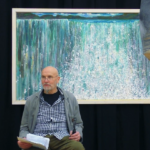
Koenraad Elst (born 7 August 1959) is a Belgian orientalist and Hindutva activist. He is known for his writings on comparative religion, Hindu-Muslim relations and Indian history. He has contributed columns of numerous Indian and Flemish newspapers, and published in Dutch about philosophy, politics and religion.[1] He is also known for his support of the Out of India theory which argues against the mainstream academic view that the Indo-European languages originated in the Kurgan culture of the Central Asian steppes.
Biography
Elst though born into a Flemish Catholic family, rejects Roman Catholicism and calls himself a “secular humanist”.[2] He graduated in Indology, Sinology and philosophy at the Catholic University of Leuven. Around that time, Elst became interested in Flemish nationalism.[3] Between 1988 and 1992, Elst was at the Banaras Hindu University. In 1999, he received a Ph.D. in Asian Studies from Leuven.[4] His doctoral dissertation on Hindu revivalism was published as Decolonizing the Hindu Mind.[3]
He was an editor of the New Right Flemish nationalist journal Teksten, Kommentaren en Studies from 1992 to 1995,[5] focusing on criticism of Islam, various other conservative and Flemish separatist publications such as Nucleus, 't Pallieterke, Secessie, or the neoconservative The Brussels Journal and Middle East Forum.[citation needed]
Elst, known for his support for the Out of India theory related to Indo-Aryan migration, has also written about multiculturalism, language-policy issues, ancient Chinese philosophy and history, and comparative religion.[6] Elst became identified with Hindutva politics during the 1990s, following his support for the Bharatiya Janata Party's position on the Ram Janmabhoomi temple in Ayodhya and in parallel with the BJP's rise to prominence on the Indian national stage.[citation needed]
Indigenous Aryan theories

In two books, Update on the Aryan Invasion Debate (1999) and Asterisk in Bhāropīyasthān (2007), Elst has written in support of Out of India,which argues against the academically accepted view that Indo-European languages originated in the Kurgan culture of the Central Asian steppes and that the migrations to Indian subcontinent in the second millennium BCE brought a proto-Indo-European language with them.[7][8] Elst argues that the migration went the other way and that Aryans indigenous to India migrated out of India, taking Indo-European languages to the Middle East and to Europe. Elst is one of the few supporters who uses paleolinguistics in support of the Out-of-India theory.[9][10] The Out-of-India theory is considered[by whom?] an extreme view of the origin of the Indo-European family of languages and Elst is thought to be one of its leading proponents.[9][11][need quotation to verify]
According to Elst, the linguistic data are a soft type of evidence and are compatible with a variety of scenarios. The dominant linguistic theories may be compatible with an out-of-India scenario for Indo-European expansion.[12]
Hindu revivalism
Elst is known to be sympathetic to Hindutva, a Hindu nationalist movement.[13] In Ram Janmabhoomi vs Babri Masjid, Elst makes the case for an enduring historical tradition associating the Ram Janmabhoomi site with the birthplace of Rama, the Hindu god/king.[14] The book, which was published by Voice of India, a publication house devoted to furthering the Hindu cause,[15][16] brought attention and praise for Elst from L. K. Advani, the leader of the Bharatiya Janata Party.[17]
Writings on Islam
Every Muslim is a Sita who must be released from Ravana's prison. We should help Muslims in freeing themselves from Islam …
Elst is considered a member of the school of thought championed by Ram Swarup and Sita Ram Goel, the founders of the Voice of India (VOI) publishing house and writers who were highly critical of both Christianity and Islam. He adopts their hard-line stance against the two religions in his book, Decolonizing the Hindu Mind.[15] In it, he contends that the "need for 'reviving' Hinduism spring from the fact that the said hostile ideologies (mostly Islam) have managed to eliminate Hinduism physically in certain geographical parts and social segments of India, and also (mostly the Western ideologies) to neutralize the Hindu spirit among many nominal Hindus."[19] In Ayodhya and After (1991), Elst states that the Ayodhya temple movement offered "an invitation to the Muslim Indians to reintegrate themselves into the society and culture from which their ancestors were cut off by fanatical rulers and their thought police, the theologians. It is thus an exercise in national integration".[20]
According to Meera Nanda, Elst uses "the writings of his [Voice of India] mentors to peddle the worst kind of Islamophobia imaginable". She supports this with an example from one of his essays where he advises his readers that the best way to criticise Muhammad is to question his sanity as, from a yogic viewpoint, his divine revelations were "born from a deluded consciousness" fed by "sexual arousal" provided by his wife, Khadija.[15][21] Elst, on the other hand questions Nanda's motive behind "shielding the religious dogma of monotheism from criticism," and suggests she accepts the Christian view of moral superiority of monotheism.[22] Elst strongly denies the charges of him being an anti-Muslim, but insists that "not Muslims but Islam is the problem".[23]
In his 1992 book, Negationism in India: Concealing the Record of Islam,[24] Elst attempts to demonstrate that there exists a prohibition of criticism of Islam in India and a denial of its "historic crimes against humanity" that amounts to censorship.[25][26][27][28] The book compares the phenomenon of "negationism" to holocaust denial in Europe.[citation needed]
Reception
Elst's work has drawn both praise and criticism. David Frawley called his work on Ayodhya "definitive",[29] K. D. Sethna regarded it as "absolutely the last word".[30] Paul Beliën described him as "one of Belgium's best orientalists",[31] while the neo-conservative Daniel Pipes was positive about his stance on the Rushdie-affair.[32]
On the other hand, the anthropologist Thomas Blom Hansen described Elst as a "Belgian Catholic of a radical anti-Muslim persuasion who tries to make himself useful as a 'fellow traveller' of the Hindu nationalist movement",[33] while the historian Sarvepalli Gopal called Elst "a Catholic practitioner of polemics" who "fights the Crusades all over again on Indian soil".[34] Meera Nanda criticised his support for Hindu nationalism.[15]
Works
- In English
- Ram Janmabhoomi Vs. Babri Masjid: A Case Study in Hindu-Muslim Conflict. Voice of India. 1990.
- Ayodhya and after: issues before Hindu society. Voice of India. 1991.
- Negationism in India: concealing the record of Islam. Voice of India. 1992. ISBN 81-85990-01-8.
- Bharatiya Janata Party vis-à-vis Hindu resurgence. New Delhi: Voice of India. 1997. ISBN 81-85990-47-6.
- Decolonizing the Hindu mind: ideological development of Hindu revivalism. Rupa & Co. 2001. ISBN 9788171675197.
- The Saffron Swastika: The Notion of "Hindu Fascism". Voice of India. 2001. ISBN 9788185990699.
- Ayodhya: the case against the temple. Voice of India. 2002. ISBN 9788185990750.
- Ayodhya, the Finale: Science Versus Secularism in the Excavations Debate. Voice of India. 2003. ISBN 9788185990774.
- With Rao, Ramesh N. (2003). Gujarat after Godhra: real violence, selective outrage. Har Anand Publications.
- As editor
- Goel, Sita Ram (2005). India's Only Communalist: In Commemoration of Sita Ram Goel. Voice of India. ISBN 9788185990781.
- In Dutch
- The India chapter in Wim Van Rooy & Sam Van Rooy, eds.: De islam. Kritische essays over een politieke religie (“Islam: Critical Essays on a Political Religion”), ASP, Brussels 2010.
- Heidendom in India: hindoeïsme en christendom, dialoog tussen vreemden (“Paganism in India: Hindus and Christians, Dialogue between Strangers”, Mens & Cultuur, Ghent 2014).
Notes
- ^ Pollet, Gilbert (1995). Indian Epic Values: Rāmāyaṇa and Its Impact : Proceedings of the 8th International Rāmāyaṇa Conference, Leuven, 6-8 July 1991. Peeters Publishers. p. 42. ISBN 9789068317015.
- ^ "The Problem of Christian Missionaries". bharatvani.org. Retrieved 11 December 2010.
- ^ a b Nanda 2009, p. 112.
- ^ Geybels, Hans; Herck, Walter Van (2011). Humour and Religion: Challenges and Ambiguities. Bloomsbury Publishing. p. IX. ISBN 9781441194831.
- ^ NIEUW RECHTS TEN ONDER, beschreven door Dr Koenraad Elst
- ^ "Koenraad Elst - The Brussels Journal".
- ^ Shikui Dong, Karim-Aly S. Kassam, Jean François Tourrand, Randall B. Boone (2016). Building Resilience of Human-Natural Systems of Pastoralism in the Developing World. Springer. Retrieved 31 March 2019.
The nomads originated from the Kurgan culture of southern Russia are believed to have expand into the Indian subcontinent about 3500 years ago, bringing with them not only the practice of nomadic pastoralism but also the Indo-European languages they spoke
{{cite book}}: CS1 maint: multiple names: authors list (link) - ^ Walter Bär, Angelo Fiori, Umberto Rossi. Advances in Forensic Haemogenetics. Springer Science & Business Media. Retrieved 31 March 2019.
The Gimbautas hypothesis of an origin in the kurgan region and spread during the Bronze Age (between 4,000 and 2,500 BC) [...] seems to have the greatest support from archaeological and other considerations [...].
{{cite book}}: CS1 maint: multiple names: authors list (link) - ^ a b Bryant, Edwin (2001). The Quest for the Origins of Vedic Culture: The Indo-Aryan Migration Debate. New York: Oxford University Press. p. 146.
In any event, Elst's proposal that earlier tribes could have emigrated from India bearing the centum characteristics and, after the velars had evolved into palatals in the Indian Urheimat, later tribes could have followed them bearing the new satem forms (while the Indo-Aryans remained in the homeland), cannot actually be discounted as a possibility on these particular grounds.
- ^ Avari, Burjor (2016). India: The Ancient Past: A History of the Indian Subcontinent from c. 7000 BCE to CE 1200. Routledge. p. 79. ISBN 9781317236726.
A Belgian revisionist, Koenraad Elst, has nevertheless claimed that the Aryan migration was not towards India but out of India. Their ancestral homeland, their Urheimat, was the land of Sapta-Sindhava (the Punjab), and from there they expanded outwards towards Afghanistan, Iran, Central Asia and, ultimately, towards Europe.
- ^ Humes, Cynthia Ann (2012). "Hindutva, Mythistory, and Pseudoarchaeology". Numen. International Review for the History of Religions. 59: 178–201. doi:10.1163/156852712x630770. JSTOR 23244958.
- ^
Patton, Laurie L. (2005). "Introduction". In Bryant, Edwin; Patton, Laurie L. (eds.). The Indo-Aryan Controversy. Psychology Press. pp. 1–19. ISBN 9780700714636.
It is possible that the absorption of foreign words could have taken place after the emigration of other branches of Indo-Europeans from India (p. 8).
- ^ Guha, Sudeshna (May 2005). "Negotiating Evidence: History, Archaeology and the Indus Civilisation". Modern Asian Studies. 39 (2). Cambridge University Press: 399–426. doi:10.1017/s0026749x04001611. JSTOR 3876625.
- ^ Sethi, Harish (26 January 1991). "Justifying Hindu Hurt.Ram Janmabhoomi vs Babri Masjid by Koenraad Elst. Review". Economic and Political Weekly. 26 (4): 167–168. JSTOR 4397247.
- ^ a b c d Nanda 2009, pp. 112–113.
- ^ Sikand, Yogesh (Spring 2002). "Hinduism and Secularism After Ayodhya by Arvind Sharma: A Review". Islamic Studies. 41 (1): 166–169. JSTOR 20837185.
- ^ Sita Ram Goel, How I became a Hindu. ch.9
- ^ Nanda 2009, p. 106.
- ^ Guichard 2010, p. 94.
- ^ Anand 2011, p. 138.
- ^ Nanda 2011, pp. 161–163.
- ^ Elst, Koenraad (18 February 2015). Return of the Swastika: Hate and Hysteria versus Hindu Sanity. Arktos. ISBN 9781910524183.
- ^ "Book Review -- Saffron Wave". koenraadelst.bharatvani.org. Retrieved 20 October 2017.
- ^ Negationism in India: concealing the record of Islam
- ^ Singh, Ranbir (14 February 2012). "Negationism in Indian History: Its Lessons for the Arab Spring Dystopia". ChakraNews.com. Retrieved 11 February 2018.
- ^ "WebCite query result". WebCite (in Spanish). 25 October 2009. Retrieved 11 February 2018.
{{cite web}}: Cite uses generic title (help) - ^ "Taj Mahal or Tejo-Mahalaya?". The Express Tribune. 21 July 2016. Retrieved 11 February 2018.
- ^ Robin Abraham (16 August 2017). The Philosopher Volunteer. Notion Press. pp. 49–. ISBN 978-1-947498-27-3.
- ^ Frawley, David (2000). How I Became a Hindu: My Discovery of Vedic Dharma. Voice of India. p. 96. ISBN 9788185990606.
- ^ Mother India: Monthly Review of Culture, Volume 58. page 521
- ^ Is Islam Dying? Europe Certainly Is
- ^ Pipes, Daniel. The Rushdie Affair: The Novel, the Ayatollah, and the West. Transaction Publishers. p. 305.
- ^ Hansen, Thomas. "The Saffron Wave". p. 262.
- ^ Gopal, S., Anatomy of a Confrontation: Ayodhya and the Rise of Communal Politics in India, Palgrave Macmillan, 1993, p.21.
References
- Nanda, Meera (11 July 2009). "Hindu Triumphalism and the Clash of Civilisations". Economic and Political Weekly. 44 (28): 106–114. JSTOR 40279263.
{{cite journal}}: Invalid|ref=harv(help) - Nanda, Meera (2011). The God Market: How Globalization is Making India More Hindu. NYU Press. ISBN 9781583672501.
{{cite book}}: Invalid|ref=harv(help) - Guichard, Sylvie (2010). The Construction of History and Nationalism in India: Textbooks, Controversies and Politics. Routledge. ISBN 9781136949302.
{{cite book}}: Invalid|ref=harv(help) - Anand, Dibyesh (2011). Hindu Nationalism in India and the Politics of Fear. Palgrave Macmillan US. ISBN 9781349371907.
{{cite book}}: Invalid|ref=harv(help)
External links
- Articles and Books by Koonraad Elst
- Articles by Koenraad Elst in India Facts
- Articles by Koenraad Elst in Pragyata
- Koenraad Elst, (2013) The Wikipedia lemma on "Koenraad Elst": a textbook example of defamation
| International | |
|---|---|
| National | |
| Academics | |
| People | |
| Other | |
