








Talk:Seven-dimensional cross product: Difference between revisions
Brews ohare (talk | contribs) |
making some headers to have talk as threads |
||
| Line 1: | Line 1: | ||
== Some questions 2008 == |
|||
Is this an [[Exterior algebra|Exterior product]] or something else? --[[User:Salix alba|Salix]] ([[User talk:Salix alba|talk]]): 19:19, 27 September 2008 (UTC) |
Is this an [[Exterior algebra|Exterior product]] or something else? --[[User:Salix alba|Salix]] ([[User talk:Salix alba|talk]]): 19:19, 27 September 2008 (UTC) |
||
Why can't cross products be defined in fifteen dimensions? The article should provide at least some explanation, even if it's obvious, because nothing's really obvious at this level. [[User:Eebster the Great|Eebster the Great]] ([[User talk:Eebster the Great|talk]]) 02:36, 8 December 2008 (UTC) |
Why can't cross products be defined in fifteen dimensions? The article should provide at least some explanation, even if it's obvious, because nothing's really obvious at this level. [[User:Eebster the Great|Eebster the Great]] ([[User talk:Eebster the Great|talk]]) 02:36, 8 December 2008 (UTC) |
||
== Multi-dimensional vector product by Silagadze == |
|||
I've read the attached reference to Multi-dimensional vector product by Z.K.Silagadze. The quote of interest would be: |
I've read the attached reference to Multi-dimensional vector product by Z.K.Silagadze. The quote of interest would be: |
||
"From a view point of composition algebra,the vector product is just the commutator divided by two. According to Hurwitz theorem the only composition algebras are real numbers,complex numbers,quaternions and Octonions. Quaternions produce the usual three-dimensional vector products. The seven-dimensional vector product is generated by Octonions." |
"From a view point of composition algebra,the vector product is just the commutator divided by two. According to Hurwitz theorem the only composition algebras are real numbers,complex numbers,quaternions and Octonions. Quaternions produce the usual three-dimensional vector products. The seven-dimensional vector product is generated by Octonions." |
||
Revision as of 23:20, 27 June 2010
Some questions 2008
Is this an Exterior product or something else? --Salix (talk): 19:19, 27 September 2008 (UTC)
Why can't cross products be defined in fifteen dimensions? The article should provide at least some explanation, even if it's obvious, because nothing's really obvious at this level. Eebster the Great (talk) 02:36, 8 December 2008 (UTC)
Multi-dimensional vector product by Silagadze
I've read the attached reference to Multi-dimensional vector product by Z.K.Silagadze. The quote of interest would be: "From a view point of composition algebra,the vector product is just the commutator divided by two. According to Hurwitz theorem the only composition algebras are real numbers,complex numbers,quaternions and Octonions. Quaternions produce the usual three-dimensional vector products. The seven-dimensional vector product is generated by Octonions." I'll try to put this in with a tag for improvement. 86.80.122.213 (talk) 00:01, 3 April 2009 (UTC) LCV
Nevermind, looks like it's already there. 86.80.122.213 (talk) 00:03, 3 April 2009 (UTC) LCV
Why only three and seven?
Eebster asks, 'why can we not have a fifteen dimensional vector cross product?'. Well at least in part, the answer lies with the distributive law. The only reason why the vector product is so useful is because it can be used to describe certain problems in three dimensions, and that we can multiply the individual components out. If the operation did not obey the distributive law, it would have no practical use, because we could not numerically multiply the individual components out.
As it so happens, the seven dimensional cross product also obeys the distributive law.
As regards the deeper question of 'why only three and seven?', I don't know. I read in a 1970's Encyclopaedia Britannica that they were in the process of deriving a theorem to prove that it could only exist in three and seven dimensions, but that the theorem was very lengthy and complicated, and that it was not yet completed.
All I can say is that I once tried to multiply it out in five dimensions and it failed the consistency test. If you want to set up a fifteen dimensional set of operators and try it out, you are welcome. But you will need lots of paper, and lots of patience, and your eyes will be sore at the end of it. The chances are that you will make at least one silly mistake which will ruin the whole purpose of the exercise. David Tombe (talk) 03:17, 29 December 2009 (UTC)
- The reason is given in the last section: the space above it must be a normed division algebra, and these only exist in 1, 2, 4, 8 dimensions. So a cross product can only exist in 0, 1, 3, 7 dimensions. Except the first two are too trivial, so only in 3 and 7 dimensions. --JohnBlackburne (talk) 10:18, 29 December 2009 (UTC)
John, I think it needs alot more explaining than that. Why only three and seven? And you reply "the space above it must be a normed division algebra, and these only exist in 1, 2, 4, 8 dimensions". Where's your proof that these exist only in 1, 2, 4, and 8 dimensions? You've stated the facts themselves as the proof. David Tombe (talk) 14:48, 29 December 2009 (UTC)
- WP:NOT, in particular WP:NOTTEXTBOOK, suggests you are looking in the wrong place for proofs. The article has some good references so you could consult those, or try and prove it yourself (you will learn a lot more that way). Or ask at the reference desk --JohnBlackburne (talk) 14:58, 29 December 2009 (UTC)
John, I'm not going to try and prove it myself. The Encyclopaedia Britannica in the 1970's said that the proof was extremely complex and as yet not completed. So it would be a tall order to suggest that I could just simply prove it myself. Your first reply made out that you knew the proof and that the proof was a one liner. I think that we both know that that is not the case. David Tombe (talk) 15:08, 29 December 2009 (UTC)
- I would disregard the Encyclopaedia Britannica if it's so old. Most of the theory on it is based on today has been developed significantly in the last two decades. And where did I say "one liner" ? --JohnBlackburne (talk) 15:21, 29 December 2009 (UTC)
OK John, There are a number of points to be tackled here. A 1970's Encyclopaedia Britannica is not old. Things have not moved on that much since the middle of the nineteenth century when Hamilton's colleagues were getting into difficulties with the 16 dimensional equivalent to octonians. Encyclopaedia Britannica is written by professionals. Maths articles in the Britannica will be written by recognized academics.
An encyclopaedia is not a textbook. It's purpose is to give basic knowledge to interested readers. So we must not lose track of the fact that wikipedia is also an encyclopaedia and not a textbook. Encyclopaedia readers don't want to read 'pure maths speak'. And the so-called explanation in the main article for why we can only have the cross product in 3 and 7 dimensions, not only fails to explain it, but it is written in the language of 'pure maths speak'.
Your reply above,
the space above it must be a normed division algebra, and these only exist in 1, 2, 4, 8 dimensions. So a cross product can only exist in 0, 1, 3, 7 dimensions.
is 'pure maths speak' and it fails to address the very question that it is supposed to be addressing. Few readers, even with a university mathematics education could make any sense out of that statement.
The truth of the matter is that we can in fact have a cross product in 5 dimensions. But it will not obey the distributive law, and as such it will be effectively useless. The 7 dimensional cross product does however obey the distributive law.
We know that it is generally accepted that we can only have the cross product in 0, 1, 3 , and 7 dimensions. But unless that proof that they were talking about in the 1970's Britannica is now finally completed, then we don't have a formal proof of this fact as such. We are no further on than we were in the days of Hamilton in the 1840's.
So I put in a sentence regarding the importance of the distributive law as regards the reason why we can only have it in 0,1,3, and 7 dimensions. I used a language that was going to be comprehensible to the average high school student. But you deleted it, and referred me to the incomprehensible 'pure maths speak' in the last section, which didn't even answer the issue in question.
I've always had a problem with pure mathematicians. Applied mathematicians can also be problematic. Applied mathematicians often go off the rails as regards linking their maths to the real world. But pure mathematicians tend to off the rails as regards linking their maths to maths. I've always felt that pure mathematicians think that they are not really in this world, and that they relish 'pure maths speak' because of its inaccessibility to the rest of humanity.
When writing these maths articles, please try to have some consideration for the curious readers who will not be educated in 'pure maths speak'. David Tombe (talk) 04:19, 1 January 2010 (UTC)
- I've added two new refs with two different proofs, both of which you can read online - the proofs are only one and a half and two pages, but they are from 2004 and 2009 so it's understandable an encyclopaedia from 1970 does not know about them. Each contains other references you could check for other proofs. WP is not the place for the proofs themselves but they are a good reference for anyone like yourself wanting more information. --John Blackburne (words ‡ deeds) 09:16, 1 January 2010 (UTC)
John, OK. Now we are beginning to make progress. You have provided two links for the main article which purport to give proofs for the question that has been raised above. You now acknowledge, contrary to your initial comments above, that no proof already existed in the article, but merely a statement of the facts.
One of these proofs that you have supplied may well be the proof that the 1970's Encyclopaedia Britannica was referring to. I think it is now important that you make a direct note in the main article, regarding the issue of 'proof', and then draw specific attention to these links which you have kindly provided.
But we are still lacking something. The proofs in question are very very complex, and will only be understood by the top echelons in the pure mathematics community. We need something else for the poor old applied mathematicians like myself to be able to relate to. I like to explain things to people in a way that they can at least partially understand. As I said above, it is actually possible to set up a 5 dimensional cross product. But because it won't obey the distributive law it will be useless. It's important to give this layman's explanation for the benefit of the average reader. We need some statement near the top of the article to the extent that it's only in 1, 3, and 7 dimensions that a vector product will satisfy the distributive law, and hence be of any practical use.
And one final point. You do realize that the second reference that you supplied confirms exactly what I said on the edit that you deleted. It says that we can have the vector cross product in 0,1,3, and 7 dimensions. You deleted my edit which said that, and said that the 0, and 1, cases were wrong.
While I have sympathy with your own private views regarding the 0 dimensional case, and to a lesser extent regarding the 1 dimensional case, I was merely writing what I had read in the Encyclopaedia Britannica. You will maybe now be slowly beginning to realize that your wholesale reversion of all my edits was somewhat premature. David Tombe (talk) 10:52, 1 January 2010 (UTC)
- The proofs are as they are. They are short and straightforward but are dense and assume a familiarity with techniques beyond the level of this article. But in general WP is not the place for proofs, so so beyond providing the links there's not much we can do. As they are from this decade I am sure the Encyclopaedia Britannica writers in 1970 were not aware of them.
- As for 0 and 1 dimensions you can derive them but they are not cross products. In one dimensional space all "vectors" are parallel, so sin θ == 0. In 0 dimensions you don't have numbers. The products in each case are just identically 0: trivially satisfying the conditions but not cross products, or meaningful products in any sense. You can define trivial products like this in any dimension but non-zero so non-trivial ones that satisfy the conditions only exist in 3 and 7 dimensions. --John Blackburne (words ‡ deeds) 11:20, 1 January 2010 (UTC)
- OK, I've clarified all that in the article, summarising the above and making the refs inline so the proofs are associated with where they're mentioned. --John Blackburne (words ‡ deeds) 11:32, 1 January 2010 (UTC)
(We just got an edit conflict, so the below may now be out of date)
John, I would agree with you about the zero dimensional case. As for the one dimensional case, I also have sympthay for your point of view. But I was just stating what it said in the sources. The sources say 0, 1, 3, and 7.
I rationalize with it all as follows. The one dimensional case is plain simple real number algebra. It is not technically a cross product, but at least it is something. I can't imagine any kind of algebra in zero dimensions. The three dimensional case is the familiar cross product which works excellently with standard three dimensional Euclidean geometry. Using it in conjunction with the partial differential spatial operator leads to the extremely useful 'curl' operator. I do believe it was Maxwell who coined the terms curl, div, and grad. Finally, we have the mysterious seven dimensional vector product which works, but which doesn't tie in with any geometry that the human mind can comprehend. I await the day when we see a practical application of the seven dimensional case.
Finally add the extra imaginary factor of the square root of minus one to any of these three, and we get (1) complex conjugate pairs (2) quaternions, and (3) octonians. The 1,3,7 then becomes a 2,4,8. This points to a series based on powers of 2. So why not a 15 dimensional vector product as the man rightly asks above?
As for the proof of why only 1, 3, and 7, it may well be too complicated for wikipedia but it is important to write in the main article that proofs have been attempted, and then to give the links to these purported proofs. I can't vouch for the authenticity of the proofs, and I doubt if many editors will be able to do that. Whether or not these proofs are correct is something that only the pure mathematics community will deep down know amongst themselves. But nevertheless, the official state of existing knowledge is that we trust the pure mathematics community and that they claim that proofs exist, and that these proofs are in the links which you have kindly provided. David Tombe (talk) 11:45, 1 January 2010 (UTC)
- Yep. That's the idea. You've now drawn attention to the proofs, if they are proofs. But we have to trust them. Now what about something for the layman and the poor old applied mathematicians? What about an explanation as to why a 3D case is so useful, but why a 5D case is useless, and why the 7D case might be useful? David Tombe (talk) 11:50, 1 January 2010 (UTC)
But it does not exist in 1 dimension. From either

or
- |x × y| = |x||y|sin θ
it is identically zero. The first equation as x and y would be complex numbers which commute so the product is zero. The second equation more obviously as in 1D there is only one direction so θ is zero or π and sin θ is zero. This is not particular to 1D - you can define a trivial cross product that results in the zero vector in any dimension, including 5D. The sentence "Nontrivial binary cross products exist only in 3 and 7 dimensions" covers this pretty well.
As for why not 15, the 16 dimensional Sedenions are not a Normed division algebra, which is required for the construction given to work. But the proofs also show that it's only possible in 3 and 7 dimensions more directly. As for use, it does not have one that I'm aware of, apart from to answer the question "does the cross product exist in any other dimensions?", though a lot of interesting theory is associated with it. I recommend Lounesto's book, which has a chapter on it. --John Blackburne (words ‡ deeds) 12:26, 1 January 2010 (UTC)
- John, The one dimensional case is i×i = 0. And the equation |x × y| = |x||y|sinθ is only a result which follows in the special case of three dimensions. That needs to be made clear in the article. The article currently states the equation |x × y| = |x||y|sinθ in a way that gives the wrong impression that it is general for all dimensions that the cross product holds in.
- The situation has been confused by the fact that Hamilton was working on the premises that i, j, and k, were extensions of the imaginary concept. So Hamilton's quaternions differed slightly from the later Gibbs's cross product, in that for Hamilton i×i = -1, whereas for Gibbs i×i = 0. Cross product is real. But Hamilton was thinking of the 3D bit as being imaginary. Hamilton also adds an extra real number algebra to the situation, making the 3D vector cross product into a 4D quaternion.
- Hence we have a 1, 3, and 7 when we use the Gibbs style relationship i×i = 0, and we get a 2, 4, and 8 when we use the Hamilton style with the extra real number, and where i×i = -1.
- But whatever, the cross product does exist in 1 dimension, and the sources say so. You need to go by what the sources say. This article still needs some touching up.
- And we need explanations for the layman, the high school students, and the applied mathematicians. We need to state in plain English, that the reason why only 1, 3, and 7 work, is because they are the only ones that obey the distributive law. David Tombe (talk) 10:47, 2 January 2010 (UTC)
- It exists but is trivial, as in zero dimensions. There's nothing interesting to say about it beyond what's already said in the lede and last section.
- As for explanations for the layman the reasons why the cross product only exists in 3 and 7 dimensions are given in the proofs, 2 of which you can read following links - it's nothing to do with the distributive law. I don't think these can be summarised in a way that would make them more accessible, nor do I think WP is the place to do so. --John Blackburne (words ‡ deeds) 10:59, 2 January 2010 (UTC)
John, You are now backtracking. When I first added mention of the zero and one dimensional cross products to the main article, as per the sources, you made a mass revert boldly stating that there is no cross product in zero or one dimensions. While I am sympathetic to your own private views as regards the zero dimensional case, I was merely writing what was in the sources. As regards the one dimensional case, I have shown you above that it does exist, and you have now agreed that it exists. So we are now finally making some kind of progress.
Wikipedia is an encyclopaedia with the aim of bringing general knowledge to a wide readership. Those proofs that you have supplied are fine for the pure maths community, and I'm glad that you have provided them. I intend to study them soon. But we need something for other levels as well. Where do you get the idea that it has got nothing to do with the distributive law? It has got everything to do with the distributive law. I can easily set up a cross product in 5 dimensions. But it will not obey the distributive law and so we cannot therefore multiply out the components, and so it is useless. Are we not allowed to state this fact in the article? Does everything in the article have to be shrouded in 'pure maths speak' so that only a pure maths elite can read it? David Tombe (talk) 11:15, 2 January 2010 (UTC)
- Do you have a reference for that ? You cannot use a result you've proved otherwise, as per WP:NOR. And the proofs I've found, with references, suggest it's far more complex than "will not obey the distributive law". --John Blackburne (words ‡ deeds) 12:08, 2 January 2010 (UTC)
John, The distributive law issue is not a proof as such. It's a qualitative explanation as to why a 5D cross product would not work. The proofs that you have provided are new stuff. But it has been generally accepted since the 1840's that outer product only works in 1, 3, and 7 dimensions? What was the basis of that general acceptance? Well didn't Hamilton's friend WT Graves try it out practically in 15 (16 actually because he was doing octonians)? And didn't he get stuck? Why did he get stuck?
You are a mathematician. You know yourself that an algebra is only an algebra if it satisfies basic laws like the commutative law, the associative law, and the distributive law. We also know that cross product is anti-commutative and non-associative. So if it is non-distributive, then it is useless. But 1,3, and 7 dimensions are not non-distributive. That is the whole point behind them. The 3D cross product can be multiplied out in its i, j, and k component form, hence making it into a useful tool. And you can easily set up a 5D arrangement yourself with i, j, k, l, and m and then multiply it out as if the distributive law worked. You will find that it crashes in 5D.
I don't think that OR comes into it. When we do the cross product in applied maths, one of the first things that we do is to prove that it obeys the distributive law. It's a fundamental fact of why the 3D cross product is a useful tool in applied mathematics.
Let's go back to the 1960's before those proofs came out. What would your explanation have been as to why the 5D cross product didn't work? You would have been telling people that it only works in 1, 3, and 7. They would have asked 'why not 5 or 15?'. What would you have replied? David Tombe (talk) 15:27, 2 January 2010 (UTC)
- What? I've added two proofs for the existence of cross products only existing in 3 and 7 dimensions. I've no interest in finding any more. Please feel free to spend five minutes with Google looking for them yourself. --John Blackburne (words ‡ deeds) 15:36, 2 January 2010 (UTC)
John, You have missed the point. The readers want a layman's explanation as to why 5D or 15D doesn't work. David Tombe (talk) 15:57, 2 January 2010 (UTC)
- There isn't one: the proofs though short are hardly layman's proofs. But as I wrote you are welcome to add one, properly referenced, if you can findd one.--John Blackburne (words ‡ deeds) 16:01, 2 January 2010 (UTC)
John, There is one. It's the one that you deleted. It's the fact that only 1, 3, and 7 obey the distributive law. No course on vector product is complete without showing that it obeys the distributive law. David Tombe (talk) 17:02, 2 January 2010 (UTC)
- You mean this ? I'm happy for you to add it back in with a proper reference. So far you've only indicated it's your own work, which we can't include as per WP:NOR. --John Blackburne (words ‡ deeds) 17:12, 2 January 2010 (UTC)
Well John, that really is rich. You blatantly disregard the sources when it comes to the issue of the fact that cross product works in 0,1,3, and 7 dimensions. The sources are quite clear on that point, and you have just provided such a source yourself. But nevertheless, you have decided that we are not allowed to mention the 0 and 1 dimensional cases in the article because you personally do not believe in them. You deleted my amendment where I added mention of the two trivial cases of 0 and 1 dimension, while stating that they are wrong.
But when it comes to something much more basic, such as the distributive law, then you are demanding sources. You can see yourself, just by looking at the cross product article that the distributive law is a central feature of the cross product. But it appears that while you accept that cross product doesn't work in 5D, the penny has never yet dropped with you that the reason for this is that the 5D case does not obey the distributive law!
You see John, I'm an applied mathematician. I use these operations, and I inquire into why they are useful. I don't get involved in terminologies such as 'normed division algebra' or 'Clifford algebra'. To say that 5D doesn't work because it is not a 'normed division algebra' does not give a reason that is of any use to the applied mathematician, or the high school student, or the layman.
We need to be fair to the wider readership. We need to end all these silly games of shrouding the topic inside a defensive ring of 'pure maths speak'. Cross product is a subject which is of interest to a wider range of scientists than merely the pure maths elite. It is simply not fair that the article should be owned by the pure mathematicians, and disguised in 'pure maths speak'.
Anyway, I'll leave you to it and you can write the article whatever way you like. David Tombe (talk) 04:57, 3 January 2010 (UTC)
- We need to make the article as accessible as possible, but not at the expense of accuracy, or more precisely verifiability. So if there's a proof it does not work in 5D because of the distributive law, and there's a reference for it, we can include it. Otherwise we have to make do with the maybe less accessible but well sourced proofs that are there now. --John Blackburne (words ‡ deeds) 10:23, 3 January 2010 (UTC)
John, You are getting confused between the issue of (1) The reason why it doesn't work in 5D, and (2) The proof of the fact that it only works in 1D, 3D, and 7D. These are two different issues and you are confusing them with each other.
The reason why it doesn't work in 5D is because the distributive law doesn't work in the 5D case. It has got nothing to do with the issue of proof. No proof is necessary to show that the distributive law doesn't work in 5D, other than to show that the proof of the distributive law in 3D, which is in the article, doesn't work when you try it out with a 5D case. You are getting your train of logic all wrong. The distributive law is an essential feature of the cross product. And we can have a cross product in 1, 3 and 7 dimensions. The reason we can't have it in 5 dimensions is because the distributive law will not hold in 5 dimensions. This is such a fundamental fact that it seems to have been totally missed by the pure mathematicians. If you prove that it only works in 1, 3, and 7 dimensions, you still haven't explained why it works.
Once again, I should remind you that it is you who is ignoring the sources. You have decided to impose your own opinion on the article and avoid listing the 0, and 1 dimensional cases, as per the sources. David Tombe (talk) 11:55, 3 January 2010 (UTC)
- I'm not ignoring any sources, you have still to provide any --John Blackburne (words ‡ deeds) 11:57, 3 January 2010 (UTC)
John, You are ignoring the sources. The sources say that it works in 0,1,3, and 7 dimensions. The article only mentions 3, and 7. I added in the 0, and 1. You removed that edit stating that 0, and 1 are wrong. David Tombe (talk) 12:00, 3 January 2010 (UTC)
- The article does mention the trivial 0 and 1 dimensional products, and I think is as clear about them as it can be. But I was asking in particular for a source for your assertion that "The reason why it doesn't work in 5D is because the distributive law doesn't work in the 5D case."--John Blackburne (words ‡ deeds) 12:42, 3 January 2010 (UTC)
- I have added Pertti Lounesto's hard source and explicitised the number of factors. Do you think there is an effective way to stop David from disrupting this talk page? This is getting rather tiresome. DVdm (talk) 13:05, 3 January 2010 (UTC)
John, We seem to be working on 'cross talk pages'. On the cross product page the statement reads The cross product is only defined in three or seven dimensions. I added mention of the zero and one dimensional cases, and you removed that edit contrary to what the sources say. So while you are continuing to maintain that your edits are in keeping with the sources, then it is impossible to have a rational discussion with you on this topic. It seems to me that you never before realized the actual reason why 5D doesn't work. It is wrong to say that 5D doesn't work because it is not a 'normed division algebra'. That is a statement of the facts, but it is not a reason. The actual reason is in fact so basic that the pure mathematicians don't seem to have noticed it. 5D doesn't work because it doesn't obey the distributive law, and hence we can't multiply out the components. I don't intend to discuss the issue of whether or not such a trivial fact needs a source, with somebody who so blatantly disregards sources in other respects. So go ahead and write the article how you wish. But do have some consideration for the readers who are not skilled in 'pure maths speak' and who are reading with an inquiring mind.David Tombe (talk) 14:57, 3 January 2010 (UTC)
- You say "5D doesn't work because it doesn't obey the distributive law" but the proofs are far more complicated than this. Which is why I suspect you are wrong and so why you need something other than your own assertion that it's a "trivial fact" to support it. The article is currently well sourced and is not going to be improved by any editor inserting unsourced assertions like this.--John Blackburne (words ‡ deeds) 15:40, 3 January 2010 (UTC)
John, The proofs, if they are actually proofs, are about proving that we can only have cross products in 0, 1, 3, and 7 dimensions. That is a completely separate issue from why we can have a cross product in 0, 1, 3 or 7 dimensions, but not in 5 or 15 dimensions. You are confusing these two issues. The second issue is about practicality. Can you not see the distinction? David Tombe (talk) 16:07, 3 January 2010 (UTC)
- It's not about practicality, which can be determined once we have the sourced information to evaluate. But without a source for your assertion it's impossible to evaluate at all. Please provide one. --John Blackburne (words ‡ deeds) 16:10, 3 January 2010 (UTC)
Forget it John, I'm not going to bring the debate down to sources with somebody who blatantly disregards sources. You can't have it both ways. Clearly you had never before considered the issue of why we cannot have a 5D cross product. David Tombe (talk) 16:14, 3 January 2010 (UTC)
- You might not have noticed but my last change to the page was to provide two sources for the proof that there's a non-trivial cross product in 3 and 7 dimensions only. It is you that has yet to produce sources for the assertions you want to insert. --John Blackburne (words ‡ deeds) 16:28, 3 January 2010 (UTC)
- This is useless. I propose we give David the last word if he wants it. The disruption is then ended by simple silence. DVdm (talk) 16:38, 3 January 2010 (UTC)
- (reply to David after edit conflict) But there is where the debate should be, are the statements in an article backed up by reliable sources. If so is fine to include it, if not then the statement should be removed. So the question is which source can be use to back up that 5 and 15 dim cross products do not obey the distributive law? --Salix (talk): 16:41, 3 January 2010 (UTC)
We're working on 'cross talk pages'. Ideally we should be discussing this on the more general Talk:cross_product page. JohnBlackburne removed this edit of mine [1] contrary to what it says in the sources. Hence it is impossible to have a rational discussion about this topic with people who blatantly disregard sources, yet at the same time demand sources to back up basic facts which are not in dispute, but which have been overlooked by pure mathematicians who are so blinkered by 'pure maths speak' that they have lost track of what the operator is all about in the real world. So you can all take it or leave it. If you don't want to have that line about the distributive law in the article, then so be it. But I want to leave you all with this thought.
If, as you all claim, it has got nothing to do with the distributive law, then why can we not have a cross product in 5 dimensions? Why does it not work? I can easily set one up. But why does it not work? A proof that cross product only works in 1, 3, and 7 does not actually explain why it doesn't work in 5. Talking the language of 'normed division algebra' or 'Clifford algebra' merely states the facts, but it doesn't tell the lay reader why why can't actually have a 5D cross product.
Any university course on the 3D cross product begins by proving that it obeys the distributive law and the Jacobi identity. Apply that same proof to a 5D case and it will not work. Apply it to a 7D case and it will work.
And one more important point. The 7D case is a misnomer. It is not a truly seven dimensional concept relating to 7D space in the sense that the 3D cross product relates to 3D space. The 7D cross product only involves 3 components in any given operation.It has no connection with either 3D geometry or 7D geometry if such a thing even exists.
And there I will rest my case and leave you all to it. David Tombe (talk) 04:27, 4 January 2010 (UTC)
- "The 7D case is a misnomer" => An article talk page is not a soapbox, nor is it a moot court, but thank you for having decided to finally rest your case. DVdm (talk) 08:31, 4 January 2010 (UTC)
The Lagrange Identity
John, The equation,
- |x × y|2 = |x|2 |y|2 − (x · y)2
is only a special 3D case of the Lagrange identity. The more general form of the Lagrange identity is more complicated. You have decided unilaterally that the special 3D version is now the more general n-dimensional version. You are are quite wrong.
Do you never discuss changes on the talk page before you do your reverts? David Tombe (talk) 08:40, 5 January 2010 (UTC)
- If a change is obviously incorrect I will revert it. If I think it's adequately described in the edit summary I'll initially leave it at that.
- But as you've raised it here: that formula is a condition of the cross product in 3D and 7D. With orthogonality it's one of the two conditions that the cross product has to satisfy. So to say it is does not hold in 7D is wrong, and contradicted by the article at the top of the same section.--John Blackburne (words ‡ deeds) 08:47, 5 January 2010 (UTC)
John, How can you possibly use the argument that it is 'contradicted by the article at the top of the same section'? Since when has material in a wikipedia article been considered as a reliable source such as to back up its own errors?
The Lagrange identity in three dimensions cannot possibly be a condition for the cross product in seven dimensions. How could you say such a thing? You have got alot to learn about this subject. David Tombe (talk) 08:57, 5 January 2010 (UTC)
- Just read the article, especially the 8th line. If you need sources for it check e.g. the references. --John Blackburne (words ‡ deeds) 09:04, 5 January 2010 (UTC)
No John, it doesn't work like that. The 8th line is wrong as regards the 7D case. Whoever wrote that was copying from a source about the 3D case. So let's not play silly games of quoting a wikipedia sentence as proof of its own veracity.
This article needs overhauled, because whoever wrote it didn't think it through properly. It's no good telling me to go and read the references. You show me the page and line in those references that says that the special 3D case of the Lagrange identity can be extrapolated to any dimension. David Tombe (talk) 09:17, 5 January 2010 (UTC)
- Lounesto, page 42, outlines the argument. --John Blackburne (words ‡ deeds) 09:27, 5 January 2010 (UTC)
John, You only have to look at page 4 and the top of page 5 in this weblink [2]. It is quite clear that the lagrange identity in the form above, only applies in three dimensions. David Tombe (talk) 14:02, 5 January 2010 (UTC)
- That page says nothing about higher dimensions. I recommend you get a copy of Lounesto's book, "Clifford Algebras and Spinors". It's an excellent book and has a chapter entirely on "The Cross Product" and a later one on Octonions that also discusses the 7D cross product. --John Blackburne (words ‡ deeds) 14:52, 5 January 2010 (UTC)
John, The last three lines on page 4, reading on into page 5 [3] makes it quite clear that the Lagrange Identity,
- |x × y|2 = |x|2 |y|2 − (x · y)2
only holds in the special case of 3 dimensions. The information in the main article is therefore wrong because it applies the Lagrange Identity to the seven dimensional vector cross product. David Tombe (talk) 09:23, 15 April 2010 (UTC)
- The last three lines on page 4 demonstrate the 3d case. It says nothing about other dimensions. DVdm (talk) 09:44, 15 April 2010 (UTC)
DVdm, Page 4 is about the Schwarz inequality which holds in all dimensions. The Lagrange Identity is a special 3D case of the Scwharz inequality.David Tombe (talk) 10:04, 15 April 2010 (UTC)
- David, that chapter is about the product in three dimensions. It says nothing about the seven dimensional case so is no use as a source for this article.--JohnBlackburnewordsdeeds 10:13, 15 April 2010 (UTC)
John, Yes, the chapter is about the 3D cross product. It shows how the Lagrange identity is derived as a special 3D case of the n dimensional Shwarz inequality. The 3D Lagrange identity is then utilized in the 3D cross product in order to estabish the relationship a×b = absinθ. Are you seriously trying to say that the 3D Lagrange identity can be used in the 7D cross product? David Tombe (talk) 10:29, 15 April 2010 (UTC)
- And where in this article does it mention the Lagrange identity?--JohnBlackburnewordsdeeds 10:39, 15 April 2010 (UTC)
John, It's clearly mentioned in the section 'Characteristic properties'. The Lagrange identity is this,
- |x × y|2 = |x|2 |y|2 − (x · y)2
David Tombe (talk) 10:48, 15 April 2010 (UTC)
- You'll find the n-dim identity formulated on page 25 of this one. DVdm (talk) 10:57, 15 April 2010 (UTC)
DVdm, Yes, but we specifically need the 3D version to establish that a×b = absinθ. I never doubted that there was an 'n'dimensional version. But the 'n'dimensional version can't be used to prove that a×b = a b sinθ. My original point in all of this was that,
- |x × y|2 = |x|2 |y|2 − (x · y)2
should be listed along with those properties of the 3D cross product that do not hold in the 7D case. At the moment, the main article lists it as a characteristic property that does hold in the 7D case. I believe that this is an error in the main article. David Tombe (talk) 11:04, 15 April 2010 (UTC)
- You believe wrongly. The "angle" θ can be defined as the thing that satisfies |a×b| = |a| |b| sinθ. Any first year math student knows this. This has been explained to you more than once.
- By the way, you will find another ref to the identity in n-dim in this one. DVdm (talk) 11:17, 15 April 2010 (UTC)
Dvdm, Let's assume as you say that it's a simple matter of defining "angle" θ through the equation |a×b| = |a| |b| sinθ. We're then agreed that the 3D Lagrange identity must follow. The question then is, how can a 3D identity be compatible with a 7D operator? I'm not denying the existence of a 7D Lagrange identity, but it is specifically the 3D Lagrange identity that is used to establish the relationship |a×b| = |a| |b| sinθ. It's the compatibility between a 3D identity and a 7D operator that you need to address. David Tombe (talk) 14:14, 15 April 2010 (UTC)
- David, concerning your statement "I'm not denying the existence of a 7D Lagrange identity", above you have said:
- "The equation ... is only a special 3D case of the Lagrange identity. The more general form of the Lagrange identity is more complicated." => it is not.
- "It is quite clear that the lagrange identity in the form above, only applies in three dimensions." => It does not.
- "...makes it quite clear that the Lagrange Identity ... only holds in the special case of 3 dimensions." => It does not.
- "The Lagrange Identity is a special 3D case of the Scwharz inequality." => It is not.
- "... we specifically need the 3D version to establish that a×b = absin?." => We don't.
- "I never doubted that there was an 'n'dimensional version." => You did. Four times in this section alone."
- If we are supposed to continue assuming good faith from your part, I hope you understand that assuming no clue is our only remaining option here. Please stop it. Thank you. DVdm (talk) 14:21, 15 April 2010 (UTC)
DVdm, I think that we're going to have to leave it to future readers to decide who doesn't have a clue. Meanwhile I still maintain that the main article contains an error by virtue of assuming that a certain 3D identity applies to a 7D operator. David Tombe (talk) 17:07, 15 April 2010 (UTC)
- DVdm: Reading this thread over, I find that Tombe's specific argument, stated succinctly immediately above, has not been addressed. It is an unfortunate tactic to exercise a violation of WP:AGF yourself, rather than engage in the thought needed to address the issue: to repeat Tombe's argument: a certain identity verified in 3D has been applied to a 7D operator without reference to any consideration that might establish it's extension to 7D, and despite specific stated reservations indicating that the 3D proof has elements that cannot apply in 7D. Either a suitable source can be found, or it cannot. Brews ohare (talk) 09:05, 16 April 2010 (UTC)
- Nothing "has been applied to" anything in the article. No "3D proof" is present in the article. DVdm (talk) 09:21, 16 April 2010 (UTC)
- The sources are in the article, all of them online if you want to review them yourself. As always I recommend Lounesto's book, mostly as it explains both the three and seven dimensional cases very well in a few short pages, though it does not have a proof. (he references this proof, which is not in the article but behind a paywall so I can't look at it).
- As for David's argument his main mistake is identifying this
- |x × y|2 = |x|2 |y|2 − (x · y)2
- as the Lagrange identity. It is, but only in three dimensions. In seven it does not simplify like this. Lounesto calls the above the "Pythagoras theorem", which makes some sense if you think of the various things geometrically but I don't think would add anything to the article. Here the above is simply a condition. We say we want a product that satisfies it as well as orthogonality and antisymmetry, then deduce (or point to the proofs that show it) that non-trivial products only exist in 3 and 7 dimensions.--JohnBlackburnewordsdeeds 21:38, 16 April 2010 (UTC)
John, You have just pointed out what I have been trying to point out all along, which is that
- |x × y|2 = |x|2 |y|2 − (x · y)2
is a special 3D case. And in doing so, you have tried to infer that I have been saying the opposite and that that is 'my mistake'. My very first sentence in this section was,
The equation,
*|x × y|2 = |x|2 |y|2 − (x · y)2
is only a special 3D case of the Lagrange identity.
Now that we are finally both agreed that this identity is restricted to 3D, can we get back to the original argument which was that we cannot apply a 3D identity to a 7D operator? The 3D Lagrange identity should be listed alongside the Jacobi identity as an identity which holds only in the 3D cross product and not in the 7D cross product. David Tombe (talk) 02:24, 17 April 2010 (UTC)
The source Z K Silagadze Multi-dimensional vector product, states that the identity:
- |x × y|2 = |x|2 |y|2 − (x · y)2
applies in ℝn over the real numbers with the standard Euclidean scalar product. This statement contradicts Tombe.
This result is derived from the assumed property set forth as a desideratum of the vector cross product that:
- |x × y| = |x| |y| ; provided that (x · y) = 0
using
- |x × y| = |( x- (x · y) / | y|2 y ) × y|
He proceeds to show that
- x × ( y × z) =y(x · z) - z(x · y)
then holds only for dimension n = 3, the case n = 1 being uninteresting. This statement is probably what Tombe is referring to as restricted to 3-D. If this condition is abandoned, n must satisfy:
- n (n - 1) (n - 3) (n - 7) = 0,
in order that a necessary ternary identity be satisfied.
There is no need to introduce the notion of the Lagrange identity (and the article doesn't do this). There also is no need to introduce the notion of the angle θ, through sinθ, which the article does do. I'd suggest the angle θ be dropped from the article.
Silagadze goes on to mention the vector product as connected to the commutator divided by two in a composition algebra, and the connection to the Hurwitz theorem as limiting such algebras to real numbers, complex numbers, quaternions and octonions. Quaternions lead to the usual 3D vector products, and the 7D vector product is generated by octonions. The other two aren't interesting. Presently the article does not make these connections.
Apparently there are physical applications of octonions: Silagadze suggests the sources: Okubo & Dixon & Feza Gürsey, Chia-Hsiung Tze.
My take from reading this source is that everybody here is a bit right and a bit wrong, and a more collaborative atmosphere would lead to a better article. Brews ohare (talk) 05:00, 17 April 2010 (UTC)
- Brews, Thanks for that information. It seems then that while Silagadze considers the expression,
- |x × y|2 = |x|2 |y|2 − (x · y)2
- to be applicable in all dimensions, the source which I supplied above [4] makes it clear that it only applies as a special 3D case of the Schwarz inequality. This is exactly what I had feared. I feared that this would end up as an issue of contradiction between sources. Certainly if it applies in 7D then the angle formula a×b = absin will follow automatically, but if it doesn't apply in 7D, then the angle formula will not follow.
- It is the applicability of the angle formula which I was challenging in relation to the 7D cross product. What we really need to do now is to establish the definitive answer as to whether the equation,
- |x × y|2 = |x|2 |y|2 − (x · y)2
- is restrictied to 3D. I have one source which says that it is restricted to 3D, and also, the wikipedia article which John Blackburne has quoted above confirms this. Ironically however, John also quotes Lounesto who seems to think that this identity applies to the 7D case, and you have just produced another source which seems to say likewise.
- On a more general note, I think that we are all agreed that the cross product only holds in 0, 1, 3, and 7 dimensions. And I think that we are all agreed that the 0D case is less than trivial and in reality meaningless. The 1D case is simply i×i = 0 and it is trivial and of no interest. The 3D case is a full cross product which is highly useful. The 7D case is not a full cross product because some of the identities that hold in the 3D case don't hold in the 7D case. We are all agreed about what some of these identities are. It seems that the only thing that remains to be resolved is whether or not the particular identity,
- |x × y|2 = |x|2 |y|2 − (x · y)2
- falls into that category of identities that hold in 3D but not in 7D. I am of the opinion that it does fall into that category, and as such the angle relationship a×b = absin should be removed from the article, and the identity above should be moved to join alongside with the Jacobi identity as one of the identities that doesn't hold in 7D. David Tombe (talk) 09:42, 17 April 2010 (UTC)
- David you are misunderstanding the use of the formula:
- |x × y|2 = |x|2 |y|2 − (x · y)2
- In 3D, after the cross and dot product have been defined, it is an identity relating them. It is also Lagrange's identity, but only in 3D - see Lagrange's identity#Lagrange's identity and vector calculus. This identity gives the magnitude of the cross product as |a||b| sin θ. The other defining properties of the cross product are orthogonality (a × b is orthogonal to both a and b) and antisymmetry, as well as it being a bilinear with vector result.
- In 7D we do not prove the above formula: we instead state it as a property of the product we want to find, the "cross product" in 7 dimensions. We then find a product that satisfies this and the other properties. Finally we show (though this is not in the article but in the references) that this is the only non-trivial cross product of two vectors other than the familiar 3D version.--JohnBlackburnewordsdeeds 10:12, 17 April 2010 (UTC)
John, I agree with everything that you have said in your first paragraph above. I also understand the principle which you are advocating in your second paragraph. You are stating properties which you wish to hold, one of them being the formula in question, and then claiming that the 7D cross product is one of the outcomes (along with the 3D cross product of course). But I am having difficulty in reconciling the two. How can we start with a property which we already know to be a 3D property, and expect it to be a property of a 7D operator? I am not a pure mathematician and it's possible that I may be overlooking something here. But what you seem to be saying is that the formula,
- |x × y|2 = |x|2 |y|2 − (x · y)2
is a special 3D case of the Lagrange Identity (which I agree with), but that it can also exist in this exact form in 7D outside of the context of the Lagrange identity. That is where I am having the difficulty. You may be right, but I thought that I would raise the matter because it is crucial as regards the issue of the validity of the angle formula a×b = absin in the 7D case. David Tombe (talk) 10:48, 17 April 2010 (UTC)
- We don't expect it to be true, we assert it. We say "this works in 3D, is there any other dimension it works in?" and as
- |x × y|2 = |x|2 |y|2 − (x · y)2
- is a property of the product in 3D was say that it must be a property of the product in other dimensions. This article gives one such product, in seven dimensions. The proofs in the references prove this is the only non-trivial dimension other than three.
- As for Lagrange's identity this
- Is a general form of it, i.e. the form in all dimensions expressed in terms of simple products. In 3D is is the same as
- |x × y|2 = |x|2 |y|2 − (x · y)2
- Because the exterior/wedge product can be associated with the cross product as it's dual. This is not true in seven dimensions as vectors and bivectors are not dual. There is a relationship between them, given in e.g. Lounesto, but it's rather more complex.--JohnBlackburnewordsdeeds 11:58, 17 April 2010 (UTC)

Silagadze does propose Blackburne's approach of postulating what one wants in a cross product and then finding in what dimensions it can be found. In 7 D, Silagadze's postulates force abandonment of:
- x × ( y × z) =y(x · z) - z(x · y)
which holds in 3D only, and which may agree with Tombe in these terms: Postulating one of two cross-product properties means that in 3D both of the two properties will apply, while in 7D only one of the two will be true.
A point of Silagadze, which is not being looked at here, is that he takes this postulate approach as standing independent of another approach that defines the cross product in the context of composition algebra. He regards composition algebra as a realization of the postulate methodology, but appears to believe other realizations may be possible. From the composition algebra approach, the cross product is defined, not in terms of properties as above, but as:
- x × y =1⁄2 (x y − y x)
Then the Hurwitz theorem provides the dimensional restrictions. As I understand Silagadze, he is suggesting that there are various possible starting points, but the resulting dimensional restrictions end up the same.
This debate here on WP may really be one of what axioms are selected as the starting point, and which approaches are the more restrictive? Brews ohare (talk) 13:28, 17 April 2010 (UTC)
- John and Brews, OK let's then assert that,
- |x × y|2 = |x|2 |y|2 − (x · y)2
- holds in any dimensions, and then set out to find which operators satisfy this assertion. But in doing so, let's bear in mind that this assertion, when in 3D, is the 3D case of more complicated 'n'D relationships such as the Lagrange identity and the Schwarz inequality. On that basis, I would expect that any operators satisfying this assertion would have to be in 3D only. But that is only my own assumption. Silagadze apparently finds this assertion to be compatible with a 7D cross product. I suspect that Silagadze has made an oversight, in that his more primitive assumptions are already restricted to 3D.
- Now I don't doubt that proofs exist which restrict cross products to 0,1,3 and 7 dimensions. I fully accept that a 7D cross product 'of sorts' exists. But do any of the proofs listed in the references actually utilize the relationship,
- |x × y|2 = |x|2 |y|2 − (x · y)2 ?
- I have scanned through a few of these proofs and I can't see where that relationship comes into it, but do please correct me if I am wrong on that point because I only did a scan read.
- Ultimately I think that the problem here lies with trying to define 'angle' in 7D. It's no good defining angle through dot product and cosine. An angle only has a cosine if it exists in the first place.
- I'll need to take a closer look now at exactly what Silagadze has done, and I need to see exact quotes from the proofs in the references which directly link this relationship to the 7D cross product. I just can't see how a relationship that is so heavily connected with 3D can in any way be extended to 7D. David Tombe (talk) 14:17, 17 April 2010 (UTC)
- John and Brews, OK let's then assert that,
I'll paraphrase to see if I got your point. Please correct me if I have slipped up. (i) The Lagrange identity is valid in any number of dimensions. (ii) |x × y|2 = |x|2 |y|2 − (x · y)2 is the same as the Lagrange identity in 3D. Now where do these facts take us? If we propose to find whether this 3D "coincidence" can be made to occur in other dimensions, it appears that it can, in 7D, but the resulting cross-product doesn't satisfy all the 3D identities, only some of them. That seems to be possible: of course, only the details will decide whether it really is true. As I understand it, Silagadze went through the details to his satisfaction and found all was well. As I understand it, your instincts are to disbelieve his analysis. Of course, your instincts may be quite valid, and personally I hold some regard for your instincts. However, without actually support by detailed analysis, instinct remains only a motivation for more work, I'd guess. What do you think?
My guess is that there are several logical bases for introducing the cross product. Silagadze's is one. Forcing the wedge product definition of cross product in 3D to other dimensions is another. There may be more, and one of them may fit your instincts. If so, you have a viable alternative that suits your intuition. Brews ohare (talk) 14:46, 17 April 2010 (UTC)
- Brews, Ultimately if we have a source which directly links |x × y|2 = |x|2 |y|2 − (x · y)2 to the number 7, then we'll have to let it go at that. It sounds like your Silagadze might be that source. Is it possible that you can give a brief outline as to how Silagadze makes the linkage to the number 7 without using any 3D assumptions? David Tombe (talk) 15:00, 17 April 2010 (UTC)
- Silagadze uses a different starting point: |a × b| = |a| |b| if a.b = 0. Geometrically this is "the cross product's magnitude is the same as the area of the rectangle with sides a and b, if they are perpendicular vectors". This looks like a special case, so a weaker condition than the Pythagorean one, as geometrically that one says the magnitude of the cross product is the same as the parallelogram with sides a and b, and a rectangle is just a parallelogram with perpendicular sides. But he then derives the more general rule from the specific, so showing they are equivalent. All this is without reference to the dimension, i.e .the properties are true in any dimension, if the cross product exists. He then shows that such a product only exists in 3 and 7 dimensions.--JohnBlackburnewordsdeeds 16:21, 17 April 2010 (UTC)
John, Thanks for that information. I know that we cannot use wikipedia articles as sources, but I'd like to hear your comments on this passage which I have copied from the wikipedia article cross product.
- The following identity also relates the cross product and the dot product:
- :
- This is a special case of the multiplicativity of the norm in the quaternion algebra, and a restriction to of Lagrange's identity.



As regards Silagadze, all his fundamental postulates are 3D based. Even though he then shows that these axioms satisfy n(n-1)(n-3)(n-7) = 0, it has already been established from the outset that n=3. The equation n(n-1)(n-3)(n-7) = 0 came from other references and there was no establishment of the fact that n could equal 7, because it had already been established as being particularly equal to 3. All that Silagadze established was that if n doesn't equal 3 then it could equal 7. But we already know from the fundamental axioms that n does equal 3. David Tombe (talk) 17:07, 17 April 2010 (UTC)
- No, they are not "3D based". Only later in his proof does he show that the dimension must be 3 or 7 (the other vales 0 and 1 not representing products). The earlier properties are stated and manipulated without assuming the dimension.--JohnBlackburnewordsdeeds 17:18, 17 April 2010 (UTC)
John, I am only working from a secondary transcription of the Silagadze source which states clearly that the fundamental axioms are all 3D. But I haven't actually seen the primary source. But let's say for the sake of argument that the primary source is silent on the issue. Silagadze does openly state that the vector triple product only holds in 3D. That deals with the volume of a parallelepiped. What would make the Pythagorean relationship any different in that respect? David Tombe (talk) 17:27, 17 April 2010 (UTC)
- The Silagadze paper is online, and linked in the article. No-where does is say the fundamental axioms are all 3D. I suggest you read it as it's perfectly clear.--JohnBlackburnewordsdeeds 17:35, 17 April 2010 (UTC)
John, I don't think that that will be necessary. As I have already said, why would the vector triple product be restricted to 3D and not also the Pythagorean relationship? Is it just because the volume of the parallelepiped is too obviously 3D? I've already shown you sufficient evidence that the identity in question is heavily linked up to 3D. It wouldn't be within the natural order of things for it to be applicable to a 7D operator. It's now become obvious that this is yet another of these modern controversies that isn't going to be resolved on wikipedia and so I think that we had better close the discussion down before somebody ends up 'in Seine'. But thanks anyway for your participation. You have been very helpful in drawing my attention to some of the underlying issues. David Tombe (talk) 17:47, 17 April 2010 (UTC)
Is the Silagadze formal approach separate from the wedge product approach?
My understanding of Silagadze's paper is that he begins with some postulated properties of the cross product, inspired by the 3D example, and then shows that these properties can be obtained in 7D, although some additional properties of the 3D cross product are not carried over.
My understanding also is that the cross product and wedge product as related in 3D can be carried over to other dimensions only if n=7, and this approach has similar limitations, but not arrived at the same way as Silagadze, but through the limitations of composition algebra and the Hurwitz theorem.
I take it that Silagadze believes this last to be a particular embodiment of his approach.
So here are two questions:
- Are we to believe that the "cross product" can be arrived at in several ways that boil down to the normal concept of cross product in 3D, but which do not obey all the 3D behaviors in 7D?
- The cross product is defined like this, and generally accepted. Some products of the 3D product are not true in 7D, but they are not needed for the definition. You could define other products which do not satisfy all the conditions but they would not be cross products and so not as interesting.
- Is this general 7D cross product unique, regardless of how we go about it, or may there be several cross products, obtained by retaining a different subset of 3D behaviors as defining properties of the cross product? Brews ohare (talk) 19:10, 17 April 2010 (UTC)
- It's not unique and the article says so, at the start of this section, before giving one of the ways to do it. Another way, as seen in Lounesto, is define a trivector, again not unique, which when multiplied by a ∧ b gives the cross product. In three dimensions the trivector, i.e. the pseudoscalar, is unique up to a scale factor.--JohnBlackburnewordsdeeds 19:44, 17 April 2010 (UTC)
Characteristic properties
This section states as a property that the norm of the cross product should be the area of the corresponding parallelogram and links to the 2D article parallelogram. Unfortunately, that leaves the reader wondering what an n-dimensional parallelogram is, and how its area is defined. Is this a circular relation as we can't define such an area in n-dimensions without referring to a cross product?
In any event, some guidance and probably a reference is necessary here. Brews ohare (talk) 21:40, 17 April 2010 (UTC)
And, it seems likely that parallelograms can be defined of a variety of dimensions (also this), and therefore are more flexible than cross products. What about the area of parallelograms in dimensions where cross products can't be defined? Brews ohare (talk) 21:52, 17 April 2010 (UTC)
- It's defined in 7D the same way as in 3D: as the shape on the plane spanned by the vectors. Such a plane always exists if the vectors are not parallel, and it's a standard 2D Euclidian plane, so angles, lengths, shapes etc. all have their familiar meanings - and you don't use the cross product to define a parallelogram in 2D.--JohnBlackburnewordsdeeds 21:53, 17 April 2010 (UTC)
Hi John: As the definition is related in a fundamental manner to the parallelogram in the article, something is needed to explain what that means in n (or n-1) dimensions. Brews ohare (talk) 22:06, 17 April 2010 (UTC)
- I see you added a reference on parallelograms but the reference is not about parallelograms: the author is, as he states on the first page, using the word "parallelogram" instead of "parallelepiped", and that is what his chapter is about, the volume of parallelepipeds. I have therefore removed it.--JohnBlackburnewordsdeeds 17:05, 18 April 2010 (UTC)
- Again, the reference is misleading. It links to a chapter titled "Volumes of parallelograms", but the author means something totally different by this, as he explains on the first page: the discussion is all about parallelepipeds. On the same page it says
a 3-dimensional parallelogram could lie in a plane and itself be a 2-dimensional parallelogram, for instance. PROBLEM 8–1. Consider the “parallelogram” in R3 with “edges” equal to the three points ... Draw a sketch of it and conclude that it is actually a six-sided figure in the x − y plane.
- So a parallelogram can be a six-sided plane figure ! And this is all on the first page. It seems a poor source to use for parallelograms as the author has a very different understanding of them from you or me.--JohnBlackburnewordsdeeds 18:00, 18 April 2010 (UTC)
Rotation
Often the cross product in 3D is related to rotation; shouldn't rotation be a subsection here too? Brews ohare (talk) 21:44, 17 April 2010 (UTC)
- In 3D the cross product is related to relation as it is the dual of the bivector, and the bivector is related to rotation: usually the cross product can be replaced with an exterior product to simplify the maths (or at least simplify it if you understand bivectors).
- In 7D bivectors still are related to rotations, but they form a 21-dimensional linear space and are not dual to, or simply related to, vectors in 7D.--JohnBlackburnewordsdeeds 21:49, 17 April 2010 (UTC)
Please add some discussion to the article. Brews ohare (talk) 22:07, 17 April 2010 (UTC)
- I don't see how it would help: the cross product in 7D is not related to rotations, as it's not related to many things. I would say there's no point mentioning it unless its notable in some way, such as it was once thought to be the case but now is not. The 7D cross product is far less useful and interesting than the quantity of our discussions here imply, as it's really a fairly obscure mathematical oddity, of interest mostly as it relates to other little used bits of mathematics like higher dimensional geometric algebra and the octonions.--JohnBlackburnewordsdeeds 12:57, 18 April 2010 (UTC)
John, I would agree with you that the 7D cross product is a mathematical oddity which is not very useful in practice. But it is neverthless of interest to readers for the very purpose of enabling them to ascertain how its usefulness compares to that of the 3D cross product. I studied this subject in depth and I came to this page in January to fix it up. You seem to be intent on making it out to be more useful than it really is, by wanting to insist contrary to simple natural reasoning, that it is commensurate with the Pythagorean identity. I suggest that you get out a pen and a piece of paper and apply the Pythagorean relation to 7D and see how you get on. David Tombe (talk) 14:41, 18 April 2010 (UTC)
Use of sinθ
It adds no information to introduce sinθ in this section, and it has raised questions on this Talk page. Just what the "inner angle" is between x & y in n-dimensions has not been presented in the article, and seems to me to be a confusing side issue, less clear than the preceding statement in the article:
- |x × y|2 = |x|2 |y|2 − (x · y)2
which has a ready interpretation in n-dimensions. Brews ohare (talk) 00:44, 18 April 2010 (UTC)
- Brews, I maintain that if you were to multiply the right hand side of this equation out in 7D that you would get 21 xy-xy terms. This would reduce to a triplication of 7×z^2 terms within the context of a 7D cross product. Your equation would then become unbalanced by a factor of 3. However, if you do the same thing in 3D, it will check out perfectly. David Tombe (talk) 07:57, 18 April 2010 (UTC)
- What an "inner angle" is between x & y in n-dimensions is now presented in the article. DVdm (talk) 08:50, 18 April 2010 (UTC)
- DVdm: The role of sinθ in a 2D parallelogram is not a question, although it is what you have addressed. What needs explanation is (i) the definition of a parallelogram in 6D, and (ii) the meaning of sinθ in 6D. Personally, answering these questions is irrelevant and all reference to both should be removed from the article as nothing is added. The explanation of parallelogram in 6D and sinθ in 6D is a non-intuitive waste of time. Brews ohare (talk) 14:00, 18 April 2010 (UTC)
- Please stop disrupting this tak page. DVdm (talk) 14:21, 18 April 2010 (UTC)
- Why is my suggestion about content of this page characterized as a disruption instead of being responded to with your ideas why this irrelevant material has some value to this article? Surely the notion of the area of a n-dimensional parallelogram and its connection to an angle is non-intuitive, therefore requires explanation, and as it is not needed, all of that extra description would be simply digression without value. Brews ohare (talk) 16:54, 18 April 2010 (UTC)
- We don't need n-dimensional parallelograms. There is a simple 2-dim paralellogram in the 2-dim subspace spanned by the vectors. I have removed the irrelevant remark again. Please stop re-inserting it. DVdm (talk) 18:42, 18 April 2010 (UTC)
Pythagorean identity
Here is a source[5] (page4) which explains how to expand the right hand side of,
|x × y|2 = |x|2 |y|2 − (x · y)2
in any dimensions. Put in seven dimensions and we get 21 terms. It is quite clear that the Pythagorean identity only holds in 3D. DVdm avoids commenting on the issue and John Blackburne, rather than commenting, immediately goes to the introduction of the main article and writes that the Pythagorean identity holds with the 7D cross product, when it is quite obvious to everybody that this is not true. The article aleady contains this piece of information and so one would have thought that the last thing to do on discovering that the information may not be correct would be to repeat the information in the introduction in the knowledge that it was being objected to by one editor. So much for collaborative editing. David Tombe (talk) 12:28, 18 April 2010 (UTC)
- That source is about the cross product in 3D: it deduces the Schwarz inequality in general, then shows that in 3D the result gives the expression above. Nowhere does it work out a 7D result, so it is irrelevant to this article which is on the seven-dimensional cross product.--JohnBlackburnewordsdeeds 12:51, 18 April 2010 (UTC)
- Commenting on the issue:
- In junior high school we learned that (a-b)^2 = a^2 - 2ab + b^2, which is an equation with 1 term on the lhs and 3 terms on the rhs -- or, in David Tombe's lingo, an equation "unbalanced by a factor of 3".
- In 3 dimensions the lhs has 3 quadratic z-terms, which when expanded produce 9 terms -- The equation is "unbalanced by a factor of 3".
- In 7 dimensions the lhs has 7 quadratic z-terms which when expanded produce 21 terms -- The equation is "unbalanced by a factor of 3".
- DVdm (talk) 13:01, 18 April 2010 (UTC)
DVdm, The equation only applies in 3D. If we expand the right hand side in 7D as per the formula at the end of page 4 in the source which I provided, there will be 21 terms and the equation will no longer be an equation. Try it out for yourself. Expand the right hand side in 7D. You will end up with 7 × (z^2) terms in triplicate. This of course reflects the fact that in the 7D cross product, we have unit vectors i,j,k,l,m,n, and o, and that each of these is the product of three different pairs of the rest. For example, i might be equal to j×k, l×m, and n×o. In total there are 21 operations.
In 0D, there are 0 operations. In 1D, there is 1 operation which is i×i = 0. In 3D there are 3 operations and the subject is well understood and widely used. In 4D there are 6 operations. In 5D there are 10 operations. In 6D there are 15 operations, and in 7D there are 21 operations. Hence only in 3D does the right hand side of the equation above balance with the left hand side. And for your interest, in the even dimensions, we can't even relate them to any cross product type relationship, ie. we can't get a z^2 from the x and y. For the odd dimensions we can always get a cross product type relationship, but it is only in the case of 0, 1, 3, and 7, that this cross product will obey the distributive law. Hence in 5D, the operation is totally useless. In 7D none of the geometrical relationships hold. That means neither the Jacobi identity, the vector triple product, nor the Pythagorean identity hold in 7D. David Tombe (talk) 14:27, 18 April 2010 (UTC)
- David Tombe, please stop disrupting this tak page. I am sorry, but your comments really show that you have no clue. Please try to accept that. DVdm (talk) 15:36, 18 April 2010 (UTC)
- David: As I understand Silagadze, he postulates the Pythagorean identity, and then deduces that besides n=3, n=7 will work. That is, the restriction to 7D is one of the consequences of requesting the property given by the Pythagorean identity. Are you suggesting that it is absurd even to postulate the hypothetical possibility of the Pythagorean identity in 7D? In other words, it is internally contradictory on the face of it? That seems not to be true in 3D, so why can't we entertain the hope (provisionally) that it might be true in more dimensions? We then, according to Silagadze, will discover that indeed this postulate is not viable except for the cases n=3 or 7. Brews ohare (talk) 17:07, 18 April 2010 (UTC)
- As regards the [6] (page4), this author proves that the left-hand side of the Pythagorean identity must be positive or zero. We know already that for n=3 it is zero. It seems likely, though I haven't looked at it carefully, that for n=7 Silagaze's approach would show that n=7 is the only other case for which the left-hand side is zero. What do you think about that? Brews ohare (talk) 17:21, 18 April 2010 (UTC)
- Brews, Take a look at the last line of the derivation on page four and look at the right hand side. It is a summation over (XiYj-XjYi)^2. He then shows that in the special case of 3D we get (X1Y2-X2Y1)^2 + (X1Y3-X3Y1)^2 + (X2Y3-X3Y2). Under the terms of the 3D cross product this becomes Z3^2 + Z2^2 + Z1^2. Hence we get the Pythagorean relationship. However, if we substitute in seven dimensions, instead of having the three (XiYj-XjYi)^2 terms on the right hand side, we will have 21 terms. Under the rules of the 7D cross product, these terms will converts to Z^2 terms, but we will have 3[Z1^2 + Z2^2 + Z3^2 + Z4^2 + Z5^2 +Z6^2 +Z7^2]. The factor of three means that we have lost the Pythagorean relationship. If we were to do it for 5D, we would have a factor of 2. But in addition to that, the 5D cross product would not satisfy the distributive law. For 4D and 6D it would end up a dog's dinner. So the fact is that the Pythagorean identity is unequivocally a 3D affair. 7D is only special by virtue of the fact that we can actually have a cross product of sorts that obeys the distributive law. So you are correct in your believe that I think it is an absurdity to assert a 3D identity to exist in any dimensions and then set out to find which dimensions are compatible. There are however proofs listed in the sources of the main article which purport to prove that cross products only exist in 0,1,3,and 7 dimensions. These proofs are all very modern even though the result itself has been known since the 1840's. One should not confuse a proof of this issue with the other issue of whether or not a particular cross product is commensurate with the Pythagorean identity. David Tombe (talk) 17:49, 18 April 2010 (UTC)
Brews, I have removed an irrelevant remark which you added. Rationale in the edit summary. DVdm (talk) 15:36, 18 April 2010 (UTC)
- DVdm, I'll take your phony allegation of disruption as meaning that you have done the substitution in 7D and realized that you have been wrong all along. And we'll leave it for future readers to decide who the disruptive elements have been in this debate, which in other circumstances might have proved to have been a very interesting and instructive debate. The correct answer is very easy to establish for anybody who wishes to perform the substitution in 7D into the contentious equation. David Tombe (talk) 17:14, 18 April 2010 (UTC)
- I have no other option that repeating my request to stop disrupting this talk page. Also please stop accusing me of making a phony allegation. The history of this talk page speaks for itself -- you have no idea what you are talking about or dealing with here. This is the second time you propose to "leave it for future readers", so please do leave it for future readers now. Thank you. DVdm (talk) 18:06, 18 April 2010 (UTC)
Response to D Tombe: Hi David; I gather that your analysis is that simple algebra suggests that in 7D, in the Pythagorean theorem a different numerical factor must be introduced. Silagadze's derivation, his Eq 4, depends only upon the cross product being orthogonal to its constituents, and that for normal constituents |A × B| = |A| |B|. I'll check into it, but it looks pretty basic. Where do you think a fallacy creeps in? Brews ohare (talk) 18:34, 18 April 2010 (UTC)
I agree that there are 21 squared terms in the cross product, but I'm unsure how to relate them to the z's. For example, do we take:
- z12 = (x2y3-x3y2)2 + (x3y4-x4y3)2 +(x4y5-x5y4)2 +(x5y6-x6y5)2 +(x6y7-x7y6)2
Then each z has five terms. That won't work: there are too many terms. Besides, the z's aren't orthogonal. We need each z to have 3 terms. Then the 21 components of the cross product will have 7 z-terms and the Pythagorean theorem will hold with no extra numerical factor. Brews ohare (talk) 19:20, 18 April 2010 (UTC)
Or: z12 = (x2y3-x3y2)2; z22 = (x3y4-x4y3)2;
That won't work either: each z has 1 term, and there are then 21 z-components instead of 7. Brews ohare (talk) 19:37, 18 April 2010 (UTC)
I suspect that when the issue of how to express orthogonal z′s is straightened out, the proof that n=7 will be at hand. Brews ohare (talk) 19:41, 18 April 2010 (UTC)
- Brews, Your second suggestion is correct, and yes, there will be 21 z-components. We will have 3[z12 + z22 +z32 +z42 +z52 +z62 +z72 ]. Each z-component will be in triplicate due to the fact that each unit vector in the 7D cross product can be the product of three different pairs of the other 6. For example, unit vector i could be equal to the products j×k, l×m, and n×o. So the 21 components actually only contain 7 different z directional components. This of course puts a factor of 3 unto the right hand side of the equation which scuppers the Pythagorean identity. And yes, we can indeed have a cross product in 7D but this particular equation has got nothing to do with the proof of that fact. This equation only proves that the 7D cross product does not fit with the Pythagorean identity. David Tombe (talk) 04:41, 19 April 2010 (UTC)
- David: if you want to prove the Pythagorean identity wrong it's easy. Find a counter-example. I.e. pick two vectors, work out their 7D cross product using one of the methods in the article, and if it's magnitude is not equal to ab sin θ then the cross product does not satisfy the Pythagorean identity. Because the product is bilinear you can choose two unit vectors - then the magnitude needs only be compared with sin θ, making it easier still. If you are sure it is wrong it should be easy to find a counter example and post it here. If you cannot, because every cross product you try has magnitude ab sin θ, then logically the cross product satisfies the identity.--JohnBlackburnewordsdeeds 11:36, 19 April 2010 (UTC)
Hi David and John: Following up on this suggestion I made a spreadsheet to calculate the sum of squared differences in David's source, p. 4 for two 7-D vectors x & y. Letting x=(1, 0, 0, 0, 0, 0, 0) and y=(0, 1, 0, 0, 0, 0, 0) or any other pair with entries of 1 or 0 such that x·y = 0 the spreadsheet produces |x × y|2 = |x|2|y|2. As all choices of x &y of this type span the 7D space, I'd say that establishes for me that for orthogonal vectors the Pythagorean theorem works. Assuming I've set up the sum of squared differences correctly, would you agree that this experiment proves the point? Brews ohare (talk) 14:53, 19 April 2010 (UTC)
BTW, for nonorthogonal vectors that I have tried, |x × y| < |x||y|, so a θ can be found such that |x × y| = |x||y| sinθ, not that θ means anything. That's only a spot check, so it's not definitive. However, Silagadze's derivation indicates that proof for orthogonal vectors is sufficient to establish the general case. Brews ohare (talk) 15:20, 19 April 2010 (UTC)
- Yes, Silagadze proves the general case from the special case of x ⋅ y = 0, so if you are satisfied |x × y| = |x||y| is true for all orthogonal x and y then the Pythagorean identity holds for all x and y. Of course it's not me that needs convincing.--JohnBlackburnewordsdeeds 15:27, 19 April 2010 (UTC)
John, That's exactly what I just did above. I substituted seven dimensions into the right hand side. Watch carefully. Brews, you were on the right tracks when you wrote,
z12 = (x2y3-x3y2)2; z22 = (x3y4-x4y3)2
All we have to do is to write out all 21 terms, but you weren't sure how to do this. It's based on this set of correspondences,
If x and y are 2 and 4, 3 and 7, or 6 and 5, then z is 1
If x and y are 1 and 4, 3 and 5, or 6 and 7, then z is 2
If x and y are 1 and 7, 2 and 5, or 4 and 6, then z is 3
If x and y are 1 and 2, 3 and 6, or 5 and 7, then z is 4
If x and y are 1 and 6, 2 and 3, or 4 and 7, then z is 5
If x and y are 1 and 5, 3 and 4, or 2 and 7, then z is 6
If x and y are 1 and 3, 2 and 6, or 4 and 5, then z is 7
This will enable you to convert your 21 terms into 7 × z-terms, and the right hand side will become,
3[z12 + z22 +z32 +z42 +z52 +z62 +z72 ]
The factor of 3 will scupper the Pythagorean relationship. In fact for 4D we will have a factor of 1.5, for 5D we will have a factor of 2, for 6D we will have a factor of 2.5, and for 7D we will have a factor of 3. However, only the odd dimensions allow us to set up a set of relationships as I have just illustrated above. And even in the case of 5D, the final result will not obey the distributive law. It seems that it is only 3 and 7 which can both produce a table of correspondences as above, and also satisfy the distributive law. But we must also conclude that it is only in the case of 3D that the Pythagorean relationship holds, because it's the only case where the coefficient on the right hand side of the equation is unity. David Tombe (talk) 16:17, 19 April 2010 (UTC)
- You misunderstood me David. You don't need to do any algebra, just supply the two vectors for which the Pythagorean identity does not hold: if it is always wrong by a factor of 3 then you should be able to use any non-trivial data to disprove it.--JohnBlackburnewordsdeeds 16:54, 19 April 2010 (UTC)
Hi David: I was a bit hurried. What I've shown is that ΣΣi<j(xiyj -xjyi)2 -x· y ≥ 0, with equality for normal vectors. That applies regardless of what x, y are chosen. However, I haven't shown that this expression is the norm of x × y. Silagadze suggests that if this expression is not the norm of some x ⊗ y then ⊗ ≠ ×. So I'm only half way. I'll look harder. Brews ohare (talk) 16:56, 19 April 2010 (UTC)
- I've made a spreadsheet that does the entire calculation:
- Type the two vectors in the coloured areas at the left, and it works out the cross product, inner product, magnitude, then compares two sides of the Pythagorean identity. Whatever vectors I type in the two sides are identical (the diff is zero) so the identity holds. All the maths is there in the spreadsheet, it's not very pretty but it's a long time since I used a spreadsheet and the first time I've used Google docs. --JohnBlackburnewordsdeeds 23:28, 19 April 2010 (UTC)
John, I followed your argument perfectly except for one bit. You didn't show how you actually esblished the 7D cross product in order to determine its magnitude. Let's now recap on the entire subject from the beginning. In 1843, Hamilton establishes the basis of the 3D algebra‡,
i = j×k
j = k×i
k = i×j
Lets already assume the 3D scalar dot product and then expand the expression,
|X|2 |Y|2 − (X · Y)2
for vectors X = x1i + x2j +x3k, and Y = y1i + y2j +y3k
Using the formula on page 4 of the source which I supplied [8], this comes out to be equal to,
z12 + z22 +z32
Since this is equal to the magnitude of vector X×Y, we have then proved that,
|X×Y| = XYsinθ
Shortly after Hamilton's discovery in 1843, his friend John T. Graves decides to try out the 7D algebra‡,
i = j×l, k×o, and n×m
j = i×l, k×m, and n×o
k = i×o, j×m, and l×n
l = i×j, k×n, and m×o
m = i×n, j×k, and l×o
n = i×m, k×l, and j×o
o = i×k, j×n, and l×m
However, since each vector can be obtained in three different ways, the expression,
|X|2 |Y|2 − (X · Y)2
expands to,
3[z12 + z22 +z32 +z42 +z52 +z62 +z72]
The factor of 3 scuppers the Pythagorean relationship. At the top of page 5 in my source, it is made quite clear that the equation,
|X × Y|2 = |X|2 |Y|2 − (X · Y)2
only holds in 3D, and also in the wikipedia article cross product, and also in the wikipedia article Lagrange identity. On your spreadsheet, you seemed to pull the numerical magnitude of |X×Y| out of a hat.
The conclusion is that the 7D cross product does not link to geometry, and that neither the Jacobi identity, the vector triple product, nor the Pythagorean identity apply, whereas they all do in the case of the 3D cross product. And as such, it is an absurdity to commence the 7D cross product from the standpoint of the Pythagorean identity.
‡ Hamilton and Graves were actually working in 4D and 8D. But the relationships of interest within quaternions and octonians are 3D and 7D, and in later years Gibbs and Grassman concentrated on these aspects. David Tombe (talk) 03:44, 20 April 2010 (UTC)
- John, I've checked it out and your numbers are correct. But we still have to resolve the dilemma about the factor of 3. It would appear that rather than having z1 in triplicate, that we have three separate values that add together, as like,
- z12 = (x2y4-x4y2)2 + (x3y7-x7y3)2 + (x6y5-x5y3)2
- That would get rid of the factor of three and it means that you are right, and that the equation,
- |x × y|2 = |x|2 |y|2 − (x · y)2
- holds in both 3 and 7 dimensions. I'm still not convinced however about the issue of angle applying in seven dimensions, but that is another matter. David Tombe (talk) 05:58, 20 April 2010 (UTC)
John Blackburne's conflicting positions over two articles
At the cross product article, John Blackburne is adamant that,

only holds in 3D. So was I until earlier today. I based my adamancy partly on that article and partly on other sources. And I argued the point on this page for the last four days. Eventually after working it out from first principles, I concluded that I was wrong, and that in fact, the above equation can also hold in 7D. As you can read above, I conceded the point to John Blackburne. And as such, I went to the cross product article to make the appropriate correction.
Unfortunately however, it now seems that John Blackburne holds a different view on different pages. On this page, he believes that the above equation holds in both 3D and 7D. But over on the cross product page, he believes that it only holds in 3D.
I will now stick by my latest findings that it can hold in 7D, and the argument from first principles is shown above. This is a classic case where conflicting sources in maths need to be resolved by establishing the correct result from first principle arguments. And while my priority is to make the articles correct for the benefit of the readers, I will now withdraw from both the cross product articles until such times as other editors establish exactly what John Blackburne's position is. David Tombe (talk) 12:41, 20 April 2010 (UTC)
Spreadsheet to test Pythagorean theorem for 7D X-product z = x × y for arbitrary x & y
An on-line Google spreadsheet using Google docs can be found here, following the lead by Blackburne. It finds z = x × y for arbitrary vectors, checks that z is normal to both x & y, and compares the norm |z| with the Pythagorean formula. The formula works for all x and y I have tried. Brews ohare (talk) 19:10, 20 April 2010 (UTC)
- Yes, seems to work. I did not think to add an orthogonality check to mine so yours is more complete. A shame we can't add them to the article as that would be original research, but the maths is all there and it's more instructive for the reader to understand it and do it themselves.--JohnBlackburnewordsdeeds 19:25, 20 April 2010 (UTC)
Yes, we know that the numbers work, and we are now all agreed on that issue. But let's not lose track of what the original argument was about. The argument from the outset was over the issue of the conversion of Lagrange's identity in the general form,

into the particular form which is being referred to as the Pythagorean identity,

I had been wrongly saying that the particular form only works in 3D. I was mislead by two other wikipedia articles (cross product and Lagrange's identity), and by the bottom of page 4 of this source [9]
After working it out from first principles above, I finally agreed with John Blackburne that this conversion also applies for n=7. So the dispute on this article is now over. We are all agreed that the Pythagorean identity holds in both 3 and 7 dimensions. It is wrong however to say that it holds in all dimensions because we can only have a cross product in 3 and 7 dimensions.
The new problem is now the fact that when I went to correct the other two wikipedia articles at cross product and Lagrange's identity, John Blackburne reversed his position and undid the corrections, stating in the edit summary that it only works for n=3. So on this page, John Blackburne is agreeing that it works for both 3 and 7, whereas on those other two pages, he is saying that it only works in 3. See here [10], [11]. David Tombe (talk) 06:43, 21 April 2010 (UTC)
Commutator product
I've removed this as it's not relevant to the 3D or 7D cross product: it's an entirely different product generally most useful when used with bivectors, not vectors. It uses a similar symbol, ×, but as the source notes "there is little danger of confusing them in formulas, since we will use the commutator product only when one of the arguments is a bivector".--JohnBlackburnewordsdeeds 17:26, 18 April 2010 (UTC)
John: You are right about the source, but not about the suggestion. I am aiming at description of Silagadze's remarks, where he says:
“So far we only have shown that seven dimensional vector product can exist in principle. What about its detailed representation?”
He continues:
“Namely, for any composition algebra with unit element e we can define the vector product in the subspace orthogonal to e by x × y = 1⁄2(xy-yx). Therefore, from the viewpoint of composition algebra, the vector product is just the commutator of divided by two.”
He appears to leave open the possibility of different realizations, though none are given.
Instead of deleting this discussion, you might try to re-express it in a form more suitable to yourself. Brews ohare (talk) 18:13, 18 April 2010 (UTC)
I'd add that IMO Silagadze's approach is a general one that reduces to Hurwitz' theorem only for this particular realization as a composition algebra. That is, the notion of 7D cross product is not co-extensive with composition algebras. Brews ohare (talk) 18:20, 18 April 2010 (UTC)
Question for John Blackburne
John, The equation,

is listed over on the main article as a property of the seven dimensional cross product. You argued all last week that you believed this equation to be valid in seven dimensions. I believe now that you are correct in that respect. But in order for me to be able to compare your position here to your position on the talk page at Lagrange's identity, I need to ask you for a straight 'yes' or 'no' answer to the question,
Do you believe that the equation,
holds in seven dimensions? David Tombe (talk) 11:10, 22 April 2010 (UTC)
- David stop posting the same question in multiple places, and stop mischaracterising my posts. I have already given clear reasons at Talk:Lagrange's identity why you are mistaken.--JohnBlackburnewordsdeeds 11:22, 22 April 2010 (UTC)
John, as regards your latest edits, by all means call it the Pythagorean identity if you want to. But don't then come to talk page at Lagrange's identity claiming that the Pythagorean identity holds in 3 and 7 dimensions and link to an equation that wasn't the equation that we were talking about. On the talk page at Lagrange's identity it appeared that you were trying to say that the equation,
has got nothing to do with the Pythagorean identity. This is yet another example of you putting on a different face for a different page. David Tombe (talk) 16:22, 22 April 2010 (UTC)
- David: My take is that Blackburne says the equation,
- has nothing to do with Lagrange's identity, not Pythagoras'. Lounesto has clearly named this equation the Pythagorean theorem, although that nomenclature contradicts much mathematical usage for this term, which uses this name for the squared norm of a vector as the sum of squares of the orthogonal components (also called Parseval's identity). IMO, Blackburne's concern that Pythagoras' equation is not the same as Lagrange's identity in 7D has been disposed of at this link. Brews ohare (talk) 16:22, 23 April 2010 (UTC)
Lagrange's identity etc.
I just removed this as it made no sense. The first part, the equation, is already given as the defining property of the cross product, as is the distributive property from bilinearity. The rest seems to be original research, but it's difficult to tell what it's trying to show as it made no sense. It's unsourced as the only source was to a chapter on the cross product in 3D, so there's little chance anyone could improve it.--JohnBlackburnewordsdeeds 13:53, 26 May 2010 (UTC)
- IIRC, he has been pushing this on a number of talk pages, including yours. Since you weren't really interested in pursuing this, perhaps he had decided that his research really belongs in this article. DVdm (talk) 14:01, 26 May 2010 (UTC)
- Yes, I saw it on mine. Could not make sense of it then and still can't now. But even if made presentable the article is not the place for unsourced OR. If it's correct and at all notable it will be in a source somewhere.--JohnBlackburnewordsdeeds 14:08, 26 May 2010 (UTC)
John, It wasn't original research, and it didn't have any bearing on the controversy about angle that is being discussed on another page.
The problem here seems to be that you are approaching this whole issue as a pure mathematician, whereas I am approaching as an applied mathematician. I am fully aware of the fact that the equation in question is a defining equation for the cross product. That is all covered in an earlier section. I am fully aware that the likes of Silagadze and Lounesto can prove that this defining equation restricts the cross product to 3 and 7 dimensions. And we are all agreed that the distributive law holds for both cross products.
But some readers have commented on the absence of any formal proof of the fact that the distributive law holds. In my applied maths notes, there is such a proof for the 3D case. If you apply that same proof to the seven dimensional case, it expands into 252 terms. We need to cancel out two pairs of 84 terms, and then reduce the remaining 84 terms into 21 squared terms.
As regards stating that the equation in question holds in 3 and 7 dimensions, I accept that the pure mathematicians have found a way to prove this fact. But an applied maths reader is likely to want to see an illustration. I could have done an illustration for the 3D case because it is rather trivial. Instead, I supplied a source. I then went on to apply the exact same logic to the 7D case and pointed out that it involves 252 terms, and that the proof is simultaneous with the proof that the distributive law holds.
Rather than deleting the section, it would have been more beneficial if somebody could have converted the cumbersome equation into a more preferable format. Maths typing is not my speciality.
It's all very well that you fully understand this subject. But try to put yourself into the frame of mind of a casual high school student who knows about the 3D cross product and who wants to see more clearly how this could be extrapolated to 7D. Think about the questions that might be going through his mind. I was trying to address the kind of questions that might be asked. David Tombe (talk) 15:59, 26 May 2010 (UTC)
- If it's not OR then please provide the non-WP source it is from. Then maybe someone can work out what it means, as what you added made no sense.--JohnBlackburnewordsdeeds 16:14, 26 May 2010 (UTC)
John, It made perfect sense. The distributive law is proved in the process because we have to distribute the i, j, and k components, or the i, j, k, l, m, n, and o components while proving the equation. David Tombe (talk) 09:59, 27 May 2010 (UTC)
- Please take your OR elsewhere and stop disrupting this talk page. DVdm (talk) 10:05, 27 May 2010 (UTC)
Pythagorean theorem
I'd suggest that the label "Pythagorean theorem" attached to the relation:
- |x × y|2 = |x|2 |y|2 − (x ⋅ y)2
(as is done by Lounesto) be replaced. This label is ambiguous. It could be taken to imply that this statement is equivalent to Pythagoras' theorem, or that it somehow replaces Pythagoras' theorem in 7-dimensions. Without exception, in every dimensionality of space, Pythagoras theorem is universally:

where

and the vk are orthogonal components. The stated equation:
- |x × y|2 = |x|2 |y|2 − (x ⋅ y)2
is more correctly designated as a special form of Lagrange's identity.
To bore you a bit, if we define:

and substitute this result into the general form of Lagrange's identity, then the special form of Lagrange's identity:

is found only in 3-dimensions and in 7-dimensions and even there only for some very particular multiplication tables ck ij. The connection to Pythagoras' theorem is not immediate. If angle is introduced using the dot product:

this relation can be substituted into the special form of Lagrange's identity as:

Only at this point is any relation to Pythagoras found, namely via the Pythagorean trigonometric identity:

Doubtless this was what Lounesto had in mind with his labeling, and not to indicate a replacement for the Pythagorean sum of squares.
The Pythagorean trigonometric identity then leads to:

If you are in agreement, I'll change this labeling accordingly in the article. Brews ohare (talk) 17:35, 26 May 2010 (UTC)
- What you think "Lounesto had in mind", is entirely your WP:SYNTH and doesn't belong here. DVdm (talk) 17:40, 26 May 2010 (UTC)
- DvDM: Can you kindly try to be helpful instead of searching for non-sequitors to start arguments over? Nobody cares what Lounesto thought, and it is not an issue. The issue is that the labeling he has used as a shorthand designation of an equation is ambiguous and misleading, and there is no need that this label be be used here. Brews ohare (talk) 17:53, 26 May 2010 (UTC)
- If indeed "Nobody cares what Lounesto thought, and it is not an issue", then a statement like "Doubtless this was what Lounesto had in mind with his labeling, and not to indicate a replacement for the Pythagorean sum of squares" is entirely out of line. Please open a blog somewhere to speculate about what Lounesto had in mind. This is not the place for such. DVdm (talk) 18:01, 26 May 2010 (UTC)
- You can reject my categorical statement that this observation I made about Lounesto's thoughts is peripheral, and that it is not the subject here. But why? Why make catty remarks about blogs?. Brews ohare (talk) 18:08, 26 May 2010 (UTC)
- If indeed "Nobody cares what Lounesto thought, and it is not an issue", then a statement like "Doubtless this was what Lounesto had in mind with his labeling, and not to indicate a replacement for the Pythagorean sum of squares" is entirely out of line. Please open a blog somewhere to speculate about what Lounesto had in mind. This is not the place for such. DVdm (talk) 18:01, 26 May 2010 (UTC)
- DvDM: Can you kindly try to be helpful instead of searching for non-sequitors to start arguments over? Nobody cares what Lounesto thought, and it is not an issue. The issue is that the labeling he has used as a shorthand designation of an equation is ambiguous and misleading, and there is no need that this label be be used here. Brews ohare (talk) 17:53, 26 May 2010 (UTC)
- (edit conflict) Why is it ambiguous ? All that line does is impose a condition on the magnitude of x × y. The words "Pythagorean theorem" guides the reader to one way of thinking of it: the different parts are in the ratios of the ratio of the sides of a right angled triangle, one angle the same as the angle between the vectors. But this is a bit more work to establish formally - the vectors are not sides of such a triangle for example - so too much should not be read into it, and it doesn't say anything about the Pythagorean theorem. I would prefer to use "Pythagorean identity", which was there at one point, as that more directly relates to the cos and sin below, but David objected to it and removed it.--JohnBlackburnewordsdeeds 17:59, 26 May 2010 (UTC)
- Hi John: Ambiguity doesn't suggest that a correct interpretation can't be found, but that also incorrect interpretations may result. I can speak for myself that I was led completely astray by this labeling initially. You may say I am a dope or that I represent only small group of readers. But a change of labeling would avoid this problem for all readers, eh? Could you help? Brews ohare (talk) 18:08, 26 May 2010 (UTC)
I've been in mixed minds about Lounesto's use of the name 'Pythagoras' in relation to that equation. It is more commonly referred to as the Lagrange identity, but even that is not an ideal name in the circumstances, because it pre-empts the point which is being made. 'Pythagoras identity' captures the spirit and purpose of the equation much better for the circumstances, and indeed it is an absolutely accurate name, but for the 3D case only. Lounesto is nevetheless in a minority in using this name. In some sources, no name is used.
What about labelling it with the dual name Pythagorean identity/Lagrange identity? David Tombe (talk) 19:27, 26 May 2010 (UTC)
- The ratios of the magnitudes relate the same way in 3 and 7 dimensions, and the angle is defined the same way, so the name is as accurate there as here. As for Lagrange's identity I don't see how that's relevant - do you have any sources that say it's the more common name for this expression?--JohnBlackburnewordsdeeds 19:41, 26 May 2010 (UTC)
John, You're entitled to your opinion as regards the fact that angle works just as well in 7D as in 3D. But I do suggest that you look at the link between 'sine of angle' and Jacobi identity that I supplied in the section below. On your other point, I can certainly supply sources that call the equation in question the Lagrange identity, but I can't supply any sources that will specifically state that this is a more common name than the Pythagorean identity. Can you supply any sources which specifically state that the Pythagorean identity is the more common name? At any rate, you should have seen that I was suggesting a compromise by using both names. David Tombe (talk) 19:54, 26 May 2010 (UTC)
- It's not my opinion it's fact: angles are defined identically in three and seven dimensions, it just you can do more with them in seven. And it's not the name of the equation, no more than "orthogonality" is the name of the previous one. It's a property, of in this case the magnitudes relative to each other: they are related as the sides of a right angled triangle, so satisfy Pythagoras's theorem.--JohnBlackburnewordsdeeds 20:21, 26 May 2010 (UTC)
- This source refers to the same equation Lounesto calls the Pythagorean theorem by the name Lagrange's identity. This source calls it Lagrange's vector identity. A more general version is called Lagrange's identity in this source, third from bottom of list of equations. I can find nobody aside from Lounesto that calls this equation "Pythagoras' theorem". This google book search] shows roughly 900 citations that refer to Pythagoras as sum of squares. The name Pythagoras' theorem in n-dimensions can be found here and here, here & so forth. Brews ohare (talk) 20:28, 26 May 2010 (UTC)
- All of those are from three dimensional vector algebra where as the first explicitly mentions "the n = 3 case is equivalent to (it)". They say nothing about it more generally or in seven dimensions.--JohnBlackburnewordsdeeds 20:46, 26 May 2010 (UTC)
- This source refers to the same equation Lounesto calls the Pythagorean theorem by the name Lagrange's identity. This source calls it Lagrange's vector identity. A more general version is called Lagrange's identity in this source, third from bottom of list of equations. I can find nobody aside from Lounesto that calls this equation "Pythagoras' theorem". This google book search] shows roughly 900 citations that refer to Pythagoras as sum of squares. The name Pythagoras' theorem in n-dimensions can be found here and here, here & so forth. Brews ohare (talk) 20:28, 26 May 2010 (UTC)
Look again John: (i) The name Pythagoras' theorem in n-dimensions can be found here and here, here & so forth. All are in n-dimensions and refer to Pythagoras' theorem as sum of squares. No reference refers to Lagrange's equation as "Pythagoras' theorem" except Lounesto. This source states Lagrange's identity in Eq. (1) in n dimensions, and later says that the restricted form also is often referred to as Lagrange's identity itself. Lagrange's identity provides the n-dimensional version too. Krantz states the n-dimensional form (p. 22) and says the Cauchy-Schwarz inequality is a consequence of it. If Lounesto is indulged in "inventing" a label for his unorthodox 7D "Pythagoras' theorem" based upon it's 3D connotations, the other sources identifying the Lagrange's identity in 3 D are an even better starting point for a 7D label having much usage and properly distinguishing this result from Pythagoras' theorem. Brews ohare (talk) 22:04, 26 May 2010 (UTC)
- How is he inventing anything? The values of |x × y|, |x||y| and x⋅y are such that if a triangle were formed with side lengths equal to those values it would be a right angled triangle, so the values satisfy Pythagoras's theorem. Furthermore the angle between the vectors is one of the angles of the triangle, immediately giving the magnitude of the cross product as xy sin θ, which with the similar expression for the dot product give the Pythagorean identity. Straightforward and to me clear.--JohnBlackburnewordsdeeds 23:30, 26 May 2010 (UTC)
- John: Here are the facts: (i) Lounesto's label misled me, so yes, it can be misleading. (ii) No-one other than Lounesto refers to the equation this way (ii) The arguments to support his usage are all 3D arguments; no n-D arguments exist. (iii) Many authors call this the Lagrange identity, not only in 3D but in n-D. Predominant usage favors calling this one the Lagrange identity. (iv) There is a well established usage for the term Pythagorean theroem, namely the sum of squares, and Lounesto's label is not referring to this traditional usage. Don't you think you are a bit unrelenting on this one? Brews ohare (talk) 00:18, 27 May 2010 (UTC)
- (i) If you misunderstood it that is your problem, it is perfectly clear to me, as I described above; but do introduce other sources on the 7D cross product if you find ones that are more accessible to you
- (ii) It's nothing to do with 3D, Pythagoras's theorem is defined in 2D and the triangle is a 2D triangle
- (iii) That makes no sense as the cross product is not defined in n-dimensions, only 3 and 7; I suspect you are misunderstanding the sources
- (iv) (|x × y|)2 + (x⋅y)2 = (|x||y|)2, i.e. a2 + b2 = c2, Pythagoras's theorem--JohnBlackburnewordsdeeds 10:24, 27 May 2010 (UTC)
- (i) If I misunderstood it is my problem - yes it is, but not only my problem. Others will find this challenge to their understanding of Pythagoras as sum of squares to be perplexing and will wonder if in 7D something odd happens to Pythagoras' theorem. If it is labeled as Lagrange's identity, that won't happen.
- (ii) You have not responded to Lounesto being the only author that uses this designation.
- (iii) John, it is the Lagrange identity that applies in any dimension n. However, it takes on a special form in 3-D and in 7-D, the one displayed by Lounesto. The fact that the general Lagrange identity simplifies in these two cases is not a pretext for changing its name to Pythagoras' theorem in these cases. In fact, the simplified form in 3D is called Lagrange's identity by many many authors, and is the same form as in 7D. There is no misunderstanding on my part.
- (iv) Your little algebra exercise has been presented before in my initial exposition in this subsection in a manner that shows clearly the various steps you have swept together blurring the initial starting point of Lagrange's identity. Please do me the courtesy to read what I initially wrote here.
- (v) You have raised the notion that all that is involved here is a plane embedded in a 7-space. That is a bit elliptic inasmuch as Lounesto points out (page 97) "In the 3D space a×b = c×d implies a, b, c, d are in the same plane, but in R7 there are other planes than the linear span of a and b giving the same direction as a and b". In addition, the 7D cross product doesn't behave like a vector in 3-D: it is invariant only under G2, a set of symmetry operations far smaller than SO(7), while in 3D the full SO(3) can be used. These different properties give the finger to the notion that the cross product we are looking at is describing a plain vanilla 2-D plane embedded in a 7-space. Brews ohare (talk) 14:33, 27 May 2010 (UTC)
John, Regarding your point number (iv), that equation, which you have called Pythagoras's theorem, only holds in 3 and 7 dimensions, yet in your point number (ii), you have said that Pythagoras's theorem is defined in 2 dimensions. As regards your point number (iii), The Lagrange identity is defined in all dimensions. The equation at your point number (iv) is simply the Lagrange identity in the special case of 3 and 7 dimensions. There is good reason to refer to the equation (|x × y|)2 + (x⋅y)2 = (|x||y|)2, as either the Lagrange identity or the Pythagorean identity. And there is also good reason based on this information to assume that Pythagoras's theorem is narrowed down to 3 and 7 dimensions. But the Jacobi identity narrows it down even further to just 3D. David Tombe (talk) 14:14, 27 May 2010 (UTC)
- Pythagoras's theorem is defined in 2D, but that means it works in any 2D subspace of 3D or 7D - such as the plane spanned by the two initial vectors. The angle between the vectors is one of the angles of the triangle, so the Pythagorean trig identity can be deduced from it. This would work in any dimension, but the cross product only works in 3D and 7D so the term (|x × y|)2 is only defined in those dimensions. No contradiction: simple and elegant mathematics.--JohnBlackburnewordsdeeds 14:41, 27 May 2010 (UTC)
- Blackburne: You have responded to David, but not to my comment before his. Pythagoras' theorem on sum of squares is applicable in spaces of any dimension. It is not restricted to 2-D or to 2-D subspaces. It is Lagrange's identity in its special form using the cross-product that is restricted to 3-D and 7-D. You can supplement it with the Pythagorean trigonometric identity, but that doesn't make Lagrange's identity into Pythagoras theorem. The two together can produce the sin θ form for the magnitude of the cross product.
- You have yet to respond to Lounesto being the only author to call this special form of Lagrange's identity by the name "Pythagoras' theorem". Brews ohare (talk) 14:58, 27 May 2010 (UTC)
- I did - I wrote that if you are unhappy with Lounesto and have some other source on the 7D cross product that you prefer then add it to the article, and we can use it to improve the article. So far though your arguments seem based on 3D and so irrelevant sources.--JohnBlackburnewordsdeeds 15:07, 27 May 2010 (UTC)
- You have yet to respond to Lounesto being the only author to call this special form of Lagrange's identity by the name "Pythagoras' theorem". Brews ohare (talk) 14:58, 27 May 2010 (UTC)
Rotations
John Blackburne: I wonder if you might consider a bit further elaboration of the subsection "Rotations". The idea of rotations in 7-D appears to have some non-intuitive aspecs, mentioned briefly by Lounesto. For example, the Jacobi identity does not hold, and so the cross product cannot form a Lie algebra. Yet I seem to recall that Lie algebras and rotations are closely allied. The thought occurs to me that the angle θ introduced with the dot product may not be the angle that x must be rotated through to align with y. Further, Lounesto says that x × y has the same direction as some c × d vectors where c and d are not in the same plane as x & y. How is θ to be connected to rotation of x into y and about what axis?? Thank you, John. Brews ohare (talk) 17:59, 26 May 2010 (UTC)
- Seems fine to me. Rotations work in all dimensions, not just three, but are much more complicated than you suggest. E.g. a general rotation in three dimension has three planes and three angles of rotation. That the cross product in seven dimensions is not rotationally invariant is interesting but not that surprising, and it's even more interesting that the group under which it is invariant is G2 as it's an application for that exceptional group, but I don't know you can say much more than that.--JohnBlackburnewordsdeeds 18:08, 26 May 2010 (UTC)
- John; of course it seems fine for you, but what about casting some light for those of us that aren't familiar with all this and wonder what the absence of a Jacobi identity means in this context? Brews ohare (talk) 18:14, 26 May 2010 (UTC)
- I don't see how it's related, except that they're both properties of the 7D cross product, so are related by being in the same article.--JohnBlackburnewordsdeeds 18:28, 26 May 2010 (UTC)
- John; of course it seems fine for you, but what about casting some light for those of us that aren't familiar with all this and wonder what the absence of a Jacobi identity means in this context? Brews ohare (talk) 18:14, 26 May 2010 (UTC)
John, The Jacobi identity and the sine of an angle are related. See this exercise,
Exercise: Show that the Jacobi identity,

together with:

where θ is the angle between the vectors and is perpendicular to the vectors a and b, requires that


so that

taking

Solution: Take a, b, and c to be coplanar and choose the angle between a and b, and between b and c to be θ, and the angle between a and c to be 2θ. Then,


and so,

Now,

and so:

Since

it follows that:

or, for arbitrary values of θ:

wheθre:

Hence:

and so:
- David Tombe (talk) 19:40, 26 May 2010 (UTC)
- That would be OR but it's not even correct maths and contains numerous elementary mistakes. Please take your maths homework elsewhere. --JohnBlackburnewordsdeeds 19:45, 26 May 2010 (UTC)

John, You have been making alot of allegations of errors today. Can you point out the errors in the above proof? It's not OR and I didn't derive this proof. It was in my applied maths notes from 1979. David Tombe (talk) 19:57, 26 May 2010 (UTC)
- My apologies, that is correct, but not very relevant. It uses a more complex formula to derive a simpler one which can be derived more easily in other ways. That the Jacobi identity does not hold here means you can't use a similar proof here, but the magnitude is the same, by definition.--JohnBlackburnewordsdeeds 20:15, 26 May 2010 (UTC)
There is no other theorem I know of that provides a general proof of this sort without invoking dimensionality of the space. The only other approach I know of is to use Lagrange's vector identity, and that requires 3D or 7D. Because this proof of David's requires the Jacobi identity, however, it (non-obviously) is restricted to 3-D. Brews ohare (talk) 20:36, 26 May 2010 (UTC) My suspicion is that there is no simple and direct connection between the cross product in 7D and rotations in 7D just for the same reason: no Jacobi identity. Brews ohare (talk) 20:39, 26 May 2010 (UTC)
- The standard way to prove that the cross product contains a sine relationship is to use the cosine relationship in the Pythagorean/Lagrange identity. But that of course assumes that the cosine relation holds in the dot product. The importance of the Jacobi identity is to yield the sine relationship independently from the cosine relationship.
- If we ignore the Jacobi identity and then accept the sine relationship for any dimensions in the Lagrange identity, the concept of angle goes skew from the rotation axis. Basically, outside of 3D, 'angle' becomes merely an algebraic construct which loses its connection with rotation, and Pythagoras's theorem loses its connection with geometry. David Tombe (talk) 10:07, 27 May 2010 (UTC)
- DVdm: It is WP:Uncivil to denigrate editors as "having no clue" and exhibiting "painful ignorance" and saying their good faith efforts on this talk page are "disrupting". Quite evidently you don't agree with David, but you have two better choices: (i) simply ignore D Tombe's contributions to discussion or (ii) actually try to make constructive comments. The choice you have made is actually capable only of disruption of the atmosphere on this page and can only assist a downward spiral. Brews ohare (talk) 13:46, 27 May 2010 (UTC)
- It's been my experience (with some editors) that rewriting an article to address issues on the Talk page, even where one disagrees or judges there to be misunderstanding, results in a clearer presentation that anticipates reader confusion. Pooh-poohing objections rather than discussing them squelches opportunity for a more accessible article useful to a wider audience. The "sound bite" approach to rejection and reversion of contributions is widespread on WP, but not a good method. Brews ohare (talk) 14:01, 27 May 2010 (UTC)
- I'm afraid DVdm is right: the angle is most easily understood in 2D but it works in all higher dimensions. What's more it works identically, e.g. the formula for calculating it, arccos (a⋅b / ab), is independent of dimension, simple rotations through an angle work the same way, etc.. This has been repeatedly pointed out to David, with references to places where it is clearly explained, but he has simply ignored this and kept on repeating clearly incorrect mathematics. That he is wrong justifies the WP:NOCLUE; that he comes back again and again with the same nonsense to the same talk page is simply disruptive.--JohnBlackburnewordsdeeds 14:08, 27 May 2010 (UTC)
Hi John. Personally I do not believe use of Noclue has ever accomplished anything more than a momentary venting for the editor that uses it. The notion that repeated attempts by David to get his point across have not been successful doesn't mean that the audience has listened carefully and responded thoughtfully. The glib reiteration that 2D planes in 7D are not different from 2-D planes in 3-D does not address at all the peculiarities mentioned by Lounesto and does not explain what the loss of the Jacobi identity means. It is just being glib to suggest that fundamental differences in 7-D magically are of no importance when one looks at the cross product. A civil discussion could well improve this article, whether or not David ultimately accepts the result. Brews ohare (talk) 14:46, 27 May 2010 (UTC)
- We've had the discussion, or at least I and others have said how it works repeatedly. But that David either ignores or does not understand us, and repeatedly states the same erroneous basic facts long after he's been shown to be wrong, makes it impossible to argue with him. As for the Jacobi identity it means nothing, other than what's stated in the article.--JohnBlackburnewordsdeeds 15:11, 27 May 2010 (UTC)
I don't think there is anything uncivil about pointing to WP:NOCLUE as long as we are supposed to assume good faith. Let's look at some evidence from [12]:
- "If we try to contemplate a 2D space in isolation, we are effectively playing the game of 'let's pretend'."
- "I would say that we can't properly conceive of the idea of a 2D space any more than we can conceive of the idea of a 5D space."
- "I just don't think that we can assume that Pythagoras's theorem in its classical form can automatically be generalized to 'n' dimensions"
- "In an 'n'D inner product space, I see Pythagoras's theorem as being merely a definition."
- "Anything that we assume about a 2D space is based on our observations of 2D geometry in a 3D space."
- "It's impossible to know anything at all about the realities of a purely 2D space, because the idea is purely imaginary."
- "We can certainly discuss it (the concept of an angle in 2-dim space). But it will all be pure speculation that will no doubt be heavily prejudiced by our knowledge of a 2D plane in a 3D space."
- "But we should not assume that these defined 'n' dimensional Pythagoras's theorems, which are purely mathematical constructs, should be equated with the very real Pythagoras's theorem, which is actually a proveable theorem in 3D space."
- "A purely mathematical 2D space has go no connection whatsoever with areas or geometry."
- "We cannot assume that a purely mathematical 2D space has got any connection with a 2D plane in a 3D space."
- "Only 3D space can be linked to Euclidean geometry,"
- "The problem is because I can't imagine any such concept as a plane geometrical 2D plane in the absence of a third dimension. If we want to simply assume that such a 2D plane can exist, and then import all the rules and visualizations from a 2D plane in a 3D space, then of course I would have to concede that we can have angle. But we will run into trouble when we discover that we can't use the cross product to describe rotational phenomena"
- "You seem to be assuming that a mathematical 2D space can be represented by a 2D plane as we understand such in a 3D space. Are you confident that you can make that assumption?"
- "You are still making the assumption that a purely 2D space can be represented by plane geometry, whereas in fact it is merely an algebraic contruct."
Yes, this is merely on user talk page, but after all the efforts that have been made to explain things to David Tombe, we are not allowed to categorize this under WP:NOCLUE, then I think the only other option is to assume bad faith and interpret this as trolling. DVdm (talk) 15:42, 27 May 2010 (UTC)
- DVdm: Most of the statements above are quite defensible. And it is clear that what David is after is clarification of how 3D space is differentiated from other dimensional spaces. That is clearly a question many, many readers will ask. A clear comparison is yet to be found in this article, or on this Talk page, or on WP. It's just contentious to say your alternative to assigning a label WP:NOCLUE is to assume bad faith and make accusations of trolling. Personally, I would never accuse Tombe of bad faith. He has his own intuitive view of many matters, and actually such an intuitive examination, even if outside the box, provides some insight into a better formulation of the article and to examples that you might never otherwise think of. Brews ohare (talk) 17:19, 27 May 2010 (UTC)
- He was topic banned from editing physics articles for exactly the same reasons, just like you were, and i.m.o. the two of you should be banned from editing mathematics related articles - broadly construed. Wherever either one of you show up, there is trouble. DVdm (talk) 17:30, 27 May 2010 (UTC)
DVdm: Your notion that "where we show up, there is trouble" seems to indicate dislike for open back-and-forth. There is no "trouble" here; just comparing notes, and all of it polite except when you began with the WP:NOCLUE, "trolling", now escalated to "bans from editing". You don't like discussion beyond the sound-bite format. I am sorry to bother you, but so far the two of us haven't actually discussed substance: only attutude. Maybe working upon the article would prove more tolerable, eh? Brews ohare (talk) 19:48, 27 May 2010 (UTC)
- DVdm, Regarding the quotes by myself which you have listed above, I don't think that you will find anything there which represents an unconventional point of view. I have a letter dated 29th April 1993 from Lars Mahinske at the editorial division of the Encyclopaedia Britannica. The letter provides a reply from one of their advisers in relation to a query which I had made about their maths article from where I first learned about the seven dimensional cross product. I will give you an exact quote from this reply. The reply indicates that he has picked me up wrongly and assumed that I was suggesting that the geometry in 7D was the same as the geometry in 3D. This is a common problem in correspondence. Although I can't remember what I wrote on the original query, my guess is that I asked them how the 7D case relates to geometry. Anyway, here is the relevant quote from the reply,
- But again he/she has made an unwarranted assumption: that the vector product in 7 dimensions should have the same geometric properties as that in 3. The article doesn't say that, merely that a list of certain algebraic properties must hold.
- This tells us that it is a standard belief amongst the mathematical establishment that the 7D cross product loses its connection with geometry. Hence if Pythagoras's theorem holds in 7D, the interpretation will shift. David Tombe (talk) 20:14, 27 May 2010 (UTC)
- Assuming good faith, it's not a surprise to me that you don't think that I "will find anything there which represents an unconventional point of view." And again, a statement like "This tells us that it is a standard belief amongst the mathematical establishment that {whatever} ..." following the phrase you quoted, is WP:SYNTH of the WP:CLUELESS kind. Sorry, but we can't help you with this. O.t.o.h. assuming bad faith, I'm supposed "not to feed the troll". So either way there's nothing for me to comment. My apologies to the other contributors for having brought this up here. DVdm (talk) 20:48, 27 May 2010 (UTC)
Is the X-product tied to a 2D plane in 3D the way it's tied to a 2D plane in 7D?
Lounesto points out (page 97) "In the 3D space a×b = c×d implies a, b, c, d are in the same plane, but in R7 there are other planes than the linear span of a and b giving the same direction as a and b". In addition, the 7D cross product doesn't behave like a vector in 3-D: it is invariant only under G2, a set of symmetry operations far smaller than SO(7), while in 3D the full SO(3) can be used. These different properties give the finger to the notion that the cross product we are looking at is describing a plain vanilla 2-D plane embedded in a 7-space.
These oddities should appear in the article with their implications for the cross product and the connection of a cross product to a 2D plane. In 3-D the cross-product has a clear connection to rotations, and on an infinitesimal basis can generate rotations about its axis. These very interesting properties from both a mathematical and physical standpoint apparently are not carried over to 7D.
These limitations are worthy of a subsection to make clear the distinctions, and possibly provide some additional insight into the cross product. Brews ohare (talk) 15:29, 27 May 2010 (UTC)
- I'm not sure what you mean by "These different properties give the finger to the notion that the cross product we are looking at is describing a plain vanilla 2-D plane embedded in a 7-space". The cross product does not describe a 2D plane, in 3 or 7D.
- One way to understand Lounesto's point is in 7D planes (and rotations) have 21 degrees of freedom. As lines and vectors have only 7 then a map from planes to vectors will lose information, and multiple planes with map to the same vector. Only in three dimensions do planes and lines have the same dimensionality, and are related through the Hodge dual so there's as 1-1 correspondence.--JohnBlackburnewordsdeeds 15:44, 27 May 2010 (UTC)
- Nice description. So what happens with the connection to infinitesimal rotations? Apparently an attempt to use cross products causes separate rotations to become lumped together as the same, even though they aren't? In other words, this cross product of two vectors is pretty useless language for a description of what goes on in 7D, eh? One will have to develop a different way to handle these matters. How does that impact the formulation of (say) conserved quantities. While in 3D these can be related to SO(3) and simply described with cross products, in 7D they will be described by SO(7) and can't be summarized in terms of the 7D cross product.
- I don't know: I've come across infinitesimal rotations, in e.g. looking at the connections to Lie Algebra, but it's not something I've had reason to really get to know. That link doesn't work for me BTW.--JohnBlackburnewordsdeeds 16:18, 27 May 2010 (UTC)
- Nice description. So what happens with the connection to infinitesimal rotations? Apparently an attempt to use cross products causes separate rotations to become lumped together as the same, even though they aren't? In other words, this cross product of two vectors is pretty useless language for a description of what goes on in 7D, eh? One will have to develop a different way to handle these matters. How does that impact the formulation of (say) conserved quantities. While in 3D these can be related to SO(3) and simply described with cross products, in 7D they will be described by SO(7) and can't be summarized in terms of the 7D cross product.
Maybe a few words about the total futility of description using cross products in 7D could be contrasted with the very useful description constructed with cross-products in 3D. Brews ohare (talk) 15:57, 27 May 2010 (UTC)
- I'm not sure what you mean.--JohnBlackburnewordsdeeds 16:18, 27 May 2010 (UTC)
- Hi John, here it is again, or try googling CLE Moore: Rotations in Hyperspace ; Proceedings of the American Academy of Arts and Sciences, Volume 53 (1918). As you know, symmetries lead to conservation laws. Where a rotational symmetry exists, a conservation law appears. If the cross-product identifies the symmetry it can be associated with it. But if the 7D cross product is subject to an aliasing problem (to rephrase your remarks), that isn't going to work. Brews ohare (talk) 16:37, 27 May 2010 (UTC)
Irrelevant 3D stuff
I just removed long footnote that had nothing to do with the article. If something's not suitable for the article that does not mean it should be added among the references - that section is meant to be a list of sources. Stick to information about the 7D cross product, drawn from sources that are about the 7D cross product. We are not short of good references for this article, there's no need to try and include information from wholly irrelevant sources.--JohnBlackburnewordsdeeds 18:45, 27 May 2010 (UTC)
- Hi John: I've rewritten this section to be more suitable. Lounesto is still there, but the more general reference for this equation is added. Brews ohare (talk) 19:05, 27 May 2010 (UTC)
- Reverted as that source says nothing about the 7D cross product. Please stop introducing incorrect information from irrelevant sources --JohnBlackburnewordsdeeds 19:33, 27 May 2010 (UTC)
- Hi John. I thought we had straightened that out: there is no 3D "stuff" here. if one defines x = x1 e1 + x2e2 + ... in a space of any dimension n, the Binet-Cauchy identity always applies as does the Lagrange identity. In particular:
- Of course, a basis set {ei} is necessary to determine the components that enter into the summation. If one comes up with the appropriate multiplication table:

- with the correct structure factors {ckij} (as can be found only in 3D and in 7D), then the right-hand side with the summation can be expressed as the magnitude of a vector perpendicular to x and y that we can call x × y (or , if one doesn't wish to prejudge the properties). That is what Lounesto is using under the label "Pythagorean theorem".


- Let me inquire, do you agree with these remarks? They all are documented, I believe. Brews ohare (talk) 20:21, 27 May 2010 (UTC)
Documented where ? The only sources you provided were for 3D.--JohnBlackburnewordsdeeds 20:24, 27 May 2010 (UTC)
- HI John: I'll take your response as suggesting the above is not correct. I'll provide sources for you again.
- First, I've provided sources for the Binet–Cauchy identity, namely Eric W. Weisstein (2003). "Binet-Cauchy identity". CRC concise encyclopedia of mathematics (2nd ed.). CRC Press. p. 228. ISBN 1584883472. You have looked at this before, but not closely enough to see his Equation 1 that clearly is an n dimensional formula. As Weisstein says, this identity becomes the Lagrange identity when two of the four vectors are made the same, and this is the equation displayed above. I hope there is no trouble with this result or its generality, extending to n dimensions? See also Robert E Greene and Steven G Krantz (2006). "Exercise 16". Function theory of one complex variable (3rd ed.). American Mathematical Society. p. 22. ISBN 0821839624.
- Second: Weisstein also displays the simplified version for n = 3 where he says this form is often itself called the Lagrange identity. Formally, it appears identical to the n=7 case used in this WP article, but although Weisstein provides the formula for general n and for n = 2 & 3, he did not provide n=4.
- Third: Nonetheless, there is no doubt that with the appropriate multiplication table, the summation is indeed ||x × y||2. As you know, there is much discussion in the literature pointing out that such a multiplication table is possible only in 3-D and in 7-D. An example is of such discussion is: Silagadze, Z.K. (2002). "Multi-dimensional vector product" (PDF). arXiv:0204357
{{arxiv}}: Checkarxivvalue (help).{{cite journal}}: Cite journal requires|journal=(help)
- You'll recall we both made spreadsheets to prove our multiplication rules worked and my own also checked Lagrange's formula. I doubt you have a problem with that: You have supplied such a multiplication table in this article yourself, and you quote a simple form for it from Lounesto. The article Octonion has another version sourced to Shestakov
- Fourth: Putting this result into the Lagrange identity, we have

- This is identically the equation in use by Lounesto.
- If you have further requests for support, please let me know just what points need more detail. Brews ohare (talk) 21:39, 27 May 2010 (UTC)
- The problem is none of the sources are about the cross product in 7D. To take e.g. this source on the Binet Cauchy identity no-where does it mention the above formula, or say anything about 7D. It gives a general algebraic formula then relates that to a vector equation in 3D. But that is particular to 3D and does not generalise. It's also a different equation to the one above even in 3D. So such a source adds nothing to our understanding of the 7D cross product.--JohnBlackburnewordsdeeds 21:42, 27 May 2010 (UTC)
- Hi John: It's a moving target. First you didn't see Binet–Cauchy identity applied in n-D. Now it applies in n-D, 2,-D and 3-D but not in 4-D. Weisstein refers explicitly to the cross product in 3-D but the obvious substitution of Σxiei × Σyjej and the Silagadze paper seemingly are beyond your understanding. Hmm. Well such shenanigans may be fun, but they are not serious. Brews ohare (talk) 22:00, 27 May 2010 (UTC)
- it's an "obvious substitution" to you maybe, but even if your reasoning were correct that would be OR, which is not allowed. Hence you need sources on the topic, which is the seven-dimensional cross product. We already have more than enough good sources for such a short article, but if you can find more then they can be added and used to improve the article. But we can't use sources on entirely different topics connected by unsourced OR.--JohnBlackburnewordsdeeds 22:21, 27 May 2010 (UTC)
- Hi John: It's a moving target. First you didn't see Binet–Cauchy identity applied in n-D. Now it applies in n-D, 2,-D and 3-D but not in 4-D. Weisstein refers explicitly to the cross product in 3-D but the obvious substitution of Σxiei × Σyjej and the Silagadze paper seemingly are beyond your understanding. Hmm. Well such shenanigans may be fun, but they are not serious. Brews ohare (talk) 22:00, 27 May 2010 (UTC)
- The problem is none of the sources are about the cross product in 7D. To take e.g. this source on the Binet Cauchy identity no-where does it mention the above formula, or say anything about 7D. It gives a general algebraic formula then relates that to a vector equation in 3D. But that is particular to 3D and does not generalise. It's also a different equation to the one above even in 3D. So such a source adds nothing to our understanding of the 7D cross product.--JohnBlackburnewordsdeeds 21:42, 27 May 2010 (UTC)
So labeling of this equation as "Pythagoras' theorem" will not be changed, though no source on the planet uses this terminology but Lounesto, and even though we both know that it is the 7-D form of the Binet-Cauchy identity. And although Pythagoras' theorem is about sums of squares in n dimensions, and is not about cross-products that have no meaning outside 3- and 7-dimensions. We cannot even put a footnote in to reassure the reader that Pythagoras' theorem doesn't change just for 7-D. Got it, John: we cannot drop Lounesto's inappropriate labeling of the 7-D form of the Binet-Cauchy identity because personally you like it. Brews ohare (talk) 23:41, 27 May 2010 (UTC)
- It's not the 7D form of the Binet-Cauchy identity. You keep claiming this but have provided no evidence of this, e.g. relevant sources. Until you do we should not be rewriting the article with misleading footnotes based on your original research or synthesis. Further I don't know what you've got against Lounesto. It's by far the best source on the subject as although it does not contain a proof it covers most of the topic very well, as well as explaining all the theory it uses in earlier chapters. But as I've already written: if you have a source on the 7D cross product you prefer please include it.--JohnBlackburnewordsdeeds 08:25, 28 May 2010 (UTC)
John:
It is established that

is called the Lagrange identity (a specialization of the Binet-Cauchy identity) in n-dimensions. For example see this.
On the other hand, the equation Lounesto calls the "Pythagorean theorem" is

and is being applied here to 7 dimensions.
In 3D, Weisstein, Eq. 3 displays the Lagrange identity in this form using the cross-product. Of course, to express the Lagrange identity in terms of the cross product one needs to define the cross product, and that can be done only in 3 and in 7-dimensions. To define it in 7-D, one uses Lounesto's multiplication table for the . If the resulting components are plugged into Lagrange's identity, you get the same thing as Lounesto's equation, of course. (You know that, we did it in spreadsheets and David proved it algebraically).

So you might explain whether you personally disbelieve this connection, or are simply insisting upon WP:RS and WP:OR as a rather pedantic application of WP rules to suppress even a footnote . You don't need even to establish this connection between Lagrange and Lounesto's equation to justify a note to the reader that this is an idiosyncratic use (read: use peculiar to Lounesto, and no-one else) of the term "Pythagorean theorem" , which is normally taken as a sum of squares in n-dimensions, including n=7 of course. See Douglas; §3.10. (Such a note was there before all this started, BTW, but you removed it in its entirety). Brews ohare (talk) 20:48, 28 May 2010 (UTC)
- Why is is "idiosyncratic"? You understand it, I understand it, and given that it's half way through a post-graduate level maths textbook I suspect all readers of the book will understand it. As for "no-one else" you've yet to provide another source on the seven-dimensional cross product that puts it differently. That's reliable sources - a Google spreadsheet and David's incorrect "proof" are not by any stretch of the definition reliable sources.--JohnBlackburnewordsdeeds 21:54, 28 May 2010 (UTC)
- John, try a little harder please. Don't put words in my mouth. Address the two points: do you believe Lounesto's equation is not equivalent to the Lagrange identity in 7-D? Do you think the typical reader will intuit that Lounesto's "Pythagorean theorem" is obviously connected to the standard Pythagorean theorem, so no note would help the reader? Brews ohare (talk) 22:10, 28 May 2010 (UTC)
I don't believe it is, no. I've not seen it in any source on the 7D cross product, and I'm not convinced by David's shaky logic. As for Pythagoras's theorem I think anyone with a degree in maths, the level of mathematics this is at, will be able to see the correspondence between
- |x × y|2 = |x|2 |y|2 − (x ⋅ y)2
and Pythagoras's theorem, i.e.
- a2 = c2 - b2
without any further help. --JohnBlackburnewordsdeeds 22:31, 28 May 2010 (UTC)
- So, you do not think:
- So, you do not think:

- Perhaps you really think there is an error in the spreadsheet not discovered for any a and b that has been tried?
- Of course, what we believe is not terribly relevant to WP, but if you actually think there is equivalence it might make you a bit more receptive, eh?
- As Lagrange's equation applies for all a and b, and as one side of Lagrange's identity and one side of Lounesto's are identical, it seems hard to avoid the conclusion that the other sides are equal as well. Brews ohare (talk) 00:16, 29 May 2010 (UTC)
John, It seems to me that we are all agreed that,
- |x × y|2 = |x|2 |y|2 − (x ⋅ y)2
holds in 3D, and that it is the special case of Lagrange's identity in 3D, and that it is also Pythagoras's theorem.
We are also all agreed that this equation holds in 7D.
The disagreement seems to be that in 7D, I see this equation as being the Lagrange identity only, and not the Pythagorean identity, whereas you see it the other way around. Hence there are two issues to be ironed out.
(1) The Jacobi identity limits the sine relationship to 3D. Hence the equation above does not convert to the Pythagorean identity in 7D.
(2) Then there is the issue of proving that the equation above is the special case of the Lagrange identity in 7D. You keep stating that my proof is wrong. It's not wrong. I have said quite correctly that in 7D, the left hand side involves seven z^2 terms. These expand into 252 terms when multiplied out distributively. 168 of these terms mutually cancel and that leaves 84 terms. The 84 terms reduce to 21 squared terms in brackets. These 21 squared terms are exactly as is required by the Lagrange identity. That is not original research. It is a simple case of illustration by example of an established mathematical equation. Try it out for yourself. But I warn you that you will get a headache while trying to cancel out the 168 terms (never mind doing the initial expansions). I had to get my applied maths professor to do it for me because I kept making errors. He provided me with an amazing sheet of paper with all the 168 terms, with cancellation dots in pencil above each of them. (actually, the 168 terms are in duplicate so it really becomes a mutual cancellation of two lots of 42 terms within a set of brackets, multiplied by 2. That is 168 terms in total.) David Tombe (talk) 11:58, 29 May 2010 (UTC)
- (1) No it doesn't: the relation to a2 = c2 - b2 works in 3 and 7 dimensions. Neither depends on the Jacobi identity.
- (2) I've yet to see a plausible proof: the above formula free paragraph is a good example of why proofs are done using mathematical steps and formulae. If as you say you could not do even do it without your maths teacher's help it's unlikely you understand it well enough to produce a proper proof. But as I've already written it doesn't matter as a proof by you or from Brews is original research, so WP is no place for it.--JohnBlackburnewordsdeeds 12:29, 29 May 2010 (UTC)
No John, The reason why I contacted the applied maths professor was because I couldn't get the cancellation correct. There were so many terms involved, (252), that I kept making trivial errors while writing the subscripts. There is no need to infer that I didn't understand the issue. The issue is about multiplying out the equation,
- |x × y|2 = |x|2 |y|2 − (x ⋅ y)2
in its orthogonal components and proving that the distributive law holds. And that reminds me to tell Brews that we can actually set up a cross product of this kind in any dimensions as long as it is an odd number, but that only 3 and 7 will work in the above Lagrange equation. We can set up a 5D cross product of mutually orthogonal vectors, but it won't satisfy the Lagrange identity, and hence it won't satisfy the distributive law, and so it will be practically useless. In fact, I was very surprised to discover that the 7D cross product satisfies the Lagrange identity. All the sources only show the proof in the 3D case, which is quite basic, and it is such that I would have been highly sceptical about the idea that this proof could be applied in 7D also. You do recall that I initially objected to the idea that the above equation holds in 7D. You convinced me otherwise by using numerical substitution and so I made the extra effort to get to the bottom of the matter. I then realized that it involved the exact same cancellation as I had got the applied maths professor to do for me back in 1993. And I then realized when I dug out the old notes, that it was the same equation. The thing about the 7D cross product which makes it special is the fact of that amazing mutual cancellation of the 168 terms. That doesn't happen in any other dimensions.
On the other point, I agree with you that Lounesto is a very good source for this topic. But he seems to have overlooked the link between the sine relationship and the Jacobi identity. He knows that the Jacobi identity doesn't hold in 7D and he knows that the Jacobi identity is linked to lie algebras, which are in turn linked to rotations. But he hasn't then made the connection back to angle. I have serious doubts therefore that Pythagoras's theorem will hold in 7D.
I think that an additional name on top of 'Pythagoras's theorem' is required to describe the equation above, and the obvious choice is the Lagrange identity. David Tombe (talk) 19:02, 29 May 2010 (UTC)
a=b & b=c means a=c
It is established that
is called the Lagrange identity (a specialization of the Binet-Cauchy identity) in n-dimensions. For example see this.
Lounesto's "Pythagorean theorem" is:
and is being applied here to 7 dimensions. Restricting ourselves to 7-D vectors x and y, both the Lagrange identity and Lounesto's equation have identical left-hand sides. Consequently their right-hand sides also are identically the same in this 7-D case. In other words:

applies in 7-dimensions for every pair of 7-D vectors x and y.
It follows that in 7-dimensions Lounesto's equation is exactly the same as Lagrange's identity. Brews ohare (talk) 14:02, 29 May 2010 (UTC)
- By the same argument the Pythagorean trigonometric identity and the geometric progression (0.5 + 0.25 + 0.125 + ...) are both = 1. So the Pythagorean trigonometric identity and the progression are "exactly the same". But they are not, they are two different things that have the same value. In mathematics generally just because two things are equal to something simpler (in this case the square of xy sin θ) does not mean they are the same formula, or the same identity. To deduce so is synthesis. As you clearly do not have a source for your reasoning perhaps now is the time to drop it.--JohnBlackburnewordsdeeds 14:39, 29 May 2010 (UTC)
- John, you are just a bit too close to this right now. The relation above is an identity that holds for all vector arguments. I am sure that you'd agree that if the relation f(x, y ) = g(x, y) holds for all permissible x and y, then f≡g. Your comparison is not applicable. The statement stands. Brews ohare (talk) 14:54, 29 May 2010 (UTC)
- To elaborate:
- differ only in the way they are evaluated, it is proper to say f and g are the same function because they map every x into the same value, whether you call that value f or call it g. Likewise,
- differ only in the order the terms are added up. Regardless of whether you calculate using the components of the cross product (using g ), or evaluate it using the components of the vectors themselves (using f ), you get
- That is, precisely the same number results for each pair (x, y), regardless of which function one chooses: f or g. Therefore, f = g.
- To elaborate:
- John, you are just a bit too close to this right now. The relation above is an identity that holds for all vector arguments. I am sure that you'd agree that if the relation f(x, y ) = g(x, y) holds for all permissible x and y, then f≡g. Your comparison is not applicable. The statement stands. Brews ohare (talk) 14:54, 29 May 2010 (UTC)


- It follows that in 7-dimensions Lounesto's equation (using g ) is exactly the same as Lagrange's identity (which uses f ). Brews ohare (talk) 17:40, 29 May 2010 (UTC)
- A consequence of equivalence is that Lounesto could make f = g by definition of the cross product, and deduce his "Pythagorean equation" from Lagrange's identity. Brews ohare (talk) 18:30, 29 May 2010 (UTC)
Brews, This seems to be a clash between the pure mathematician and the applied mathematician.
John has already satisfied himself that,
holds in seven dimensions on the grounds that if we use this equation as a starting point, the likes of Silagadze have come up with some very high powered pure maths type proof that such an equation can only hold in 3 or 7 dimensions. Hence John needs no more convincing. But most people would never comprehend such a pure maths proof. Even applied mathematics university students wouldn't necessarily understand it. They will be looking for something more illustrative. They will easily be convinced in the simple 3D case, but the 7D case does not look very convincing from the outset. Indeed, no other case apart from 3 and 7 works. What John seems to be overlooking is the fact that this equation is the Lagrange identity. With his pure maths proof, he has by-passed all need to mention the Lagrange identity. But applied mathematicians will commence all of this from the Lagrange identity explicitly. My applied maths professor began like Lounesto and Silagadze with the equation above as a desired starting point. But then he took the generalized 'n' dimensional Lagrange identity and demonstrated that only odd number dimensions work. Then he further demonstrated that 5D didn't work. He then did the big 168 term cancellation to show that 7D did work. He then said that he spoke to some pure mathematicians and that they said that there are 'group theoretic' reasons why it only works in 3 and 7 dimensions.
You are adopting the applied maths approach and you have identified that the problem is one of justifying the equation,
That brings you to the big 252 term expansion that was deleted a couple of days ago. It is not original research. It is mere substitution into an established equation and it is absolutely correct. David Tombe (talk) 19:17, 29 May 2010 (UTC)
- Yes, rather than an abstract argument, one can simply construct the result (an applied math approach, you say). If one requires of the cross-product that

- you are requesting the double summation on the left be re-expressed on the right as a sum of only seven combinations of the many products on the left. It also is required that the cross product be orthogonal to its arguments. Both can be done in 7-D if the components of the cross product are found using Lounesto's multiplication table for the basis vectors:
- with {1, 2, 3, 4, 5, 6, 7} permuted cyclically and translated modulo 7. That is what both John and I did separately using a google spreadsheet. David, you had the courage to do it algebraically.

- However, my argument is neither the pure nor the applied maths approach. It consists of the very basic logic that if :
- and also
- for all pairs x, y, then


- (Here it is not significant to the argument, but it happens that: )
- That conclusion is a consequence of such simple high-school logic that I don't think it aspires to the name "mathematics". Brews ohare (talk) 22:09, 29 May 2010 (UTC)
- The literal use of a syllogism like a=b & b=c → a=c is not WP:OR or WP:SYNTH either. Brews ohare (talk) 15:57, 30 May 2010 (UTC)


A note would aid the reader
The article carries over the practice of Lounesto in using the term "Pythagoras' theorem" to refer to the equation:
Using the ancillary relations:

one obtains:

which is sometimes called the fundamental Pythagorean trigonometric identity. There is, therefore, a connection between Lounesto's equation and the Pythagorean trigonometric identity. The label suggests some connection.
The common use of the term "Pythagorean theorem" is different, however. In n-dimensions the basic formulation is provided by Douglas, p. 60:

where f is an n-dimensional vector in an n-dimensional space. Clearly, the practical implications of this equation differ from those of Lounesto's equation. One such difference is that the Pythagorean theorem is a quadratic relation involving a single vector, while Lounesto's is a quartic equation involving a pair of vectors.
Whatever steps one might take to connect Lounesto's equation to the Pythagorean theorem, it is clear that some kind of bridge connects the two and must be understood. I'd suggest that the reader would benefit from a footnote suggesting that the label here as applied to Lounesto's equation is heuristic in nature, and there is no intention with this labeling to suggest that this equation somehow is a replacement or equivalent for Pythagoras' theorem in 7-dimensions.
It also would be helpful if the note indicated this equation is in fact Lagrange's identity in 7-dimensions, which notification would provide the correct context to further pursue this equation and to connect it to spaces of other dimensions. Brews ohare (talk) 14:50, 29 May 2010 (UTC)
- Again, do you have a source for this "fact" ? --JohnBlackburnewordsdeeds 15:38, 29 May 2010 (UTC)
- You respond only to the last sentence, which is the topic in this thread. Brews ohare (talk) 15:45, 29 May 2010 (UTC)
In the 3D case, I'm with Lounesto. The equation is actually the Lagrange identity, but the reason why it is chosen as a desired starting point is because it carries the soul of Pythagoras's theorem. This does however need to be clarified in the main article. As regards the 7D case, it is not Pythagoras's theorem. But it does carry the spirit of something similar to Pythagoras's theorem in 7D. So overall, I'm not too bothered about Lounesto's choice of terminology. I do however think that elaboration, clarification, and an additional name would be to the benefit of the readers. David Tombe (talk) 19:27, 29 May 2010 (UTC)
- I've asked Brews this but I'll try again: do you have a source on the 7D cross product for this. Your own working, or your maths professor's, does not qualify - it's original research. Drawing on that and odd facts from 3D to make a case is synthesis. We need a source. The information can then be included in the article with a straightforward reference; no need for long expository footnotes making tangential arguments, like the one I removed. --JohnBlackburnewordsdeeds 20:27, 29 May 2010 (UTC)
- Again, John, your remark belongs in this thread. Here the point is simply that a short footnote to clarify that the labeling as "Pythagoras' theorem" is oblique and not intended to suggest that the above sum-of-squares is being supplanted. Brews ohare (talk) 20:32, 29 May 2010 (UTC)
- You've read my point here, I'm not going to repeat it yet again - it's you that's been starting multiple threads to try and prove your point, so don't expect me to guess which is the correct thread to answer in. But I can't see anything anywhere that answers my point. Which source on the 7D cross product is it from? If it's not from a source it's original research and synthesis that has no place here.--JohnBlackburnewordsdeeds 23:12, 29 May 2010 (UTC)
- Again, John, your remark belongs in this thread. Here the point is simply that a short footnote to clarify that the labeling as "Pythagoras' theorem" is oblique and not intended to suggest that the above sum-of-squares is being supplanted. Brews ohare (talk) 20:32, 29 May 2010 (UTC)
John; your comment belongs in the earlier thread here. The present thread refers to the possible confusion engendered by referring to an expression involving a cross product as "Pythagoras' theorem", which expression is very unlike the normal sum-of-squares statement of Pythagoras' theorem, which applies in n-dimensions, while the cross-product applies (of course) only in 3-D and 7D. However, to accommodate you, I have answered your comment directly in a new section immediately below. Brews ohare (talk) 14:25, 30 May 2010 (UTC)
The role of Lagrange's identity should be made clear
John: I moved your comment to this section where discussion of your question can be isolated and you will not have to concern yourself with separating two distinct matters. The discussion of your question first began here. The sources are provided, and the logic “a = b; b = c ; therefore a = c” is stated. If you have trouble with the logic, the sources for the premises, or the conclusion, please indicate them precisely, and I will attempt to clarify. Here is your comment:
- You've read my point here, I'm not going to repeat it yet again - it's you that's been starting multiple threads to try and prove your point, so don't expect me to guess which is the correct thread to answer in. But I can't see anything anywhere that answers my point. Which source on the 7D cross product is it from? If it's not from a source it's original research and synthesis that has no place here.--JohnBlackburnewordsdeeds 23:12, 29 May 2010 (UTC)
The object of the discussion is to establish the role of Lagrange's identity in limiting the cross product.
The discussion begins with Lounesto's equation (labeled "Pythagorean theorem"), and with Lagrange's identity, one source is Weisstein, another is Boichenko et al.
I regret that you have not had time to look at these sources and gain some familiarity with Lagrange's identity. You claim it is irrelevant in that it doesn't refer directly to the cross product, but of course it is framed for n-dimensions, and the cross product is not defined except in 3 and 7-dimensions.
Lounesto's "Pythagorean theorem" is used as part of the definition of the cross product as:
and is being applied here to 7 dimensions.
Lagrange's identity in 7-dimensions is:

(a specialization of the Binet-Cauchy identity) . For example see this.
John, please take time to notice that both Lounesto's equation and Lagrange's identity hold for every pair of vectors x, y in 7-space. Please take time also to notice that Lagrange's identity has the same left-hand side as Lounesto's equation.
Therefore, as pointed out in great detail earlier, the right-had sides also are equal. That makes:

(Notice how straightforward this formulation is in 3-D.) In other words, Lounesto could equally begin instead with the above logical equivalent as his definition. It has no relation to Pythagoras' theorem.
Doubtless, the thought will arise that although the above could be done, it is not what Lounesto chose to do, and therefore the Lagrange relation is not pertinent here. On the other hand, as the Lagrange relation holds true, whether you ignore it or not, it is apparent that a successful cross product will satisfy

no matter how it originates. Differently said, Lounesto's procedure is logically equivalent to the above, but that fact can be established only if one is aware of Lagrange's identity.
My aim in this protracted discussion has been simply to point out that it is not "Pythagoras' theorem" that is the key in establishing the 7-D cross product, and that is not the real content of Lounesto's equation:
but the Lagrange theorem, and Lounesto's approach based upon defining the cross product as
has really very little to do with enforcing a condition upon the cross product imposed by Pythagoras' theorem and much more to do with imposing upon the cross product the necessary constraint imposed by Lagrange's identity.
Consequently, Lounesto's label for his equation as "Pythagoras' theorem" alludes to a near irrelevancy in defining the cross product, and not the real source of restrictions upon it, which stem instead from Lagrange's identity. Brews ohare (talk) 13:38, 30 May 2010 (UTC)
I'd like to see somewhere in the article a mention of Lagrange's identity and the equivalence of Lounesto's definition of the cross product to one based upon:
This last equation is a clear illustration of the restrictions upon the cross product, as one can see directly that there are many terms on the right that must be summarized in only the seven components of the cross product on the left. These restrictions imposed by Lagrange's identity clearly play an important role in deciding whether a multiplication table can be found. It is a service to the reader to alert them to this identity, important in many arenas actually, that plays such an important role here in determining the cross product. Brews ohare (talk) 13:32, 30 May 2010 (UTC)
- Brews, Just as a point of interest, a multiplication table can be found in 5D or in any odd number of dimensions,
z = x × y x × y i j×m, l×k j i×l, k×m k i×j, l×m l i×m, j×k m i×k, j×l
- But it's only in 3D and 7D that the Lagrange identity will be satisfied. Hence, a cross product can exist in any odd number of dimensions and so can the Lagrange identity. But the two only intersect at 3 and 7 dimensions. That intersection is Pythagoras's theorem in the 3D case. In the 7D case it does not appear to be Pythagoras's identity because the Jacobi identity restricts the sine relationship to 3D. David Tombe (talk) 22:17, 30 May 2010 (UTC)
Proposed amendment
- The following is a proposal for a brief insertion into the existing article. The surrounding text already present is included to show the flow is not interrupted.
- Characteristic properties
A cross product in an n-dimensional Euclidean space V is defined as a bilinear map
- V × V → V
such that
- x ⋅ (x × y) = y ⋅ (x × y) = 0, (orthogonality)
- |x × y|2 = |x|2 |y|2 − (x ⋅ y)2 (Pythagorean theorem)[1]
for all x and y in V, where x ⋅ y denotes the Euclidean dot product. The first property states that the cross product is perpendicular to each of its arguments. The second property determines the magnitude of the cross product. The second property determines the magnitude of the cross product. An alternative expression for the magnitude is in terms of the angle θ between the vectors, which in higher dimensions is given by:[2]
- x ⋅ y = |x||y| cos θ.
From the Pythagorean trigonometric identity and the second property the norm |x × y| is therefore:
- |x × y| = |x||y| sin θ.
This is the area of the parallelogram with edges x and y, as measured in the 2-dimensional subspace spanned by the vectors.[3]
( Insert→ ) By substitution for the right-hand side using Lagrange's identity Weisstein, Boichenko et al.:
the second equation defining the cross product also can be written as:
This formulation shows clearly the challenge for the cross-product to succeed in capturing the many terms on the right in only the seven components of a single cross-product vector. ( ←End of insert ) It has been shown that nondegenerate nontrivial cross products with 2 factors exist only for n = 3 and n = 7. ...
- Of course, the added references would be properly formatted using the cite book template. Brews ohare (talk) 16:27, 30 May 2010 (UTC)
- (edit conflict)Again, do you have a source for that, i.e. a source relevant to this article on the 7D cross product? That Lagrange's identity exists and is defined in n-dimensions is not at issue. It's the leap you make that it's important for the 7D cross product that needs a source.--JohnBlackburnewordsdeeds 16:46, 30 May 2010 (UTC)
- John: OK, we're converging on the issue here. I take it that you agree that Lagrange's identity applies to n=7, as it does to all n. I take it you agree that it enables the second form of definition for the cross product, namely:
- John: OK, we're converging on the issue here. I take it that you agree that Lagrange's identity applies to n=7, as it does to all n. I take it you agree that it enables the second form of definition for the cross product, namely:
- (edit conflict)Again, do you have a source for that, i.e. a source relevant to this article on the 7D cross product? That Lagrange's identity exists and is defined in n-dimensions is not at issue. It's the leap you make that it's important for the 7D cross product that needs a source.--JohnBlackburnewordsdeeds 16:46, 30 May 2010 (UTC)
- The issue outstanding is whether it matters that Lagrange's identity or its consequence above applies. Have I got it, John? Brews ohare (talk) 17:33, 30 May 2010 (UTC)
- It clearly doesn't matter that if you do a long and tedious calculation (which according to David is so difficult he "kept making errors") you can show that the thing on the left equals the thing on the right. If it did matter, i.e. if it were interesting or useful, it would be in a source. If it were called "Lagrange's identity" in 7D it would be in a source.
- On the other hand Pythagoras's theorem is clearly relevant. Not only is the formula clearly of the form a2 = c2 - b2, but when you know that the dot product is xy cos θ you can immediately deduce that |x × y| is xy sin θ from the related Pythagorean trigonometric identity. This is all that's needed: the second property establishes the magnitude of x × y, and it doesn't get much simpler than xy sin θ. Most importantly it's sourced.--JohnBlackburnewordsdeeds 20:16, 30 May 2010 (UTC)
- The issue outstanding is whether it matters that Lagrange's identity or its consequence above applies. Have I got it, John? Brews ohare (talk) 17:33, 30 May 2010 (UTC)
John, your remarks make no sense. When equation “a=b” is sourced and equation “b=c” is sourced, there is neither need to source “a=c” nor to derive it. As spelled out at length above, it is grade-school logic, as you know of course. Your arguments are parody. Brews ohare (talk) 05:49, 31 May 2010 (UTC)
- WP:SYN says:
- "A and B, therefore C" is acceptable only if a reliable source has published the same argument in relation to the topic of the article.
- so, again, where is your source? And your source for this:
- This formulation shows clearly the challenge for the cross-product to succeed in capturing the many terms on the right in only the seven components of a single cross-product vector.
- ?--JohnBlackburnewordsdeeds 07:36, 31 May 2010 (UTC)
- Brews, earlier you wrote: "The literal use of a syllogism like a=b & b=c ? a=c is not WP:OR or WP:SYNTH either."
- Look at the latter where it says:
- Do not combine material from multiple sources to reach or imply a conclusion not explicitly stated by any of the sources. If one reliable source says A, and another reliable source says B, do not join A and B together to imply a conclusion C that is not mentioned by either of the sources. This would be a synthesis of published material to advance a new position, which is original research.
- Now replace A with "a=b", B with "b=c" and C with "a=c". This is a school book example of WP:SYNTH. DVdm (talk) 07:51, 31 May 2010 (UTC)
- DVdm: If we were dealing with something like the example given in WP:OR where a conclusion actually is drawn, you'd have a point. But we're not. There is no judgment on my part involved. It is straightforward substitution, done routinely in all mathematical reasoning. Pardon me if I take you at face value as expressing your real (and final) understanding of the matter. Brews ohare (talk) 15:06, 31 May 2010 (UTC)
Yes John, it is indeed a challenge for the cross-product to succeed in capturing the many terms on the right in only the seven components of a single cross-product vector. That was the challenge which I put to you in April. But unfortunately it turned out that we were working at cross purposes, because you accepted it in 7D but only in a particular uniform. It's a challenge alright. The seven terms which you mention are all squared terms each with six components. That multiplies out to 252 terms, and 168 of those are mutually cancelling. It's time for you to rise to that challenge, and then you will see for yourself how easy it is to make trivial mistakes with all the subscripts etc. In 1993, I couldn't do it, and I sent it to my applied maths professor because I wasn't sure whether or not the problem was that it couldn't actually be done, or that I was making silly mistakes. I only realized last month that what I was doing in 1993, which was trying to prove the distributive law for the 7D cross product, was actually one and the same problem that we were discussing here.
In fact, I'll give you a start. Take,
z1 = x2y4-x4y2+x5y6-x6y5+x3y7+x7y3
z2 = x3y5-x5y3+x6y7-x7y6+x4y1-x1y4
z3 = x4y6-x6y4+x7y1-x1y7+x5y2-x2y5
z4 = x5y7-x7y5+x1y2-x2y1+x6y3-x3y6
z5 = x6y1-x1y6+x2y3-x3y2+x7y4-x4y7
z6 = x7y2-x2y7+x3y4-x4y3+x1y5-x5y1
z7 = x1y3-x3y1+x4y5-x5y4+x2y6-x6y2
Square each of the z terms and you will get 252 terms in total. 168 of these will mutually cancel. In fact, the 168 terms will be 2x84 terms, with each group of 84 containing two groups of 42 mutually cancelling terms. The remaining uncancelled 84 terms can then be reduced to the 21 squared terms. David Tombe (talk) 18:41, 31 May 2010 (UTC)
Reconsideration of 7-D cross product?
This dialogue is transferred from John Blackburne's Talk page. Brews ohare (talk) 19:38, 3 June 2010 (UTC)
Hi John:
In the article Cross product is the section Cross product#Alternative formulation based upon the paper by WS Massey. This is the approach he uses for the 7-D cross product.
In the cross-product article also is the subsection Cross product#Lagrange's identity, which follows (for the 3D cross product) exactly the paradigm I have suggested for the 7-D cross product. In particular, it combines the documented relations:

and

to obtain the cross product in terms of components of a and b (changed to 7D below):

I wonder if this 3-D example might have persuaded you to support including this result in the article Seven-dimensional cross product? Brews ohare (talk) 16:03, 3 June 2010 (UTC)
- Nothing's changed: we need a source for this, i.e. one on the 7D cross product. If you can point to a source that "this result" is from it will be clear how it relates to what's there already. Otherwise it's original research, so should not be included.--JohnBlackburnewordsdeeds 16:09, 3 June 2010 (UTC)
- (edit conflict) and in future please take time to review your comments before posting, not after. It is most annoying that I have to edit my reply twice because you've edited yours in the interim.--JohnBlackburnewordsdeeds 16:09, 3 June 2010 (UTC)
- OK, John. It is still my opinion that no source is necessary. Both the equations:
- which I might shorthand as:
- and
- which I might shorthand as:
- are documented in the cross product article and in previous discussion between us. The result I'd like to see in the 7-D cross product article is then:
- which I cannot understand as a "new" result unsupported by sources, because a simple mathematical substitution of equivalent results is simply Routine calculation, and not at all Synthesis to advance a position: it doesn't involve my judgment on an issue, but merely replaces one expression of a mathematical quantity with another one in different form, sourced as being identical. Brews ohare (talk) 19:38, 3 June 2010 (UTC)
- Doing algebra using seven dimensional vectors is not "routine calculations" by any stretch of the definition - just look at the examples given. So it is original research and synthesis.--JohnBlackburnewordsdeeds 20:09, 3 June 2010 (UTC)
- OK, John. It is still my opinion that no source is necessary. Both the equations:




John: The point here is content-independent, which is why it is not WP:OR. The functions x(a,b), y(a,b) and z(a,b) can be any functions whatsoever. Regardless of their form, the mathematical statement that x(a,b) = y(a,b) = z(a,b) for all a, b requires x(a,b) = z(a,b) for all a,b. That is a matter of mathematical usage, and to quarrel with it is to quarrel over grammar, not content. Brews ohare (talk) 20:27, 3 June 2010 (UTC)
For example, T. Koetsier says “In order to prove nowadays the equality of two functions f and g of one variable, one must prove that ∀(x) f(x) = g(x).” That is, f(x) = g(x) is true for all x for which f and g are defined. Clearly, if f(x) = g(x) and g(x) = h(x), then f(x) = h(x). Adding more arguments doesn't change anything. Brews ohare (talk) 22:07, 3 June 2010 (UTC)
- Resolution
It turns out to be trivial to show the Gram determinant form of cross product is exactly the same as the Lagrangian form:
- "Lagrangian" or component form
- "Gram determinant" or "Pythaogorean" form

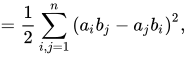

In other words, the expression of the cross product in component form using the Lagrange identity contributes nothing new to the situation, and is trivially identical with the "Pythagorean theorem" or "Gram determinant" formulation of the cross product. Consequently, either can be used at will. Brews ohare (talk) 05:55, 6 June 2010 (UTC)
It's algebraic substitution, not OR
- Brews, It's OK. As far as I am concerned, you don't need a source for this information. It is not original research and it is not synthesis. The equation,

- is public domain. In 3D the left hand side becomes,
- (x2y3-x3y2)2 + (x3y1-x1y3)2 + (x1y2-x2y)2 which happens to equate to z12 + z22 + z32 in the cross product.
- In 7D the left hand side becomes,
- (x2y4-x4y2)2 + (x3y7-x7y3)2 + (x6y5-x5y6)2 + (x1y4-x4y1)2 + (x3y5-x5y3)2 + (x6y7-x7y6)2 + (x1y7-x7y1)2 + (x2y5-x5y2)2 + (x4y6-x6y4)2 + (x1y2-x2y1)2 + (x3y6-x6y3)2 + (x5y7-x7y5)2 + (x1y6-x6y1)2 + (x2y3-x3y2)2 + (x4y7-x7y4)2 + (x1y5-x5y1)2 + (x3y4-x4y3)2 + (x2y7-x7y2)2 + (x1y3-x3y1)2 + (x2y6-x6y2)2 + (x4y5-x5y4)2
- which happens to be equal to z12 + z22 + z32 + z42 + z52 + z62 + z72 in the cross product. It's just a question of taking,
- z1 = x2y4-x4y2+x5y6-x6y5+x3y7+x7y3
- z2 = x3y5-x5y3+x6y7-x7y6+x4y1-x1y4
- z3 = x4y6-x6y4+x7y1-x1y7+x5y2-x2y5
- z4 = x5y7-x7y5+x1y2-x2y1+x6y3-x3y6
- z5 = x6y1-x1y6+x2y3-x3y2+x7y4-x4y7
- z6 = x7y2-x2y7+x3y4-x4y3+x1y5-x5y1
- z7 = x1y3-x3y1+x4y5-x5y4+x2y6-x6y2
and squaring each of the z terms. You will get 252 terms in total. 168 of these will mutually cancel. In fact, the 168 terms will be 2x84 terms, with each group of 84 containing two groups of 42 mutually cancelling terms. The remaining uncancelled 84 terms can then be reduced to the 21 squared terms. That is not original research. It is pure algebraic substitution. We have plenty of sources for the 3D case. We don't need any sources in order to apply the same logic in 7D when it is manifestly obvious to everybody that the same principle applies there too. David Tombe (talk) 21:07, 3 June 2010 (UTC)
- ^ Lounesto (2001) p. 96
- ^ Ron Larson, David C. Falvo (2008). "§5.1 Length and dot product in ℝn ". Elementary Linear Algebra (6th ed.). Cengage Learning. ISBN 0618783768.
- ^ Kendall, M. G. (2004). A Course in the Geometry of N Dimensions. Courier Dover Publications. p. 19. ISBN 0486439275., p. 19