



President's House (Philadelphia)
| President's House in Philadelphia | |
|---|---|
 An 1830 lithograph of the President's House in Philadelphia. This served as the U.S. Executive Mansion for President George Washington from November 1790 to March 1797, and for President John Adams from March 1797 to May 1800. | |
 Interactive map of the President's House in Philadelphia area | |
| Former names | 190 High Street Masters-Penn House Robert Morris Mansion |
| General information | |
| Architectural style | Georgian |
| Location | 524–30 Market Street, Philadelphia, Pennsylvania, United States |
| Coordinates | 39°57′02″N 75°09′00″W / 39.9505°N 75.1501°W |
| Construction started | 1767[1] |
| Demolished | 1832/1951 |
| Client | Mary Lawrence Masters |
President's House in Philadelphia was the third U.S. presidential mansion.[a] George Washington occupied the Philadelphia President's House from November 27, 1790 to March 10, 1797. John and Abigail Adams occupied the house from March 21, 1797 to May 30, 1800.
The Philadelphia house was located on what is now Market Street, one block north of Independence Hall (then known as the Pennsylvania State House). It had been built by widow Mary Masters around 1767, who gave it as a wedding present to her daughter Mary, who married Lieutenant Governor of Pennsylvania, Richard Penn. During the 1777–1778 British occupation of Philadelphia, the house was headquarters for General Sir William Howe, Commander of the British Army. The British abandoned the city in June 1778, and the house next became headquarters for the military governor of Philadelphia, American General Benedict Arnold.
Robert Morris, a financier of the Revolutionary War and a Founding Father, purchased the house following a January 1780 fire,[2] and restored and expanded it. George Washington was his houseguest when in Philadelphia, including for the May-to-September 1787 U.S. Constitutional Convention, which met at Independence Hall.
Philadelphia served as the temporary national capital from 1790 to 1800, while Washington, D.C. was under construction. Then U.S. Senator from Pennsylvania Robert Morris gave up the house for use by President Washington, who insisted on paying rent. Morris also owned the house next door, to which he and his family moved.
In November 1790, Washington brought eight enslaved Africans from Mount Vernon to work in his presidential household: Moll, Oney Judge, Christoper Sheels, Austin, Giles, Paris, Hercules Posey, and Posey's son Richmond.[3] A ninth enslaved African from Mount Vernon, "Postilion" Joe, joined the presidential household following Austin's December 20, 1794 death in Maryland.
The house also served as the executive mansion for the second U.S. president, John Adams. He spent most of his single term in Philadelphia, and moved into the not-yet-completed White House in Washington, D.C., on November 1, 1800. Later that month, Thomas Jefferson defeated Adams in the 1800 Presidential Election, although Jefferson was not inaugurated until March 1801. In 1951, confusion over the exact location of the Philadelphia President's House led to its surviving walls being unknowingly demolished for what is now Independence National Historical Park, or Independence Mall.[4]
Advocacy by historians and African American groups resulted in the 2010 commemoration of the site as a memorial to the nine slaves in Washington's household and the history of slavery in the United States. In 2025, President Donald Trump issued an executive order to promote a more positive view of the nation's history, resulting in the January 2026 removal of all exhibits at the site, and sparking a lawsuit that saw some of the displays restored for the duration of the case.
History
The three-and-a-half-story brick mansion on the south side of Market Street was built in 1767 by widow Mary Lawrence Masters.[1] In 1772, she gave it as a wedding gift to her elder daughter, Polly, who married Richard Penn, the lieutenant-governor of the colony and a grandson of William Penn. Richard Penn entertained delegates to the First Continental Congress, including George Washington, at the house. Penn was entrusted to deliver Congress' Olive Branch Petition to King George III in a last-ditch effort to avoid war between Great Britain and the colonies. Penn, his wife, and in-laws departed for England in July 1775.[5]
During the British occupation of Philadelphia from September 1777 to June 1778, the house was occupied by General Sir William Howe, who used it as the British Army's headquarters. Following the British evacuation, it housed the American military governor, Benedict Arnold. Arnold began a secret and treasonous correspondence with the British while living in the house. The next resident was John Holker, a purchasing agent for the French, who were American allies in the war. During Holker's residency, the house suffered a fire. Financier Robert Morris purchased the house from Richard Penn in 1781, although transfer of the deed was delayed because of the Revolutionary War.
Morris refurbished and expanded the house, and lived there while Superintendent of Finance. Washington lodged with Morris during the 1787 Constitutional Convention, which he presided over at Independence Hall. In 1790, Philadelphia became the temporary national capital, and Morris gave up the house for Washington's use as the Executive Mansion. Morris moved to the house next door, that he also owned.
President Washington occupied the Philadelphia President's House from November 1790 to March 1797, and Washington's successor, President John Adams, occupied it from March 1797 to May 30, 1800. Adams then visited Washington, D.C., to oversee the transfer of the federal government and returned to his Peacefield home in Quincy, Massachusetts for the summer. He moved into the not yet completed White House on November 1, 1800, the first U.S. president to live there, and occupied it for just over four months. Thomas Jefferson won the 1800 presidential election, was inaugurated on March 4, 1801, and became the first U.S. president to occupy the White House for his entire presidential term. In the 1804 presidential election, Jefferson was reelected, and resided at the White House during his entire two terms, which lasted from 1801 to 1809.
Post-presidential
Following President Adams's 1800 departure, the house was converted into Francis's Union Hotel. Hardware merchant Nathaniel Burt purchased the property in 1832,[6] and gutted the house, inserting three narrow stores between its exterior walls. He and his descendants owned these stores for just over a century.[4]
In 1861, merchant John Wanamaker opened his first clothing store, Oak Hall, at 536 Market Street. He expanded into the stores at 532 and 534 Market, and eventually built up their height to six stories.[7] The party wall between 530 and 532 Market was the four-story west wall of the President's House, and would have been incorporated into the expanded Oak Hall.[4] Oak Hall was demolished in 1936, leaving two stories of the party wall intact.[4] The four-story east wall of the President's House was the party wall shared between 524 and 526 Market Street.[4] This survived intact until 1951.
What was left of the Burt stores, along with the house's surviving walls, were demolished in 1951 for the creation of Independence Mall.[4] A public toilet was built upon the house's footprint in 1954, later demolished,[3] and replaced by a memorial site in 2010 after archeology studies. Advocacy by historians and African American groups resulted in the 2010 commemoration of the site. In 2026, the signs mentioning slavery were removed under the direction of the Executive Order titled "Restoring Truth and Sanity to American History" during the second Trump administration.[8]
President Washington in Philadelphia

The nation's first president, George Washington, along with First Lady Martha Washington and two of her grandchildren, "Wash" Custis and Nelly Custis, lived in President's House in Philadelphia. He had an initial household staff of about 24, eight of whom were enslaved Africans, plus an office staff of four or five, who also lived and worked there. The house was too small for the 30-plus occupants, so the President made additions:
"...a large two-story bow to be added to south side of the main house making the rooms at the rear thirty-four feet in length, a long one-story servants' hall to be built on the east side of the kitchen ell, the bathtubs to be removed from the bath house's second floor and the bathingroom turned into the President's private office, additional servant rooms to be constructed, and an expansion of the stables."[1]
Major actions as president
- Oversaw the establishment of the federal judiciary
- Oversaw the establishment, location and planning of the future District of Columbia.
- Quashed the Whiskey Rebellion in western Pennsylvania.
Use of slave labor
In 1790, President Washington brought eight enslaved Africans to Philadelphia from his plantation at Mount Vernon: Moll, Christopher Sheels, Hercules and his son Richmond, Oney Judge and her half-brother Austin, Giles, and Paris.[9]
Pennsylvania had begun a gradual abolition of slavery in 1780, freezing the number of slaves in the state and granting freedom only to their future children. The law did not free anyone at once; its gradual abolition was to be accomplished over decades as the enslaved aged and died off. The law allowed slaveholders from other states to hold personal slaves in Pennsylvania for six months, but empowered those same enslaved to legally petition for their freedom if held beyond that period.
Washington recognized that slavery was unpopular in Philadelphia, but argued (privately) that he remained a resident of Virginia and subject to its laws on slavery. He gradually replaced most of the President's House enslaved servants with German indentured servants, and rotated the others in and out of the state to prevent them from establishing an uninterrupted six-month residency. He was also careful that he himself never spent six continuous months in Pennsylvania. Joe (Richardson) was the only slave added to the presidential household. He was brought up from Virginia in 1795, following Austin's December 20, 1794, death in Maryland.[10]
Oney Judge

Oney Judge was the personal slave of Martha Washington, and was about 17 when she was brought to the President's House in 1790. More is known about her than any of the other enslaved because she gave two interviews to abolitionist newspapers in the 1840s. She escaped to freedom from the President's House in May 1796, and was hidden by Philadelphia's free-black community.[11] The President's House steward placed runaway advertisements in Philadelphia newspapers offering a reward for her recapture. She was smuggled aboard a ship to Portsmouth, New Hampshire, where Judge hoped she was safe, but she was recognized on the street by a friend of the Washingtons. Through intermediaries, Washington attempted to convince her to return, but Judge refused unless she was guaranteed her freedom upon their deaths.[12] Martha Washington's nephew, Burwell Bassett, traveled to Portsmouth in 1798. He lodged with Senator John Langdon and revealed his plan to abduct Judge. Langdon sent word for Judge to go into hiding, and Bassett was forced to return without her.
Hercules
Hercules was the chief cook at Mount Vernon in 1786, and was brought to the President's House in November 1790 to run the kitchen.[13] He requested that his 12-year-old son Richmond accompany him, but Richmond spent less than a year in Philadelphia. Much of what is known about Hercules comes from a nostalgic and affectionate account by Martha Washington's grandson, who presumed that "Uncle Harkless" had been content in slavery.[13] Stephen Decatur Jr., author of The Private Affairs of George Washington (1933), wrote that Hercules had escaped to freedom in Philadelphia at the end of Washington's presidency, and for 79 years this was accepted as true. Research published in 2012 establishes that Hercules escaped to freedom from Mount Vernon on February 22, 1797, Washington's 65th birthday.[14]
Hercules left behind Richmond and daughters Evey and Delia at Mount Vernon.[13] There was a reported sighting of him in New York City in 1801,[15] but by then he had been freed under the terms of George Washington's will. The mystery of his journey after escaping Mount Vernon seems to have been solved in 2019.[16] Genealogist Sara Krasne, searching records at the Westport Historical Society in Massachusetts, found a Hercules Posey, born in Virginia, who died of consumption on May 15, 1812, age 64, and was buried in the Second African Burying Ground in New York City.[16] John Posey was the Virginia slaveholder who mortgaged Hercules to George Washington in 1767, and later defaulted on the loan.[17]
Archaeology and advocacy
Liberty Bell Center
As the turn of the 21st century approached, a major new building to house the Liberty Bell was planned for Independence Mall. Nearly the length of a football field, including its 40 ft (12 m) porch, the Liberty Bell Center would stretch along the east side of Sixth Street from Chestnut Street almost to Market Street.[18]
2000 archaeology

An archaeological excavation of the Liberty Bell Center's footprint was undertaken in November and December 2000.[1] The most significant President's House-related artifact uncovered was the bottom half of its icehouse pit.[19] A technological marvel built by Robert Morris in the early 1780s, the icehouse had been a windowless building erected over an octagonal stone-walled pit, 13 ft (4.0 m) in diameter and 18 ft (5.5 m) deep.[20]: 46–53 In midwinter the pit would be packed with blocks of ice harvested from the Schuylkill River.[21] The icehouse provided refrigeration for most of the year:
The Door for entering this Ice house faces the north, a Trap Door is made in the middle of the Floor through which the Ice is put in and taken out. I find it best to fill with Ice which as it is put in should be broke into small pieces and pounded down with heavy Clubs or Battons such as Pavers use, if well beat it will after a while consolidate into one solid mass and require to be cut out with a Chizell or Axe. I tried Snow one year and lost it in June. The Ice keeps until October or November and I believe if the Hole was larger so as to hold more it would keep untill Christmas..."[22]
The truncated icehouse pit was measured and photographed by the National Park Service, and then reburied.[20] It lies beneath the concrete slab of the Liberty Bell Center's floor.
Presidential slavery campaign

Abolitionists gave the Liberty Bell its name in the 1830s, and adopted it as their emblem for the movement to end slavery in America.[4] In 1790, Washington brought eight enslaved Africans from Mount Vernon to Philadelphia to work in his presidential household. He directed that his white coachman and enslaved stableworkers be housed in a building behind the kitchen.[4] The footprint of this building was located under the porch of the planned Liberty Bell Center, about five feet (1.5 m) from the LBC's main entrance.[20]: 46–50 The Liberty Bell Center was under construction in January 2002, when the Historical Society of Pennsylvania published Edward Lawler, Jr.'s research on the President's House,[4] including the revelation that future visitors to the LBC would "walk over" the footprint of Washington's "slave quarters" as they entered the new building.[23]
In a March 12, 2002, evening lecture at the Arch Street Friends Meeting House and an interview the next morning on WHYY-FM, Philadelphia's National Public Radio affiliate, UCLA historian Gary Nash scathingly criticized Independence Park for its refusal to interpret the enslaved Africans at the President's House site.[24] Independence National Historical Park Superintendent Martha Aikens countered with an op-ed proposing that the enslaved be interpreted at the Germantown White House, some eight miles (13 km) miles away.[25] Nash's anger inspired the founding of the Ad Hoc Historians, a group of Philadelphia-area scholars whose immediate concern was the interpretation for the under-construction Liberty Bell Center.[26]
The issue led to the formation of two African-American groups that advocated for the enslaved: Avenging the Ancestors Coalition, founded by attorney Michael Coard;[27] and Generations Unlimited, founded by local historian Charles Blockson and activist Sacaree Rhodes.[20] Coard delivered a petition signed by 15,000 people to Independence Park urging it to build a memorial to the President's House and Washington's slaves.[20]: 52
The Philadelphia Inquirer published a front-page, banner-headlined article on Sunday, March 24, 2002, "Echos of Slavery at Liberty Bell Site."[23] This included a terse statement from Independence Park: "The Liberty Bell is its own story, and Washington's slaves are a different one better told elsewhere."[23] The Inquirer followed up with more major articles, and its lead editorial on March 27 was titled: "Freedom and Slavery. Just as they coexisted in the 1700s, both must be part of the Liberty Bell's story."[26] The Inquirer published an op-ed by Nash and St. Joseph's University historian Randall Miller on Sunday, March 31, alongside one by Rutgers University historian Charlene Mires. The next day, the Associated Press issued a national story: "Historians Decry Liberty Bell Site."[26]
NPS Chief Historian Dwight Pitcaithley wrote to Independence Park's superintendent, urging her to consider a different perspective:
The contradiction in the founding of the country between freedom and slavery becomes palpable when one actually crosses through a slave quarters site when entering a shrine to a major symbol of the abolition movement....How better to establish the proper historical context for understanding the Liberty Bell than by talking about the institution of slavery? And not the institution as generalized phenomenon, but as lived by George Washington's own slaves. The fact that Washington's slaves Hercules and Oney Judge sought and gained freedom from this very spot gives us interpretive opportunities other historic sites can only long for. This juxtaposition is an interpretive gift that can make the Liberty Bell "experience" much more meaningful to the visiting public. We will have missed a real educational opportunity if we do not act on this possibility.[28]
Pitcaithley read Independence Park's interpretive script for the Liberty Bell Center's exhibits, and found it disappointing. He described it as "an exhibit to make people feel good but not to think," that "works exactly against NPS's new thinking," and "would be an embarrassment if it went up."[26] Members of the Ad Hoc Historians, ATAC, and Generations Unlimited participated in a May 13, 2002, planning session on the LBC interpretation, overseen by Pitcaithley.[26] Later in the month, he assembled a panel of top NPS historians to rewrite the interpretation.[26]
President's House site
The Philadelphia City Council and the Pennsylvania General Assembly each passed resolutions urging the National Park Service to interpret the story of the enslaved Africans at the President's House site.[29] In July 2002, a provision was inserted into the FY2003 Department of Interior appropriation bill requiring NPS to study this and report back to the U.S. Congress.[3]
A design process for the President's House site began in October 2002, although it was boycotted by Generations Unlimited. Preliminary designs for the site were unveiled at a January 15, 2003, public meeting at the African American Museum in Philadelphia. These were angrily rejected by most of those present, and the design team withdrew from the project. Philadelphia City Council appropriated $1.5 million toward a commemoration of the site, which Mayor John Street announced at the Liberty Bell Center's opening, October 9, 2003.
A second design process was undertaken as a joint project by Independence Park and the City of Philadelphia.[30] Congressmen Chakka Fatah and Robert Brady secured $3.6 million in federal funds for the project, which they jointly announced on September 6, 2005.
[31] A national design competition for the President's House site was announced in late 2005, and more than twenty teams of architects, artists and historians submitted proposals. Six of these teams were selected as semi-finalists, and were given stipends to create models and finished drawings. The models and drawings were exhibited at the National Constitution Center and the African American Museum in Summer 2006, and the public had several weeks to comment and cast votes for their favorite design.[20]: 53–54 Philadelphia architectural firm Kelly Maiello Architects was announced as the winner of the design competition on February 27, 2007.[32]
2007 archaeology

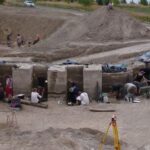
A second archaeological excavation was begun on March 27, 2007.[33] This was focused on the house's backbuildings, and a temporary observation platform was erected atop the footprint of the main house.
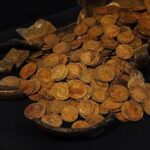
Early discoveries included brick foundations of the three Burt stores, built between the exterior walls of the gutted house. Excavation of the kitchen established that it had a basement, and a section of this had a root cellar below it.[34] At the juncture of the kitchen's foundations and the stores' was found an 1833 coin, possibly left by the builders to mark their completed work.[35] As the stores' plaster cellar floors were chipped away, older foundations were revealed beneath them.
The excavation uncovered the rear wall of the main house and, most surprisingly, much of the curved foundation of Washington's bow window.[36] This two-story semi-circular expansion of the State Dining Room (and the State Drawing Room above it) was designed by the President to be a ceremonial space in which he would receive guests. "There can be little doubt that in Washington's bow can be found the seed that was later to flower in the oval shape of the Blue Room [of the White House]."[37]
Hundreds of thousands of people visited the observation platform between March and July 2007.[20] As the excavation's closing approached, the City and Independence Park issued a joint press release:
More than a quarter million visitors have stood at the public viewing platform to witness this extraordinary place, to learn from the archaeologists, and to interact with each other on important topics such as race relations in the United States. The reaction to the site has served as a signal that the President's House site has the potential to become a major national icon in the heart of the City.[38]
The excavation was closed with a July 31 ceremony that included speeches, the dedication of a bronze plaque listing the names of the nine enslaved held at the site, a prayer, and the African ritual of spilling of sand and water as oblations.[39]
President's House Memorial
Completed in 2010, the memorial, President's House: Freedom and Slavery in the Making of a New Nation, is an open-air pavilion that shows the outline of the original buildings and allows visitors to view the remaining foundations.[40] Some artifacts are displayed within the pavilion. Signage and video exhibits portrayed the history of the structure, as well as the roles of Washington's slaves in his household and slaves in American society,[30][41] until the federal government removed the exhibits in 2026.[42] CBS described it as the only federal historic site to commemorate the history of slavery in the United States.[42] The memorial was a joint project of the City of Philadelphia and the National Park Service.[43]
-
 Memorial at the site of the former President's House.
 -
 President's House Memorial, looking north.
 -
 Kitchen foundations


Trump executive order and removal of exhibits
In March 2025, President Donald Trump signed Executive Order 14253, "Restoring Truth and Sanity to American History." In it he directed the Interior Department, which oversees the National Park Service, to ensure memorials do not "inappropriately disparage Americans past or living"[44] and "instead focus on the greatness of the achievements and progress of the American people or, with respect to natural features, the beauty, abundance, and grandeur of the American landscape."[45] The Service initiated a review of all its 433 national parks, monuments, and historic sites.[46] Employees were told to report items for review for removal,[46][47] and to post signs and QR codes at all sites.[46][48] Both went up in Independence Park, asking viewers to report repairs, service improvements, or "any signs or other information that are negative about either past or living Americans or that fail to emphasize the beauty, grandeur, and abundance of landscapes and other natural features."[49]
At the President's House, 13 items across six exhibits were reported.[50] Asked for confirmation, an Interior Department spokesperson replied: “As the President has stated, federal historic sites and institutions should present history that is accurate, honest and reflective of shared national values,” and “Interpretive materials that focus solely on challenging aspects of U.S. history, without acknowledging broader context or national progress, may unintentionally provide an incomplete understanding rather than enrich it.”[51] All exhibit panels were removed[50] and videos taken down[52][53] on January 22, 2026, not just the flagged items,[50] leaving the President's House with only the names of the nine slaves engraved into a cement wall.[54][b] Politico reported that the Interior Department did not answer questions about what would replace the removed exhibits.[54]
| A partial list of submissions by park staff, reported by The Philadelphia Inquirer and The New York Times citing internal materials. | |
| Exhibit | Reason given |
|---|---|
| "Life Under Slavery" | "speaks of whipping, depriving of food, clothing, and shelter; as well as beating, torturing, and raping those they enslaved"[55] |
| "History Lost & Found" | "The first paragraph mentions history being both admirable and deplorable, with the President’s House being a stark focus of that definition. The second paragraph uses words ‘profoundly disturbing’ to describe Washington transporting enslaved people. It also says as the new federal government embraced the lofty concept of liberty, slavery in the President’s House mocked the pretense of liberty"[55] |
| "The Dirty Business of Slavery" | "The 4th paragraph has a sentence about the enslaved population growth and mentions births to enslaved women resulting from rape by white men and forced breeding"[55] |
| "An Act respecting Fugitives from Justice" (single illustration) | Depicts Washington's arms signing the Fugitive Slave Act of 1793 in the foreground and white men shooting escaping black slaves in the background. “The following panels and illustrations may need revision if found that they are inappropriately disparaging to historical figures".[48] |
The city of Philadelphia filed a lawsuit the same day,[56][57] with city officials saying the removal violated a long-standing cooperative agreement that required consultation before alterations, and pointing out the panels were funded primarily by the city and private donations, not the federal government.[58] White House spokesman Davis Ingle said in a statement that President Trump "continues to fulfill his promise to restore truth and common sense to the United States and its institutions" and "is ensuring that we are honoring the fullness of the American story instead of distorting it in the name of left-wing ideology". The Interior Department said in another that it was taking appropriate action in accordance with the order[56] and called the lawsuit frivolous, aimed at "demeaning our brave Founding Fathers who set the brilliant road map for the greatest country in the world."[59]
On February 16, federal judge Cynthia M. Rufe granted a preliminary injunction, a temporary measure to restore the displays while the case played out in court.[60] Rufe said unilateral changes had violated federal law and agreements requiring consent of the city, and that additionally the exhibits about Oney Judge were essential to the site's selection under a 1998 law meant to commemorate the National Underground Railroad Network to Freedom.[61] Rufe had expressed horror over the government's argument that it gets to choose the message it wants to convey,[62] and in her ruling stated "As if the Ministry of Truth in George Orwell’s 1984 now existed, with its motto 'Ignorance is Strength,' this Court is now asked to determine whether the federal government has the power it claims—to dissemble and disassemble historical truths when it has some domain over historical facts. It does not."[60] She wrote that the government was not prevented from conveying whatever message it wanted to elsewhere, but not at the President's House until it followed the law and consulted with the city.[61] The Interior Department said in a statement that "updated interpretive materials providing a fuller account of the history of slavery at Independence Hall would have been installed in the coming days".[63]
The administration restored some of the displays[64] after Judge Rufe, two days later, gave it until February 20.[65] An hour before the government was going to miss the deadline, Third Circuit judge Thomas Hardiman partially granted its appeal, so that the remaining displays do not need to be returned, and forbade changes to the President's House, so that those already back must remain.[66][67] The Philadelphia Inquirer reported that 16 of 17 glass panels were reinstalled on February 19, with the remaining one needing repairs,[66] and that this was out of the site's 34 panels total.[64] The Philadelphia Tribune, citing a government filing, added that videos ran again on four of five monitors (with the fifth not working when exhibits were removed) and four other panels were reinstalled. The remaining glass panel needed repairs on its mounting bolts and the 13 metal panels needed a process to readhere.[68] The Inquirer reported further decisions as being unlikely before May.[66]
Residents protested the review and removal repeatedly.[51][67][69][70][71][72] The architecture firm responsible for the memorial issued a statement opposing changes to the site and the city's main tourism agency, a nonprofit, offered to find another location open to the public to host the displays if they were removed from the President's House.[73][74] A local data librarian became a founding member of Save Our Signs, a project to crowdsource a photo archive of national parks' displays.[75] 45 local preservation and historical groups sent a letter to Secretary of the Interior Doug Burgum opposing changes to, or removal of, the slavery exhibits.[76] Neighboring counties and Pennsylvania governor Josh Shapiro filed amicus briefs in support of Philadelphia's court case,[70][77] and the Philadelphia City Council passed a resolution condemning the review.[78]
See also

- Samuel Osgood House, first Presidential mansion
- Alexander Macomb House, second Presidential mansion
- Germantown White House, twice temporarily occupied by President Washington
- White House/Executive Residence, the Washington D.C. home of U.S. presidents and their families
- President's House, house intended for the president on Ninth Street, Philadelphia
- List of residences of presidents of the United States
Notes
- ^ New York City served as the first national capital under the U.S. Constitution. From April 1789 to February 1790, President George Washington occupied a house on Cherry Street. His presidential household moved to larger a house on Broadway in February 1790, but that was only occupied until the end of August 1790.
- ^ The removal of non-compliant displays had initially been slated for September 17, 2025.[50]
References
- ^ a b c d Lawler, Jr., Edward (May 2010). "The President's House in Philadelphia: A brief history". ushistory.org. Independence Hall Association. Archived from the original on November 17, 2025. Retrieved February 16, 2026.
- ^ https://journals.psu.edu/pmhb/article/download/45510/45231/45349
- ^ a b c Edward Lawler, Jr., "The President's House Revisited", The Pennsylvania Magazine of History and Biography, October 2005, pp. 371–410.
- ^ a b c d e f g h i Edward Lawler, Jr., "The President's House in Philadelphia: The Rediscovery of a Lost Landmark", The Pennsylvania Magazine of History and Biography, January 2002, pp. 5–95.
- ^ Brown, Weldon A. (1941). Empire or independence; a study in the failure of reconciliation, 1774–1783. Port Washington, New York: Kennikat Press (published 1966). OCLC 341868.
- ^ Philadelphia Deed Book AM-25, p. 202, April 12, 1832.
- ^ The Golden Book of the Wanamaker Stores (Philadelphia, 1911).
- ^ Spring, Jake (January 22, 2026). "Park Service removes slavery exhibit at Independence Park in Philadelphia". The Washington Post. ISSN 0190-8286.
- ^ "Enslaved Persons of African Descent in the President's House". ushistory.org. Independence Hall Association. Archived from the original on December 24, 2025. Retrieved February 16, 2026.
- ^ Lawler, Jr., Edward. "President's House Slavery: By the Numbers". ushistory.org. Independence Hall Association. Archived from the original on December 13, 2025. Retrieved February 16, 2026.
- ^ Oney Judge from George Washington's Mount Vernon
- ^ Stephan Salisbury, "A Slave's Defiance: The story of rebellious Oney Judge is finally being told, along with those of other slaves who lived with George and Martha Washington in Philadelphia," The Philadelphia Inquirer, July 1, 2008.
- ^ a b c Lawler, Jr., Edward. "Hercules". ushistory.org. Independence Hall Association. Archived from the original on January 29, 2026. Retrieved February 16, 2026.
- ^ Craig LaBan, "A birthday shock from Washington's chef", The Philadelphia Inquirer, 22 February 2010, accessed 2 April 2012
- ^ Martha Washington to Col. Richard Varick, 15 December 1801. "Worthy Partner:" The Papers of Martha Washington, Joseph E. Fields, ed., (Westport, CT: Greenwood Press, 1994), pp. 398–99.
- ^ a b Liana Teixeira, "Centuries-old Mystery Solved by Westport Historical Society," Associated Press, May 16, 2019.
- ^ Hercules from George Washington's Mount Vernon.
- ^ Rodolphe el-Khoury, ed., Liberty Bell Center, Bohlin Cywinski Jackson, (Philadelphia, PA and San Rafael, CA: ORO Editions, 2006), p. 107.
- ^ Faye Flam, "Formerly on Ice, Past Unearthed. The Icehouse Found in Philadelphia Gives a Glimpse into Colonial History," The Philadelphia Inquirer, February 23, 2001.
- ^ a b c d e f g Rebecca Yamin, Digging in the City of Brotherly Love: Stories from Philadelphia Archeology, Yale University Press, 2008.
- ^ "The First Icehouse in America?". ushistory.org. Independence Hall Association. Archived from the original on January 30, 2026. Retrieved February 16, 2026.
- ^ Robert Morris to George Washington, June 15, 1784, George Washington Papers, Series 4, General Correspondence, Library of Congress.
- ^ a b c Stephan Salisbury and Inga Saffron, "Echos of Slavery at Liberty Bell Site," The Philadelphia Inquirer, March 24, 2002.
- ^ "A President and His Property," WHYY-FM, December 15, 2010.
- ^ Martha Aikens, Op-ed: "Park Tells the Story of Slavery," The Philadelphia Inquirer, April 7, 2002.
- ^ a b c d e f Gary Nash, "For Whom Will the Liberty Bell Toll: From Controversy to Collaboration," January 25, 2003 lecture given at Christ Church, Philadelphia.
- ^ Avenging The Ancestors http://www.avengingtheancestors.com/index.asp Archived 2017-09-14 at the Wayback Machine
- ^ Dwight Pitcaithley to Martha Aikens, April 2002, quoted in Gary Nash, "For Whom Will the Liberty Bell Toll? From Controversy to Collaboration," (January 2003).
- ^ "PA House Resolution No. 490 Session of 2002". ushistory.org. Independence Hall Association. Archived from the original on November 12, 2025. Retrieved February 16, 2026.
- ^ a b "President's House Opens on Independence Mall in Philadelphia", Press Release, City of Philadelphia and Independence National Historical Park, accessed 16 February 2012
- ^ "$3.6M Awarded to the project". ushistory.org. Independence Hall Association. Archived from the original on November 12, 2025. Retrieved February 16, 2026.
- ^ Press release: "Finalist Team for President's House Site Selected," City of Philadelphia & INHP, February 27, 2007 (PDF)
- ^ City of Philadelphia and Independence National Historical Park; John F. Street, Mayor, City of Philadelphia; Dennis Reidenbach, Superintendent, Independence National Historical Park (March 21, 2007). "Kick-Off for President's House Site Archeological Dig". ushistory.org (Press release). Independence Hall Association. Archived from the original on August 12, 2025.
{{cite web}}: CS1 maint: multiple names: authors list (link) - ^ "Archaeology at the President's House: May 1, 2007". ushistory.org. Independence Hall Association. Archived from the original on November 13, 2025. Retrieved February 16, 2026.
- ^ "Archaeology at the President's House: April 26, 2007". ushistory.org. Independence Hall Association. Archived from the original on August 12, 2025. Retrieved February 16, 2026.
- ^ "Archaeology at the President's House: May 8, 2007". ushistory.org. Independence Hall Association. Archived from the original on July 26, 2025. Retrieved February 16, 2026.
- ^ William Seale, The President's House, A History (Washington, D. C.: White House Historical Association, 1986), p. 8.
- ^ "Archaeology at the President's House". ushistory.org. Independence Hall Association. Archived from the original on August 12, 2025. Retrieved February 16, 2026.
- ^ "Archaeology Closing Ceremony at the President's House: July 31, 2007". ushistory.org. Independence Hall Association. Retrieved February 16, 2026.
- ^ Rothstein, Edward (December 15, 2010). "Reopening a House That's Still Divided". The New York Times. ISSN 0362-4331. Retrieved February 10, 2026.
- ^ "The Presidents House: Freedom and Slavery in the Making of a New Nation". City of Philadelphia. Retrieved March 20, 2016.
- ^ a b Fay, Laura; Jacobson, Scott (January 23, 2026). "Slavery displays removed from Philadelphia historical site after Trump directive". CBS News Philadelphia. Retrieved January 23, 2026.
- ^ Stephan Salisbury (August 20, 2012). "Problems still plague Philadelphia's President's House memorial". The Philadelphia Inquirer. Archived from the original on September 18, 2013. Retrieved March 20, 2016.
- ^ Fay, Laura; Jacobson, Scott; CBS News Philadelphia Staff (January 23, 2026). "Slavery displays removed from Philadelphia historical site after Trump directive". CBS News. Archived from the original on February 23, 2026. Retrieved February 26, 2026.
- ^ Mancini, Ryan (January 23, 2026). "Philadelphia sues Interior Department over slavery exhibit removal". The Hill. Retrieved February 26, 2026.
- ^ a b c Friedman, Lisa (June 13, 2025). "National Parks Are Told to Delete Content That 'Disparages Americans'". The New York Times. Archived from the original on July 23, 2025. Retrieved January 23, 2026.
- ^ Langfitt, Frank (September 17, 2026). "Trump moves to scrub national parks sites of signs that cast America in a 'negative light'". NPR. Archived from the original on February 18, 2026. Retrieved March 1, 2026.
A national park staff member tells NPR that their employees have reported more than a thousand items for review. The Department of the Interior set Sept. 17 as a deadline to remove any content that does not comply with the order.
- ^ a b Joselow, Maxine; Friedman, Lisa (July 22, 2025). "Trump Told Park Workers to Report Displays That 'Disparage' Americans. Here's What They Flagged". The New York Times. Archived from the original on July 22, 2025. Retrieved January 23, 2026.
- ^ Roth, Fallon; Anastasakos, Evgenia; Choudhury, Bedatri D. (July 25, 2025). "The Trump admin asked visitors to report 'negative' displays at national parks. Few in Philly did". The Philadelphia Inquirer. Archived from the original on February 24, 2026. Retrieved February 21, 2026.
- ^ a b c d Roth, Fallon; Prosser, Maggie (January 22, 2026). "The slavery exhibits at the President's House have been removed following Trump administration push". The Philadelphia Inquirer. Archived from the original on February 11, 2026. Retrieved January 23, 2026.
A total of 13 items across six exhibits at the President's House were initially flagged for the Trump administration's review, but on Thursday everything was taken down.
- ^ a b Roth, Fallon; Schneider, Aliya (September 16, 2026). "Trump administration to alter Independence Park exhibit that describes slavery under George Washington, reports say". The Philadelphia Inquirer. Archived from the original on February 20, 2026. Retrieved February 26, 2026.
Asked to confirm reporting that the President's House exhibits were being targeted, Department of the Interior spokesperson Elizabeth Peace sent a statement saying the department is implementing orders "to carry out the President's Executive Order on 'Restoring Truth and Sanity to American History.'" "As the President has stated, federal historic sites and institutions should present history that is accurate, honest and reflective of shared national values," the statement continued. "Interpretive materials that focus solely on challenging aspects of U.S. history, without acknowledging broader context or national progress, may unintentionally provide an incomplete understanding rather than enrich it." [...] On Tuesday, a group of about 30 protesters gathered at the President's House to sing songs of peace and freedom.
- ^ Hellmann, Melissa (February 10, 2026). "'So shameful': backlash as US national monuments conform to Trump's rewrite of history". The Guardian. Archived from the original on February 14, 2026. Retrieved February 24, 2026.
After the panels' removal (videos at the site were also taken down)
- ^ Hurley, Amanda; Rule, Kelly; Soisson, Isabel (February 17, 2026). "Judge orders slavery exhibit must be restored at President's House in Philadelphia". Fox 29 Philadelphia. Retrieved February 28, 2026.
On January 22, the National Park Service removed 34 educational panels and deactivated accompanying video exhibits […]
- ^ a b Associated Press (January 24, 2026). "Philadelphia sues over removal of slavery exhibit at Independence National Historical Park". Politico. Retrieved February 24, 2026.
- ^ a b c Fallon, Roth (July 28, 2025). "More than a dozen slavery displays in Philly, including at Washington's former home, have been flagged for a Trump admin review". The Philadelphia Inquirer. Archived from the original on January 30, 2026. Retrieved February 16, 2026.
- ^ a b Kottke, Joe; Helsel, Phil (January 22, 2026). "Philadelphia sues after slavery exhibits were taken down from President's House site". NBC News. Archived from the original on February 12, 2026. Retrieved January 23, 2026.
- ^ "City of Philadelphia v. Burgum (2:26-cv-00434)". CourtListener. January 22, 2026. Retrieved January 23, 2026.
- ^ Russell-Sluchansky, Carmen (January 28, 2026). "Philly is fighting to block 'whitewashing' of history after slavery exhibit removal". WHYY. Archived from the original on February 9, 2026.
- ^ Vejpongsa, Tassanee; Brewer, Graham Lee (January 23, 2026). "Philadelphia sues Trump administration over removal of slavery exhibit from public park". PBS. Archived from the original on January 29, 2026. Retrieved February 19, 2026.
- ^ a b Patil, Anushka (February 16, 2026). "Judge Orders Trump Administration to Restore Displays, for Now, About Slavery at Washington's House". The New York Times.
{{cite web}}: CS1 maint: deprecated archival service (link) - ^ a b Gerstein, Josh; Cheney, Kyle (February 16, 2026). "Judge orders restoration of Philadelphia slavery exhibits". Politico. Retrieved February 20, 2026.
- ^ Dale, Maryclaire (January 31, 2026). "Judge calls Justice Department's statements on slavery exhibit display 'dangerous' and 'horrifying'". Associated Press. Archived from the original on February 9, 2026. Retrieved February 25, 2026.
- ^ Fay, Laura; Ignudo, Tom; Andersen, Eva; Snyder, Dan (February 18, 2026). "Trump administration appeals judge's order to restore slavery exhibits at President's House in Philadelphia". CBS News. Retrieved February 23, 2026.
- ^ a b Fallon, Roth; Prosser, Maggie; Gutman, Abraham (February 19, 2026). "The slavery exhibits at the President's House are starting to be restored by the National Park Service". The Philadelphia Inquirer. Archived from the original on February 26, 2026. Retrieved February 28, 2026.
- ^ Gutman, Abraham (February 18, 2026). "Judge gives Trump administration a deadline to restore President's House exhibits". The Philadelphia Inquirer. Archived from the original on February 21, 2026. Retrieved February 28, 2026.
- ^ a b c Gutman, Abraham; Roth, Fallon (February 20, 2026). "Trump administration doesn't need to restore more President's House exhibits for now, appeals court says". The Philadelphia Inquirer. Archived from the original on February 26, 2026. Retrieved February 28, 2026.
- ^ a b Simon, Alexandra; Corrado, Kerri; Snyder, Dan (February 20, 2026). "Remaining slavery exhibits at President's House in Philadelphia don't need to be restored for now, judge rules". CBS News. Archived from the original on February 21, 2026. Retrieved February 28, 2026.
She had been to several rallies supporting the restoration of the displays.
- ^ Cerino, Marco (February 24, 2026). "Feds detail plans for restoring President's House". The Philadelphia Tribune. Archived from the original on February 24, 2026. Retrieved February 28, 2026.
- ^ Russell-Sluchansky, Carmen (August 4, 2026). "Philly activists rally at Independence Park to protest Trump's moves to remove exhibits that depict slavery in early America". WHYY. Archived from the original on January 23, 2026. Retrieved February 27, 2026.
More than 100 people gathered Saturday afternoon in Philadelphia's Old City, just steps away from the Liberty Bell, to defend the integrity of a slavery-focused exhibit at the President's House Site.
- ^ a b Simon, Alexandra; Crawford, Liz (February 10, 2026). "Counties surrounding Philadelphia support city's effort to restore slavery exhibits at President's House". CBS News. Archived from the original on February 12, 2026. Retrieved February 27, 2026.
Bucks, Chester, Delaware and Montgomery counties filed a joint amicus brief that supports Philadelphia's effort in court to restore the exhibits. [...] Numerous community groups are backing the city's lawsuit as well, including the Avenging the Ancestors Coalition, which organized a rally Tuesday afternoon at the President's House site. About 200 people heard from several speakers, including some elected officials, during the event. An amicus brief is filed by an individual or party that is not directly involved in a legal case. Latin for "friend of the court," amicus briefs can provide additional information or arguments to the court before a judge makes a ruling.
- ^ Prosser, Maggie (December 21, 2025). "Amid uncertain future, the President's House Site celebrates 15th anniversary". The Philadelphia Inquirer. Archived from the original on January 25, 2026.
More than 75 activists, preservationists, historians, and public officials gathered at the site Sunday afternoon to commemorate the occasion and mobilize resistance amid its uncertain future.
- ^ Thomas, TaRhonda (January 29, 2026). "Group launches 30‑day campaign to restore slavery exhibit at President's House". 6abc. Archived from the original on February 24, 2026. Retrieved February 27, 2026.
Members of the Avenging the Ancestors Coalition marched to the site on Wednesday, where the outlines of the torndown exhibits remain visible on the walls. The group also launched a 30-day campaign titled "Tell the Truth. Restore our History."
- ^ Roth, Fallon (August 22, 2026). "A President's House architect is ready to 'fight' the Trump administration's potential exhibit removal next month". The Philadelphia Inquirer. Archived from the original on January 23, 2026. Retrieved February 28, 2026.
- ^ Roth, Fallen (September 9, 2026). "Visit Philadelphia will find 'new home' for slavery exhibits if Trump administration removes them from the President's House". The Philadelphia Inquirer. Archived from the original on February 15, 2026. Retrieved February 27, 2026.
- ^ Roth, Fallon (August 1, 2026). "Inside the fight to save more than a dozen Independence Park exhibits from potential Trump administration removal in September". The Philadelphia Inquirer. Archived from the original on February 19, 2026.
- ^ Roth, Fallon (September 8, 2026). "Removing or editing Philly slavery exhibits is 'un-American,' 45 local historical groups tell Trump's Interior secretary". The Philadelphia Inquirer. Archived from the original on February 20, 2026. Retrieved February 27, 2026.
- ^ Ignudo, Tom; Andersen, Eva (January 27, 2026). "Shapiro takes legal action after Philadelphia slavery exhibits were removed under Trump order". CBS News. Archived from the original on February 27, 2026. Retrieved February 28, 2026.
- ^ Snyder, Dan; Wheeler, Alan (September 25, 2025). "Philadelphia City Council passes 2 resolutions to condemn acts by Trump administration". CBS News. Archived from the original on January 23, 2026. Retrieved January 23, 2026.
External links
- National Park Service: History of the President's House
- "President's House in Philadelphia", from ushistory.org
- Edward Lawler, Jr., "A Brief History of the President's House in Philadelphia", US History, updated May 2010
- "President's House Opens on Independence Mall in Philadelphia", Press Release, City of Philadelphia and Independence National Historical Park
- "Mansion originally belonging to Richard Penn", Historical Society of Pennsylvania
- Save Our Signs Archive, incl. Independence National Historical Park
- "Censored Interpretive Panels: Independence National Historical Park", a Save Our Signs & Data Rescue Project zine of those exhibits at the President's House that were flagged for the review
- SOS Removal Tracker, a Save our Signs compilation of alterations to National Park Service signs
| ||||||||||||
| Executive Residence |
|     | ||||||||||
| West Wing | ||||||||||||
| East Wing (demolished; rebuild planned) | ||||||||||||
| Grounds | ||||||||||||
| Staff | ||||||||||||
| Annex | ||||||||||||
| Nearby streets | ||||||||||||
| Related | ||||||||||||


| International | |
|---|---|
| National | |
| Other | |
