


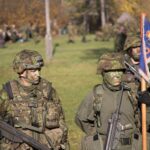





People's Army of Vietnam Special Forces
| Special Operation Force Arms | |
|---|---|
| Binh chủng Đặc công | |
 Symbol | |
| Founded | March 19, 1967 |
| Country | Vietnam |
| Allegiance | Communist Party of Vietnam |
| Type | Special operations force |
| Role | Direct action |
| Mottos | Đặc biệt tinh nhuệ, Anh dũng tuyệt vời, Mưu trí táo bạo, Đánh hiểm thắng lớn (Uniquely elite; Superbly heroic; Ingenious and daring; Deadly attacks for great victories) |
| Decorations | |
| Commanders | |
| Notable commanders |
|
The Special Operation Force Arms (SOFA; Vietnamese: Binh chủng Đặc công[2]) are an arm and the special forces of the People's Army of Vietnam (VPA).[1] SOFA attacks targets in enemy rear areas.[2]
History
First Indochina War
The Viet Minh (VM) used commandos during the First Indochina War. A commando organization developed that stationed units in strategic areas and operated on land, rivers and at sea. Operations included coordinated attacks on 50 French watchtowers in Biên Hòa on March 21 and March 23, 1950; and attacks on Phú Thọ, the Tân An bomb depot, Cát Bi airport and Gia Lam Airport towards the end of the war.[2]
Vietnam War
After the 1954 Geneva Conference, VPA commandos began infiltrating into and attacking targets in South Vietnam; the first unit was the 60th Company. Specialized and mobile commando units were developed. In 1961 and 1962, VPA 5th Military Region in South Vietnam was reinforced with 1,122 men from 10 specialized commando companies and a mobile battalion. VPA commandoes were tasked with conducting guerrilla warfare in South Vietnam.[2]
Tactics to attack strategic command centers were developed during the period when American forces joined the war. VPA commandos attacked the Brinks Hotel and USNS Card in 1964, and Camp Holloway in 1965.[2]
On March 19, 1967, VPA Special Operations was created by Ho Chi Minh, General Secretary of the Communist Party of Vietnam.[2] The organization's first commander was Colonel Nguyễn Chí Điềm.[1]
VPA commandos were involved in combat operations during the 1968 Tet Offensive.[2] A study for the US Commander, Naval Forces Vietnam reported 88 successful VPA frogman attacks from January 1962 to June 1969, causing 210 killed and 325 wounded for 20 sappers killed or captured. A frogman attack on the tank landing ship USS Westchester County in 1968 killed 25 and wounded 27; it was the United States Navy's single deadliest combat incident during the war.[3]
The Pochentong raid
On the night of January 21–22, 1971, a hundred or so-strong PAVN "Sapper" Commando force (Đặc Công, equivalent of "spec op" in English) managed to pass undetected through the defensive perimeter of the Special Military Region (Région Militaire Speciale – RMS) set by the Cambodian Army around Phnom Penh and carried out a spectacular raid on Pochentong airbase. Broken into six smaller detachments armed mostly with AK-47 assault rifles and RPG-7 anti-tank rocket launchers, the PAVN raiders succeeded in scaling the barbed-wire fence and quickly overwhelmed the poorly armed airmen of the Security Battalion on duty that night. Once inside the facility, the raiders unleashed a furious barrage of small-arms fire and rocket-propelled grenades against any aircraft they found on the parking area adjacent to the runway and nearby buildings; one of the commando teams even scaled the adjoining commercial terminal of the civilian airport and after taking position at the international restaurant located on the roof, they fired a rocket into the napalm supply depot near the RVNAF apron.
When the smoke cleared the next morning, the Khmer Air Force had been virtually annihilated. A total of 69 aircraft stationed at Pochentong at the time were either completely destroyed or severely damaged on the ground, including many T-28D Trojans, nearly all the Shenyang, MiG, T-37B and Fouga Magister jets, all the L-19A Bird Dogs and An-2 transports, the UH-1 helicopter gunships, three VNAF O-1 Bird Dogs and even a VIP transport recently presented to President Lon Nol by the South Vietnamese government. Apart from the aircraft losses, 39 AVNK officers and enlisted men had lost their lives and another 170 were injured. The only airframes that escaped destruction were six T-28D Trojans temporarily deployed to Battambang, ten GY-80 Horizon light trainers (also stationed at Battambang), eight Alouette II and Alouette III helicopters, two Sikorsky H-34 helicopters, one T-37B jet trainer, and a single Fouga Magister jet that had been grounded for repairs. Pochentong airbase was closed for almost a week while the damage was assessed, wreckage removed, the runway repaired, and the stocks of fuel and ammunitions replenished.[4][5][6][7]
Similar raids occurred the following year against U-Tapao Airfield which housed Boeing B-52 Stratofortress bombers, with three bombers being damaged and a Thai sentry killed.[8]
Training of foreign commando units in Southeast Asia and Latin America
The effectiveness of the Dac Cong during the Vietnam War saw them instruct various other countries and Marxist rebel groups. From the 1970s to 1990s, they covertly provided training at the PAVN Special Forces School in Vietnam, by Vietnamese advisors assigned to the Cuban Army’s Sapper School in Cuba, and, during the 1980s, by a secret Vietnamese sapper training team stationed in Nicaragua. In addition to training Cambodian, Laotian, Soviet, and Cuban military personnel, their publications revealed that among the foreign revolutionary forces that received training in sapper tactics, bomb-making, and the use of weapons and explosives, were members of the Marxist El Salvadoran FMLN (Farabundo Marti National Liberation Front), the Chilean MIR (Movement of the Revolutionary Left) fighting against the dictatorial regime of Augusto Pinochet, as well as the Colombian FARC (Revolutionary Armed Forces of Colombia) movement, a Marxist guerilla group that was also heavily involved in narcotics trafficking.[9]
Units
- Vietnam People's Ground Force
- 2 special forces brigades[10]
- Vietnam People's Navy Naval Infantry
- 1 commando brigade[11]
Equipment
Small arms
| Name | Image | Type | Origin | Details |
|---|---|---|---|---|
| Scopes | ||||
| ITL MARS | 
|
Red dot sight |  Israel Israel
|
Mounted on Uzi, AKM-1 and IWI Tavor.[12] |
| Meprolight M21 | 
|
Red dot sight | Israel
|
Mounted on Uzi, AKM-1, STV rifle, IWI Galil ACE and IWI Tavor.[12] |
| Barrel | ||||
| CornerShot | 
|
Weapon accessory | Israel
|
|
| Under barrel | ||||
| SPL-40 | 
|
Grenade launcher |  Vietnam Vietnam
|
Standard issue grenade launcher accompanying the STV-380 rifles.[13] |
| M203 | 
|
Grenade launcher |  United States United States
|
Replaces the trigger for a lever. Mounts on the Galil ACE 31/32, STL-1A, M18, M16A2 and TAR-21.[14] |
| Name | Image | Type | Caliber | Variant | Origin | Details |
|---|---|---|---|---|---|---|
| IWI Jericho 941 | 
|
Semi-automatic pistol | 9×19mm Parabellum | Israel
|
Often comes equipped with CornerShot.[15] | |
| Glock | 
|
Semi-automatic pistol | 9×19mm Parabellum |  Austria Austria
|
||
| TT-33 | 
|
Semi-automatic pistol | 7.62×25mm Tokarev | Type 54/K54 K14 |
 Soviet Union Soviet Union China Vietnam China Vietnam
|
Standard issue service pistol.[16] |
| Name | Image | Type | Caliber | Variant | Origin | Details |
|---|---|---|---|---|---|---|
| Uzi | 
|
Submachine gun | 9×19mm Parabellum | Mini Uzi Micro Uzi |
Israel Vietnam
|
Used by land and underwater special forces.[12] |
| Heckler & Koch MP5 | 
|
Submachine gun | 5.56×45mm NATO | SMG-PK |  West Germany West Germany Pakistan Pakistan
|
The SMG-PK is a Pakistani-made version produced under license from Germany. It is equipped for Binh chủng Đặc công, security forces, and Mobile Police Command.[17] |

| Name | Image | Type | Caliber | Variant | Origin | Details |
|---|---|---|---|---|---|---|
| IWI Tavor | 
|
Assault rifle | 5.56×45mm NATO | TAR-21 GTAR-21 |
Israel
|
Used by land and underwater special forces.[18] |
| M-18 | 
|
Assault rifle | 5.56×45mm NATO | United States Vietnam
|
The M-18 is a variant developed from the XM177E2 version of the CAR-15. Manufactured locally at Z111 Factory.[19] | |
| Galil ACE | 
|
Assault rifle | 7.62×39mm | Galil ACE 31 Galil ACE 32 |
Austria
|
Replaced by the domestically manufactured STV-215/STV-380.[18] |
| AKM | 
|
Assault rifle | 7.62×39mm | AKMS AKM-1 STL-1A |
Soviet Union Vietnam
|
Replaced by the STV-215/STV-380 as the standard issue.[20] |
| AK-47 | 
|
Assault rifle | 7.62×39mm | AKS | Soviet Union Vietnam
|
Replaced by the STV-215/STV-380 as the standard issue.[21] |
| STV | 
|
Assault rifle | 7.62×39mm | STV-215 STV-022 |
Vietnam
|
Standard issue service pistol.[22] |
| Name | Image | Type | Caliber | Variant | Origin | Details |
|---|---|---|---|---|---|---|
| RPK | 
|
Squad automatic weapon | 7.62×39mm | Soviet Union Vietnam
|
Standard issue squad-level machine gun. Manufactured locally. | |
| PKM | 
|
General-purpose machine gun | 7.62×39mm | PKM PKMS |
Soviet Union Vietnam
|
Standard issue squad-level machine gun. Manufactured locally. |
| Name | Image | Type | Caliber | Variant | Origin | Details |
|---|---|---|---|---|---|---|
| IWI Galatz | 
|
Sniper rifle | 7.62×51mm NATO | SBT-7.62VN | Israel Vietnam
|
Manufactured locally at the Z111 Factory under the name SBT-7.62VN with free-float M-LOK handguard and adjustable stock similar to the ORSIS T-5000.[23] |
| Dragunov SVD | 
|
Designated marksman rifle | 7.62×54mmR | SBT-7.62M1 | Soviet Union Vietnam
|
Manufactured locally at the Z111 Factory under the name SBT-7.62M1. SBT-7.62M1 is the modernized variant.[23] |
| OSV-96 | 
|
Anti-materiel rifle | 12.7×108mm | SBT-12M1 |  Russia Vietnam Russia Vietnam
|
Manufactured locally at the Z111 Factory under the name SBT-12M1. SBT-12M1 is the domestic copy.[24] |
| KSVK | 
|
Anti-materiel rifle | 12.7×108mm | SBT12M1 | Russia Vietnam
|
Manufactured locally at the Z111 Factory under the name SBT12M1. SBT12M1 is the modernized variant.[25] |
- Notice: Mortars are not a primary weapon in the inventory of the Special Operation Force Arms of Vietnam.
| Name | Image | Type | Caliber | Variant | Origin | Details |
|---|---|---|---|---|---|---|
| STA-50 (Fly-K) | 
|
Light mortar | 50mm Mortar | Vietnam
|
Silenced mortar, inspired by Belgian Fly-K design. Manufactured locally at Z117 Factory. Used by Special Operation Force Arms.[26] | |
| M2 mortar | 
|
Infantry mortar | 60mm Mortar | M2 Type 31 Type 63 |
United States China
|
It can be used by several units in mobile combat operations.[27] |
| 82-PM-41 | _%D0%B2_%D0%9C%D1%83%D0%B7%D0%B5%D0%B5_%D0%BE%D1%82%D0%B5%D1%87%D0%B5%D1%81%D1%82%D0%B2%D0%B5%D0%BD%D0%BD%D0%BE%D0%B9_%D0%B2%D0%BE%D0%B5%D0%BD%D0%BD%D0%BE%D0%B9_%D0%B8%D1%81%D1%82%D0%BE%D1%80%D0%B8%D0%B8.jpg)
|
Mortar | 82mm Mortar | 82-PM-41 Type 67 Type 53 |
Soviet Union
|
It can be used by several units at the company/battalion level. |
References
- ^ a b c d e "Arms". Ministry of National Defence of Vietnam. 2021. Retrieved December 19, 2025.
- ^ a b c d e f g "Quá trình hình thành và phát triển". Ministry of National Defence of Vietnam. Retrieved December 19, 2025.
- ^ Donohue, Hector (2021). "The Swimmer Sapper Attack on USS Meeker County – June 1970". Australia's Vietnam War. Archived from the original on October 3, 2024.
- ^ Conboy and Bowra, The War in Cambodia 1970–75 (1989), pp. 19–20.
- ^ Conboy and McCouaig, South-East Asian Special Forces (1991), p. 53.
- ^ Conboy, FANK: A History of the Cambodian Armed Forces, 1970–1975 (2011), pp. 217–218; 226.
- ^ Serra, L'armée nord-vietnamienne, 1954–1975 (2e partie) (2012), p. 38.
- ^ "Guerrilla Attack Reported on a U.S. Base in Thailand, 2nd in 24 Hours". New York Times. 1972.
- ^ Pribbenow, Merle. "Vietnam Trained Commando Forces in Southeast Asia and Latin America". Wilson Center.
- ^ The International Institute for Strategic Studies 2025, p. 308.
- ^ The International Institute for Strategic Studies 2025, p. 310.
- ^ a b c "'Điểm mặt' các loại súng uy lực của đặc công Việt Nam". soha.vn (in Vietnamese). Retrieved February 7, 2026.
- ^ "Vietnamese People's Army to Start Mass Producing OPL-40M Grenade Launcher". Global Business Press. Retrieved January 6, 2025.
- ^ "Trang bị súng phóng lựu thế hệ mới T40 cho Galil ACE?". baodatviet.vn. Archived from the original on August 6, 2019. Retrieved April 2, 2019.
- ^ "Khẩu súng đặc biệt - Vũ khí chống khủng bố cực lợi hại của Đặc công Việt Nam". soha.vn (in Vietnamese). Retrieved February 8, 2026.
- ^ "Binh chủng "Đặc biệt" trình diễn kỹ, chiến thuật đặc biệt". qdnd.vn (in Vietnamese). Retrieved February 8, 2026.
- ^ "Các loại súng trang bị cho an ninh, cảnh sát cơ động Việt Nam". baohatinh.vn (in Vietnamese). Retrieved February 13, 2026.
- ^ a b "Bộ ba súng trường tấn công hiện đại của Đặc công Việt Nam". kienthuc.net.vn (in Vietnamese). Retrieved February 8, 2026.
- ^ "Tìm hiểu 5 loại súng được Việt Nam cải tiến nâng cấp gần đây". infonet.vietnamnet.vn (in Vietnamese). Retrieved February 13, 2026.
- ^ "Súng trường tấn công của Việt Nam bất ngờ lên báo nước ngoài". kienthuc.net.vn (in Vietnamese). Retrieved February 8, 2026.
- ^ "Đây là khẩu tiểu liên cực mạnh của đặc công Việt Nam". giaoducthoidai.vn (in Vietnamese). Retrieved February 8, 2026.
- ^ "Dàn súng 'Made in Vietnam' được trang bị cho các khối diễu binh lễ kỷ niệm 30/4". baolangson.vn (in Vietnamese). Retrieved February 8, 2026.
- ^ a b "Vietnam Defence Expo 2024: New Sniper Rifles". thefirearmblog.com. Retrieved February 11, 2026.
- ^ "Triển lãm Quốc phòng quốc tế Việt Nam 2022: Súng bộ binh hiện đại của ngành công nghiệp quốc phòng Việt Nam". qdnd.vn (in Vietnamese). Retrieved February 11, 2026.
- ^ "Cận cảnh súng bắn tỉa do Việt Nam sản xuất mới được công bố". thanhnien.vn (in Vietnamese). Retrieved February 11, 2026.
- ^ "Súng cối và đạn cối triệt âm 50 mm Việt Nam có gì đặc biệt?". soha.vn (in Vietnamese). Retrieved February 15, 2026.
- ^ Rottman, Gordon L. (February 10, 2009). North Vietnamese Army Soldier 1958–75. Warrior 135. Osprey Publishing. p. 32. ISBN 9781846033711.
Sources
- International Institute for Strategic Studies (2025). The Military Balance 2025. London: Routledge. ISBN 978-1-041-04967-8.
| General | |||||
|---|---|---|---|---|---|
| Services & Arms | |||||
| Military regions |
| ||||
| Army corps |
| ||||
| Others | |||||

