








Madonna of Trapani
| Basilica-Sanctuary of Maria Santissima Annunziata | |
|---|---|
Basilica santuario di Maria Santissima Annunziata | |
 Basilica-Sanctuary of Maria Santissima Annunziata, Trapani | |
 Basilica-Sanctuary of Maria Santissima Annunziata | |
| 38°1′8.724″N 12°32′30.160″E / 38.01909000°N 12.54171111°E | |
| Location | Trapani, Sicily, Italy |
| Country | Italy |
| Denomination | Roman Catholic |
| History | |
| Status | Minor basilica |
| Dedication | Maria Santissima Annunziata |
| Architecture | |
| Functional status | Active |
| Architect | Simone Pisano (bell tower) |
| Architectural type | Church |
| Style | Gothic, Renaissance, Baroque |
| Administration | |
| Diocese | Roman Catholic Diocese of Trapani |
Madonna of Trapani is the common name for the Basilica-Sanctuary of Maria Santissima Annunziata, a Roman Catholic church, minor basilica, and former Carmelite convent in Trapani, Sicily. The sanctuary is dedicated to the Annunciation and to the Blessed Virgin Mary of Mount Carmel.[1][2][3] The sanctuary includes the Chapel of the Madonna of Trapani, where the marble statue of the same name, a medieval representation of the Virgin and Child, is preserved.[4]
The sanctuary stands on the eastern edge of Trapani along the historic route to Erice. At the time of its foundation in the early fourteenth century it lay outside the medieval city walls, in an area that was later incorporated into the urban fabric. The church forms part of the Roman Catholic Diocese of Trapani.[4]
History


Swabian–Aragonese period
The Carmelites, expelled from Jerusalem and brought to Sicily in 1194, settled in Trapani in the area of the present convent enclosure; the first abbot was Palmerio.[5]
The first small church, dedicated to Santa Maria del Parto, was assigned to the Carmelites and dates to 1240.
On 20 November 1270 the church hosted for 15 days the mortal remains of Saint Louis IX of France, who had died in Tunis during the Eighth Crusade,[6][7] together with Cardinal Rodolfo (Raoul Grosparmi), bishop of Albano and a fervent supporter of the campaign against the infidels. Philip III of France ordered the temporary transfer of his father’s remains to the Chapel of Saint Louis of the French in the Cathedral of Santa Maria Nuova in Monreale, and later to the Cathedral Basilica of Saint Denis, in Paris.[8]
According to the 19th-century Trapani historian Giuseppe Maria di Ferro, the church of the Annunziata was completed in 1332, as attested by an inscription in a plaque bearing the date and recorded by Father Daniele della Vergine Maria. Over time the building was enriched with additional works and decorative interventions.[8]
Spanish period
In 1537 the Chapel of the Madonna of Trapani was completed by the Gagini.[6] It houses the precious statue in Parian marble of the Madonna of Trapani, depicting the Virgin and Child, attributed to Nino Pisano. The statue arrived in Trapani after 1300 and became venerated throughout the Mediterranean.[9]
Contemporary period
In the eighteenth century the church was enlarged to its present form. The Carmelite prior Vincenzo Ferreri entrusted the decoration of the interior to the Trapani architect Giovanni Biagio Amico,[10] who designed Corinthian-order columns and pilasters without altering the original dimensions of the church. Di Ferro reports that errors in the execution of later works in 1760 caused structural problems in the vault, leaving several marble elements unused.[1]
On 25 March 1950 Pope Pius XII elevated the sanctuary to the title and dignity of a minor basilica.[11]
It is the most famous Marian sanctuary in western Sicily.[12] Entrusted to the Carmelite order, the basilica belongs to the Fondo Edifici di Culto.
Architecture and furnishings
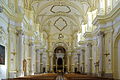
The basilica consists of a single nave terminating in the high altar. In the choir stands a bronze lectern composed of five elements, executed in 1582 by the Trapani sculptor Annibale Scudaniglio, who placed his own portrait and signature on the work. Di Ferro praised the refinement of its ornament, figures and expressive qualities.[8]
Two notable paintings flank the choir: a Martyrdom of Saint Andrew, attributed by Di Ferro to Cavalier Mattia, and a Christ Bearing the Cross by Andrea Carreca, inspired by the Michelangelo statue in Santa Maria sopra Minerva in Rome.[8]
The bell tower on the southern side of the church was designed and directed by the Trapani architect Simone Pisano.[8]
Di Ferro recorded the patronage of several noble families, including the Marchese Fardella and Don Emmanuele Fardella, Prince of Paceco. Other notable patrons were Don Marcello Pepoli e Carafa, the Prince of the Cattolica of the Bosco family, and the Viceroy Count of Albadalista.[8]
Façade
Rose window and Gothic portal.[10]
Bell tower[1][10] on the southern side of the façade, a work by Simone Pisano.
Interior
The nave, with sixteen columns and silvered stuccoes, was transformed in 1742, based on a design by the Trapani architect Giovanni Biagio Amico, in a Baroque–Renaissance style.[13] A radial rose window surmounts the main portal.[14]
- Sanctuary:
- Chapel of Saint Teresa, formerly of Saint Vitus, on the Gospel side, a space created in 1570.[15]
- Chapel of the Madonna of Trapani.[6][10]
- Triumphal arch.[6] An expression of the Sicilian Renaissance, the monumental entrance arch of the Chapel of the Madonna of Trapani, the marble portal commissioned from Antonello Gagini in 1531 and completed after his death in 1537, was the result of collaboration by his heirs, the brothers Giandomenico, Antonino and Giacomo.[16] In the roundels of the pillars are sculpted the profiles of ten prophets; in the medallions of the pendentives are the representations of the Announcing Angel and the Announced Virgin; in the pediment is the half-figure of God the Father in high relief with a globus cruciger in his left hand, surrounded by winged putti on clouds. On the cimaises lie the full-length statues of Saint Elijah (on the left with the flaming sword) and Saint Elisha (on the right with the book of Scripture). In contrast to the whiteness of Carrara marble, the structure presents rich decoration with acanthus leaves, garlands, festoons, grotesques and rosettes.
- 1591, Grille, bronze artifact, a gift from the Viceroy of Sicily Diego Enríquez de Guzmán, Count of Albadalista.[17][18] At the centre of the colonnade, with eight Ionic columns arranged in a semicircle on the altar and enriched with Corinthian capitals and gilded stylobates, stands the statue representing the Virgin.
- Statue of the Madonna of Trapani.[6][19][20]
- Fardella Chapel under the title of Saint Albert, a space sponsored by the Fardella family.[6][10][15]
- Silver statue of Saint Albert.[15]
- 17th century, Martyrdom of Saint Andrew, painting attributed to Mattia Preti.[6][21]
- 17th century, Nazarene Embracing the Cross, painting by Andrea Carrera.[6][21]
- Chapel of the Risen Christ sponsored by the “Merchants of the Marina”, on the Gospel side.[22] The space is also known as the Chapel of the Sailors or Chapel of the Resurrection, used for the custody of the Blessed Sacrament and Eucharistic adoration.[10]
- Altar of the Risen Christ: marble sepulchre supported by the symbols of the four evangelists, surmounted by the statue of the Risen Christ. Four wall niches each contain a statue representing a Centurion, that is, the guards of the tomb.
- Chapel of the Fishermen or baptistery.[10]
Documented works
- 1725 c., Immaculate Conception, painting by Giuseppe Felici.[2]
In the nave are canvases depicting the Birth of Mary, Presentation of Mary at the Temple, Visitation, Presentation of Jesus at the Temple, Dormition of Mary, and Assumption of Mary, works by the Jesuit Giuseppe Felici.
- 1735 c., Virgin among the Saints with the depiction of the city of Trapani at her feet, oil on canvas, work by Domenico La Bruna.
- 1582, Lectern, a bronze artifact documented in the choir, work by Annibale Scudaniglio.[21][23]
- 16th century, The Precursor, that is John the Baptist baptizing Jesus, painting in the style of the Giorgione school in the cornu evangelii of the high altar.[22]
- ?, Faces of Muslims, painting located in the cornu evangelii of the high altar.[22]
- 1486, Font, marble artifact in Renaissance style by an unknown author.[24]
- 1539, Paintings and gildings, documented activities by Francesco Martorana and Orazio d'Alfano “the Perugian”.[25]
Statue of the Madonna (Our Lady of Trapani)

The sanctuary preserves a life-sized marble statue of the Virgin and Child known as the Madonna of Trapani.
A side entrance of the basilica leads to the chapel of the Madonna.
The Madonna of Trapani.[26] was crowned by the Vatican Chapter in 1734. A second coronation was carried out at the request of Pope Pius XII in 1935.[27]
Di Ferro emphasised that the precise circumstances of the statue's arrival in Trapani were already uncertain in his time, owing to the loss of archival sources and the contradictions among later writers. He cited the historian Pirri in noting that both the injury of time and the negligence of writers had obscured its early history.[8] Di Ferro considered the most plausible tradition to place the statue's arrival in Trapani in 1291 under the reign of James II of Aragon, following a route from Cyprus to Ptolemais in Phoenicia and from there to Sicily. He reported a tradition that the statue had originally belonged to a Templar commandery and was left in Trapani at the insistence of the local population.[8]
The feast of the Madonna of Trapani, together with the Procession of the Mysteries during Holy Week, is the most important religious event of the city.
The "Madonna of Trapani" is venerated both in Italy and abroad. Among the places where devotion exists are Messina,[28] Tonnarella, Palagonia,[29] Palermo,[30] Genoa, and Tunis.
Cloisters and convent
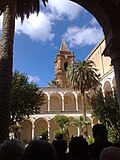
Adjacent to the church is the general convent[3][31] of the Carmelite fathers, which was the largest of the Order in Italy, with its cloister. The convent is described by Di Ferro as an extensive and isolated complex, accessed by a monumental staircase and organised around spacious corridors and cloisters supported by Doric columns. The cloisters preserved numerous lapidary inscriptions recording royal visits and acts of devotion to the image of the Virgin.[8] It includes:
- A large cloister, with porticoes and loggias, consisting of 80 columns.[22]
- Plaques bearing inscriptions of Ferdinand III of Bourbon and his son Francis I, Duke of Calabria.[22]
- Northern cloister with the cell–chapel of Saint Albert. On the architrave an inscription reads:[32]
"HÆC FVIT ALBERTI DREPANENSI CÆLVLA SANCTI SISTE GRADVM - ATQVE PIAS PECTORE FVNDITE PRECES".
A second cloister on the northern side contained the cell traditionally associated with Saint Albert of Trapani, later converted into a small chapel. The convent was one of the three general convents of the Carmelite Order, whose prior therefore held voting rights in the general chapters of the order alongside those of Naples and Paris.[8]
A large part of the convent’s premises houses the Agostino Pepoli Regional Museum, which also preserves the “treasury of the Madonna”.
In front of the basilica is the garden of Villa Pepoli, now a public park.
- Congregation
- 1660 c., Congregation of the Crucifix, known as the Figurella.[33] A confraternity founded with the task of washing the feet of devout pilgrims.
Modern use
Following the suppression of religious orders in the nineteenth century, the convent buildings were gradually adapted for secular purposes. Today the former convent houses the Agostino Pepoli Regional Museum, a state museum preserving collections of sculpture, painting, decorative arts and archaeology from western Sicily.[34]
Relics
- Saint Clement
Beneath the basilica’s altar lie the remains (some relics) of Saint Clement, a Roman martyr.
- Saint Albert of Trapani
Inside the church there is a chapel erected in 1586 containing the silver reliquary statue of the Trapani-born Albert of Trapani, made by the silversmith Vincenzo Bonaiuto, which still preserves his relics, including the saint’s entire skull.[15][35]
- Blessed Rabatà
Next to it is the small cell where Saint Albert lived, where the relics of Louis Rabatà are kept.
See also
Gallery
-
 Museum entrance
 -
 Nave
Nave -
 Chiaramonte Gothic portal
 -
 Basilica and garden
 -
 Rose window
 -
 Bell tower designed by Simone Pisano
 -
 Gagini portal
 -
 Cloister porticoes
 -
 Chapel of the Sailors
 -
 Chapel of Saint Albert of Trapani
 -
 Funerary monument of the Sanclemente family


_05.jpg)
.jpg)


_10.jpg)

_07.jpg)


References
- ^ a b c Giuseppe Maria di Ferro, p. 281.
- ^ a b p. 490, Diego Ciccarelli; Marisa Dora Valenza, La Sicilia e l'Immacolata: non solo 150 anni: atti del convegno di studio - Palermo 1–4 dicembre 2004 [1], single volume, Palermo, Biblioteca Francescana, Officina di Studi Medievali, 2006.
- ^ a b Touring Club Italiano, p. 285.
- ^ a b "Basilica Annunziata – Diocesi di Trapani" [Basilica of the Annunziata – Diocese of Trapani]. comune.trapani.it (in Italian). Retrieved 13 January 2026.
- ^ Giuseppe Pitrè, p. 463.
- ^ a b c d e f g h Giovanna Power, p. 191.
- ^ Giuseppe Maria di Ferro, pp. 283–284.
- ^ a b c d e f g h i j Di Ferro, Giuseppe Maria (1825). Guida per gli stranieri in Trapani: con un saggio storico [A Guide for Foreigners to Trapani: With a Historical Essay] (in Italian). Trapani: Pietro Mannone e Solina. pp. 281, 283–289.
- ^ Giuseppe Pitrè, pp. 463–464.
- ^ a b c d e f g Touring Club Italiano, p. 286.
- ^ "Il Santuario elevato al titolo e dignità di Basilica Pontificia Minore". Archived from the original on 13 December 2015. Retrieved 23 December 2015.
- ^ "Origini e vicende storiche del luogo di culto". Archived from the original on 20 December 2015. Retrieved 23 December 2015.
- ^ Giuseppe Maria di Ferro, p. 282.
- ^ "Arte della Chiesa". Archived from the original on 8 March 2014. Retrieved 23 December 2015.
- ^ a b c d Giuseppe Maria di Ferro, p. 286.
- ^ Gioacchino di Marzo, pp. 399–402, 446, 455.
- ^ Giuseppe Maria di Ferro, p. 287.
- ^ Gioacchino di Marzo, p. 636.
- ^ Gioacchino di Marzo, pp. 40, 46.
- ^ Giuseppe Maria di Ferro, pp. 287–290.
- ^ a b c Giuseppe Maria di Ferro, p. 283.
- ^ a b c d e Giuseppe Maria di Ferro, p. 284.
- ^ Gioacchino di Marzo, p. 637.
- ^ Gioacchino di Marzo, p. 90.
- ^ Gioacchino di Marzo, p. 498.
- ^ Giuseppe Pitrè, pp. 464–465.
- ^ "La via dei Santuari Mariani". Retrieved 23 December 2015.
- ^ "La vera storia del Santuario - Santuario Madonna di Trapani a Messina". Archived from the original on 24 December 2015. Retrieved 23 December 2015.
- ^ "Parrocchia Madonna di Trapani – Palagonia". Retrieved 23 December 2015.
- ^ Antonio Mongitore (1719). Palermo divoto di Maria Vergine, e Maria Vergine protettrice di Palermo. Vol. 1. Palermo: Stamperia di Gaspare Bayona. p. 188. Retrieved 23 December 2015.
- ^ Giuseppe Maria di Ferro, pp. 281 and 286.
- ^ Giuseppe Maria di Ferro, p. 285.
- ^ Giuseppe Pitrè, p. 467.
- ^ "Museo regionale di Trapani "Agostino Pepoli"" [Agostino Pepoli Regional Museum of Trapani]. cultura.gov.it – Ministero della Cultura (in Italian). Retrieved 13 January 2026.
- ^ Gioacchino Di Marzo in his works on sculpture in Sicily instead attributes it to Antonello Gagini, who allegedly created it in 1585.
