







National Museum of Iran
موزهٔ ملی ایران Muze-ye Melli-ye Irān | |
 | |
 Facade of the National Museum of Iran, Tehran | |
 | |
| Established | 1937; 88 years |
|---|---|
| Location | Tehran, Iran |
| Type | Archaeology museum |
| Collection size | +3 million (300,000 on display) [1] |
| Visitors | 500,000 (2011) [2] |
| Director | Jebrael Nokandeh |
| Owner | ICHTO |
| Website | irannationalmuseum.ir |
The National Museum of Iran (Persian: موزهٔ ملی ایران, romanized: Mūze-ye Melli-ye Irān) in Tehran houses the richest and largest collection of Iranian antiquities in the world.[3][4] It is the world's most important institution for Iranian history and one of the most comprehensive museums globally, home to over 3 million artifacts.[5] The institution is formed of two museums; the Museum of Ancient Iran and the Museum of the Islamic Era. The institution is also considered a major global research hub for archeology,[6] and it includes multiple research departments, categorized by different historical periods. The museum is one of the oldest archaeological museums in West Asia, and one of the region’s earliest institutions dedicated to historical preservation.[7]
History
For the first time, the proposal to create a place called "Museum" was made by Morteza Gholi Khan Hedayat in 1906.[8] He was thinking of creating a museum and an office called the Department of Antiquities to organize commercial explorations, but he did not achieve this goal. The first museum was established in 1916 under the name of "National Museum" or "Museum of Education" in one of the rooms of the Ministry of Education, which was located on the north side of the Dar al-Fonun school building.[9] This museum had 270 bronze artefacts (pottery, glass, coins, old weapons, seals, wooden objects, patches, books and textiles) which were collected by the employees of the Antiquities Department or donated by the people. In 1925, the objects of this museum were moved to the Mirorr Hall at Masoudieh Mansion.

With the start of excavations by European archaeologists, especially the French archaeological team headed by Jacques de Morgan in Susa (1897), the people's attention was drawn to the importance of cultural heritage. In 1927, the unconditional privilege of the French archaeologists in Iran was canceled. They were allowed to dig only in Susa.[10] Since Iran had decided to establish a national museum and library, the privilege of designing and implementing it was given to France.[11] For this purpose, French architect Andre Godard came to Iran in 1929 to establish a museum and library and officially started his work.
.jpg)
.jpg)
The brick building of the Museum of Ancient Iran was designed by André Godard and Maxime Siroux in the early 20th century, and was influenced by Sassanid vaults, particularly the Taq Kasra at Ctesiphon.[12] Its construction, with an area of about 11,000 square metres (13,000 sq yd), began in 1935 and was completed within two years by Abbas Ali Memar and Morad Tabrizi. It was then officially inaugurated in 1937.[13]
The Museum of the Islamic Era was later built with white travertine on the grassy grounds of the Museum of Ancient Iran, and was still being remodeled when the Iranian Revolution swept the country.
While the Museum of Ancient Iran always had a clear mandate to show archaeological relics, as well as some rare medieval textiles and rug pieces, the newer complex also featured Amlash pottery from prehistoric Caspian Sea regions of Iran. The Museum of the Islamic Era exhibits over 1,500 works from Ilkanids, Seljuks, Timurids, Safavids, Qajars and more. The complex consists of three floors, and it contains various pieces of pottery, textiles, texts, artworks, astrolabes, and adobe calligraphy, from Iran's post-classical era.
The oldest artifacts kept at the Ancient Iran Museum are from Kashafrud, Darband, and Shiwatoo, which date back to the Lower Paleolithic period. Mousterian stone tools made by Neanderthals are on display at the first hall of the Museum of Ancient Iran. The most important Upper Paleolithic tools are from Yafteh, dating back about 30,000 to 35,000 years. The Museum of Ancient Iran consists of two floors. Its halls contain artifacts and fossils from the Lower, Middle, and Upper Paleolithic, as well as the Neolithic, Chalcolithic, early and late Bronze Age, and Iron Ages I-III, through the Elamite, Median, Achaemenid, Seleucid, Parthian, and Sassanian eras.
Exhibitions
.jpg)

The National Museum of Iran and the British Museum held a major exhibition. It was held in collaboration with the Iranian government, which loaned the British Museum a number of iconic artefacts in exchange for an undertaking that the Cyrus Cylinder would be loaned to the National Museum of Iran in return.[14] The Cylinder was displayed in September 2010 for a four-month period.[15] The exhibition was very popular, attracting 48,000 people within the first ten days and about 500,000 people by the time it closed in January 2011.[16]
To celebrate its 80th anniversary in 2018, the museum hosted 50 masterpieces from the Louvre and the Musée national Eugène Delacroix.[17][18] The exhibition attracted over 250,000 visitors.[19][20] An ancient Sassanid relief (224–651 AD), illegally smuggled to the United Arab Emirates during the 1980s, and left there in 2006, was later seized in the United Kingdom in 2016. Its value at an auction could exceed £30 million.[21] The Iranian government was tracking the long-missing relief for years. In 2023, The Guardian reported that the relief had been discovered and confiscated at Stansted Airport in Essex.[22] The British Museum received permission from Iran to display the relief for a short period of time, and then returned it home. After 35 years, on 28 June 2023, the Sassanid relief returned and a well-received exhibition was held at the National Museum of Iran. It is now permanently displayed at the Museum.[23]
After 85 years, the Achaemenid tablets, which were loaned to the University of Chicago for study in 1930s, returned home.[24] The 4,000 tablest were discovered in Persepolis and lent to the United States for a three-year study period.[25] They were repatriated on the plane that also brought home the Iranian delegation from New York, after it attended the United Nations General Assembly. The tablets are among the most important works of Iranian history, and contain vital insights into road resource management, social relations, basic necessities of life, wages, and the economy of Achaemenid society from the time of Darius the Great (522–486 BC).[26][27]
Another successful exhibitions was the “Silk Legacy” in 2025, which celebrated the millennia-old cultural ties between Iran and China.[28] Other exhibitions are held continuously and annually at the museum. The museum has also held several highly successful exhibitions abroad. "The Glory of Ancient Persia" was held throughout China for 15 months in 2024.[29] Over 200 artifacts went on display in Beijing (Forbidden City), Shanghai and Xinjiang[30], which attracted more than 50 million visitors and became the biggest abroad exhibition in the museum's history.[31][32][33] Being home to one of the world's four remaining statues of Homer's Penelope, the museum showcased the statue alongside its three sisters at Prada Foundation in Milan in a 4-months-long event by Iran and Italy.[34][35] All the four statues later went on display again in 2016, this time at the National Museum of Iran.[36][37][38] Other exhibitions abroad were held in Spain, Germany and the Netherlands.[39][40]
Departments
| Department | Head |
|---|---|
| Paleolithic Department | Fereidoun Biglari |
| Osteological Department | Marjan Mashkour |
| Prehistoric Department | Fariba Mojezati |
| Historic Department | Firouzeh Babaei |
| Islamic Department | Karam Mirzaei |
| Coins and seals Department | Malekeh Malekzadeh Bayani |
| Inscriptions Department | Ahmad Tafazzoli |
| Pottery Department | Omolbanin Ghafouri |
Management
| Name | Education/Activities |
|---|---|
| Andre Godard
(1936-1960) |
French architect, archaeologist and researcher. Head of the department of Antiquities and Museum of Ancient Iran and the founder of the National Museum of Iran. The designer of: National Library building, the tomb of Hafez, the tomb of Ferdowsi and the tomb of Saadi. The founder of the faculty of Fine Arts in the University of Tehran, and the first manager of this faculty.[41] |
| Jebrael Nokandeh
(Since 2015) |
PhD in archeology from the Institute of Near Eastern Archeology (Berlin). Opening the section related to the prehistoric period, completing the restoration operation of the Museum of Islamic Arts after 9 years, integrating the data of different sections, organizing storage areas and producing different catalogs of the museum's important collections, and holding joint programs between the National Museum of Iran and the largest museums around the world such as Louvre, Museum Island etc.[42] |
Gallery
-

-
 Trihedral from the Lower Paleolithic, found at Amar Merdeg.
 -
 Clay boar figurine from the Neolithic period, found at Tepe Sarab.
 -
 A clay figurine of a fertility goddess found at Tepe Sarab, dating back to the Neolithic.
 -
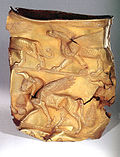
-
 Iron-Age animal statue from Marlik.
 -
![Pottery from Shahr-e Sukhteh, the world's first known animation.[43]](https://upload.wikimedia.org/wikipedia/commons/thumb/a/a6/National_Museum_of_Iran_Darafsh_%2864%29.JPG/120px-National_Museum_of_Iran_Darafsh_%2864%29.JPG) Pottery from Shahr-e Sukhteh, the world's first known animation.[43]
Pottery from Shahr-e Sukhteh, the world's first known animation.[43] -
 A chlorite object with the Master of Animals motif related to the Jiroft culture, dating back to Bronze Age I, from Kerman
 -
 Ring of Power, Elamite period
 -
 The guardian bull of Chogha Zanbil
 -

-
 Column from Persepolis
 -
 Achaemenid mastiff statue.
 -
 Statue of Empress Atossa, the daughter of Cyrus the Great, wife of Darius the Great, and mother of Xerxes the Great.
 -
 An Achaemenid plaque, the only remaining item with the symbol of the Empire's flag.
 -
 Tablets of Darius the Great, discovered at Persepolis, are housed at the museum with their original stone box.
 -
 Tablet of Xerxes the Great
 -
 The central wall of the northern stairs of Apadana Palace from Persepolis.
 -

-
![One of the world's four remaining statues of Penelope was discovered in Persepolis. The other three are kept at Vatican Museum and Capitoline Museum in Rome.[44]](https://upload.wikimedia.org/wikipedia/commons/thumb/b/b1/Achamanid-Woman-Statue-Persia-Persepolis.jpg/120px-Achamanid-Woman-Statue-Persia-Persepolis.jpg) One of the world's four remaining statues of Penelope was discovered in Persepolis. The other three are kept at Vatican Museum and Capitoline Museum in Rome.[44]
One of the world's four remaining statues of Penelope was discovered in Persepolis. The other three are kept at Vatican Museum and Capitoline Museum in Rome.[44] -

-
 The Saltmen.
 -
 Statue of Thermusa.
 -
 Statue of a Sassanid nobleman
 -
 Royal silver plate with Sassanid king Shapur II hunting lions.
 -
 Royal plate of Sassanid king Khosrow I
 -
 Royal Sassanid gilded silver vessel
 -
 Early Islamic plasterwork
 -
 Early Islamic tiling
 -

-
 Wooden window, 1126 AD
 -
 Paradise Gate, Mihrab from Ilkhanate Empire.
 -
 Depiction of Muhammad, Qajar era
 -
 A Qajar-era hookah.
 -
 A 19th-century watercolor painting, Qajar era

_Amar_Merdeg,_Mehran,_Ilam,_Lower_Paleolithic,_National_Museum_of_Iran.jpg)

_Tappeh_Sarab,_Kermanshah_ca._7000-6100_BCE_Neolithic_period,_National_Museum_of_Iran.jpg)


![Pottery from Shahr-e Sukhteh, the world's first known animation.[43]](https://en.wikipedia.org/wiki/File:National_Museum_of_Iran_Darafsh_(64).JPG)


.JPG)


.jpg)


_(4734172156).jpg)
,_Spain_-_48244034452.jpg)
![One of the world's four remaining statues of Penelope was discovered in Persepolis. The other three are kept at Vatican Museum and Capitoline Museum in Rome.[44]](https://en.wikipedia.org/wiki/File:Achamanid-Woman-Statue-Persia-Persepolis.jpg)
.JPG)
.jpg)
.JPG)


_(45146685815_001).jpg)
See also

References
- ^ در برابر سرقت ایمن است؟
- ^ "Diplomatic whirl". The Economist.
- ^ "National Museum of Iran | World Heritage Journeys of Europe". visitworldheritage.comhttps. Retrieved 27 November 2025.
- ^ "National Museum of Iran | Silk Roads Programme". en.unesco.org. Retrieved 27 November 2025.
- ^ "National Museum of Iran | World Heritage Journeys of Europe". visitworldheritage.comhttps. Retrieved 5 June 2025.
- ^ Callieri, P.; Rossi, A. V.; Sajjadi, S. M. S.; Shirazi, R. (2021). Iran and Italy: 60 Years of Collaboration on Cultural Heritage, Proceedings of the Workshop 17th November 2019, Iran National Museum, Tehran. IRN. ISBN 978-622-96536-4-7.
- ^ "Otraq.com, Iran's Tourism Guide" Archived 2014-10-20 at the Wayback Machine
- ^ "مرتضی قلی خان هدایت موسس موزه ملی". Mag Iran. 21 December 2023.
- ^ "موزه ملی ایران؛ موزه ایران باستان و دوران اسلامی". Safar Market. 21 December 2023.
- ^ Scheil, V. (21 December 2023). "Excavations made by the French in Susa and Babylonia, 1902-1903". The Biblical World. 24 (2): 146–152. doi:10.1086/473448. JSTOR 3140967. S2CID 143158851. Archived from the original on 17 May 2023. Retrieved 20 May 2025.
- ^ The First British and French Archaeological Investigations in Susa during the 19th century. Études orientales, slaves et néo-helléniques. Presses universitaires de Strasbourg. 21 December 2023. pp. 199–213. ISBN 979-10-344-0472-8. Archived from the original on 16 September 2024. Retrieved 20 May 2025.
- ^ Sandy Isenstadt, Kishwar Rizvi. Modernism and the Middle East: Architecture and Politics in the Twentieth Century. Studies in Modernity and National Identity. University of Washington Press, 2011. ISBN 0295800305 pp.14
- ^ Nokandeh, Jebrael (ed.) 2019. A Survey of the History of Iran on the Basis of Iran National Museum Collections, Second edition, Iran National Museum with the contribution of Baloot Noghrei Institute, Tehran
- ^ "British Museum in battle with Iran over ancient 'charter of rights'". The Guardian. 20 December 2023.
- ^ "Diplomatic Whirl". The Economist. 20 December 2023.
- ^ "Cyrus Cylinder warmly welcomed at home". Tehran Times. 20 December 2023.
- ^ "The Louvre at Tehran". Louvre. 6 June 2018. Archived from the original on 29 January 2021. Retrieved 20 May 2025.
- ^ "Louvre show opens in Tehran as cultural diplomacy thrives". The Guardian. 20 December 2023.
- ^ "The Louvre in Tehran". Euronews. 1 March 2018.
- ^ "موزه لوور تهران امروز به کار خود پایان میدهد/بازدید ۲۵۰ هزار نفر از موزه معروف فرانسه". Fars News. 20 December 2023.
- ^ "Smuggled Iranian carving worth £30m seized at airport by UK border control". The Guardian. 20 December 2023.
- ^ "Sassanid statue back Iran after 35 years". Ifp News. 20 December 2023. Archived from the original on 7 November 2024. Retrieved 20 May 2025.
- ^ "Lost Sassanid soldier". Iran Safar. 20 December 2023.
- ^ "رونمایی از الواح هخامنشی". ایسنا (in Persian). 18 May 2024. Retrieved 18 May 2024.
- ^ "163 Achaemenid tablets showcased at National Museum of Iran". Mehr News Agency. 18 May 2024. Retrieved 18 May 2024.
- ^ "ویدیو/ رونمایی از ۳۵۰۰ لوح هخامنشی بعد از ۹ ماه". ایسنا (in Persian). 18 May 2024. Retrieved 18 May 2024.
- ^ "۱۶۳ لوح هخامنشی به نمایش گذاشته شد". خبرگزاری مهر | اخبار ایران و جهان | Mehr News Agency (in Persian). 18 May 2024. Archived from the original on 20 May 2024. Retrieved 18 May 2024.
- ^ "China and Iran Strengthen Cultural Ties with Silk Gift Exhibition in Tehran: New Celebration of Shared Heritage and History - Travel And Tour World". 12 October 2025. Retrieved 5 December 2025.
- ^ "上海博物馆". www.shanghaimuseum.net. Retrieved 5 December 2025.
- ^ "'Glory of Ancient Persia', an exhibition of top Iranian artifacts, opens in Urumqi". Tehran Times. 7 December 2024. Retrieved 5 December 2025.
- ^ "شکوه ایران باستان". جامعه خبری تحلیلی الف (in Persian). 14 December 2024. Retrieved 5 December 2025.
- ^ "Exhibition of Iranian cultural relics kicks off at Palace Museum - People's Daily Online". en.people.cn. Retrieved 5 December 2025.
- ^ "Exhibition in China showcases ancient Iranian history with 216 cultural relics". South China Morning Post. Retrieved 5 December 2025.
- ^ Rivetti, Ermanno (23 August 2015). "Miuccia Prada plays key role in Italy-Iran cultural diplomacy". The Art Newspaper - International art news and events. Retrieved 5 December 2025.
- ^ "سفر «پنهلوپه غمگین» از تخت جمشید به ایتالیا". همشهری آنلاین (in Persian). 13 May 2015. Retrieved 5 December 2025.
- ^ "Statue Of Peace, A Journey From Persepolis To Rome And Back (PHOTOS) - Iran Front Page". ifpnews.com. 29 September 2015. Retrieved 5 December 2025.
- ^ "Statues of Penelope showcased at National Museum of Iran". Tehran Times. 29 September 2015. Retrieved 5 December 2025.
- ^ "Arrivederci, Penelope Sisters! | FinancialTribune". financialtribune.com. 12 January 2016. Retrieved 5 December 2025.
- ^ "نمایشگاه بزرگ ایران در آلمان: از زیگورات چغازنبیل تا باغ دلگشا". BBC News فارسی (in Persian). Retrieved 5 December 2025.
- ^ "'ایران: مهد تمدن': گنجینهای از موزه ملی ایران در هلند". BBC News فارسی (in Persian). Retrieved 5 December 2025.
- ^ CAOI. "André Godard - Contemporary Architecture of Iran". www.caoi.ir. Retrieved 27 November 2025.
- ^ "جبرییل نوکنده". جویشگر علمی فارسی (علم نت) (in Persian). Retrieved 27 November 2025.
- ^ Muzdakis, Madeleine (29 August 2023). "5,000-Year-Old Iranian Vase Features the First Known Animation". My Modern Met. Retrieved 27 November 2025.
- ^ "Statue Of Peace, A Journey From Persepolis To Rome And Back (PHOTOS) - Iran Front Page". ifpnews.com. 29 September 2015. Retrieved 26 December 2023.
External links
- Official website of Iran National Museum
- Official website of Journal of Iran National Museum
- Photo Gallery of the National Museum of Iran
- Virtual Tour of Iran National Museum 1 [1] Archived 2020-08-16 at the Wayback Machine
- Virtual Tour of Iran National Museum 2 [2]
35°41′13.36″N 51°24′52.60″E / 35.6870444°N 51.4146111°E


Tehran province, Iran | ||||||||||||||||||||||||||||||||||
|---|---|---|---|---|---|---|---|---|---|---|---|---|---|---|---|---|---|---|---|---|---|---|---|---|---|---|---|---|---|---|---|---|---|---|
| Capital | ||||||||||||||||||||||||||||||||||
| Counties and cities |
| |||||||||||||||||||||||||||||||||
| Landmarks |
| |||||||||||||||||||||||||||||||||
| Populated places | ||||||||||||||||||||||||||||||||||
^* indicates that this formerly independent city is now absorbed into Tehran. | ||||||||||||||||||||||||||||||||||

| International | |
|---|---|
| National | |
| Other | |
