



Sidi Belahcen Mosque
| Sidi Bellahsen Mosque | |
|---|---|
مسجد سيدي بلحسن | |
 | |
| Religion | |
| Affiliation | Islam |
| Ecclesiastical or organisational status | Mosque (former) |
| Status | Inactive (currently a museum) |
| Location | |
| Location | Tlemcen, Tlemcen Province |
| Country | Algeria |
 Interactive map of Sidi Bellahsen Mosque | |
| Coordinates | 34°52′59″N 1°18′41″W / 34.882921°N 1.3112971°W |
| Architecture | |
| Style | Moorish (Zayyanid) |
| Founder | Abi Ibrahim ibn Yahya |
| Completed | 1296 |
| Minaret | 1 |
The Sidi Belahcen Mosque (Arabic: مسجد سيدي بلحسن; French: La Mosquée de Sidi Bel Hasan), also known as Sidi Bel Hasan Mosque[1][2][3] or Sidi Abu al-Hasan Mosque[4][5] is a former mosque in the city of Tlemcen, Algeria. The former mosque is located in the southwest of the square, next to the Great Mosque of Tlemcen.
The building has been repurposed as the National Public Museum of Islamic Calligraphy in Tlemcen, an Islamic art museum.
History

The mosque was founded in 1296 by the Zayyanid ruler Abi Ibrahim ibn Yahya,[clarification needed] as inscribed on the plank of the western wall in the prayer hall and on the two groves made of plaster on top of the mihrab. The mosque's name is considered derived from the name of the local qadi and ulama Abi al-Hassan who served under the rule of Abu Said Uthman I (r. 1283–1303).
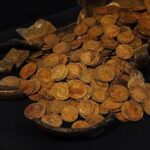
Today, the National Public Museum of Islamic Calligraphy (French: Musée public national de la calligraphie islamique) occupies the oratory of the former mosque, the adjoining room, the former courtyard, and a room on the second floor. The museum contains artefacts of Almoravid and Zayyanid art, relics found during excavations at Siga, Honaïne and the Agadir mosque, as well as Almohad and Roman coins.[6]
Architecture
The former mosque has rather modest appearance compared to the other mosques of the same era. The former mosque has no sahn and uses similar tiles for the floor and the qibla wall. The ceiling was consisted of interlocking logs made of cedar trees, which is the first of its kind in Algeria and predates three or four centuries the style employed in the Andalusian Moorish architecture.
-
 Inside the prayer hall, looking towards the mihrab (center)
 -
 Ceiling of the prayer hall
 -
 Transverse view of the prayer hall (mihrab on the right)
 -
 Mihrab decoration
 -
 Decorative capital next to the mihrab
 -
 Muqarnas inside the mihrab

_situ%C3%A9es_en_haut_du_mihrab_de_la_mosqu%C3%A9e_de_Sidi_Belhassen.jpg)


See also


References
- ^ Lafer, Ali. "Djama'a Sidi Bel-Hasan (mosque)". Discover Islamic Art, Museum With No Frontiers. Archived from the original on April 28, 2023. Retrieved March 30, 2021.
- ^ Bloom, Jonathan M. (2020). Architecture of the Islamic West: North Africa and the Iberian Peninsula, 700-1800. Yale University Press. pp. 183–184. ISBN 9780300218701. Archived from the original on January 14, 2024. Retrieved May 4, 2021.
- ^ Marçais, Georges (1954). L'architecture musulmane d'Occident (in French). Paris: Arts et métiers graphiques. p. 272.
- ^ "Qantara - Mosque of Sidi Bel Hasan (Sayyidī Abū al-Hasan)". www.qantara-med.org. Retrieved March 30, 2021.
- ^ "Jami' Sidi Abi Hasan". ArchNet. n.d. Archived from the original on November 27, 2021. Retrieved March 30, 2021.
- ^ "NATIONAL MUSEUM OF ISLAMIC CALLIGRAPHY". Petit Fute. 2025. Retrieved September 20, 2025.
Further reading
- Basset, H.; Terrasse, H. (1932). "Sanctuaires et Forteresses almohades". Hespéris (in French) (V ed.). Paris.
{{cite book}}: CS1 maint: location missing publisher (link) - Bourouiba, R. (1981). L’art religieux musulman en Algérie (in French). Alger: S.N.E.D. pp. 108–129.
- Bourouiba, A. (1986). Apports de l'Algérie à l'architecture arabo-islamique (in French). Alger: S.N.E.D.
- Marçais, G. (1950). Les villes d'art célèbres (in French). Tlemcen, Paris: H. Laurens.
- Marçais, G. (1905). Les monuments arabes de Tlemcen (in French). Paris: Fontemoing.
External links
 Media related to Sidi Bel Hasan Mosque at Wikimedia Commons
| Architecture |
| ||||||
|---|---|---|---|---|---|---|---|
| Education |
| ||||||
| Islamic scholars in Tlemcen | |||||||
| Sport | |||||||


| Algiers | |
|---|---|
| Constantine | |
| Oran | |
| Tlemcen | |
| Other provinces | |
| Former | |

