








Girgaon Chowpatty
Girgaon Chowpatty
Girgaum Chowpatty | |
|---|---|
Neighbourhood | |
 Girgaon Chowpatty during Ganesh Visarjan | |
  Girgaon Chowpatty | |
| Coordinates: 18°57′04″N 72°48′40″E / 18.951°N 72.811°E | |
| Country | India |
| State | Maharashtra |
| District | Mumbai City |
| City | Mumbai |
| Government | |
| • Type | Municipal Corporation |
| • Body | Brihanmumbai Municipal Corporation (MCGM) |
| Languages | |
| • Official | Marathi |
| Time zone | UTC+5:30 (IST) |
.jpg)
Girgaon Chowpatty (IAST: Giragāva Chaupāṭī), is a public beach at the eastern end of the Queen’s Necklace adjoining Malabar Hill in the Girgaon area of Mumbai (Bombay), Maharashtra, India. It is served by the Charni Road railway station. The beach is noted for its Ganesh Visarjan, when thousands of people from all over Mumbai and Pune come to immerse idols of Ganesha in the Arabian Sea after the 10 day festival of Ganesh Chaturthi. It is also one of the many places in the city where the Ramlila play is performed onstage every year during Navaratri, and an effigy of Ravana is erected on the sand is burned on Vijayadashami at the end of the 10 day performance.
Etymology
Chowpatty is an Anglicised form of Chau-pati (four channels or four creeks in Marathi) as per (Bombay City Gazetteer, I. 27). This name is analogous to that of Satpaty, a village in the Mahim Taluka of the Thane District, which is approached through a channel or creek containing seven divisions of water.
History
On the road running along the beach, i.e. Marine Drive, the lone surviving terrorist of the 26/11 attacks, Ajmal Kasab, was caught and arrested. A bronze bust of Tukaram Omble, the policeman who helped to arrest Kasab, was erected on 26 November 2009.
Pollution
The water surrounding the beach is severely polluted and unsafe for swimming. Fecal coliform was recorded in the water in 2013 at levels of 1455 per 100 mL, far above the acceptable standard of 500 per 100 mL. The presence of fecal coliform in the water has been attributed to waste from storm drains, open defecation, and the discharge of raw sewage from sewer pipes not connected to the city mains.[1]
In 2015, there were reports of deteriorated Ganesha idols washing up on the shore. The idols were found after they were immersed on Anant Chaturdashi day, which heralds the end of the Ganesh Chaturthi festival. The idols that were found were made from plaster-of-paris. It is believed that POP idols cause pollution to marine life. After this, the government ordered only artisan made, clay idols to be immersed, since natural clay deteriorates into the ocean quickly without harming wildlife. POP was banned in Mumbai and most of the Ganesha idols are being made from clay.
On 30 August 2016, the sand on the beach is said to be turning black due to a possible oil slick in the area. The specific cause of the blackening is unknown.[2]
Images
-
 Girgaon Chowpatty with Nariman Point skyline in the background
 -
 Girgaon Chowpatty with Malabar Hills in the background
 -
 Corn cob vendors on Girgaon Chowpatty
 -
 Walking
 -
 Walking
 -
 Twilight at Girgaon Chowpatty
 -
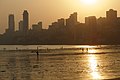 Sunset at Girgaon Chowpatty
 -
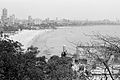 View of Girgaon Chowpatty from Malabar Hill
.jpg)


See also
References
- ^ Lewis, Clara (4 October 2013). "Mumbai's coastal waters go from bad to worse". The Times of India. Retrieved 5 July 2018.
- ^ "Why the sand at Mumbai's famous Girgaum chowpatty is turning black | Latest News & Updates at Daily News & Analysis". 30 August 2016. Retrieved 30 August 2016.
External links
- Mumbai attractions, Maharashtra Tourism.
| Pre-colonial | |
|---|---|
| Colonial | |
| Beaches | |
| Places of worship | |
| Cultural |
|
| Boulevards | |
| Districts | |
| Shopping | |
| Buildings | |
| Parks, zoos and stadia | |
| Museums | |
| Forts | |
| Restaurants & bars | |


