








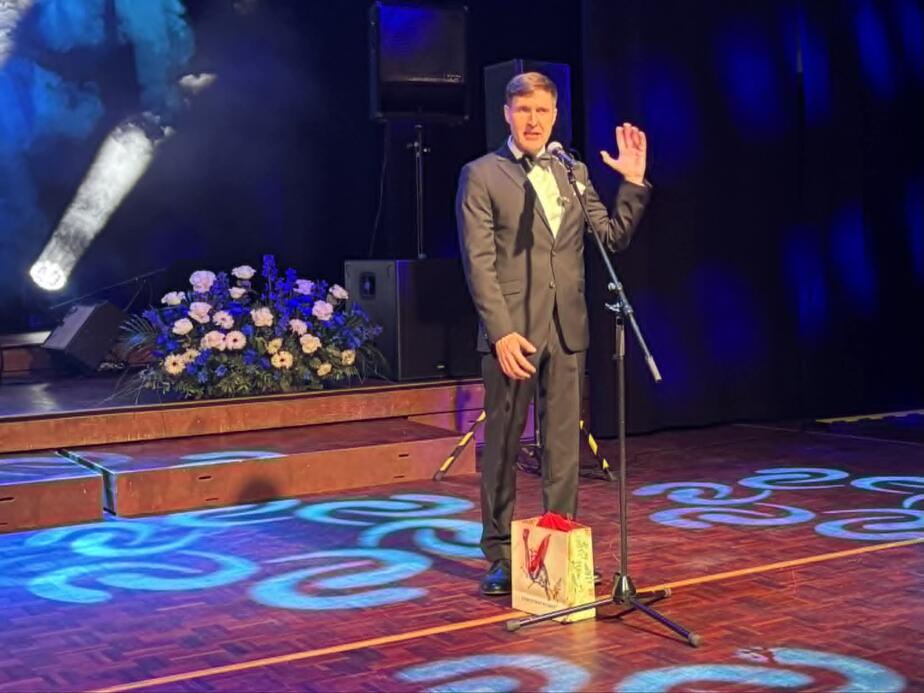
Jacob O. Meyer
Elder Jacob O. Meyer | |
|---|---|
| Personal life | |
| Born | November 11, 1934 |
| Died | April 9, 2010 (aged 75) |
| Spouse | Head Deaconess Ruth F. Meyer |
| Notable work(s) |
|
| Known for | Religious teacher, composer, singer, musician, writer, poet |
| Religious life | |
| Religion | Assemblies of Yahweh |
| Founder of |
|
Elder Jacob O. Meyer (November 11, 1934 – April 9, 2010) was an American religious leader, best known for founding the Assemblies of Yahweh. He also worked as a farmer, broadcaster and author. Meyer was instrumental in establishing educational institutions and publications that have significantly influenced religious thought and practice including the Narrow Way magazine.
Elder Meyer is credited with coining the terms Messianic and Spiritual Israelites to define the adherents of the Assemblies of Yahweh, emphasizing their commitment to following biblical teachings and embracing what they believe is a restored understanding of faith. The Assemblies of Yahweh is often grouped with the Sacred Name Movement by outside observers; however, it does not identify with that movement and maintains a distinct theological foundation, organizational structure, and set of practices.[1]
Family
Meyer’s family line traces its American roots to 1717, when Johannes Meyer journeyed to the New World to evaluate opportunities for permanent settlement. After liquidating his holdings in Germany, he returned to what is now the United States with his entire household, establishing himself in a region approximately 40 miles south of present-day Bethel and 40 miles west of Philadelphia, in Lancaster County. Their early settlement formed part of the wave of industrious German-speaking immigrants who contributed significantly to the development of the area.
In 1732, Johannes Meyer acquired 500 acres of land roughly 10 miles west of Bethel at Fredericksburg, where he created a substantial homestead to serve future generations. The family relocated to this property around 1740, establishing a stable agricultural base and a respected local presence.
Meyer’s grandfather later moved east to the settlement then known as Berlin (in present-day Berks County). There he married a local resident and purchased a farm two miles south of Bethel. It was on this family farm, rooted in several generations of steady settlement and community involvement, that Meyer was born in 1934.[2]
Early life
Meyer was born in Bethel, Berks County, Pennsylvania. He was raised within a conservative, religious Pennsylvania Dutch household and was active in his local Anabaptist congregation. Demonstrating an early commitment to Scriptural study, he enrolled at the Evangelical Congregational School of Theology (now the Evangelical Seminary) in Myerstown, Pennsylvania, where he participated energetically in theological training, conducted meetings, and coordinated biblical classes at the institutes he attended.[2] He later continued his academic development at Dropsie University in Philadelphia and at Johns Hopkins University in Baltimore.[3]
Meyer first encountered the teaching on the Tetragrammaton and the name Yahweh in the late 1950s through an ordained minister of a prominent denomination during a course in Biblical studies.[4][2] According to this instruction, the true name of God was Yahweh, a point that profoundly shaped his subsequent theological direction. He and his wife began searching for religious groups that upheld this teaching while pursuing a consistent, harmonized reading of the Bible.[2][5] Their search brought them into contact with various Sacred Name groups, which at the time were small and often doctrinally fragmented.[6]
When no existing organization matched their convictions, Meyer briefly considered a plan in which his family would withdraw from society, save their tithes, and eventually issue a single public proclamation of the message—perhaps through a newspaper notice or similar medium. Meyer later concluded that such isolation was "not the will of Yahweh," and resumed seeking groups committed to advancing the Sacred Name message. Although he encountered several such bodies, he judged many to contain significant doctrinal inconsistencies. During this period he assisted in publishing the Sacred Name Herald before returning to Bethel in 1964.
In 1965, following a radio broadcast, Meyer was invited to begin an assembly-type organization. He agreed, saying, "If it be Yahweh's will." At thirty years old, he was anointed with oil, marking the beginning of the Assemblies of Yahweh. Meyer later noted that this age corresponded with the Scriptural requirement for the installation of priests in the Hebrew Scriptures—a parallel he viewed as confirming the timing of his calling.[2]
Ruth F. Meyer
Elder Meyer met Ruth Meyer on the first day of high school.[7]: 9 Her family had relocated from Lancaster County in 1945, settling northeast of Bethel.[7]: 9
Both Meyers had long held an interest in the Bible, but this interest deepened substantially after their marriage, particularly following their acceptance of the Sacred Names in 1962 and the conviction that all commandments were to be observed.[7]: 9 In the earliest days of the ministry, it was simply Elder Jacob O. Meyer, Ruth Meyer, and their children working together.[8]: 2 In 1965, Elder Meyer was anointed into the ministry, and he subsequently anointed his wife and children as part of the emerging work.[7]: 2
Ruth Meyer proved instrumental during both the formative years and the continued development of the Assemblies of Yahweh. According to the June 2018 issue of the Sacred Name Broadcaster (Volume L, Number 3), she served in an extraordinary range of roles—including sound ‘recording technician’, receptionist, secretary, typist, mail clerk, printing assistant, and “chief cook”—all offered voluntarily in support of the growing ministry.[7]: 18
Beyond daily operations, Ruth Meyer also acted as a trusted advisor to Meyer and was consulted on significant initiatives, including the founding of the Sacred Name Broadcaster and other major projects.[7]: 2 She personally printed the original covers of the Sacred Name Broadcaster[7]: 3 and delivered the first completed issue to Meyer in the summer of 1968.[7]: 3 She later accompanied him to Israel for periods of study and research related to the ministry’s educational aims.[7]: 3
Ruth Meyer continues to serve as the Head Deaconess in the Assemblies of Yahweh and is widely recognized for her longstanding contributions and personal sacrifices on behalf of the ministry.[citation needed] She also oversees the preparation of bread prior to the Feast of Unleavened Bread.[9]
Assemblies of Yahweh
As head (“directing elder”) of the Assemblies of Yahweh, Meyer became a full-time minister in 1970.[10] During the 1970s, he also completed a short part-time academic program that led to the award of an associate degree from Thomas Edison State College. The name “Assemblies of Yahweh” derives from the Hebrew phrase “qahal Yahweh,”[11] used in reference to the Israelites in Deuteronomy 23:1–8. Elsewhere in Scripture, the related expression Edah Yahweh appears.[2]
Missionary journeys
Meyer became a prolific contributor to the ministry’s publications, a translator of the conservative Sacred Name Bible known as the Sacred Scriptures Bethel Edition, and the author of several books. He also undertook extensive international travel, distributing literature and visiting individuals who had expressed interest in the ministry’s message. His journeys included North and South America, Germany, Berlin, France, Poland, England, Ireland, the Philippines, Thailand, India, Trinidad, Dominica, St. Lucia, and Israel. On several of these missions he was accompanied by his wife.[2]
Awards
On March 21, 2004, Meyer received a tribute recognizing more than forty years of dedication and perseverance in bringing the message of the ministry to a global audience.[citation needed] He also served as a board member of the National Association of Shortwave Broadcasting[3] and was nominated to the office of township constable in Philadelphia—a position he had not sought.[3]
Teaching
Meyer taught more than 5,000 sermons during his lifetime,[12] addressing a wide range of doctrinal and practical themes. The following areas represent the central teachings of the Assemblies of Yahweh as articulated through Meyer’s ministry.
Commandment-keeping
A central emphasis of Meyer’s preaching was the necessity of commandment-keeping. The ethos of the Assemblies of Yahweh is strongly rooted in obedience to the law, reflecting both the ministry’s Statement of Doctrine—authored by Meyer—and his consistent exposition of Biblical commandments. He frequently devoted sermons to individual laws, especially those drawn from the Ten Commandments, such as in the sermon “Thou Shall Not Commit Adultery,” where he surveyed Scriptural references from both the Old and New Testaments and explored the law’s implications for daily life. These in-depth examinations were often expanded and formalized in articles printed in The Sacred Name Broadcaster.[13]
Topics tied to commandment-keeping included the Biblical holy days, dietary regulations, tithing, proper speech, repentance, and moral conduct. Across these subjects Meyer consistently preached against sin and emphasized the transformative role of the law.
Spirituality
Within the Assemblies of Yahweh, Meyer was regarded as a significant spiritual leader. His sermons on spirituality frequently centered on prayer, quiet study, and disciplined introspection.[14][15] He regularly encouraged believers to focus on matters that draw them closer to Yahweh, often contrasting the fruits of the Spirit with the works of the flesh.
In his series “A New Young Israel Emerges,” Meyer compared the faithful Israelites who entered the Promised Land with the Assemblies of Yahweh, contrasting them with the unspiritual Israelites who perished in the wilderness. Sermons on zeal, good works, and the characteristics of the Holy Spirit were also integral to his presentations on spirituality.
Love
Each year, Meyer traditionally delivered the first message of the Feast of Tabernacles on the subject of love. His teachings frequently examined the Greek terms agape and Philadelphia,[16] with particular focus on the latter. He rejected mainstream Chr-stianity’s concept of love, teaching instead that true love can only be understood through obedience to Yahweh’s commandments, since Yahweh’s loving character is revealed in the law.
Meyer also connected love with unity within the Assembly, teaching believers how to express love toward Yahweh—such as in the sermon “Loving Yahweh from the Heart” (2008)—and toward fellow human beings, including the principles of the Great Commandment. The characteristics of the Philadelphia assembly in Revelation 3:8—faithfulness to the Name and good works—were held by Meyer as ideals for the Assemblies of Yahweh. He emphasized love of the brethren especially in The Narrow Way publications.[17]
Faith
Faith was a recurring theme in Meyer’s sermons,[18] even when not the primary focus—as in “Remembrance Brings Rejoicing.” He spoke frequently of his confidence in the authority of the Bible, the power of Yahweh to accomplish His purposes, and the ministry’s commitment to fulfilling the Great Commission. Some sermons, such as “Fear of Faith” (1993), were devoted entirely to this subject.
In sermons recounting the history of the Assemblies of Yahweh, Meyer also reflected on events he regarded as miracles he had personally witnessed within the ministry.
Prophecy
Meyer frequently preached Sabbath sermons on end-time prophecy, comparing contemporary world events with Biblical predictions[12] and arguing that the Assemblies of Yahweh was living in the end times. His series “Age Ending Events Surveyed” (2006) is an example of this focus. These sermons often identified societal violations of the law, critiqued moral decline, and called listeners to repentance.
Although some[who?] considered Meyer a prophet, he consistently refrained from setting specific dates for prophetic fulfillment, citing Matthew 25:13.[19] He taught the need to prepare for the tribulation, frequently addressing themes such as the coming Beast System and, to a lesser extent, the future Kingdom. Meyer often concluded sermons with the exhortation, “On to the Kingdom.”
Piety
Meyer emphasized sanctification, holiness, dedication, and the rejection of pagan customs and practices—including Easter, Halloween, and Christmas.[20] He also spoke against worldly dress styles, urging modesty and reverence in worship, including formal attire on holy days.
The Assemblies of Yahweh continue to uphold these teachings. In his series “Become an Iconoclast,” Meyer taught that believers must resist worldliness as the Maccabees once did. Prior to the Three Pilgrimage Festivals, he instructed the leadership to prepare sermons promoting purification and spiritual renewal, such as “Let Us Wash Our Hearts.”
Instructions
Meyer instructed the Assemblies of Yahweh to learn and recite the Shema three times daily and to follow a structured Bible-reading program designed to guide adherents through the entire Scriptures within one year. He also established specific passages to be read at the opening and closing of the Sabbath, embedding regular Scriptural reflection into the rhythm of communal worship. In accordance with Leviticus 19:32, the congregation would rise when Meyer entered or exited a building—a gesture of respect that was encouraged by the Work of the Ministry.
The service format that he implemented has remained largely unchanged for more than fifty years: a mini-sermon of approximately 40 minutes, followed by a main sermon of about 75 minutes. The main message is typically a selected pre-recorded sermon by Meyer himself. Congregational singing and spiritual offerings are encouraged, though all music must receive approval from the ministry’s music director.
Meyer also composed the theme song of the Assemblies of Yahweh, Under Zion's Banner,[21] modeled after the melody of the Battle Hymn of the Republic. As specified in his will, his faithful children continue to lead the Assemblies of Yahweh, with leadership rotating weekly for the preaching of the mini-sermon on the Sabbath. Meyer’s sermons and writings continue to be replayed and republished throughout the organization to the present day. Within the ministry, the honorific "of blessed memory" (O.B.M.) is customarily appended to his name, possibly in reference to Proverbs 10:7.
Will
Meyer's will outlined his desire that the Assemblies of Yahweh attain to and remain as Philadelphia:
I want and desire that this organisation will be, shall be and always will endure as Philadelphia
— Elder Jacob O. Meyer, excerpt from his will for the Assemblies of Yahweh
Meyer's sermons and literature are still used copiously within the ministry. His sermons are still broadcast on WMLK and streamed on Tunein.com. He died peacefully at age 75 in 2010; the ministry is now run by his faithful children.[2]
See also
References
- ^ Schmitz, Timo. "Journal of Ethnophilosophical Questions and Global Ethics". Central and Eastern European Online Library. pp. 47–48. Retrieved 28 January 2021.
- ^ a b c d e f g h Zucker, Alfred. "Elder Jacob O. Meyer". Bible Group Pickings. Archived from the original on 2016-01-23. Retrieved 2019-11-28.
 Material was copied from this source, which is available under a [https://creativecommons.org/licenses/by-sa/3.0/
Creative Commons Attribution-ShareAlike 3.0 Unported] license and the GNU Free Documentation License (unversioned, with no invariant sections, front-cover texts, or back-cover texts).
Material was copied from this source, which is available under a [https://creativecommons.org/licenses/by-sa/3.0/
Creative Commons Attribution-ShareAlike 3.0 Unported] license and the GNU Free Documentation License (unversioned, with no invariant sections, front-cover texts, or back-cover texts).
- ^ a b c "Obituary". Lamm & Witman Funeral Home. 2010. Retrieved 2019-12-16.
- ^ E. Meyer. The Memorial Name Yahweh LCN-87-072550, "Preface", Assemblies of Yahweh, 1987, page i
- ^ Meyer, Jacob (1990). "Introducing the Assemblies of Yahweh": 2.
{{cite journal}}: Cite journal requires|journal=(help) - ^ Meyer, Jacob (April 1999). "The Sacred Name Broadcaster".
{{cite journal}}: Cite journal requires|journal=(help) - ^ a b c d e f g h i Meyer, Jacob (June 2018). "Milestones" (PDF). The Sacred Name Broadcaster. L (3). Retrieved 25 December 2019.[permanent dead link]
- ^ 2
- ^ "Assemblies of Yahweh Facebook page". Facebook. Retrieved 21 March 2024.
- ^ Meyer, Jacob (February 2006). Translation and Commentary on Micah. Assemblies of Yahweh. pp. preface. LCCN 2006901945.
- ^ Giles, Richard. At Heaven's Gate: Reflections on Leading Worship. Canterbury Press, 2013.
- ^ a b "Elder Jacob O. Meyer". Assemblies of Yahweh. Retrieved 2019-12-16.
- ^ Jacob, Meyer (October 2005). "Radio Message The Law of Yahweh, The Ninth Commandment You Shall Not Bear False Witness Against Your Neighbour". The Sacred Name Broadcaster. Assemblies of Yahweh: 17–20.
- ^ Jacob, Meyer (June 2014). "Seeds Left Ungerminated". The Sacred Name Broadcaster. Assemblies of Yahweh: 15.
You should have a desire to enrich yourself spiritually with the knowledge of the Word of Yahweh
- ^ Jacob, Meyer (June 2014). "Seeds Left Ungerminated". The Sacred Name Broadcaster. Assemblies of Yahweh: 15.
Reread the Sacred Scriptures, allow the Word of Yahweh to speak to you forthrightly ... and your spiritual life will be greatly enriched
- ^ Commentary on the book of Revelation, Volume 1. The Seven Lamps of Yahweh. Chapter: Philadelphia—Assembly of Sincere Brotherly Love, p. 151, 2006.
- ^ Jacob, Meyer (September 1993). "Letter to the Brethren". The Narrow Way. XXI (12). Assemblies of Yahweh.
Brethren pray for us as we do for you… Brethren, let us love one another as we should as members of the Body of the Messiah… With heartfelt fraternal love in Yahshua's Name, Elder Jacob O. Meyer
- ^ Jacob, Meyer (July 2016). "Faith & Love part 2". The Sacred Name Broadcaster. Assemblies of Yahweh: 1–9.
- ^ Jacob, Meyer (October 2005). "Is End Time Judgment Falling". The Sacred Name Broadcaster. Assemblies of Yahweh: 10–15.
- ^ Jacob, Meyer (October 2005). "Ancient Pagan Practice Halloween Survive to Modern Times". The Sacred Name Broadcaster. Assemblies of Yahweh: 1–3.
Therefore … it is absolutely essential that Yahweh's people reject pagan practices, such as the keeping of Halloween and avoid assimilating them
- ^ Meyer, Jacob (1972). Psalms, Anthems and Spiritual Songs. Assemblies of Yahweh. p. 145.

| International | |
|---|---|
| National | |
| Other | |
