Electronic devices have significantly influenced the development of many aspects of modern society, such as telecommunications, entertainment, education, health care, industry, and security. The main driving force behind the advancement of electronics is the semiconductor industry, which continually produces ever-more sophisticated electronic devices and circuits in response to global demand. The semiconductor industry is one of the global economy's largest and most profitable industries, with annual revenues exceeding $481 billion in 2018. The electronics industry also encompasses other branches that rely on electronic devices and systems, such as e-commerce, which generated over $29 trillion in online sales in 2017. (Full article...)
These are Good articles, which meet a core set of high editorial standards.
Image 1
Galaxy S III in white
The Samsung Galaxy SIII (unofficially known as the Samsung Galaxy S3) is an Android-based smartphone developed and marketed by Samsung Electronics. Launched in 2012, it had sold more than 80 million units overall, making it the most sold phone in the S series. It is the third smartphone in the Samsung Galaxy S series.
It is distinguished from its predecessor by its larger, higher-resolution screen, higher storage options, a larger battery, and a video camera with stereo audio recording for a spatial effect on headphones and external speakers. While the picture and video resolutions of the camera stayed the same, its launching speed and shutter lag improved. (Full article...)
Image 2
The Electro-Dynamic Light Company of New York was a lighting and electrical distribution company organized in 1878. The company held the patents for the first practical incandescent electric lamp and electrical distribution system of incandescent electric lighting. They also held a patent for an electric meter to measure the amount of electricity used. The inventions were those of Albon Man and William E. Sawyer. They gave the patent rights to the company, which they had formed with a group of businessmen. It was the first company in the world formally established to provided electric lighting and was the first company organized specifically to manufacture and sell incandescent electric light bulbs.
Man, an attorney from New York City, supplied money for experimentation to Sawyer, an electrical engineer. This partnership developed into the Electro-Dynamic Light Company that brought in other investors that became partners. Sawyer devised a unique electrical distribution system where electrical power could be obtained anywhere in the city from an electrical generator with the turn of a switch to light up electric lamps to produce glowing light like a gas lamp. It was unique in that it produced this power without consumers having to maintain local galvanic batteries and at a fraction of the cost of producing the same lighting as from gas lamps. Other features of the system were that safety devices were built in to prevent the early destroying of the other electric lamps in the circuit should there be a power surge due to a lamp burning up early and leaving the distribution circuit. The patents for the Man and Sawyer system were in place before any other electrical companies had similar systems. (Full article...)
Image 3
The Nakamichi Dragon is an audio cassette deck that was introduced by Nakamichi in 1982 and marketed until 1994. The Dragon was the first Nakamichi model with bidirectional replay capability and the world's first production tape recorder with an automatic azimuth correction system; this feature, which was invented by Philips engineers and improved by Niro Nakamichi, continuously adjusts the azimuth of the replay head to minimize apparent head skew and correctly reproduce the treble signal present on the tape. The system allows the correct reproduction of mechanically skewed cassettes and recordings made on misaligned decks. Apart from the Dragon, similar systems have only been used in the Nakamichi TD-1200 car cassette player and the Marantz SD-930 cassette deck.
At the time of its introduction, the Dragon had the lowest-ever wow and flutter and the highest-ever dynamic range, losing marginally to the former Nakamichi flagship, the 1000ZXL, in frequency response. Competing models by Sony, Studer, Tandberg and TEAC that were introduced later in the 1980s sometimes surpassed the Dragon in mechanical quality and feature set but none could deliver the same mix of sound quality, flexibility and technological advancement. The Dragon, despite inherent issues with long-term reliability, remained the highest point of compact cassette technology. (Full article...)
Filters are required to operate at many different frequencies, impedances and bandwidths. The utility of a prototype filter comes from the property that all these other filters can be derived from it by applying a scaling factor to the components of the prototype. The filter design need thus only be carried out once in full, with other filters being obtained by simply applying a scaling factor. (Full article...)
Image 5
An antimetric electrical network is an electrical network that exhibits anti-symmetrical electrical properties. The term is often encountered in filter theory, but it applies to general electrical network analysis. Antimetric is the diametrical opposite of symmetric; it does not merely mean "asymmetric" (i.e., "lacking symmetry"). It is possible for networks to be symmetric or antimetric in their electrical properties without being physically or topologically symmetric or antimetric. (Full article...)
Image 6
Late model (c.1998) LS3/5A from Spendor, one of the BBC licensees The LS3/5A (each element pronounced separately, without the stroke) is a small studio monitor loudspeaker originated by the BBC for use by outside broadcast vans to ensure quality of their broadcasts. The speaker concept set out transparent and natural sound as the goal, and the achievement of the result is widely acknowledged.
The BBC granted licences to a small number of British firms, which first manufactured the product in 1975. The product underwent a change in 1987 due to consistency issues in manufacturing, and again in around 2003 when original parts from KEF ran out. Upwards of 60,000 pairs of the speaker have been sold. Reviewers have recognised its enormous importance as a bookshelf design. (Full article...)
Image 7
The circuit topology of an electronic circuit is the form taken by the network of interconnections of the circuit components. Different specific values or ratings of the components are regarded as being the same topology. Topology is not concerned with the physical layout of components in a circuit, nor with their positions on a circuit diagram; similarly to the mathematical concept of topology, it is only concerned with what connections exist between the components. Numerous physical layouts and circuit diagrams may all amount to the same topology.
Strictly speaking, replacing a component with one of an entirely different type is still the same topology. In some contexts, however, these can loosely be described as different topologies. For instance, interchanging inductors and capacitors in a low-passfilter results in a high-pass filter. These might be described as high-pass and low-pass topologies even though the network topology is identical. A more correct term for these classes of object (that is, a network where the type of component is specified but not the absolute value) is prototype network. (Full article...)
Numerically controlled oscillators offer several advantages over other types of oscillators in terms of agility, accuracy, stability and reliability. NCOs are used in many communications systems including digital up/down converters used in 3G wireless and software radio systems, digital phase-locked loops, radar systems, drivers for optical or acoustic transmissions, and multilevel FSK/PSK modulators/demodulators. (Full article...)
The iPhone 5s is a smartphone that was developed and marketed by Apple. It is the seventh generation of the iPhone, succeeding the iPhone 5, and was unveiled in September 2013 alongside the iPhone 5c. It was the last iPhone to have Steve Jobs involved in its design.
The iPhone 5s has almost the same external design as well as the same 4-inch screen as its predecessor, the iPhone 5. The 5s received a new white/gold color scheme in addition to white/silver and space gray/black. The 5s features upgrades mostly in the form of internal hardware; it introduced the Apple A764-bit dual-core system-on-chip, the first 64-bit processor to be used on a smartphone, accompanied by the M7 "motion co-processor". A redesigned home button with Touch ID – a fingerprint recognition system which can be used to unlock the phone and authenticate App Store and iTunes Store purchases – was also introduced. The camera was updated with a larger aperture and a dual-LED flash optimized for different color temperatures. EarPods, which were introduced the year prior and had been shipping with the iPhone 5, were included in the box. (Full article...)
Image 11
The Revox B215 is a cassette deck manufactured by Studer from 1985 until around 1990. A professional version with different control layout and audio path electronics was manufactured concurrently as the Studer A721. A later improved version was marketed as the Revox B215S. Because it was expensive compared to other consumer models and had exceptionally good mechanical performance and durability, the B215 was used primarily by professional customers—radio stations, recording studios and real-time cassette duplicators.
The B215 used a proven, reliable four-motor tape transport derived from the earlier B710 model. The B215 differed from the B710 and competing decks of the period in having an unusual, computer-like control panel and elaborate automation performed by three Philipsmicrocontrollers. The deck was equipped with automatic tape calibration, microcontroller-assisted setting of recording levels, and non-volatile memory. (Full article...)
Image 12
Foster's reactance theorem is an important theorem in the fields of electrical network analysis and synthesis. The theorem states that the reactance of a passive, lossless two-terminal (one-port) network always strictly monotonically increases with frequency. It is easily seen that the reactances of inductors and capacitors individually increase or decrease with frequency respectively and from that basis a proof for passive lossless networks generally can be constructed. The proof of the theorem was presented by Ronald Martin Foster in 1924, although the principle had been published earlier by Foster's colleagues at American Telephone & Telegraph.
The theorem can be extended to admittances and the encompassing concept of immittances. A consequence of Foster's theorem is that zeros and poles of the reactance must alternate with frequency. Foster used this property to develop two canonical forms for realising these networks. Foster's work was an important starting point for the development of network synthesis. (Full article...)
Image 13
The impedance analogy is a method of representing a mechanical system by an analogous electrical system. The advantage of doing this is that there is a large body of theory and analysis techniques concerning complex electrical systems, especially in the field of filters. By converting to an electrical representation, these tools in the electrical domain can be directly applied to a mechanical system without modification. A further advantage occurs in electromechanical systems: Converting the mechanical part of such a system into the electrical domain allows the entire system to be analysed as a unified whole.
The mathematical behaviour of the simulated electrical system is identical to the mathematical behaviour of the represented mechanical system. Each element in the electrical domain has a corresponding element in the mechanical domain with an analogous constitutive equation. All laws of circuit analysis, such as Kirchhoff's circuit laws, that apply in the electrical domain also apply to the mechanical impedance analogy. (Full article...)
The project began with two aims: to prove the practicality of the Williams tube, an early form of computer memory based on standard cathode-ray tubes (CRTs); and to construct a machine that could be used to investigate how computers might be able to assist in the solution of mathematical problems. The first of the series, the Manchester Baby, ran its first program on 21 June 1948. As the world's first stored-program computer, the Baby, and the Manchester Mark 1 developed from it, quickly attracted the attention of the United Kingdom government, who contracted the electrical engineering firm of Ferranti to produce a commercial version. The resulting machine, the Ferranti Mark 1, was the world's first commercially available general-purpose computer. (Full article...)
Image 15
Sinclair Executive Type 1
The Sinclair Executive was the world's first "slimline" pocket calculator, and the first to be produced by Clive Sinclair's company Sinclair Radionics. Introduced in 1972, the calculator was produced in at least two versions with different keyboard markings; a variant called the Sinclair Executive Memory was introduced in 1973.
Its small size was made possible by pulsing current to the Texas Instruments TMS1802 "calculator on a chip" integrated circuit, reducing the power consumption more than tenfold. The Executive was highly successful, making £1.8 million of profit for Sinclair and winning a Design Council Award for Electronics. (Full article...)
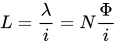
where; L is the inductance in henrys, i is the current in amperes, Φ is the magnetic flux in webers. Strictly speaking, the quantity just defined is called self-inductance, because the magnetic field is created solely by the conductor that carries the current.
When a conductor is coiled upon itself N number of times around the same axis (forming a solenoid), the current required to produce a given amount of flux is reduced by a factor of N compared to a single turn of wire. Thus, the inductance of a coil of wire of N turns is given by:
... that police investigating rapist Zhenhao Zou had to develop custom computer code to examine more than 9million WeChat messages on his electronic devices?
... that in Yugoslavia, Rudi Čajavec, the electronics company that produced various components of the M-84 tank, also made guitar amplifiers?
... that in 2019, Chinese electronics company Xiaomi posted a video of their third-quarterly financial report featuring a parody of the anime song "Renai Circulation"?
... that Japanese electronic musician Camellia began producing music at the age of ten using his mother's computer?



.png)