








Shang dynasty: Difference between revisions
Lam Kin Keung (talk | contribs) m Reverted edit(s) by 70.179.34.94 identified as test/vandalism using STiki |
→Shang dynasty kings: fact tag (see talk) |
||
| Line 170: | Line 170: | ||
<tr><td>18 </td><td>29 </td><td>南庚 </td><td class = "lft" >[[Nan Geng|Nán Gēng]] </td><td> </td></tr> |
<tr><td>18 </td><td>29 </td><td>南庚 </td><td class = "lft" >[[Nan Geng|Nán Gēng]] </td><td> </td></tr> |
||
<tr><td>19 </td><td>07 </td><td>陽甲 </td><td class = "lft" >[[King Yang Jia|Yáng Jiǎ]] </td><td> </td></tr> |
<tr><td>19 </td><td>07 </td><td>陽甲 </td><td class = "lft" >[[King Yang Jia|Yáng Jiǎ]] </td><td> </td></tr> |
||
<tr><td>20 </td><td>28 </td><td>盤庚 </td><td class = "lft" >[[Pan Geng|Pán Gēng]] </td><td>Shang finally settled down at Yīn (殷). The period starting from Pán Gēng is also called the Yīn Dynasty, beginning the golden age of the Shāng dynasty. [[Oracle bone]] inscriptions are thought to date at least to Pán Gēng's era.</td></tr> |
<tr><td>20 </td><td>28 </td><td>盤庚 </td><td class = "lft" >[[Pan Geng|Pán Gēng]] </td><td>Shang finally settled down at Yīn (殷). The period starting from Pán Gēng is also called the Yīn Dynasty, beginning the golden age of the Shāng dynasty. [[Oracle bone]] inscriptions are thought to date at least to Pán Gēng's era.{{fact|date=June 2011}}</td></tr> |
||
<tr><td>21 </td><td>29 </td><td>小辛 </td><td class = "lft" >[[Xiao Xin of Shang|Xiǎo Xīn]] </td><td> </td></tr> |
<tr><td>21 </td><td>29 </td><td>小辛 </td><td class = "lft" >[[Xiao Xin of Shang|Xiǎo Xīn]] </td><td> </td></tr> |
||
<tr><td>22 </td><td>21 </td><td>小乙 </td><td class = "lft" >[[Xiao Yi of Shang|Xiǎo Yǐ]] </td><td> </td></tr> |
<tr><td>22 </td><td>21 </td><td>小乙 </td><td class = "lft" >[[Xiao Yi of Shang|Xiǎo Yǐ]] </td><td> </td></tr> |
||
Revision as of 17:51, 14 June 2011
Template:Contains Chinese text
商朝 Shang Dynasty | |||||||||
|---|---|---|---|---|---|---|---|---|---|
| 1600 BC–1046 BC | |||||||||
 Remnants of advanced, stratified societies dating back to the Shang period have been found in the Yellow River Valley. | |||||||||
| Status | Kingdom | ||||||||
| Capital | Yinxu, Zhaoge | ||||||||
| Common languages | Chinese | ||||||||
| Religion | Chinese folk religion | ||||||||
| Government | Monarchy, Feudalism | ||||||||
| King | |||||||||
| Historical era | 1600-1046 BC | ||||||||
• Established | 1600 BC | ||||||||
| 1046 BC | |||||||||
| Area | |||||||||
| 1122 BC est.[1] | 1,250,000 km2 (480,000 sq mi) | ||||||||
| Population | |||||||||
• | 13.7 million | ||||||||
| |||||||||

| Part of a series on the |
| History of China |
|---|
 |
| Shang dynasty | |||||||||||
|---|---|---|---|---|---|---|---|---|---|---|---|
| Chinese | 商朝 | ||||||||||
| Literal meaning | Shang Dynasty | ||||||||||
| |||||||||||
| Alternative Chinese name | |||||||||||
| Chinese | 殷代 | ||||||||||
| Literal meaning | Yin Dynasty | ||||||||||
| |||||||||||
The Shang Dynasty (Chinese: 商朝) or Yin Dynasty (殷代) was according to traditional sources the second Chinese dynasty, after the Xia Dynasty. They ruled in the northeastern regions of the area known as "China proper" in the Yellow River valley. According to the chronology based upon calculations by Liu Xin, the Shang ruled between 1766 BC and 1122 BC, but according to the chronology based upon the Bamboo Annals, they ruled between 1556 BC and 1046 BC. The results of the Xia Shang Zhou Chronology Project place them between 1600 BC and 1046 BC. According to historical tradition, the Shang Dynasty followed the (possibly mythical) Xia Dynasty and preceded the Zhou Dynasty.
While some direct information about the Shang Dynasty comes from Shang-era inscriptions on bronze artifacts, most comes from oracle bones — turtle shells, cattle scapulae, or other bones, which bear glyphs that form the first significant corpus of recorded Chinese characters. Other sources on the Shang come from historical records of the later Zhou Dynasty and the Han Dynasty Shiji, or Records of the Grand Historian, by Sima Qian. The inscriptions on the oracle bones are divinations, and because they can be gleaned for information on many topics from the politics and economy to the art and medicine of the period,[2] they provide critical insight into the early stages of Chinese civilization.
One site of the Shang capitals, later historically called the Ruins of Yin (殷墟), is near modern day Anyang. Archaeological work there uncovered eleven major Yin royal tombs and the foundations of palaces and ritual sites, containing weapons of war and remains from both animal and human sacrifices. Tens of thousands of bronze, jade, stone, bone, and ceramic artifacts have been obtained. The workmanship on the bronzes attests to a high level of civilization. In terms of inscribed oracle bones alone, more than 20,000 were discovered in the initial scientific excavations during the 1920s and 1930s, and over four times as many have been found since.
Archaeological discovery
During the Song Dynasty (961–1284 AD), scholar-bureaucrats and the Chinese gentry became avid antiquarians and collectors of ancient artwork, some claiming to have found Shang Dynasty era bronze vessels with written inscriptions.[3] Despite this, archeologists of the 19th century knew of written records and historical documentations spanning only as far back as the Zhou Dynasty (1046 BC–256 BC).[3] In 1901, it was found that Chinese pharmacists were selling "dragon bones" marked with curious and arithmaticestics characters.[3] These were finally traced back in 1928 to a site near Anyang in the Yellow River valley, modern Henan province, where the National Government's Academia Sinica began an archeological excavation.[3] Work at the site was halted by the Japanese invasion in 1939, but by 1949, a Shang capital had been discovered near Zhengzhou.[3]
At the excavated royal palace of Yinxu, large stone pillar bases were found along with rammed earth foundations and platforms, which according to Fairbank, were "as hard as cement."[3] These foundations in turn originally supported 53 buildings of wooden post-and-beam construction.[3] In close proximity to the main palatial complex, there were underground pits used for storage, servants' quarters, and housing quarters.[3] It has been determined that the remnants of the earth walls at Zhengzhou would have risen 27 feet (8.2 m) in height and formed a roughly rectangular wall 4 miles (6.4 km) around the ancient city.[4] Construction of these walls was actually a tradition inherited by the Shang civilization, since much older rammed earth fortifications have been found at Chinese Neolithic sites of the Longshan culture (c. 3000 BC–2000 BC).[4]

In 1959, the site of the Erlitou culture was found in Yanshi, south of the Yellow River near Luoyang. Their culture is often associated with the legendary Xia Dynasty, and they built large palaces, which also suggests the existence of a dynastic kingdom preceding the Shang.[5] Radiocarbon dating suggests that the Erlitou culture flourished ca. 2100 BC to 1800 BC.[6]
Cowry shells, obtained from the seacoast, were also excavated at Anyang, suggesting that the Shang were somewhat a maritime people.[6] Neolithic sites[clarification needed] on the island of Taiwan, one hundred miles off of mainland China's southern coasts of Fujian, have been dated as far back as 4000 BC.[6] However, there was very limited sea trade in ancient China since China was isolated from other large civilizations during the Shang period.[6] Trade relations and diplomatic ties with other formidable powers via the Silk Road and Chinese voyages to the Indian Ocean did not exist until the reign of Emperor Wu during the Han Dynasty (206 BC–221 AD).[7][8]
Many Shang royal tombs had been tunneled into and ravaged by grave robbers in ancient times,[9] but in the spring of 1976, the discovery of Tomb 5 at Yinxu revealed a tomb that was not only undisturbed, but one of the most richly lavished Shang tombs that archaeologists had yet come across.[10] With over 200 bronze ritual vessels and 109 inscriptions of Lady Fu Hao's name, archaeologists realized they had stumbled across the tomb of the militant consort to King Wu Ding, as described in 170 to 180 Shang oracle bones.[11] Along with bronze vessels, stoneware and pottery vessels, bronze weapons, jade figures and hair combs, and bone hairpins were found.[12][13][14] Historian Robert L. Thorp states that the large assortment of weapons and ritual vessels in her tomb correlate with the oracle bone accounts of her military career and involvement in Wu Ding's ritual ancestral sacrifices.[15]
The Rise of Shang

According to Chinese tradition, the Shang dynasty was founded by a rebel king, Tang of Shang, who overthrew the last Xia ruler in the Battle of Mingtiao. According to the Shiji, the Shang had a long history, and there are different theories about their origin.[16] An analysis of bones from the remains of Shang people showed a Huaxia ethnic origin.[17] Their civilization was based on agriculture and augmented by hunting and animal husbandry,[18] and in addition to war, the Shang also practiced human sacrifice.[19]
According to different history records, the Shang people moved their capital many times over the course of their rule, with the final and most important move to Yin, in 1350 BC, initiating the golden age of the dynasty.[20][21][22][23] In fact, the name "Yin dynasty" has been synonymous with the Shang throughout history and was actually the more popular term. However, it is now often used specifically to describe the later half of the Shang dynasty. In Japan and Korea, the Shang are still referred to almost exclusively as the Yin (In) dynasty.
The capitals, particularly the city of Yin, were centers of glittering court life. Over time, court rituals to appease spirits developed, and in addition to his secular duties, the king would serve as the head of the ancestor worship cult. Oftentimes, the king would even perform oracle bone divinations himself, especially near the end of the dynasty. Evidence from excavations of the royal tombs indicates that royalty were buried with articles of value, presumably for use in the afterlife. Perhaps for the same reason, hundreds of commoners, who may have been slaves, were buried alive with the royal corpse.

The Shang had a fully developed system of writing as attested on bronze inscriptions, oracle bones, and a small number of other writings on pottery, jade and other stones, horn, etc.[24] Their writing system's complexity and sophistication indicates an earlier period of development, but direct evidence of that development is still lacking. Chinese bronze casting and pottery also advanced during the Shang dynasty, with bronze commonly being used for art rather than weapons.[inconsistent] Other advances included the invention of many musical instruments and observations of Mars and various comets by Shang astronomers.
A line of hereditary Shang kings ruled over much of northern China, and Shang troops fought frequent wars with neighboring settlements and nomadic herdsmen from the inner Asian steppes. The Shang king, in his oracular divinations, repeatedly shows concern about the fang groups, the barbarians living outside of the civilized tu regions, which made up the center of Shang territory[clarification needed]. In particular, the tufang group of the Yanshan region were regularly mentioned as hostile to the Shang.[25]
Shang influence, though not political control, extended as far northeast as the area of modern Beijing, where early pre-Yan material culture shows evidence of Shang influence.[25] At least one burial in this region during the Early Shang period contained both Shang-style bronzes and local-style gold jewelry.[25] This Shang influence likely made possible the integration of Yan into the later Zhou Dynasty.[25] The discovery of a Chenggu-style ge dagger-axe at Xiaohenan demonstrates that even at this early stage of Chinese history, there were some ties between the distant areas of north China.[25]
The Fall of Shang

Shang Zhou (商紂), the last Shang king, committed suicide after his army was defeated by the Zhou (周) people. Legends say that his army and his equipped slaves betrayed him by joining the Zhou rebels in the decisive Battle of Muye. According to the lost books of Zhou (逸周書) and Mencius the battle was very bloody. The classic, Ming-era novel Fengshen Yanyi retells the story of the war between Shang and Zhou as a conflict where rival factions of gods supported different sides in the war.
After Shang were defeated, the Zhou king, King Wu of Zhou (周武王), allowed Shang Zhou's son Wugeng Lufu (武庚祿父) to rule the Shang people as a vassal kingdom. However, Zhou Wu sent three of his brothers and an army to ensure that Wugeng Lufu would not rebel.[26][27][28] After Zhou Wu's death, the Shang would join the Three Governors' Rebellion (三監之亂) against the Duke of Zhou, but the rebellion collapsed after three years, leaving Zhou in control of Shang territory.
After Shang's collapse, Zhou's rulers forcibly relocated "Yin diehards" (殷頑) and scattered them throughout Zhou territory.[29] Some surviving members of the Shang royal family collectively changed their surname from the ancestral name Zi (子) to the name of their fallen dynasty, Yin (殷). The family retained an aristocratic standing and often provided needed administrative services to the succeeding Zhou Dynasty. The Shiji states that King Cheng of Zhou, with the support of his regent and uncle, the Duke of Zhou, enfeoffed Weiziqi (微子啟), a brother of Shang Zhou, as the ruler of Wei (微).[clarification needed] Shang (商), the eponymous first capital of the former Shang dynasty, would become the capital of Weiziqi's state. In time, this territory would become the state of Song, and the descendants of Shang royalty there would maintain rites honoring the dead Shang kings until 286 BC.[clarification needed]
Guzhu (孤竹國)[clarification needed], located in what is now Tangshan, was formed by another remnant of the Shang, and was destroyed by Duke Huan of Qi.[30][31][32] Many Shang clans that migrated northeast after the dynasty's collapse were integrated into Yan culture during the Western Zhou period. These clans maintained an elite status and continued practicing the sacrificial and burial traditions of the Shang.[25]
Both Korean and Chinese legends state that a disgruntled Shang prince named Jizi (箕子), who had refused to cede power to the Zhou, left China with a small army. According to these legends, he founded a state known as Gija Joseon in Northwest Korea during the Gojoseon period of ancient Korean history. However, the historical accuracy of these legends is widely debated by scholars.
Early cultures


While written records found at Yin, near modern-day Anyang, confirmed the existence of the Shang dynasty, Western scholars are hesitant to ascribe some settlements contemporaneous with Yin to the Shang dynasty.[33] For example, archaeological findings at Sanxingdui suggest the existence of a technologically advanced civilization that was culturally unlike the settlement at Yin. Also unlike the Shang, no known evidence that the Sanxingdui culture had a system of writing exists. The culture at Yin, and the Shang, thus are generally considered the first civilization in Chinese history.[34]
The geographical extent of Shang control is difficult to determine due to a lack of archaeological exploration. It is accepted among historians that the city of Yin, ruled by the same Shang dynasty of official history, coexisted and traded with other culturally diverse settlements in North China.[35] Chinese historians living in later periods were accustomed to the notion of one dynasty succeeding another, but the actual political situation in early China may have been more complicated. The Xia and the Shang can possibly refer to political entities that existed concurrently, just as the early Zhou, who established the successor state of the Shang, are known to have existed at the same time as the Shang.[25]
At the Shang Dynasty site of Ao, large walls were erected in the 15th century BC that had dimensions of 20 meters / 65 feet in width at the base and enclosed an area of some 2100 yards (1920 meters).[36] In similar dimensions, the ancient Chinese capital for the State of Zhao, Handan (founded in 386 BC), had walls that were again 20 meters / 65 feet wide at the base, a height of 15 meters / 50 feet tall, with two separate sides of its rectangular enclosure measured at a length of 1530 yards (1400 meters).[36][needs context]
Economy

As far back as c. 1500 BC, the early Shang Dynasty engaged in large-scale production of bronze-ware vessels and weapons.[37] This production required a large labor force that could handle the mining, refining, and transportation of the necessary copper, tin, and lead ores. This in turn created a need for official managers that could oversee both hard-laborers and skilled artisans and craftsmen.[37] The Shang royal court and aristocrats required a vast amount of different bronze vessels for various ceremonial purposes and events of religious divination.[37] Ceremonial rules even decreed how many bronze containers of each type a nobleman or noblewoman of a certain rank could own. With the increased amount of bronze available, the army could also better equip itself with an assortment of bronze weaponry. Bronze was also used for the fittings of spoke-wheeled chariots, which came into widespread use in China by 1200 BC.[38]
Apart from their role as the head military commanders, Shang kings also asserted their social supremacy by acting as the high priests of society and leading the divination ceremonies.[38] As the oracle bone texts reveal, the Shang kings were viewed as the best qualified members of society to offer sacrifices to their royal ancestors and to the high god Di, who in their beliefs was responsible for the rain, wind, and thunder.[38]
Military

Shang infantry were armed with a variety of stone and bronze weaponry, including máo spears, yuè pole-axes, ge pole-based dagger-axes, composite bows, and bronze or leather helmets (Wang Hongyuan 1993).[39] Their western military frontier was at the Taihang Mountains, where they fought the ma or "horse" barbarians, who might have used chariots. While the Shang themselves likely only used chariots as mobile command vehicles or elite symbols,[40] they reportedly amassed over a thousand chariots to overthrow the Xia Dynasty.
Although the Shang depended upon the military skills of their nobility, Shang rulers could mobilize the masses of town-dwelling and rural commoners as conscript laborers and soldiers for both campaigns of defense and conquest.[41] Aristocrats and other state rulers were obligated to furnish their local garrisons with all necessary equipment, armor, and armaments. The Shang king maintained a force of about a thousand troops at his capital and would personally lead this force into battle.[42] A rudimentary military bureaucracy was also needed in order to muster forces ranging from three to five thousand troops for border campaigns to thirteen thousand troops for suppressing rebellions against Shang authority.
Mythology
In Book 5 of Mozi, Mozi gives a legendary account of the end of the Xia dynasty and the rise of the new Shang dynasty. He states that during the reign of the last Xia ruler, King Jie, the climate experienced extreme changes, the paths of the sun and moon were altered, crops withered away, and other supernatural events occurred. Mozi then claims that the Xia dynasty had lost the mandate of Heaven due to its moral failings, and Shang Tang, the legendary founder of the Shang dynasty, was chosen by Heaven to overthrow the Xia.[43]
Mozi also recounts stories of the last Shang king, King Zhou. According to Mozi, King Zhou was corrupt and had neglected his obligations to offer ritual sacrifices. As a result, he also lost the mandate of Heaven, and many supernatural omens began to occur. Among other wonders, Mozi describes mud raining down for ten days and nights, the Nine Tripod Cauldrons (legendary treasures of the royal family) spontaneously moving, women transforming into men, and brambles covering the roads of the country. One more omen Mozi mentions is a red bird landing on Mt. Qi and declaring that Heaven had chosen "King Wen of Zhou to punish Yin and possess its empire."[43] The legend continues with King Wu, after succeeding his father King Wen, being visited by three gods in a dream. They tell King Wu that they have drowned King Zhou in wine and that King Wu should attack and defeat Shang.[43]
Gallery
-
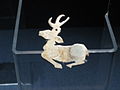
-
 A bronze gong ritual vessel
 -
 A bronze gefuding gui vessel
 -
 A bronze yuefu you vessel
 -
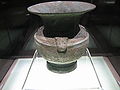 A bronze zun ritual vessel
 -

-
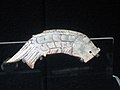
-

-
 A bronze yue, late Shang era.
 -
 Bronzewares from the excavated tomb of Fu Hao, c. 1250 BC.
 -
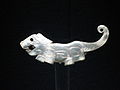 A jade carved tiger
 -
 Shang/Zhou sculpture, 14-10th century BC.


Shang dynasty kings
| Posthumous names | ||||
|---|---|---|---|---|
| Convention: posthumous name or "King" + posthumous name | ||||
| Order | Reign | Chinese | Hanyu Pinyin | Notes |
| 01 | 29 | 天乙 (太乙) | Tiān Yǐ (Tài Yǐ) | a Sage king; overthrew tyrant Jié (桀) of Xià (夏) |
| 02 | 02 | 太丁 | Tài Dīng | |
| 03 | 32 | 外丙 | Wài Bǐng | |
| 04 | 04 | 仲壬 | Zhòng Rén | |
| 05 | 12 | 太甲 | Tài Jiǎ | |
| 06 | 29 | 沃丁 | Wò Dǐng | |
| 07 | 25 | 太庚 | Tài Gēng | |
| 08 | 17 | 小甲 | Xiǎo Jiǎ | |
| 09 | 12 | 雍己 | Yōng Jǐ | |
| 10 | 75 | 太戊 | Tài Wù | |
| 11 | 11 | 仲丁 | Zhòng Dīng | |
| 12 | 15 | 外壬 | Wai Ren | |
| 13 | 09 | 河亶甲 | Hé Dǎn Jiǎ | |
| 14 | 19 | 祖乙 | Zǔ Yǐ | |
| 15 | 16 | 祖辛 | Zǔ Xīn | |
| 16 | 20 | 沃甲 | Wò Jiǎ | |
| 17 | 32 | 祖丁 | Zǔ Dīng | |
| 18 | 29 | 南庚 | Nán Gēng | |
| 19 | 07 | 陽甲 | Yáng Jiǎ | |
| 20 | 28 | 盤庚 | Pán Gēng | Shang finally settled down at Yīn (殷). The period starting from Pán Gēng is also called the Yīn Dynasty, beginning the golden age of the Shāng dynasty. Oracle bone inscriptions are thought to date at least to Pán Gēng's era.[citation needed] |
| 21 | 29 | 小辛 | Xiǎo Xīn | |
| 22 | 21 | 小乙 | Xiǎo Yǐ | |
| 23 | 59 | 武丁 | Wǔ Dīng | married to consort Fu Hao, who was a renowned warrior. Most of the oracle bones studied are believed to have come from his reign. |
| 24 | 12 | 祖庚 | Zǔ Gēng | |
| 25 | 20 | 祖甲 | Zǔ Jiǎ | |
| 26 | 06 | 廩辛 | Lǐn Xīn | |
| 27 | 06 | 庚丁 | Gēng Dīng | or Kang Ding (康丁 Kāng Dīng) |
| 28 | 35 | 武乙 | Wǔ Yǐ | |
| 29 | 11 | 文丁 | Wén Dīng | |
| 30 | 26 | 帝乙 | Dì Yǐ | |
| 31 | 30 | 帝辛 | Dì Xīn | aka Zhòu (紂), Zhòu Xīn (紂辛) or Zhòu Wáng (紂王). Also referred to by adding "Shāng" (商) in front of any of these names. |
Note:
|
||||
See also
- Chinese historiography
- Chinese sovereign
- Chinese mythology
- Erligang culture
- Historical capitals of China
- Xia Shang Zhou Chronology Project
Notes
- ^ Turchin, Peter; Adams, Jonathan M.; Hall, Thomas D (December 2006). "East-West Orientation of Historical Empires" (PDF). Journal of world-systems research. 12 (2): 219–229. ISSN 1076–156x. Retrieved 12 August 2010.
{{cite journal}}: Check|issn=value (help) - ^ See, for instance, Keightley (2000)
- ^ a b c d e f g h Fairbank 33.
- ^ a b Fairbank, 34.
- ^ Fairbank, 34–35.
- ^ a b c d Fairbank, 35.
- ^ Sun 1989, 161-167.
- ^ Chen 2002, 67-71.
- ^ Thorp, 239.
- ^ Thorp, 240.
- ^ Thorp, 240 & 245.
- ^ Thorp, 242 & 245.
- ^ Li (1980), 393–394.
- ^ Valenstein & Hearn, 77.
- ^ Thorp, 245.
- ^ A Summary of Studies in the Origins of the Shang Clan
- ^ 大辛庄遗址明显地显示了商代人的特征
- ^ Beck, Roger B. (1999). World History: Patterns of Interaction. Evanston, IL: McDougal Littell. ISBN 0-395-87274-X.
{{cite book}}: Unknown parameter|coauthors=ignored (|author=suggested) (help)CS1 maint: extra punctuation (link) - ^ Flad, Dr. Rowan (28 Feb. 2010). "Shang Dynasty Human Sacrifice". NGC Presents. National Geographic. Retrieved 3 Mar. 2010.
{{cite news}}: Check date values in:|accessdate=and|date=(help) - ^ 略论商周徙都制度
- ^ 中国史话 盘庚迁殷
- ^ 商代第一都城在商丘———质疑“郑州商城为商初亳都”
- ^ 商族的起源及其早期遷徙 王震中
- ^ Qiu 2000, p.60
- ^ a b c d e f g Sun, Yan (2006). "Colonizing China's Northern Frontier: Yan and Her Neighbors During the Early Western Zhou Period". International Journal of Historical Archaeology. 10 (2): 159–177(19). doi:10.1007/s10761-006-0005-3.
{{cite journal}}: Unknown parameter|month=ignored (help) - ^ 邶、鄘二國考
- ^ 周初“三监”与邶、鄘、卫地望研究
- ^ “三监”人物疆地及其地望辨析 ——兼论康叔的始封地问题
- ^ 一 被剥削者的存在类型
- ^ 中国孤竹文化网
- ^ 解开神秘古国 ——孤竹之谜
- ^ 孤竹析辨
- ^ The Cambridge History of Ancient China: From the Origins of Civilization to 221 BC. Cambridge University Press. 1999. pp. 124–125. ISBN 0521470307.
{{cite book}}: Unknown parameter|coauthors=ignored (|author=suggested) (help) - ^ Lin, 2007
- ^ 商代社会疆域地理的政治架构与周边地区青铜文化
- ^ a b Needham, Volume 4, Part 2, 43.
- ^ a b c Ebrey, 17.
- ^ a b c Ebrey, 14.
- ^ Sawyer, 35.
- ^ Shaughnessy, Edward L. (1988). "Historical Perspectives on The Introduction of The Chariot Into China". Harvard Journal of Asiatic Studies. 48 (1). Harvard Journal of Asiatic Studies, Vol. 48, No. 1: 189–237. doi:10.2307/2719276.
- ^ Sawyer, 33.
- ^ Sawyer, 34.
- ^ a b c Section 3, Book 5 of Mozi at The Chinese Text Project
- ^ 殷代积年与各王在位年数
References
- Chang, Kwang-Chih (1980). Shang Civilization. Yale University Press. ISBN 0-300-02885-7, ppbk.
- Chang-Qun, Duan, Xue-Chun, Gan, Wang, Jeanny and Chien, Paul K. (1998). Relocation of Civilization Centers in Ancient China: Environmental Factors. Allen Press on behalf of the Royal Swedish Academy of Sciences.
- Chen, Yan (2002). Maritime Silk Route and Chinese-Foreign Cultural Exchanges. Beijing: Peking University Press. ISBN 7-301-03029-0.
- Ebrey, Patricia Buckley, Anne Walthall, James B. Palais (2006). East Asia: A Cultural, Social, and Political History. Boston: Houghton Mifflin Company. ISBN 0-618-13384-4.
- Fairbank, John King and Merle Goldman (1992). China: A New History; Second Enlarged Edition (2006). Cambridge: MA; London: The Belknap Press of Harvard University Press. ISBN 0-674-01828-1
- Keightley, David N. (1978). Sources of Shang History: The Oracle-Bone Inscriptions of Bronze Age China. University of California Press, Berkeley. Large format hardcover, ISBN 0-520-02969-0 (out of print); A 1985 paperback 2nd edition is still in print, ISBN 0-520-05455-5.
- Keightley, David N. (2000). The Ancestral Landscape: Time, Space, and Community in Late Shang China (ca. 1200–1045 B.C.). China Research Monograph 53, Institute of East Asian Studies, University of California – Berkeley. ISBN 1-55729-070-9, ppbk.
- Lee, Yuan-Yuan and Shen, Sin-yan. (1999). Chinese Musical Instruments (Chinese Music Monograph Series). Chinese Music Society of North America Press. ISBN 1-880464039
- Li, Chu-tsing. "The Great Bronze Age of China," Art Journal (Volume 40, Number 1/2, 1980): 390–395.
- Lin, Ershen (19 July 2007). "A Critical Review on the Rise of Civilization, the Formation of the State, and Early Slavery". draft. The Science & Philosophy Forums (2005-2008). Retrieved 3 Mar. 2009.
{{cite journal}}: Check date values in:|accessdate=(help); Cite has empty unknown parameter:|coauthors=(help); Cite journal requires|journal=(help) - Loewe M. and Shaughnessy E.L. (eds), The Cambridge History of Ancient China, 1999, ISBN 9780521470308
- Needham, Joseph (1986). Science and Civilization in China: Volume 4, Part 3. Taipei: Caves Books, Ltd.
- Sawyer, Ralph D. and Mei-chün Lee Sawyer (1994). Sun Tzu's The Art of War. New York: Barnes and Noble Inc. ISBN 1566192978
- Shen, Sinyan (1987), Acoustics of Ancient Chinese Bells, Scientific American, 256, 94.
- Sun, Guangqi (1989). History of Navigation in Ancient China. Beijing: Ocean Press. ISBN 7-5027-0532-5.
- Sun, Yan. "Colonizing China's Northern Frontier:Yan and Her Neighbors During the Early Western Zhou Period." International Journal of Historical Archaeology (10, no. 2, 2006): 159-177.
- Thorp, Robert L. "The Date of Tomb 5 at Yinxu, Anyang: A Review Article," Artibus Asiae (Volume 43, Number 3, 1981): 239–246.
- Valenstein, Suzanne G. and Maxwell Hearn. "Asian Art, by Martin Lerner; Alfreda Murck; Barbara B. Ford," Recent Acquisitions (Metropolitan Museum of Art) (Number 1985/1986, 1985): 72–88.
- Wang, Hongyuan 王宏源 (1993). The Origins of Chinese Characters 漢字字源入門. Sinolingua, Beijing, ISBN 7-80052-243-1, ppbk.
Further reading
- Timperley, Harold J. The Awakening of China in Archaeology; Further Discoveries in Ho-Nan Province, Royal Tombs of the Shang Dynasty, Dated Traditionally from 1766 to 1122 B.C.. 1936.
External links
- Shang Dynasty at Minnesota State University
- Shang Dynasty at Washington State University
- Zhengzhou Shang City Site
- 中国殷商网