








Copeland–Erdős constant: Difference between revisions
Michael Hardy (talk | contribs) deleted "stub" tag |
129.15.127.234 (talk) No edit summary |
||
| Line 1: | Line 1: | ||
The '''Copeland–Erdős constant''' is the concatenation of "0." with the base 10 representations of the [[prime number]]s in order. Its value is approximately |
The '''Copeland–Erdős constant''' is the [[concatenation]] of "0." with the base 10 representations of the [[prime number]]s in order. Its value is approximately |
||
:0.235711131719232931374143… {{OEIS|id=A33308}}. |
:0.235711131719232931374143… {{OEIS|id=A33308}}. |
||
Revision as of 00:20, 27 October 2009
The Copeland–Erdős constant is the concatenation of "0." with the base 10 representations of the prime numbers in order. Its value is approximately
The constant is irrational; this can be proved with Dirichlet's theorem on arithmetic progressions or Chebyshev's theorem (Hardy and Wright, p. 113). It also follows directly from its normality (see below).
By a similar argument, any constant created by concatenating "0." with all primes in an arithmetic progression dn + a, where a is coprime to d and to 10, will be irrational. E.g. primes of the form 4n + 1 or 8n + 1. By Dirichlet's theorem, the arithmetic progression dn·10m + a contains primes for all m, and those primes are also in cd + a, so the concatenated primes contain arbitrarily long sequences of the digit zero.
In base 10, the constant is a normal number, a fact proven by Arthur Herbert Copeland and Paul Erdős in 1946 (hence the name of the constant).
The constant is given by
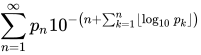
where pn is the nth prime number.
Its continued fraction is [0; 4, 4, 8, 16, 18, 5, 1, …] (OEIS: A30168).
Related constants
In any given base b the number

which can be written in base b as 0.0110101000101000101…b where the nth digit is 1 if n is prime, is irrational. (Hardy and Wright, p. 112).
See also
- Smarandache–Wellin numbers: the truncated value of this constant multiplied by the appropriate power of 10.
References
- Hardy, G. H.; Wright, E. M. (1980), An Introduction to the Theory of Numbers (5th ed.), Oxford University Press, ISBN 0-19-853171-0.