





User talk:Richard Nevell: Difference between revisions
→DYK for Tell Ruqeish: one of them grammar things |
Richard Nevell (talk | contribs) →DYK for Tell Ruqeish: Reply Tags: Mobile edit Mobile web edit Advanced mobile edit Reply |
||
| Line 47: | Line 47: | ||
:"The Neo-Assyrian Empire ... became a vassal city state." [[Tell_Ruqeish#History]] Really? [[User:Shenme|Shenme]] ([[User talk:Shenme|talk]]) 01:37, 29 March 2025 (UTC) |
:"The Neo-Assyrian Empire ... became a vassal city state." [[Tell_Ruqeish#History]] Really? [[User:Shenme|Shenme]] ([[User talk:Shenme|talk]]) 01:37, 29 March 2025 (UTC) |
||
::Not exactly what was meant, though it is what I wrote. Hopefully it's clearer now. [[User:Richard Nevell|Richard Nevell]] ([[User talk:Richard Nevell#top|talk]]) 09:40, 29 March 2025 (UTC) |
|||
Revision as of 09:40, 29 March 2025

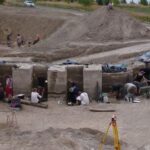
File:Excavations at Ard-al-Moharbeen necropolis, July 2023.jpg listed for discussion

A file that you uploaded or altered, File:Excavations at Ard-al-Moharbeen necropolis, July 2023.jpg, has been listed at Wikipedia:Files for discussion. Please see the discussion to see why it has been listed (you may have to search for the title of the image to find its entry). Feel free to add your opinion on the matter below the nomination. Thank you. UndercoverClassicist T·C 12:02, 3 February 2025 (UTC)
Good article reassessment for Destruction of cultural heritage during the Israeli invasion of the Gaza Strip
Destruction of cultural heritage during the Israeli invasion of the Gaza Strip has been nominated for a good article reassessment. If you are interested in the discussion, please participate by adding your comments to the reassessment page. If concerns are not addressed during the review period, the good article status may be removed from the article. — Anonymous 01:50, 5 February 2025 (UTC)
- (talk page stalker) - have left a comment at Wikipedia:Good article reassessment/Destruction of cultural heritage during the Israeli invasion of the Gaza Strip/1. It's not clear to me that the requirements for initiating a review have been met. KJP1 (talk) 09:49, 5 February 2025 (UTC)
Castellology terms
Hi Richard. I see castles is one of your domains of expertise. My memory doesn't help here: have I asked in the past for your opinion on the matter of castellology articles created by Bermicourt? He has translated dozens of them from German. My problem is with the terminology: German has a very peculiar approach to naming things by using specially created combined words and thus producing very precise and narrow terms for everything and anything, which makes German an extremely precise, rich, but also demanding language to use. English is fundamentally different. Nothing new there. Our friend though has "forced" German terms & concepts into English, and although I've done my fair share of reading about castles in both languages (and never came across any of his typical German-terms-turned-English), I don't know if English-language academic castellology allows for that. There is also the fact that the German typology is partly different from the British one, which means either that German terms are adopted, in German, for typically German types of castles, or that those terms are maybe sometimes literally translated into English. But what about the common types and features?
I don't have my notes handy, so I just looked a bit through his edit list and found a good example at Hill castle. All terms are based on German terminology. Maybe that's genius and enriching English castellology with knowledge from a far more sophisticated, Central European twin school, but is it? How was English castellology managing before him? Maybe there are established English terms already and using the literally translated German ones is an unneeded artifice? I'll stay forever curious about it.
Thank you. Arminden (talk) 10:42, 26 February 2025 (UTC)
- Somewhere I've got a book from the 1980s which translated key castle terms between English, French, and German. I got it recently to see if it had one particular term (slighting [sadly it didn't]). I'll have to dig it out and see how it handles things.
- The same castle typology hasn't really developed in English. Categorisations are based on castle form (concentric, ringwork, motte-and-bailey) rather than location and feature. There are some publications that will use similar terms (like Swallow, Rachel (2018). "Hilltop castles in a medieval landscape: Beeston and Buckton, Cheshire, England". Château Gaillard 28: L'environnement du château. Actes du colloque international de Roscommon (Irlande, 14-18 août 2016). 28: 271–282.) but I'm not sure how much it is rooted in the typology used in German or if it is simply a descriptor. I can't think of any publications in English that look at the various categories of lowland castle for example. There are some very esoteric approaches. D. J. Cathcart King developed categorisations of mottes based on their height and ringworks based on the form of their banks, but they don't seem to have been widely adopted by other researchers.
- There is something very appealing to me about that level of structure and categorisation. Are the categories meaningful for analysis and discussion? I've not engaged with enough to be sure, but I do like the prospect of Wikipedia's potential for creating a shared vocabulary; the 1980s book was one such attempt in the field. Richard Nevell (talk) 22:05, 26 February 2025 (UTC)
DYK for Fadel al-Utol

On 26 March 2025, Did you know was updated with a fact from the article Fadel al-Utol, which you recently created, substantially expanded, or brought to good article status. The fact was ... that Fadel al-Utol considers preserving Gaza's archaeological sites to be a peaceful act of resistance against Israel? The nomination discussion and review may be seen at Template:Did you know nominations/Fadel al-Utol. You are welcome to check how many pageviews the nominated article or articles got while on the front page (here's how, Fadel al-Utol), and the hook may be added to the statistics page after its run on the Main Page has completed. Finally, if you know of an interesting fact from another recently created article, then please feel free to suggest it on the Did you know talk page.
Cielquiparle (talk) 00:02, 26 March 2025 (UTC)
DYK for Tell Ruqeish
On 29 March 2025, Did you know was updated with a fact from the article Tell Ruqeish, which you recently created, substantially expanded, or brought to good article status. The fact was ... that the fortified walls surrounding the Iron Age Tell Ruqeish in Palestine are up to 5.5 metres (18 feet) thick? The nomination discussion and review may be seen at Template:Did you know nominations/Tell Ruqeish. You are welcome to check how many pageviews the nominated article or articles got while on the front page (here's how, Tell Ruqeish), and the hook may be added to the statistics page after its run on the Main Page has completed. Finally, if you know of an interesting fact from another recently created article, then please feel free to suggest it on the Did you know talk page.
1=Launchballer 00:02, 29 March 2025 (UTC)
- "The Neo-Assyrian Empire ... became a vassal city state." Tell_Ruqeish#History Really? Shenme (talk) 01:37, 29 March 2025 (UTC)
- Not exactly what was meant, though it is what I wrote. Hopefully it's clearer now. Richard Nevell (talk) 09:40, 29 March 2025 (UTC)