This page is mainly for reviewing the accuracy of non-dinosaur paleoart (usually by the artists themselves, but anyone who wants an image scrutinized is welcome to post them for review). Any other image, such as size comparisons or photos of skeletal mounts, can also be posted here to review their accuracy.
If you want to submit paleoart images for accuracy review, place them here as well as links to what you used as references. If you want to participate as reviewer, you can put the page on your watchlist. New images of any type can also be added to the requested images list or by including "Request:" in the section title here, and if submitted, such an image will thereafter be reviewed. Sections are archived automatically after some time when a discussion stalls, to encourage speedy responses from both artists and reviewers. It is allowed to revive sections if they have been archived before being resolved, unlike regular talk page archives.
Modifications of previously uploaded amateur restorations to correct anatomical inaccuracies is encouraged (including by others than the original artists), but modifications of historical restorations are discouraged, as these should be used to show historical ideas. Drastic modifications to restorations published in peer-reviewed journals should be uploaded as separate files, so that both versions are available.
User-made paleoart should be approved during review before being added to articles. Images that have been deemed inaccurate should be tagged with the Wikimedia Commons template "Inaccurate paleoart"[5] (which automatically adds the "Inaccurate paleoart" category[6]), so they can be prevented from being used and easily located for correction. User created images are not considered original research, per WP:OI and WP:PERTINENCE[a], but it is appreciated if sources used are listed in file descriptions (this is often requested during WP:Featured Article reviews).
Per project consensus, AI-generated paleoart is not accepted, and will be removed and nominated for deletion when encountered. From our experience, AI paleoart is always inaccurate, and since it derives from copyrighted, human-made artwork, is is both unethical and legally questionable.
If image is included for historical value. In these cases the image caption should explain that it is an outdated reconstruction. Historical interest images should not be used in the taxobox, but preferably in a section of the text discussing the history of a taxon.
Criteria sufficient to remove an image:
Images should not speculate unnecessarily beyond what has been indicated by reliable sources. Therefore, depicting overly speculative physical features, behaviors, and pathologies should be avoided, to prevent WP:OR issues. Restorations that show serious pathologies known from fossil evidence are welcome, but should not be used as the main representation of a given taxon. These should instead show healthy, typical individuals, and not focus on unknown areas of their anatomy. Since Wikipedia is an encyclopaedia rather than an art gallery, it is not the place for artistic experimentation, and we cannot include every piece of available artwork.
Image differs appreciably from known skeletal elements.
Example: If Lystrosaurus is reconstructed with four fingers.
Example: If an hesperornithid bird known only from postcranial elements is reconstructed without teeth, a feature made highly improbable by its phylogenetic position.
Image differs appreciably from known non-skeletal elements.
Example: If a restoration of Castorocauda lacks hair.
Image differs appreciably from implied non-skeletal elements.
Example: Scaphognathus should not be depicted without pycnofibres, since phylogenetic bracketing implies that it had them.
Image pose differs appreciably from known range of motion.
Example: Plesiosaurs reconstructed with overly flexible necks.
Exception: If the range of motion is debated in the scientific literature, as is the case with sauropod neck position.
Image depicts a scene which is anachronistic or contradicts known geographic range.
Example: Utahraptor hunting an Iguanodon, two animals which did not live together.
Example: Dinosaurs from the Triassic or Jurassic depicted walking on grass, which did not exist at that time.
Exception: Photographs of life-sized models taken in parks. It should be made clear in the caption that these are models.
While evaluating an old Simolestes restoration by DBogdanov for inaccuracies to fix, I noticed it was never reviewed, and wondered how many of his older images this is the case for. It turns out it's a lot, so I thought it was time to finally get them over with here, as many of them are very widely used. I know these megathreads are cumbersome, but I don't see any other practical way of getting through this. But there are so many images that it seems they have to be posted in several rounds (one round per Commons category page[7]). FunkMonk (talk) 05:03, 7 July 2025 (UTC)[reply]
Maybe for the next batch, but damn, this took time... Of course, anyone is welcome to rearrange the gallery accordingly. FunkMonk (talk) 21:27, 7 July 2025 (UTC)[reply]
Deuterosaurus is in need of major revisions, its posture is outdated based on its closest relative Tapinocaninus Rubidge (2019) . Its considerably shrink wrapped heavily and based on the evidence we have dinocephalians most likely didn't have hair. Eru Calypso (talk) 21:54, 30 August 2025 (UTC)[reply]
I'm assuming this doesn't apply to the head only restoration? In which case I don't think it's worth the effort to fix the other one. FunkMonk (talk) 17:47, 3 September 2025 (UTC)[reply]
Dimetrodons posture is dated see Scott Hartmans skeletal and article on the subject [8] , and in general most of the mural work seems to have glaring issues with posture, Brithopus is considered nomina dubia Kammerer 2011. I would also say most of these are too shrink wrapped. Eru Calypso (talk) 08:14, 16 September 2025 (UTC)[reply]
That said, being able to stand upright doesn't mean it wasn't able to crouch and sprawl (resting pose etc., which some of them seem to specifically be in, though the walking one is iffy)? So I'm not sure we can say they're all downright inaccurate? FunkMonk (talk) 20:09, 17 September 2025 (UTC)[reply]
Alright, I've finally got time to do a deep dive and have a crack at going over all of these. Broadly, the hair on the therapsids is something I want to acknowledge as contentious, but since depicting hair on them neither here nor there with current evidence I won't count it as a critique. Onto individual reviews, starting with the anomodonts because I'm biased:
Anomocephalus: Nothing egregiously wrong, but I think the proportions are slightly off. I can't match it up with either the skull reconstruction of Modesto et al. (1999) or the fossil—the snout is a little too long and its dorsal surface too shallowly angled. Assuming the areas with highlights correspond to the bony landmarks of the skull, the orbit also looks too small and the zygoma arched too high. That said, we're not shrinkwrapping and wouldn't see these landmarks anyway, and colouration doesn't have to correspond to them, so these could be ignored. You could quibble the visible teeth, but the mouth is open slightly so I'm not worried about that, and they are its most prominent feature. Overall I'd still call this passable, ideally with revisions, but not a priority.
Australobarbarus: As far as I can tell, this shouldn't have tusks, but with limited accessibility to Russian literature I'm not entirely certain on that. The snout is too deep (with the nostrils too low) and the beak too hooked—cut off the existing beak below the nostril and you'd just about have it right. The tail is very short comparing it to photos of the material and just compared to other dicynodonts in general, not sure why. I'm not sure where the 'hump' over the shoulders and neck comes from either. Body proportions otherwise at least seem to match photos of a referred skeleton. Needs revision.
Aulacephalodon: So this is intended to be A. bainii, but the tusk is very small when A. bainii is known for its hypertrophied tusks. I suspect it's taken cues from the "A. peavoti" skeleton mounted in the Field Museum, which lacks tusks and has a distorted, compressed skull, which could also be why the cranium looks so shallow compared to typical A. bainii. I presume the paired nubs at the front of the snout are intended to be the nasal bosses, in which case they are much too small and the flat surface of the snout separating them too wide. Otherwise, I think the body proportions are fine. Potentially workable, but needs revision.
Biseridens: Exposed teeth have already been edited out, skull matches the fossil material, body is reasonable extrapolation for a very early diverging anomodont. Pass.
Cistecephalus: Proportions and anatomy look good. Small eyes are accurate to known sclerotic rings in other cistecephalids, even with relatively large orbits like Cistecephalus. Pass.
"Dicynodon": Actually Vivaxosaurus, like Australobarbarus I can't match it to any known specimens, but it approximates the overall shape and might blend several skulls? It's got the diagnostic anterior lobe on the caniniform process (proportionately sized to the holotype), but the snout is convex and bulbous rather than diagnostically shallow sloping. The tusks also seem to be smaller than figured specimens, and the upper beak may be too hooked. The dentary may need to be a little deeper too, but these sort of things could depend on the specimen(s) used as references. Overall, broadly depicts the right morphology, deviations from specimens could be chalked up to taphonomic or even individual variation, with one diagnostic feature that appears incorrect. Could be passable, but needs revisions.
"Dicynodon": Actually Euptychognathus kingae, based on a skeletal reconstruction of a pretty complete specimen by King, so the postcrania is fine. The skull of the specimen it's based on is damaged, however. The premaxilla in this specimen is damaged and most of the dentary symphysis is missing, so both the premaxillary and dentary beak would be longer, especially the dentary which is longer and shallower in the holotype than King's reconstruction. Both beak tips also appear to be out-turned in the holotype. Needs revisions to work.
Antarctilamna ultima descripted here is based on juvenile specimen described here[9] (unfortunately Wikipedia Library does not work for Springer paper right now), which is only tentatively assigned to that genus, so it could be controversial. Although, the article of Antarctilamna was edited by what appears to be describer Robert Gess himself, and the article conclusively states that the specimen in question is in fact a juvenile of this species, so Gess seems to be personally certain of this. That said, I think some commentary is needed either way, since research has come to inconclusive conclusions on the matter. Ta-tea-two-te-to (talk) 22:41, 8 July 2025 (UTC)[reply]
I definitely have thoughts about the cartilaginous fish, and I'll leave discussion of the bony fish to someone more qualified.
Brochoadmones looks to be very closely based on the specimens and figures in Hanke & Wilson (2006), which as far as I know is the most recent detailed treatment of this taxon. Unusually, Bogdanov's has an additional prepelvic spine that isn't present in the fossils, giving his a total of seven prepelvic spines instead of the accurate count of six. This seems to just be a simple mistake, as the specimens are well-preserved enough that such a spine would've been preserved if it were present, so I would suggest minor tweaks if possible to remove the seventh prepelvic spine.
Agree with the above about Antarctolamna, both of Bogdanov's reconstructions differ significantly from what's been proposed for material more confidently assigned to the genus, and the page itself may have some conflict of interest concerns. They do closely match the Waterloo specimen, so the question is just if that specimen actually belongs to this genus rather than one of accuracy.
The Caseodus matches both the skeletal reconstructions and figured remains of C. basalis in Cope (1895) and Zangerl (1981). The two currently recognized species of Caseodus (basalis and eatoni) are identical in every aspect besides the shape of the teeth, so this reconstruction is a good genus-level approximation. A minor complaint is that the gill slits are positioned very close to the back of the skull, overlying the gill arches themselves, rather than opening further back near the pectoral fin. The size of the gill chamber in Caseodus isn't known, though, so I would call this a minor complaint at best and not something worth worrying about. I give this reconstruction a pass, although I wouldn't mind to see the gill position tweaked if possible.
Apologies for the late reply, the 5th gill opening would presumably sit just before the pectoral fin. The gill slits themselves sit quite a bit further back than the underlying gill arches in living sharks to make room for the gill basket, although there isn't any literature specifically suggesting to what extent this was the case in eugeneodonts (and thus I don't think its necessary to adjust the drawing). I would consider this adjustment totally optional, I don't think its all that pressing and would by extension apply to all(?) of Bogdanov's Paleozoic shark recons which put the gill slits directly above the gill skeleton. Gasmasque (talk) 18:02, 11 August 2025 (UTC)[reply]
That Campodus is a weird one, one and I've been meaning to comment on it for quite some time now. While small amounts of skull material that might belong to C. agassizanus have been described in Ginter (2018), these are extremely fragmentary and ambiguous, and the genus remains largely known by its teeth. This drawing is interesting because its very clearly based on the absolutely gorgeous body fossil listed under the eugeneodonts here (also seen here alongside some questionable information that's been transcribed to the Wiki in the past). The thing is, this specimen has never been scientifically described to my knowledge, and has certainly never been described as a genuine body fossil of the historic wastebasket Campodus. There is something of a mystery about what this specimen actually is and where it comes from, Richard Carr even suggested it may be a Fadenia from Greenland, if I remember correctly. The University of Nebraska site has several mislabeled fossils, including multiple Romerodus orodontus called "cladondonts" (spelling error theirs) seen here. This exact Romerodus specimen is photographed and correctly labeled in Gerard Case's Pictoral Guide to Fossils, and it is worth noting that the illustration of it is strikingly similar to Bogdanov's own cladodont Glikmanius reconstruction (a genus known only by teeth as of 2008). I say that neither the Campodus or the (also unreviewed until now) Glikmanius should be used, as both are very closely based on mislabeled fossils of totally different fish. If the Nebraska specimen is ever described, Bogdanov's "Campodus" would make a great life reconstruction of whatever taxon that ends up assigned to.
I'm going to give a pass to Acrolepis, Aidachar, and Allenypterus. Birgeria needs minor revisions; the ventral lobe of the caudal fin is too long. It should be shorter relative to the dorsal lobe of the fin. Cladocyclus needs major revisions; the head is way too long and the mandible should be more upturned. A Cynical Idealist (talk) 00:24, 7 August 2025 (UTC)[reply]
They both have images of the fossils on their respective articles. Birgeria may be passable depending on which species it is meant to represent since one species has a much more dorsoventrally symmetrical caudal fin. A Cynical Idealist (talk) 01:43, 9 October 2025 (UTC)[reply]
My lack of fish knowledge makes the Cladocyclus too difficult for me to fix, looks like there are all sorts of head elements that would have to be significantly warped in a specific way that I simply don't know about. FunkMonk (talk) 03:29, 26 November 2025 (UTC)[reply]
I'll take a stab at the Campylognathoides - inaccurate, but definitely salvageable. General proportions look good; the feet could make look a bit longer, but skull shape, wing length, tail length, etc all seem to match Witton's skeletal very closely. Main issue is the wing musculature - it'd be pathetic on any pterosaur, and Campylognathoides in particular has an especially overengineered shoulder. Witton frames it as a "pterosaurian gorilla" in his book. So the lower arm should be very prominently muscled, not a twig. Other issue of note is the teeth, which are so long and thin they protrude past the bottom of the jaw. Should be much more blunt and unspecialized; Witton's skeletal and a clear image of a skull are both on its page as reference material. LittleLazyLass (Talk | Contributions) 19:21, 7 July 2025 (UTC)[reply]
Forgot to mention that the crest is speculative, so may or may be worth removing. The overbite is also erroneous, and there's a shrink-wrapped fenestra that might need erasing. LittleLazyLass (Talk | Contributions) 00:48, 8 July 2025 (UTC)[reply]
From the article on Proterosuchus: "Chasmatosaurus yuani was named by C. C. Young in 1936, based on specimens from the Induan-age Jiucaiyuan Formation of China. It is considered a valid species of proterosuchid, but is not formally assigned to Proterosuchus. It is considered to be in need of taxonomic revision. It is more closely related to Proterosuchus goweri than to other species of Proterosuchus." A Cynical Idealist (talk) 00:41, 14 July 2025 (UTC)[reply]
Alright. Even though the binomial name is invalid, the skull's shrinkwrapped, so it needs revisions. And, perhaps it should have lips, as I would lip proterosuchids. 2600:4040:5100:FC00:8C46:67FF:FE1A:BCC1 (talk) 22:12, 14 September 2025 (UTC)[reply]
How would that look? Considering how the upper jaw considerably overhangs the lower jaw, I'm not seeing how lips could even seal the mouth. I found this attempt[10], but even there, one version has the frontmost teeth exposed. FunkMonk (talk) 01:23, 15 September 2025 (UTC)[reply]
That's what I'm trying to say. Only the frontmost teeth of the animal should be exposed. 2600:4040:5100:FC00:A265:CB57:A775:95A2 (talk) 20:48, 15 September 2025 (UTC)[reply]
I think that would be overdoing it, even in modern reptiles, such as monitors, you can see faint indications of the fenestrae. Not sure why the spines should be moved, do we have any evidence against them? FunkMonk (talk) 09:19, 16 September 2025 (UTC)[reply]
While the fenestrae don't need to be blurred any further, I still highly recommend you remove the spines as a lot of depictions show it without them. 2600:4040:5100:FC00:69B2:C57E:12F1:4817 (talk) 10:11, 16 September 2025 (UTC)[reply]
That's not much of a rationale, though, it's not like those are complex features, they exist independently in many reptile groups. I did find a few other proterosuchid restorations with them as well, but in general, new, professional restorations of these are few and far between. FunkMonk (talk) 10:29, 16 September 2025 (UTC)[reply]
Oh, it still needs some revisions. It should have visible teeth, a key feature among sauropterygians. 2600:4040:5100:FC00:8C46:67FF:FE1A:BCC1 (talk) 22:14, 14 September 2025 (UTC)[reply]
The teeth are visible in the image, but are obscured by the object in its mouth and the angle of the animal's head. I think if nothing else needs to be done besides the teeth, this is a pass. A Cynical Idealist (talk) 01:45, 9 October 2025 (UTC)[reply]
Do we have any source that states this explicitly or rules out lack of lips entirely? It sounds like it's the same debate as for dinosaurs, with no conclusive evidence. For our purpose, there's difference between "most likely" and "inaccurate", only the latter have to be removed. FunkMonk (talk) 19:20, 9 July 2025 (UTC)[reply]
Tho I myself would lip rauisuchians, I am unaware of any papers expressly arguing for the presence of them in this group. That being said far as I can tell the number of fingers, toes and corresponding claws does not match what we know from members of the group and tho the tail is only partially preserved both Scott Hartmann and the Museum für Naturkunde in Stuttgart show a much deeper tail based on the few caudal vertebrae we have (Gower and Schoch 2009). I will concede that this might be a perspective issue however.Armin Reindl (talk) 11:50, 13 July 2025 (UTC)[reply]
Chalishevia and Batrachotomus don't need lips, even though I and @Armin Reindl would personally lip both erythrosuchids and rauisuchians. However, the number of digits and the tail depth, as above-mentioned, should be changed, and the skulls are shrinkwrapped, so those need some working too. 2600:4040:5100:FC00:8C46:67FF:FE1A:BCC1 (talk) 22:18, 14 September 2025 (UTC)[reply]
Not sure if the neck is necessarily wrong, the holotype of Simolestes has ~20 cervical vertebrae, using a 3.2 cm centrum length for the only measured midcervical gives a total neck length of 64cm assuming fairly constant centrum length (and not taking cartilage into account), the snout tip to occipital condyle length is 73cm, so I don't think the neck is unreasonably long in the front individual (the back individual looks like it's somewhat longer-necked though). The cervicodorsal transition looks like it could use a bit more meat on it. The tail, however, does seem rather long; it almost looks longer than the torso. In Hauffiosaurus the tail seems to be about as long as the trunk, in Peloneustes it's typically reconstructed as a good bit shorter, and while incomplete, it does not look like it would have been particularly long in Sachicasaurus; the latter two taxa are probably better models for body proportions. The iconic not-Liopleurodon skeletal shows a slightly longer tail than trunk, which might be what the proportions here were based on, but I have no idea what, if anything, this was based on. I'm somewhat concerned about the tooth arrangement as well, having 5-6 symphyseal tooth pairs is diagnostic of Simolestes, but there only seem to be three here. I haven't done a rigorous check but looking at the figures from Noè's 2001 dissertation I'm also somewhat suspicious of the head shape, the practically straight jawline in the toothbearing part, the gently rounded "chin", and the positioning of the eye all seem suspect. --Slate Weasel [Talk - Contribs] 21:19, 9 July 2025 (UTC)[reply]
The ceresiosaurus has some bizarre anatomy on the trunk, I don’t know how to precisely describe what’s wrong but it should be more smooth rather than the way it is.The tail is also too lizardy, nothosaurs likely used their tails for propulsion so reconstructions should include a more paddle shaped tail. Neck also appears too long and the body/tail too short. Driptosaurus (talk) 03:20, 11 July 2025 (UTC)[reply]
I made the belly fatter, but I can't seem to find other restorations that give it a paddle-like tail? Any skeletal to go by if I am to make the neck shorter? FunkMonk (talk) 20:09, 14 July 2025 (UTC)[reply]
Nothosaur tail fins are a fairly recent development and I don't see many reconstructions with them either. The one on the nothosauruswikipedia page has one. In 2021 This paper (https://link.springer.com/article/10.1007/s12542-021-00563-w) is the most recent one I can find talking about tail propulsion in nothosauroids. There's no preserved soft tissue suggesting a tail paddle but just about every aquatic animal has some compression on the tail for better hydrodynamics, so a round tail is unlikely.
For the neck length, the neck seems a bit long compared to the skeleton on the page, at least in relation to the head size. It appears closer to C. lanzi than C. calcagnii. Driptosaurus (talk) 22:04, 14 July 2025 (UTC)[reply]
The neck on the image in the infobox is very clearly compressed by taphonomic forces. Several of the vertebrae are overlapping and the neck itself is bent in half. I think the neck in this image is fine as is. A Cynical Idealist (talk) 00:59, 7 August 2025 (UTC)[reply]
The following discussion is closed. Please do not modify it. Subsequent comments should be made on the appropriate discussion page. No further edits should be made to this discussion.
Rhamphorhynchus DB
Apparently unreviewed Rhamphorhynchus from 2016, used in infobox. Several issues immediately apparent, including head too large and inaccurate pedal digit V. I would consider this unusable but I am not editing the page because of wp:coi. Interested in hearing others' thoughts as well. Skye McDavid (talk) 15:14, 27 July 2025 (UTC)[reply]
Major revisions The head should be about the same length as the torso. In this image its like a full 50% larger than it should be. The neck is also too short. A Cynical Idealist (talk) 21:48, 30 July 2025 (UTC)[reply]
Sorry for the delay in responding, I've been busy with various things and haven't had time to check Wikipedia. Proportions are better, but pedal digit V should be articulating in the same place the others are, rather than articulating so much more proximally. Skye McDavid (talk) 22:44, 7 September 2025 (UTC)[reply]
Oh, now I think I get it, isn't it more a matter of moving the rest of the toes closer to it? And drawing them going all the way to the same area of articulation of the foot? FunkMonk (talk) 13:47, 8 September 2025 (UTC)[reply]
The discussion above is closed. Please do not modify it. Subsequent comments should be made on the appropriate discussion page. No further edits should be made to this discussion.
Unktaheela specta
Life reconstruction of the Polycotylid plesiosaur, Unktaheela specta, described in late December of 2023. As always, if there are any changes I should make, I will do so as soon as I can. — Preceding unsigned comment added by ShamuBlackfish (talk • contribs) 9 September 2025
After adding a {{unsigned}} tag to this section, I noticed that it had been added nearly 2 months ago, meaning if I hadn't added the tag, it would have been archived with no reply. I think FunkMonk would have advice for this reconstruction, as I can't say much about it besides that it looks odd compared to other plesiosaurs, especially the lack of a caudal fin. -BlueEleephant (talk) 06:15, 6 January 2026 (UTC)[reply]
I am wrong: this section is actually four months old, so maybe, the spontaneous edits made to it throughout that time kept it from getting archived. Either way, this image deserves to get reviewed by an expert. -BlueEleephant (talk) 06:32, 6 January 2026 (UTC)[reply]
Not an expert on these guys (we have a few editors who are), but the tail-shape seems in line with how polycotylids are generally restored now? FunkMonk (talk) 12:48, 6 January 2026 (UTC)[reply]
Made using an unpublished sketch by @Piranga94: (formerly 4444hhhh). (Piranga94, it would be good to confirm here that you have given me permission to use this sketch). I am aware the right side feet are lifted off the ground somewhat, which is due to the way the photograph of the mount this was based off was taken [12]. I am not good at fixing silhouettes and my efforts making the right feet level with the ground plane would probably make them look very wonky and worse than just the floating feet. Anyone else competent has my permission to edit the silhouette to fix this if they so choose. Hemiauchenia (talk) 22:51, 12 October 2025 (UTC)[reply]
Also found this one, its inaccurate because it has arthropod like antennae.Used in de and fi wiki. Houcaris\Zhenghecaris^|Talk^| 13:46, 4 November 2025 (UTC)[reply]
I drew the second one back at the turn of the century when various vendiamorphs were still thought to be arthropod-like organisms. As far as I know, all of the articles still using this either are using it for historical purposes or their editors have not yet gotten the memo about Vendia sp. being proarticulates. The first picture is accurate, based off of this paperMr Fink (talk) 01:53, 5 November 2025 (UTC)[reply]
It seems like they haven’t updated, I know since on de wiki it is probably too simple to be innacurate reconstruction and the other based on the links is probably saying vendia is a trilobite also spriggina. Houcaris\Zhenghecaris^| Talk^01:58, 5 November 2025 (UTC)[reply]
I’d probably let others voice their opinions on the new one since basing things off of papers can still mean mistakes. Houcaris\Zhenghecaris^| Talk^01:59, 5 November 2025 (UTC)[reply]
Just noticed this whilst touching up the article for Paravendia, but the number of isomers for that one is one too many, its only known to have four isomers on either side (The front set of course forming something akin to a head-shield), but here you've reconstructed it with five isomers on either side.
Reconstruction of H. simplex based on the reinterpretation in Coates et al. (2021) and Cohen et al. (2025). In these papers the upper tooth whorls have been reinterpreted as part of a flexible tenaculum, and the shape of the skull has been better defined compared to older reconstructions. I've given the fish colors based vaguely on various benthic sharks and freshwater stingrays, but the patterns are not lifted from any specific species. Note that Ray Troll's 2016 reconstruction here (which is presumably the basis for Csotonyi's reconstruction for the NPS and figure 2 of Hodnett et al. (2022)) is based on the same specimens and is seemingly a preliminary interpretation of the material drawn prior to more in-depth study, hence some of the anatomical discrepancies. I've opted to disregard these slightly older reconstructions because of that. Gasmasque (talk) 16:58, 9 November 2025 (UTC)[reply]
Chondrenchelys
Male (above) and female (below) Chondrenchelys problematica, Based on Coates et al. (2014). Pose and colors inspired by the now-outdated Chondrenchelys problematica.jpg by Nobu Tamura, which this reconstruction is meant to replace
Adding onto this with a Chondrenchelys problematica male and female, to showcase the sexual dimorphism in the species. These are based on the figures in Coates et al. (2014), and the patterns and pose are inspired by the reconstruction by Nobu Tamura currently used on the page. Said reconstruction has unfortunately become quite outdated since it was drawn, and this is intended as a replacement. Gasmasque (talk) 05:42, 17 November 2025 (UTC)[reply]
INSTANT PASSPass I know as I'm the one who requested this illustration I'm slightly non-impartial, but I think you've done a good job here and it seems accurate to the sources and I have no issues/quibble. Hemiauchenia (talk) 23:38, 19 November 2025 (UTC)[reply]
Pass for me as well. They look great after comparing them to the known material and sources. I also like the coloration choice for them, it really works well for a more nektobenthic chondrichthyan, and also act as good homage to Tamura’s piece. No complaints from my end. Fossiladder13 (talk) 23:54, 19 November 2025 (UTC)[reply]
Myoscolex
This image has never been reviewed, the interpretation of it as an opabiniid is questionable but I feel like assuming it’s like other opabiniids then this looks like it might need revisions. Houcaris\Zhenghecaris^| Talk^19:39, 9 November 2025 (UTC)[reply]
I think it's time you stopped inserting images in the middle of your comments. It's just not good at layout. Aside from that, probably this image needs to be removed from article, cause most of modern studies does not support affinity of Myoscolex as opabiniid, so revision is impossible. Ta-tea-two-te-to (talk) 22:53, 9 November 2025 (UTC)[reply]
I mean as a historical image it might not be good as it appears the anatomy also differs from known opabiniids. Houcaris\Zhenghecaris^| Talk^00:18, 10 November 2025 (UTC)[reply]
It seems to be mouthless, lacks setal blades, is too thick and the attachment of the swimming flaps is odd. Houcaris\Zhenghecaris^| Talk^00:51, 10 November 2025 (UTC)[reply]
These recons haven’t been reviewed yet, the lobopodians look rough.These are not used anywhere so it shouldn’t be a problem. Houcaris\Zhenghecaris^| Talk^01:09, 10 November 2025 (UTC)[reply]
Junnn11's reconstruction is diagrammatic; it's meant to show the anatomy, not how it looked in life, so it's acceptable to exclude elements that aren't part of the body and that it didn't make to show parts that would otherwise be obscured (in this case by the tube). This reconstruction aims to represent how it would have looked in life; this would have included a tube, even if it didn't make it, and even if it's not part of the body. Radiodont2011 (talk) 18:43, 30 November 2025 (UTC)[reply]
What about the conulariids, though? That image could be very useful, though I know so little about conulariids that I cannot even attempt to review it. Radiodont2011 (talk) 23:01, 30 November 2025 (UTC)[reply]
Thamks for reviewing mate, and I was looking forward to use these later on even if I said I won't use em I've changed my mind so I would highly appreciate you if u could tell me if there are other probs in the paleoart.
MAJOR REVISIONS This is traced directly from the Pterodaustro image you used. Please understand I humbly recommend you make it more original. Also, that's some pretty bizarre jaw musculature over there. And it looks like it doesn't have pycnofibers. ~2025-31600-97 (talk) 01:15, 13 November 2025 (UTC)[reply]
@~2025-31600-97: I've uploaded a new version of the file that hopefully addresses the issues. I've made the image focus entirely on the head, which is the most distinctive part of the animal. I've improved the jaw musculature and made it more clear that the skin underneath the jaw is a pouch/dewlap. I have also made the pycnofibers more prominent. ArtemisiaGentileschiFan (talk) 03:27, 13 November 2025 (UTC)[reply]
@~2025-31600-97, I don’t think it is a direct trace of the figure, even so it isn’t an exact copy, File:Australimicola.svg is similar to a paper too, I wouldn’t have a problem with it being made more original though. Houcaris\Zhenghecaris^| Talk^21:27, 14 November 2025 (UTC)[reply]
I think the flaps should be more sideways not just straight down, also I’m not sure if the lobopods should be that close together. Houcaris\Zhenghecaris^| Talk^20:49, 12 November 2025 (UTC)[reply]
For the spines it should line up with the annulations, with a gap of one annulation per spine on the nozzle. Houcaris\Zhenghecaris^| Talk^17:06, 13 November 2025 (UTC)[reply]
I would assume the flaps would have been flexible enough in life, and showing them as drooping downwards does appear to common enough in paleoart of opabiniids and radiodonts (including in some of Junnn11's reconstructions, like of opabinia). Radiodont2011 (talk) 21:05, 13 November 2025 (UTC)[reply]
While Junnn11's diagrammatic is excellent, the fossil material is not great, so the diagrammatic shows only one possible interpretation of the fossil. For one, I am not entirely sure that we know exactly how long the first flap was relative to the other flaps, given the poor quality of the material, but I am not an expert and if after reviewing it you decide it should still be changed I will change it. Radiodont2011 (talk) 21:07, 13 November 2025 (UTC)[reply]
I also think that the setal blades look quite bold as is, and not too much fainter than other radiodont/opabiniid reconstructions, but once again I am not by any means an expert, so if after reviewing you think I should revise it, I will. Radiodont2011 (talk) 21:08, 13 November 2025 (UTC)[reply]
I also don't know that we can tell exactly how many annulations there were and how dense they were, especially with the risk that not all the annulations were preserved, though I'll admit that the amount of annulations I drew might be a bit on the high side; if after discussing you think that there should still be fewer, I will also fix it. Radiodont2011 (talk) 21:09, 13 November 2025 (UTC)[reply]
From what I can tell, the spines seem to line up fairly well with the annulations already, but once again if after discussing you decide it should still be changed I will do so. Radiodont2011 (talk) 21:12, 13 November 2025 (UTC)[reply]
When it comes to how many annulations there were between the spines, the paper describing Mieridduryn states (emphasis mine) that "the proboscis...displays slender spines at regular intervals (~0.2 mm spacing, one per two to four annulations)..." In my reconstruction, the spines are each four annulations apart, so Junn11's diagrammatic (one every two annulations) and my reconstruction are both consistent with the paper. Radiodont2011 (talk) 21:12, 13 November 2025 (UTC)[reply]
For the stoutness of the lobopods, most of any given lobopod's posterior edge (except for the tip, where it narrows and should not be quite so stout) is obscured by the flap, so my reconstruction does not show any information about the lobopod's stoutness. Radiodont2011 (talk) 21:14, 13 November 2025 (UTC)[reply]
Again, the material is limited, so I am not sure we can say for certain how many annulations it had on the lobopods. I do agree what I drew seems a little high; I can revise it if need be. Radiodont2011 (talk) 22:57, 13 November 2025 (UTC)[reply]
I just uploaded an updated version in which I made all revisions I agreed with. If you could take another look at the image and look at my responses to your feedback to see what you still think needs to be changed, that would be appreciated. Radiodont2011 (talk) 23:06, 13 November 2025 (UTC)[reply]
The setal blades are faint, if you have it at taxobox size (link) its already really hard to see. Houcaris\Zhenghecaris^| Talk^01:19, 14 November 2025 (UTC)[reply]
I’d say Pass for now, but the fossils are hard to interpret so before anyone adds it too the article comments from someone else is needed. Houcaris\Zhenghecaris^| Talk^02:45, 14 November 2025 (UTC)[reply]
Try to comment here for readability. I don't think there is much use to pinging the same people again and again. I'm sure they got the notifications: they will respond if they want to. I suggest either pinging someone new or just accepting this might not get reviewed. If need be, maybe after a while (some time after it gets archived) I can resubmit it with the vermontcaris and any other old reconstructions that need more comments to renew interest, but other than that, not really much that can be done. Radiodont2011 (talk) 23:19, 17 December 2025 (UTC)[reply]
Hello everyone. To give you some context, Gasmasque and I are currently collaborating to expand at our best the article about the famous buzzsaw shark Helicoprion. While browsing Wikimedia Commons, I found an illustration made by the now legendary DiBgd, wich is show below. However, Gasmaque pointed out that this drawing, dating from 2008, is outdated because it doesn't correspond to the model established since Tapanila et al., (2013). I would therefore be grateful to anyone who could correct this detail of the animal's jaw, with the aid of more accurate pictures to help:
Pinging @NGPezz and @Hemiauchenia for this, since they were involved with the original 2021 expansion of the page and discussions of Helicoprion paleoart back in 2021, and @Apokryltaros who drew the sixgilled 2013 illustration. Something that came up then was that giving them green/blue reflective eyes like those of chimaeras is probably inaccurate based on ecology, which I am inclined to agree with. My issue with DiBgd's 2008 recon is the apparent lack of any encapsulating cartilage for the whorl, which was not known at the time it was drawn. The lack of a distinct upper jaw isn't particularly noticeable in this reconstruction, and compared to the same artist's other reconstruction from the same year it has aged very gracefully. I really don't understand why Entelognathus' recon would need replacing since it was reviewed previously, was heavily revised, and as far as I can tell currently has no anatomical problems besides Amirani's vague reference to it being "too shark-like". Gasmasque (talk) 22:10, 14 November 2025 (UTC)[reply]
Agree that Entelognathus's reconstruction is entirely usable and no need to fix the old one. The "it's too shark like" criticm seems misplaced. The last common ancestor of all living chondrichthyans was shark like, and the earliest diverging total group holocephalans, the Symmoriiformes, are also very shark like. Eugeneodonts don't have that much morphologically in common with chimaeras and aren't that close to them within total group Holocephali, so it's not unreasonable to reconstruct them as shark-like, especially as Helicoprion is thought to have been an open ocean pelagic fish. Hemiauchenia (talk) 22:12, 14 November 2025 (UTC)[reply]
An alt version with a darker pupil would be appreciated. The number of gills for caseodonts seems to be uncertain so I don't think you giving it six gill slits is an inaccuracy, and nothing else strikes me as off. Gasmasque (talk) 21:13, 16 November 2025 (UTC)[reply]
is there any reason to believe helicoprion had gill slits as opposed to an operculum cover like ratfish? I remember ray troll saying something to the effect that he gives them gill slits simply because it looks sharkier, but as a holocephalian relative wouldn't an operculum be a safer bet? Jfstudiospaleoart (talk) 16:47, 19 November 2025 (UTC)[reply]
If an opercular reconstruction is desired somewhere on the page then Bogdanov's 2013 one can be used. I am personally neutral on the matter and don't think it can be said for sure either way; I draw my eugeneodonts with shark-like gill slits but also would not be terribly surprised if they had an opercular cover like all holocephalans with known soft tissue (debeerids, petalodonts, gregoriids, iniops, etc.). I recently discussed this exact same matter while reconstructing Edestodus and talking with @EvolutionIncarnate, and she very strongly believes they would not have had any kind of large gill cover. The evidence against an operculum is that Fadenia, Romerodus, an undescribed "Campodus" and potentially Ornithoprion had gill slits that were widely spaced along the "neck" region rather than packed under the skull, and that the rays that support an opercular cover are not preserved in any of the above (only the gill arches themselves are preserved). The evidence in favor of an operculum is phylogenetic bracketing, which doesn't account for the wildly different lifestyle Helicoprion had, the fact that its hyoid arch was not used in jaw suspension and that in all other known examples of non-suspensory hyoids in cartilaginous fish it supports an operculum, and that Heteropetalus and the (probably convergent) Cosmoselachus had large opercula despite having widely spaced gill slits that weren't under the skull. Richard Lund and Eileen Grogan are proponents that eugeneodonts/edestiforms had opercular covers, but other working researchers seem to be entirely neutral or gill-slit leaning on the issue due to the lack of certainty. Troll's "more sharky" reconstruction approach doesn't sound terribly scientific, except when considering that almost every other aspect of these animal's postcranial anatomy is closely convergent with elasmobranchs.
Also, this discussion applies moreso to caseodonts than to Helicoprion itself, for which nothing of the gill skeleton is actually known. Maybe Helicoprion did have an opercular cover and Romerodus and Fadenia lost it independently, we may never know. My vote is for gill slits if doing as conservative of a recon as possible, but an operculate reconstruction somewhere in the description section for the sake of "teaching the controversy" wouldn't bother me nearly as much as it would EvoIncarnate. Susan Ewing's book has a decently good summary about the operculum discussion as of 2017, and as far as I know no new evidence has appeared in favor of either conclusion. Gasmasque (talk) 18:39, 19 November 2025 (UTC)[reply]
the evidence for an operculum is slim on the anatomical end, and cosmoselachus has multiple gill covers according to the fossil with multiple layers to the operculum and its own relatives have separate gills. currently the consensus is separate gills and is the safest option as of now based on the anatomy we know of these animals. EvolutionIncarnate (talk) 02:49, 27 November 2025 (UTC)[reply]
Hello again. Sorry for asking another review. This time I tried to make archerfish species from Sangkarewang Formation (T.beauforti). I am aware that there are no illustration avalaible on the internet (based on free website). But the description said to be very similar with modern species (presumably Toxotes not Protoxotes) except the number of dorsal spines (six compare to four and five in modern ones). So I tried to draw it based on the description. For the color, I based it on Protoxotes since it is said to be more primitive like lacking stripes and spots? And I assumed this Eocene species to be more primitive...
As always, is my image good enough to be used? I know it is quite speculative but I think it is still reasonable? Thank you in advance...
Pass Looks good to me. Also, a reminder in the future, no need to apologize. You're welcome to come here anywhen you want. ~2025-31600-97 (talk) 19:53, 16 November 2025 (UTC)[reply]
I found this image in commons, I don’t see any segments in the trunk of Tamisiocaris but the environment was really dark so it could just be that darkness. Houcaris\Zhenghecaris^| Talk^14:48, 16 November 2025 (UTC)[reply]
I’m pretty sure that radiodonts have external segmentation, and all of the recons have it apart from innacurate ones. Houcaris\Zhenghecaris^| Talk^16:10, 16 November 2025 (UTC)[reply]
The Tamisiocaris eye might need stalks but the closest known relative, Echidnacaris didn’t. Houcaris\Zhenghecaris^| Talk^16:16, 16 November 2025 (UTC)[reply]
The paper describing Echidacaris says that "unique eye characters documented in E. briggsi, such as being sessile and encircled by an eye sclerite, are unknown in the other tamisiocaridids, Tamisiocaris and Houcaris, and are tentatively regarded as diagnostic for Echidnacaris", though the same paper also says that "new data from Tamisiocaris in particular might show that some of the apparent autapomorphies of the eyes of E. briggsi are shared by other tamisiocaridids". As such, if we are to follow the literature strictly, it is probably better to put the eyes on stalks, though this alone is probably not disqualifying. Radiodont2011 (talk) 20:24, 18 November 2025 (UTC)[reply]
Of course it actually had one, but how visible would it be is depending on interpretation. Some do arthropod-like, some do just as groove, and there are models that does not show visible segments.[15]Ta-tea-two-te-to (talk) 07:06, 17 November 2025 (UTC)[reply]
I would think those black lines running along the trunk are supposed to be the setal blades? I'll admit, they are quite a bit bolder and more disorganized than what I am used to seeing, which could be an inaccuracy if they are supposed to be setal blades, though I'll await your thoughts since I do not know much about this topic. What's wrong with the carapace elements? They seem normal enough to me? Radiodont2011 (talk) 20:14, 20 November 2025 (UTC)[reply]
It would be best to notify the artist to put the eyes on stalks to best match the literature. If the artist doesn't respond or is unable to make the changes, I think it can still be used, but it would be preferable to fix the eyes. Radiodont2011 (talk) 18:26, 27 November 2025 (UTC)[reply]
From the paper describing Echidnacaris: "unique eye characters documented in E. briggsi, such as being sessile and encircled by an eye sclerite, are unknown in the other tamisiocaridids, Tamisiocaris and Houcaris, and are tentatively regarded as diagnostic for Echidnacaris". My main concern here is not so much that I think it's more likely that Tamisiocaris had stalked eyes than sessile eyes (in fact, if you were to argue that Tamisiocaris most likely had sessile eyes, I would agree with you) so much as to whether sessile eyes might qualify as original research. I am fairly new to Wikipedia, so if you feel it does not constitute original research, then I will defer to you. Radiodont2011 (talk) 20:08, 27 November 2025 (UTC)[reply]
If there aren’t any more comments this would be nice to add to the Tamisiocaris article as it is the only recon apart from Prehistorica cms old one with innacurate kerygmachela, the Tamisiocaris in that one weren’t diagnostic enough for he genus anyway. Houcaris\Zhenghecaris|Talk01:33, 6 December 2025 (UTC)[reply]
This is used in a few pages and has never been reviewed, this was based on the older interpretation of Pikaia which is now known to be upside down but that isn’t that much of a problem since it’s sideways so it would be any of the interpretations. Houcaris\Zhenghecaris^| Talk^23:46, 16 November 2025 (UTC)[reply]
I’m grouping this one together as they are both
by Prehistorica CM and are images of Burgess Shale animals stuck in brine seeps.Used in Chinese Wikipedia.Houcaris\Zhenghecaris^| Talk^23:51, 16 November 2025 (UTC)[reply]
Very lenghty process making this one, lots of desicions that could be explain if asked
The museum skeletal mounts of this creature are chimeric between differently-sized specimens, and the isolated bones of the skull from different individuals are innacurately assembled LiterallyMiguel (talk) 01:04, 18 November 2025 (UTC)[reply]
Erythrosuchus africanus
very well described and figured animal, most is measured and its really complete, although while all the drawn scale-bars of the 2003 osteology were accurate, some of the given mm lenghts in them were noticeably mislabeled
Hello there! I've made a reconstruction of Athabascasaurus and figured I'd submit it here for review before posting it to the page for it. Let me know if I need to make any adjustments!
Benwrops (talk) 06:55, 24 November 2025 (UTC)[reply]
the tail "fins" should be on a broad triangular terminal segment, and the tail overall should be very stout. see my reconstruction here. i would upload it but vermontcaris doesnt have a good wiki page anyway Prehistorica CM (talk) 23:59, 24 November 2025 (UTC)[reply]
okay yeah sure idk about the wording but can you take a look at the figures in the paper. specifically like, figures 8 and 9. there is no extra segment behind the "tail flaps", so the revised version is still incorrect. "articulating" means something different. also, the telson and tail flaps have a fringe of tiny spines or setae. Prehistorica CM (talk) 21:43, 26 November 2025 (UTC)[reply]
still no. the limbless abdominal segments are much shorter (getting slightly longer posteriorly), the telson piece should be about as long as the preceeding 3 segments. That is to say, the abdomen segments need to be short, and the telson needs to be very large. also, there is no reason to illustrate the "tail flaps" as being so detached from the telson. Prehistorica CM (talk) 02:26, 27 November 2025 (UTC)[reply]
Not sure if this should be lumped here but someone should upload the images from the paper, they are CC 4.0 I’d do it myself if I had been better at uploading things from papers. Houcaris\Zhenghecaris|Talk^16:43, 27 November 2025 (UTC)[reply]
It's limited what more I can do with the previous DBogdanov entries here, but in the meantime, I noticed a bunch of his pterosaurs (and Sharovipteryx) were never reviewed. So here they are, and feel free to add more that could need modifications. FunkMonk (talk) 03:36, 26 November 2025 (UTC)[reply]
Tupuxuara - already got some edits following Discord suggestions
Ordovician extinction probably fine, Cretoperipatus replaced months ago, Cryodrakon idk probably fine, Koolasuchus probably fine, Isoxys bad, Tambach fine, Repeno idk, fish probably fine idk Prehistorica CM (talk) 19:36, 27 November 2025 (UTC)[reply]
@Prehistorica CM: I hope you aren't too bothered by Zenghecaris's antics. I and other Wikiproject Paleontology members have really appreciated the high-quality artwork you have contributed to Wikipedia over the years. As a question, do you think that the paddle-like exopods suggested for Isoxys volucris in the Martin et al. 2009 study are correct, or do you think that they had exopods more similar to those of I. curvirostratus? Hemiauchenia (talk) 19:44, 27 November 2025 (UTC)[reply]
Please be cautious about rubberstamp reviewing like this. If you aren't familiar with a taxon or the clade that the taxon belongs to it might be better to ping someone else more familiar, or to try and familiarize yourself, before commenting. Just saying reconstructions look fine at a first glance even when they have previously been noted to not be fine is not ideal. Gasmasque (talk) 11:13, 29 November 2025 (UTC)[reply]
@Gasmasque Yes, you're right. I will admit, I can often review better with non-avian dinosaurs, but I have pinged others before. I'm terribly sorry for doing this. I will humbly permit others to properly review it. ~2025-31600-97 (talk) 12:37, 29 November 2025 (UTC)[reply]
Cretoperipatus was already found to be incorrect during that article's review, since the coloration of the worm is actually known and it was not bright blue. No need to correct this reconstruction since Prehistorica did a very nice 3D model as a replacement. The Protopsephurus is very painterly so it is hard to say if this is intentional or not, but the dorsal fin looks quite different in shape from the preserved specimens and also seems to be much fleshier, more like the fin on a cetacean than on a bony fish. It otherwise looks pretty consistent with the fossils, and the odd looking dorsal fin might be more of a result of artistic liberties than scientific ones. Cryodrakon is very fragmentary, so making sure the limb proportions look consistent is about all that can be done. It definitely looks like a pterosaur to me, and at least at a quick glance the wing and hindlimb look roughly consistent in proportions to the fossil. No comment on the other reconstructions, those are definitely better covered by someone more familiar. Gasmasque (talk) 11:10, 29 November 2025 (UTC)[reply]
Should we really have the blue one as a separate file, sooner or later somebody is going to use it, even if someone puts an inaccurate template on there’s a chance it will be used as File:Opabinia BW.jpg is used in several wikis even though the template is there as an accurate reconstruction, that one has some history in though, being used in the english version for quite a while. Houcaris\Zhenghecaris|Talk^22:54, 30 November 2025 (UTC)[reply]
That's a question I think could be asked for all of Tatarinov's image mirrors, frankly. They're a headache when the original paleoart gets updated, that's for sure. Gasmasque (talk) 23:52, 5 December 2025 (UTC)[reply]
Could someone add the 5.5 m estimate to this size chart? It's been bothering me that one is not present here recently. — Preceding unsigned comment added by Otodusm (talk • contribs) 28 November 2025
As I discussed with SS for Toxodon, notoungulate expert Darrin Croft still prefers the old low hanging head bent foreleg interpretation of Toxodon (as discussed in an email conversation between SS and Darrin), but admits that no thorough study of its posture has been done for decades. I think this restoration is fine, considering it accurately represents the interpretation of Farina and Alvarez, 1994. I note that Julio Lacerda made a similar restoration high headed straight-legged restoration of Toxodon a few years ago [16]. I think this can be considered a Pass, with the caveat that Toxodon 's posture is not a settled question. Hemiauchenia (talk) 00:11, 29 November 2025 (UTC)[reply]
Brygmophyseter size diagram
I know this has previously been reviewed in 2018, but is this actually an accurate representation? The published estimates indicate that the animal measured up to 6 m (20 ft), yet the diagram seems to make the animal appear a bit larger assuming the person is 1.8 m (6 ft) long. Junsik1223 (talk) 18:19, 28 November 2025 (UTC)[reply]
This reconstruction is definitely a bit on the skinny side. The fenestrae in the rear of the skull shouldn't be as visible as they are. Beyond that, most modern reconstructions tend to make the body a little bit smoother/torpedo shaped as opposed to having clearly divided head/body/tail segments like this one, as that's more hydrodynamic. Driptosaurus (talk) 19:21, 1 December 2025 (UTC)[reply]
Bogdanov's appears to be a straight trace of Newman & Tarlow's skeletal and muscular reconstruction from 1967 (or one of the many sources that reproduce it), which as far as I know is actually a generalized pliosaur that is often misattributed as Liopleurodon in later books and papers that use it. I'm inclined against its usage based on the age of the source and the fact it may not be based on Liopleurodon. I don't know if I follow the opposition to the animal being slender in the newer art, is that just extrapolation from Mauriciosaurus? Are the body dimensions of Liopleurodon well known enough to say it is "too slender"? I was under the impression that the genus was comparatively fragmentary/known from disarticulated partial skeletons. Gasmasque (talk) 06:31, 12 December 2025 (UTC)[reply]
Well, the silhouette of the size comparison (https://commons.wikimedia.org/wiki/File:Liopleurodon_Size.svg) has been made bulkier over time, so there is probably some basis to the claim that it's too slender. I also think the fins/flippers may be a bit too small, though I'm not sure.
Using other user-generated paleoart as a source is not ideal. I'm not sure if Slate Weasel is still very active, but if so they should definitely be asked about the dimensions of their 2022 silhouette revision to better know the reasoning. Also, it seems rude to not tag Cody Lake when criticizing or suggesting to alter their work. I've looked through Vincent et al. (2024), which seems to be the most recent work on the postcrania of Liopleurodon, and I don't see anything suggesting proportions similar to Slate's scale drawing without a very large amount of soft tissue completely obscuring the skeleton. If the "slenderness" is just a matter of how much whale-like blubber is added, then I definitely don't think that's reason to correct Cody's drawing since that isn't known in this genus. Gasmasque (talk) 19:19, 15 December 2025 (UTC)[reply]
I would like to say both, though the old one seems easier to edit...
Reconstruction of Aquilonifer spinosis from dorsal, ventral, and lateral view
Reconstruction of Aquilonifer spinosis from dorsal, ventral, and lateral view
I wanted to submit this diagrammatic reconstruction I've made of Aquilonifer spinosis for review before adding it to the article. I have one where different parts of the anatomy are color-coded and one that is black and white if that is visually more fitting.
UltraLuther (talk) 17:27, 30 November 2025 (UTC)[reply]
I definitely find the colour diagram to be much more legible. Some kind of key to what the different colours represent would be useful, for example someone unfamiliar with Aquilonifer could easily mistakenly assume that the red appendages are stalked eyes when this is not the case. Hemiauchenia (talk) 22:15, 30 November 2025 (UTC)[reply]
Something like this? I couldn't really think of a neater way to do it.
Yeah, it looked about like that. It would be better to include these unreviewed images together in a single new section, or in this case preferably in one of the two already existing open sections where Bogdanov's cartilaginous fish reconstructions are being discussed. Gasmasque (talk) 23:16, 4 December 2025 (UTC)[reply]
Forgot to give a real review, oops. The Fadeniapasses, with my only criticism being the minor gill position comment I brought up previously for Bogdanov's Caseodus. This illustration is very closely based on the skeletal and dental reconstructions by Svend Erik Bendix-Almgreen published in Zangerl (1981), and the numerous textbooks that reuse the figures. The actual Fadenia crenulata fossils remain largely undescribed, but the (probable) close relative Fadenia uroclasmato has very similar fins, teeth and gills and serves as a better-figured analogue that confirms the anatomy here sans a side profile of the head.
The problems with this image come from the prey animals: some kind of hooded, inking, orthocone cephalopod from the Late Permian. I assume these are meant to be some kind of orthocerid nautiloid, which would mean the Nautilus-esque hood might be a misinterpreted mouthpart and there shouldn't be any ink. Were there such things as ink-producing orthoconic cephalopods during the Late Permian? Are orthocones of any specific genus known from Wordie Creek? I don't know enough about them to say off the top of my head. Pinging @Carnoferox as the closest thing we have to an orthocerid expert, just to verify if these are even usable for anything in particular or not. I can say that Fadenia has been proposed as a cephalopod hunter, so my concern is only with their anatomy. Would it be reasonable to create an alternate version of the image with the large foreground shark cropped out (and maybe rotated 90 degrees), and the background and cephalopods removed? Gasmasque (talk) 17:29, 9 December 2025 (UTC)[reply]
Orthocerids did have opercula (I disagree with the jaw interpretation), but they should be round to match the shape and size of the shell opening. The opercula on these orthocerids do look to be based on Nautilus and are thus too triangular. Ink sacs have occasionally been proposed for orthocerids but have always turned out to be misinterpreted structures. The current evidence suggests that ink is restricted to coleoids. Carnoferox (talk) 00:11, 10 December 2025 (UTC)[reply]
The jaw interpretation does seem to be prevalent enough that it might be worth opting for no opercular covers instead of trying to modify the nautilus hood into a more appropriate shape, if it's worth keeping the cephalopods at all. Could ink have been present in Paleozoic non-ammonite ammonoids or bactritids? Bogdanov doesn't seem to specify an intended genus or order or subclass, so if they're kept I don't know what taxon they should best be modeled after besides "generic orthocone". Gasmasque (talk) 06:34, 10 December 2025 (UTC)[reply]
To be honest, the operculum of orthocones is still a topic of ongoing debate and has received little recent research, and even if Aptychopsis was an operculum, there is no certainty as to what it was like in orthocones of lineages other than orthoceratoids. (Especially bactritids which are related to ammonoids and coleoids would have had no operculum at all.) Cephalopods with internal shells already existed at the time Fadenia lived, and it would be better to replace them with such type of cephalopods, but frankly, that may be beyond the scope. Ta-tea-two-te-to (talk) 16:10, 12 December 2025 (UTC)[reply]
I'm leaning towards an alternate version with just the foreground shark and the background and cephalopods removed. Because they have somewhat confused anatomy and aren't any specific kind of cephalopod I don't know if retaining them is useful, since the subject is the uncontroversial Fadenia anyway. A paleoecology section, where a depicted predator-prey interaction would be most useful, would in my opinion be better illustrated by brachiopods since there is direct evidence that Fadenia fed on those. Gasmasque (talk) 05:03, 15 December 2025 (UTC)[reply]
Addendum to the Fadenia: there is a very small dot behind the eye that I had previously not even noticed because of the dots across the body, which is probably meant to be a spiracle. I'm not familiar with any sources that suggest a spiracle in any caseodont genera, and have seen some sources which say they aren't known in any holocephalans. That may be best to remove if revisions are being made anyway. Gasmasque (talk) 06:17, 10 December 2025 (UTC)[reply]
I've created an alternate version of the Fadenia with some minor tweaks to the face, eye, gills, and pectoral fin that help is align as closely with the original figures (and shark soft tissues) as possible. More importantly I've gotten rid of the background and cephalopods. Something I hadn't noticed during my original review is that the original drawing doesn't have the projection from the mandible that is known in this genus, so hopefully my effort to edit that in doesn't look too crude. I've gone ahead and switched the file on the animal's enwiki page to this one, since I don't see any reason to retain the other reconstruction. Gasmasque (talk) 21:09, 23 December 2025 (UTC)[reply]
Apart from that it is pretty good, but the number of auxiliary spines on the first endite should be 7, your recon has more, on both the holotype and one of the paratypes it has 7 which means it probably had 7, the other paratype is too poorly preserved to tell me anything conclusive about the endite number. Houcaris\Zhenghecaris|Talk01:28, 6 December 2025 (UTC)[reply]
I feel like for the speculative trunk and sclerites you based it off of Hurdia victoria while the one in the paper has a flatter h-element so I would assume its based on H. triangulata. Houcaris\Zhenghecaris|Talk01:38, 6 December 2025 (UTC)[reply]
i would have a lot of comments but i am drafting a reply paper anyway, so i would argue any reconstruction you make will be inaccurate. we should just use Jun's frontal appendage diagram till then. Prehistorica CM (talk) 02:45, 6 December 2025 (UTC)[reply]
As always, is my image good enough to be use? I will color it if there are no more revisions needed.. Thank you in advance and sorry for my long ranting!
Are there any guides out there for scaling fossil taxa for size charts/skeletals? Additionally, does anyone have a set of grids, silhouettes, and rulers available to use for skeletals? Thank you so much in advance. I would like to begin creating skeletals for the site, firstly one of that of ElrhazosaurusAFH (talk) 03:48, 8 December 2025 (UTC)[reply]
Buccaspinea is probably among the more completely known Radiodonts, we have most of the trunk, the oral cone and the frontal appendage so its surprising to me there aren’t any life restorations in commons except for one but it isn’t the main focus and isn’t really useful as a recon, I could only find one recon on the internet and probably there won’t be much more. Maybe @Radiodont2011 could make a reconstruction? Houcaris\Zhenghecaris|Talk01:32, 9 December 2025 (UTC)[reply]
Since my reconstruction just shows a solid background and does not attempt to show the habitat, it is fine as-is. I'll fix the segment lengths soon. Radiodont2011 (talk) 02:17, 15 December 2025 (UTC)[reply]
Then maybe if it is just a recon of the animal itself we can make a white background version as the black background could be misleading as it implies that Buccaspinea lived in the open ocean as no sea floor is visible. Houcaris\Zhenghecaris|Talk13:25, 15 December 2025 (UTC)[reply]
I measured out the segments of the fossil and my reconstruction (if only very roughly) and found that the only segment that was too far out of the range of the fossil was the first segment, so I separated it into two segments. I think now all the segments should fall within the range of the fossil. Radiodont2011 (talk) 22:00, 17 December 2025 (UTC)[reply]
anatomically it should be. in hurdiids, the appendages typically surround the mouth like a basket - this is also true in buccaspinea, where the oral cone takes up nearly a quarter of the entire body length. the oral cones of radiodonts, especially buccaspinea, are also three-dimensional, and protrude outwards greatly. Prehistorica CM (talk) 23:54, 17 December 2025 (UTC)[reply]
Proportionally, Buccaspinea had a huge oral cone compared to most radiodonts. And I assume the lack of an oral cone was one of the issues Prehistorica had with the Falciscaris that he didn't mention because that reconstruction will be inaccurate once he publishes his reply paper, so it wasn't worth pointing out. Also, I wasn't quite happy with how the oral cone in this one came out, so I redid it. The size should still be right, though. Radiodont2011 (talk) 02:06, 18 December 2025 (UTC)[reply]
Please think of the oral cone as something like a hemisphere. The corners (the small plates) formed creases, like jello. Please see my reconstruction here (The oral cone is biting outwards from the top and bottom here, but the point stands). To be honest, we already have two fine reconstructions of Buccaspinea (one published in a paper, and also Jun's appendage diagram), so i will not be adding this one. Prehistorica CM (talk) 03:48, 18 December 2025 (UTC)[reply]
Yes, but how usable is the reconstruction from the paper? The Pahvantia is outdated and it wouldn’t be the best recon to use as it is pretty small and isn’t really good for the page. Houcaris\Zhenghecaris|Talk20:42, 18 December 2025 (UTC)[reply]
The reconstruction from the paper seems high resolution enough that maybe we could crop it and still end up with a high-enough resolution image to be usable. I think that in combination with other images, we should be able to represent the taxon fairly well. Radiodont2011 (talk) 02:12, 19 December 2025 (UTC)[reply]
Since the other reconstruction is from the paper, I really don't think we can question the appendage morphology, but I agree the numbers are very confusing. Really, I just put it there for now until mine gets passed, and we can replace it. Radiodont2011 (talk) 00:11, 20 December 2025 (UTC)[reply]
@Prehistorica CM, if you didn't already see (I know I didn't ping you in the other comment, and it got somewhat buried under the other replies), I fixed the oral cone per your comments and I request your thoughts. Radiodont2011 (talk) 00:15, 20 December 2025 (UTC)[reply]
About the appendage, it’s just not precise like yours or Prehistorica CM’s and it is supposed to be quite small so really, it’s not a reason to remove it but one with a more precise anatomy would be better. Houcaris\Zhenghecaris|Talk00:30, 20 December 2025 (UTC)[reply]
I think it is probably fine because Echidnacaris' oral cone was much smaller than Buccaspinea's and the angle of the reconstruction might also put the oral cone out of view, but I would definitely ask prehistorica. Radiodont2011 (talk) 01:05, 20 December 2025 (UTC)[reply]
Thought I'd get this one done also, as its very simple. A 3D Recon of Protoconites, soft-body parts are based on its probable cnidarian affinities, also features a felled cone with a slight curve in it. DevonHalDraedle (talk) 16:05, 9 December 2025 (UTC)[reply]
It looks fine, this isn’t my speciality but there isn’t a big problem as its so simple, its just a cone, the soft parts are speculative so really there isn’t really too much to get wrong I would let someone more knowledgeable take a look though. Houcaris\Zhenghecaris|Talk20:53, 9 December 2025 (UTC)[reply]
The only known material of Wawelia gerholdi is an immature specimen that indicate a much smaller size than what the image presents, so I don't think this is the best representation unless it's trying to represent an adult though there is no indication of such in the image description. Laura Nicoli et al. (2016) proposed that it represents a junior synonym of Calyptocephalella, due to being indistinguishable from juvenile C. gayi. There hasn't been a rebuttal to this claim ever since the proposed synonymy based on what I can find, so this seems to be the current consensus; the 2022 study did recommend a more thorough revision, but even their phylogenetic analyses recovered both C. gayi and W. gerholdi to be very close at the base of the strict consensus analysis tree. Junsik1223 (talk) 00:57, 13 December 2025 (UTC)[reply]
How does this reconstruction hold up in 2025, it was reviewed in 2023 but new studies have been made since then, it doesn’t matter that much as we have Prehistorica CM’s 3d reconstruction. Houcaris\Zhenghecaris|Talk00:05, 17 December 2025 (UTC)[reply]
Glaucabalaena, a Gray Whale from Pliocene-era Piedmont, formerly called Glaucobalaena
About a month ago, I noticed that this image was not used in any page, including the article about its subject, except for an old archive of this page, which made me wonder if it was suitable for use in the article. However, I forgot about it for a while, but I finally remembered today.
The description of the file on Commons doesn't say what source it is from, and since the nominal specimen of the species (MGPT-PU 19512) only includes part of the skull & mandible, I am curious if the image is based off of any source, or not. Note: I am fairly new to this Wikiproject & its community,so I might not know everything about the customs here.BlueEleephant (talk) 03:45, 17 December 2025 (UTC)[reply]
Seems to me like a reasonable enough reconstruction. We only have fragments of the skull and mandible so the only thing we can really go off for the rest of the body is the gray whale, and the rest of the body here is decently obscured by being pointed away from the "camera". The description is wrong though, Glaucobalaena seems to be a mixup in the abstract and a few figures, with Glaucabalaena used nearly 5x as much in the paper that described and named the remains. The Morrison Man (talk) 00:04, 21 December 2025 (UTC)[reply]
Good to know. I honestly wonder why the paper the article uses as its main source doesn't care to normalize one spelling of the genus name over the other, e.g. use only Glaucabalaena, and not ever Glaucobalaena, huh. Likewise, I also am confused by the fact that the original article was started as Glaucobalaena, yet uses the same source the modern article does. -BlueEleephant (talk) 00:29, 21 December 2025 (UTC)[reply]
My guess is that the original article was started based off the abstract, which has the name as Glaucobalaena for some reason. The inclusion of that spelling is probably a mistake on the authors' part. The Morrison Man (talk) 14:06, 21 December 2025 (UTC)[reply]
Oh. The glaucus[18] page on Wiktionary states that "glaucus" is from the Greek "glaukós", which could be spelled as "glauco" if used as a prefix, which might explain the spelling mistake in the abstract. -BlueEleephant (talk) 16:41, 21 December 2025 (UTC)[reply]
Hi, I am not especially familiar with cetaceans so I can't comment on the accuracy of this image besides a vibes-based "looks nice". Generally if an image has been on a review page before (like this one, as you mentioned) but didn't receive comments, we treat it as usable. Though we slightly modified this system this year to require explicit passes or fails to make image usability more clear. That being said, I'm not sure what you mean by "what source it is from", as this is a user-created image and thus not "from a source". The restoration seems consistent with the available sources; the bodyplan matches its phylogenetic position as a gray whale relative. Hope this helps. -SlvrHwk (talk) 09:13, 20 December 2025 (UTC)[reply]
Ohhh, okay. When I said "what source it is from", I meant "what source the reconstruction was based off of", but I didn't really make that clear enough. Good to know that this recon is probably a pass, but I am still confused on the "Generally, if an image has been on a review page before but didn't recieve comments, we treat it as usable" part of your comment; sometimes, I will go look at one of the archives of this page, or really just any section on this page, and I will see a section that got no replies before getting archived, or a section here that is 40 days old, and has no replies, and I will get worried that nobody with the required skillset saw the section, or nobody at all saw it, which is what prompted me to initiate this thread at the Teahouse. Normally, when nobody replies to a section on a noticeboard, I assume that either nobody wanted to reply to it for some reason, or nobody with the right amount of time/permissions/skillset saw it. -BlueEleephant (talk) 17:25, 20 December 2025 (UTC)[reply]
I thought this was discussed at some point, but if sections are still being auto-archived without comments, that is a problem. Something like this should probably be discussed at the project talk page (here) or on this page's talk, where it will get more visibility from people familiar with the process compared to at the Teahouse. -SlvrHwk (talk) 22:26, 20 December 2025 (UTC)[reply]
Ah, okay. About an hour ago, I added the image to Glaucabalaena, thinking about your comment, but it is good to know that I probably should have gone to WT:PALEO first, instead of the TeaHouse, but like I stated there, I wasn't quite sure where I should have brought up the discussion, so I decided to play safe and go to the TeaHouse, where I knew somebody would direct me to the right place. -BlueEleephant (talk) 22:36, 20 December 2025 (UTC)[reply]
I realize, now, that there may not be a need for a discussion about this page's inactivity, at all. I looked at some recent archives of this page a couple minutes ago, and about 95% of the sections there did get at least one reply, eventually, so I might have just straight up been a dunce when I made the TeaHouse discussion. -BlueEleephant (talk) 23:09, 20 December 2025 (UTC)[reply]
Hominin skulls
Australopithecus africanus (Mrs. Ples)
Australopithecus africanus (Mrs. Ples)
Homo habilis (ER-1430)
Homo habilis (ER-1430)
H. rudolfensis (KNM-ER 1802)
H. ergaster (ER-3733)
H. ergaster (ER-3733)
H. erectus (Peking man)
H. antecessor
H. antecessor
H. neanderthalensis & H. sapiens
H. neanderthalensis
H. sapiens
Gorilla, "Australopithecine", H. erectus, H. neanderthalensis, Steinheim, H. sapiens
I'm back, and I think I cooked with this new batch.
Bungartius perrisus, an aspinothoracid arthrodire placoderm found in the Famennian (Late Devonian) of Ohio.
New Bung hit the scene, I have improved my modeling skills over the past few months, more complex color schemes, proportions, scale-less skin texture AND better suture normals for dermal cranium. Also, I based the body proportions on Engelman's 2023 supplementary materialon section 5 (conclusions) where his measurements placed Bungartius' total length as 178.8 cm.
Gymnotrachelus hydei, from the Late Devonian of Ohio.
Hey! Hit the gym! Jokes aside, here's a Gymnotrachelus school. The fishes are about 74 cm, also based on the supplementary information seen above. They are fusiform in shape, have finely serrated gnathals, the morphology of fins and the color scheme are what you'd expect from an open water fish.
First off, these are a huge improvement artistically and look very nice visually! That said, I'm really not sure about the Gymnotrachelus scene(?), it is quite hard to focus on the anatomy of the fish themselves at thumbnail size. Something similar to the Bungartius with a lighter background and only a single individual would be preferable if not trying to depict a scene, or alternatively you could keep the schooling behavior and place them in an ocean environment, which would make them both a bit easier to see and could serve to furnish a paleoenvironment section. As for the anatomy of the Gymnotrachelus themselves, why have you given them separate shark-like gill slits extending far beyond the gill opening? Gasmasque (talk) 02:01, 20 December 2025 (UTC)[reply]
I figured that since the Orbit-Opercular length measurement for arthrodires goes to the cranio-thoracic joint, that's where the gill arches would be, and the individual gills need to vent the water passing through them. The homologous submarginal (= operculum) is pretty small in comparison to the distance between that and the cranial neck joint. Plus, the exact nature of the arthrodire gill condition is pretty enigmatic, both in fossil record and at least to me.
On one hand, you have one gill cleft at the posterior border of the pharyngeal gill cavity where the water flows out of, on the other hand you have Engelman for example saying stuff like, due to the position of the branchial arches in relation to the endocranium being constrained across gnathostomes, the effect will be that the enlarged mouth from the dimensions of the cheek and mandibular arch would cause the gill slits to be covered, at least in his case study, Dunkleosteus.
Given the positioning of cheeks and jaws in relation to my inferred position of the branchial arches, the gills would have plenty of space to have individual slits, plus the submarginal "operculum" would be small enough to permit multiple slits, though that's probably due to the extensive space caused by modifying the orientation of the redescribed fossil reconstruction in antero-posterior view. I wanted the Gymno to have a more natural head elevation as the reference image had the head levitated to the extreme and the mandible swung down. so I had to rotate the image and make sure the elements except the stationary pectoral girdle were aligned properly when modelling and before any normal bump mapping could be done.
In the Bung, this problem is not applicable because of the tight fit of the branchial arches and the possibility of the combined cheek+submarginal+mandible unit getting in the way and working as a specialized "pseudo gill cover". PlacodermReconstructions (talk) 02:49, 20 December 2025 (UTC)[reply]
Is there any papers or sources showing or explaining evidence of multiple gillslits in Gymnotrachelus despite no evidence for any other placoderm having multiple gillslits? Mr Fink (talk) 17:07, 21 December 2025 (UTC)[reply]
I think this constitutes original research, and if I can be blunt it isn't particularly well founded original research. I don't think there is any reason to expect shark-like gill slits in this genus based on current evidence, and I have not been able to find any recent sources advocating for that. Notifying @EvolutionIncarnate, since she has worked closely with Engelmann and is more knowledgeable about arthrodires than I am. Also, please do not add this to the page if there are unresolved accuracy concerns. Gasmasque (talk) 21:58, 21 December 2025 (UTC)[reply]
Life restoration of the extinct muensterellid Enchoteuthis melanae
So I made this reconstruction of Enchoteuthis a while back, but forgot to post it here for review, most of the anatomy is based on Greenfield’s diagram, however I have also added some speculative papillae above the eyes based on modern octopods, which I thought would fit well given this groups relation to modern octopods. Would be very open to criticism from anyone knowledgeable on cephalopods. Fossiladder13 (talk) 16:54, 20 December 2025 (UTC)[reply]
We don't have any soft tissue for enchoteuthids, so it's all a matter of uncertainty, but I do have some nitpicks with this. The general body shape looks fine, but the mantle fins are a bit weird. I cannot really see it in the dark, but it looks like they are conjoined at the top? I don't think this is a condition seen in any octobrachian; it also looks like they come out of the body at the widest part when they should originate closer to the dorsal surface of the body. As for the eyes and the speculative papillae, while I must admit that they do look pretty cool, they are very much unlikely, as are the eyes themselves, which are very octopus-like. Octopuses have eyes like that because they are benthic animals often times inhabiting complex reef environments, but when you look at pelagic octopuses like Ocythoe, Haliphron or argonauts, you see much simpler eyes without any papillae. See also cuttlefish compared to pelagic squid, etc.
As for the arms, they are probably fine; the interbrachial web in Muensterella is described as very short, and its presence actually cannot be entirely confirmed at that, but this varies a lot even amongst species of the same genus in modern cirrates, so it probably doesn't matter. As for the suckers, in Muensterella they are described as creating a zigzag pattern the closer they get to the distal end of the arms, so they stop being in a straight row, but this also varies wildly in modern-day taxa, so it doesn't matter, I think. Dean Falk Schnabel (talk) 18:45, 5 January 2026 (UTC)[reply]
This relatively new image appears to have some problems, the H-element shape is wrong, the eye size is exaggerated, the P-element is missing, also one has setal blades on the bottom of the flaps and the other has them on top, also they should be on the trunk, the oral cone looks wrong too. Houcaris\Zhenghecaris|Talk01:12, 21 December 2025 (UTC)[reply]
Probably better to ping account @Jose manuel canete: who added image in Wikipedia. Note that second image is already tagged inaccurate, but seems model is not changed well. (uploader is different but judging from name they are same) Ta-tea-two-te-to (talk) 02:30, 21 December 2025 (UTC)[reply]
Yeah, Radiodonts have setal blades on their segments not their flaps, also it lacks segments for the reduced flaps. Plus, the one with two Anomalocaris is the one in review I posted the 14copy.jpg for comparison. Houcaris\Zhenghecaris|Talk03:03, 21 December 2025 (UTC)[reply]
Some other things that ought to be changed: the comment on the "neck" flaps also applies to the tail fan, the more distal endites should have dorsal spines (this was actually portrayed correctly in the one with the single Anomalocaris), and the frontal appendages should have 14, not 11, podomeres. And for clarification for Jose manuel canete: the issues with the oral cone are that 1) all the plates are the same size, when there should be three large plates with medium and small plates in between, and 2) the plates lack "teeth" on the interior margin. Radiodont2011 (talk) 03:10, 21 December 2025 (UTC)[reply]
Jose manuel canete, sorry for the barrage of feedback! Your work is excellent artistically, and we are suggesting revisions not simply for the sake of criticism, but because we think it would be great to use your work in an article once these revisions are made. Radiodont2011 (talk) 03:51, 21 December 2025 (UTC)[reply]
This is used in list of Placoderms, even though I’m not an expert this is clearly outdated so what should be done? Maybe there should be a note saying it’s inaccurate on the page or it could be replaced. Houcaris\Zhenghecaris|Talk16:34, 21 December 2025 (UTC)[reply]
Excited to see the revision, this artwork is a personal favorite of mine in spite of its datedness. Are you planning to base the revised version off of a specific formation, or to use an anachronistic mix of placoderms to better showcase total diversity? Gasmasque (talk) 18:56, 22 December 2025 (UTC)[reply]
I'm working on a redo of Dunkleosteus as per the 2025 paper, also a collection of Cleveland Shale critters and a collage of placoderms to showcase diversity. Mr Fink (talk) 23:00, 22 December 2025 (UTC)[reply]
Pahvantia
Reconstruction of Pahvantia
Hurdia mouthpart positions by Junnn11
Reconstruction of Houcaris saron.
A reconstruction of Guanshancaris
Reconstruction of Pahvantia
I made this reconstruction of Pahvantia, it will probably be inaccurate, I’m pinging @Radiodont2011 as Radiodont2011 has more experience reconstructing radiodonts, I based the head off of the diagrams on the page and I omitted the dorsal flaps as the Cladogram on the Hurdiidae page places Pahvantia between Hurdia and the “Cambrorasterine” forms, which lack dorsal flaps. Houcaris\Zhenghecaris|Talk20:27, 21 December 2025 (UTC)[reply]
I'm not sure I alone am qualified to review this (I would ping someone else after you make the changes I request), but generally, I think it looks great, though there are a couple of changes I would make. My main concern is that the frontal appendages look more slender than shown in both Junnn11's appendage diagram and figure 6 in Caron & Moysiuk, 2021. The position of the P-elements also looks somewhat unnatural, almost as though they are situated completely horizontally, and the anterior edges look like they are perhaps too far away from the H-element. The eyes also look a little small, but I think that last one is probably optional. The image quality isn't great, but I appreciate there is little you can do about that, and there will always be some artifacts whenever you try to get an image on paper onto a computer. Maybe you could try going over it digitally? Radiodont2011 (talk) 21:28, 21 December 2025 (UTC)[reply]
I don’t know how to go over it digitally, I tried to make the eyes bigger, I tried to fix the frontal appendages by covering the overlong part with the P-element and I tried my best on the P-element. Houcaris\Zhenghecaris|Talk21:37, 21 December 2025 (UTC)[reply]
The frontal appendages and eyes look much better. The P-elements still look like they are situated in an unnatural way, though it's pretty minor. Refer to this image by Junnn11 of Hurdia, which is very similar to Pahvantia anatomically, when editing the P-elements. I appreciate this is in lateral view, unlike your drawing; just try the best you can. I think it's minor enough that if you can't fix it, it's probably still usable (though I would maybe check with someone else). What I meant by going over it digitally was to open the file on your computer/phone and in the photo editing tools, try to "paint" over some of the lines to make the image sharper. I don't know how well it will work, but perhaps it's worth a shot. Also, this image is very dark, so when uploading new versions, make sure the light works out well.
Here’s a new recon of Houcaris as an Amplectobeluid, the appendages are rough because of the size, which is a problem, this one isn’t really good but it’s better than File:Houcaris reconstruction.jpg (the one in glitter pen).The endites look a bit closer to Tamisiocaridid appendages because of the numerous auxiliary spines which should be evident enough to identify this. Houcaris\Zhenghecaris|Talk22:22, 21 December 2025 (UTC)[reply]
The new Pahvantia looks pretty good. The only things are that the "spine" at the anterior tip of the H-element looks slightly too long and the segments look somewhat sclerotized. It also might be more useful to show Pahvantia in lateral view to show the frontal appendages and P-elements, but this is good, too. The Guanshancaris also looks pretty good, but the placement of the appendages on the Guanshancaris is indeed very odd, almost as though they are rotated 90 degrees from the position they should be in, and it would be best to revise this, if possible. Generally, when drawing radiodonts, if you want to show the details of the frontal appendages and/or P-elements, try to draw it in lateral view, so that you can show these elements well without putting them into unnatural positions. The Guanshancaris' segments also look sclerotized. Radiodont2011 (talk) 16:57, 22 December 2025 (UTC)[reply]
It’s just that I can’t draw the head in lateral, I’ll upload a new one soon, the reason it looks sclerotized is that making it look fainter means that it would look somewhat messy, I’m not giving it much texture, sometimes that’s just to make it less messy like the shaded one. Houcaris\Zhenghecaris|Talk20:36, 22 December 2025 (UTC)[reply]
All of your reconstructions still have the same issue with parts being unnaturally situated due to the body being "twisted" when the anterior part is put in lateral view, but the posterior part is in dorsal view. I think the extent of this is low enough for File:Pahvantia reconstruction.jpg to pass it. The H-element of the Guanshancaris still looks too large; your original Guanshancaris was probably most accurate. If you can get the frontal appendages into a more natural orientation (which would most likely mean putting the entire head in lateral view), that would definitely still be best, but otherwise, I'll probably still pass that original Guanshancaris anyway. Radiodont2011 (talk) 23:23, 22 December 2025 (UTC)[reply]
I think the version with the white background might look better if you make sure that the outline is made sharp, with bold lines (the P-element on the right and some of the flaps had the outline removed completely in some spots). Yes, I do think it would be best to fix the oral cone. Though it might still be okay as-is, it would be better to fix it. Radiodont2011 (talk) 23:50, 25 December 2025 (UTC)[reply]
I made this recon of Falciscaris for fun and not for Wikipedia, I somewhat dumbly assumed it was a basal aegirocassine due too overall similarities in frontal appendage structure (podomere number, relatively round distal endite, lack of dorsal spines) I don’t expect that to be WP:OR infringing as the paper, based on a not detailed read does not assign Falciscaris to any subfamily or suggests any specific relationships. Houcaris\Zhenghecaris|Talk23:02, 25 December 2025 (UTC)[reply]
"For fun and not for Wikipedia"? This page is more than just a forum to share your art. If you just want your illustrations to be appreciated, wouldn't it be better to post them on DeviantArt or somewhere similar? Ta-tea-two-te-to (talk) 12:20, 26 December 2025 (UTC)[reply]
I am unsure about the skeletal reconstruction of crocodylus porosus being of use in any page, but it does serve as a base for other extinct relatives, the skull of C. thorbjarnarsoni is correctly scaled considering damage and perspective.
Crocodylus porosus
Crocodylus thorbjarnarsoni
Crocodylus falconensis
Crocodylus sudani
Skull diagram of Crocodylus checchiai
Crocodylus checchiai
Size comparison of Crocodylus anthropophagus, sadly, not much more could be done with the given description of this taxon
This was reviewed a few years ago but I think it might need to be tagged inaccurate due to it’s lack of P-elements, but
there might be something special about Innovatiocaris that I don’t know. Houcaris\Zhenghecaris|Talk21:39, 28 December 2025 (UTC)[reply]
Life reconstruction of gobiosuchus, to portray its body proportions and arrangement of osteoderms with the given measurements, descriptions, and limited pictures of the specimens
It looks good, I would say maybe get rid of one of the teeth at the very front of the dentary, since you don't depict any of the other teeth in pairs it makes it seem as though their are four caniniform dentary teeth as opposed to three on each side. Otherwise it's very good. Driptosaurus (talk) 21:35, 2 January 2026 (UTC)[reply]
the 1997 paper describes "the enlarged 4th dentary tooth" and the pit for it more than once (as its widespread on crocodyliformes), though im aware of the conflicting drawings showing said tooth as the third, i personally chose that to be a reconstruction artifact considering the very widespread enlarged 4th tooth as an homologous feature as they write about LiterallyMiguel (talk) 21:34, 3 January 2026 (UTC)[reply]
I have made 4 reconstructions of various animals from the Coalbrookdale Formation. I don't know if any of these would be useful on the Coalbrookdale Formation page, but they might be useful for some of the individual animals' pages.
Aquilonifer spinosis.
Carimersa neptuni and Colymbosathon ecplecticos.
Kenostrychus clementsi, Punk ferox, Offacolus kingi, and Cinerocaris magnifica.
It does have the tentacles, I drew them with stripes to better differentiate them. I can see how that'd be hard to see though; I'll make sure to increase the brightness of these images. UltraLuther (talk) 22:45, 5 January 2026 (UTC)[reply]
I agree with FunkMonk. These are beautiful reconstructions that would be great to have on their respective pages, but I think they should be brightened slightly as the darkness makes the subjects hard to see. Wiki.Ichthys (talk) 22:26, 5 January 2026 (UTC)[reply]
Also, for Thanahita, looking at the virtual reconstructions on the page, maybe it’s preservation but the tentacles seem to be too long in your recon, but I don’t know. Houcaris\Zhenghecaris|Talk20:43, 8 January 2026 (UTC)[reply]
Well I guess it’s preservation as the length in the virtual reconstruction is inconsistent with the feeding tentacles in relatives, anyway, the virtual recon only shows known material. Houcaris\Zhenghecaris|Talk03:09, 10 January 2026 (UTC)[reply]
Pahvantia 3
@Radiodont2011, I couldn’t make a new historical Myoscolex as I had password problems and can’t access my old account or Wikipedia library for the Myoscolex paper, I made another reconstruction of Pahvantia with dorsal flaps, in case that is needed but it looks weird (contributing to the file name).
this is the third Pahvantia subsection you've made, the fifth pencil sketch of Pahvantia you've uploaded, none of which are usable on anatomical terms. I ask you to slow down. Prehistorica CM (talk) 02:29, 30 December 2025 (UTC)[reply]
Prehistorica is right, Zhenghecaris and Radiodont2011 should post less frequently here. Zhenghecaris has already left over 200 comments on this page alone, which is peculiar. Please be aware that posting multiple unnecessary reviews can be extremely annoying to other users who wish to leave reviews. In fact, people aren't able to comment on reviews other than yours very often, and one reason for this may be that you post too frequently and your comments are quickly swept away. Zhenghecaris, why not try refraining from posting for a week or so and calming down a bit? If you keep doing this, might be able to force you to do so by blocking you. Ta-tea-two-te-to (talk) 02:37, 30 December 2025 (UTC)[reply]
I know this is from a paper but there are a few problems, the frontal appendage placement is kinda weird, it appears to wait her have no frontal appendage and only endites or more likely, it lacks P-elements, also one of them does not have visible frontal appendages or P-elements, plus they lack setal blades, so this should be removed from the pages where it is in sue, right? Houcaris\Zhenghecaris|Talk22:45, 4 January 2026 (UTC)[reply]
i will agree, the cordaticaris is very weird. this image also seems to include multiple plagarized elements (agnostid, mollisonia, cambroraster, etc). Prehistorica CM (talk) 03:52, 5 January 2026 (UTC)[reply]
Been a while, struggled with motivation but thats not important. Did a quick, admittedly fairly tentative size comparison for Eremosuchus since I've expanded the page the past few days. Armin Reindl (talk) 13:52, 5 January 2026 (UTC)[reply]
Here’s an illustration I’ve made of the Campanian plesiosaur Elasmosaurus platyurus devouring a juvenile Tylosaurus, based on recent research into the feeding habits of Elasmosaurids which show that some of them were much more raptorial and capable of taking on bigger prey than previously thought: https://sobekswimmingpool.wordpress.com/2021/05/30/what-sea-dragons-ate-plesiosaur-diets-revised/
The blog actually happens to be heavily researched as it’s run by three biology students who are citing research papers on the subject they’re talking about, and they’re also alluding to a then-upcoming paper that was published in 2023 on the ecology and feeding habits of mosasaurs from the Bearpaw Shale of Alberta and which states that the dietary preferences of the local Mosasaurus and Prognathodon species were similar to those of large Elasmosaurids and the mackerel shark Cretodus: https://www.researchgate.net/publication/363611314_CSVP_2021_Abstracts_Feeding_ecology_Bearpaw_mosasaursMakairodonX (talk) 03:45, 10 January 2026 (UTC)[reply]
Dimetrodon grandis illustration
Here’s an illustration I’ve made of a Dimetrodon grandis standing upon a rock under a full moon, in order to highlight the potential nocturnal behavior of this Early Permian synapsid. MakairodonX (talk) 00:49, 10 January 2026 (UTC)[reply]
I’ll try to correct and rework the image by increasing the size of the Dimetrodon and changing its eye shape, and I can also decrease the side of the cliff too. MakairodonX (talk) 03:26, 10 January 2026 (UTC)[reply]
Quick note: please make sure to upload updates as "new versions" of existing files, rather than entirely new files. "Upload a new version of this file" under "File history" on the Commons page (e.g., here). -SlvrHwk (talk) 06:41, 10 January 2026 (UTC)[reply]
Eardasaurus
Hello again. Can I have another review of my drawing? This time I try to reconstruct Eardasaurus. I mainly used the skeletal photos on Wiki. But admittedly I have a bit difficult time estimating the head height dimension since the skull was quite flattened. As for the body, I used Peloneustes since they are both basal thallasophonean and closely related? Sorry if I am wrong and thank you in advance as always...
leptomitus and fuxianospira are not usable (fuxianospira lacks a pneumatocyst, and leptomitus has an osculum), dalyia might be fine. these were commissioned by the uploader so own work is excusable i suppose Prehistorica CM (talk) 04:08, 11 January 2026 (UTC)[reply]
I would venture to reiterate that a whole-body reconstruction of an animal known only from its frontal appendages would not be very useful for an article. Proportion is not bad according to Anomalocaris, but details are rough. Ta-tea-two-te-to (talk) 03:15, 11 January 2026 (UTC)[reply]
An illustrated reconstruction of the extinct Bermuda hawk
A quick illustration of the Bermuda hawk I made because there exists almost no paleoart of this Accipitrid. I look a lot of liberty with this reconstruction because no contemporary descriptions of the bird exists to my knowledge other than one account from the Wikipedia page where it was said to resemble a "sparrowhawk". I based the illustration off the proportions of a sparrowhawk and attempted to make the plumage similarly remeniscent of the species. Due to the species being the type species of its genus, as well as the only member, its place in relation to other Accipitrids isn't well-understood. As a result I didn't know any related birds I could base the reconstruction on, so the plumage is a complete guess, though I tried to make it appear suitable for a woody subtropical environment with mottling and browns (Bermuda is dominated by conifer forests). Gone Extinct (talk) 05:23, 14 January 2026 (UTC)[reply]
Not in my opinion. I'm tempted to suggest adding more elements from the environment, but it's clear that you want focus on the beast, and anything additional would distract from that. Mr Fink (talk) 06:22, 14 January 2026 (UTC)[reply]
Yeah, I have a tendency to blur up my backgrounds when I get the chance lol (stems partially from my inability to nicely render environments that don't look kinda off). Also just a question, how do I know when this is sufficiently accurate enough to post on the actual article? Gone Extinct (talk) 06:45, 14 January 2026 (UTC)[reply]
Here you have reconstructed the tibiotarsi as being relatively gracile and skinny, but in life they were more robust in proportion to the body than those of the red-shouldered hawk. In general the animal should be a bit more robust (especially in the toes) as it's similar in size to the Red-Tailed Hawk (B. jamaicaensis). The leg anatomy known is more like Buteo lagopus than anything else so I would look at those for reference. The plumage being sparrowhawk-like is fine but the fossil material shows the actual proportions of the animal as being quite different and relatively robust.
Perfect! That's exactly what I'm looking for. I'll make the appropriate anatomical changes and replace the file when I'm ready. And thanks for the cite too, having references will make this far easier. Gone Extinct (talk) 01:52, 15 January 2026 (UTC)[reply]
@Driptosaurus I've bulked the leg up to portray it more accurately in life. I used mostly red-tailed hawk leg anatomy to base it on, though I did breifly look at rough-legged buzzards for help with texturing. I think for the most part the tibiotarsi has been bulked up sufficiently, though any more tips will be taken into account and added in future versions if needed. I lengthened the talons to be more in line with both reference species and the Bermuda hawk's bird-catching behaviour as stated in the citation as well. The cuff has also been 'fluffed' up more to aid in implying thigh structure. Gone Extinct (talk) 02:49, 15 January 2026 (UTC)[reply]
Sick, thanks! I'm already editing the article to improve on its content and declassify it as a stub now, so I'll add the image when I get the chance. Thanks for helping with the anatomical accuracy. Gone Extinct (talk) 06:11, 15 January 2026 (UTC)[reply]
These look fantastic. The brightness is not an issue at all here and the anatomical diagrams are very informative. It's not every day you see an illustration of an ostracod.
My knowledge of arthropod anatomy is fairly limited, so I can't comment much there, but I do notice that the small extension on the Colymbosathon's dark red appendage doesn't seem to be present in the life reconstruction, is that intentional? Also, maybe it would be beneficial to have the appendages labeled in the diagram? Wiki.Ichthys (talk) 20:23, 14 January 2026 (UTC)[reply]
Thanks for the feedback, I completely missed that I hadn't drawn the 2nd appendage's endopod. I can easily fix that, as well as put labels on the diagram. UltraLuther (talk) 21:21, 14 January 2026 (UTC)[reply]
The illustration in question featuring Metaspriggina.
I just noticed that I was mentioned in a conversation held in November last year in a talk page section about Cambrian fish due to the fact that I've made several illustrations of them over the years I've been on Wikipedia. In particular, @Zhenghecaris stated that the presence of a tiny fin was inaccurate. While the fossils themselves do not preserve any clear fins, I took the "absence of evidence is not evidence of absence" approach due to the presence of fins in related animals like Haikouichthys and Myllokunmingia — not to mention the presence of fins in other, non-vertebrate chordates, extant and extinct, such as lancelets, tunicate larvae, appendicularians, and Pikaia. As such, a small fin could have plausibly existed in this animal. Where I would concede on, however, is the presence of visible fin rays resembling those of bony fish, which would not exist regardless, as is the case with my other pre-vertebrate illustrations also mentioned in that conversation. Giant Blue Anteater (talk) 23:34, 15 January 2026 (UTC)[reply]







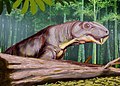


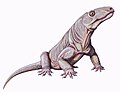


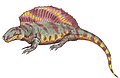


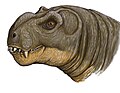


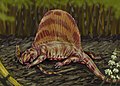
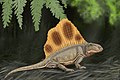


 Inostrancevia and Rubidgea skulls


.jpg)


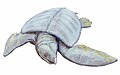
 Belemnites, but what kind?

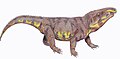


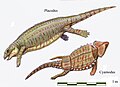


 Houcaris\Zhenghecaris^|Talk^| 13:42, 4 November 2025 (UTC)
 Houcaris\Zhenghecaris^|Talk^| 13:46, 4 November 2025 (UTC)


 This image has never been reviewed, the interpretation of it as an opabiniid is questionable but I feel like assuming it’s like other opabiniids then this looks like it might need revisions. Houcaris\Zhenghecaris^| Talk^ 19:39, 9 November 2025 (UTC)


 Reconstruction of Mieridduryn bonniae.
 2008 DiBgd's life restoration
 2013 Apokryltaros's life restoration
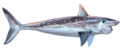 2021 Entelognathus's life restoration


 Life Reconstruction of Athabascasaurus
 A reconstruction of the extinct bivalved arthropod Vermontcaris montcalmi.
 Carnufex skull diagram
 Carnufex skeletal
 Chalishevia skull diagram
 Bharitalasuchus skeletal
 Sarmatosuchus skeletal
 Almadasuchus skeletal
 Nundasuchus skeletal
 Mandasuchus skeletal
 Erpetosuchus skull diagram adapted from Butler & Walker 2002
 Diagram showing polydactyl condition on a specimen
 Skeletal reconstruction and size comparison of 2 specimens of Erpetosuchus
 Malerisaurus skeletal
 Koilamasuchus skeletal (silhouette interchangeable as a plesiomorphic archosaur or suchian)
 Arganasuchus skeletal implementing referred skull material in the same silhouette
 Acresuchus skull diagram done with a scan of the specimen
 Fasolasuchus skeletal, only showing figured elements
 Fasolasuchus skeletal with both specimens merged and scaled to the biggest
 Zaraasuchus skeletal
 Varanosuchus skull diagram
 Varanosuchus skeletal
 Schultzsuchus skeletal
 Teleocrater skeletal


 Tupuxuara - already got some edits following Discord suggestions
 Tupandactylus navigans, but note it was originally labelled Tapejara wellnhoferi , so not sure what's going on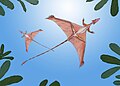


 Xotodon prominens
 Blourugia seeleyi
 Toxodon platensis
 Peraceras hessei
 Pakicetas sp.
 Leptomeryx sp.
 Zaisanamynodon protheroi
 Labrangomeryx dorcapolis
 Amynodontopsis jiyuanensis


 Reconstruction of Aquilonifer spinosis from dorsal, ventral, and lateral view
 Reconstruction of Aquilonifer spinosis from dorsal, ventral, and lateral view


 Maresaurus
 skeletal reconstruction
 Same but no dorsal armor in lateral view for visibility of neural spines
 Skull diagram


 3D reconstruction of Redkinia.


_Marjum_biota_(cropped).png)
 3D Reconstruction of Protoconites minor


 Glaucabalaena, a Gray Whale from Pliocene-era Piedmont, formerly called Glaucobalaena
 Australopithecus africanus (Mrs. Ples)
 Australopithecus africanus (Mrs. Ples)
 Homo habilis (ER-1430)
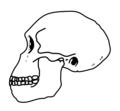 Homo habilis (ER-1430)
 H. rudolfensis (KNM-ER 1802)
 H. ergaster (ER-3733)
 H. ergaster (ER-3733)
 H. erectus (Peking man)
 H. antecessor
 H. antecessor
 H. neanderthalensis & H. sapiens
 H. neanderthalensis
 H. sapiens
 Gorilla, "Australopithecine", H. erectus, H. neanderthalensis, Steinheim, H. sapiens


.png)
.png)
 Life restoration of the extinct muensterellid Enchoteuthis melanae


 Reconstruction of Pahvantia
 Hurdia mouthpart positions by Junnn11
 Reconstruction of Houcaris saron.
 A reconstruction of Guanshancaris
 Reconstruction of Pahvantia


 A reconstruction of Pahvantia.
 Guanshancaris
 Pahvantia


 Falciscaris reconstruction
 Utahnax reconstruction.
 Crocodylus porosus
 Crocodylus thorbjarnarsoni
 Crocodylus falconensis
 Crocodylus sudani
 Skull diagram of Crocodylus checchiai
 Crocodylus checchiai
 Size comparison of Crocodylus anthropophagus, sadly, not much more could be done with the given description of this taxon


 Aquilonifer spinosis.
 Carimersa neptuni and Colymbosathon ecplecticos.
 Kenostrychus clementsi, Punk ferox, Offacolus kingi, and Cinerocaris magnifica.
 Carduispongia pedicula, Thanahita distos, Protaster sp., Haliestes dasos, Nymphatelina gravida, and Offacolus kingi.


 Arctocyon primaevus
 Limnocyon verus
 Taotienimravus songi
 Potamotherium valletoni
 Puijila darwini
 Phareodus encaustum


 Leptomitus ("Leptomitid")
 Fuxianospira gyrata (why this article is just for species)


 A life reconstruction of Cinerocaris magnifica.
 A diagrammatic reconstruction of Cinerocaris magnifica.
 A life reconstruction of Colymbosathon ecplecticos.
 A diagrammatic reconstruction of Colymbosathon ecplecticos.


