
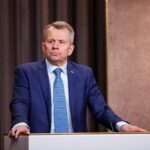






Anicet-Georges Dologuélé
Anicet-Georges Dologuélé | |
|---|---|
.jpg) Dologuélé in 2015 | |
| Prime Minister of the Central African Republic | |
| In office 4 January 1999 – 1 April 2001 | |
| President | Ange-Félix Patassé |
| Preceded by | Michel Gbezera-Bria |
| Succeeded by | Martin Ziguélé |
| Personal details | |
| Born | 17 April 1957 |
| Party | Union for Central African Renewal (2013–present) |
| Alma mater | University of Bangui University of Bordeaux |
Anicet-Georges Dologuélé (French pronunciation: [anisɛʒɔʁʒ dologele]; born 17 April 1957) is a Central African politician who was Prime Minister of the Central African Republic from 4 January 1999 to 1 April 2001. Subsequently, he was President of the Development Bank of Central African States from 2001 to 2010. He ran in the 2025 presidential election, obtaining 14.66% of the vote against incumbent Faustin-Archange Touadéra.
Life and career
Dologuélé was Minister of Finance and the Budget in the government of Prime Minister Michel Gbezera-Bria[1][2] and subsequently served as Prime Minister from 1999 to 2001. As Prime Minister, Dologuélé, who not a member of the ruling Movement for the Liberation of the Central African People, faced hostility from the party; on 1 April 2001, he was dismissed by President Ange-Félix Patassé and replaced by Martin Ziguélé. Dologuélé criticized this decision as putting political considerations ahead of "good management".[3]
Dologuélé was appointed to head the Development Bank of Central African States, remaining in that post for over eight years; he was eventually replaced by Mickaël Adandé from Gabon in January 2010.[4]
In October 2013, Dologuélé founded a political party, the Union for Central African Renewal (URCA). He also planned to stand as a candidate in the next presidential election.[5] As campaigning began for the election, which was eventually scheduled for 27 December 2015, Dologuélé presented himself as a candidate of peace and inclusion. He declared that he had "never held a weapon" and said that the ousted and exiled former President François Bozizé, who was barred from standing in the election, would be able to play some unspecified role in national affairs. Bozizé's Kwa Na Kwa party threw its support behind Dologuélé.[6] While some thirty candidates stepped forward, only Dologuélé and Faustin-Archange Touadéra qualified for the runoff on 14 February 2016. He was beaten by Touadéra in the second round, by 62 percent to 37 percent.[7] Although Dologuélé alleged fraud, he nevertheless stated that "for the sake of peace" he accepted the official results, would not appeal, and "recognize[d] Faustin-Archange Touadéra as the leader of all Central Africans".[8]
In the February–March 2016 parliamentary election, Dologuélé was elected to the National Assembly as the URCA candidate in the first constituency of Bocaranga, winning in the second round with 75.33% of the vote.[9]
In order to be able to run in the 2025 presidential election, Anicet-George Dologuélé renounced his French nationality in September 2025.[10] He was nominated as URCA's presidential candidate on 8 October following an extraordinary party congress in Bangui.[11] Later that month, his CAR passport was revoked, prompting him to file a complaint with the OHCHR.[12]
Dologuélé, who won 14.66% of the vote, placed second in the presidential election and lost to the incumbent Touadéra. However, Dologuélé disputed the results, citing alleged malpractice by the National Authority of Elections and widespread electoral fraud and declared himself the winner on 2 January 2026.[13] He then filed a protest before the Constitutional Court on 6 January. On 19 January, the Constitutional Court rejected Dologuélé's electoral protest and declared Touadéra as the winner in the presidential race, having won 77.9% of the vote, followed by Dologuélé with 13.1%.[14]
Notes
- ^ "Les Anciens Ministres". Ministère des Finances et du Budget.
- ^ "Le gouvernement de Centrafrique du 18 février 1997". Afrique Express (in French). Archived from the original on 29 September 2007. Retrieved 2 November 2016.
- ^ "Que va faire Dologuélé ?". Jeune Afrique (in French). 10 April 2001. Retrieved 2 November 2016.
- ^ Meyer, Jean-Michel (1 February 2010). "BDEAC: Anicet-Georges Dologuéle, victime collatérale". Jeune Afrique (in French). Retrieved 2 November 2015.
- ^ "RCA : naissance d'un nouveau parti de l'opposition". Radio France Internationale (in French). 26 October 2013. Retrieved 2 November 2016.
- ^ "Campaign takes off in C. Africa as 30 vie for president". Yahoo! News. 22 December 2015. Retrieved 2 November 2016.
- ^ Bradshaw & Fandos-Rius 2016, p. 49.
- ^ Dembassa-Kette, Crispin (20 February 2016). "Ex-PM Touadera wins Central African Republic presidential vote". Yahoo! News. Retrieved 2 November 2016.
- ^ "Législatives 2eme tour - Résultats provisoires circonscription(s)" (in French). National Elections Authority. 5 April 2016. p. 9. Retrieved 2 November 2016..
- ^ "Présidentielle en Centrafrique: l'opposant Anicet-Georges Dologuélé renonce à sa nationalité française" (in French). Radio France International. 2 September 2025. Retrieved 3 September 2025..
- ^ "Dologuelé enters presidential race despite opposition calls for a boycott". Africanews. 9 October 2025. Retrieved 9 October 2025.
- ^ "Central African Republic president seeks third term in election". France 24. Retrieved 2025-12-28.
- ^ Koena, Jean-Fernand; Adetayo, Ope (2026-01-06). "Central African Republic President Faustin Archange Touadéra reelected, provisional results show". AP. Archived from the original on 2026-01-06. Retrieved 2026-01-06.
- ^ "Central African Republic confirms Touadéra's election win despite fraud claims". AP News. January 19, 2026.
References
- Bradshaw, Richard; Fandos-Rius, Juan (2016). Historical Dictionary of the Central African Republic. Lanham, MD: Rowman & Littlefield. ISBN 978-0-81087-991-1.
| Ubangi-Shari (1903–1960) |  | |
|---|---|---|
| Central African Republic (1960–1976) | ||
| Central African Empire (1976–1979) | ||
| Central African Republic (1979–present) | ||
| ||

| International | |
|---|---|
| Other | |
