







Virgil, Illinois
Virgil, Illinois | |
|---|---|
 Welcome sign on Illinois Route 64 | |
| Motto: "Rooted in the Past with Pride & Tradition"[1] | |
 Location of Virgil in Kane County, Illinois | |
.svg) Location of Illinois in the United States | |
| Coordinates: 41°57′21″N 88°31′44″W / 41.95583°N 88.52889°W[2] | |
| Country | United States |
| State | Illinois |
| County | Kane |
| Township | Virgil |
| Settled | 1836 |
| Incorporated | 1990 |
| Government | |
| • Type | Mayor–council |
| • Village President | Jamie LeBlanc[citation needed] |
| Area | |
• Total | 2.18 sq mi (5.65 km2) |
| • Land | 2.18 sq mi (5.65 km2) |
| • Water | 0 sq mi (0.00 km2) |
| Elevation | 866 ft (264 m) |
| Population (2020) | |
• Total | 289 |
| • Density | 132.4/sq mi (51.11/km2) |
| Time zone | UTC-6 (CST) |
| • Summer (DST) | UTC-5 (CDT) |
| ZIP Code(s) | 60151, 60182 |
| Area codes | 630/331 |
| FIPS code | 17-78175 |
| GNIS feature ID | 2400074[2] |
| Wikimedia Commons | Virgil, Illinois |
| Website | villageofvirgil |
| [4] | |
Virgil is a village in Virgil Township, Kane County, Illinois, United States. It was incorporated on November 6, 1990.[5] The population was 289 at the 2020 census.[6]
History
.jpg)
Virgil was the site of the 2010 Illinois earthquake's epicenter in the early morning hours of February 10.[7][8]
Geography
Virgil is located in western Kane County. Illinois Route 64 passes through the village center, leading east 12 miles (19 km) to St. Charles and west 8 miles (13 km) to Sycamore.
According to the 2021 census gazetteer files, Virgil has a total area of 2.18 square miles (5.65 km2), all land.[9]
Demographics
| Census | Pop. | Note | %± |
|---|---|---|---|
| 2000 | 266 | — | |
| 2010 | 329 | 23.7% | |
| 2020 | 289 | −12.2% | |
| U.S. Decennial Census[10] | |||
2020 census
| Race / Ethnicity (NH = Non-Hispanic) | Pop 2000[11] | Pop 2010[12] | Pop 2020[13] | % 2000 | % 2010 | % 2020 |
|---|---|---|---|---|---|---|
| White alone (NH) | 255 | 302 | 257 | 95.86% | 91.79% | 88.93% |
| Black or African American alone (NH) | 3 | 6 | 5 | 1.13% | 1.82% | 1.73% |
| Native American or Alaska Native alone (NH) | 0 | 2 | 3 | 0.00% | 0.61% | 1.04% |
| Asian alone (NH) | 1 | 5 | 0 | 0.38% | 1.52% | 0.00% |
| Native Hawaiian or Pacific Islander alone (NH) | 0 | 0 | 0 | 0.00% | 0.00% | 0.00% |
| Other race alone (NH) | 0 | 0 | 0 | 0.00% | 0.00% | 0.00% |
| Mixed race or Multiracial (NH) | 2 | 4 | 4 | 0.75% | 1.22% | 1.38% |
| Hispanic or Latino (any race) | 5 | 10 | 20 | 1.88% | 3.04% | 6.92% |
| Total | 266 | 329 | 289 | 100.00% | 100.00% | 100.00% |
As of the 2020 census[6] there were 289 people, 132 households, and 113 families residing in the village. The population density was 132.39 inhabitants per square mile (51.12/km2). There were 119 housing units at an average density of 54.51 per square mile (21.05/km2). The racial makeup of the village was 90.31% White, 1.73% African American, 1.04% Native American, 0.35% Asian, 0.00% Pacific Islander, 3.11% from other races, and 3.46% from two or more races. Hispanic or Latino of any race were 6.92% of the population.
There were 132 households, out of which 35.6% had children under the age of 18 living with them, 63.64% were married couples living together, 16.67% had a female householder with no husband present, and 14.39% were non-families. 12.12% of all households were made up of individuals, and 6.06% had someone living alone who was 65 years of age or older. The average household size was 3.39 and the average family size was 3.15.
The village's age distribution consisted of 22.6% under the age of 18, 9.0% from 18 to 24, 24.2% from 25 to 44, 28.1% from 45 to 64, and 16.2% who were 65 years of age or older. The median age was 41.9 years. For every 100 females, there were 135.2 males. For every 100 females age 18 and over, there were 120.3 males.
The median income for a household in the village was $83,333, and the median income for a family was $90,417. Males had a median income of $45,096 versus $43,333 for females. The per capita income for the village was $33,216. About 3.5% of families and 4.0% of the population were below the poverty line, including 1.1% of those under age 18 and 0.0% of those age 65 or over.
See also

References
- ^ "Welcome to Virgil, Illinois". Village of Virgil. Retrieved February 14, 2019.
- ^ a b c U.S. Geological Survey Geographic Names Information System: Virgil, Illinois
- ^ "2020 U.S. Gazetteer Files". United States Census Bureau. Retrieved March 15, 2022.
- ^ "Virgil village, Illinois - Fact Sheet". American FactFinder. U.S. Census Bureau. 2000. Retrieved February 16, 2010.
{{cite web}}: CS1 maint: deprecated archival service (link) - ^ Official website
- ^ a b "Explore Census Data". data.census.gov. Retrieved June 28, 2022.
- ^ "Small earthquake wakes up northern Ill., no damage". WGEM-TV. February 10, 2010. Archived from the original on July 17, 2011. Retrieved February 16, 2010.
- ^ Greene, Richard Allen (February 10, 2010). "Earthquake rattles northern Illinois". CNN. Retrieved February 16, 2010.
- ^ US Census Bureau. "Gazetteer Files". Census.gov. Retrieved June 29, 2022.
- ^ "Census of Population and Housing". Census.gov. Retrieved June 4, 2015.
- ^ "P004: Hispanic or Latino, and Not Hispanic or Latino by Race – 2000: DEC Summary File 1 – Virgil village, Illinois". United States Census Bureau.
- ^ "P2: Hispanic or Latino, and Not Hispanic or Latino by Race – 2010: DEC Redistricting Data (PL 94-171) – Virgil village, Illinois". United States Census Bureau.
- ^ "P2: Hispanic or Latino, and Not Hispanic or Latino by Race – 2020: DEC Redistricting Data (PL 94-171) – Virgil village, Illinois". United States Census Bureau.
External links
Places adjacent to Virgil, Illinois | |
|---|---|


Municipalities and communities of Kane County, Illinois, United States | ||
|---|---|---|
| Cities | 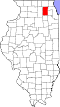 | |
| Villages | ||
| Townships | ||
| CDP | ||
| Other unincorporated communities | ||
| Footnotes | ‡This populated place also has portions in an adjacent county or counties | |