









Thuggee
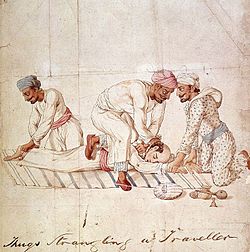
 Depiction of thugs about to strangle a traveller, c. 1837[a] | |
| Date | Possibly 17th or 18th centuries – 1840s[4][5][6] |
|---|---|
| Location | Indian subcontinent, mainly central India[7] |
| Cause | Socioeconomic factors, disputed religious origins |
| Motive | Robbery, alleged human sacrifice |
| Target | Travellers |
| Deaths | ~1,000 exhumed[8] Estimated 50,000–100,000 total[9] |
| Convictions | 1,368 (1826–1835)[10] 4,224 (1826–1847)[11] 1,545 (estimated 1826–1835)[12] 6,366 (estimated as of 1840)[12] |
Thuggee (UK: /θʌˈɡiː/ thuh-GHEE, US: /ˈθʌɡi/ THUH-ghee; Hindustani: ठगी or ٿهگی, pronounced [ʈʰə.ɡiː]) was a phenomenon of highway robbery in the Indian subcontinent that saw gangs of thugs (sometimes spelled thags) traverse the region murdering and robbing travellers, often by strangling. However, there is a general consensus among historians against the cultic portrayal popularised by the British colonial authorities.[13]
The thuggee phenomenon came to prominence in the early 19th century, in the course of which the British colonial authorities came to propagate a view of thuggee as a secret pan-Indian fraternity of ritual stranglers driven by fanaticism and bloodlust, with ancient origins.[14] Colonial administrator William Henry Sleeman led a policing campaign against thuggee in the 1830s that saw the Thuggee Department formally established in 1835 and legal developments that facilitated convictions. Sleeman and his colleagues published works on thuggee and recorded interviews with approvers,[b] which remain the only sources on the phenomenon. Thuggee was portrayed as 'hereditary criminality' and provided a precedent for the 1871 Criminal Tribes Act.
Contemporary historians generally view the colonial-era portrayal of thuggee, at least to some extent, as a colonial construct, though they offer varying hypotheses as to the actual nature of the phenomenon.[13][16] Historians' reinterpretations generally contest the significance of religion to thuggee and have emphasised the diversity of individuals arrested over the course of the campaign. A theory that has gained traction among historians views the phenomenon as arising out of itinerant mercenary bands following a contraction in the military labour market caused by the British conquest. Scholars have described the 19th century representation as an invention by the British regime to legitimise colonial rule and justify an extension of the East India Company's power.
Following the publication of the 1839 novel Confessions of a Thug, thuggee became a Victorian sensation. Notable depictions in modern popular fiction include the 1984 film Indiana Jones and the Temple of Doom.[17][18]
Etymology
Thug (Hindustani: ठग; ٹھگ) translates to 'swindler' or 'deceiver' and is derived from the Sanskrit word स्थग (sthaga) meaning 'to cover' or 'to conceal'.[19][20][21] The earliest generally accepted usage of the word dates to 1350 and the Janamsakhis evidence that 'thag' came to be used more or less interchangeably with 'robber' in precolonial India.[22][23] The English word thug is from the same roots.[24] The word phansigar (फाँसीगार; پھانسی گار) literally meaning 'strangler' was used interchangeably with 'thug' during the 19th century and tended to be the term used in the Madras Presidency.[25] Thuggee refers to the practise of thugs and the crime itself.[26]
History
During his travels across India in the 7th century, the Chinese monk Hsüen Tsang was attacked by pirates on the Ganges and narrowly escaped being sacrificed to Durga.[27][28] On another occasion, and while he was journeying to Pataliputra, Hsüen Tsang was told while passing a temple that no foreigner who entered it ever came out again.[27] These incidents have been interpreted as early accounts of thuggee.[28][29][30] Kim A. Wagner asserts the view that, by this rationale, every account of banditry and human sacrifice in ancient India could be linked to the thugs of the 19th century.[28] According to a 14th century chronicle by Ziauddin Barani, Sultan of Delhi Jalal-ud-Din Khalji deported 1,000 arrested 'thags' from Delhi to Bengal sometime between 1290 and 1296, however the chronicle makes no mention of what they were arrested for.[29][22][28] The 15th–16th century poet Surdas wrote illustratively of a 'thag' luring a pilgrim with sweets and wine and then murdering and robbing them.[31]
Following his travels across India in 1666–1667, Jean de Thévenot wrote in 1684 of the "cunningest robbers in the world" operating in the Delhi area that strangled their victims with a running noose and used attractive women to lure travellers.[32][33] In 1672, Mughal emperor Aurangzeb issued a farman specifying the punishment to be meted out to stranglers, including those that were "habituated to the work" or were notorious for it among the local population.[34][35][36] John Fryer wrote of his experience in 1675 witnessing the execution of fifteen members of a bandit gang near Surat that had strangled and robbed passing travellers using a cotton bowstring.[37][38][39] In 1785, James Forbes recounted how an Indian acquaintance had witnessed the arrest of several men that belonged to a tribe he referred to as phanseegars, describing how they would deceive and strangle travellers.[40] A November 1797 tax list prepared for Maharaja Daulat Rao Sindhia covering 20 villages across the parganas of Parihara and Sursae lists 318 houses as belonging to thugs, who were subjected to a soldier tax.[41][42]
Colonial era
Etawah crisis (1809–1811)


The British colonial authorities first encountered what they would come to refer to as thuggee in Southern India in 1807 and in Northern India in 1809.[43] In April 1809, ten bodies were discovered in a well in the Etawah district (newly ceded in 1801), with the Magistrate of Etawah James Law tasked with investigating the killings.[44] Amid the failure of Law's inquiries and the discovery of four strangled native soldiers in a jungle within his jurisdiction in July, the two magistrates of the neighbouring Aligarh and Farrukhabad districts were assigned to the matter.[45] In November, Law's assistant made the first officially recorded reference to 'Thugs', describing them as "a set of people... who have from time immemorial carried on their abominable and lamentable practices" in secret.[46]
Following the discovery of two strangled travellers in December and the initiation of a more thorough investigation, Law wrote: "It is presumed that the murdered persons were travellers and fell victims to that detestable race of monsters called T,ugs... The T,ugs have infested the whole of the Doab, and this district in particular, from time immemorial, and they are so strongly leagued together, that scarcely an instance has ever been known of their having betrayed each others secrets."[47] More bodies were discovered throughout December and early 1810, in the midst of which Law was removed from his post, and when questioned by an investigation in February, local zamindars reported that the perpetrators were "Thugs".[48] The findings reported by the colonial authorities in the north were nearly identical to those reported in the south in 1807 despite there having been no formal exchange between the Madras and Bengal presidencies.[49]
Law's replacement, Thomas Perry, offered a large reward of Rs 1,000 for information leading to the arrest of the perpetrators.[50][51] After eight suspected thugs were arrested in March 1810, a young thug who had been adopted by the gang after they had murdered his father and uncle agreed to testify at trial in return for a pardon and claimed that there were some 1,500 thugs based in Etawah.[52][51] At the trial in November, he demonstrated for the court how the gang would strangle their victims with strips of cloth and testified to having been on five expeditions with the thugs, witnessing 95 murders.[53][54] However, he repeatedly changed his testimony regarding the extent of his own involvement and ultimately had his evidence rejected for repeated perjury, whereafter Perry was admonished by the Company's supreme court (the Nizamat Adalat) and forced to release the suspects.[55][56]
1810s and 1820s
Regulation VI of 1810 first referred to Thugs as a distinct criminal category, alongside Dacoits, Cozauks, and Buddecks.[57] Though many individuals were convicted and sentenced to death by the circuit courts in the early attempts to combat thuggee, all the cases were ultimately dismissed by the superior courts owing to strict evidentiary requirements.[58] In October 1812, Nathaniel John Halhed[c] was tasked with leading an expedition to introduce British law and order and to set up a thana in Sindouse (located in the pargana of Parihara, southernmost Etawah), where thugs were allegedly retained by Rajput zamindars as local mercenaries.[61][62][63] The operation caused the thugs to disperse into neighbouring Maratha territory, though led to the death of a British officer for which the village of Murnae was razed the following month.[64][62] Regulation VIII of 1818 effectively allowed notorious Dacoits to be held indefinitely, with Regulation III of 1819 extending its provisions to also apply to Thugs.[65][66] In the 1820s the colonial authorities began to adopt a new strategy of handing captured thugs over to local rulers and chiefs to circumvent the British colonial legal system and convict them by proxy.[67]
The first Thugs were convicted in Sagar in 1826, whereby two were sentenced to be hanged and a further 29 sentenced to transportation for life.[68][69] This was possible due to Sagar and Narbada being established in 1818 as 'Non-Regulation Territories', meaning that the Agent at Sagar could operate outside the usual Company regulations with virtually unlimited powers.[68] In 1829 in the Bombay Presidency, two Thugs were sentenced to hanging, six to transportation, and one to life imprisonment for the murder of six men carrying Rs 100,000 of valuables in February.[70] Later that year, the Agent at Mahidpur Captain William Borthwick arrested 74 Thugs for the murder of five travellers.[71][72][73] Up until this point, efforts to combat thuggee were led by local authorities and the case marked the first time the central government intervened to ensure that the Thugs were convicted and to develop a judicial argument that saw Thugs treated in the same vein as pirates.[74][72] Forty of the Thugs were hanged, 20 sentenced to transportation for life, and a further 12 received limited sentences.[75]
Centralised campaign (1830–1839)

Captain William Henry Sleeman, as assistant to the Agent at Jabalpur, began assigning approvers (the period term for informants)[15] that he had in custody to escort detachments of troops along exposed routes and his methods led to the arrests of 24 thugs in late 1829.[75] Sleeman and Borthwick's arrests led to an extensive exchange of information between officials and the sharing of approvers, resulting in a spate of arrests over the course of 1830.[77] In October, Sleeman contributed an anonymous letter to the Calcutta Literary Gazette entitled 'Thugs' that recounted the execution of 11 Thugs and asserted that thugs were fanatical worshippers of the Devi, including Kali.[78][79][80] The letter also asserted that the thugs were headquartered at the Vindhyachal Temple near Mirzapur, where their expeditions were planned by the temple priests.[81] He further provided details on the alleged religious nature of thuggee and demanded that the government "put an end in some way or other to this dreadful system of murder, by which thousands of human beings are now annually sacrificed upon every great road throughout India".[81][82]

The letter made an impression on the Government, with the Chief Secretary to the Governor-General of India George Swinton writing the following day that the destruction of "this Tribe would... be a blessing conferred on the people of India" comparable to the abolition of sati.[83][62] Swinton was the prime instigator within the Government of efforts to combat thuggee and, while the author of the letter remained anonymous, appointed Sleeman Agent at Sagar later that month.[83] Agent of the Sagar and Narbada Territories Francis Curwen Smith submitted a plan in November that he had written with Sleeman and which called for an officer to be appointed Superintendent for the Suppression of Thugs, who would send Thugs to be tried in the Sagar and Narbada Territories.[84] The report marked the first portrayal of thuggee as an irredeemable identity, based on the Thug's purported personality and thuggee gangs often involving sons of members.[85] Governor-General Lord William Bentinck declined to establish a specific office for thuggee, though he provided Sleeman with 50 barkandazes (mercenaries) to pursue and apprehend the gangs.[85]
Anti-thuggee operations continued under the direction of Smith and Sleeman, whereby approvers were sent out with detachments of troops to disinter bodies and point out their former associates, with the campaign's supply of approvers growing as more Thugs were caught.[86] In November 1830, Sleeman captured the thuggee leader Feringheea after holding his relatives captive, whereafter he became Sleeman's most valuable approver.[86][87] In 1832 and 1833, respectively, officials were despatched to the Doab and Rajputana to oversee anti-thuggee operations there.[88] Thugs were convicted based on circumstantial evidence and approver testimony and, between 1832–1833, 145 Thugs were hanged, 323 sentenced to deportation, and 41 given life in prison by the Sagar and Narbada courts.[86][12] Sleeman successfully played different thuggee factions off of one another to secure approver testimony, exploiting the varying loyalties between different families and castes within the gangs, such as between Hindu and Muslim thugs.[86]
In 1834, Smith began to call for a central agency for the suppression of thuggee that would station officials in more territories.[88] Backed by an official report, the Government established the Thuggee Department in January 1835 and appointed Sleeman 'General Superintendent of the operations for the suppression of Thuggee' in March.[88] In 1836, 'river-thugs' operating on the Ganges were discovered in Bihar, Orissa, and Bengal, whose methods of throwing their victims overboard meant that there was very little circumstantial evidence with which to convict them.[89] Sleeman used this to argue that new regulation was required to enable convictions and the groundbreaking Act XXX of 1836 was passed, which made simply belonging to a thuggee gang punishable by life imprisonment with hard labour.[89][90] The term 'Thug' was not defined and it thereafter became a legal umbrella-term for a range of crimes such as poisoning (datura-thugs), while the original thuggee gangs that could be traced back to Sindouse had practically ceased to exist by this point.[91] Dacoity was added to Sleeman's responsibilities in 1838 as thuggee activity had been effectively suppressed and, in 1839, he coined the term Megpunnaism to refer to the murder of impoverished parents to attain their children for sale, portraying it as a new form of thuggee.[91][92] Following the failure of efforts by the Thuggee and Dacoity Department to apply anti-thuggee legislation to itinerant communities such as Thoris and Jogis, Sleeman declared in 1839 that thuggee had been eradicated, marking the end of the campaign.[93][94][95][96] As of 1840, 3,869 Thugs were estimated to have been hanged, 1,564 sentenced to deportation, 933 imprisoned for life, and 86 acquitted while 56 became approvers and 208 died before trial.[12] Between c. 1826 and 1841, thuggee trials had a conviction rate of 98.9%.[97]

In 1839, Philip Meadows Taylor published the historical fiction novel Confessions of a Thug, which derived much of its material from Sleeman's writings.[99] Thuggee thereafter became a Victorian sensation, with Queen Victoria herself requesting the pre-publication proofs of Taylor's book, witnessing the birth of a literary tradition.[100][26][101] Among those to write about thuggee were Eugène Sue in his 1844 book Le Juif errant and Mark Twain in his 1897 book Following the Equator.[98]
The thuggee campaign of the 1830s provided a model for the later shift to a centralised police bureaucracy and established an all-India framework for policing and surveillance.[102] The Thuggee and Dacoity Department remained in existence until 1904, when it was replaced by the Central Criminal Intelligence Department.[103] The campaign marked one of the first times that the study of criminality was recognised and co-opted into colonial rule.[104] The 1836 Thuggee Act set a precedent for the trying of 'criminal communities' that culminated in the 1871 Criminal Tribes Act (CTA).[105][106][107][108] Though the CTA was repealed in 1949, tribes considered criminal still exist in India today.[109]
Historical evaluations
Sources and historicity
The only sources that exist on thuggee are those written by Sleeman and his colleagues, meaning that historians have no alternative accounts with which to confirm, balance, or invalidate the colonial sources.[110] Historians such as Stewart N. Gordon, Christopher Bayly, Martine van Woerkens, Kim A. Wagner, and Mike Dash have sought to engage with the sources to revise Sleeman's colonial-era representation and reconstruct thuggee.[111] While historian Tom Lloyd doesn't reject this approach, he criticises the assumption that the sources present a truth waiting to be uncovered and asserts the view that the sources can only be used to study its representations.[112] Literary scholar Amal Chatterjee describes the colonial representation of thuggee as "a fiction that served all the interests of British power in India", wherein it provided conclusive proof of the moral superiority of the 'advanced' European over the 'primitive' Indian and was presented as a triumph of Christian faith over Indian tradition.[113] Lloyd notes that the British authorities moulded thuggee into what the Company needed it to be while van Woerkens points to how thuggee allowed the British to reformulate their relations with native states.[112][114] Wagner describes the events of the 1830s as a moral panic.[115] Historian Parama Roy asserts that the colonial discourse on thuggee was highly self-referential, discrepancies between approver accounts were smoothed over, and approvers were driven to authenticate the official knowledge of thuggee.[116]
Wagner argues that, though the colonial representation cannot be taken at face value, it was not invented from nothing, and historians can clearly identify and evaluate the biases that permeate the texts due to them also including the questions asked by the British officials.[117] Alexander Lyon Macfie concludes that, though the thuggee archive should be seen in part as an Orientalist construction, it is broadly accurate in its presentation of most of the facts.[118] To evidence that the sources point to some sort of social reality, Wagner and Dash cite consistencies across the first reports of thuggee that they judge to have been made without knowledge of the others.[119][8] Van Woerkens holds the thugs' recorded argot of Ramasee to place them in a "concrete reality".[120] Dash further points to British efforts to keep their approvers isolated from one another and the bodies that were exhumed.[8] Wagner cites the volume of information collected by British officials that had no bearing on legal procedures as evidence that thuggee was not simply a colonial project for control over their Indian subjects.[115] Wagner also visited Sindouse (modern day Sindaus, Uttar Pradesh) in 2001 and found that the presence of thugs and the 1812 attack were remembered in local tradition.[121]
Historical revisionism
According to Wagner and a theory first posited by historian Hiralal Gupta in 1959, the proliferation of thuggee came about due to the expansion of British rule that constrained the previously dynamic military labour market and East India Company policy that led to the disbandment of native standing armies in the late 18th and early 19th centuries.[122] The theory holds that this left scores of armed men and itinerant mercenaries unemployed, some of whom resorted to thuggee, with Wagner positing that the disbanded soldiers, who were often paid with loot, merely continued their predatory lifestyle.[123] Historian Radhika Singha describes how highway robbery was probably practised by mercenary bands moving between employers and may have become permanent as the market contracted.[124] Wagner asserts the view that the thugs were "no more than a species of robber... best understood in the context of banditry rather than some vague notion of a religious sect or caste-like entity".[125] He judges that thuggee could be distinguished from other types of banditry based on the combination of secrecy, deception, and the murder of the victims.[126] Wagner concludes that thuggee was a longstanding phenomenon predating British colonial rule and that there was not a single representative thug archetype.[127]
Martine van Woerkens, who authored the first scholarly monograph on thuggee in 2002,[128] conversely theorises that the thugs had once been authentic worshippers of Kali but that their religious construction had broken down over time and their community identity had disintegrated due to geographical dispersion.[129] Van Woerkens suggests that the thugs may have been made up of Banjaras, Pindaris, and Nagas whose livelihoods were disrupted by the British conquest.[130] Mike Dash surmises that thuggee could not be considered 'organised crime' in the modern sense of the term as the thugs lacked a central organisation or complex hierarchy, describing them as "merely one product, among many, of India’s lawless interior".[35] Dash describes the distinguishing feature of thugs as being that they invariably murdered their victims before robbing them.[8]
Beyond mere sensationalism, Wilhelm Halbfass notes that the Thuggee phenomenon appealed to the British sense of destiny in India, whereby it was used to legitimise colonial rule.[131] Christopher Bayly posited that the initial reaction of the British authorities to thuggee arose out of an 'information panic' whereby the nascent colonial administration feared their lack of knowledge about the local population and that the locals were conspiring to deny it information.[132][133] Van Woerkens describes the colonial-era portrayal of thuggee as a projection of British fear and anxiety arising from the prospect of ruling over a people they knew little about.[134] According to Wagner, some officials "clearly" exploited the Government's concern over thuggee to assume more authority, with Sleeman's opportunism merely part of a wider trend that he refined.[67] The thuggee campaign also saw the British authorities assert their right to 'paramount authority' in India in territories belonging to independent rulers, who were seen as failing in their duty to protect the local population.[135][136][137] Thuggee became one of the most potent images of colonial lore and fiction, and historians in the colonial tradition have cited the thuggee campaign in particular to redeem the record of Company rule.[138]
Culture and beliefs
Methods

Thuggee gangs embarked on seasonal expeditions for months at a time, typically leaving in Kartika after the autumn harvest and returning around Asharh at the start of the monsoon season.[140] Among the main victims of thuggee were sepoys, soldiers of native rulers, and Hindu and Muslim pilgrims.[141] The thugs would ingratiate themselves among parties of travellers based on mutual protection, adopting a range of disguises as soldiers in search of work, merchants, mendicants, wealthy people, Brahmins, sepoys, pundits, or travellers.[142] Though thugs would sometimes murder for modest sums, they preferred wealthy victims and surveilled travellers to ascertain their wealth.[143][144]
The thugs would distract their victims or entice them to look up, upon which, using a handkerchief with a knot tied at the end as a sort of handle, one thug would strangle the victim while another held their hands.[145][146] Thugs might strangle their victims in the night or wake them up, pretending it to be dawn, and take them to a secluded spot along the road.[143][146] They sometimes administered datura seeds to their victims to incapacitate them before killing them.[147][148] Thugs would quite often also murder their victims with swords, knives, or poison, whereafter their bodies would be thrown into a well or a nullah, or buried in a hole dug with pickaxes.[149][150]

There were no eyewitnesses since every member of the party was murdered and little circumstantial evidence as the act was done by stealth, while items such as a rumāl, scarf, dhoti, wrap, cord, or even a knife and sword were likely to be found on innocent travellers.[152][153] It was also a recorded practice among thugs to stab their victims in the face to prevent them from being recognised.[154][155][156] Wagner describes thuggee as being "very close to being the 'perfect crime'", noting that its inexpensive nature made it accessible to a wide range of people.[126] The 1836 Thuggee Act was later used to prosecute child trafficking and robbers who non-lethally poisoned their victims.[157][91][158] Amid controversy over the jurisdiction of the Thuggee and Dacoity Department, thuggee was defined in Act III of 1848 to include poisoning as a species of thuggee and 'child-stealing'.[157]
Religious beliefs
Depositions of thugs conducted in the 1830s contain accounts of rituals and ceremonies that they partook in during their expeditions.[159] In the interviews, Sleeman's colleague Captain James Paton specifically honed in on the thugs' religious orientations, asking loaded questions based on Christian thought.[160] When conducting the interviews, Sleeman and Paton were predominantly interested in the goddess-worship of the thugs, their observance of rules and omens, and the variance between different gangs' customs.[161] Wagner holds their "extreme interest" in matters of religion to "very likely" have influenced the manner in which the approvers discussed their own identities.[161] The significance of religion to thuggee has been a matter of debate among historians, epitomised by Jorge Luis Borges in 1923 when, after reading Confessions of a Thug, he posed the question: "Were the Thugs brigands who sanctified their profession with the cult of the goddess [Bhavani], or was it the cult of the Goddess [Bhavani] that turned them into brigands?"[162]
Thugs worshipped different manifestations of the Devi, of which Bhavani was most often referred to, alongside Kali and others, in what composed a variety of traditions.[163][164] According to Wagner and van Woerkens, they believed their actions to be sanctioned by the Devi.[127][165] Though the British were fascinated by the fact that Muslims worshipped Hindu deities, religious syncretism in India was common.[166][167] According to Cynthia Ann Humes, Thug testimony only rarely referred to Bhavani, mostly in response to Sleeman's leading questions, and the Islamic concept of fate was invoked most often.[168] Some Muslim approvers identified Bhavani with Fatima and therein maintained their belief in monotheism, while others worshipped Bhavani but disowned her upon turning King's evidence.[166][169]
The thugs also held a myth of divine origins based on a story from the Devi Mahatmya in which Kali fought with the demon Raktabīja, aided by a group of goddesses called Matrikas— in the thugs' version, they took the place of the Matrikas and Kali defeated the final demons with strangulation.[170][171] It remains unclear whether the myth held Kali to have created the progenitors of thugs, as Sleeman claimed.[170][171] Thugs ate consecrated goor in honour of the Devi and made offerings to her before their expeditions.[172][173][174] They strongly adhered to omens, with a bad omen such as an owl chirping at the wrong time being enough to abort a murder.[175][176][177] Thugs' rules forbade them from murdering women or members of certain lower castes.[170][178][179]
_-_Copy.jpg)
Dr. Richard C. Sherwood, who authored the first scholarly work on thuggee out of the Madras Presidency in 1816, was the first to mention religion in connection with the phenomenon.[181][182][183] Sherwood described the phansigars as highly superstitious, who, though some of them were Muslim, held Kali as their tutelary deity.[184] In making an argument for the inadequacy of regulation in 1818, Perry's assistant made the earliest known reference to thuggee having a religious element, whereby he claimed that they "worshipped and sacrificed a kid to obtain the auspicious protection of their deity".[185] By the early 1830s, the religious elements of thuggee had been sensationalised by Sleeman and brought to the fore, leading to an institutionalised portrayal of thugs as soldiers of the Goddess for which they engaged in human sacrifice.[186][187]
According to Wagner and historian Radhika Singha, the religious beliefs and practices of those who practised thuggee were common in the wider population.[188][189] Wagner states that "robbers, who did not worship a tutelary deity, perform pujas or entertain certain beliefs concerning the moral sanction of their acts would have been truly exceptional in an Indian context".[190] Singha asserts that the examining officers of the Thuggee Department were "in fact becoming acquainted with popular religion and culture but refracted through the prism of criminality".[189] Dash similarly surmises that the motives behind thuggee weren't religious in nature, concluding that the thugs' beliefs were closer to folklore than a distinct faith.[191] Wagner notes that ordinary dacoits, who were never assumed to have religious motivations, also held a puja before and after robberies.[163] According to Wagner, the thugs' invocation of Bhavani before their execution was in fact the war cry of Marathas and Rajputs.[163] He argues that the incentive for thuggee most likely had nothing to do with religion and that the thugs' pursuit of legitimacy and moral or social status, for which they ascribed a ritual and religious meaning to their acts, lay behind the aspects of thuggee that attracted the attention of the British.[190][192]

In contrast to this, van Woerkens places the thugs in a Tantric tradition based on Halbfass's work linking them to the Samsaramochaka, religious killers briefly mentioned by Kumārila Bhaṭṭa that believed himsa (antithetical to ahimsa) to be virtuous, and Yoginis in the Netratantra that sacrifice human beings to unite their victims with Shiva.[194]
Based on interviews in which Thugs were asked how it was that they were about to be hanged if they were divinely protected, van Woerkens concludes that the thugs had once been true shaktas but had since neglected their rituals and the rules of their vocation.[195] Van Woerkens posits that the thugs' internal belief system had collapsed due to an "unbounded lust for loot" that caused their quest for salvation to devolve from ritually controlled violent actions to mass crimes for which the goods they stole no longer constituted divine payments in return for the sacrificial victims.[196] She concludes that the thugs didn't constitute a sect since they lacked a parampara.[197] Wagner holds van Woerkens to have deconstructed the colonial representation of thuggee only to use Sleeman's account to resurrect it.[128]
Customs and place in society
According to the daroga of Sindouse in 1810, the locals supported themselves by cultivating the land for eight months of the year and for the remainder by horse trading or committing thuggee.[198] A patwari from Parihara stated in 1812 that the thugs had been living in the area for generations and never cultivated the land, but brought back valuables from their expeditions.[198] He also stated that the local zamindars took care of their families while they were gone and earned interest on loans given to the thugs.[198] According to Wagner, the thugs were also commonly and interchangeably referred to by themselves and others as sepoys (meaning 'soldier' or 'retainer').[199] The thugs borrowed military terminology in their use of jemadar to mean gang leader and subedar for when several bands joined together.[144][200][201] Evidenced by the 1797 tax list, Wagner concludes that thuggee was completely institutionalised into the local power structure, whereby thugs were among the armed retainers under the patronage of zamindars.[125] He further asserts that, rather than encompassing a "counter-society... fully excluded from the 'law-abiding' sedentary society", links between various thuggee gangs and various communities evidence a loose-knit "itinerant underworld" that encompassed overlapping networks of people who committed various crimes.[125]
Thugs commonly spared the children of their victims, and a large number of them were consequently adopted.[202][203][204] Girls were married off to the sons or relatives of their adoptee, thus avoiding the costs of a dowry, while boys tended to go to childless parents in the context of high infant mortality rates.[202][205][204] Thugs didn't always spare children, and, according to Wagner, only well-off thugs with a secure home base tended to adopt them.[202][206]

The thugs used a criminal argot called Ramasee, which was compiled by Sleeman from interviews with more than a dozen Thugs in his 1836 seminal work on thuggee Ramaseeana.[208][79] Sleeman perceived the "peculiar language" as being the key to uncovering thuggee and collected the vocabulary with a focus on establishing the thugs as rigidly governed by fixed rituals, rules, and omens.[208] Sherwood had also published in 1816 a list of 57 "slang terms and phrases" from phansigars imprisoned in Madras, 20 of which also appeared in Sleeman's vocabulary derived from Thugs in northern and central India.[209][210]
Thugs used the argot to communicate in front of their victims, to identify other thugs, and to define identity and status.[211][212][213] The argot involved giving secondary meanings to established words and phrases so as not to arouse suspicion, such as using Tumbakoolao ('bring tobacco') to give the signal for the murders to take place.[214][146][215] Similar argots were used by many different groups in 19th-century India as the lingua franca of the itinerant underworld and trading communities, with Wagner surmising that Ramasee wasn't exclusive to thugs.[216][146] Wagner disputes that Ramasee could be thought of as a language, or even as a fixed argot, and asserts that it was also employed by traders, jugglers, and peddlers.[217][218]
Hereditary nature
During the 1830s British officials propagated a representation of thuggee and thugs as an all-India conspiracy and an irredeemable hereditary criminal fraternity, which allowed them to win the case for special procedures.[219][220][221] Though Sherwood described the phanisigars as "hereditary murderers and plunderers", he posited that their lack of compassion and ruthlessness was due to their never having known an alternative rather than an inherent evil.[184] According to an 1834 report by the Thugee Department officer in Rajputana Donald Friell McLeod, the thugs believed that they all originated from a group 15 generations prior that settled around Delhi under the protection of the Mughal emperor.[222] At this point, according to the legend, they didn't commit any crimes but were forced to flee after murdering one of their associates, giving rise to seven nomadic Muslim clans.[223] Starting from the 1797 tax list, Sleeman made detailed genealogies of thugs that he published in Ramseeana, though they tended not to stretch further back than three generations and included the names of adopted children.[41][224] The colonial-era portrayal saw thuggee as an "ancient practice", with Sleeman arguing that the Sagartii of the 5th century BCE were ancestors of the stranglers described by Thévenot.[225][226][227]
According to Wagner, while many thugs followed a family tradition and were rooted in their village, some were 'occasional thugs' who fell in and out of the practice.[228] Wagner asserts that thuggee was not a uniform phenomenon and that neither were the individuals who practised it, further stating that the extant sources do not allow for discussion about the existence of thuggee prior to the 17th century.[229] Singha and Lloyd similarly emphasise the diversity of individuals arrested for thuggee, with Singha noting that Thugs' alternative occupations were often dismissed by the colonial authorities as disguises.[230][231] Singha considers the vast amount of material generated by the Thuggee and Dacoity Department on the hereditary nature of Thugs and Dacoits to, in reality, disguise the failure of the colonial regime to set up mechanisms of policing and prosecution capable of tying the specific offense to the individual offender.[232] Singha attributes the subsequent conception of whole communities as 'criminal' to a wider process of colonial pacification.[233]
Notable groups

British officials recorded extensive lists of subgroupings, and the colonial-era material on thuggee alludes to some 40 different 'classes' of Thugs.[234] Notable groups include:
- Sindouse Thugs: based around the town of Sindouse on the Yamuna river (modern day Sindaus, Uttar Pradesh), which as of 1812 was on the British-Maratha border while the neighbouring village of Murnae was on the Maratha side.[235] Feringheea heralded from the area.[236][237] After the 1812 campaign, the Sindouse thugs resettled in villages in Jagammanpur and Jalaun or fled further south.[238][239] Laljee, the head zamindar of Sindouse who had protected the gangs and given them financial advances, was arrested in December 1812 amid a Rs 5,000 reward for his capture and sentenced to life in prison with hard labour.[240][241]
- Telingana Thugs: from the Telangana region in the north of the Deccan.[35][242] Other groups of thugs from the area reportedly refused to mix with them on the basis that they were descended from cattle herders and itinerant tradesmen, and thus of a lower caste.[243][242]
- Moltanee (Multaneea) Thugs: deriving their name from the city of Multan.[244][245] They supposedly strangled their victims with the leather thongs they used to drive their oxen, suggesting that their main occupation was cattle herding and transportation.[236][246][35]
- Soosea Thugs: recorded as being based in Rajastan and Malwa, operating in Gujarat, Khandesh and in Rajasthan.[245] The biggest thuggee haul has been attributed to a Soosea gang from Rajputana, amounting to Rs 200,000 seized in Khandesh in the early 19th century.[247]
- River Thugs: operated on the Ganges in Bihar, Bengal, and Orissa.[89][248] Numbering approximately 300, they tricked passengers onto their boats and strangled them, whereafter they would throw the bodies overboard.[89][249] Discovered by the British authorities in 1836, they were largely suppressed by 1840.[89][96]
- Megpunna Thugs: a loose association of thieves discovered in the vicinity of Delhi that included itinerant groups such as the Banjara and Naik, but otherwise shared a similar modus operandi, argot, and religious beliefs to common thugs.[250][236] They murdered parents to sell their children, typically strangling them with reins, and were officially classified as Thugs in 1839.[251][248] According to Dash, they originated in 1826 and never numbered more than 200 men and women, being mostly restricted to Delhi and Rajputana.[250]
- Tashma-baz Thugs: thimble-riggers found on the outskirts of Cawnpore in 1848 that were legally classified as Thugs due to their having murdered and robbed a few travellers that they had met on the roads.[236][252][248]
Approvers

Thugs were motivated to become approvers to avoid the death penalty, whereby they confessed to specific crimes and, after they were conditionally pardoned, provided depositions.[236][254][255] Around 100 Thugs were accepted as approvers by Sleeman and his colleagues and approver testimony and interviews served as the British authorities' main source of information on the phenomenon.[256][236] Wagner notes that, for the initial confession to be believed and accepted, the thugs had to comply with any preconceived notions that the interrogator had about the case in question.[236] Feringheea was returned to jail in 1832, though other approvers remained on the roads with their nujeeb escorts (militiamen used by the Thuggee Department as pseudo-police detectives), hunting thuggee gangs they had personal knowledge of.[257][258] They were temporarily freer as long as they remained useful and Dash suggests that at least a few of them might have levelled false accusations against innocent men to prolong this arrangement.[257]
Jubbulpore School of Industry

By the late 1830s, 56 approvers had been returned to Jubbulpore Central Jail, where they were kept in a lockup outside the prison gates away from the other inmates.[257] Though the authorities believed that the approvers couldn't be reformed, the Jubbulpore School of Industry was established in 1837 as a manufactory where they and their families learnt trades.[257][260][91] The approvers were kept in a small walled village, separate from their families who were held under strict surveillance in a village adjacent to the manufactory.[261] They were generally allowed to meet their families at mealtimes and were given allowances in return for their work that, after deducting food and clothing, went to their families.[262] Sons of the approvers were often employed with their fathers, while women assisted in spinning textiles.[263] The School of Industry's first products were bricks, and it was able to become self-sustaining, selling into the Central Provinces markets where the cost of importing from elsewhere was prohibitive.[264]

They were later taught to make tents and carpets, and by 1847 produced 130 tents and 3,300 yards of carpet yearly.[266][267] A carpet made by the Thugs was exhibited at the Great Exhibition in 1851 and they later made a 40 by 80 feet (12 m × 24 m) carpet for Queen Victoria that, as of 2005, remained on display in the Waterloo Chamber at Windsor Castle.[266] Items made by the Thugs were also exhibited at the 1862 International Exhibition in London and the 1867 Exposition Universelle in Paris.[268]
As of 1870, the institution housed 158 Thugs (mostly arrested in the 1840s and 1850s), 202 Dacoits, and over 1,500 wives and children.[264] The productivity of the School declined heavily as the Thugs aged, and by 1888, it was no longer making a profit.[269] According to Sleeman, who visited the School three times between 1843 and 1848, the Thugs were initially keen to talk with visitors about their prior careers, but by his last visit, he noted they had become ashamed of their past lives.[270] By the start of the 20th century, the School of Industry had effectively ceased to exist and became a reformatory school for juvenile offenders.[271]
In popular culture
Literature
%27_(11055428646).jpg)

- The 1826 novel Pandurang Hari, or Memoirs of a Hindoo by William Browne Hockley effectively constitutes the first depiction of thuggee in an English novel. In it, the "T,hugs" are portrayed as cunning bandits and spare the lives of the protagonist and his companions.[272][273]
- The 1839 novel Confessions of a Thug by Philip Meadows Taylor was largely based on Sleeman's writings and presents itself as a discovered manuscript on the confessions of Ameer Ali, a "real-life" thug-turned-approver.[225][274] Ali recounts how he was kidnapped at a young age and initiated into the cult, also detailing thuggee customs and religious practices.[101]
- The 1844–1845 serial novel Le Juif errant (The Wandering Jew) by Eugène Sue features a fictionalised version of Feringheea as 'chief of the Thugs', who are presented as products of the tyranny of Indian society and the exploitation of colonisers.[275]
- The 1857–1858 novel Nena Sahib, oder: Die Empörung in Indien (Nana Sahib, or: The Uprising in India) by Hermann Goedsche sees Nana Saheb ally with the Thugs as a reaction to British greed and tyranny.[276]
- In Francisco Luís Gomes's 1866 novel Os Brâmanes (The Brahmans), the Brahmin antagonist becomes a Thug and later a mutineer.[277]
- The 1877 novel Le Procès des Thugs (The Trial of Thugs) by René de Pont-Jest [fr] centres around a spectacular trial of thuggee chief Feringheea, with the Thugs later allying with the Fenians against their British oppressors.[278]
- In his 1880 novel La maison à vapeur (The Steam House), Jules Verne depicts Nana Saheb as being found in Bundelkhand among Thugs, Dacoits, and Pindaris.[276]
- The 1886 novel Kalee's Shrine by Grant Allen and May Cotes sees the Anglo-Indian protagonist initiated into thuggee as a girl whereafter she is sent to England, possessed by Kali.[279]
- In Sir Arthur Conan Doyle's 1887 short story "Uncle Jeremy's Household", Miss Warrender, the Anglo-Indian governess, is discovered to be a thuggee princess, orphaned after her father was killed during the 1857 uprising.[280]
- Bram Stoker's 1890 short story "Gibbet Hill" centres on thuggee-like children attacking a traveller in England.[281]
- The second and fourth novels in Emilio Salgari's Sandokan series feature Thugs as the antagonists. I misteri della jungla nera (The Mystery of the Black Jungle; 1895) sees the protagonist, a Bengali hunter, battle the Thugs to rescue a love interest, while Le due tigri (The Two Tigers; 1904) is set against the backdrop of the Indian Rebellion of 1857 and sees Sandokan rescue his daughter from the Thugs, who have joined forces with the mutineers to fight the British colonisers.[276]
- The 1952 John Masters novel The Deceivers sees a British officer go undercover in a thuggee cult and participate in acts of thuggee.[282] It was later adapted into a 1988 film.[283]
- Ameer Ali thug na peela rumal ni gaanth, a 1970 Gujarati novel in three parts by Harkisan Mehta, is a fictionalised account of the Thug Amir Ali, based on Confessions of a Thug.[284][285]
- First appearing in 1987, the DC Comics villain Ravan features as a member of the Suicide Squad and is a modern-day member of the Thuggee cult.[286][287]
- The 2014 historical fiction novel The Strangler Vine by Miranda Carter sees the protagonists encounter Sleeman's system for reclaiming suspected Thugs at Jubbulpore, becoming suspicious of his treatment of the native population.[288][289]
- The 2015 Bengali novel Firingi Thagi by Himadri Kishor Dashgupta is a fictionalised rendering of Sleeman's operations against the Thugs.[290]
- Thuggee gangs play a prominent part in the 2018 Bengali horror fiction novel Ebong Inquisition by Avik Sarkar.[291]
Film
.jpg)
- The 1939 film Gunga Din sees three British soldiers and a waterbearer (Gunga Din) come into conflict with a resurgent sect of Thuggee cultists. The film is partly based on Rudyard Kipling's poem of the same name and ends with Kipling penning the first words of the poem after being saved by the three protagonists.[292][293]
- The 1940 and 1963 West German film adaptations of the 1931 play The Case of the Frightened Lady by Edgar Wallace make an indirect reference to thuggee, featuring murders done by strangulation with scarves.[294]
- The 1959 film The Stranglers of Bombay recounts a story that centres around the discovery of a thuggee sect and its defeat by an officer of the East India Company. The film ends with a quote attributed to Sleeman: "If we have done nothing else for India, we have done this good thing."[295]
- The 1963 Mario Camerini films Kali Yug, la dea della vendetta (Kali Yug: Goddess of Vengeance) and Il mistero del tempio indiano (The Mystery of the Indian Temple) feature Klaus Kinski as the leader of a thuggee cult.[296][297]
- The 1965 film Help! sees The Beatles encounter a "Kahili"-worshipping ancient Indian cult, parodying prior portrayals of thuggee.[298]


- In the 1966 film Our Man Flint, the protagonist dons a turban and screams "Kali!" while shooting a gun into the air to empty a club of its patrons.[299][300]
- The 1968 Hindi film Sunghursh, based on a short story by Mahasweta Devi, depicts a thuggee family and sees a Kali devotee attempt to pass his mantle on to his grandson, the protagonist.[301]
- The 1984 Steven Spielberg film Indiana Jones and the Temple of Doom, drawing inspiration from Gunga Din, features a fanatical thuggee cult based in a subterranean temple and led by the Kali priest Mola Ram. In the film, the Thugs have stolen a lingam and use kidnapped children for slave labour in their mines, aiming to "massacre the British imperialists, crush the Muslims, and then cause the god of the Christians to crumble into dust".[302][303][304]
- The 2018 Hindi-language film Thugs of Hindostan centres around a band of Thugs that resist Company rule, starring Amitabh Bachchan, Aamir Khan, and Katrina Kaif.[305][306]
Television
- In Highlander: The Series season 4 episode 9 (1995), titled "The Wrath of Kali", an immortal Thug hunts for a long-lost statue of Kali, recently sold to an American museum.[307]
- Season 4, episode 6 of Grimm (2014), entitled "Highway of Tears", features a "Phansigar" that engages in human sacrifice.[308]
Videogames
- The strategy game Age of Empires III: The Asian Dynasties features a "Marathan Thuggee" as a unit available to players.[309]
Gallery
-

-
 Depiction of thugs ensuring their victims are dead, c. 1837.[155] These illustrations were prepared for Captain James Paton by an Indian artist and featured in an unpublished manuscript. According to notes in the margin, Paton had the artist redo another watercolour of thugs burying their victims to be more gory.[1]
 -
 1837 depiction of thugs despatching a sleeping victim, inaccurately portrayed as European.[155] Paton also requested that the victims in the burial watercolour be "made handsome to excite compassion and raise indignation against the assassins". According to Kim A. Wagner, this entailed giving them a lighter skin tone.[310]
 -
 "Reclaimed Thugs" in Sir John William Kaye's The Suppression of Thuggee and Dacoity, which was originally published in his 1853 book The Administration of the East India Company; a History of Indian Progress[311]
 -
 Cartoon in Punch of a "Patent Anti-garotte Overcoat" by Charles Keene in December 1856, at the height of a garotte panic in London that was compared in a parliamentary debate to thuggee[312]
 -
 1858 illustration of a thuggee puja to Kali in Harper's Weekly


.jpg)


See also
Notes
- ^ This illustration is part of a collection of watercolour sketches made by an Indian artist under the direction of Captain James Paton, the Assistant Resident at Lucknow. Other illustrations include watercolours of a traveller being pulled from his horse and a man being murdered as he slept, as well as a series of black-and-white portraits of Paton's approvers. Paton claimed they were authentic, writing in one caption: "This sketch was shown by me to three Thug assassin leaders, who all declared it to be a very faithful depiction".[1][2][3]
- ^ The period term for informants.[15]
- ^ Assistant to the Superintendent of Police for the Western Provinces and nephew of the Orientalist Nathaniel Brassey Halhed.[59][60]
References
- ^ a b Wagner 2012, pp. 143, 147.
- ^ Fanny, Eden (1988). Dunbar, Janet (ed.). Tigers, Durbars and Kings: Fanny Eden's Indian Journals, 1837–1838 (PDF). London: John Murray. pp. 121–122.
- ^ Wagner 2007, p. 279.
- ^ Wagner 2007, p. 217.
- ^ Van Woerkens 2002, p. 101.
- ^ Dash 2005, pp. 245, 289.
- ^ Rawat & Mukherjee 2025, p. 5.
- ^ a b c d Dash 2005, p. xii.
- ^ Dash 2005, p. 289.
- ^ Wagner 2007, p. 216.
- ^ Wagner 2007, p. 235.
- ^ a b c d Van Woerkens 2002, p. 83.
- ^ a b Chakraborty 2021, p. 1.
- ^ Wagner 2012, pp. 145, 151.
- ^ a b Dash 2005, p. 61.
- ^ Wagner 2007, pp. xiii, 6.
- ^ Macfie 2008, p. 383.
- ^ Van Woerkens 2002, p. 8.
- ^ Wagner 2007, p. 25.
- ^ Dash 2005, p. 29.
- ^ Van Woerkens 2002, p. 116.
- ^ a b Dash 2005, p. 298.
- ^ Wagner 2007, p. 27.
- ^ Wagner 2007, pp. 1–2.
- ^ Wagner 2007, pp. 29, 195, 199.
- ^ a b Wagner 2007, p. 232.
- ^ a b Van Woerkens 2002, p. 109.
- ^ a b c d Wagner 2007, p. 26.
- ^ a b Van Woerkens 2002, p. 110.
- ^ Dwivedi, Amitabh Vikram (2022). "Thuggee (Thugs or Ṭhags)". Hinduism and Tribal Religions. Encyclopedia of Indian Religions. Shri Mata Vaishno Devi; University, Katra, Jammu and Kashmir, India: Springer. pp. 1–2. doi:10.1007/978-94-024-1188-1_201. ISBN 978-94-024-1187-4. Retrieved 30 October 2025.
- ^ Wagner 2007, pp. 26–27.
- ^ Van Woerkens 2002, p. 111.
- ^ Wagner 2007, pp. 27–28.
- ^ Wagner 2007, pp. 28–29.
- ^ a b c d Dash 2005, p. 38.
- ^ Singha 1993, p. 105.
- ^ Wagner 2007, p. 28.
- ^ Dash 2005, pp. 37–38.
- ^ Van Woerkens 2002, pp. 111–112.
- ^ Wagner 2007, pp. 29–30.
- ^ a b Wagner 2007, p. 95.
- ^ Dash 2005, pp. 35–36.
- ^ Wagner 2007, p. 7.
- ^ Wagner 2007, pp. 38–39.
- ^ Wagner 2007, pp. 39–40.
- ^ Wagner 2007, pp. 39–40, 239.
- ^ Wagner 2007, p. 41.
- ^ Wagner 2007, pp. 42–43, 69.
- ^ Wagner 2007, pp. 23, 193.
- ^ Wagner 2007, p. 50.
- ^ a b Dash 2005, p. 28.
- ^ Wagner 2007, pp. 50–51, 53.
- ^ Wagner 2007, pp. 53–54.
- ^ Dash 2005, pp. 30, 33.
- ^ Wagner 2007, pp. 54–56.
- ^ Lloyd 2006, p. 4.
- ^ Wagner 2007, p. 44.
- ^ Wagner 2007, pp. 62–65.
- ^ Wagner 2007, p. 67.
- ^ Wagner 2004, p. 955.
- ^ Wagner 2007, pp. 68, , 71–73, 218.
- ^ a b c Van Woerkens 2002, p. 3.
- ^ Lloyd 2006, p. 3.
- ^ Wagner 2007, pp. 73–74, 175–176.
- ^ Wagner 2007, pp. 187–190.
- ^ Singha 1993, p. 134.
- ^ a b Wagner 2007, p. 222.
- ^ a b Wagner 2007, p. 197.
- ^ Van Woerkens 2002, p. 4.
- ^ Wagner 2007, p. 198.
- ^ Wagner 2007, p. 199.
- ^ a b Singha 1993, pp. 119–120.
- ^ Dash 2005, p. 145.
- ^ Wagner 2007, pp. 199–200.
- ^ a b Wagner 2007, p. 201.
- ^ "Thugs". Calcutta Magazine and Monthly Register, Vol. 33. 1832. pp. 503–510. Originally printed in the Calcutta Literary Gazette in 1830 and anonymously contributed by William Henry Sleeman, as stated in a footnote on p. 472.
- ^ a b Wagner 2007, p. 204.
- ^ Wagner 2007, pp. xvii, 205–206.
- ^ a b Van Woerkens 2002, p. 45.
- ^ Dash 2005, p. 224.
- ^ a b Wagner 2007, pp. 205–206.
- ^ Van Woerkens 2002, p. 2.
- ^ a b Wagner 2007, p. 207.
- ^ Wagner 2007, p. 209.
- ^ a b Wagner 2007, p. 210.
- ^ a b c d Wagner 2007, p. 211.
- ^ Dash 2005, pp. 183–184, 188.
- ^ a b c Wagner 2007, p. 212.
- ^ a b c d e Wagner 2007, p. 214.
- ^ Singha 1993, p. 83.
- ^ a b c d Wagner 2007, p. 215.
- ^ Singha 1998, pp. 161, 220.
- ^ a b Wagner 2007, pp. 215–216.
- ^ Singha 1998, pp. 221–223.
- ^ Lloyd 2006, p. 32.
- ^ a b Van Woerkens 2002, pp. 103–104.
- ^ Lloyd 2006, p. 14.
- ^ a b Wagner 2007, p. 2.
- ^ Wagner 2007, pp. 1, 232.
- ^ Van Woerkens 2002, pp. 187, 199.
- ^ a b Perris 2025, p. 208.
- ^ Singha 1993, p. 146.
- ^ Lal, Vinay. "Criminality and Colonial Anthropology". Retrieved 19 January 2026. Originally published as the introduction to:
- Bahadur, Rai; Naidu, M. Pauparao (1996). Lal, Vinay (ed.). The History of Railway Thieves, with Illustrations and Hints on Detection (4th ed.). Haryana: Vintage Books. ISBN 978-818-532-687-0.
- ^ Brown 2014, p. ix.
- ^ Singha 1998, p. 225.
- ^ Van Woerkens 2002, p. 106.
- ^ Wagner 2007, p. 225.
- ^ Reid, Darren (2017). "On the Origin of Thuggee: Determining the Existence of Thugs in Pre-British India". The Ascendant Historian. 4 (1): 76.
- ^ "Thugs Traditional View". BBC. Archived from the original (shtml) on 17 October 2007. Retrieved 17 September 2007.
- ^ Van Woerkens 2002, p. 7.
- ^ Lloyd 2006, pp. 5–6, 9.
- ^ a b Lloyd 2006, p. 9.
- ^ Chatterjee 1998, pp. 4, 128, 141: "like Teltscher, I treat them 'primarily as representations. That is to say they are neither evaluated on their supposed accuracy, nor assessed on the extent of knowledge of India which they display.'"
- Lloyd 2006, p. 8: "Wagner and Dash argue that Chatterjee's account (and others that they characterise as similar, such as those by P. Roy (1998) and Flathuín (2001, 2004)) denies the existence of 'thuggee'... Of course, Wagner and Dash here try to bind the likes of Chatterjee into their own historical and historiographical projects, which rest on the prospect of reaching The Truth behind things"
- ^ Van Woerkens 2002, p. 57.
- ^ a b Wagner 2012, p. 145.
- ^ Roy 1998, pp. 60, 70.
- ^ Wagner 2007, pp. 7, 15–16.
- ^ Macfie 2008, p. 396.
- ^ Wagner 2007, p. 23.
- ^ Van Woerkens 2002, pp. 8, 115.
- ^ Wagner 2007, p. 12, book dedication.
- ^ Wagner 2007, pp. 5–6, 92.
- ^ Wagner 2007, p. 92.
- ^ Singha 1993, pp. 98–99.
- ^ a b c Wagner 2007, p. 218.
- ^ a b Wagner 2007, p. 159.
- ^ a b Wagner 2007, p. 219.
- ^ a b Wagner 2007, p. 5.
- ^ Van Woerkens 2002, pp. 182–184.
- ^ Van Woerkens 2002, p. 34.
- ^ Van Woerkens 2002, p. 108.
- ^ Wagner 2007, p. 6.
- ^ Lloyd 2006, p. 39.
- ^ Van Woerkens 2002, pp. 291–298.
- ^ Wagner 2007, p. 203.
- ^ Singha 1993, p. 88.
- ^ Lloyd 2006, p. 41.
- ^ Wagner 2007, pp. 1–2, 4.
- ^ Kaye, John William (1897). The Suppression of Thuggee and Dacoity. London; Madras: Christian Literature Society for India. Frontpiece illustration. Reprinted from The Administration of the East India Company; a History of Indian Progress (1853).
- ^ Wagner 2007, p. 111.
- ^ Wagner 2007, pp. 112–113.
- ^ Wagner 2007, pp. 46, 114, 144.
- ^ a b Wagner 2007, p. 114.
- ^ a b Van Woerkens 2002, p. 120.
- ^ Wagner 2007, pp. 110, 116–117.
- ^ a b c d Van Woerkens 2002, p. 121.
- ^ Wagner 2007, pp. 46–47, 51.
- ^ Dash 2005, pp. xv, 78.
- ^ Wagner 2007, pp. 116–117.
- ^ Dash 2005, pp. 32, 59, 79, 81, 162.
- ^ Sleeman, James L. (1933). Thug: Or a Million Murders. London: S. Low, Marston & Company Limited. Sleeman's grandson. Frontpiece illustration, found online here. Caption revised by Dash 2005, pp. 168–169.
- ^ Singha 1993, pp. 109, 116.
- ^ Wagner 2007, pp. 159–160.
- ^ Wagner 2007, p. 250.
- ^ a b c d e Dash 2005, pp. 168–169.
- ^ Van Woerkens 2002, p. 125.
- ^ a b Singha 1993, pp. 142–143.
- ^ Van Woerkens 2002, p. 118.
- ^ Wagner 2007, p. 137.
- ^ Wagner 2007, p. 140.
- ^ a b Wagner 2007, p. 19.
- ^ Van Woerkens 2002, p. 176.
- ^ a b c Wagner 2007, p. 151.
- ^ Van Woerkens 2002, p. 153.
- ^ Van Woerkens 2002, p. 182.
- ^ a b Wagner 2007, p. 141.
- ^ Van Woerkens 2002, pp. 150–151.
- ^ Humes 2003, p. 159.
- ^ Van Woerkens 2002, p. 150.
- ^ a b c Wagner 2007, p. 138.
- ^ a b Van Woerkens 2002, p. 152.
- ^ Wagner 2007, pp. 151, 219.
- ^ Van Woerkens 2002, pp. 154, 160, 279.
- ^ Dash 2005, p. 85.
- ^ Wagner 2007, pp. 102, 150–151.
- ^ Van Woerkens 2002, p. 162.
- ^ Dash 2005, pp. 175–176.
- ^ Van Woerkens 2002, p. 161.
- ^ Dash 2005, p. 192.
- ^ The Missionary Repository for Youth, and Sunday School Missionary Magazine, Vol. IX. London: John Snow. 1847. p. 98.
- ^ Wagner 2007, pp. 193–194.
- ^ Rawat & Mukherjee 2025, p. 4.
- ^ Sherwood, Richard C. (1820). "Of the Murderers Called Phansigars". Asiatic Researches, Vol. 13. Delhi: Cosmo Publications. pp. 250–281. Originally printed in the Madras Literary Gazette in 1816.
- ^ a b Wagner 2007, p. 194.
- ^ Wagner 2007, pp. 188–189.
- ^ Wagner 2007, pp. 137, 193, 219.
- ^ Van Woerkens 2002, p. 6.
- ^ Wagner 2007, pp. 151–152, 219.
- ^ a b Singha 1993, p. 101.
- ^ a b Wagner 2007, p. 152.
- ^ Dash 2005, pp. xi, 228.
- ^ Wagner 2004, p. 954.
- ^ Kaye, John William (1897). The Suppression of Thuggee and Dacoity. London; Madras: Christian Literature Society for India. p. 13. Reprinted from The Administration of the East India Company; a History of Indian Progress (1853).
- ^ Van Woerkens 2002, pp. 172–174, 356.
- ^ Van Woerkens 2002, pp. 182–183.
- ^ Van Woerkens 2002, p. 183.
- ^ Van Woerkens 2002, pp. 156–157.
- ^ a b c Wagner 2007, p. 85.
- ^ Wagner 2007, p. 89.
- ^ Wagner 2007, p. 110.
- ^ Dash 2005, pp. 66–67.
- ^ a b c Wagner 2007, p. 107.
- ^ Van Woerkens 2002, p. 143.
- ^ a b Dash 2005, p. 86.
- ^ Van Woerkens 2002, p. 144.
- ^ Van Woerkens 2002, pp. 144–145.
- ^ Sleeman, William Henry (1836). Ramaseeana: Or A Vocabulary of the Peculiar Language Used by Thugs. Calcutta: G. H. Huttman, Military Orphan Press.
- ^ a b Wagner 2007, pp. 129–130.
- ^ Wagner 2007, p. 130.
- ^ Singha 1993, p. 124.
- ^ Wagner 2007, pp. 131–133.
- ^ Van Woerkens 2002, p. 119.
- ^ Dash 2005, p. 56.
- ^ Wagner 2007, p. 132.
- ^ Dash 2005, p. 5.
- ^ Wagner 2007, p. 133.
- ^ Wagner 2007, pp. 131, 218–219.
- ^ Van Woerkens 2002, pp. 104, 115, 134, 180.
- ^ Wagner 2007, pp. 28, 196, 210, 219.
- ^ Singha 1998, pp. 169, 174.
- ^ Van Woerkens 2002, p. 85.
- ^ Wagner 2007, p. 121-122.
- ^ Wagner 2007, p. 122-123.
- ^ Singha 1993, p. 100.
- ^ a b Wagner 2007, p. 1.
- ^ Lloyd 2006, p. 6.
- ^ Van Woerkens 2002, pp. 221–222.
- ^ Wagner 2007, pp. 135–136.
- ^ Wagner 2007, pp. 135, 217.
- ^ Singha 1998, p. 182.
- ^ Lloyd 2006, p. 33.
- ^ Singha 1993, p. 135.
- ^ Singha 1998, pp. 169–170.
- ^ Wagner 2007, p. 121.
- ^ Wagner 2007, p. 78, book dedication.
- ^ a b c d e f g Wagner 2007, p. 128.
- ^ Dash 2005, pp. 96, 175.
- ^ Wagner 2007, pp. 178–179.
- ^ Dash 2005, pp. 49–50.
- ^ Wagner 2007, pp. 82, 87–88, 177.
- ^ Dash 2005, pp. 44, 48–49, 65.
- ^ a b Van Woerkens 2002, p. 133.
- ^ Dash 2005, pp. 38–39.
- ^ Wagner 2007, p. 145.
- ^ a b Van Woerkens 2002, p. 314.
- ^ Van Woerkens 2002, p. 137.
- ^ Dash 2005, p. 123.
- ^ a b c Van Woerkens 2002, p. 103.
- ^ Dash 2005, pp. 247–248.
- ^ a b Dash 2005, p. 250.
- ^ Wagner 2007, pp. 128, 145.
- ^ Dash 2005, pp. 251–252.
- ^ Wagner 2007, p. 213.
- ^ Dash 2005, pp. 154–155.
- ^ Van Woerkens 2002, p. 68.
- ^ Dash 2005, p. 188.
- ^ a b c d Dash 2005, p. 272.
- ^ Lunt, Andrew Paul (2020). Crime, Mobility and State-Building in Western India, c. 1850 – 1920 (PDF). PhD diss. (Thesis). School of History, University of Leeds. pp. VII, 77.
- ^ Rawat & Mukherjee 2025, pp. 1–2.
- ^ Rawat & Mukherjee 2025, pp. 2, 14.
- ^ Rawat & Mukherjee 2025, pp. 14–15, 17.
- ^ Rawat & Mukherjee 2025, pp. 15–16, 18.
- ^ Rawat & Mukherjee 2025, pp. 17–18.
- ^ a b Dash 2005, p. 273.
- ^ "Beautiful photos of Imperial India". The Telegraph. 29 September 2014.
- ^ a b Dash 2005, p. 274.
- ^ Rawat & Mukherjee 2025, p. 15.
- ^ Rawat & Mukherjee 2025, pp. 16–17.
- ^ Dash 2005, p. 275.
- ^ Dash 2005, pp. 275–276.
- ^ Rawat & Mukherjee 2025, p. 19.
- ^ Chakraborty 2021, pp. 2–3.
- ^ Hockley, William Browne (1891). Pandurang Hari, or Memoirs of a Hindoo (PDF). London: Chatto & Windus.
- ^ Perris 2025, pp. 208, 220.
- ^ Van Woerkens 2002, p. 272.
- ^ a b c Chakraborty 2020, p. 10.
- ^ Chakraborty 2020, p. 12.
- ^ Van Woerkens 2002, pp. 273, 277–278.
- ^ Chakraborty, Ayusman (2021b). "Thuggee in England: Tracing the origin and development of fantasies of Thug-invasion and reverse colonization in late nineteenth century British fiction". Rupkatha Journal on Interdisciplinary Studies in Humanities. 13 (1): 6–8. doi:10.21659/rupkatha.v13n1.12.
- ^ Chakraborty 2020, p. 9.
- ^ Browning, John Edgar (2025). "A Note on 'Gibbet Hill' and 'The Hues of [Imperial] Decay'". In McAlduff, Paul S.; Browning, John Edgar (eds.). Bram Stoker's Gibbet Hill and Other Lost Writings: An Anthology. Palgrave Macmillan. pp. xxv–xxxvii. ISBN 978-3-031-83075-4.
- ^ Macfie 2008, pp. 386–387.
- ^ Macfie 2008, p. 384.
- ^ "અમીર અલી ઠગના પીળા રૂમાલની ગાંઠ નવલકથા – હરકિસન મહેતા" [Amir Ali Thug's Yellow Handkerchief Knot Novel – Harkisan Mehta]. Amarkathao (in Gujarati). 2 March 2024.
- ^ "Amirali thag ni pila rumal ni gath". Goodreads.
- ^ "Ravan". League of Comic Geeks.
- ^ Ostrander, John (w), McDonnell, Luke (p), Kesel, Karl (i), Gafford, Carl (col). "Trial by Blood" Suicide Squad, vol. 1, no. 1 (May 1987). DC Comics.
- ^ Jakeman, Jane (2 February 2014). "Book review: The Strangler Vine by MJ Carter". The Independent.
- ^ Westerhoff, Jeff. "The Strangler Vine". Historical Novel Society.
- ^ "ফিরিঙ্গি ঠগি (হার্ডকভার)" [Firingi Thuggi (Hardcover)]. Rokomari (in Bengali).
- ^ "Ebong Inquisition". Goodreads.
- ^ Macfie 2008, p. 386.
- ^ "Gunga Din". IMDB.
- ^ Chapman, James (1998). "Celluloid Shockers". In Richards, Jeffrey (ed.). The Unknown 1930s: An Alternative History of the British Cinema 1929–1939. London: Bloomsbury Academic. p. 86. ISBN 978-186-064-628-7.
- ^ Fujiwara, Chris (2019). "Gothic Journeys: Travel and Transportation in the Films of Terence Fisher". In Bayman, Louis; Pinazza, Natália (eds.). Journeys on Screen: Theory, Ethics, Aesthetics (PDF). Edinburgh University Press. pp. 208–210. ISBN 978-147-442-184-3.
- ^ Lo Turco, Bruno. "Il cuore nero dell'India: omicidi rituali e stereotipi letterari" [The Black Heart of India: Ritual Murders and Literary Stereotypes]. In Calanchi, Alessandria (ed.). Arcobaleno noir. Genesi, diaspora e nuove cittadinanze del noir fra cinema e letteratura [Noir Rainbow. Genesis, Diaspora, and New Citizenships of Noir in Film and Literature.] (in Italian). Giulianova: Galaad. pp. 212–213. ISBN 978-889-522-796-2.
- ^ "Kali Yug, Teil 2 – Aufruhr in Indien". Cinema (in German).
- ^ Shumsky, Susan (2022). The Inner Light: How India Influenced the Beatles. New York City: Simon and Schuster. pp. 12–13. ISBN 978-168-261-978-0.
- ^ Erickson, Glenn (9 November 2021). "The Deceivers". Trailers from Hell.
- ^ "Our Man Flint". IMDB.
- ^ Upadhyaya, Amit (7 October 2018). "Superstar Dilip Kumar was the 'Thug of Hindostan' in 1968 hit film Sunghursh". ThePrint.
- ^ Macfie 2008, p. 387.
- ^ Van Woerkens 2002, pp. 283–284.
- ^ Barkman, Adam; Sanna, Antonio, eds. (2022). A Critical Companion to Steven Spielberg. London: Lexington. p. 9. ISBN 978-149-859-361-8.
- ^ Mitra, Shilajit (10 November 2018). "'Thugs of Hindostan' Movie Review: A rebelliously slow film that remains stranded on the shore". The New Indian Express.
- ^ Maini, Kartik (13 November 2018). "Thugs of Hindostan's representation of the cult of 'Thuggee' may make for good cinema, but is bad history". Firstpost.
- ^ "Highlander: The Series, Season Four". The History Files.
- ^ Horton, Christine (30 November 2014). "Grimm season 4 episode 6 review: Highway Of Tears". Den of Geek.
- ^ Goldstein, Maarten (2 April 2008). "Age of Empires 3: The Asian Dynasties Patched". Shacknews.
- ^ Wagner 2012, p. 147.
- ^ Kaye, John William (1897). The Suppression of Thuggee and Dacoity. London; Madras: Christian Literature Society for India. p. 19. Reprinted from The Administration of the East India Company; a History of Indian Progress (1853).
- ^ Perris 2025, pp. 207–208.
Bibliography
- Brown, Mark (2014). Penal Power and Colonial Rule. Abingdon; New York: Routledge. ISBN 978-113-894-481-7.
- Chakraborty, Ayusman (2020). "'Providential' Campaigns: Intertwining Thuggee and the Sepoy Mutiny in Colonial Fictions" (PDF). Rupkatha Journal on Interdisciplinary Studies in Humanities. 12 (4): 1–16.
- Chakraborty, Ayusman (2021). "Were Thugs of India religious terrorists or mere bandits? The evidence of Hockley's Pandurang Hari". Academia Letters (198): 2–3. doi:10.20935/AL198.
- Chatterjee, Amal (1998). Representations of India, 1740-1840: The Creation of India in the Colonial Imagination. Basingstoke: Palgrave Macmillan. ISBN 978-023-037-816-2.
- Dash, Mike (2005). Thug: The True Story of India's Murderous Cult. London: Granta. ISBN 978-1-86207-846-8.
- Humes, Cynthia Ann (2003). "Wrestling with Kālī: South Asian and British Constructions of the Dark Goddess". In McDermott, Rachel Fell; Kripal, Jeffrey J. (eds.). Encountering Kali: In the Margins, at the Center, in the West (PDF). Berkely; Los Angeles; London: University of California Press. pp. 145–168. ISBN 978-052-023-240-2.
- Lloyd, Tom (2006). "Acting in the "theatre of Anarchy": The "anti-thug campaign" and elaborations of colonial rule in early nineteenth-century India" (PDF). Edinburgh Papers in South Asian Studies (19): 38.
- Macfie, Alexander Lyon (2008). "Thuggee: an orientalist construction?". Rethinking History. 12 (3): 383–397. doi:10.1080/13642520802193262.
- Perris, Jonathan (2025). ""Thuggee in London!": Metropolitan Sensationalism and the Invention of the Thug". Victorian Literature and Culture. 53 (2): 207–232. doi:10.1017/S1060150325000014.
- Rawat, Maneesh; Mukherjee, Jenia (2025). "'Discipline and Punish': A Historical Account on the Jubbulpore School of Industry in Central India". Journal of the Asiatic Society. 67 (1): 1–22.
- Roy, Parama (1998). "Discovering India, Imagining Thuggee". Indian Traffic: Identities in Question and Postcolonial India. Berkely; Los Angeles; London: University of California Press. pp. 41–70. ISBN 987-654-321-0.
- Singha, Radhika (1993). "'Providential' Circumstances: The Thuggee Campaign of the 1830s and Legal Innovation". Modern Asian Studies. 27 (1): 83–146. doi:10.1017/S0026749X00016085. JSTOR 312879.
- Singha, Radhika (1998). A Despotism of Law: Crime and Justice in Early Colonial India. Delhi: Oxford University Press. ISBN 978-019-564-049-6.
- Van Woerkens, Martine (2002). The Strangled Traveler: Colonial Imaginings and the Thugs of India. Translated by Tihanyi, Catherine. Chicago, London: University of Chicago Press. ISBN 978-022-685-086-3. Originally published in 1995 as Le voyageur étranglé: L'Inde des Thugs, le colonialisme et l'imaginaire (in French).
- Wagner, Kim A. (2004). "The Deconstructed Stranglers: A Reassessment of Thuggee". Modern Asian Studies. 38 (4): 931–963. doi:10.1017/S0026749X04001258. JSTOR 3876674.
- Wagner, Kim A. (2007). Thuggee: Banditry and the British in Early Nineteenth-Century India. New York: Palgrave Macmillan. ISBN 978-0-230-59020-5.
- Wagner, Kim A. (2012). "'In Unrestrained Conversation': Approvers and the Colonial Ethnography of Crime in Nineteenth-Century India". In Roque, Ricardo; Wagner, Kim A. (eds.). Engaging Colonial Knowledge: Reading European Archives in World History. London: Palgrave Macmillan. pp. 135–162. ISBN 978-1-349-31766-0.
Further reading
Colonial literature
- Bruce, George (1968). The Stranglers: The Cult of Thuggee and its Overthrow in British India. New York: Harcourt, Brace & World. Wagner (2007:1) describes Bruce's book as having "brilliantly exemplified" what was at the time the conventional account of thuggee.
- Hutton, James (1857). A Popular Account of the Thugs and Dacoits: The Hereditary Garotters and Gang-Robbers of India. London: W. M. H. Allen and Co.
- Kaye, John William (1897). The Suppression of Thuggee and Dacoity. London; Madras: Christian Literature Society for India. Reprinted from The Administration of the East India Company; a History of Indian Progress (1853).
- Paton, James. Collections on Thuggee and Dacoitee, by Capt. James Paton (1798–1847), or "Paton Collections", ID: Add. Mss. 41300. British Library.
- Sherwood, Richard C. (1820). "Of the Murderers Called Phansigars". Asiatic Researches, Vol. 13. Delhi: Cosmo Publications. pp. 250–281. Originally printed in the Madras Literary Gazette in 1816.
- Sleeman, William Henry (1836). Ramaseeana: Or A Vocabulary of the Peculiar Language Used by Thugs (PDF). Calcutta: G. H. Huttman, Military Orphan Press.
- ——— (1839). A report on the system of Megpunnaism, or the murder of indigent parents for their young children (who are sold as slaves) as it prevails in the Delhie territories, and the native states of Rajpootana, Ulwar and Bhurtpore. Serampore Press.
- ——— (1840). Report on the depredations committed by the Thug gangs of upper and central India, from the cold season of 1836-37, down to their gradual suppression, under the operation of the measures adopted against them by the supreme government, in the year 1839. Calcutta: G. H. Huttman, Bengal Military Orphan Press.
- ——— (1844). Rambles and Recollections of an Indian Official, Vol. 1. London: J. Hatchard and Son. Both volumes revised and annotated in 1915 by Vincent A. Smith.
- Sleeman, James L. (1933). Thug: Or a Million Murders. London: S. Low, Marston & Company Limited. Sleeman's grandson, Gutenberg Project html version.
- Spear, Percival (1958). The Oxford History Of India. Oxford University Press. pp. 245, 575–576, 588, 648.
- Thornton, Edward (1837). Illustrations Of The History And Practices Of The Thugs And Notices Of Some Of The Proceedings Of The Government Of India For The Suppression Of The Crime Of Thuggee. London: W. H. Allen. 2000 reprint.
- "Thugs". Calcutta Magazine and Monthly Register, Vol. 33. 1832. pp. 503–510. Originally printed in the Calcutta Literary Gazette in 1830 and anonymously contributed by William Henry Sleeman, as stated in a footnote on p. 472.
- Tuker, Francis (1977). The Yellow Scarf: The Story of the Life of Thuggee Sleeman. London: White Lion. OCLC 578826920. Originally published in 1961.
Modern scholarship
- Bayly, C. A. (1996). Empire and Information: Intelligence Gathering and Social Communication in India, 1780–1870. Cambridge University Press. ISBN 978-052-166-360-1.
- Brown, Mark (2002). "Crime, Governance and the Company Raj: The Discovery of Thuggee". The British Journal of Criminology. 42 (1): 79–95. JSTOR 23638761.
- Brown, Mark (2017). "The Birth of Criminology in Colonial South Asia: 1765–1947". In Shahidullah, Shahid M. (ed.). Crime, Criminal Justice, and the Evolving Science of Criminology in South Asia: India, Pakistan, and Bangladesh. London: Palgrave Macmillan. pp. 35–54. doi:10.1057/978-1-137-50750-1_2. ISBN 978-1-137-50749-5.
- Chakraborty, Ayusman (2020). "Ungendering thuggee: A relook at the female thugs". Synergy. 16 (1): 82.
- Chakraborty, Ayusman (2021). "Thuggee in England: Tracing the origin and development of fantasies of Thug-invasion and reverse colonization in late nineteenth century British fiction". Rupkatha Journal on Interdisciplinary Studies in Humanities. 13 (1): 1–14. doi:10.21659/rupkatha.v13n1.12.
- ní Fhlathúin, Máire (2001). "The Travels of M. de Thévenot through the Thug Archive". Journal of the Royal Asiatic Society. 11 (1): 31–42. JSTOR 25188082.
- ní Fhlathúin, Máire (2001). ""That solitary Englishman": W.H. Sleeman and the biography of British India". Victorian Review. 27 (1): 1–13. doi:10.1353/vcr.2001.0003.
- Freitag, Sandria B. (1991). "Crime in the Social Order of Colonial North India". Modern Asian Studies: 227–261. JSTOR 312511.
- Gordon, Stewart N. (1969). "Scarf and Sword: Thugs, Marauders, and State-formation in 18th Century Malwa". The Indian Economic and Social Review. 6 (4): 403–429.
- Gupta, Hiralal (1959). "A critical study of the Thugs and their activities". Journal of Indian History. 34 (2): 167–177.
- Shankar, S. (2013). "Thugs and Bandits: Life and Law in Colonial and Epicolonial India" (PDF). Biography. 36 (1): 97–123. doi:10.1353/bio.2013.0011.
- Wagner, Kim A. (2009). Stranglers and Bandits: A Historical Anthology of Thuggee. Oxford University Press. ISBN 978-019-569-815-2.
External links
- Selected Records: Collected from the Central Provinces and Berar Secretariat relating to the suppression of Thuggee (1829–1832). Nagpur: Government Printing, C P & Berar. 1939. Retrieved 6 May 2022.
- Mike Dash at r/AskHistorians in 2017 and in 2024.
| National | |
|---|---|
| Other | |
