







Sori (music)


The sori (Persian: سُری) is a symbol that corresponds to a quarter step higher in tone in Persian traditional music.[1] It is written as a ">" sign, crossed by two vertical lines, and can be used like an accidental.
In the early 20th century, Iranian master musician Ali-Naqi Vaziri established this sign for the sori for use in written Persian music using standard western notation.[2]
Character representation of this accidental symbol together with Koron[3] encoding (encoded as U+1D1E9 and U+1D1EA) microtones used in modern Iranian classical music added to the Unicode standard[4] in Version 14.0.0.[5]
-
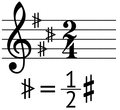 Sori used in musical notation

See also
External links
- Persian accidentals in the SMuFL glyph (Standard Music Font Layout)
References
- ^ Mohajeri, Shaahin. "About 24-EDO". 96edo.com. Archived from the original on 22 September 2020.
- ^ Pirnazar, Maryam (16 July 2013). "Reza Vali: An Iranian Composer to Watch and - of course - to Hear". payvand.com. Payvand.
For transcription of the micro-tones, I use the standard notation of the micro-tones, the Sori and the Koron, which were developed during early 20th century by the Persian master Alinaghi Vaziri.
- ^ Pournader, Roozbeh (23 April 2020). "Proposal to encode two accidentals for Iranian classical music" (PDF). unicode.org. Unicode Consortium.
- ^ "The Unicode® Standard Version 14.0 – Core Specification" (PDF). unicode.org. Unicode Consortium. September 2021.
- ^ "Musical Symbols - Range: 1D100–1D1FF" (PDF). unicode.org. Unicode Consortium. 2021.