








Portal:Energy
| Main page | New articles & Tasks |
 The Energy Portal Welcome to Wikipedia's Energy portal, your gateway to energy. This portal is aimed at giving you access to all energy related topics in all of its forms.
|
Page contents: Selected article • Selected image • Selected biography • Did you know? • General images • Quotations • Related portals • Wikiprojects • Major topics • Categories • Help • Associated Wikimedia |
Introduction

Energy (from Ancient Greek ἐνέργεια (enérgeia) 'activity') is the quantitative property that is transferred to a body or to a physical system, recognizable in the capacity to do work and in the form of heat and light. Energy is a conserved quantity—the law of conservation of energy states that energy can be converted in form, but not created or destroyed. The unit of measurement for energy in the International System of Units (SI) is the joule (J).
Forms of energy include the kinetic energy of a moving object, the potential energy stored by an object (for instance due to its position in a field), the elastic energy stored in a solid object, chemical energy associated with chemical reactions, the radiant energy carried by electromagnetic radiation, the internal energy contained within a thermodynamic system, and rest energy associated with an object's rest mass. These are not mutually exclusive.
All living organisms constantly take in and release energy. The Earth's climate and ecosystems processes are driven primarily by radiant energy from the Sun. (Full article...)
Selected article

Selected image

Photo credit: United States Department of Energy
The fireball created as energy is released in a nuclear explosion.
Did you know?
- The Obninsk Nuclear Power Plant was the world's first civilian nuclear power plant while Sellafield (pictured) was the world's first commercial nuclear power station?
- The Chinese energy company Fushun Mining Group operates the largest oil shale plant in the world consisting 220 Fushun-type retorts?
- Three of the four largest power stations in the world are in South America?
- Adriatic LNG is the world's first offshore gravity-based structure LNG regasification terminal?
- The Horse Hollow Wind Energy Center is the world's largest wind farm at 735.5 megawatt?
- Scotland has 85% of the United Kingdom's hydro-electric energy resource?
- The day when Exxon canceled its Colony Shale Oil Project in Colorado is known by locals as "Black Sunday"?
- The Australian energy company Linc Energy is the first company in the world to produce synthetic fuel by combining underground coal gasification and gas-to-liquid technologies?
Selected biography

Fermi was well-known for his simplicity in solving problems. Whenever possible, he avoided complicated mathematics and obtained quick results based on order of magnitude estimates. Fermi also meticulously recorded his calculations in notebooks, and later used to solve many new problems that he encountered based on these earlier known problems.
After accepting the 1938 Nobel Prize in Stockholm, Fermi immigrated to New York with his family to escape the anti-Semitic laws of Fascist Italy, as his wife Laura was Jewish.
After working at Columbia University, Fermi went to the University of Chicago and began studies that led to the construction of the world's first nuclear reactor Chicago Pile-1 (CP-1). The first artificial, self-sustaining, nuclear chain reaction was initiated within CP-1, on December 2, 1942.
In the news
- 15 February 2026 – Operation Midas
- Ukraine's National Anti-Corruption Bureau arrest former energy minister German Galushchenko at the state border for his alleged involvement in a ₴4 billion (US$100 million) kickback scheme in the energy sector. (AFP via The Straits Times)
- 13 February 2026 – Russo-Ukrainian war
- Two electricians are killed and five other people are injured in a Ukrainian missile strike on energy infrastructure and a residential area in Belgorod, Russia. (Reuters)
- 12 February 2026 – Greenhouse gas emissions by China
- The Centre for Research on Energy and Clean Air reports that China's carbon dioxide emissions remained flat or declined slightly in 2025 by about 0.3%, marking the first full calendar year in which emissions in China did not rise despite increasing energy demand, largely due to expanded renewable energy capacity. (AFP via France 24)
- 9 February 2026 – United States embargo against Cuba
- Air Canada suspends all flights to Cuba and deploys empty aircraft to repatriate stranded passengers after the country's fuel supply was exhausted due to the U.S. blockade and the end of fuel supplies from Venezuela. (Reuters)
- 9 February 2026 – Armenia–United States relations
- Armenia and the United States reach a nuclear deal, outlining a Section 123 Agreement and up to US$9 billion in total exports to Armenia related to nuclear energy. (Reuters)
General images
-
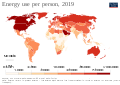 Global energy usage is highly unequal. High income countries such as the United States and Canada use 100 times as much energy per capita as some of the least developed countries in Africa. (from Sustainable energy)
 -

-
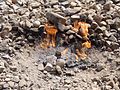 Burning of natural gas coming out of the ground (from Natural gas)
 -
 A micro-hydro facility in Vietnam (from Hydroelectricity)
 -

-
 A photovoltaic power station in California, United States
 -
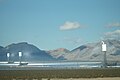 Ivanpah Solar Electric Generating System with all three towers under load (from Solar power)
 -
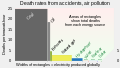 Deaths caused by use of fossil fuels such as natural gas (areas of rectangles in chart) greatly exceed those resulting from production of wind energy, nuclear energy or solar energy (rectangles barely visible in chart). (from Natural gas)
 -
 The status of nuclear power globally (click for legend) (from Nuclear power)
 -

-
 Kenyan dairy farmer lighting a biogas lamp. Biogas produced from biomass is a renewable energy source that can be burned for cooking or light. (from Sustainable energy)
 -

-
 Part of the Senftenberg Solarpark, a solar photovoltaic power plant located on former open-pit mining areas close to the city of Senftenberg, in Eastern Germany. The 78 MW Phase 1 of the plant was completed within three months. (from Solar power)
 -
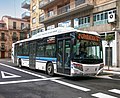 Natural gas bus in Salamanca, Spain (from Natural gas)
 -

-
 The Calder Hall nuclear power station in the United Kingdom, the world's first commercial nuclear power station (from Nuclear power)
 -
 Sample of kerosene (from Oil refinery)
 -
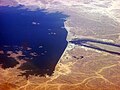 Merowe Dam in Sudan. Hydroelectric power stations that use dams submerge large areas of land due to the requirement of a reservoir. These changes to land color or albedo, alongside certain projects that concurrently submerge rainforests, can in these specific cases result in the global warming impact, or equivalent life-cycle greenhouse gases of hydroelectricity projects, to potentially exceed that of coal power stations. (from Hydroelectricity)
 -
 Global geothermal electric capacity. Upper red line is installed capacity; lower green line is realized production. (from Geothermal power)
 -

-
 Proportions of the isotopes uranium-238 (blue) and uranium-235 (red) found in natural uranium and in enriched uranium for different applications. Light water reactors use 3–5% enriched uranium, while CANDU reactors work with natural uranium. (from Nuclear power)
 -
 Passive cooling features, such as these windcatcher towers in Iran, bring cool air into buildings without any use of energy. (from Sustainable energy)
 -
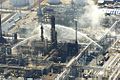 Fire-extinguishing operations after the Texas City refinery explosion (from Oil refinery)
 -

-
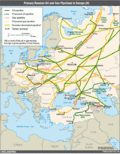 Russia was a key oil and gas supplier to Europe (map from 2013). This changed with the Russian invasion of Ukraine in 2022. (from Energy policy)
 -
 The outdoor section of a heat pump. In contrast to oil and gas boilers, they use electricity and are highly efficient. As such, electrification of heating can significantly reduce emissions. (from Sustainable energy)
 -
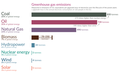 Greenhouse gas emissions per energy source. Solar power is one of the sources with the least greenhouse gas emissions. (from Solar power)
 -
-
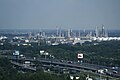
 Anacortes Refinery, on the north end of March Point southeast of Anacortes, Washington, United States (from Oil refinery)
 -
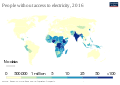 World map showing where people without access to electricity lived in 2016—mainly in sub-Saharan Africa and the Indian subcontinent (from Sustainable energy)
 -

-
 Enhanced geothermal system 1: Reservoir 2: Pump house 3: Heat exchanger 4: Turbine hall 5: Production well 6: Injection well 7: Hot water to district heating 8: Porous sediments 9: Observation well 10: Crystalline bedrock (from Geothermal power)
 -
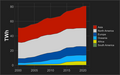 Yearly geothermal generation by continent (from Geothermal power)
 -
 Following the 2011 Fukushima Daiichi nuclear disaster, the world's worst nuclear accident since 1986, 50,000 households were displaced after radiation leaked into the air, soil and sea. Radiation checks led to bans of some shipments of vegetables and fish. (from Nuclear power)
 -
 Part of the 354 MW Solar Energy Generating Systems (SEGS) parabolic trough solar complex in northern San Bernardino County, California (from Solar power)
 -
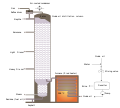 Schematic flow diagram of a typical crude oil distillation unit as used in petroleum crude oil refineries (from Oil refinery)
 -
 The U.S. and Russia have been the predominant producers of natural gas. (from Natural gas)
 -
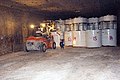 Nuclear waste flasks generated by the United States during the Cold War are stored underground at the Waste Isolation Pilot Plant (WIPP) in New Mexico. The facility is seen as a potential demonstration for storing spent fuel from civilian reactors. (from Nuclear power)
 -
 Thomas Young - the first to use the term "energy" to refer to kinetic energy in its modern sense, in 1802. (from History of energy)
 -
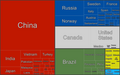 Hydro generation by country, 2021 (from Hydroelectricity)
 -
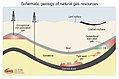 The location of shale gas compared to other types of gas deposits (from Natural gas)
 -
 Electrified transport and renewable energy are key areas of investment for the renewable energy transition. (from Sustainable energy)
 -

-
 Nuclear fuel assemblies being inspected before entering a pressurized water reactor in the United States (from Nuclear power)
 -
 The Ffestiniog Power Station can generate 360 MW of electricity within 60 seconds of the demand arising. (from Hydroelectricity)
 -
 The Three Gorges Dam in Central China is the world's largest power-producing facility of any kind. (from Hydroelectricity)
 -
 Natural gas extraction by countries in cubic meters per year around 2013 (from Natural gas)
 -
 The Hoover Dam in the United States is a large conventional dammed-hydro facility, with an installed capacity of 2,080 MW. (from Hydroelectricity)
 -
 The oil refinery in Haifa, Israel, is capable of processing about 9 million tons (66 million barrels) of crude oil a year. Its two cooling towers are landmarks of the city's skyline. (from Oil refinery)
 -
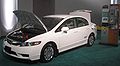 Honda Civic GX, a natural gas-powered automobile sold in North America from 1998 to 2015 (from Natural gas)
 -
 The multi-mission radioisotope thermoelectric generator (MMRTG), used in several space missions such as the Curiosity Mars rover (from Nuclear power)
 -
 Acceptance of wind and solar facilities in one's community is stronger among U.S. Democrats (blue), while acceptance of nuclear power plants is stronger among U.S. Republicans (red). (from Solar power)
 -
 Natural gas processing plant in Aderklaa, Lower Austria (from Natural gas)
 -
 Utility cycling infrastructure, such as this bike lane in Vancouver, encourages sustainable transport. (from Sustainable energy)
 -
 The Ikata Nuclear Power Plant, a pressurized water reactor that cools by using a secondary coolant heat exchanger with a large body of water, an alternative cooling approach to large cooling towers (from Nuclear power)
 -
 Cooling towers at a geothermal power plant in Larderello, Italy
 -
 The growth of solar PV on a semi-log scale since 1996 (from Solar power)
 -
 Measurement of the tailrace and forebay rates at the Limestone Generating Station in Manitoba, Canada (from Hydroelectricity)
 -
 By 2025, investment in the energy transition had grown to about twice that for fossil fuels (oil, natural gas and coal). (from Sustainable energy)
 -
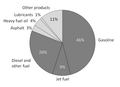 A breakdown of the products made from a typical barrel of US oil (from Oil refinery)
 -
 Wind turbines in Xinjiang, China
 -
 Sample of diesel fuel (from Oil refinery)
 -
 Manhole for domestic gas supply, London, UK (from Natural gas)
 -
 Oil refinery in Iran (from Oil refinery)
 -
 Several countries and the European Union have committed to dates for all new cars to be zero-emissions vehicles. (from Sustainable energy)
 -
 Olkiluoto 3 under construction in 2009. It was the first EPR, a modernized PWR design, to start construction. (from Nuclear power)
 -
 Example of energy policy decisions: The goal of the Southern Gas Corridor, which connects the giant Shah Deniz gas field in Azerbaijan to Europe, is to reduce Europe's dependency on Russian gas. (from Energy policy)
 -
 Motor oil (from Oil refinery)
 -
 The Warwick Castle water-powered generator house, used for the generation of electricity for the castle from 1894 until 1940 (from Hydroelectricity)
 -
 Anti-nuclear protest near nuclear waste disposal centre at Gorleben in northern Germany (from Nuclear power)
 -
 The US has been counting on private industry to lead in fusion power, while more recently China's government has made fusion a national priority. In 2025, $2.1 billion was poured into a single Chinese state-owned fusion company, an amount two and a half times the U.S. Energy Department's annual fusion budget. (from Nuclear power)
 -
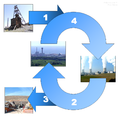 The nuclear fuel cycle begins when uranium is mined, enriched, and manufactured into nuclear fuel (1), which is delivered to a nuclear power plant. After use, the spent fuel is delivered to a reprocessing plant (2) or to a final repository (3). In nuclear reprocessing, 95% of spent fuel can potentially be recycled to be returned to use in a power plant (4). (from Nuclear power)
 -
 Reactor decay heat as a fraction of full power after the reactor shutdown, using two different correlations. To remove the decay heat, reactors need cooling after the shutdown of the fission reactions. A loss of the ability to remove decay heat caused the Fukushima accident. (from Nuclear power)
 -

-
-
 A comparison of levelized cost of energy (LCOE) over time for nuclear power and other sources. While wind turbines and solar panels can be mass-produced and thus enjoy learning curve effects, nuclear are almost always one-of-a-kind projects due to the limited number of reactors being built. The source of this chart, Our World in Data notes that the costs presented here is the global average, and these costs were driven up by 2 projects in the United States. The organization recognises that the median cost of the most exported and produced nuclear energy facility in the 2010s the South Korean APR1400, remained "constant", including in export. (from Nuclear power)
 -

-
 Crude oil is separated into fractions by fractional distillation. The fractions at the top of the fractionating column have lower boiling points than the fractions at the bottom. The heavy bottom fractions are often cracked into lighter, more useful products. All of the fractions are processed further in other refining units. (from Oil refinery)
 -
 Storage tanks and towers at Shell Puget Sound Refinery (Shell Oil Company), Anacortes, Washington (from Oil refinery)
 -
 China's count of multi-country patent filings has surged since the mid-2010s, leading in batteries and solar, though Europe still dominates in wind energy and smart grids. China also leads in highly cited publications in global peer-reviewed journals. (from Sustainable energy)
 -
 Since 1985, the proportion of electricity generated from low-carbon sources has increased only slightly. Advances in deploying renewables have been mostly offset by declining shares of nuclear power. (from Sustainable energy)
 -
 Peoples Gas Manlove Field natural gas storage area in Newcomb Township, Champaign County, Illinois. In the foreground (left) is one of the numerous wells for the underground storage area, with an LNG plant, and above-ground storage tanks are in the background (right). (from Natural gas)
 -
Clean energy investment has benefited from post-pandemic economic recovery, a global energy crisis involving high fossil fuel prices, and growing policy support across various nations. By 2025, investment in the energy transition had grown to about twice that for fossil fuels (oil, natural gas and coal). (from Sustainable energy)
-
 Sulphur (from Oil refinery)
 -
 Actual annual deployments of solar PV vs predictions by the IEA for the period 2002–2016. Predictions have largely and consistently underestimated actual growth. (from Solar power)
 -
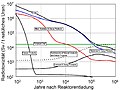 Activity of spent UOx fuel in comparison to the activity of natural uranium ore over time (from Nuclear power)
 -
 Natural gas burning on a gas stove (from Natural gas)
 -
 For cooking, electric induction stoves are one of the most energy-efficient and safest options. (from Sustainable energy)
 -
 Growth in solar and wind power from the first half of 2024 to the first half of 2025 increased more than the growth in overall demand for electricity, reducing reliance on fossil fuels and helping to curb greenhouse gas emissions. (from Sustainable energy)
 -
 Electricity production by source (from Solar power)
 -
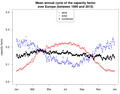 Seasonal cycle of capacity factors for wind and photovoltaics in Europe shown under idealized assumptions. The figure illustrates the balancing effects of wind and solar energy at the seasonal scale (Kaspar et al., 2019). (from Solar power)
 -
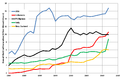 Trends in the top five geothermal electricity-generating countries, 1980–2012 (US EIA) (from Geothermal power)
 -
 A woman in rural Rajasthan, India, collects firewood. The use of wood and other polluting fuels for cooking causes millions of deaths each year from indoor and outdoor air pollution. (from Sustainable energy)
 -
 The first light bulbs ever lit by electricity generated by nuclear power at EBR-1 at Argonne National Laboratory-West (now the Idaho National Laboratory), December 20, 1951. (from Nuclear power)
 -
 Death rates per unit of electricity production for different energy sources (from Nuclear power)
 -
-
 A gas bill from Baltimore, Maryland, 1834, for manufactured coal gas, before the introduction of ground-extracted methane gas. (from Natural gas)
 -
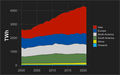 Yearly hydro generation by continent (from Hydroelectricity)
 -
Deaths caused as a result of fossil fuel use (areas of rectangles in chart) greatly exceed those resulting from production of sustainable energy (rectangles barely visible in chart). (from Sustainable energy)
-
 Sample of crude oil (petroleum) (from Oil refinery)
 -
 Cracks at the historic Town Hall of Staufen im Breisgau presumed due to damage from geothermal drilling (from Geothermal power)
 -
 The warming influence (called radiative forcing) of long-lived greenhouse gases has increased substantially in the last 40 years, with carbon dioxide and methane being the dominant drivers of global warming. (from Natural gas)
 -

-
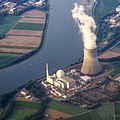 The Leibstadt Nuclear Power Plant in Switzerland (from Nuclear power)
 -
-
 Construction close to high-pressure gas-transmission pipelines is discouraged, often with standing warning signs. (from Natural gas)
 -
 Map of solar resources from World bank (from Solar power)
 -
 Sample of gasoline (from Oil refinery)
 -
 Museum Hydroelectric power plant "Under the Town" in Užice, Serbia, built in 1900 (from Hydroelectricity)
 -
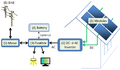 Schematics of a grid-connected residential PV power system (from Solar power)
 -
 The launching ceremony of USS Nautilus January 1954. In 1958 it would become the first vessel to reach the North Pole. (from Nuclear power)
 -
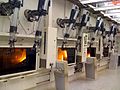 Most waste packaging, small-scale experimental fuel recycling chemistry and radiopharmaceutical refinement is conducted within remote-handled hot cells. (from Nuclear power)
 -
 Yearly solar generation by continent (from Solar power)
 -
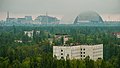 The town of Pripyat abandoned since 1986, with the Chernobyl plant and the Chernobyl New Safe Confinement arch in the distance (from Nuclear power)
 -
 Refinery, Bayport Industrial Complex, Harris County, Texas (from Oil refinery)
 -
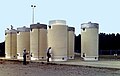 Dry cask storage vessels storing spent nuclear fuel assemblies (from Nuclear power)
 -
Growth in solar and wind power from the first half of 2024 to the first half of 2025 increased more than the growth in overall demand for electricity, reducing reliance on fossil fuels and helping to curb greenhouse gas emissions. (from Solar power)
-
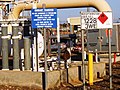 A pipeline odorant injection station (from Natural gas)
 -
 Life-cycle greenhouse gas emissions of electricity supply technologies, median values calculated by IPCC (from Nuclear power)
 -
 Buildings in the Solar Settlement at Schlierberg, Germany, produce more energy than they consume. They incorporate rooftop solar panels and are built for maximum energy efficiency. (from Sustainable energy)
 -
 A parabolic collector concentrates sunlight onto a tube in its focal point. (from Solar power)
 -
 Typical composition of uranium dioxide fuel before and after approximately three years in the once-through nuclear fuel cycle of a LWR (from Nuclear power)
 -
 Countries' proven natural gas reserves (2014), based on data from The World Factbook (from Natural gas)
 -
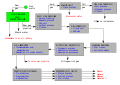 Schematic flow diagram of a typical natural gas processing plant (from Natural gas)
 -
 Geothermal generation by country, 2021 (from Geothermal power)
 -

-
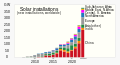 Benefitting from favorable policies and declining costs of modules, photovoltaic solar installation has grown consistently. In 2023, China added 60% of the world's new capacity. (from Solar power)
 -

-
 Natural gas drilling rig in Texas, US (from Natural gas)


.jpg)


.svg)


.jpg)


.svg)


.jpg)


Quotations
- "We simply must balance our demand for energy with our rapidly shrinking resources. By acting now we can control our future instead of letting the future control us." – Jimmy Carter, 1977
- "It is sensible to improve energy efficiency and to develop alternative and sustainable sources of supply; it's sensible to replant the forests which we consume; it's sensible to re-examine industrial processes; it's sensible to tackle the problem of waste. I understand that the latest vogue is to call them 'no regrets' policies. Certainly we should have none in putting them into effect." – Margaret Thatcher, 1990
- "We have the opportunity and potential to create an oil-free future today, it is potentially right around the corner - and, more often than not, the technology is already here." – John Kerry, 2003
Related portals


WikiProjects
WikiProjects connected with energy:
Other WikiProjects that may be of interest:
Major topics


.svg)


Major categories
National energy supply, use & conservation
National electricity sector
Politics, economics, environment
- Climate change
- Energy conservation
- Energy economics
- Energy crises
- Energy development
- Energy policy
- Peak oil
Energy sources
- Fuels
- Biofuels
- Fossil fuels
- Fusion power
- Nuclear technology
- Renewable energy
- Energy conversion
- Electric power
- Energy storage
Energy-related design
Scientific usage
Category browser

Help

Puzzled by energy?
Can't answer your question?
Don't understand the answer?
- Ask at the reference desk
- Read the Wikipedia help pages
For further ideas, to leave a comment, or to learn how you can help improve and update this portal, see the talk page.
Associated Wikimedia
The following Wikimedia Foundation sister projects provide more on this subject:
-
 Commons
Free media repository -
 Wikibooks
Free textbooks and manuals -
 Wikidata
Free knowledge base -
 Wikinews
Free-content news -
 Wikiquote
Collection of quotations -
 Wikisource
Free-content library -
 Wikiversity
Free learning tools -
 Wiktionary
Dictionary and thesaurus
-

-

-

-

-

-

-

-

-

-

-
 Random portal
 -


