





Portal:Classical music
The Classical Music Portal


Classical music generally refers to the art music of the Western world, considered to be distinct from Western folk music or popular music traditions. It is sometimes distinguished as Western classical music, as the term "classical music" can also be applied to non-Western art musics. Classical music is often characterized by formality and complexity in its musical form and harmonic organization, particularly with the use of polyphony. Since at least the ninth century, it has been primarily a written tradition, spawning a sophisticated notational system, as well as accompanying literature in analytical, critical, historiographical, musicological and philosophical practices. (Full article...)
Selected articles -
-

The harp is a stringed musical instrument that has individual strings running at an angle to its soundboard; the strings are plucked with the fingers. Harps can be played in either a seated or standing position. Most commonly, harps are made of wood and are triangular in shape. Some have multiple rows of strings and pedal attachments.
Ancient depictions of harps were recorded in Mesopotamia (now Iraq), Persia (now Iran) and Egypt, and later in India and China. By medieval times harps had spread across Europe. Harps are found across the Americas; in some regions, they are used in popular folk music traditions. Distinct designs also emerged from the African continent. Harps have symbolic political traditions and are often used in logos, including in Ireland. (Full article...) -
Robert Schumann (/ˈʃuːmɑːn/; German: [ˈʁoːbɛʁt ˈʃuːman]; 8 June 1810 – 29 July 1856) was a German composer, pianist, and music critic of the early Romantic era. He composed in all the main musical genres of the time, writing for solo piano, voice and piano, chamber groups, orchestra, choir and the opera. His works typify the spirit of the Romantic era in German music.
Schumann was born in Zwickau, Saxony, to an affluent middle-class family with no musical connections, and was initially unsure whether to pursue a career as a lawyer or to make a living as a pianist-composer. He studied law at the universities of Leipzig and Heidelberg but his main interests were music and Romantic literature. From 1829 he was a student of the piano teacher Friedrich Wieck, but his hopes for a career as a virtuoso pianist were frustrated by a worsening problem with his right hand, and he concentrated on composition. His early works were mainly piano pieces, including the large-scale Carnaval, Davidsbündlertänze (Dances of the League of David), Fantasiestücke (Fantasy Pieces), Kreisleriana and Kinderszenen (Scenes from Childhood) (1834–1838). He was a co-founder of the Neue Zeitschrift für Musik (New Musical Journal) in 1834 and edited it for ten years. In his writing for the journal and in his music he distinguished between two contrasting aspects of his personality, dubbing these alter egos "Florestan" for his impetuous self and "Eusebius" for his gentle poetic side. (Full article...) -

The six-part fugue in the "Ricercar a 6" from The Musical Offering, in the hand of Johann Sebastian Bach
In classical music, a fugue (/fjuːɡ/, from Latin fuga, meaning 'flight' or 'escape') is a contrapuntal, polyphonic compositional technique in two or more voices, built on a subject (a musical theme) that is introduced at the beginning in imitation (repetition at different pitches), which recurs frequently throughout the course of the composition. It is not to be confused with a fuguing tune, which is a style of song popularized by and mostly limited to early American (i.e. shape note or "Sacred Harp") music and West Gallery music. A fugue usually has three main sections: an exposition, a development, and a final entry that contains the return of the subject in the fugue's tonic key. Fugues can also have episodes, which are parts of the fugue where new material often based on the subject is heard; a stretto (plural stretti), when the fugue's subject overlaps itself in different voices, or a recapitulation. A popular compositional technique in the Baroque era, the fugue was fundamental in showing mastery of harmony and tonality as it presented counterpoint.
In the Middle Ages, the term was widely used to denote any works in canonic style; however, by the Renaissance, it had come to denote specifically imitative works. Since the 17th century, the term fugue has described what is commonly regarded as the most fully developed procedure of imitative counterpoint. (Full article...) -
"Nessun dorma" (Italian: [nesˌsun ˈdɔrma]; 'Let no one sleep') is an aria from the final act of Italian composer Giacomo Puccini's opera Turandot (text by Giuseppe Adami and Renato Simoni) and one of the best-known tenor arias in all opera. It is sung by Calaf, il principe ignoto (the unknown prince), who falls in love at first sight with the beautiful but cold Princess Turandot. Any man who wishes to wed Turandot must first answer her three riddles; if he fails, he will be beheaded. In the aria, Calaf expresses his triumphant assurance that he will win the princess.
Although "Nessun dorma" had long been a staple of operatic recitals, Luciano Pavarotti popularised the piece beyond the opera world in the 1990s following his performance of it for the 1990 FIFA World Cup, which captivated a global audience. Both Pavarotti and Plácido Domingo released singles of the aria; Pavarotti's reached number 2 in the UK, and it appeared on the best-selling classical album of all time, The Three Tenors in Concert. The Three Tenors, which includes José Carreras, performed the aria at three subsequent FIFA World Cup Finals, in 1994 in Los Angeles, 1998 in Paris, and 2002 in Yokohama. Since 1990, many crossover artists have performed and recorded it. The aria has been sung often in films and on television. (Full article...) -
The saxophone (often referred to colloquially as the sax) is a type of single-reed woodwind instrument with a conical body, usually made of brass. As with all single-reed instruments, sound is produced when a reed on a mouthpiece vibrates to produce a sound wave inside the instrument's body. The pitch is controlled by opening and closing holes in the body to change the effective length of the tube. The holes are closed by leather pads attached to keys operated by the player. Saxophones are made in various sizes and are almost always treated as transposing instruments. A person who plays the saxophone is called a saxophonist or saxist.
The saxophone is used in a wide range of musical styles including classical music (such as concert bands, chamber music, solo repertoire, and occasionally orchestras), military bands, marching bands, jazz (such as big bands and jazz combos), and contemporary music. The saxophone is also used as a solo and melody instrument or as a member of a horn section in some styles of rock and roll and popular music. (Full article...) -

The xylophone (from Ancient Greek ξύλον (xúlon) 'wood' and φωνή (phōnḗ) 'sound, voice'; lit. 'sound of wood') is a musical instrument in the percussion family that consists of wooden bars struck by mallets. Each bar is an idiophone tuned to a pitch of a musical scale, whether pentatonic or heptatonic in the case of many African and Asian instruments, diatonic in many western children's instruments, or chromatic for orchestral use.
The term xylophone may be used generally, to include all such instruments such as the marimba, balafon and even the semantron. However, in the orchestra, the term xylophone refers specifically to a chromatic instrument of somewhat higher pitch range and drier timbre than the marimba, and these two instruments should not be confused. A person who plays the xylophone is known as a xylophonist or simply a xylophone player. (Full article...) -
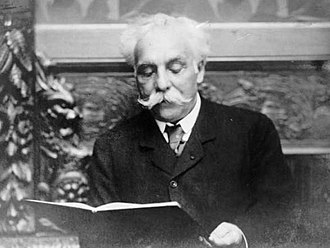
Fauré in 1907
Gabriel Urbain Fauré (12 May 1845 – 4 November 1924) was a French composer, organist, pianist and teacher. He was one of the foremost French composers of his generation, and his musical style influenced many 20th-century composers. Among his best-known works are his Pavane, Requiem, Sicilienne, nocturnes for piano and the songs "Après un rêve" and "Clair de lune". Although his best-known and most accessible compositions are generally his earlier ones, Fauré composed many of his most highly regarded works in his later years, in a more harmonically and melodically complex style.
Fauré was born into a cultured but not especially musical family. His talent became clear when he was a young boy. At the age of nine, he was sent to the École Niedermeyer music college in Paris, where he was trained to be a church organist and choirmaster. Among his teachers was Camille Saint-Saëns, who became a lifelong friend. After graduating from the college in 1865, Fauré earned a modest living as an organist and teacher, leaving him little time for composition. When he became successful in his middle age, holding the important posts of organist of the Église de la Madeleine and director of the Paris Conservatoire, he still lacked time for composing; he retreated to the countryside in the summer holidays to concentrate on composition. By his last years, he was recognised in France as the leading French composer of his day. An unprecedented national musical tribute was held for him in Paris in 1922, headed by the president of the French Republic. Outside France, Fauré's music took decades to become widely accepted, except in Britain, where he had many admirers during his lifetime. (Full article...) -
The recorder is a family of woodwind musical instruments and a member of the family of duct flutes that includes tin whistles and flageolets. It is the most prominent duct flute in the western classical tradition. A recorder can be distinguished from other duct flutes by the presence of a thumb-hole for the upper hand and holes for seven fingers: three for the upper hand and four for the lower.
Recorders are made in various sizes and ranges. The sizes most commonly in use today are the soprano (also known as descant, lowest note C5), alto (also known as treble, lowest note F4), tenor (lowest note C4), and bass (lowest note F3). Recorders were traditionally constructed from wood or ivory. Modern professional instruments are wooden, often boxwood; student and scholastic recorders are commonly made of moulded plastic. The recorders' internal and external proportions vary, but the bore is generally reverse conical (i.e. tapering towards the foot) to cylindrical, and all recorder fingering systems make extensive use of forked fingerings. (Full article...) -

A performance of Gustav Mahler's Eighth Symphony in the Kölner Philharmonie by the Sinfonieorchester Wuppertal conducted by Heinz Walter Florin
A symphony is an extended musical composition in Western classical music, most often for orchestra. Although the term has had many meanings from its origins in the ancient Greek era, by the late 18th century the word had taken on the meaning common today: a work usually consisting of multiple distinct sections or movements, often four, with the first movement in sonata form. Symphonies are almost always scored for an orchestra consisting of a string section (violin, viola, cello, and double bass), brass, woodwind, and percussion instruments which altogether number about 30 to 100 musicians. Symphonies are notated in a musical score, which contains all the instrument parts. Orchestral musicians play from parts which contain just the notated music for their own instrument. Some symphonies also contain vocal parts (e.g., Beethoven's Ninth Symphony, or Mahler's Second Symphony). (Full article...) -
Peer Gynt, Op. 23, is the incidental music to Henrik Ibsen's 1867 play Peer Gynt, written by the Norwegian composer Edvard Grieg in 1875. It premiered along with the play on 24 February 1876 in Christiania (now Oslo). Grieg later created two suites from his Peer Gynt music. Some of the music from these suites has received coverage in popular culture. (Full article...) -
Ludwig van Beethoven (baptised 17 December 1770 – 26 March 1827) was a German composer and pianist. One of the most revered figures in the history of Western music, his works rank among the most performed of the classical music repertoire and span the transition from the Classical period to the Romantic era. Beethoven's early period, during which he forged his craft, is typically considered to have lasted until 1802. From 1802 to around 1812, his middle period showed an individual development from the styles of Joseph Haydn and Wolfgang Amadeus Mozart, and is sometimes characterised as heroic. During this time, Beethoven began to grow increasingly deaf. In his late period, from 1812 to 1827, he extended his innovations in musical form and expression.
Born in Bonn, Beethoven displayed his musical talent at a young age. He was initially taught intensively by his father, Johann van Beethoven, and later by Christian Gottlob Neefe. Under Neefe's tutelage in 1783, he published his first work, a set of keyboard variations. He found relief from a dysfunctional home life with the family of Helene von Breuning, whose children he loved, befriended, and taught piano. At age 21, he moved to Vienna, which subsequently became his base, and studied composition with Haydn. Beethoven then gained a reputation as a virtuoso pianist, and was soon patronised by Karl Alois, Prince Lichnowsky for compositions, which resulted in his three Opus 1 piano trios (the earliest works to which he accorded an opus number) in 1795. (Full article...) -
Wolfgang Amadeus Mozart (27 January 1756 – 5 December 1791) was a prolific and influential composer of the Classical period. Despite his brief life, his rapid pace of composition and proficiency from an early age resulted in more than 800 works representing virtually every classical genre of his time. Many of these compositions are acknowledged as pinnacles of the symphonic, concertante, chamber, opera, and choral repertoires. Mozart is widely regarded as one of the greatest composers in the history of Western music, with his music admired for its "melodic beauty, its formal elegance and its richness of harmony and texture".
Born in Salzburg, Mozart showed prodigious ability from his earliest childhood. At age five, he was already competent on keyboard and violin, had begun to compose, and performed before European royalty. His father, Leopold Mozart, took him on a grand tour of Europe and then three trips to Italy. At 17 he was a musician at the Salzburg court but grew restless and travelled in search of a better position. Mozart's fruitless journey in search of employment led him to Paris, Mannheim, Munich, and eventually back to Salzburg. During this time he wrote his five violin concertos, the Sinfonia Concertante, and Concerto for Flute and Harp, as well as sacred pieces and masses, the motet Exsultate Jubilate, and the opera Idomeneo, among other works. (Full article...)


.svg)


_by_Elliot_and_Fry_-_02.jpg)


General images -
-
 Fortepiano by Paul McNulty after Walter & Sohn, c. 1805 (from Classical period (music))
 -
 Gustav Mahler, photographed in 1907 by Moritz Nähr at the end of his period as director of the Vienna Hofoper (from Romantic music)
 -
-
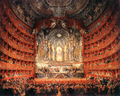 A large instrumental ensemble's performance in the lavish Teatro Argentina, as depicted by Panini (1747) (from Baroque music)
 -
 Claudio Monteverdi in 1640 (from Baroque music)
 -
 Musicians from 'Procession in honour of Our Lady of Sablon in Brussels.' Early 17th-century Flemish alta cappella. From left to right: bass dulcian, alto shawm, treble cornett, soprano shawm, alto shawm, tenor sackbut. (from Renaissance music)
 -
 The opening bars of the Commendatore's aria in Mozart's opera Don Giovanni. The orchestra starts with a dissonant diminished seventh chord (G# dim7 with a B in the bass) moving to a dominant seventh chord (A7 with a C# in the bass) before resolving to the tonic chord (D minor) at the singer's entrance. (from Classical period (music))
 -
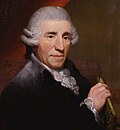 Haydn portrait by Thomas Hardy, 1792 (from Classical period (music))
 -
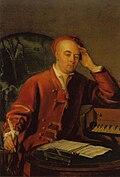
-
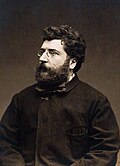 Bizet photographed by Étienne Carjat (1875) (from Romantic music)
 -
 Josef Danhauser's 1840 painting Liszt at the Piano featuring Franz Liszt at the piano surrounded by (from left to right) Alexandre Dumas, Hector Berlioz, George Sand, Niccolò Paganini, Gioachino Rossini and Marie d'Agoult, with a bust of Ludwig van Beethoven on the piano (from Romantic music)
 -
 Wanderer above the Sea of Fog, by Caspar David Friedrich, is an example of Romantic painting. (from Romantic music)
 -
 1875 oil painting of Franz Schubert by Wilhelm August Rieder, after his own 1825 watercolor portrait (from Classical period (music))
 -
 Painting by Evaristo Baschenis of Baroque instruments, including a cittern, viola da gamba, violin, and two lutes (from Baroque music)
 -
 View of Vienna in 1758, by Bernardo Bellotto (from Classical period (music))
 -
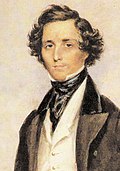
-
 Portrait of the Mozart Family, dated 1780–81 (from Classical period (music))
 -
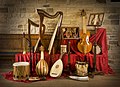 Selection of Renaissance instruments (from Renaissance music)
 -
 Bernhard Crusell, a Swedish-Finnish composer and clarinetist, in 1826 (from Classical period (music))
 -
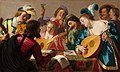 Gerard van Honthorst, The Concert (1623), National Gallery of Art, Washington D.C. (from Renaissance music)
 -
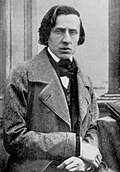 Daguerreotype of Chopin, c. 1849 (from Romantic music)
 -
 Balakirev (top), Cui (upper left), Mussorgsky (upper right), Rimsky-Korsakov (lower left), and Borodin (lower right). (from Romantic music)
 -

-
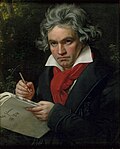 Portrait of Beethoven, 1820 (from Classical period (music))
 -
 Portion of Du Fay's setting of Ave maris stella, in fauxbourdon. The top line is a paraphrase of the chant; the middle line, designated "fauxbourdon", (not written) follows the top line but exactly a perfect fourth below. The bottom line is often, but not always, a sixth below the top line; it is embellished, and reaches cadences on the octave.Play (from Renaissance music)
 -
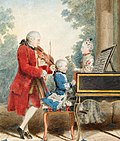 Wolfgang Amadeus Mozart, a representative composer of the Classical period, seated at a keyboard. (from Classical period (music))
 -

-
 Gluck, detail of Portrait of Christoph Willibald Gluck by Joseph Duplessis, dated 1775 (Kunsthistorisches Museum, Vienna) (from Classical period (music))
 -
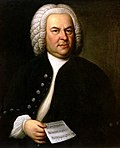 Johann Sebastian Bach, 1748 (from Baroque music)
 -
 Franz Liszt in 1858, by Franz Hanfstaengl (from Romantic music)
 -
 Wolfgang Amadeus Mozart, posthumous painting by Barbara Krafft in 1819 (from Classical period (music))
 -

-
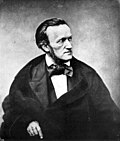 Richard Wagner in Paris, 1861
 -
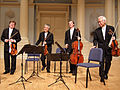 A modern string quartet. In the 2000s, string quartets from the Classical era are the core of the chamber music literature. From left to right: violin 1, violin 2, cello, viola (from Classical period (music))
 -
 Hummel in 1814 (from Classical period (music))
 -


.jpg)


Quotes -
| “ | Music, moody food of us that trade in love. | ” |
| — William Shakespeare | ||
Related portals


WikiProjects




 Selected composers -


-
 Saint-Saëns c. 1880
Charles-Camille Saint-Saëns (UK: /ˈsæ̃sɒ̃(s)/, US: /sæ̃ˈsɒ̃(s)/, French: [ʃaʁl kamij sɛ̃sɑ̃(s)] ⓘ 9 October 1835 – 16 December 1921) was a French composer, organist, conductor and pianist of the Romantic era. His best-known works include Introduction and Rondo Capriccioso (1863), the Second Piano Concerto (1868), the First Cello Concerto (1872), Danse macabre (1874), the opera Samson and Delilah (1877), the Third Violin Concerto (1880), the Third ("Organ") Symphony (1886) and The Carnival of the Animals (1886).
Saint-Saëns was a musical prodigy; he made his concert debut at the age of ten. After studying at the Paris Conservatoire he followed a conventional career as a church organist, first at Saint-Merri, Paris and, from 1858, La Madeleine, the official church of the French Empire. After leaving the post twenty years later, he was a successful freelance pianist and composer, in demand in Europe and the Americas. (Full article...) -
Pandit Ravi Shankar (Bengali pronunciation: [ˈrobi ˈʃɔŋkor]; born Robindro Shaunkor Chowdhury, sometimes spelled as Ravindra Shankar Chowdhury; 7 April 1920 – 11 December 2012) was an Indian sitarist and composer. A sitar virtuoso, he became the world's best-known exponent of Indian classical music in the second half of the 20th century, and influenced many musicians in India and throughout the world. Shankar was awarded India's highest civilian honour, the Bharat Ratna, in 1999. He is also the father of American singer Norah Jones and British-American musician and sitar player Anoushka Shankar.
Shankar was born to a Bengali family in India, and spent his youth as a dancer touring India and Europe with the dance group of his brother Uday Shankar. At age 18, he gave up dancing to pursue a career in music, studying the sitar for seven years under court musician Allauddin Khan. After finishing his studies in 1944, Shankar worked as a composer, creating the music for the Apu Trilogy by Satyajit Ray, and was music director of All India Radio, New Delhi, from 1949 to 1956. (Full article...) -

Rossini as a young man, c. 1810–1815
Gioachino Antonio Rossini (29 February 1792 – 13 November 1868) was an Italian composer of the late Classical and early Romantic eras. He gained fame for his 39 operas, although he also wrote many songs, some chamber music and piano pieces and some sacred music. He set new standards for both comic and serious opera before retiring from large-scale composition while still in his thirties, at the height of his popularity.
Born in Pesaro to parents who were both musicians (his father a trumpeter, his mother a singer), Rossini began to compose by the age of twelve and was educated at music school in Bologna. His first opera was performed in Venice in 1810 when he was 18 years old. In 1815 he was engaged to write operas and manage theatres in Naples. In the period 1810–1823, he wrote 34 operas for the Italian stage that were performed in Venice, Milan, Ferrara, Naples and elsewhere; this productivity necessitated an almost formulaic approach for some components (such as overtures) and a certain amount of self-borrowing. During this period he produced his most popular works, including the comic operas L'italiana in Algeri, Il barbiere di Siviglia (known in English as The Barber of Seville) and La Cenerentola, which brought to a peak the opera buffa tradition he inherited from masters such as Wolfgang Amadeus Mozart, Domenico Cimarosa and Giovanni Paisiello. He also composed opera seria works such as Tancredi, Otello and Semiramide. All of these attracted admiration for their innovation in melody, harmonic and instrumental colour, and dramatic form. In 1824 he was contracted by the Opéra in Paris, for which he produced an opera to celebrate the coronation of Charles X, Il viaggio a Reims (later cannibalised for his first opera in French, Le comte Ory), revisions of two of his Italian operas, Le siège de Corinthe and Moïse, and in 1829 his last opera, Guillaume Tell. (Full article...) -
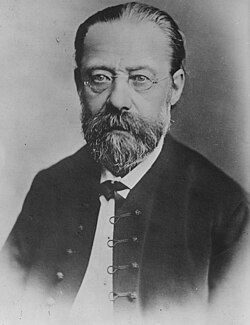
Smetana, c. 1878 
Bedřich Smetana (/ˌbɛdərʒɪx ˈsmɛtənə/ BED-ər-zhikh SMET-ən-ə; Czech: [ˈbɛdr̝ɪx ˈsmɛtana] ⓘ; 2 March 1824 – 12 May 1884) was a Czech composer who pioneered the development of a musical style that became closely identified with his people's aspirations to a cultural and political "revival". He has been regarded in his homeland as the father of Czech music. Internationally he is best known for his 1866 opera The Bartered Bride and for the symphonic cycle Má vlast ("My Fatherland"), which portrays the history, legends and landscape of the composer's native Bohemia. It contains the famous symphonic poem "Vltava", also popularly known by its German name "Die Moldau" (in English, "The Moldau").
Smetana was naturally gifted as a composer, and gave his first public performance at the age of six. After conventional schooling, he studied music under Josef Proksch in Prague. His first nationalistic music was written during the 1848 Prague uprising, in which he briefly participated. After failing to establish his career in Prague, he left for Sweden, where he set up as a teacher and choirmaster in Gothenburg, and began to write large-scale orchestral works. (Full article...) -

Bizet photographed by Étienne Carjat (1875)
Georges Bizet (né Alexandre César Léopold Bizet; 25 October 1838 – 3 June 1875) was a French composer of the Romantic era. Best known for his operas in a career cut short by his early death, Bizet achieved few successes before his final work, Carmen, which has become one of the most popular and frequently performed works in the entire opera repertoire.
During a brilliant student career at the Conservatoire de Paris, Bizet won many prizes, including the prestigious Prix de Rome in 1857. He was recognised as an outstanding pianist, though he chose not to capitalise on this skill and rarely performed in public. Returning to Paris after almost three years in Italy, he found that the main Parisian opera theatres preferred the established classical repertoire to the works of newcomers. His keyboard and orchestral compositions were likewise largely ignored; as a result, his career stalled, and he earned his living mainly by arranging and transcribing the music of others. Restless for success, he began many theatrical projects during the 1860s, most of which were abandoned. Neither of his two operas that reached the stage in this time—Les pêcheurs de perles and La jolie fille de Perth—were immediately successful. (Full article...) -
Nobuo Uematsu (植松 伸夫, Uematsu Nobuo; born March 21, 1959) is a Japanese composer and keyboardist best known for his contributions to the Final Fantasy video game series by Square Enix. A self-taught musician, he began playing the piano at the age of twelve, with English singer-songwriter Elton John as one of his biggest influences in pursuing a musical career.
Uematsu joined Square in 1986, where he first met Final Fantasy creator Hironobu Sakaguchi. The two later worked together on many games at the company, most notably in the Final Fantasy series. After nearly two decades with Square, Uematsu left in 2004 to create his own production company and music label, Dog Ear Records. He has since composed music as a freelancer for other games, including ones developed by Square Enix and Sakaguchi's studio Mistwalker. (Full article...) -
Jane Marian Joseph (31 May 1894 – 9 March 1929) was an English composer, arranger, and music teacher. She was a pupil and later associate of the composer Gustav Holst, and was instrumental in the organisation and management of various of the music festivals which Holst sponsored. Many of her works were composed for performance at these festivals and similar occasions. Her early death at age 34, which prevented the full realisation of her talents, was considered by her contemporaries as a considerable loss to English music.
Holst first observed Joseph's potential when he was teaching her composition at St Paul's Girls' School. She began to act as his amanuensis in 1914, when he was composing The Planets, her special responsibility being the preparation of the score for the "Neptune" movement. She continued to assist Holst with transcriptions, arrangements and translations, and was his librettist for the choral ballet The Golden Goose. (Full article...) -

Merrill Bradshaw in 1963
Merrill Bradshaw (June 18, 1929 – July 12, 2000) was an American composer and professor at Brigham Young University (BYU), where he was composer-in-residence from 1967 to 1994.
Bradshaw grew up in Lyman, Wyoming; Salt Lake City, Utah; and Portland, Oregon. He was a member of the Church of Jesus Christ of Latter-day Saints (LDS Church). He studied music theory at BYU with John R. Halliday and others, after which he continued his studies in composition at the University of Illinois. He became a faculty member at BYU in 1957. He was chairman of composition and theory from 1973 to 1983, and the executive director of the Barlow Endowment for Music Composition from 1983 to 1999. From 1973 to 1978 he chaired an LDS Church committee to revise the hymnbook, although the committee was suspended before they published their intended hymnal. A different committee authored the 1985 hymnal. (Full article...) -

A l’arme A l’arme by Grimace, verso 55 from the Chantilly Codex
Grimace (fl. mid-to-late 14th century; French: [ɡʁi.mas]; also Grymace, Grimache or Magister Grimache) was a French composer-poet in the ars nova style of late medieval music. Virtually nothing is known about Grimace's life other than speculative information based on the circumstances and content of his five surviving compositions of formes fixes; three ballades, a virelai and rondeau. His best known and most often performed work in modern-times is the virelai and proto-battaglia: A l’arme A l’arme.
He is thought to have been a younger contemporary of Guillaume de Machaut and based in southern France. Three of his works were included in the Chantilly Codex, which is an important source of ars subtilior music. However, along with P. des Molins, Jehan Vaillant and F. Andrieu, Grimace was one of the post-Machaut generation whose music shows few distinctly ars subtilior features, leading scholars to recognize Grimace's work as closer to the ars nova style of Machaut. (Full article...) -
Frederick II (German: Friedrich II.; 24 January 1712 – 17 August 1786) was the monarch of Prussia from 1740 until his death in 1786. He was the last Hohenzollern monarch titled King in Prussia, declaring himself King of Prussia after annexing Royal Prussia from the Polish–Lithuanian Commonwealth in 1772. His most significant accomplishments include military successes in the Silesian wars, reorganisation of the Prussian Army, the First Partition of Poland, and patronage of the arts and the Enlightenment. Prussia greatly increased its territories and became a major military power in Europe under his rule. He became known as Frederick the Great (German: Friedrich der Große) and was nicknamed "Old Fritz" (German: der Alte Fritz).
In his youth, Prince Frederick was more interested in music and philosophy than war, which led to clashes with his authoritarian father, Frederick William I of Prussia. However, upon ascending to the throne, he attacked and annexed the rich Austrian province of Silesia in 1742, winning military acclaim. He became an influential military theorist, whose analyses emerged from his extensive personal battlefield experience and covered issues of strategy, tactics, mobility and logistics. (Full article...) -
Yasunori Mitsuda (光田 康典, Mitsuda Yasunori; born January 21, 1972) is a Japanese composer. He is best known for his work in video games, primarily for the Chrono, Xeno, Shadow Hearts, and Inazuma Eleven franchises, among various others. Mitsuda began composing music for his own games in high school, later attending a music college in Tokyo. While still a student, he was granted an intern position at the game development studio Wolf Team.
Mitsuda joined Square upon graduation in 1992 and worked there as a sound effects designer for two years before telling Square's vice president Hironobu Sakaguchi he would quit unless he could write music for their games. Shortly after, Sakaguchi assigned him to work on the soundtrack for Chrono Trigger (1995), whose music has since been cited as among the best in video games. (Full article...) -

Ravel in 1925
Joseph Maurice Ravel (7 March 1875 – 28 December 1937) was a French composer, pianist and conductor. He is often associated with Impressionism along with his elder contemporary Claude Debussy, although both composers rejected the term. In the 1920s and 1930s Ravel was internationally regarded as France's greatest living composer.
Born to a music-loving family, Ravel attended France's premier music college, the Paris Conservatoire; he was not well regarded by its conservative establishment, whose biased treatment of him caused a scandal. After leaving the conservatoire, Ravel found his own way as a composer, developing a style of great clarity and incorporating elements of modernism, baroque, neoclassicism and, in his later works, jazz. He liked to experiment with musical form, as in his best-known work, Boléro (1928), in which repetition takes the place of development. Renowned for his abilities in orchestration, Ravel made some orchestral arrangements of other composers' piano music, of which his 1922 version of Mussorgsky's Pictures at an Exhibition is the best known. (Full article...) -
Carl August Nielsen (Danish: [ˈkʰɑˀl ˈne̝lsn̩]; 9 June 1865 – 3 October 1931) was a Danish composer, conductor, and violinist, widely recognized as his country's most prominent composer.
Brought up by poor yet musically talented parents on the island of Funen, he demonstrated his musical abilities at an early age. He initially played in a military band before attending the Royal Danish Academy of Music in Copenhagen from 1884 until December 1886. He premiered his Op. 1, Suite for Strings, in 1888, at the age of 23. The following year, Nielsen began a 16-year stint as a second violinist in the Royal Danish Orchestra under the conductor Johan Svendsen, during which he played in Verdi's Falstaff and Otello at their Danish premieres. In 1916, he took a post teaching at the Royal Danish Academy and continued to work there until his death. (Full article...) -

Portrait by Herbert Lambert, c. 1922
Sir Arnold Edward Trevor Bax KCVO (8 November 1883 – 3 October 1953) was an English composer, poet, and author. His prolific output includes songs, choral music, chamber pieces, and solo piano works, but he is best known for his orchestral music. In addition to a series of symphonic poems, he wrote seven symphonies and was for a time widely regarded as the leading British symphonist.
Bax was born in the London suburb of Streatham to a prosperous family. He was encouraged by his parents to pursue a career in music, and his private income enabled him to follow his own path as a composer without regard for fashion or orthodoxy. Consequently, he came to be regarded in musical circles as an important but isolated figure. While still a student at the Royal Academy of Music Bax became fascinated with Ireland and Celtic culture, which became a strong influence on his early development. In the years before the First World War he lived in Ireland and became a member of Dublin literary circles, writing fiction and verse under the pseudonym Dermot O'Byrne. Later, he developed an affinity with Nordic culture, which for a time superseded his Celtic influences in the years after the First World War. (Full article...) -
Olivier Eugène Prosper Charles Messiaen (UK: /ˈmɛsiæ̃/, US: /mɛˈsjæ̃, meɪˈsjæ̃, mɛˈsjɒ̃/; French: [ɔlivje øʒɛn pʁɔspɛʁ ʃaʁl mɛsjɑ̃]; 10 December 1908 – 27 April 1992) was a French composer, organist, and ornithologist. One of the major composers of the 20th century, he was also an outstanding teacher of composition and musical analysis.
Messiaen entered the Conservatoire de Paris at age 11 and studied with Paul Dukas, Maurice Emmanuel, Charles-Marie Widor and Marcel Dupré, among others. He was appointed organist at the Église de la Sainte-Trinité, Paris, in 1931, a post he held for 61 years, until his death. He taught at the Schola Cantorum de Paris during the 1930s. After the fall of France in 1940, Messiaen was interned for nine months in the German prisoner of war camp Stalag VIII-A, where he composed his Quatuor pour la fin du temps (Quartet for the End of Time) for the four instruments available in the prison—piano, violin, cello and clarinet. The piece was first performed by Messiaen and fellow prisoners for an audience of inmates and prison guards. Soon after his release in 1941, Messiaen was appointed professor of harmony at the Paris Conservatoire. In 1966, he was appointed professor of composition there, and he held both positions until retiring in 1978. His many distinguished pupils included Iannis Xenakis, Mikis Theodorakis, George Benjamin, Alexander Goehr, Pierre Boulez, Jacques Hétu, Tristan Murail, Karlheinz Stockhausen, György Kurtág, and Yvonne Loriod, who became his second wife. (Full article...)


.jpg)


.jpg)
.jpg)


Did you know (auto-generated) -

- ... that WFMT classical music radio host Don Tait owned such a large collection of recordings that he had to buy a house and have its floor reinforced to accommodate the weight?
- ... that opera singer Charles Holland spent much of his career in Europe as opportunities in classical music for African Americans were limited?
- ... that in 1994, Anthony Pople created two computer programs to analyse classical music?
Selected image
-

A picture of the first theatre drawn shortly before it burned down in 1808.
The Royal Opera House is an opera house and major performing arts venue in the London district of Covent Garden. The large building, often referred to as simply "Covent Garden", is the home of The Royal Opera, The Royal Ballet and the Orchestra of the Royal Opera House. -
 Stradivarius is one of the violins, violas, cellos and other string instruments built by members of the Italian Stradivari family, particularly Antonio Stradivari.
 -
 Photo: W. J. Mayer; Restoration: Lise BroerA bust of the German composer and pianist Ludwig van Beethoven (1770–1827), made from his death mask. He was a crucial figure in the transitional period between the Classical and Romantic eras in Western classical music, and remains one of the most acclaimed and influential composers of all time. Born in Bonn, of the Electorate of Cologne and a part of the Holy Roman Empire of the German Nation in present-day Germany, he moved to Vienna in his early twenties and settled there, studying with Joseph Haydn and quickly gaining a reputation as a virtuoso pianist. His hearing began to deteriorate in the late 1790s, yet he continued to compose, conduct, and perform, even after becoming completely deaf.
 -
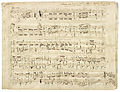 Sheet music for the Polonaise in A-flat major, Op. 53, a solo piano piece written by Frédéric Chopin in 1842. This work is one of Chopin's most admired compositions and has long been a favorite of the classical piano repertoire. The piece, which is very difficult, requires exceptional pianistic skills and great virtuosity to be interpreted. A typical performance of the polonaise lasts seven minutes.
 -
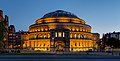 Photograph: David IliffThe Royal Albert Hall is a concert hall, seating a maximum of 5,272, on the northern edge of South Kensington, London. Constructed beginning in 1867, the hall was inaugurated on 29 March 1871. Since 1941 it has held The Proms, an eight-week summer season of daily orchestral classical music concerts and other events.
 -
 Photograph credit: Eugène Pirou; restored by Adam CuerdenJules Massenet (12 May 1842 – 13 August 1912) was a French composer of the Romantic era, best known for his operas. Between 1867 and his death, he wrote more than forty stage works in a wide variety of styles, from opéra comique to grand depictions of classical myths, romantic comedies and lyric dramas, as well as oratorios, cantatas and ballets. Massenet had a good sense of the theatre and of what would succeed with the Parisian public. Despite some miscalculations, he produced a series of successes that made him the leading opera composer in France in the late 19th and early 20th centuries. By the time of his death, he was regarded as old-fashioned; his works, however, began to be favourably reassessed during the mid-20th century, and many have since been staged and recorded. This photograph of Massenet was taken by French photographer Eugène Pirou in 1875.
 -
 Ballet is a formalized form of dance with its origins in the French court, further developed in France and Russia as a concert dance form.
 -
 Photograph credit: William P. Gottlieb; restored by Adam CuerdenBilly Strayhorn (November 29, 1915 – May 31, 1967) was an American jazz composer, pianist, lyricist, and arranger, best remembered for his long-time collaboration with bandleader and composer Duke Ellington that lasted nearly three decades. Though classical music was Strayhorn's first love, his ambition to become a classical composer went unrealized because of the harsh reality of a black man trying to make his way in the world of classical music, which at that time was almost completely white. He was introduced to the music of pianists like Art Tatum and Teddy Wilson at age 19, and the artistic influence of these musicians guided him into the realm of jazz, where he remained for the rest of his life. This photograph of Strayhorn was taken by William P. Gottlieb in the 1940s.
 -
 The Teatro alla Scala (or La Scala, as it is known), in Milan, Italy, is one of the world's most famous opera houses. The theatre was inaugurated on 3 August 1778, under the name Nuovo Regio Ducal Teatro alla Scala with Salieri's Europa riconosciuta.
 -
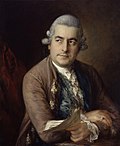 Painting: Thomas GainsboroughJohann Christian Bach (5 September 1735 – 1 January 1782) was a composer of the Classical era, the eighteenth child of Johann Sebastian Bach, and the youngest of his eleven sons. Bach was taught by his father and then, after the latter's death, by his half-brother C. P. E. Bach. Bach moved to Italy in 1754, and then to London in 1762, where he became known as the "London Bach". Bach's compositions include eleven operas, as well as chamber music, orchestral music and compositions for keyboard music. In 1764 Bach met Wolfgang Amadeus Mozart, who was eight at the time, and spent five months teaching him composition. He had considerable influence on Mozart, and was later described by scholars as his "only, true teacher".
This portrait of Bach was painted in 1776 by Thomas Gainsborough, as part of a collection started by Bach's former teacher Padre Martini. It now hangs in the National Portrait Gallery, London. -
 Photo: Guillaume PiolleThe anatomy of a Périnet piston valve, this one taken from a B♭ trumpet. When depressed, the valve diverts the air stream through additional tubing, thus lengthening the instrument and lowering the harmonic series on which the instrument is vibrating (i.e., it lowers the pitch). Trumpets generally use three valves, with some variations, such as a piccolo trumpet, having four. When used singly or in combination, the valves make the instrument fully chromatic, or capable of playing all twelve pitches of classical music. Trumpets may also use rotary valves instead.


.jpg)


Topics
Things you can do
 |
Here are some tasks awaiting attention:
|
Categories

Associated Wikimedia
The following Wikimedia Foundation sister projects provide more on this subject:
-
 Commons
Free media repository -
 Wikibooks
Free textbooks and manuals -
 Wikidata
Free knowledge base -
 Wikinews
Free-content news -
 Wikiquote
Collection of quotations -
 Wikisource
Free-content library -
 Wikiversity
Free learning tools -
 Wiktionary
Dictionary and thesaurus
-

-

-

-

-

-

-

-

-

-

-
 Random portal
 -


