








Lee County, Illinois
Lee County, Illinois | |
|---|---|
 | |
 Location within the U.S. state of Illinois | |
| Coordinates: 41°45′N 89°18′W / 41.75°N 89.3°W | |
| Country |  United States United States |
| State |  Illinois Illinois |
| Founded | February 27, 1839 |
| Named after | Henry Lee III |
| Seat | Dixon |
| Largest city | Dixon |
| Area | |
• Total | 729 sq mi (1,890 km2) |
| • Land | 725 sq mi (1,880 km2) |
| • Water | 4.1 sq mi (11 km2) 0.6% |
| Population (2020) | |
• Total | 34,145 |
• Estimate (2024) | 33,544  [1] [1] |
| • Density | 47.1/sq mi (18.2/km2) |
| Time zone | UTC−6 (Central) |
| • Summer (DST) | UTC−5 (CDT) |
| Congressional district | 16th |
| Website | www |
Lee County is a county located in the U.S. state of Illinois. According to the 2020 census, it has a population of 34,145.[2] Its county seat is Dixon.[3] The Dixon, IL Micropolitan Statistical Area includes all of Lee County.
History
The area's first non-native settlers were mostly from the six New England states.[4] The early nineteenth century saw a wave of westward movement from New England, due largely to completion of the Erie Canal and the end of the Black Hawk War.[5][6]
The area that included present-day Lee County was delineated as St. Clair County in 1809. In 1823, a large section of northern St. Clair County was partitioned off as Fulton County. In 1825, the northwestern portion of that county was partitioned off as Putnam County. In 1831, the area was further partitioned into Jo Daviess County. A section of that county was partitioned off in 1836 as Ogle County, and in 1839 the bottom half of Ogle County was split off as Lee County. It is largely understood that the county's name honors "Lighthorse Harry" Lee, an officer in the American Revolutionary War.[7] An alternative theory suggests the name honors Richard Henry Lee, a member of the Continental Congress (the Declaration of Independence was adopted pursuant to the Lee Resolution).
President Ronald Reagan lived in Dixon as a boy and attended Dixon High School.[8]
-
 Lee County's boundaries have remained unchanged since its creation in 1839.

Geography
According to the US Census Bureau, the county has a total area of 729 square miles (1,890 km2), of which 725 square miles (1,880 km2) is land and 4.1 square miles (11 km2) (0.6%) is water.[9]
Adjacent counties
- Ogle County – north
- DeKalb County – east
- LaSalle County - southeast, south
- Bureau County – south, southwest
- Whiteside County – west
Climate and weather
| Dixon, Illinois | ||||||||||||||||||||||||||||||||||||||||||||||||||||||||||||
|---|---|---|---|---|---|---|---|---|---|---|---|---|---|---|---|---|---|---|---|---|---|---|---|---|---|---|---|---|---|---|---|---|---|---|---|---|---|---|---|---|---|---|---|---|---|---|---|---|---|---|---|---|---|---|---|---|---|---|---|---|
| Climate chart (explanation) | ||||||||||||||||||||||||||||||||||||||||||||||||||||||||||||
| ||||||||||||||||||||||||||||||||||||||||||||||||||||||||||||
| ||||||||||||||||||||||||||||||||||||||||||||||||||||||||||||
In recent years, average temperatures in the county seat of Dixon have ranged from a low of 10 °F (−12 °C) in January to a high of 82 °F (28 °C) in July, although a record low of −27 °F (−33 °C) was recorded in January 1999 and a record high of 110 °F (43 °C) was recorded in July 1936. Average monthly precipitation ranges from 1.43 inches (36 mm) in February to 4.88 inches (124 mm) in June.[10]
Major highways


Other features
Demographics
| Census | Pop. | Note | %± |
|---|---|---|---|
| 1840 | 2,035 | — | |
| 1850 | 5,292 | 160.0% | |
| 1860 | 17,651 | 233.5% | |
| 1870 | 27,171 | 53.9% | |
| 1880 | 27,491 | 1.2% | |
| 1890 | 26,187 | −4.7% | |
| 1900 | 29,894 | 14.2% | |
| 1910 | 27,750 | −7.2% | |
| 1920 | 28,004 | 0.9% | |
| 1930 | 32,329 | 15.4% | |
| 1940 | 34,604 | 7.0% | |
| 1950 | 36,451 | 5.3% | |
| 1960 | 38,749 | 6.3% | |
| 1970 | 37,947 | −2.1% | |
| 1980 | 36,328 | −4.3% | |
| 1990 | 34,392 | −5.3% | |
| 2000 | 36,062 | 4.9% | |
| 2010 | 36,031 | −0.1% | |
| 2020 | 34,145 | −5.2% | |
| 2024 (est.) | 33,544 | [11] | −1.8% |
| US Decennial Census[12] 1790-1960[13] 1900-1990[14] 1990-2000[15] 2010[16] | |||
2020 census
As of the 2020 census, the county had a population of 34,145. The median age was 43.7 years. 19.7% of residents were under the age of 18 and 20.0% of residents were 65 years of age or older. For every 100 females there were 112.0 males, and for every 100 females age 18 and over there were 114.1 males age 18 and over.[17][18]
The racial makeup of the county was 85.3% White, 5.5% Black or African American, 0.3% American Indian and Alaska Native, 0.7% Asian, <0.1% Native Hawaiian and Pacific Islander, 2.7% from some other race, and 5.5% from two or more races. Hispanic or Latino residents of any race comprised 6.8% of the population.[18]
46.8% of residents lived in urban areas, while 53.2% lived in rural areas.[19]
There were 13,589 households in the county, of which 26.9% had children under the age of 18 living in them. Of all households, 47.2% were married-couple households, 19.5% were households with a male householder and no spouse or partner present, and 25.1% were households with a female householder and no spouse or partner present. About 30.9% of all households were made up of individuals and 14.1% had someone living alone who was 65 years of age or older.[17]
There were 14,985 housing units, of which 9.3% were vacant. Among occupied housing units, 72.9% were owner-occupied and 27.1% were renter-occupied. The homeowner vacancy rate was 2.2% and the rental vacancy rate was 9.6%.[17]
Racial and ethnic composition
| Race / Ethnicity (NH = Non-Hispanic) | Pop 1980[20] | Pop 1990[21] | Pop 2000[22] | Pop 2010[23] | Pop 2020[24] | % 1980 | % 1990 | % 2000 | % 2010 | % 2020 |
|---|---|---|---|---|---|---|---|---|---|---|
| White alone (NH) | 34,820 | 32,191 | 32,643 | 31,824 | 28,435 | 95.85% | 93.60% | 90.52% | 88.32% | 83.28% |
| Black or African American alone (NH) | 580 | 1,212 | 1,753 | 1,709 | 1,831 | 1.60% | 3.52% | 4.86% | 4.74% | 5.36% |
| Native American or Alaska Native alone (NH) | 38 | 71 | 32 | 51 | 30 | 0.10% | 0.21% | 0.09% | 0.14% | 0.09% |
| Asian alone (NH) | 123 | 170 | 202 | 244 | 248 | 0.34% | 0.49% | 0.56% | 0.68% | 0.73% |
| Native Hawaiian or Pacific Islander alone (NH) | x [25] | x [26] | 5 | 6 | 10 | x | x | 0.01% | 0.02% | 0.03% |
| Other race alone (NH) | 168 | 21 | 11 | 25 | 95 | 0.46% | 0.06% | 0.03% | 0.07% | 0.28% |
| Mixed race or Multiracial (NH) | x [27] | x [28] | 269 | 370 | 1,172 | x | x | 0.75% | 1.03% | 3.43% |
| Hispanic or Latino (any race) | 599 | 727 | 1,147 | 1,802 | 2,324 | 1.65% | 2.11% | 3.18% | 5.00% | 6.81% |
| Total | 36,328 | 34,392 | 36,062 | 36,031 | 34,145 | 100.00% | 100.00% | 100.00% | 100.00% | 100.00% |
2010 census
As of the 2010 United States census, there were 36,031 people, 13,758 households, and 9,064 families residing in the county.[29] The population density was 49.7 inhabitants per square mile (19.2/km2). There were 15,049 housing units at an average density of 20.8 per square mile (8.0/km2).[9] The racial makeup of the county was 90.9% white, 4.8% black or African American, 0.7% Asian, 0.2% American Indian, 1.9% from other races, and 1.5% from two or more races. Those of Hispanic or Latino origin made up 5.0% of the population.[29] In terms of ancestry, 38.0% were German, 18.8% were Irish, 8.4% were English, and 8.2% were American.[30]
Of the 13,758 households, 30.0% had children under the age of 18 living with them, 51.2% were married couples living together, 10.0% had a female householder with no husband present, 34.1% were non-families, and 28.8% of all households were made up of individuals. The average household size was 2.41 and the average family size was 2.94. The median age was 42.0 years.[29]
The median income for a household in the county was $48,502 and the median income for a family was $60,759. Males had a median income of $42,114 versus $30,920 for females. The per capita income for the county was $24,440. About 7.6% of families and 9.6% of the population were below the poverty line, including 11.8% of those under age 18 and 6.5% of those age 65 or over.[31]
Communities

Cities
Villages
Census-designated places
Unincorporated communities
Townships
Politics
Lee County is, together with neighboring Ogle County, the most consistently Republican county in Illinois. It is one of very few counties in the United States to have never supported a Democrat for President since the Civil War. The only occasion when the Republican candidate did not win the county in this time was in 1912, when Theodore Roosevelt carried it while running as a member of the Progressive Party, unofficially known as the "Bull Moose" party.
As of 2018, Lee County is in the 16th congressional district, the 45th legislative district, and the 74th and 90th representative districts.[32]
| Year | Republican | Democratic | Third party(ies) | |||
|---|---|---|---|---|---|---|
| № | % | № | % | № | % | |
| 1892 | 3,513 | 54.24% | 2,740 | 42.30% | 224 | 3.46% |
| 1896 | 4,797 | 64.78% | 2,469 | 33.34% | 139 | 1.88% |
| 1900 | 4,820 | 63.55% | 2,528 | 33.33% | 237 | 3.12% |
| 1904 | 4,634 | 69.77% | 1,604 | 24.15% | 404 | 6.08% |
| 1908 | 4,255 | 63.50% | 2,144 | 32.00% | 302 | 4.51% |
| 1912 | 1,482 | 23.03% | 1,995 | 31.00% | 2,959 | 45.98% |
| 1916 | 7,985 | 63.95% | 4,087 | 32.73% | 414 | 3.32% |
| 1920 | 7,615 | 78.94% | 1,715 | 17.78% | 316 | 3.28% |
| 1924 | 8,363 | 69.36% | 2,367 | 19.63% | 1,327 | 11.01% |
| 1928 | 9,238 | 67.14% | 4,476 | 32.53% | 46 | 0.33% |
| 1932 | 7,802 | 51.46% | 7,182 | 47.37% | 177 | 1.17% |
| 1936 | 8,914 | 54.92% | 6,845 | 42.17% | 473 | 2.91% |
| 1940 | 11,228 | 64.96% | 6,005 | 34.74% | 52 | 0.30% |
| 1944 | 10,397 | 67.88% | 4,899 | 31.98% | 21 | 0.14% |
| 1948 | 9,001 | 66.97% | 4,368 | 32.50% | 72 | 0.54% |
| 1952 | 11,941 | 71.71% | 4,700 | 28.23% | 10 | 0.06% |
| 1956 | 11,653 | 71.98% | 4,531 | 27.99% | 5 | 0.03% |
| 1960 | 10,835 | 64.73% | 5,896 | 35.22% | 8 | 0.05% |
| 1964 | 8,445 | 53.59% | 7,315 | 46.41% | 0 | 0.00% |
| 1968 | 9,598 | 62.92% | 4,727 | 30.99% | 930 | 6.10% |
| 1972 | 10,636 | 68.67% | 4,788 | 30.91% | 65 | 0.42% |
| 1976 | 8,674 | 57.54% | 6,076 | 40.30% | 326 | 2.16% |
| 1980 | 11,373 | 73.67% | 3,170 | 20.53% | 895 | 5.80% |
| 1984 | 11,178 | 73.76% | 3,919 | 25.86% | 58 | 0.38% |
| 1988 | 8,903 | 65.48% | 4,608 | 33.89% | 85 | 0.63% |
| 1992 | 6,652 | 43.15% | 5,530 | 35.87% | 3,235 | 20.98% |
| 1996 | 6,677 | 47.08% | 5,895 | 41.57% | 1,610 | 11.35% |
| 2000 | 8,069 | 55.19% | 6,111 | 41.80% | 440 | 3.01% |
| 2004 | 9,307 | 58.62% | 6,416 | 40.41% | 153 | 0.96% |
| 2008 | 8,258 | 50.49% | 7,765 | 47.47% | 334 | 2.04% |
| 2012 | 8,059 | 52.51% | 6,937 | 45.20% | 352 | 2.29% |
| 2016 | 8,612 | 55.60% | 5,528 | 35.69% | 1,349 | 8.71% |
| 2020 | 9,630 | 58.58% | 6,407 | 38.97% | 403 | 2.45% |
| 2024 | 9,680 | 59.86% | 6,105 | 37.75% | 387 | 2.39% |
Education
K-12 school districts include:[34]
- Amboy Community Unit School District 272
- Ashton Community Unit School District 275
- Bureau Valley Community Unit School District 340
- Dixon Unit School District 170
- Earlville Community Unit School District 9
- Indian Creek Community Unit District 425
- La Moille Community Unit School District 303
- Lee Center Community Unit School District 271
- Polo Community Unit School District 222
- Sterling Community Unit District 5
Secondary school districts include:[34]
- Mendota Township High School District 280
- Ohio Community High School District 505
- Rochelle Township High School District 212
- Rock Falls Township High School District 301
Elementary school districts include:[34]
- Creston Community Consolidated School District 161
- East Coloma-Nelson Consolidated Elementary School District 20
- Mendota Community Consolidated School District 289
- Montmorency Community Consolidated School District 145
- Ohio Community Consolidated School District 17
- Rochelle Community Consolidated District 231
- Steward Elementary School District 220
See also
Notes
References
- ^ "County Population Totals and Components of Change: 2020–2024". United States Census Bureau. U.S. Department of Commerce. March 2025. Retrieved August 31, 2025.
- ^ "Lee County, Illinois". United States Census Bureau. Retrieved June 10, 2023.
- ^ "Find a County". National Association of Counties. Retrieved June 7, 2011.
- ^ Stevens, Frank Everett. History of Lee County, Illinois, Vol. 1 p. 382
- ^ Holbrook, Stewart Hall. The Yankee Exodus: An Account of Migration from New England, University of Washington Press (1968)
- ^ Shalev, Eran. American Zion: The Old Testament as a Political Text from the Revolution to ..., Yale University Press (March 26, 2013) ISBN 9780300186925 pp. 70-71
- ^ Gannett, Henry (1905). The Origin of Certain Place Names in the United States. U.S. Government Printing Office. p. 184.
- ^ "School House to White House: The Education of the Presidents". National Archives and Records Administration. Retrieved December 30, 2007.
- ^ a b "Population, Housing Units, Area, and Density: 2010 - County". US Census Bureau. Archived from the original on February 12, 2020. Retrieved July 12, 2015.
- ^ a b "Monthly Averages for Dixon IL". The Weather Channel. Retrieved January 27, 2011.
- ^ "Population and Housing Unit Estimates Tables". United States Census Bureau. Retrieved July 24, 2025.
- ^ "US Decennial Census". US Census Bureau. Retrieved July 6, 2014.
- ^ "Historical Census Browser". University of Virginia Library. Retrieved July 6, 2014.
- ^ "Population of Counties by Decennial Census: 1900 to 1990". US Census Bureau. Retrieved July 6, 2014.
- ^ "Census 2000 PHC-T-4. Ranking Tables for Counties: 1990 and 2000" (PDF). US Census Bureau. Archived (PDF) from the original on March 27, 2010. Retrieved July 6, 2014.
- ^ "State & County QuickFacts". US Census Bureau. Archived from the original on June 23, 2011. Retrieved July 6, 2014.
- ^ a b c "2020 Decennial Census Demographic Profile (DP1)". United States Census Bureau. 2021. Retrieved December 25, 2025.
- ^ a b "2020 Decennial Census Redistricting Data (Public Law 94-171)". United States Census Bureau. 2021. Retrieved December 25, 2025.
- ^ "2020 Decennial Census Demographic and Housing Characteristics (DHC)". United States Census Bureau. 2023. Retrieved December 25, 2025.
- ^ "1980 Census of Population - General Population Characteristics - Illinois- Table 14 - Persons by Race and Table 16 (p. 18-28) - Total Persons and Spanish Origin Persons by Type of Spanish Origin and Race (p. 29-39)" (PDF). United States Census Bureau.
- ^ "1990 Census of Population - General Population Characteristics - Illinois - Table 6 - Race and Hispanic Orogin" (PDF). United States Census Bureau.
- ^ "P004: Hispanic or Latino, and Not Hispanic or Latino by Race – 2000: DEC Summary File 1 – Lee County, Illinois". United States Census Bureau.
- ^ "P2: Hispanic or Latino, and Not Hispanic or Latino by Race – 2010: DEC Redistricting Data (PL 94-171) – Lee County, Illinois". United States Census Bureau.
- ^ "P2: Hispanic or Latino, and Not Hispanic or Latino by Race – 2020: DEC Redistricting Data (PL 94-171) – Lee County, Illinois". United States Census Bureau.
- ^ included in the Asian category in the 1980 Census
- ^ included in the Asian category in the 1990 Census
- ^ not an option in the 1980 Census
- ^ not an option in the 1990 Census
- ^ a b c "Profile of General Population and Housing Characteristics: 2010 Demographic Profile Data". US Census Bureau. Archived from the original on February 13, 2020. Retrieved July 12, 2015.
- ^ "Selected Social Characteristics in the United States – 2006-2010 American Community Survey 5-Year Estimates". US Census Bureau. Archived from the original on February 13, 2020. Retrieved July 12, 2015.
- ^ "Selected Economic Characteristics – 2006-2010 American Community Survey 5-Year Estimates". US Census Bureau. Archived from the original on February 13, 2020. Retrieved July 12, 2015.
- ^ 2018 Election Results - Lee County IL
- ^ Leip, David. "Atlas of US Presidential Elections". uselectionatlas.org.
- ^ a b c Geography Division (December 22, 2020). 2020 CENSUS - SCHOOL DISTRICT REFERENCE MAP: Lee County, IL (PDF) (Map). U.S. Census Bureau. Retrieved December 13, 2024. - Text list
External links
Places adjacent to Lee County, Illinois | ||||||||||||||||
|---|---|---|---|---|---|---|---|---|---|---|---|---|---|---|---|---|
| ||||||||||||||||


Municipalities and communities of Lee County, Illinois, United States | ||
|---|---|---|
| Cities | 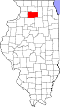 | |
| Villages | ||
| Townships | ||
| CDPs | ||
| Other communities | ||
| Footnotes | ‡This populated place also has portions in an adjacent county or counties | |
| International | |
|---|---|
| National | |
| Other | |
