



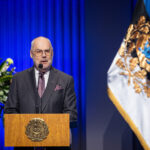




Amrom Harry Katz
Amrom Harry Katz | |
|---|---|
 | |
| Born | August 15, 1915 |
| Died | February 9, 1997 (aged 81) |
| Alma mater | University of Wisconsin |
| Occupations | Physicist, technologist |
| Years active | 1940–1980s |
| Known for | Development of photogrammetry and satellite reconnaissance during Cold War; panoramic photography |
| Notable work | One of ten National Reconnaissance Office founders, RAND Corporation leader, CORONA spy satellite program, Battle of Inchon |
| Board member of | Arms Control and Disarmament Agency, Committee on International Security and Arms Control, World Federalist Movement/Institute for Global Policy |
| Awards | Society of Photographic Instrumentation Engineers (SPIE) George W. Goddard Award, Operational Research Society Space Sciences Award |
Amrom Harry Katz (August 15, 1915 – February 9, 1997) was an American physicist and intelligence technologist who was a key figure in the development of aerial and satellite reconnaissance during the Cold War. Over a five-decade career spanning World War II, the Korean War, and the Cold War, Katz contributed to advances in airborne camera systems, photogrammetry, and space-based surveillance. He served as a civilian photo scientist for the U.S. Army Air Corps and later at Wright-Patterson Air Force Base, where he improved aerial imaging techniques and helped document the atomic tests at Bikini Atoll.
During the Korean War, he devised a novel tidal prediction method that supported the amphibious landing at the Battle of Inchon. From 1954 to 1969, Katz worked at the RAND Corporation, where his collaboration with Merton Davies led to the concept of a recoverable film-return satellite, leading to the CORONA spy satellite program. In later declassified histories, the National Reconnaissance Office credited Katz and Davies with originating the concept of photographic film-return reconnaissance satellites, and Katz was posthumously recognized by the NRO in 2000 as one of its ten founders. He later promoted the civilian use of reconnaissance technologies and served as Assistant Director of the U.S. Arms Control and Disarmament Agency (appointed in 1973), where he advocated using satellite surveillance for treaty verification. His contributions to airborne and space reconnaissance were recognized with the Society of Photographic Instrumentation Engineers (SPIE) George W. Goddard Award and the Operational Research Society Space Sciences Award, and he was known by the nickname "Slide-Rule Katz". Katz died of complications from Parkinson's disease in 1997.
Early life and education
Amrom Harry Katz was born in Chicago on August 15, 1915, to Max and Lena Katz.[1]: 3, 6 His mother was a homemaker and his father managed real estate properties.[1]: 6 The family later moved to Milwaukee, Wisconsin, where Katz graduated from West Division High School (now Milwaukee High School of the Arts).[1]: 7 Katz attended the first Hebrew high school program in Milwaukee.[2]: 5 He had two brothers; Matty, a doctor, and Yale, an engineer at Thompson Ramo Wooldridge (TRW).[2]: 5 He earned degrees in physics and mathematics from the University of Wisconsin.[3]: 34 Katz attended the Massachusetts Institute of Technology (MIT) for his graduate work.[4]
Army Air Corps

In 1940, Katz began work as a junior physicist in the United States Army Air Corps research and development division.[3]: 34 The following year, he began a 13-year tenure at the photographic laboratories of Wright Field at Dayton, Ohio, later renamed Wright-Patterson Air Force Base.[5] Historian Dwayne A. Day described Katz as a "wizard" in his thinking and approach; he noted Katz was not often the first to think of an idea, but was often the first to refine it into a comprehensive recommendation for bodies such as the United States Air Force.[6] Katz reengineered aerial camera systems for the Air Corps, significantly enhancing reconnaissance imaging during World War II.[3]: 34
Albert Einstein and Katz exchanged letters discussing matters related to the Emergency Committee of Atomic Scientists.[7] Katz participated in Operation Crossroads, the nuclear tests at Bikini Atoll. Based at Kwajalein Atoll, he served as a staff physicist and technical advisor,[8]: 6 leading the oblique aerial photographic documentation of the detonations.[3]: 34 Before the tests, international journalists waited with nothing to report.[9]: 32 He arranged for friends at a U.S. airbase to send horseshoes and manure (shipped in dry ice to conceal the odor).[9]: 32 Simulated horse tracks were created by Katz and friends in the middle of the night, scattering manure along the trail, hoping to find reporters investigating a horse that did not exist.[9]: 32
Katz developed a novel photogrammetric method during the Korean War to derive tidal data from aerial imagery.[3]: 34 He traveled to Korea during the war to survey and assist in the selection of landing sites for the battle.[5] His tide analysis enabled the timing of the amphibious landing at the Battle of Inchon, contributing to its operational success.[3]: 34 Katz's contribution to the battle and landing of the United States Marine Corps at the seawalls involved analysis of aerial photography taken for the invasion and using math to plan part of the successful attack.[4] During his time at Wright Field Katz developed what the National Air and Space Museum described as the "aerial photographic computer," a base board with transparent mylar overlays used for complex studies of photographic coverage.[10] Katz departed the photography programs at Wright-Patterson in 1954.[5]
RAND corporation

Katz joined the RAND Corporation in 1954 to advance global reconnaissance methods.[3]: 34 His research there encompassed aerial, balloon-based, and satellite reconnaissance platforms.[3]: 34 During this work, Katz collaborated with Edwin Land of the Polaroid Corporation, James Baker, Edward Mills Purcell of Harvard University, and RAND’s Merton Davies. Their group was so effective and congenial that William E. Burrows described them in Smithsonian Magazine as a "fraternity of grown-up whiz kids".[11] Katz and many of his colleagues were later recognized as founding figures in the establishment of the United States Intelligence community's new National Reconnaissance Office (NRO) in 1960; the NRO's very existence would remain a classified state secret until 1992.[3]: 34
Satellite reconnaissance creation
Early ideas for space-based platforms to operate reconnaissance, advocated by Davies and Katz, were "dismissed as impossible."[12]: vii During this period, RAND also reviewed observation balloon technologies with advanced cameras.[13]: 138–140 Katz told staff at the National Photographic Interpretation Center that RAND’s interest was sparked by a skyhook balloon that had "escaped" and subsequently overflew Europe and Asia undetected.[13]: 138–139 In 1957, Katz and Davies devised the concept of a recoverable film-return satellite.[3]: 34
The project evolved from WS-117L, also known as SAMOS, a cover for the development of the KH-7 Gambit reconnaissance satellites.[14] Katz was by credited by Davies and William R. Harris for his role in bringing Boston University's Walter Levison, then bed-ridden in a hospital from a back injury, into their team, which led to panoramic cameras with longer focal lengths.[15]: 7–8 : 11, 12 At the time, an initial cover story of a "cloud reconnaissance satellite" was recommended by Katz for SAMOS, but with cautions noted by him to never refer to it as a "weather satellite" or to have actual meteorological implications; Katz was concerned this would lead to jurisdictional issues with other parts of the government.[6]
Their design laid the foundation for the CORONA reconnaissance satellite program.[3]: 34 Later in 1957, Katz and Davies were informed the project was cancelled and they "were not allowed to know of its existence".[6] However, between 1957 and 1959, Katz deduced the program had moved forward under the codename of Discoverer. After making notable references to the secret program in unrelated classified documents caused issues, he was formally interviewed to determine what he know of the top secret CORONA program.[6] As a result of his actions, Katz was formally informed of and briefed into the top secret CORONA program, and was asked to stop talking about it outside of approved channels.[6]
Impacts on aerospace and intelligence doctrines
Katz wrote one of the earliest draft papers on weather satellites in 1959.[6] In the 1960s, Katz promoted adapting military reconnaissance tools for domestic mapping and scientific use.[3]: 34 He emphasized the importance of accelerating the interpretation and documentation of imagery derived from aerospace sensors.[3]: 34 While at RAND, Katz supported the use of aerial reconnaissance to monitor treaty and arms control compliance by the Soviet Union.[5] In 1963, Air & Space Forces Magazine highlighted a 1959 report in which Katz observed that many World War II-era photointerpreters had dismissed the idea that high-altitude photography "might ever be useful."[16]
In a 1972 memorandum for the NRO titled Preliminary Thoughts on Crises: More Questions Than Answers, Katz warned that U.S. space systems had been "protected by assumption—the belief that nobody would interfere with their operation," and cautioned that this development path risked "tempting [adversaries] with juicier targets than we used to."[17]: 33 He outlined four approaches for protecting space assets: making satellites harder to attack, harder to detect, easier to replace, and preparing to shoot down an adversary's satellites.[17]: 24 He also advocated using local nationals for aerial photography in arms control contexts, reasoning that such missions would provoke less opposition than satellite surveillance.[18]: 44–45
Many of his proposed civil applications for aerospace imaging were not implemented until decades later.[3]: 34 The earlier Air & Space Forces Magazine article had outlined three rules Katz regarded as essential for satellite photography: that focal length is more important than scale factor; that the fastest possible shutter speed should be used; and that there is no benefit to miniaturization, with equipment made as large as possible to maximize photographic outcomes.[16] Military historian Walter Dorn noted that Katz was involved in Project Feedback while at RAND, which developed toward space nuclear reactors flown during the 1960s by NASA.[19]
Arms Control and Disarmament Agency
In 1973, U.S. President Richard Nixon appointed Katz Assistant Director of the Arms Control and Disarmament Agency (ACDA).[3]: 34 At ACDA, he promoted the use of overhead surveillance as a key element of treaty verification.[3]: 34 Known for his gallows humor,[20] Katz once told President Ronald Reagan during a discussion of arms control, "we have never discovered anything that the Soviets have successfully hidden," a remark that left the president laughing.[20] Arthur C. Lundahl often quoted Katz for his ability to underscore serious points with terse, humorous observations.[13]: 121 Throughout his career, Katz served on and attended many international conferences, talks and summits related to Soviet Union–United States relations and the nuclear arms race between them, including the Strategic Arms Limitation Talks, the Pugwash Conferences on Science and World Affairs, and the American Assembly.[21]
Related works and writings
Katz was active in the American Society for Photogrammetry and Remote Sensing and worked with Itek, a defense contractor that specialized in camera systems for spy satellites and other reconnaissance platforms.[22]: 1 Dino Brugioni quoted him on the distinction between a mapping camera and a reconnaissance camera: "Mapping photography is designed to give information about the character of the terrain; reconnaissance/intelligence photography is designed to give information about characters on the terrain."[13]: 294 Katz also recalled a notable exchange with Soviet counterparts at a 1960 conference, when a Soviet scientist asked what kind of film the U.S. used in the Lockheed U-2 program. When Katz pressed for the reason, the Soviet replied, "They were damn good pictures."[13]: 348
Katz taught political science at University of California, Los Angeles's National Security Studies Program in 1963.[21] Over his career, Katz would speak to youth groups about nuclear weapons programs.[23]: 2 Katz was a long-time board member of the World Federalist Movement/Institute for Global Policy, served on the Committee on International Security and Arms Control, and sat on the boards of several arms control related journals, periodicals, and organizations.[21]
A 1968 report by Chile’s Instituto de Investigación de Recursos Naturales identified him as a specialist in orbital photography.[18]: 44–45 Herman Kahn, in On Thermonuclear War, credited Katz with coining the term "catalytic war" to describe a conflict intentionally started by a third country to provoke two major powers into fighting one another.[24]: 156 William W. Herrmann of the System Development Corporation in 1968 described that Katz's views of military conflicts were based on repeating patterns: fight, peace, and rebuild iteratively, as often as necessary for conflicts with developed countries, but that the methods may not apply to less developed adversaries.[25]: 15 Katz was clear, however, that there was to be simultaneous efforts; the defeated adversary had to be rebuilt and empowered to succeed down to the level of the citizenry.[25]: 15–16
In 1969, John L. McLucas, then Director of the National Reconnaissance Office (DNRO), wrote that Katz felt "imagination formerly prevalent in the reconnaissance business is waning".[26]: 2 Katz's tenure at RAND continued through 1969.[27] By 1975, Katz was not "sympathetic" to full nuclear disarmament by the U.S. military.[23]: 2 Davies in 1990 wrote that Katz concluded of his career there, that the "most important work he did after coming to RAND in 1954 was not on the means of accomplishing reconnaissance missions, but on the nature of and specification of reconnaissance requirements."[12]: 76 Katz's RAND discussion papers were often, as historian Day described, filled with "wry, slightly sarcastic remarks about the military bureaucracy".[6]
Awards and legacy

In 1987's then-classified report, The Corona Story, the NRO formally credited Katz and Davies with the invention of photographic spy satellites.[28]: 17 Katz received the Society of Photographic Instrumentation Engineers (SPIE) George W. Goddard Award in 1963 for his contributions to airborne and space reconnaissance.[3]: 34 [23]: 2 In 1970, Katz received the inaugural Space Sciences Award from the Operational Research Society.[23]: 2 RAND Corporation called Katz a "photoreconnaissance expert".[15]: 4 A 2016 academic conference of the Southern Network of History, Anthropology, and Sociology, held at Prince of Songkla University in Thailand, credited him—working under the Central Intelligence Agency with support from the RAND Corporation—with developing panoramic photography technology later incorporated into the CORONA reconnaissance satellite program.[29]: 53 In 2000, the National Reconnaissance Office recognized Katz as one of its ten founders.[30]: 13
His analytical sharpness earned him the nickname "Slide-Rule Katz" from General George William Goddard, reflecting his reputation for intellectual precision.[3]: 34 Writing in Studies in Intelligence, Jeffrey R. Cooper called Katz a "pioneer in aerial and overhead reconnaissance", and credited the statement to him that, "You rarely find what you’re not looking for and usually do find what you are looking for."[31]: 26 U.S. Air Force general Larry K. Grundhauser writing in Air and Space Power Journal called Katz "an arms control legend and father of NTM", or national technical means of verification, the methods and process of using satellite photography to verify adherence to international treaties.[32]: 72
The New York Times noted Katz was "quick to discern possible civilian applications of reconnaissance technology", and applying it to humanitarian and environmental causes, such as natural disasters and resource conservation.[4] According to general Noel F. Parrish, commanding officer of the Tuskegee Airmen, Katz was known for a "talent for humility".[33]: 80
Later life and death
Katz was married for 56 years to Louise Katz (née Klibanow), had two daughters, Barbara and Deborah, and a son, Michael, and six grandchildren.[4] In the 1970s, Katz served on the board of trustees for Temple Beth Shalom in Milwaukee.[2]: 5 Katz died of complications from Parkinson's disease on February 9, 1997, at St. Johns Hospital and Health Center in Santa Monica, California.[34][5][4]
Bibliography
- Katz, Amrom H. Balloon Reconnaissance-Part I: Intelligence Requirements and Reconnaissance Systems. RAND Corporation, May 1957.[12]: 76
- Katz, Amrom H. P-1707, Observation Satellites: Problems, Possibilities, and Prospects. RAND Corporation, May 1959.[12]: 114
- Katz, Amrom H. Observation Satellites: Problems and Prospects. In six parts. Astronautics, Vol. 5, Nos. 4, 6, 7, 8, 9, and 10 (May–October 1960).[35]: 61
- Katz, Amrom H. Some Things to Do and Some to Think, Bulletin of the Atomic Scientists, Vol. 17, No. 4, April 1961, pp. 139–143.[21]
- Katz, Amrom H. Good Disarmament—and Bad, Air and Space Forces Digest, May 1961.[21]
- Katz, Amrom H. Make the World Safe for Disarmament, War/Peace Report, September 1962.[21][36]: 33836
- Katz, Amrom H. The Stumbling Block of Soviet Secrecy, War/Peace Report, October 1962.[21]
- Katz, Amrom H. Clichés, Complexes and Contingencies, War/Peace Report, October 1962.[21]
- Katz, Amrom H. The Soviets and the U-2 Photos – an Heuristic Argument. RAND Corporation, Paper RM-3584-PR, March 1963.[37]
- Katz, Amrom H., ed. Selected Readings in Aerial Reconnaissance. RAND Corporation, Paper P-2762, August 1963.[12]: 114
- Katz, Amrom H. The Myth of Overkill. Air & Space Forces Magazine, February 1, 1964.[21]
- Katz, Amrom H. Reflections on satellites for earth resource surveys, RAND Corporation, Paper P-3753, 1967.[35]: 61
- Katz, Amrom H. A Guide for the Perplexed, or a Minimal/Maxim-al Handbook for Tourists in a Classified Bureaucracy, Air and Space Forces Digest, November 1967.[38]: 60
- Katz, Amrom H. Let Aircraft Make Earth-Resource Surveys. Astronautics and Aeronautics, June 1969.[35]: 35
- Katz, Amrom H. Verification of SALT: The State of the Art and the Art of the State. National Security Record, April 1979.[32]: 80 [39]: 10179
- Katz, Amrom H. Psychologist's Cure for Arms Race Questioned. War/Peace Report, January 1982.[21]
See also
References
 This article incorporates public domain material from websites or documents of the United States government.
- ^ a b c "National Air and Space Museum, Joint Oral History Project on the History of the RAND Corporation" (PDF). Smithsonian Institution. Archived (PDF) from the original on March 8, 2022.
- ^ a b c "Katz Bros. Play Key Role at SPIE Parley". Wisconsin Jewish Chronicle. September 18, 1970. p. 5. Archived from the original on January 5, 2026.
- ^ a b c d e f g h i j k l m n o p q r Ondrejka, Ronald J. (May 28, 2004). "Memorial address by Ondrejka" (PDF). American Society for Photogrammetry and Remote Sensing. Archived from the original (PDF) on August 4, 2025.
- ^ a b c d e Pace, Eric (February 15, 1997). "Amrom H. Katz, 81, Early Expert on Space Reconnaissance". New York Times. Archived from the original on May 27, 2015.
- ^ a b c d e "Amrom H. Katz; Expert in Photographic Reconnaissance". Los Angeles Times. February 13, 1997.
{{cite web}}: CS1 maint: deprecated archival service (link) - ^ a b c d e f g Day, Dwayne (March 28, 2022). "Dark clouds: The secret meteorological satellite program (part 1)". The Space Review. Archived from the original on March 29, 2022.
- ^ Katz, Amrom H. (February 2, 1948). "Katz, Amrom H., June 2, 1948". Special Collections & Archives Research Center. The Valley Library, Oregon State University. Archived from the original on September 16, 2019.
- ^ "Amrom Katz Leaves U.S. for Kwajalein Atom Tests". Wisconsin Jewish Chronicle. April 19, 1946. Archived from the original on January 5, 2026.
- ^ a b c Digby, James (March 2001). "Early RAND: Personalities and Projects as Recalled in the Alumni Bulletin" (PDF). Defense Technical Information Center. Archived (PDF) from the original on August 10, 2023.
- ^ "Calculator, Graphic, Oblique, Aerial Type A-1, Prototype, with 18 Transectors". National Air and Space Museum. 1949. Archived from the original on March 30, 2025.
- ^ Burrows, William E. (January 2000). "The Coldest Warriors: Tales from the corridors of an agency so secret that officially it didn't exist". Smithsonian Magazine. Archived from the original on January 17, 2022.
- ^ a b c d e Davies, Merton E.; Harris, William R. (January 24, 1990). "RAND's Role In the Evolution of Balloon and Satellite Observation Systems and Related U.S. Space Technology" (PDF). Defense Technical Information Center. Archived (PDF) from the original on July 1, 2025.
- ^ a b c d e Brugioni, Dino A. (2010). Eyes in the Sky: Eisenhower, the CIA and Cold War Aerial Espionage. Naval Institute Press. ISBN 9781591140825.
- ^ Gerald K. Haines (1997). "Development of the GAMBIT and HEXAGON Satellite Reconnaissance Systems" (PDF). National Reconnaissance Office. Archived from the original (PDF) on July 13, 2014. Retrieved October 8, 2011.
- ^ a b Davies, Merton E.; Harris, William R. (August 15, 1986). "Space Research In The Early Years At RAND" (PDF). National Reconnaissance Office. RAND Corporation. Archived (PDF) from the original on December 23, 2025.
- ^ a b Butz Jr., J. S. (January 1, 1963). "The Need to Know". Air & Space Forces Association. Archived from the original on September 28, 2025.
- ^ a b Harrison, Todd (2013). The Future of MILSATCOM (PDF) (Report). Center for Strategic and Budgetary Assessments. pp. 32–35. Archived from the original (PDF) on September 28, 2025.
- ^ a b Ruiz-Tagle, Miguel P.; Villa S., Miguel (December 1968). Uso de Sensores Remotos en la Percepción de Recursos Naturales [Use of Remote Sensors in the Perception of Natural Resources] (Informe Nº 26) (in Spanish). Santiago, Chile: Instituto de Investigación de Recursos Naturales (IREN), CORFO. II02668. Archived from the original (PDF) on September 28, 2025.
- ^ Dorn, Walter (1987). "PEACEKEEPING SATELLITES: The Case for International Surveillance and Verification". Walter Dorn.
{{cite web}}: CS1 maint: deprecated archival service (link) - ^ a b Allen, Richard V. (December 22, 1998). "Saddam muß gestürzt werden". Die Welt. Archived from the original on May 1, 2019.
- ^ a b c d e f g h i j Katz, Amrom H. (February 1, 1964). "The Myth of Overkill". Air & Space Forces Magazine. Archived from the original on December 9, 2023.
The author of the following study possesses unimpeachable credentials. Mr. Katz is a physicist and an outstanding expert on aerial and space reconnaissance, first with the Air Force and now with the RAND Corporation. More importantly, he has a long record of activity and interest in the problems of peace as well as war. He is a long-time member of United World Federalists and has served on its National Executive Council. He was an original member of the Committee on Security Through Arms Control of the National Planning Association. He is on the Board of Sponsors of the magazine War/Peace Report, the Board of the magazine Disarmament and Arms Control, and the Advisory Board of the Journal of Arms Control. He has actively participated in most of the major arms-control and disarmament conferences in this country and abroad, including the Pugwash Conferences in Moscow and London, the Arden House Strategy for Peace Conferences, several meetings of the American Assembly, the Stowe (Vt.) Conference of Scientists on World Affairs, and the Accra Assembly in Ghana. He was a Professor in Residence of Political Science and Senior Fellow in the National Security Studies Program at UCLA in 1963 and is a consultant to the US Arms Control and Disarmament Agency. We are proud to count him among our authors.—THE EDITORS
- ^ "Reflection of the Past" (PDF). American Society for Photogrammetry and Remote Sensing. May 2009. Archived (PDF) from the original on September 28, 2025.
- ^ a b c d Landon, Susan. "U.S. Reported Tightening Against Any Bomb Thefts". Albuquerque Journal. p. 2. Archived from the original on January 5, 2026.
- ^ Kahn, Herman (1978) [1st pub. 1960]. On Thermonuclear War. Princeton University Press. ISBN 0-313-20060-2.
The last possibility shown in Table 36, that a third country may try to touch off a war between the major powers, has been named "catalytic war" by Amron Katz. If both powers have slow reacting and flexible systems or can stop a war before both are destroyed, then starting a catalytic war would both be very difficult and very risky.
- ^ a b Herrmann, William W. (April 8, 1968). Riot Prevention and Control: Operations Research Response (PDF) (Report). Santa Monica, California: System Development Corporation. p. 24. AD0672777. Archived from the original (PDF) on February 2, 2025. Retrieved December 23, 2025.
- ^ McLucas, John L. (June 28, 1969). "Memorandum for the Record" (PDF). National Reconnaissance Office. Archived (PDF) from the original on September 28, 2024.
- ^ "National Aeronautics and Space Administration, NASA History Division, Biographies of Aerospace Officials and Policymakers, K-N". NASA. 2001. Archived from the original on March 7, 2001.
- ^ Oder, Frederic C. E.; Fitzpatrick, James C.; Worthman, Paul E. (November 1987). The CORONA Story (PDF) (Report). Sunnyvale, California: National Reconnaissance Office. p. 182. Archived from the original (PDF) on October 17, 2020. Retrieved December 23, 2025.
The concept had been invented by Amrom Katz and Merton Davies, two of several RAND scientists who contributed to the study.
- ^ รายงานการดำเนินงาน โครงการประชุมวิชาการระดับชาติ หัวข้อ "ศาสตร์แห่งการจำ ศิลป์แห่งการลืม" [Project Report: National Academic Conference on "The Science of Memory, The Art of Forgetting"] (PDF). National Conference of the Southern Network of History, Anthropology, and Sociology (in Thai). Prince of Songkla University, Pattani Campus, Thailand: เครือข่ายประวัติศาสตร์ มานุษยวิทยาและสังคมวิทยาภาคใต้. August 25–27, 2016. PDG59H0004. Archived from the original (PDF) on February 25, 2025.
Cloud ชี้ว่า ทีมนักวิทยาศาสตร์ และนักภูมิศาสตร์ที่ท าการคิดค้นและพัฒนาเทคโนโลยีซึ่งประกอบไปด้วยบุคคลส าคัญ 3 คนคือ Walder Tobler, Frederick J. Doyle และ Amron Katz ทั้งสามคนท างานอยู่ภายใต้สังกัดของ CIA โดยได้รับการสนับสนุนและ ความร่วมมือจาก RAND Corporation หน้าที่ของ Tobler ก็คือการคิดค้นการส ารวจและการท าแผนที่โดยใช้เรด้าร์ Doyle เป็นผู้พัฒนาเทคโนโลยีการท าแผนที่โดยการถ่ายภาพทางอากาศ หรือ photogrammetry และ Katz มุ่งไปที่ การพัฒนากล้องถ่ายภาพแบบพาโนรามา (panoramic camera) หรือที่ต่อมาเทคโนโลยีเหล่านี้อยู่ภายใต้โครงการ ลับที่ชื่อว่า CORONA.
- ^ "NRO By the Numb3rs: National Reconnaissance Office at 60 years" (PDF). National Reconnaissance Office, Center for the Study of National Reconnaissance. December 2021. p. 13. Archived (PDF) from the original on March 19, 2024.
Those 10 individuals were: William Baker, Merton Davies, Sidney Drell, Richard Garwin, Amrom Katz, James Killian, Edwin Land, Frank Lehan, William Perry, and Edward Purcell.
- ^ Cooper, Jeffrey R. (December 2005). Curing Analytic Pathologies: Pathways to Improved Intelligence Analysis (PDF) (Report). Washington, DC: Center for the Study of Intelligence, Central Intelligence Agency. p. 26. Archived from the original (PDF) on July 8, 2024.
Humans are extremely good at finding patterns, even when there is none—hence the classic intelligence aphorism, "You rarely find what you're not looking for and usually do find what you are looking for." Footnote: This remark is often attributed to Amrom Katz, a pioneer in aerial and overhead reconnaissance.
- ^ a b Grundhauser, Larry K. (Winter 1998). Sentinels Rising: Commercial High-Resolution Satellite Imagery and Its Implications for US National Security (PDF). Defense Technical Information Center (Report). Air and Space Power Journal. Archived from the original (PDF) on February 2, 2025. Retrieved December 30, 2025.
- ^ Parrish, Noel F. (July–August 1971). "The Civilian Analysts, in Their Pride and Their Fall" (PDF). Air University Review. 22 (5): 80. Archived from the original (PDF) on June 13, 2019. Retrieved December 30, 2025.
- ^ "Amrom Katz". The Blade. February 15, 1997. Archived from the original on January 3, 2026.
- ^ a b c Second Annual Earth Resources Aircraft Program Status Review. Volume 2: Agriculture/forestry, and sensor studies (PDF) (Report). Hampton, Virginia: National Aeronautics and Space Administration Scientific and Technical Information (STI) Program. 1971. Archived from the original (PDF) on December 29, 2025.
- ^ Congressional Record: Proceedings and Debates of the 90th Congress, First Session (PDF). Vol. 113 (Bound ed.). Washington, D.C.: U.S. Government Printing Office. November 27, 1967. p. 33836. Archived from the original (PDF) on December 18, 2024. Retrieved December 30, 2025.
- ^ Katz, Amrom (March 1963). The Soviets and the U-2 Photos – an Heuristic Argument (PDF) (Memorandum). Santa Monica, California: RAND Corporation. AD405302. Archived from the original (PDF) on October 26, 2021. Retrieved December 30, 2025.
- ^ Roylance, Gerald (May 1980). A Simple Model of Circuit Design (PDF) (Report). Cambridge, Massachusetts: MIT Computer Science and Artificial Intelligence Laboratory, Advanced Research Projects Agency. p. 65. ADA128631. Archived from the original (PDF) on April 19, 2024. Retrieved December 23, 2025.
- ^ Congressional Record: Proceedings and Debates of the 96th Congress, First Session (PDF). Vol. 125 (Bound ed.). Washington, D.C.: U.S. Government Printing Office. May 7, 1979. p. 10179. Archived from the original (PDF) on December 30, 2025. Retrieved December 30, 2025.
External links
- NRO honors pioneers of national reconnaissance.
- Smithsonian Institution Archives, SIA RU009536, Katz.
- The Myth of Overkill, by Amrom H. Katz, February 1, 1964. Air & Space Forces Magazine. Archive link.
| Current programs |
|  |
|---|---|---|
| Facilities & commands |
| |
| Technology & Science | ||
| Satellite lines & projects |
| |
| People | ||
| History | ||
| Past programs |
| |
| Founders | ||
| International | |
|---|---|
| National | |
| Academics | |
