








Lincoln County, Colorado
Lincoln County, Colorado | |
|---|---|
 Lincoln County Courthouse in Hugo | |
 Location within the U.S. state of Colorado | |
| Coordinates: 38°59′N 103°31′W / 38.98°N 103.52°W | |
| Country |  United States United States |
| State |  Colorado Colorado |
| Founded | April 11, 1889 |
| Named after | Abraham Lincoln |
| Seat | Hugo |
| Largest town | Limon |
| Area | |
• Total | 2,586 sq mi (6,700 km2) |
| • Land | 2,578 sq mi (6,680 km2) |
| • Water | 8.8 sq mi (23 km2) 0.3% |
| Population (2020) | |
• Total | 5,675 |
• Estimate (2024) | 5,598  |
| • Density | 2.201/sq mi (0.8499/km2) |
| Time zone | UTC−7 (Mountain) |
| • Summer (DST) | UTC−6 (MDT) |
| Congressional district | 4th |
| Website | lincolncounty |
Lincoln County is a county located in the U.S. state of Colorado. As of the 2020 census, the population was 5,675.[1] The county seat is Hugo.[2] The county obtains its name in memory of the United States President Abraham Lincoln.[3] The county was formed from portions of Bent and Elbert counties in 1889 from a restructuring of Colorado counties.[4]
Geography
According to the U.S. Census Bureau, the county has a total area of 2,586 square miles (6,700 km2), of which 2,578 square miles (6,680 km2) is land and 8.8 square miles (23 km2) (0.3%) is water.[5]
The main watersheds include the Arikaree and Republican Rivers in the northern part of the county and the Big Sandy, Rush, and Horse Creeks in the southern part of the county. Big Sandy and Rush Creeks ultimately drain into the Arkansas River.[6]
Adjacent counties
- Washington County - north
- Kit Carson County - east
- Cheyenne County - east
- Crowley County - south
- Kiowa County - south
- Elbert County - west
- El Paso County - west
- Arapahoe County - northwest
- Pueblo County - southwest
Major highways


Government
Lincoln County's government is based in the county courthouse in Hugo which is the office of the board of three elected commissioners and a county administrator, as well as the county sheriff, county clerk and recorder, county assessor, county treasurer, county coroner, and the county court (the trial court of limited jurisdiction for county affairs). Lincoln County is part of the 18th Colorado Judicial District — the state trial court of general jurisdiction — with judicial matters conducted in the Littleton and Centennial courthouses in Arapahoe County. Lincoln County's government operation also includes a department of social services, land use office, road and bridge department, human services department, public health department, mobile library services, probation department, county landfill, county fairgrounds, and county extension service.
| Year | Republican | Democratic | Third party(ies) | |||
|---|---|---|---|---|---|---|
| No. | % | No. | % | No. | % | |
| 1892 | 113 | 64.57% | 0 | 0.00% | 62 | 35.43% |
| 1896 | 123 | 36.72% | 210 | 62.69% | 2 | 0.60% |
| 1900 | 255 | 66.93% | 124 | 32.55% | 2 | 0.52% |
| 1904 | 323 | 69.91% | 132 | 28.57% | 7 | 1.52% |
| 1908 | 794 | 56.23% | 576 | 40.79% | 42 | 2.97% |
| 1912 | 534 | 23.41% | 796 | 34.90% | 951 | 41.69% |
| 1916 | 1,129 | 37.81% | 1,702 | 57.00% | 155 | 5.19% |
| 1920 | 1,815 | 61.26% | 1,013 | 34.19% | 135 | 4.56% |
| 1924 | 1,642 | 54.70% | 634 | 21.12% | 726 | 24.18% |
| 1928 | 2,110 | 69.11% | 888 | 29.09% | 55 | 1.80% |
| 1932 | 1,453 | 41.09% | 1,979 | 55.97% | 104 | 2.94% |
| 1936 | 1,420 | 44.89% | 1,660 | 52.48% | 83 | 2.62% |
| 1940 | 1,780 | 59.57% | 1,185 | 39.66% | 23 | 0.77% |
| 1944 | 1,689 | 59.49% | 1,147 | 40.40% | 3 | 0.11% |
| 1948 | 1,271 | 50.52% | 1,231 | 48.93% | 14 | 0.56% |
| 1952 | 1,843 | 66.46% | 927 | 33.43% | 3 | 0.11% |
| 1956 | 1,603 | 61.25% | 1,012 | 38.67% | 2 | 0.08% |
| 1960 | 1,498 | 58.93% | 1,041 | 40.95% | 3 | 0.12% |
| 1964 | 1,104 | 45.26% | 1,327 | 54.41% | 8 | 0.33% |
| 1968 | 1,407 | 57.08% | 809 | 32.82% | 249 | 10.10% |
| 1972 | 1,678 | 70.03% | 685 | 28.59% | 33 | 1.38% |
| 1976 | 1,276 | 53.46% | 1,059 | 44.37% | 52 | 2.18% |
| 1980 | 1,535 | 64.74% | 602 | 25.39% | 234 | 9.87% |
| 1984 | 1,661 | 72.91% | 587 | 25.77% | 30 | 1.32% |
| 1988 | 1,356 | 60.29% | 874 | 38.86% | 19 | 0.84% |
| 1992 | 1,079 | 46.79% | 640 | 27.75% | 587 | 25.46% |
| 1996 | 1,272 | 57.74% | 729 | 33.09% | 202 | 9.17% |
| 2000 | 1,630 | 74.12% | 510 | 23.19% | 59 | 2.68% |
| 2004 | 1,819 | 77.83% | 503 | 21.52% | 15 | 0.64% |
| 2008 | 1,717 | 74.52% | 546 | 23.70% | 41 | 1.78% |
| 2012 | 1,687 | 73.76% | 552 | 24.14% | 48 | 2.10% |
| 2016 | 1,892 | 77.67% | 409 | 16.79% | 135 | 5.54% |
| 2020 | 2,135 | 80.54% | 470 | 17.73% | 46 | 1.74% |
| 2024 | 2,090 | 81.29% | 432 | 16.80% | 49 | 1.91% |
Demographics
| Census | Pop. | Note | %± |
|---|---|---|---|
| 1890 | 689 | — | |
| 1900 | 926 | 34.4% | |
| 1910 | 5,917 | 539.0% | |
| 1920 | 8,273 | 39.8% | |
| 1930 | 7,850 | −5.1% | |
| 1940 | 5,882 | −25.1% | |
| 1950 | 5,909 | 0.5% | |
| 1960 | 5,310 | −10.1% | |
| 1970 | 4,836 | −8.9% | |
| 1980 | 4,663 | −3.6% | |
| 1990 | 4,529 | −2.9% | |
| 2000 | 6,087 | 34.4% | |
| 2010 | 5,467 | −10.2% | |
| 2020 | 5,675 | 3.8% | |
| 2024 (est.) | 5,598 | [8] | −1.4% |
| U.S. Decennial Census[9] 1790-1960[10] 1900-1990[11] 1990-2000[12] 2010-2020[1] | |||
2020 census
As of the 2020 census, the county had a population of 5,675. Of the residents, 21.0% were under the age of 18 and 17.2% were 65 years of age or older; the median age was 39.2 years. For every 100 females there were 140.9 males, and for every 100 females age 18 and over there were 149.2 males. 0.0% of residents lived in urban areas and 100.0% lived in rural areas.[13][14][15]
| Race / Ethnicity (NH = Non-Hispanic) | Pop 2000[16] | Pop 2010[17] | Pop 2020[18] | % 2000 | % 2010 | % 2020 |
|---|---|---|---|---|---|---|
| White alone (NH) | 5,126 | 4,345 | 4,252 | 84.21% | 79.48% | 74.92% |
| Black or African American alone (NH) | 298 | 280 | 275 | 4.90% | 5.12% | 4.85% |
| Native American or Alaska Native alone (NH) | 50 | 38 | 61 | 0.82% | 0.70% | 1.07% |
| Asian alone (NH) | 33 | 39 | 40 | 0.54% | 0.71% | 0.70% |
| Pacific Islander alone (NH) | 2 | 2 | 22 | 0.03% | 0.04% | 0.39% |
| Other race alone (NH) | 0 | 3 | 21 | 0.00% | 0.05% | 0.37% |
| Mixed race or Multiracial (NH) | 59 | 77 | 195 | 0.97% | 1.41% | 3.44% |
| Hispanic or Latino (any race) | 519 | 683 | 809 | 8.53% | 12.49% | 14.26% |
| Total | 6,087 | 5,467 | 5,675 | 100.00% | 100.00% | 100.00% |
The racial makeup of the county was 77.5% White, 4.8% Black or African American, 1.3% American Indian and Alaska Native, 0.8% Asian, 0.4% Native Hawaiian and Pacific Islander, 8.7% from some other race, and 6.4% from two or more races. Hispanic or Latino residents of any race comprised 14.3% of the population.[15]
There were 1,980 households in the county, of which 28.6% had children under the age of 18 living with them and 24.4% had a female householder with no spouse or partner present. About 32.8% of all households were made up of individuals and 15.7% had someone living alone who was 65 years of age or older.[14]
There were 2,358 housing units, of which 16.0% were vacant. Among occupied housing units, 65.4% were owner-occupied and 34.6% were renter-occupied. The homeowner vacancy rate was 2.7% and the rental vacancy rate was 7.8%.[14]
2000 census
At the 2000 census there were 6,087 people in 2,058 households, including 1,389 families, in the county. The population density was 2 people per square mile (0.77 people/km2). There were 2,406 housing units at an average density of 1 units per square mile (0.39 units/km2). The racial makeup of the county was 86.30% White, 4.96% Black or African American, 0.94% Native American, 0.56% Asian, 0.03% Pacific Islander, 5.65% from other races, and 1.56% from two or more races. 8.53% of the population were Hispanic or Latino of any race.[19] Of the 2,058 households 33.70% had children under the age of 18 living with them, 55.30% were married couples living together, 8.40% had a female householder with no husband present, and 32.50% were non-families. 29.00% of households were one person and 13.00% were one person aged 65 or older. The average household size was 2.44 and the average family size was 3.04.
The age distribution was 23.90% under the age of 18, 7.10% from 18 to 24, 33.00% from 25 to 44, 21.80% from 45 to 64, and 14.30% 65 or older. The median age was 38 years. For every 100 females there were 130.90 males. For every 100 females age 18 and over, there were 140.70 males.
The median household income was $31,914 and the median family income was $39,738. Males had a median income of $25,742 versus $22,188 for females. The per capita income for the county was $15,510. About 8.10% of families and 11.70% of the population were below the poverty line, including 14.40% of those under age 18 and 11.50% of those age 65 or over.
Communities
Towns
Unincorporated communities
Historic trail
The name "Smoky Hill" comes from the appearance of the misty or smoky hills that the westward travelers viewed on their journey from Kansas and Nebraska Territories and Missouri toward the Colorado Gold Rush starting in 1858. Gold, had been discovered in the Cherry Creek, near Denver. The image of the misty hills and valleys along the route west gave the name to the trail for these travelers — the Smoky Hill Trail. Parts of the trail can still be seen as a two-track road on the Eastern Plains in what was once Kansas Territory but now is Colorado.
The section of the Smoky Hill Trail which passes through much of the High Plains has become known as the "starvation trail." This section of the trail proved to be the most difficult, due to a lack of water, yet the Plains Indians of the day considered this region as prime hunting ground.[20]
See also


- Bibliography of Colorado
- Geography of Colorado
- History of Colorado
- Index of Colorado-related articles
- List of Colorado-related lists
- Outline of Colorado
References
- ^ a b "State & County QuickFacts". United States Census Bureau. Retrieved September 5, 2021.
- ^ "Find a County". National Association of Counties. Retrieved June 7, 2011.
- ^ Gannett, Henry (1905). The Origin of Certain Place Names in the United States. U.S. Government Printing Office. p. 187.
- ^ "Lincoln County". Lincoln County, Colorado. Archived from the original on April 27, 2007. Retrieved July 24, 2017.
- ^ "US Gazetteer files: 2010, 2000, and 1990". United States Census Bureau. February 12, 2011. Retrieved April 23, 2011.
- ^ Terry Blevins, "Lincoln County, Colorado: America's Home on the Range." http://lincolncountycoloradotourism.com/
- ^ Leip, David. "Dave Leip's Atlas of U.S. Presidential Elections". uselectionatlas.org. Retrieved May 26, 2017.
- ^ "County Population Totals and Components of Change: 2020-2024". United States Census Bureau. Retrieved June 3, 2025.
- ^ "U.S. Decennial Census". United States Census Bureau. Retrieved June 8, 2014.
- ^ "Historical Census Browser". University of Virginia Library. Retrieved June 8, 2014.
- ^ "Population of Counties by Decennial Census: 1900 to 1990". United States Census Bureau. Retrieved June 8, 2014.
- ^ "Census 2000 PHC-T-4. Ranking Tables for Counties: 1990 and 2000" (PDF). United States Census Bureau. Archived (PDF) from the original on March 27, 2010. Retrieved June 8, 2014.
- ^ "2020 Decennial Census Demographic and Housing Characteristics (DHC)". United States Census Bureau. 2023. Retrieved 2025-12-08.
- ^ a b c "2020 Decennial Census Demographic Profile (DP1)". United States Census Bureau. 2021. Retrieved 2025-12-08.
- ^ a b "2020 Decennial Census Redistricting Data (Public Law 94-171)". United States Census Bureau. 2021. Retrieved 2025-12-08.
- ^ "P004: Hispanic or Latino, and Not Hispanic or Latino by Race – 2000: DEC Summary File 1 – Lincoln County, Colorado". United States Census Bureau. Retrieved February 7, 2026.
- ^ "P2 Hispanic or Latino, and Not Hispanic or Latino by Race – 2010: DEC Redistricting Data (PL 94-171) - Lincoln County, Colorado". United States Census Bureau. Retrieved February 7, 2026.
- ^ "P2 Hispanic or Latino, and Not Hispanic or Latino by Race – 2020: DEC Redistricting Data (PL 94-171) - Lincoln County, Colorado". United States Census Bureau. Retrieved February 7, 2026.
- ^ "U.S. Census website". United States Census Bureau. Retrieved May 14, 2011.
- ^ "History of Smoky Hill Trail." SmokyHillBound.com http://www.smokyhillbound.com/history-smoky-hill-trail-area
External links
Municipalities and communities of Lincoln County, Colorado, United States | ||
|---|---|---|
| Towns | 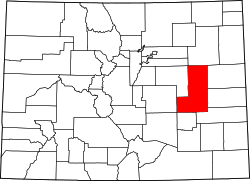 | |
| Unincorporated communities | ||
Places adjacent to Lincoln County, Colorado | ||||||||||||||||
|---|---|---|---|---|---|---|---|---|---|---|---|---|---|---|---|---|
| ||||||||||||||||


| International | |
|---|---|
| National | |
| Other | |
