






National Palace Museum
國立故宮博物院 | |||||||||||||||||||||||||
 | |||||||||||||||||||||||||
 National Palace Museum, Taipei, Taiwan | |||||||||||||||||||||||||
 Interactive fullscreen map | |||||||||||||||||||||||||
| Established | 10 October 1925 (in Forbidden City, Beijing) 12 November 1965 (in Taipei, Taiwan) | ||||||||||||||||||||||||
|---|---|---|---|---|---|---|---|---|---|---|---|---|---|---|---|---|---|---|---|---|---|---|---|---|---|
| Location | Shilin, Taipei, Taiwan | ||||||||||||||||||||||||
| Coordinates | 25°06′08″N 121°32′55″E / 25.1022°N 121.5486°E | ||||||||||||||||||||||||
| Type | National museum | ||||||||||||||||||||||||
| Collections | 699,119 (as of December 2025)[1] | ||||||||||||||||||||||||
| Visitors | Northern branch: 2,426,842 (2025)[2] Southern branch: 1,166,291 (2025)[3] | ||||||||||||||||||||||||
| Director | Hsiao Tsung-huang | ||||||||||||||||||||||||
| Architect | Huang Baoyu (Northern Branch) Kris Yao (Southern Branch) | ||||||||||||||||||||||||
| Website | npm.gov.tw | ||||||||||||||||||||||||
| Chinese name | |||||||||||||||||||||||||
| Traditional Chinese | 國立故宮博物院 | ||||||||||||||||||||||||
| Simplified Chinese | 国立故宫博物院 | ||||||||||||||||||||||||
| |||||||||||||||||||||||||
The National Palace Museum,[a] also known as Taipei Palace Museum,[b][4][5][6] is a national museum headquartered in Taipei, Taiwan.[7] Founded in Beijing in 1925, the museum was re-established in Shilin, Taipei, in 1965, later expanded with a southern branch in Taibao, Chiayi, in 2015.
The museum holds a permanent collection of nearly 700,000 pieces of artifacts and artworks, primarily comprising items relocated from the Beijing Palace Museum and other institutions in the mainland China during the government of the Republic of China's retreat to Taiwan. Before the re-establishment of the museum in Shilin in 1965, these collections were temporarily housed in various locations across Taiwan.
Spanning 8,000 years of history from the Neolithic to the modern era, the museum's collection reflects a comprehensive record of Chinese history.[8] Like the Palace Museum in Beijing, the museum's extensive array of artifacts and artworks were based on the imperial collections of the Ming and Qing dynasties in the Forbidden City.
History
In Mainland China

The National Palace Museum was originally established as the Palace Museum in the Forbidden City on 10 October 1925, shortly after the expulsion of Puyi,[9][10] the last emperor of China, from the Forbidden City by warlord Feng Yuxiang. The articles in the museum consisted of the valuables of the former imperial family.
In 1931, shortly after the Mukden Incident, the Nationalist Government ordered the museum to make preparations to evacuate its most valuable pieces out of the city to prevent them from falling into the hands of the Imperial Japanese Army. As a result, from 6 February to 15 May 1933, the Palace Museum's 13,491 crates and 6,066 crates of objects from the Exhibition Office of Ancient Artifacts, the Summer Palace and the Imperial Hanlin Academy were moved in five groups to Shanghai.[11] In 1936, the collection was moved to Nanjing after the construction of the storage in the Taoist monastery Chaotian Palace was complete.[12] As the Imperial Japanese Army advanced farther inland during the Second Sino-Japanese War, which merged into the greater conflict of World War II, the collection was moved westward via three routes to several places including Anshun and Leshan until the surrender of Japan in 1945. In 1947, it was shipped back to the warehouse in Nanjing.
In Taiwan
The Chinese Civil War resumed following the surrender of the Japanese, ultimately resulting in Generalissimo Chiang Kai-shek's decision to evacuate the arts to Taiwan, which had been handed over to the ROC in 1945. When the fighting worsened in 1948 between the Communist and Nationalist armies, the National Beijing Palace Museum and other five institutions made the decision to send some of the most prized items to Taiwan.[13] Hang Li-wu, later director of the museum, supervised the transport of some of the collection in three groups from Nanjing to the harbor in Keelung, Taiwan, between December 1948 and February 1949. By the time the items arrived in Taiwan, the Communist army had already seized control of the National Palace Museum collection from Beijing, so not all of the collection could be sent to Taiwan. A total of 2,972 crates of artifacts from the Forbidden City moved to Taiwan accounted for only 22% of the crates originally transported south, although the pieces represented some of the very best of the collection.
| Institutions | Number of crates in shipments | Total | ||
|---|---|---|---|---|
| 1 | 2 | 3 | ||
| National Beijing Palace Museum | 320 | 1,680 | 972 | 2,972 |
| National Central Museum | 212 | 486 | 154 | 852 |
| National Central Library | 60 | 462 | 122 | 644 |
| The IHP of Academia Sinica | 120 | 856 | 976 | |
| Ministry of Foreign Affairs | 60 | 60 | ||
| National Beijing Library | 18 | 18 | ||
| Total | 772 | 3,502 | 1,248 | 5,522 |
The collection from the National Beijing Palace Museum, the Preparatory Office of the National Central Museum, the National Central Library, and the National Beijing Library was stored in a railway warehouse in Yangmei following transport across the Taiwan Strait and was later moved to storage in a cane sugar mill near Taichung.[13] In 1949, the Executive Yuan created the Joint Managerial Office for the National Beijing Palace Museum, the Preparatory Office of the National Central Museum, and the National Central Library, to oversee the organization of the collection.[9] For security reasons, the Joint Managerial Office chose the mountain village of Beigou, located in Wufeng, Taichung, as the new storage site for the collection.[13] The following year, the collection stored at the cane sugar mill was transported to the new site in Beigou.[14]


With the National Central Library's reinstatement in 1955, the collection from the National Beijing Library was simultaneously incorporated into the National Central Library.[13] The Joint Managerial Office of the National Beijing Palace Museum and the Preparatory Office of the National Central Museum stayed in Beigou for another ten years. During the decade, the office obtained a grant from the Asia Foundation to construct a small-scale exhibition hall in the spring of 1956.[15] The exhibition hall, opened in March 1957, was divided into four galleries in which it was possible to exhibit more than 200 items.
In the autumn of 1960, the office received a grant of NT$32 million from AID.[15] The Republic of China (ROC) government also contributed more than NT$30 million to establish a special fund for the construction of a museum in the Taipei suburb of Waishuanxi. The construction of the museum in Waishuanxi was completed in August 1965.[10] The new museum site was christened the "Chung-Shan Museum" in honor of the founding father of the ROC, Sun Yat-sen, and first opened to the public on the centenary of Sun Yat-sen's birthday. Since then, the museum in Taipei has managed, conserved and exhibited the collections of the National Beijing Palace Museum and the Preparatory Office of the National Central Museum.[16]
Architecture

Northern Branch
The National Palace Museum's main building in Taipei was designed by Huang Baoyu and constructed from March 1964 to August 1965.[17][18] Due to the insufficient space to put on display over 600,000 artifacts, the museum underwent expansions in 1967, 1970, 1984 and 1996.[19] In 2002, the museum underwent a major US$21 million renovation revamping the museum to make it more spacious and modern.[17][20] The renovation closed about two-thirds of the museum section and the museum officially reopened in February 2007.[21][22]
Permanent exhibitions of painting and calligraphy are rotated once every three months.[23] Approximately 3,000 pieces of the museum's collection can be viewed at a given time.[24] Although brief, these exhibitions are extremely popular. In 2014, the museum organized the top three best-attended exhibitions worldwide, including paintings and calligraphic works by Tang Yin, as well as depictions of the Qing dynasty's Qianlong Emperor reinterpreted by contemporary artists.[25]
Zhishan Garden


Housed within the compound of the National Palace Museum, this classical Chinese Song and Ming style garden covers 1.88 hectares (18,800 m2).[26] It incorporates the principles of such diverse fields as feng shui, Chinese architecture, water management, landscape design, and Chinese folklore and metaphor. It contains numerous ponds, waterworks, and wooden Chinese pavilions. It was completed and opened in 1985. There is also a second garden located on the southwest side, known as the Zhide Garden.[27]
Chang Dai-chien residence
The National Palace Museum also maintains the residence of Chinese painter Chang Dai-chien, also in Shilin, Taipei. The residence, known as the Chang Dai-chien Residence or the Abode of Maya, was constructed in 1976 and completed in 1978.[28] It is a two-story Siheyuan building with Chinese-style gardens occupying approximately 1,911 m2. After Chang's death in 1983, the house and gardens were donated to the National Palace Museum and turned into a museum and memorial.
Southern Branch
The Southern Branch of the National Palace Museum is located in Taibao, Chiayi County, Taiwan, and set on 70 hectares (700,000 m2) of land. There is also a lake and Asian style garden on the grounds. Planning for the southern branch began in 2000.[29] The building was to be designed by architect Antoine Predock and began construction in 2005. However, due to serious construction delays and disputes between the contractors and the museum, the firm pulled out in 2008.[30] Museum director Chou Kung-shin stated in August 2010 that new architects Kris Yao for the project would commence, with construction completed in 2015.[31][32] The project cost NT$7.9 billion (US$268 million) and spread over 70 hectares (700,000 m2).[33] The museum itself, 9,000 square meters in total,[29] was designed by the Taiwan-based firm Artech Inc. and is both earthquake resistant and flood resistant.[33] After its grand opening on 28 December 2015, the building was plagued by water leakage, which forced its closure in April 2016. The Southern Branch then reopened on 23 August 2016, after repairs to address the water leakage issues were completed.[32]
Collections
| Categories | Numbers |
|---|---|
| Bronzes | 6,280 |
| Ceramics | 25,623 |
| Jades | 13,589 |
| Lacquerwares | 773 |
| Enamel wares | 2,520 |
| Carvings | 672 |
| Studio implements | 2,379 |
| Coins | 6,958 |
| Miscellaneous objects (religious implements, costumes and accessories, and snuff bottles) |
12,515 |
| Paintings | 6,762 |
| Calligraphic works | 3,745 |
| Calligraphic model books | 495 |
| Tapestries and embroideries | 308 |
| Fans | 1,882 |
| Rubbings | 902 |
| Rare books | 216,539 |
| Qing archival documents | 395,551 |
| Textiles | 1,626 |
| Total | 699,119 |
According to official reports, the museum houses Chinese calligraphy, porcelain, bronzes, paintings, jades and many other artifacts.[1] A large number of these items were brought to Taiwan during the retreat of the ROC government.[34] These include approximately 22% (2,972 out of 13,491) of the crates originally transported south from the Forbidden City, along with 852 crates of items from the National Central Museum.[10] Together, these two sources constitute a collection of 608,985 cultural relics.[35] Through additional transfers, donations, and purchases, the museum has accumulated nearly 700,000 artifacts of significant historical or artistic value. With a collection of this size, only 1% is exhibited at any given time, while the remainder is stored in temperature-controlled vaults.[20]
The museum houses several treasured items that are the pride of their collection and famous worldwide. The antiquities in the National Palace Museum span over thousands of years with a variety of genres.[36]
Metalwork
Among the collections of bronzes, Zong Zhou Zhong (Bell of Zhou), commissioned by King Li of Zhou, is the most important musical instrument cast under his royal decree.[37] Mao Gong Ding (Cauldron of Duke of Mao) of the late Western Zhou dynasty (1046–771 BCE) carries the longest Chinese bronze inscriptions so far extant.
In 1995, the museum acquired the Taihe Shakyamuni, a statue of The Buddha from the Northern Wei Dynasty, that represents a pivotal shift from early Indian style towards Chinese Buddhist style.[38][39]
Ceramics
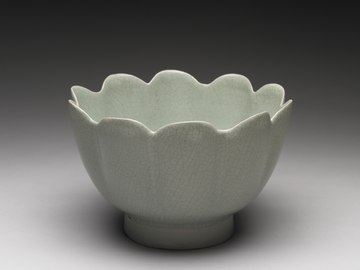
With 21 pieces out of fewer than a hundred surviving, the museum has the world's largest collection of Ru ware,[40] one of the rarest Chinese ceramics, made exclusively for the court and one of the Five Great Kilns of the Song dynasty (960–1279), along with Ding porcelain, Jun ware, Guan and Ge;[41][42] the museum has major collections of all of these. Those from the official kilns of the Ming (1368–1644) and Qing (1644–1912) dynasties, such as the doucai porcelains of the Chenghua reign during the Ming dynasty and painted enamel porcelains from the early Qing, are also of excellent quality.[43]
Carvings
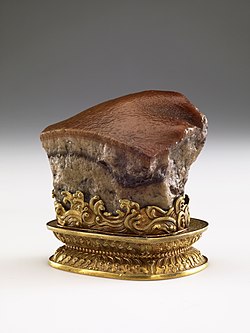
One of the most popular pieces of jade carvings in the museum is the Jadeite Cabbage,[44] a piece of jadeite carved into the shape of a cabbage head, and with a large and a small grasshopper camouflaged in the leaves. The ruffled semi-translucent leaves attached is due to the masterful combination of various natural color of the jade to recreate the color variations of a real cabbage.[45] The Meat-shaped Stone is often exhibited together with the Jadeite Cabbage.[44][46] A piece of jasper, a form of agate, the strata of which are cleverly used to create a likeness of a piece of pork cooked in soy sauce. The dyed and textured surface makes the layers of skin, lean meat, and fat materialized incredibly lifelike.
Other various carvings of materials such as bamboo, wood, ivory, rhinoceros horn, and fruit pits are exhibited.[47] The Carved Olive-stone Boat, carved by Chen Zuzhang, is a tiny boat carved from an olive stone.[48] The incredibly fully equipped skilled piece is carved with a covered deck and moveable windows. The interior has chairs, dishes on a table and eight figures representing the characters of Su Shih's Latter Ode on the Red Cliff. The bottom is carved in minute character the entire 300+ character text with the date and the artist's name.
Painting and calligraphy
The paintings in the National Palace Museum date from the Tang dynasty (618–907) to the modern era.[49] The collection covers over one thousand years of Chinese painting, and encompasses a wide range of genres, including landscape, flower and bird, figure painting, boundary painting, etc. Among the most popular paintings in the collection is the Qing Palace Version of Along the River During the Qingming Festival by five Qing dynasty court painters (Chen Mu, Sun Hu, Jin Kun, Dai Hong and Cheng Zhidao).[50] Dwelling in the Fuchun Mountains (Wu-yung version) by Huang Gongwang of the Yuan dynasty is one of the rarest and most dramatic works.[51] Walking on a Mountain Path in Spring is another significant work. The museum has a vast collection of calligraphy works from the hands of major calligraphers, scholars and important courtiers in history. The calligraphy works date from the Jin (266–420) and Tang (618–907) dynasties, with a variety of styles.
Rare books and documents
Rare books in the National Palace Museum range from the Song (960–1279) and Yuan (1271–1368) dynasties to the Ming (1368–1644) and Qing (1644–1912) dynasties, amounting to over 200,000 volumes.[52][53] Yongle Encyclopedia and Complete Library of the Four Treasuries are among the examples.[54][55]
Historical documents in the museum include Jiu Manzhou Dang, a set of Manchu archives that are the sourcebook of Manwen Laodang and a primary source of early Manchu history.[56] Other official documents such as the court archives are available for research in the history of the Qing dynasty.
Administration

The National Palace Museum operates under the Executive Yuan as a level-two agency.[57] It has been headed by many directors over the years:[58][59][60] Note that, in 1949, the Joint Managerial Office of the National Central Museum and National Central Library was established. In 1955, the Joint Managerial Office of the National Palace Museum and National Central Museum was established.
List of directors
| Name | Term begin | Term end |
|---|---|---|
| Directors of Palace Museum | ||
| Li Yü-ying | First appointed Director-General | |
| I P'ei-chi | October 1925 | October 1933 |
| Ma Heng | October 1933 | August 1949 |
| Directors of National Central Museum Preparatory Office | ||
| Fu Ssu-nien | 1933 | 1934 |
| Li Chi | 1934 | 1949 |
| Directors of the Joint Managerial Office of the National Palace Museum and National Central Museum | ||
| Hang Li-wu | September 1949 | June 1956 |
| K'ung Te-ch'eng | July 1956 | April 1964 |
| Ho Lien-k'uei | May 1964 | August 1965 |
| Directors of National Palace Museum | ||
| Chiang Fu-ts'ung | September 1965 | January 1983 |
| Ch'in Hsiao-yi | January 1983 | May 2000 |
| Tu Cheng-sheng | 20 May 2000 | 20 May 2004 |
| Shih Shou-chien | 20 May 2004 | 25 January 2006 |
| Lin Mun-lee | 25 January 2006 | 20 May 2008 |
| Chou Kung-shin | 20 May 2008 | 29 July 2012 |
| Chou Chu-kun (acting) | 30 July 2012 | 18 September 2012 |
| Feng Ming-chu | 18 September 2012 | 19 May 2016 |
| Lin Jeng-yi | 20 May 2016 | 15 July 2018 |
| Chen Chi-nan | 16 July 2018 | 13 January 2019 |
| Lee Ching-hui (acting) | 14 January 2019 | 14 February 2019 |
| Wu Mi-cha | 15 February 2019 | 30 January 2023 |
| Hsiao Tsung-huang | 31 January 2023 | Incumbent |
Controversies
Ownership disputes

The legal ownership of the National Palace Museum's collection remains a subject of cross-strait political sensitivity. The People's Republic of China (PRC) has insisted that these treasures were illegally removed during the Chinese Civil War, and that Taiwan's claim of ownership is unjustifiable.[61] Within Taiwan, some proponents of Taiwanese independence also argue that the collection does not rightfully belong to Taiwan and should be returned to China, as they do not view these artifacts as representative of Taiwanese culture. Instead of pursuing formal legal action, the PRC has emphasized a shared cultural heritage jointly owned by people across the Taiwan Strait.[62] This was highlighted during a period of warmer relations when the Palace Museum in Beijing and the National Palace Museum in Taipei engaged in several collaborative exhibitions and personnel exchanges, including the lending of relics from Beijing to Taipei.[63]
The National Palace Museum in Taipei asserts its status as the legal custodian of the collection.[64][65] Due to concerns that the artifacts might be impounded or claimed by the PRC because of the controversial political status of Taiwan, the museum does not hold exhibitions in mainland China.[66] Since its establishment in Taipei in 1965, the National Palace Museum has only held large-scale overseas exhibitions in countries that have passed laws preventing the judicial seizure of its treasures. These countries include the United States, France, Germany, Austria, Japan, Australia, and the Czech Republic.[67][68][69] One of the most significant and debated exhibitions was the 1996 U.S. tour, which featured 452 items exhibited at the Metropolitan Museum of Art, the Art Institute of Chicago, the Asian Art Museum of San Francisco, and the National Gallery of Art in Washington, D.C.[70] Recent exhibitions include those at the National Museum in Prague and the Musée du Quai Branly – Jacques Chirac in Paris in 2025.[69][71]
Safety concerns
The safety and preservation of the National Palace Museum's collection have frequently been the subject of intense political and public scrutiny. Critics have pointed to the 2022 breakage of three Ming and Qing dynasty artifacts as evidence of institutional negligence and a lack of transparency in reporting accidents.[72][73] Beyond accidental damage, the museum's vulnerability to military conflict remains a flashpoint for debate. While some experts advocate for the reactivation of mountain tunnels used for emergency storage,[74] others maintain that "staying put" is the most secure arrangement.[75] In 2022, the museum held its first "wartime response exercise" to train staff on evacuation procedures.[76] The museum declined to share details of the protocols, calling them "top secret", though US broadcaster CNN reported that the exercise focused on a high-priority list of approximately 90,000 masterpieces from the collection of nearly 700,000 items.[77]
Further controversy emerged in March 2023 when it was revealed that thousands of high-resolution digital images of the museum's collection had been leaked and were being sold on Chinese e-commerce platforms, sparking fresh criticism over the institution's information security and administrative management.[78]
Gallery
-
 The Pan water vessel with coiling dragon pattern, c. 14th – mid 11th century BC
 -
 The Zong-zhou Zhong (Bell of Zhou), 9th century BC
 -
 The Mao Gong ding, 9th century BC
 -
 The San Family Plate, 9th century BC
 -
 Taihe Shakyamuni, Northern Wei, 477
 -
-

-
-
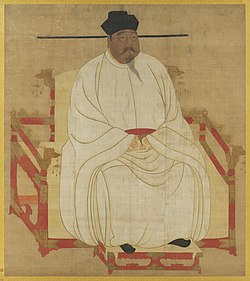
-

-
 The Early Spring, by Guo Xi, 1072
 -
 The Wind in Pines Among a Myriad Valleys, by Li Tang, 1124
 -

-
 The Walking on a Mountain Path in Spring, by Ma Yuan, 13th century
 -

-

-

-
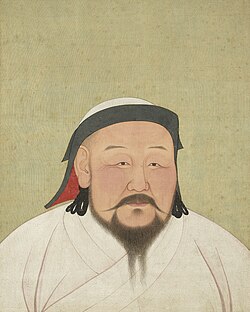
-
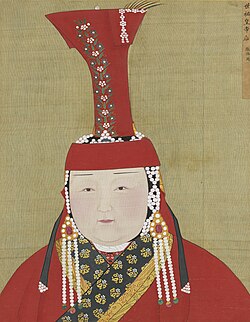
-
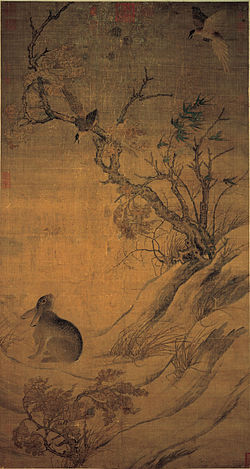 The Magpies and Hare, by Cui Bai, 1061
 -
 The Listening Quietly to Soughing Pines, by Ma Lin, 13th century
 -
 The Man Herding Horses, c. 12th century
 -
 The Homeward Oxherds in Wind and Rain, by Li Di, 12th century
 -
 The Lofty Mt.Lu, by Shen Zhou, 1467
 -
 Jadeite cabbage, Qing dynasty.
 -
 Jade seals of the Qianlong Emperor (1711–99)
 -
 An oriental garden scene based on the Chinoiserie works of French Rococo artist Jean Pillement (1728–1808)


.jpg)


.jpg)

See also
- List of most visited art museums
- List of largest art museums
- List of museums in Taipei
- List of museums in Taiwan
- Tourism in Taiwan
Notes
- ^ traditional Chinese: 國立故宮博物院; simplified Chinese: 国立故宫博物院; pinyin: Guólì Gùgōng Bówùyuàn
- ^ traditional Chinese: 臺北故宮; simplified Chinese: 台北故宫; pinyin: Táiběi Gùgōng
References
- ^ a b c "List of Categories in the Collection". National Palace Museum. 5 May 2021. Retrieved 17 January 2026.
- ^ "Northern Branch of the National Palace Museum 2025 Breakdown Table for Number of Visitors" (PDF). npm.gov.tw. Retrieved 17 January 2026.
- ^ "國立故宮博物院南部院區114年度總參觀人數分項統計表" [Southern Branch of the National Palace Museum 2025 Breakdown Table for Number of Visitors] (PDF). npm.gov.tw. Retrieved 17 January 2026.
- ^ "National Palace Museum exhibition opens in Tokyo". Taiwan Today. Taipei: Ministry of Foreign Affairs. 24 June 2014. Retrieved 10 November 2024.
- ^ "Former Palace Museum director takes consulting post in Beijing". Radio Taiwan International. 9 September 2016.
- ^ Fung, Ming-chu (2007). "The Transformation and Future of the Historiography Institute Archives". The National Palace Museum Research Quarterly. 24 (4): 119–148.
- ^ HER, KELLY (1 November 2021). "Culture Custodians". Taiwan Today. Taipei, Taiwan: Ministry of Foreign Affairs. Retrieved 10 November 2024.
- ^ Peter Enav (12 May 2009). "National art collection evokes hard history". The China Post. AP. Archived from the original on 9 October 2015. Retrieved 16 June 2012.
- ^ a b "Chronology of Events". National Palace Museum. Archived from the original on 21 December 2008. Retrieved 4 June 2008.
- ^ a b c "Tradition & Continuity". National Palace Museum. Archived from the original on 30 June 2012. Retrieved 17 June 2012.
- ^ Chiang, Fu-tsung (1979), "The Transfer of the National Palace Museum Collection to Taiwan and Its Subsequent Installation", The National Palace Museum Quarterly (in English and Chinese), 14 (1): 1–16, 37–43
- ^ "The National Palace Museum: Timeline of the NPM". National Palace Museum. May 2007. Archived from the original on 17 February 2012. Retrieved 20 December 2010.
- ^ a b c d e Hang, Li-wu (1983). 中華文物播遷記 (in Chinese) (2 ed.). Taipei: The Commercial Press.
- ^ Han Cheung (7 November 2021). "Taiwan in Time: Hiding national treasures in a cave". Taipei Times. Retrieved 7 November 2021.
- ^ a b "A Brief History of the National Palace Museum", The National Palace Museum Quarterly (in English and Chinese), 1 (1): 29–32, 85–89, 1966
- ^ "National Palace Museum Organization Act". Laws & Regulations Database of The Republic of China (Taiwan). Retrieved 17 January 2026.
Article 1: The National Palace Museum is an institution dedicated to the organization, care, and display of ancient Chinese artifacts and works of art held by the former Palace Museum of Peiping and the Preparatory Office of the National Central Museum.
- ^ a b "Renovation". National Palace Museum. Retrieved 21 September 2012.
{{cite web}}: CS1 maint: deprecated archival service (link) - ^ Huang, Bao-yu (1966), "中山博物院之建築 [The Architecture of the Chung-Shan Museum]", The National Palace Museum Quarterly (in Chinese), 1 (1): 69–78
- ^ 正館、行政大樓、圖書文獻大樓工程 [The Construction of the Main Building, the Administration Building and the Library Building] (PDF) (in Chinese). National Palace Museum. 11 October 2010. Archived from the original (PDF) on 27 October 2012. Retrieved 21 September 2012.
- ^ a b Gluck, Caroline (7 February 2007). "Taiwan's museum of treasures". BBC News. Retrieved 30 March 2010.
- ^ Bradsher, Keith (28 December 2006). "Rare Glimpses of China's Long-Hidden Treasures". The New York Times.
- ^ Quartly, Jules (4 February 2007). "National Palace Museum is born again". Taipei Times.
- ^ "Visitor's Guide". National Palace Museum. Archived from the original on 24 August 2012. Retrieved 21 September 2012.
- ^ Murakami, Takio (23 October 2011). "Taiwanese Palace Museum may increase floor area 7-fold". The Asahi Shimbun. Archived from the original on 13 November 2012.
- ^ "Visitor figures 2014: the world goes dotty over Yayoi Kusama". The Art Newspaper. 2 April 2015. Retrieved 10 April 2015.
- ^ "Zhishan Garden – Introduction". National Palace Museum. 8 October 2008. Archived from the original on 12 September 2012. Retrieved 17 June 2012.
- ^ "Outdoor Space". npm.gov.tw. 22 December 2022. Retrieved 19 January 2025.
- ^ "Chang Dai-chien Residence". National Palace Museum. October 2007. Archived from the original on 27 November 2019. Retrieved 16 June 2012.
- ^ a b "Taiwan's National Palace Museum opens new branch after 15-year wait". The Straits Times. Agence France Presse. 28 December 2015. Retrieved 5 January 2016.
- ^ "U.S. architectural firm quits NPM southern branch project". The China Post. 28 November 2008. Retrieved 20 December 2010.
{{cite news}}: CS1 maint: deprecated archival service (link) - ^ "National Palace Museum chief upsets lawmakers". Taipei Times. 11 November 2010. Retrieved 20 December 2010.
- ^ a b "NPM South Branch main hall to reopen on Tuesday". The China Post. 22 August 2016. Archived from the original on 23 August 2016. Retrieved 31 August 2016.
- ^ a b "National Palace Museum in Taiwan unveils designs of Southern Branch". World Interior Design Network. 28 March 2011. Archived from the original on 9 October 2011. Retrieved 9 April 2011.
- ^ "Multiculti roots". The Economist. 10 March 2016.
- ^ "Old Collection & New Additions". National Palace Museum. Retrieved 18 January 2026.
The holdings from the Palace Museum included 46,100 antiquities, 5,526 paintings and calligraphies, and 545,797 rare books and documents. The collection from the National Central Museum included 11,047 antiquities, 477 painting and calligraphies, and 38 rare books and documents. In sum, the combined collection consisted of 608,985 cultural relics.
- ^ "Collections: Antiquities (National Palace Museum)". Taiwan Academy. Archived from the original on 22 July 2013. Retrieved 25 September 2012.
- ^ "The Bell and Cauldron Inscriptions–A Feast of Chinese Characters: the Origin and Development". National Palace Museum. 22 December 2009. Retrieved 25 September 2012.
- ^ "Seated Sakyamuni Buddha - Unknown". Google Arts & Culture. Retrieved 26 May 2024.
- ^ Tsai, Wen-ting (November 2004). "National Palace Museum Exhibits Donated Buddhist Statuary - Taiwan Panorama". Taiwan Panorama Magazine | An international, bilingual magazine for Chinese people around the world (in Chinese). Retrieved 26 May 2024.
- ^ Sotheby's, Hong Kong, Sale "Ru – From a Japanese Collection", only lot, 4 April 2012
- ^ "Northern Song Ru Ware Recent Archaeological Finbings". Asian Art Newspaper. 3 March 2012. Archived from the original on 5 November 2012.
- ^ "Grand View: Ju Ware from the Northern Sung Dynasty". National Palace Museum. 25 December 2006. Retrieved 25 September 2012.
- ^ "The Magic of Kneaded Clay: A History of Chinese Ceramics". National Palace Museum. Retrieved 25 September 2012.
- ^ a b "Jadeite Cabbage is Moving to a New Gallery!". National Palace Museum. Archived from the original on 25 March 2014. Retrieved 4 June 2008.
- ^ "Jadeite Cabbage with Insects". National Palace Museum. Archived from the original on 1 December 2008. Retrieved 4 June 2008.
- ^ "Meat-shaped Stone". National Palace Museum. Archived from the original on 11 October 2014. Retrieved 4 June 2008.
- ^ "Uncanny Ingenuity and Celestial Feats – The Carvings of Ming and Qing Dynasties". National Palace Museum. Retrieved 25 September 2012.
- ^ "Carved Olive-stone Boat". National Palace Museum. Archived from the original on 18 May 2014. Retrieved 4 June 2008.
- ^ "Collections: Painting and Calligraphy (National Palace Museum)". Taiwan Academy. Archived from the original on 22 July 2013. Retrieved 25 September 2012.
- ^ "Along the River During the Ch'ing-ming Festival". National Palace Museum. Archived from the original on 28 October 2012. Retrieved 25 September 2012.
- ^ "Dwelling in the Fu-ch'un Mountains (Wu-yung Version)". National Palace Museum. Retrieved 25 September 2012.
- ^ "Rare Books (National Palace Museum)". Taiwan e-Learning and Digital Archives Program. Retrieved 25 September 2012.
- ^ "Collections: Rare Books (National Palace Museum)". Taiwan Academy. Archived from the original on 4 May 2013. Retrieved 25 September 2012.
- ^ "Vast Documents of the Yung-lo Era". National Palace Museum. Retrieved 25 September 2012.
- ^ "Complete Library of the Four Treasuries". National Palace Museum. Retrieved 25 September 2012.
- ^ "Archives in Old Manchu". National Palace Museum. Retrieved 25 September 2012.
- ^ "行政院全球資訊網". 行政院 (in Chinese (Taiwan)). 1 December 2011.
- ^ "Present/Former Leaders". National Palace Museum. 8 May 2020. Archived from the original on 11 April 2021.
- ^ "History of NPM". National Palace Museum. 30 January 2023.
- ^ "Director". National Palace Museum. 3 February 2023.
- ^ Wang, Horng-Luen (2004). "National Culture and Its Discontents: The Politics of Heritage and Language in Taiwan, 1949–2003". Comparative Studies in Society and History. 46 (4): 786–815. JSTOR 3879510.
- ^ Mark McDonald (2 March 2009). "Top bid on disputed Yves Saint Laurent bronzes was a protest from China". The New York Times.
- ^ "China to lend treasures to Taiwan". BBC. 16 February 2009. Retrieved 16 June 2012.
- ^ "Fighting over cultural treasures". Taipei Times. 27 July 2003. Retrieved 24 January 2026.
- ^ "China is waging a restitution campaign against Taiwan's Forbidden City treasures". The Art Newspaper. 5 June 2023. Archived from the original on 5 June 2023. Retrieved 21 August 2024.
- ^ "Officials reject China's bid to hold joint art exhibition". Taipei Times. 29 June 2003. Retrieved 18 January 2026.
- ^ "National Palace Museum signs historic display pact". Taipei Times. 18 October 2013. Retrieved 18 January 2026.
- ^ "Heaven and earth in Chinese art: treasures from the National Palace Museum, Taipei". Art Gallery of New South Wales. Retrieved 26 April 2019.
- ^ a b "Taiwan treasures debut in Prague". Taipei Times. 13 September 2025. Retrieved 17 January 2026.
- ^ "Imperial Treasures Return After a Highly Successful Tour". Taiwan Panorama. June 1997. Retrieved 18 January 2026.
- ^ "National Palace Museum's 'Dragons' exhibition opens in Paris". Focus Taiwan. 19 November 2025. Retrieved 18 January 2026.
- ^ "Taiwan museum admits to breaking three Ming and Qing dynasty artefacts worth US$77 million". CNA. 1 November 2022.
- ^ "Taiwan museum admits breaking artefacts worth £66m". The Guardian. 31 October 2022. Retrieved 24 January 2026.
- ^ "Taiwan seeks safety net for Palace Museum in case of PLA attack". South China Morning Post. 9 August 2022.
- ^ "NPM collection better left in place if China invades Taiwan, says former director". Taiwan News. 8 August 2022. Retrieved 24 January 2026.
- ^ Yang, William (17 August 2022). "Taiwan considers evacuating cultural artifacts". DW. Retrieved 24 January 2026.
- ^ Chang, Wayne (29 July 2022). "Lessons from Ukraine prompt top Taiwan museum to conduct 'wartime response' exercises". CNN. Retrieved 24 January 2026.
- ^ Lau, Chris (16 March 2023). "Hi-res art scans from famous Taiwan museum leak online… and turn up for sale on Chinese online shopping platform". CNN. Retrieved 24 January 2026.
- ^ "One Hundred Horses". National Palace Museum. Archived from the original on 19 June 2008. Retrieved 4 June 2008.
External links
- Official website

- Southern Branch of the National Palace Museum official website Archived 3 July 2020 at the Wayback Machine
- Chiang Dai-chien residence Archived 27 November 2019 at the Wayback Machine
- Virtual tour of the National Palace Museum provided by Google Arts & Culture


| International | |
|---|---|
| National | |
| Other | |