



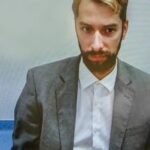


Daniele Ganser
Daniele Ganser | |
|---|---|
_JD.jpg) Ganser in 2018 | |
| Born | 29 August 1972 |
| Alma mater | University of Basel |
| Occupation | Author |
| Known for | NATO's Secret Armies |
| Spouse | Bea Schwarz[2] |
| Children | 2[2] |
| Website | danieleganser.ch |
Daniele Ganser (born 29 August 1972) is a Swiss author. He is described by Americanist Michael Butter as the "best-known conspiracy theorist in the German-speaking world".[3] He is best known for his 2005 book NATO's Secret Armies: Operation GLADIO and Terrorism in Western Europe.[4]
Ganser was a senior researcher at the ETH Zurich Center for Security Studies (CSS)[5] and was president (2006–2012) of the Swiss branch of the Association for the Study of Peak Oil and Gas.[6] He taught a course titled History and Future of Energy Systems at the University of St. Gallen from 2012 to 2017.[1][7] His public doubts about the September 11 attacks led to the termination of his university employment.[8]
Early life
Ganser was born in Lugano to Gottfried Ganser-Bosshart (1922–2014), a Protestant pastor of the Federation of Swiss Protestant Churches, and Jeannette Ganser, a nurse.[9][10][2][11] His father's parents were German.[12] He studied at the University of Basel.
NATO's Secret Armies
In 2004, Ganser published NATO's Secret Armies: Operation Gladio and Terrorism in Western Europe, in which he argued that Gladio units cooperated closely with NATO and the CIA, and that the Italian Gladio network was responsible for terrorist attacks against civilians.[13] Security analyst John Prados observed that Ganser presented evidence that Gladio networks amounted to anti-democratic elements across many nations.[14] Lawrence Kaplan commended Ganser for "heroic efforts to tease out the many strands that connect this interlocking right-wing conspiracy", but argued that connecting the dots required a stretch of facts and that some theories damaged the book's credibility.[15]
The book received substantial criticism from scholars of intelligence history. Beatrice Heuser praised the work but noted it would have benefited from a less polemical tone.[16] Peer Henrik Hansen criticised Ganser for basing claims on the US Army Field Manual 30-31B, which intelligence community members have described as a "Cold War era hoax document".[17][18] Philip H.J. Davies concluded that the book was marred by exaggerated notions and misunderstandings of covert operations, and that Ganser had not performed the basic research necessary to discuss them effectively.[19] Olav Riste of the Norwegian Institute for Defence Studies stated that his own research on the stay-behind network in Norway had been misrepresented by Ganser.[20] Riste and Leopoldo Nuti concluded that the book's "ambitious conclusions do not seem to be entirely corroborated by a sound evaluation of the sources available."[21] John R. Schindler wrote that specialists largely considered the book "shoddy" scholarship, noting that Ganser had acknowledged being unable to find official sources supporting his central charges.[22] Political scientist Markus Linden said that Ganser fostered anti-Americanism under the label of Peace Research while presenting Russia in a unilaterally positive light.[23]
Ganser appeared as an expert in the German television documentary Stay Behind: Die Schattenkrieger der NATO by Ulrich Stoll, broadcast on ZDFinfo in 2014.[24][25]
Later career and public commentary
Ganser has questioned the conclusions of the 9/11 Commission.[26][27] He has also promoted skepticism of the COVID-19 pandemic.[28][29]
In 2020, Ganser published Imperium USA: Die Skrupellose Weltmacht, republished in English in 2023 as USA: The Ruthless Empire. Jakob Kullik, writing in the German strategic studies journal Zeitschrift für Strategische Analysen, criticised the book for its "one-sided" and "superficial" portrayal of the United States as the sole perpetrator of global conflicts, arguing that it lacked analytical depth, ignored counter-evidence, and fell short of popular science standards.[30]
Regarding the Russian invasion of Ukraine, Ganser has stated that while the invasion is illegal, the United States bears responsibility for it, and that Ukrainian President Volodymyr Zelenskyy is a pawn of the United States.[31] He has also claimed that the United States instigated the Euromaidan revolution in 2014 and installed Arseniy Yatsenyuk and Petro Poroshenko in power after the removal of Viktor Yanukovych.[32]
Public presentations
As of 2023, Ganser gives large-scale public presentations in German-speaking countries, attracting audiences of over 1,000 people.[31][33] German public broadcaster ZDF reported that these events can generate around 80,000 euros per night in ticket revenue,[31] while Swiss public broadcasting reported that a presentation in Basel in May 2023 generated over 100,000 Swiss francs.[34]
German media outlets have characterised the content of these presentations as containing anti-Americanism, historical negationism, and Kremlin propaganda.[35][36][37] NDR Fernsehen reported that his content is popular among "conspiracy theorists and democracy skeptics".[38] Joachim Krause, director of the Institute for Defence Policy at Kiel University, described Ganser as "not a scientist" but rather "a dumbing down entrepreneur who makes his living by contaminating the brains of people with conspiracy fantasies".[39] Eva Binder and Magdalena Kaltseis of the University of Innsbruck described one of his presentations as "pseudoscientific seduction".[40]
Publications
English
Articles
- "Terrorism in Western Europe: An Approach to NATO's Secret Stay-behind Armies." Whitehead Journal of Diplomacy and International Relations, vol. 6, no. 1. pp. 69–97.
- "Fear As A Weapon: The Effects Psychological Warfare on Domestic and International Politics." World Affairs: The Journal of International Issues, vol. 9, no. 4 (2005), pp. 24–40. JSTOR 48531828.
- "The British Secret Service in Neutral Switzerland: An Unfinished Debate on NATO's Cold War Stay-behind Armies." Intelligence and National Security, vol. 20, no. 5 (2005). pp. 553–580.doi:10.1080/02684520500425083.
- "The Ghost of Machiavelli: An Approach to Operation Gladio and Terrorism in Cold War Italy." Crime, Law and Social Change, vol. 45, no. 2 (Mar. 2006), pp. 111–154. doi:10.3929/ethz-b-000036044.
- "The CIA in Western Europe and the Abuse of Human Rights." Intelligence and National Security, vol. 21, no. 5 (Oct. 2006), pp. 760–781. doi:10.1080/02684520600957712.
Books
- Reckless Gamble—The Sabotage of the United Nations in the Cuban Conflict and the Missile Crisis of 1962. New Orleans: University Press of the South (Dec. 2000). ISBN 978-1889431727.
- NATO's Secret Armies: Operation Gladio and Terrorism in Western Europe. London: Routledge (2005). ISBN 978-1135767853.
Book contributions
- "The 'Strategy of Tension' in the Cold War Period" (Chapter 6).[dead link] In: 9/11 and the American Empire: Intellectuals Speak Out. Edited by David Ray Griffin and Peter Dale Scott. Northampton, Mass.: Olive Branch Press (2007), pp. 79–99. ISBN 978-1566566599.
- "America is Addicted to Oil: U.S. Secret Warfare and Dwindling Oil Reserves in the Context of Peak Oil and 9/11." In: The Dual State: Parapolitics, Carl Schmitt and the National Security Complex, by Eric Wilson. UK: Ashgate (2012). ISBN 978-1409431077.
Other languages
Articles
- "L'OTAN Menace Notre Sécurité," with Hans von Sponeck and Gabriel Galice. Le Temps [Genèva] (3 April 2017), pp. 6+.
Books
- Der Alleingang—Die Schweiz 10 Jahre nach dem EWR-Nein, with Uwe Wagschal and Hans Rentsch. Zürich: Orell Füssli Verlag (Dec. 2002). ISBN 978-3280050415.
- Europa im Erdölrausch: Die Folgen einer gefährlichen Abhängigkeit. Zürich: Orell Füssli Verlag (2012). ISBN 978-3280054741.
- Illegale Kriege: Wie die NATO-Länder die UNO sabotieren. Eine Chronik von Kuba bis Syrien. Zürich: Orell Füssli Verlag (2016). ISBN 978-3280039434.
- Imperium USA: Die Skrupellose Weltmacht. Zürich: Orell Füssli Verlag (2020). ISBN 978-3280090886.
Book contributions
- "Peak Oil: Erdöl im Spannungsfeld von Krieg und Frieden." Archived 6 April 2016 at the Wayback Machine In: Energie, by Phillip Rudolf von Rohr, Peter Walde, Bertram Battlog. vdf Hochschulverlag an der ETH Zürich (2009), pp. 45–60. ISBN 978-3728132192.
References
- ^ a b "Daniele Ganser". .csfd.sk (in Slovak). Retrieved 31 March 2023.
- ^ a b c obituary notice of Ganser's father, 14 March 2014
- ^ Butter, Michael (2018). "Nichts ist, wie es scheint". Über Verschwörungstheorien (in German). Berlin: Suhrkamp. pp. 58, 83–93. ISBN 978-3-518-07360-5.
- ^ Frasch (Text), Dennis (8 April 2023). "Alles, nur nicht die Wahrheit: Ein Abend unter Verschwörungstheoretikern". Neue Zürcher Zeitung (in German).
- ^ "sciencelife:ETH Life - ETH Zurich's weekly web journal". Archiv.ethlife.ethz.ch. Retrieved 18 July 2016.
- ^ "ASPO Switzerland – Association for the Study of Peak Oil". Aspo.ch. 24 November 2015. Archived from the original on 2 March 2021. Retrieved 18 July 2016.
- ^ "University of St.Gallen". Egi.unisg.ch. Archived from the original on 29 May 2016. Retrieved 18 July 2016.
- ^ Butter, Michael (2018). "Nichts ist, wie es scheint". Über Verschwörungstheorien (in German). Berlin: Suhrkamp. pp. 58, 83–93. ISBN 978-3-518-07360-5.
- ^ Gottfried Ganser-Bosshart, portraitarchiv.ch (Swiss German)
- ^ Gottfried Ganser, obituary, pfarrverein.ch
- ^ Rico Bandle: Daniele Ganser: Missionar des Misstrauens. Die Weltwoche 21, 24 May 2017, p. 30–32
- ^ "gottfried+ganser"+"daniele+ganser"&pg=PT10 Imperium USA: Die skrupellose Weltmacht, p. 10
- ^ Anton, Andreas, and Michael Schetsche, Michael K. Walter. Konspiration. p. 175, Springer VS 2014. ISBN 978-3531193243.
- ^ Prados, John (2006). Safe for Democracy: The Secret Wars of the CIA. p. 95. ISBN 978-1615780112.
- ^ Kaplan, Lawrence (Sep. 2006). Review of NATO's Secret Armies. International History Review. pp. 685–686.
- ^ Heuser, Beatrice (Nov. 2006). Review of NATO's Secret Armies. Cold War History. pp. 567–568.
- ^ Hansen, Peer Henrik (Summer 2005).Review of NATO's Secret Armies. Journal of Intelligence History.
- ^ Hansen, Peer Henrik (Jan. 2006). "Falling Flat on the Stay-Behinds." International Journal of Intelligence and CounterIntelligence. pp. 182–186.
- ^ Davies, Philip H.J. (Dec. 2005). Review of NATO's Secret Armies. Journal of Strategic Studies. pp. 1064–1068.
- ^ Riste, Olav (Sep. 2005). Review of NATO's Secret Armies. Intelligence and National Security. pp. 550–551.
- ^ Riste, Olav and Leopoldo Nuti (Dec. 2007). "Introduction: Strategy of 'Stay-Behind'." Journal of Strategic Studies. p. 930.
- ^ Diamonds (and Disinformation) Are Forever. John R. Schindler on Ganser's NATO's Secret Armies
- ^ L'historien Daniele Ganser ravi des complots, Die Welt, 8 June 2018
- ^ Schattenkrieger der NATO (German) ZDF (Public Service Television) 25 March 2014
- ^ Stay Behind: Die Schattenkrieger der NATO at IMDb
- ^ All of the theories about 9/11 are conspiracy theories comment by Kristin Aalen, aftenbladet.no 21 April 2008
- ^ Jakob Lindenmeyer: 9/11: Terror, Lug und Trug. ETH Life, 27 September 2005; Daniele Ganser: Der erbitterte Streit um den 11. September. Tages-Anzeiger, 9 September 2006 (PDF at Siper.ch)
- ^ Fulterer, Ruth (29 January 2020). "Gansers Jünger". Neue Zürcher Zeitung (in German). Retrieved 23 February 2020.
- ^ Anina Ritscher (23 April 2021). "Daniele Ganser: Der Mann, dem die Menschen ihr Misstrauen anvertrauen". bajour.ch (in German). Retrieved 11 February 2025.
- ^ Kullik, Jakob (1 September 2020). "Daniele Ganser: Imperium USA. Die skrupellose Weltmacht. Zürich: Orell Füssli Verlag 2020, 400 Seiten". SIRIUS – Zeitschrift für Strategische Analysen. 4 (3): 381–383. doi:10.1515/sirius-2020-3028. ISSN 2510-2648.
- ^ a b c "Historiker Daniele Ganser: Gutes Geschäft mit Ukraine-Mythen". ZDFheute (in German). 10 March 2023. Archived from the original on 31 March 2023. Retrieved 9 July 2024.
- ^ Ganser, Daniele (2023). "2013: The New Silk Road". USA: The Ruthless Empire. Simon and Schuster. pp. 314–315 (Google Books version). ISBN 9781510776838.
- ^ Thomas Ludwig (28 March 2023). "Reportage vom Ukraine-Vortrag des Historikers, Radikal oder ganz normal? Eine Annäherung an das Phänomen Daniele Ganser" (in German).
- ^ Wyl, Benjamin von (8 May 2023). "Daniele Ganser vermittelt Fake News zum Krieg in der Ukraine – und ein gutes Gefühl". SWI swissinfo.ch (in Swiss High German). Retrieved 9 July 2024.
- ^ "Krieg in der Ukraine: Viel Aufmerksamkeit für fragwürdige Experten". tagesschau.de (in German). 24 March 2023. Retrieved 1 April 2023.
- ^ "Daniele Ganser in Aachen: Als würden Putins Trolle Regie führen". aachener-zeitung.de. 29 March 2023.
- ^ Georg Thanscheidt (28 March 2023). "Daniele Ganser in der Westfalenhalle Popcorn, Bier und Putin-Propaganda - ein Selbsterfahrungsbericht". ruhrnachrichten.de.
- ^ "Wie gefährlich ist der Schweizer Historiker Daniele Ganser?". NDR Fernsehen, Hallo Niedersachsen. ndr.de. 9 March 2023. Retrieved 1 April 2023.
- ^ Florian Sötje (11 February 2023). "Geplanter Vortrag in Kiel: Kritik an Ganser: "Er verhöhnt die Opfer des Holocaust"". kn-online.de (in German). Retrieved 1 April 2023.
- ^ Binder, Eva; Kaltseis, Magdalena (28 February 2023). "Pseudowissenschaftliche Verführung oder warum wir Daniele Ganser nicht einfach ignorieren sollten". uibk.ac.at (in Austrian German). Archived from the original on 1 April 2023. Retrieved 1 April 2023.
External links
- Official website
- Daniele Ganser at IMDb
- Bibliography in edoc at University of Basel
- Publications by and about Daniele Ganser in the catalogue Helveticat of the Swiss National Library
