



Bunker Hill Monument
Bunker Hill Monument | |
 Pictured in 2009 | |
    | |
| Location | Boston, Massachusetts, U.S. |
|---|---|
| Coordinates | 42°22′34.9″N 71°3′38.8″W / 42.376361°N 71.060778°W |
| Built | 1825–43 |
| Architect | Solomon Willard |
| Architectural style | Obelisk |
| Part of | |
| NRHP reference No. | 66000138 |
| Significant dates | |
| Added to NRHP | October 15, 1966[3] |
| Designated NHL | January 20, 1961[4] |
| Designated CP | June 2, 1987 (Monument Square Historic District),[3] October 26, 1974 (Boston National Historical Park)[2] |
The Bunker Hill Monument is a war memorial on Breed's Hill in Charlestown (now part of Boston), Massachusetts, United States. It commemorates the Battle of Bunker Hill, a major American Revolutionary War battle that took place there. The 221-foot (67 m) granite obelisk was erected between 1825 and 1843 with granite from Quincy, Massachusetts. There are 294 steps to the top. An exhibit lodge built near the base of the monument in the late 19th century houses a statue of Joseph Warren. Designated as a National Historic Landmark, Bunker Hill is a site along the Freedom Trail and is part of Boston National Historical Park.
The monument has required ongoing maintenance through the years, and additions have been made to the grounds. Regular maintenance is needed as the mortar between the monument's granite blocks starts to break down after about 30 years, and the mortar on the pyramidion at the top deteriorates faster. The Bunker Hill Museum, across Monument Square, was dedicated in 2007 and includes many exhibits about the battle.[5] The monument has been owned and managed by the National Park Service since 1976.
Site
The Bunker Hill Monument is located in Monument Square within Charlestown (since 1874, part of Boston[6]) in Massachusetts, United States.[7] The monument is built atop a Continental Army fortification on the summit of Breed's Hill, where in 1775 the Battle of Bunker Hill took place during the American Revolutionary War.[8][9]
Breed's Hill
Breed's Hill is a 62-foot-high (19 m) glacial drumlin in the southern portion of the Charlestown Peninsula,[10][11] created 12,000 years ago by retreating glaciers.[12] After the area was colonized by the English in 1625,[12] Breed's Hill was named for the Breed family, early settlers who owned land on the hill's eastern slope.[13][14] The hill was originally connected to the mainland portion of Charlestown (now the separate city of Somerville) in colonial times by a short, narrow isthmus known as the Charlestown Neck. In the 19th and early 20th centuries the peninsula's shape and connections to other landforms were significantly altered, with the waters of the Charles River between Cambridge and Charlestown heavily filled in.[15][10] By the American Revolution, the south slope of Breed's Hill had a road leading westward.[16]
Along Monument Square's perimeter are Greek Revival, Italianate, and Second Empire-style houses, which were developed starting in the 1840s.[17] The Charlestown High School and the former Charlestown Library also face Monument Square. The designs of these buildings are influenced by deed restrictions, including a mandatory setback from the street,[18] intended to preserve the area's character.[19] The Bunker Hill Museum, preserving artifacts from the battle,[20] is located within the Charlestown Library.[21] The hill slopes fairly steeply to the east and west. It is about 700 yards (640 m)[11] from Bunker Hill, which is situated to the north.[22][23] Bunker Hill is slightly higher than Breed's Hill, at 110 feet (34 m),[22] and is topped by the St. Francis de Sales Church.[23][24] Approximately 1⁄4 mile (0.40 km) to the southeast is the Charlestown Navy Yard.[10]
Monument Square park
The monument is located in a square, 4-acre (1.6 ha)[a] park called Monument Square,[9] which is surrounded by a street of the same name.[26] An iron fence runs along the park's perimeter, with hexagonal posts topped by hexagonal caps and triangular finials.[27] There are quatrefoil and pendant motifs at the bottom of the fence, along with granite blocks at the foundations of each post.[28] Deciduous trees run parallel to the fence.[26] For the most part, the park has grassy lawns. Five Maine granite markers, dating from 1876, denote the locations of key events in the Battle of Bunker Hill.[26]
There are four gates on the street surrounding Monument Square. These represent a different regiment that participated in the battle: the New Hampshire (north), Connecticut (east), Massachusetts (south), and United States (west) gates.[28] Grand staircases ascend from each of the gates.[9][28] Each staircase is divided into two to four flights of granite steps. The stair at the Massachusetts gate is the widest, while that at the New Hampshire gate is slightly smaller; the other two stairs are small, secondary entrances. The stairs have cast-iron handrails interspersed with posts containing triangular finials, along with granite monuments commemorating each gate's respective regiments.[28] At the time of the obelisk's completion, three gates led directly to streets extending perpendicularly off Monument Square, each measuring 50 feet (15 m) wide. Monument Avenue, a 40-foot-wide (12 m) road extending off the southern perimeter, was built only after the obelisk was completed.[17]
At the top of each staircase, concrete walkways connect with the monument itself.[9][26] A circular asphalt path connects all four concrete walkways, surrounding a platform containing the main obelisk, an entrance building to the north, and a statue of Colonel William Prescott to the south.[26] The Bunker Hill Monument is a stop on the Freedom Trail, a path connecting historic sites in Boston;[29][30] a red-brick strip marking the trail's route is embedded into the concrete walkways.[26] The strip formerly passed through two of the park's entrances. but in the 1990s, a portion of the strip at one entrance was removed to reduce confusion.[31]
Description
The obelisk, reception building, and Prescott statue are located at the center of Monument Square park.[9] They are surrounded by a north–south concrete platform,[26] which is constructed of rectangular and triangular slabs.[32] An iron fence surrounds the base of the obelisk itself, running between granite piers diagonally opposite each of the obelisk's corners. The fence has posts topped by caps and finials, and the cross-bars have Greek crosses at the bottom and inverted scallop designs at the top.[28] Brick footings are placed under the platform, while curbstone is installed under the obelisk fence.[32]
Obelisk
The main structure of Bunker Hill Monument is a granite obelisk designed by Solomon Willard.[7][9] It occupies the southeast corner of the redoubt constructed during the Battle of Bunker Hill.[33][34] The obelisk rises 221 feet (67 m) from its base;[9][35][b] this was the maximum height its sponsor, the Bunker Hill Monument Association, could afford.[37] The foundation, measuring 12 feet (3.7 m) deep and 50 by 50 feet (15 by 15 m) across,[38] is built of six courses (or horizontal layers) of granite.[39] At the base, the obelisk has a square footprint measuring about 30 by 30 feet (9.1 by 9.1 m) across, which tapers to 15 by 15 feet (4.6 by 4.6 m) near the top of the shaft.[28][36] Between the foundation and the capstone, the granite is laid horizontally into 78 courses.[37]
The exterior wall's thickness ranges from 6 feet (1.8 m) at the bottom to 2 feet (0.61 m) at the top.[39] There are narrow windows on the northern elevation at regular intervals, and the top of each elevation has a single square window.[28] At the top of the shaft is the capstone, a four-sided pyramid known as a pyramidion.[37] The pyramidon has another six courses of granite.[37] has a pinnacle with the slopes at a 90-degree angle.[28] Inside the obelisk is a hollow cylindrical shaft.[37] The entrance, through the reception building to the north,[26] leads to a spiral staircase that ascends through the shaft.[7][28] The staircase has 294 steps[9][20][40][c] and receives natural light from the narrow openings on the obelisk's northern elevation.[28] Atop the obelisk is a square observation deck measuring 11 feet (3.4 m) across and 17 feet (5.2 m) high.[41][42]
Bunker Hill Lodge

The reception building, known as the Bunker Hill Lodge, is made of granite blocks[26][43] and dates from 1902.[43][44] The Bunker Hill Lodge is a one-story neoclassical building with a rectangular grid of three by four bays,[21] measuring 50 by 38 feet (15 by 12 m) across and 19 feet (5.8 m) tall.[45][d] The facade is made of gray Deer Isle granite.[45][46] The eastern elevation has an Ionic-style portico, which supports a pediment with a carved lintel.[21] Beneath the portico are stairs leading to elaborate cast iron doors.[21] The northern and southern elevations also have smaller entrances,[21] including a ramp leading inside.[28] The rest of the facade has casement windows with slightly-protruding rectangular window frames, and the corners have pilasters with undecorated capitals. The entablature just below the roofline has egg and dart decorations.[21]
Inside the Bunker Hill Lodge is an entrance vestibule, a central room (sometimes known as the rotunda), and a pair of smaller spaces flanking the rotunda.[21][45][47] The vestibule's floor is made of multicolored marble mosaic tiles arranged into various patterns, while its plaster vaulted ceiling has a central octagonal medallion.[48] The rotunda is at the northwestern corner[21] and measures 12 by 12 feet (3.7 by 3.7 m) across, with a mosaic-tiled floor.[45][48] The rotunda's Siena-marble walls support a plaster ceiling dome with coffers.[45][49] Leading off the rotunda to the north and south are 11-by-12-foot (3.4 m × 3.7 m) rooms, which originally served as men's and women's lounges, respectively.[45][50]
Prescott statue
The bronze William Prescott statue, south of the obelisk, was sculpted by William Wetmore Story in 1880–1881. The sculpture is raised on a granite pedestal with the inscription "Colonel William Prescott; June 17, 1775".[21][51] The sculpture itself stands about 8 feet (2.4 m)[51] or 9 feet (2.7 m) tall.[21] The statue depicts Prescott with his right leg advancing and his right hand grasping a sword.[51][52] The statue's left hand is extended backward, and there are a shovel and pickaxe near its feet.[51] The pose reportedly depicted his appearance as he told his men, "Don't fire until you see the whites of their eyes".[20][52] Prescott is sometimes credited with having first said this phrase during this battle; others have instead attributed the phrase to Israel Putnam, John Stark, or Richard Gridley, but in actuality, none of them said it.[53]
Development
Background
Battle

In June 1775, American patriots, having caught word of a British plan to fortify the Charlestown peninsula, decided to fortify it before the British could.[54] On June 16, under the leadership of General Israel Putnam and Colonel William Prescott, the Americans stole out onto the Charlestown Peninsula to establish defensive positions on the hills overlooking Boston.[55][56] A redoubt, a small and usually temporary defensive fortification, was constructed on nearby Breed's Hill, which was closer to Boston but also lower than Bunker Hill.[56][57][58] Early on June 17, the British discovered the fortifications and set out to reclaim the peninsula.[59] The resulting conflict was called the Battle of Bunker Hill because that is where Prescott originally intended—and was ordered—to build the fortifications. Additionally, some people considered Breed's Hill a part of Bunker Hill, while others called it Charlestown Hill.[60]
British soldiers under General William Howe sent troops to attack Breed's Hill.[61] A force of 1,500 colonists held off two British attacks, but the third attack forced the rebels to retreat.[62] The British won at great cost, having lost a significant amount of the officer corps stationed in America.[63][64] On the American side, 450 were killed or wounded, while the British recorded more than twice as many casualties, at 1,054.[58][65] The dead were buried where they lay. The British strengthened the fortifications on the hill, before evacuating Boston in March 1776.[63] The area surrounding Breed's Hill's summit was parceled up in the early 19th century.[66] The site of the Bunker Hill Monument was likely owned by Sarah Russell and several other landowners.[14][66]
Early commemoration attempts
The Battle of Bunker Hill's anniversary was not commemorated for several years afterward due to the ongoing war.[67] The first monument commemorating the battle was a memorial to Joseph Warren, a Mason killed in the battle, constructed by the Grand Lodge of Massachusetts.[66][68] The Warren memorial, delayed due to a lack of money,[66][67] was dedicated on December 2, 1794.[68][69] It was an 18-foot (5.5 m) wooden column designed in the Tuscan order, standing on a brick pedestal measuring 10 feet (3.0 m) tall and 8 by 8 feet (2.4 by 2.4 m) across.[68][70] This pillar, which stood near where Warren was believed to have died,[66][70] was surrounded with a fence c. 1796.[71]
The Charlestown Artillery hosted its first parade memorializing the battle in 1794,[66][69] and further such parades took place in the early 19th century.[66][70] Several paintings honoring the battle were also commissioned in the late 18th and early 19th centuries,[66] and the Warren memorial remained in place until 1825.[70] Henry Dearborn's 1818 criticisms of Putnam's role in the battle rekindled interest in it.[72][73]
Origins, early fundraising, and land acquisition
The Battle of Bunker Hill battlefield was placed for sale at an auction in April 1822.[74][75] This attracted the notice of the businessman William Tudor,[76][77] who is often credited with devising the idea for the monument.[52] One of his acquaintances, the physician John Collins Warren, bought part of the site that November,[74][76] constituting about 2+3⁄4 acres (1.1 ha).[76][39] Subsequently, several men—including Warren, Tudor, Daniel Webster, George Ticknor, William Sullivan, and George Blake—met at the house of Thomas Handasyd Perkins to discuss plans for a monument.[78][79] On May 10, 1823, the group called their first meeting[78][80][81] at Boston's Merchants Exchange.[74][81] About two dozen attendees formed the Bunker Hill Monument Association (BHMA), which was incorporated by Massachusetts Governor William Eustis on June 7, 1823.[74][80][82] Eustis's immediate predecessor, John Brooks, was the organization's first president.[80][83][84] During its inaugural year, the BHMA mainly focused on administrative matters,[74][85] forming the Standing Committee to oversee its operations.[86] The new organization also collected Revolutionary-era artifacts, particularly those related to the Battle of Bunker Hill; in so doing, they obtained the Washington Benevolent Society's entire collection.[87]
The BHMA began soliciting donations from the public in mid-1824.[85] The association's director offered honorary memberships to those who donated at least $5,[I][85][89] and the BHMA distributed flyers throughout New England, asking for donations.[74][89] In its public communications, the BHMA extolled the site's topography and implied that the battlefield would be preserved as an open landscape.[90] In July 1824, the BHMA appointed a group to oversee preparations for a cornerstone-laying ceremony.[91] The association invited the Marquis de Lafayette (who was touring the United States for the war's 50th anniversary[92]) to the monument site that August.[89][93] He agreed to speak at the cornerstone-laying ceremony;[89] his involvement, along with regular newspaper reports on the progress of the fundraiser, increased public interest in the monument.[94] In a letter that October, the BHMA's directors suggested that $75,000 be raised for the monument.[II][95] Eustis addressed the Massachusetts General Court, the state legislature, in January 1825. He suggested that the General Court review plans for the monument, and that the state government government take over following its completion,[96] but these suggestions were discarded when he died shortly afterward.[97]
In February 1825, the General Court authorized the BHMA to spend up to $10,000 on stone for the monument.[III][98] The same legislation also allowed the organization to acquire up to 15 acres (6.1 ha) on Breed's Hill.[39][99] This area was soon acquired[94][100] from ten landowners at approximately $1,550 per acre ($3,800/ha);[IV] it did not include any of the Breed family's former holdings.[101] Each landowner agreed to sell the BHMA their land at its appraised value, but one of the landowners subsequently demanded ten times the appraised amount of his site; to avoid delays, the association agreed to pay the inflated price.[99] The BHMA also wanted to add Charlestown's nearby training field (now Winthrop Square) to its land holdings, but this never occurred for financial reasons.[102] About 2,500 donors had given between $5 and $500 each by April 1825.[V][103]
Design and cornerstone laying
.jpg)
Solomon Willard had been appointed in late 1824 to draw up plans for a column.[84][104] The BHMA also resolved to raise $37,000 for the construction of Willard's design,[VI] which Dearborn wrongly believed would be taller than any other commemorative column worldwide.[84] In January 1825, the BHMA decided to host an architectural design competition for the monument, publishing specifications for the monument in local newspapers,[84][105] and Willard withdrew his plans.[84][104] The first design committee consisted of Webster, the engineer Loammi Baldwin Jr., George Ticknor, Gilbert Stuart, and Washington Allston.[90][105][106] The committee preferred that contestants design a column,[107][108] and it offered $100 for the best design.[VII][90][106] The association received 50 formal submissions,[90][94][84] which were mailed from as far away as South Carolina.[109] Several plans were submitted after the April 1 deadline, including alternatives such as a Gothic church, but were not considered.[84] At least three obelisk designs were submitted, including two by Robert Mills and Horatio Greenough.[107] Greenough's design consisted of an obelisk with statuary at the base and plain surfaces elsewhere, while Mills's design was substantially more ornate.[86]
The BHMA organized a board of artists to consider the designs, which, in late April, suggested that Greenough receive the $100 award.[86][109] On May 19, the association narrowed down the choices to a column and an obelisk, and a committee was appointed to procure designs and tentative budgets for both.[94][106] At a vote on June 7, the committee voted 11–5 in favor of an obelisk,[110][111] having considered an obelisk more imposing and appropriate for the site.[33] Baldwin, who sat on the board of artists, was tasked with drawing specifications for Greenough's design.[90] Dearborn wrote a letter advocating for a column, which he said would cost $58,500,[VIII][112] while Willard claimed that an obelisk would cost only $37,000.[VI][112] The final design was adopted July 5,[33][113][114] when Baldwin recommended a plan costing $100,000.[IX][113][115] Baldwin's design deviated from Greenough's original proposal, which had called for a 100-foot-tall (30 m) obelisk atop an elevated platform, with buttresses at the corner.[114] Baldwin's plan was austere and sparsely decorated,[114] measuring 220 feet (67 m) tall and 30 by 30 feet (9.1 m × 9.1 m) across at the base, with the obelisk's faces oriented with the cardinal directions.[116][117]
Meanwhile, the BHMA procured a cornerstone with inscriptions and artifacts relating to the battle.[118] The organization also wanted to invite as many Revolutionary War veterans as possible.[119] The cornerstone was laid on June 17, 1825, the battle's 50th anniversary,[90][95][120] at the center of the proposed site.[33][121] More than 100,000 attended the event, including 190 Revolutionary War veterans,[122][e] hailing from across Massachusetts and the Eastern United States.[124] The attendees marched in procession from the Massachusetts State House to Breed's Hill, where Daniel Webster addressed the audience and Lafayette performed the ceremony.[120][125][123] In recognition of the Warren monument built by the Grand Lodge of Massachusetts,[121] the BHMA invited the fraternity's Grand Master to conduct the services.[94][125] Rev. Joseph Thaxter, who had been a Continental Army chaplain during the battle,[124] officiated as chaplain.[126][127] Webster subsequently sold the copyright to his speech for $600[X] to help fund construction.[121] The artifacts were later moved to a new cornerstone at the obelisk's northeastern corner.[33][121][38]
Construction
Initial progress
A group of five men, including Baldwin, were appointed to a construction committee on July 12, 1825.[128] By that September, the BHMA had raised $54,433.07[XI]—more than half the $100,000 construction cost—and its directors voted to begin construction.[129] Baldwin resigned not long afterward,[87][90] and Willard was rehired that October to carry out the design.[39][130][131] Willard refused to be paid more than a small salary, and he also agreed to donate $1,000 for the obelisk's construction.[XII][131][132] James S. Savage was hired to construct the monument.[131][133] The BHMA had raised $64,010.55 before construction started.[XIII][134] Only about half this amount could be used for the obelisk itself; the remainder was allocated toward land acquisition and other matters.[134][135]
Before construction formally commenced, Willard visited various quarries to examine granite, reportedly walking 300 miles (480 km) in doing so.[136] In November 1825, workers began landscaping the site,[116] and the BHMA decided to obtain granite from Quincy, Massachusetts, a southern suburb of Boston.[133][137] The BHMA paid Gridley Bryant $325 for the right to quarry the granite[XIV][137] from an outcropping that became known as the Bunker Hill Ledge.[133] By quarrying its own granite, the BHMA saved an estimated $60,000 in construction costs;[XV][138] it could spend $5.40 per cubic yard ($7.06/m3), while a typical quarry would have charged $24.30 per cubic yard ($31.78/m3).[139] To save additional money, the BHMA used larger granite blocks, which required fewer stones.[116] The granite blocks, averaging two cubic yards (1.5 m3) each, were quarried by wedging[139] and were then dressed and trimmed to fit the obelisk.[140][141] The foundation was being constructed by 1826.[116][142]
The Granite Railway—a broad-gauge, horse-drawn railway from Quincy—was constructed to transport the granite blocks.[f][144] Although the railway become operational on October 7, 1826,[144] a contract to transport the granite was not signed until early 1827.[131][133] The foundation was completed that July.[145] Since the Granite Railway ran only to the Neponset River waterfront in Quincy,[116] the blocks had to be transferred to barges, then transferred again in Charlestown.[133][146] To carry the blocks up approximately 84 feet (26 m), an inclined railway was built in Charlestown, ascending to the obelisk's southeastern corner. Within one year, the railway had transported 3,000 short tons (2,700 long tons; 2,700 t) of granite.[146][147] The repeated transfers damaged the blocks and caused delays,[131][133] and in 1828 the BHMA decided to have oxen transport the granite directly to Breed's Hill.[148]
Money issues and delays
The BHMA ran out of money in 1828[148] and obtained various loans in a futile attempt to keep the project solvent.[134][149] The association reserved a 600-by-400-foot (180 by 120 m) plot around the obelisk and placed a mortgage on the remaining, non-reserved land.[148][150] In January 1829, work was suspended after the loans were depleted.[134][145] Although $56,525.19 had been spent on construction to date,[XVI] most of these expenses had been allocated to the foundation.[149] Fourteen courses of granite had been laid, bringing the obelisk to a height of about 38 feet (12 m),[141][134][149] and there was enough stone to build another 18 feet (5.5 m).[145] A temporary roof was built atop the completed section of the obelisk.[151] The BHMA unsuccessfully asked the General Court for permission to raise money through a lottery.[152][153] The group also solicited subscriptions from Boston residents[152] and appealed to women's groups in New England.[153] The women's groups raised $2,000,[XVII][153] as each woman and child was allowed to contribute only $1.[141] In 1831, the BHMA's officers passed stringent restrictions on the sale of land or material, but these were rescinded the next year.[154] The association also made personal appeals to numerous wealthy Bostonians, to no avail.[155]
In April 1833, the philanthropist Amos Lawrence appealed to the Massachusetts Charitable Mechanic Association for funds,[134][156][157] but nothing came of this proposal, despite sizable support for it.[156][158] By that year, the association's debts totaled $30,000.[XVIII][158][159] The association planned to sell the plots around the obelisk,[148][160] and it formed a committee, which suggested reducing the obelisk's height to save money.[158][161] That June, the BHMA agreed to sell off the non-reserved land,[158][162] anticipating that it could raise $25,000[XIX] by selling off 127,000 square feet (11,800 m2).[162][163] The BHMA planned to divide the land into 50 lots,[164] having appointed Willard to oversee the process.[148] The association also agreed to shorten the obelisk to 159.5 feet (48.6 m), and its officers rehired Willard in June 1834 to oversee the design.[165][166]
Work continued until November 1835, when funding shortages stopped construction again.[166] During this time, $20,000–23,000 was raised for the project; the Ladies' Fund raised about $3,000, while the remainder was raised by the Mechanic Association.[167][168][166] Nearly the entire amount was spent on the newly-built portion of the obelisk,[167][168] which had reached 80 feet (24 m) when funds were depleted.[167][169][g] In 1838, the BHMA further reduced the north–south length of its remaining site from 600 to 417 feet (183 to 127 m),[170] bringing the lot's area to about 4 acres (1.6 ha).[163] The reduced site was to be known as Monument Square, surrounded by a 50-foot-wide (15 m) road.[163][170] This left two-thirds of the site to be sold.[171][163] These plots were sold in September 1839, enabling the BHMA to not only pay off its entire debt but also record a $1,767.57 surplus.[XX][163] Excess soil from Monument Square's western and eastern slopes was relocated to the square's northern boundary, filling in a depression there.[163][172]
Completion

In 1839, Lawrence and Judah Touro each pledged $10,000[III] to match local contributions to spur the monument's completion.[168][173] The terms of the men's gifts required private donors to raise an additional $25,000[174] or $30,000.[XXI][173] Touro made his gift on the condition that he remain anonymous, but his name was subsequently divulged; Touro told his friends that he would have withdrawn the gift if not for the negative public perception of doing so.[175] A subscription drive to raise the necessary funds was not carried out, and by June 1840, the BHMA's directors were doubtful that the monument would raise sufficient funds. In response, a local ladies' group suggested hosting a fair to raise the funds.[173][176] The BHMA's directors enlisted a committee of women, including Ladies' Magazine editor Sarah Josepha Hale, to organize a fair.[177] Hale and her group set up the Ladies' Fair at Quincy Market in Downtown Boston,[178] which ran for seven days in September 1840.[176][179] The fair raised $30,035.53,[XXII][176][180] though there is dispute over whether this amount could have been raised through refreshment sales alone.[178]
With the money from the Ladies' Fair, Lawrence, and Touro, the BHMA's directors voted to build the obelisk to its original 220-foot height, and a new construction committee was appointed.[181] James S. Savage was hired to complete the construction, and work resumed in May 1841.[181][182] Savage devised a steam-powered derrick with a specialized movable boom, which hoisted the granite blocks to the shaft's upper levels.[183][184] The pyramidion was laid on July 23, 1842.[184][185] The monument was dedicated on June 17, 1843, again with an oration by Daniel Webster;[185][186] U.S. President John Tyler and all the state governors were invited to the dedication.[187] In total, it had cost $102,000.[XXIII][185]
Management and operation
BHMA operation
When the monument opened, the BHMA charged admission to climb it;[188] many visitors hesitated to pay the fee.[52] Two cannons salvaged from the battle were displayed in the observatory.[189] The monument hosted Bunker Hill Day commemorations on June 17 each year.[190] American flags were displayed in the windows during major holidays and other special occasions approved by the BHMA.[191]
19th century
George M. Dexter began devising plans for a permanent entrance building in 1843, but he died while drawing the plans.[192][188] William S. Park completed the plans, which were then delayed for lack of funding.[188][193] Landscaping continued after the obelisk's official dedication, eliminating most remnants of the battle fortifications. Savage added a brick sidewalk, fence, and trees at Monument Square's perimeter; a granite platform around the obelisk; and walkways and stairs leading between the sidewalk and the platform.[184][194] A replica of the Grand Lodge of Massachusetts's original monument at the site was placed inside the obelisk in 1845.[71] The BHMA voted in 1849 to exclude battle-related inscriptions, including names and dates, from the obelisk.[195][196]
A wooden entrance building, the first Bunker Hill Lodge, was completed in 1857.[195][192] A statue of George Washington Warren, the BHMA's director, was installed within the entrance building.[195] A wooden flagpole mast was erected at the obelisk in 1861. This flagpole was removed in 1866,[195][197] replaced the next year by a 140-foot-tall (43 m) freestanding flagpole northeast of the obelisk.[195][198] The BHMA established a fund in the 1870s to construct a permanent entrance building, replacing the wooden structure. Lamps and iron seating areas were added to Monument Square park in 1888, and a wire fence was built around the obelisk's platform the following year.[188] Massachusetts state representative James E. Hayes proposed in 1893 that the state take over the monument and park.[199]
Early 20th century

A local group proposed installing exterior lights near the top of the obelisk in 1900,[200] but this was not carried out, as the BHMA did not want to pay for the lighting.[201][202] In June 1901, the BHMA voted to build a granite entrance building at the base of the obelisk,[45][46][203] and the original wooden building was demolished the same year.[192] The granite building was opened to the public in October 1902.[44][h] Early the next year, a state legislator proposed taking over the monument's operation,[204][205] but this legislation failed.[206] While the BHMA's expenses could no longer be funded through ticket revenue alone, it still wished to keep operating the monument.[188] The monument continued to display the American flag,[207][208] and in 1903 the British flag was flown for the first time, commemorating a visit by the British Army's Honourable Artillery Company.[209]
During the early 20th century, the BHMA's expenses continued to rise, while the grounds fell into disrepair.[210] The architect Charles Allerton Coolidge surveyed the site in 1907, finding that the walkways were in bad condition and were redundant to each other, and that the fence surrounding the obelisk's platform was unattractive.[210][211] The monument's flags were removed in either 1910[207] or the 1920s.[208] By the 1910s, the monument recorded more than 30,000 annual visitors,[212] though substantially fewer people actually paid the fee to enter.[212] By then, it cost about $5,000 per year to manage the grounds;[42][52] the BHMA recorded only $4,100 in annual ticket revenue.[XXIV][42] The association's board members included members of many prominent New England families, and the Detroit Free Press wrote in 1913 that about fifteen families effectively controlled the monument's operation.[42] An inscription on the monument was proposed in 1914.[213] During that decade, the BHMA continued to lose money, even after receiving large donations from several members.[210]
Metropolitan District Commission operation
State representative James H. Brennan proposed in late 1918 that the state government take over the monument and illuminate it at night,[214][215] and Governor Calvin Coolidge signed legislation allowing such a takeover to occur.[216] In June 1919, the BHMA voted to turn over operations to the state government.[217][218] The monument and park were deeded to the government of Massachusetts the next month,[210] and the Metropolitan District Commission (MDC) took over operation.[219][220] When the state government took over, it planned to discontinue the admission fee.[52] By then, Brennan said pieces of the obelisk's exterior were falling out,[221][222] and Frederick Law Olmsted Jr. of the Olmsted Brothers landscape-design firm reviewed the site.[223] The MDC proposed in early 1920 that $35,000 be set aside for repairs,[XXV][224] and steeplejacks repointed the masonry that year.[225][226] In 1922, the Massachusetts House of Representatives proposed further funds for maintenance.[227]
The monument had 20,000 annual visitors by the early 1950s, relatively few of whom hailed from Boston.[40] During the mid-1960s, the monument was frequently vandalized at night, prompting the MDC to construct a steel cage between the entrance building and the monument itself. This work was completed in 1967.[228] By 1972, the monument was falling apart, and the MDC proposed transferring control to the National Park Service (NPS).[169][219]
NPS operation
In 1974[25] or 1976, the NPS took over control of the monument, maintaining it as a unit of Boston National Historical Park.[229] By that decade, the monument had 150,000 annual visitors, and the Charlestown Historical Society ran the free-admission Bunker Hill Museum across the street.[8] The monument subsequently closed for repairs in December 1979. The repairs were completed in November 1980 and included making the foundation waterproof, repointing the stones, and adding fences.[230]
After new flagpoles were added in 1993, two American flags were hoisted atop them, marking the first time that flags were flown there since the early 20th century.[208][207] The NPS completed a $100,000 renovation of the monument in the mid-1990s, and a car crashed into the New Hampshire gate in 1996, shortly after the renovation was finished.[231][232] The crash caused $20,000 in damage, but the NPS struggled to raise money for repairs for two years, even after the driver's insurance company paid $5,000 toward the repair cost.[231] The monument was heated by oil until the late 1990s, when new federal government regulations made the oil tank under the monument obsolete, requiring the installation of a natural gas pipe. To avoid disrupting archeological artifacts or ripping open the lawns, workers drilled the new pipe sideways from the street.[233]
The monument underwent a $3.7 million renovation in 2007, that included repairs, handicap accessibility improvements, and new lighting. The Bunker Hill Museum, across Monument Square, was dedicated in June of that year and includes many exhibits about the battle.[234][5] Regular maintenance is required as the mortar between the monument's granite blocks starts to break down after about 30 years, and the mortar on the pyramidion at the top deteriorates faster. The monument has over 11,000 linear feet of mortar joints that require maintenance. When restoration work was done from 2021 to 2023, masons repointed the pyramidion and the top ten levels of the monument; restoration was also provided to the grounds, including the Bunker Hill Lodge.[5][235]
Impact and legacy
Reception
Until the completion of the Washington Monument in 1888, the Bunker Hill Monument was the United States' largest obelisk that served as a war memorial.[5] At the monument's 50th anniversary in 1893, the Boston Daily Globe wrote that the monument "is of national interest" because of its size and because it commemorated an important American Revolutionary War battle.[39] A writer for The Advance wrote in 1914 that, although there were "finer monuments" around the world, "there is not one that is more important" to American history.[236] The San Francisco Chronicle wrote in 1916 that the Bunker Hill Monument, along with the Washington Monument and Statue of Liberty, were "the three most glorious of all the monuments on the Western Hemisphere".[237]
The monument also stood out from the Boston skyline.[238][239] One writer said that, until the 1910s, the obelisk and the gold-domed Massachusetts State House were "the two commanding objects in Boston".[239]
Landmark designations
The monument was designated a National Historic Landmark in 1961, in part for its architectural significance as a major early war memorial[240] and in part because the site itself had historical significance.[241] It was listed on the National Register of Historic Places in 1966;[9][3] the NRHP nomination form, published in 1975, cited the site's military significance.[241] The monument is part of two United States historic districts. It is included in the Monument Square Historic District, which was designated in 1987[9][242] in part because of the architectural character of the buildings surrounding the square.[18] The monument is also one of eight sites in the 43-acre (17 ha) Boston National Historical Park,[243] which was designated in 1974.[244][245]
In popular culture
Lydia Sigourney's poem Bunker-Hill Monument was published in her Scenes in my Native Land (1845) together with a description of both the monument and the battle.[246] The monument appears in Fallout 4 as a settlement and quest hub, and it appears in the "Battle For Bunker Hill" quest when the player sides with a faction.[247]
Image gallery
-
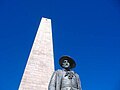 Monument and statue of Col. William Prescott
 -
 Monument and statue of Col. William Prescott
 -
 Bunker Hill Monument Park
 -
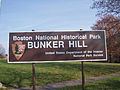 Boston National Historical Park sign
 -
 Stereoscopic image of the monument by Joseph L. Bates


See also
- List of National Historic Landmarks in Massachusetts
- National Register of Historic Places listings in northern Boston, Massachusetts
- Breed's Hill Institute
References
Notes
Explanatory notes
- ^ The park spans 3.8 acres (1.5 ha) if only the area within the perimeter fence is counted. The surrounding streets and sidewalks bring the parcel to 6.12 acres (2.48 ha)[25]
- ^ Some sources give a different height of 220 feet (67 m).[7][36] The National Park Service cites a more precise height of 221 feet 5 inches (67.49 m).[37]
- ^ A figure of 295 steps has also been given.[41][42]
- ^ One source cites the floor plan as measuring 50 by 48 feet (15 by 15 m).[46]
- ^ These included 40 veterans of the battle itself,[121][119] though one source cited the 190 soldiers as being Bunker Hill veterans.[122] Another source described the procession as having 200 total veterans.[123]
- ^ Although contemporary sources described the Granite Railway as the United States' first railway, several others had preceded it.[143]
- ^ A figure of 82 feet (25 m) is also given.[168] Another source cites a figure of 85 feet (26 m), with 32 courses having been built.[141]
- ^ Although later sources largely describe the Bunker Hill Lodge as having been built in 1902,[43][188] one source gives an alternate date of 1903.[21]
Inflation figures
- ^ Equivalent to $163 in 2024[88]
- ^ Equivalent to $2,614,000 in 2024[88]
- ^ a b Equivalent to $334,000 in 2024[88]
- ^ Equivalent to $52,000 per acre or $127,000 per hectare in 2024[88]
- ^ Equivalent to $170–16,690 in 2024[88]
- ^ a b Equivalent to $1,235,000 in 2024[88]
- ^ Equivalent to $3,000 in 2024[88]
- ^ Equivalent to $1,952,000 in 2024[88]
- ^ Equivalent to $3,337,000 in 2024[88]
- ^ Equivalent to $20,000 in 2024[88]
- ^ Equivalent to $1,817,000 in 2024[88]
- ^ Equivalent to $33,000 in 2024[88]
- ^ Equivalent to $2,136,000 in 2024[88]
- ^ Equivalent to $11,000 in 2024[88]
- ^ Equivalent to $2,002,000 in 2024[88]
- ^ Equivalent to $1,871,000 in 2024[88]
- ^ Equivalent to $66,000 in 2024[88]
- ^ Equivalent to $1,004,000 in 2024[88]
- ^ Equivalent to $837,000 in 2024[88]
- ^ Equivalent to $51,000 in 2024[88]
- ^ Equivalent to $760,000–911,000 in 2024[88]
- ^ Equivalent to $913,000 in 2024[88]
- ^ Equivalent to $3,441,000 in 2024[88]
- ^ The expenses are equivalent to $116,000, while revenue was equivalent to $95,000, in 2024[88]
- ^ Equivalent to $414,000, in 2024[88]
Citations
- ^ "MACRIS Maps". MACRIS Maps. Retrieved February 9, 2026.
- ^ a b "Federal Register: 44 Fed. Reg. 7107 (Feb. 6, 1979)" (PDF). Library of Congress. February 6, 1979. pp. 7502–7503 (PDF pp. 302–303). Archived (PDF) from the original on December 30, 2016. Retrieved March 8, 2020.
- ^ a b c "National Register Information System". National Register of Historic Places. National Park Service. January 23, 2007.
- ^ "Bunker Hill Monument". National Historic Landmark summary listing. National Park Service. Archived from the original on June 6, 2009. Retrieved June 30, 2009.
- ^ a b c d "Repairing the Bunker Hill Monument: Preserving Our Nation's Heritage (U.S. National Park Service)". National Park Service. Retrieved November 28, 2025.
- ^ Gaquin, Deirdre A.; Ryan, Mary Meghan (June 24, 2015). County and City Extra: Special Historical Edition, 1790-2010. Bloomsbury Publishing USA. p. 269. ISBN 979-8-89205-347-1.
- ^ a b c d National Park Service 1966, p. 7.1.
- ^ a b Williams, Edwin (May 20, 1979). "Bunker Hill battle reenacted". The Belleville News-Democrat. p. 60. Retrieved March 6, 2026.
- ^ a b c d e f g h i j "Bunker Hill Monument". TCLF. September 12, 2020. Retrieved March 6, 2026.
- ^ a b c National Park Service 2015, p. 7.6.
- ^ a b Rines, George Edwin, ed. (1920). . Encyclopedia Americana.
- ^ a b Brouillette & Brown 2000, p. 3.
- ^ Brouillette & Brown 2000, p. 4.
- ^ a b Snell & Evans 1982, p. 26.
- ^ Mapping Boston, Krieger, Alex, ed., MIT Press 1999, pp. 16–18.
- ^ Brouillette & Brown 2000, p. 5.
- ^ a b Brouillette & Brown 2000, p. 26.
- ^ a b Brouillette & Brown 2000, p. 89.
- ^ "May Appeal to Courts". The Boston Daily Globe. April 6, 1906. p. 9. Retrieved March 9, 2026.
- ^ a b c Kaiser, Harvey H. (March 20, 2008). The National Park Architecture Sourcebook. Princeton Architectural Press. pp. 562–563. ISBN 978-1-56898-742-2.
- ^ a b c d e f g h i j k National Park Service 2015, p. 7.9.
- ^ a b Chidsey, Donald Barr (1966). The Siege of Boston. Boston: Crown. p. 91. OCLC 890813.
- ^ a b Wilson 2004, p. 34.
- ^ Chorpenning, Joseph F. (2022). "Mary de Sales Chappuis, Louis Brisson, Léonie Frances de Sales Aviat, and the Oblate Sisters and Oblates of St. Francis de Sales". The Nineteenth-Century Salesian Pentecost: 135–175. doi:10.5040/9780809172221.ch-004.
- ^ a b Brouillette & Brown 2000, p. x.
- ^ a b c d e f g h i National Park Service 2015, p. 7.7.
- ^ National Park Service 2015, pp. 7.7, 7.8.
- ^ a b c d e f g h i j k National Park Service 2015, p. 7.8.
- ^ Pietrzyk, Cindi D. (September 1, 2011). Boston's Freedom Trail: Trace the Path of American History. Simon and Schuster. p. 68. ISBN 978-0-7627-6849-3. Retrieved January 29, 2026.
- ^ Broudy, Jack (May 29, 1960). "Through Boston in the Footsteps of History". The New York Times. ISSN 0362-4331. Retrieved February 1, 2026.
- ^ "Boston's Freedom Trail renovations complete". Public Works. Vol. 129, no. 1. January 1998. p. 73. ProQuest 218824065.
- ^ a b Mahlstedt 1981, p. 9.
- ^ a b c d e Packard 1853, p. 16.
- ^ Snell & Evans 1982, pp. 52–53.
- ^ Johnson, Rossiter (1897). A History of the World's Columbian Exposition Held in Chicago in 1893: By Authority of the Board of Directors Edited by Rossiter Johnson : Fully Illustrated : in 4 Volumes. D. Appleton. p. 224.
- ^ a b Holley, Orville Luther (1844). The Picturesque Tourist: Being a Guide Through the Northern and Eastern States and Canada ; Giving an Accurate Description of Cities and Villages, Celebrated Places of Resort, Etc. J. Disturnell. p. 220. Retrieved March 6, 2026.
- ^ a b c d e f "Bunker Hill Monument: By The Numbers". U.S. National Park Service. July 25, 2024. Retrieved March 6, 2026.
- ^ a b Warren 1877, p. 205.
- ^ a b c d e f "Silent, Yet It Speaks". The Boston Daily Globe. June 17, 1893. p. 7. Retrieved March 7, 2026.
- ^ a b Cameron 1953, chapter "Today".
- ^ a b "What People Talk About.: Bunker Hill Monument". The Boston Daily Globe. November 9, 1911. p. 12. ISSN 0743-1791. ProQuest 501855214. Retrieved March 9, 2026.
- ^ a b c d e "Who Owns Bunker Hill Monument?: Only Important Historical Shaft Private Property; Expenses Exceed Receipts". Detroit Free Press. July 6, 1913. p. B4. ProQuest 565361345.
- ^ a b c Hardy-Heck-Moore Inc. & Volz & Associates Inc. 2011, p. 15.
- ^ a b "Real Estate Matters". Boston Evening Transcript. October 4, 1902. p. 10. Retrieved March 9, 2026.
- ^ a b c d e f g "Lodge on the Hill". Charlestown Enterprise. June 29, 1901. pp. 1, 4. Retrieved March 9, 2026 – via Digital Commonwealth.
- ^ a b c "Will Build a New Lodge". Boston Evening Transcript. May 18, 1901. p. 5. Retrieved March 9, 2026.
- ^ Hardy-Heck-Moore Inc. & Volz & Associates Inc. 2011, p. 17.
- ^ a b Hardy-Heck-Moore Inc. & Volz & Associates Inc. 2011, p. 28.
- ^ Hardy-Heck-Moore Inc. & Volz & Associates Inc. 2011, p. 29.
- ^ Hardy-Heck-Moore Inc. & Volz & Associates Inc. 2011, p. 30.
- ^ a b c d Ryan, Donald R. (July 15, 2025). Colonel William Prescott: Heroic Commander of the Battle of Bunker Hill. Casemate. p. 197. ISBN 978-1-63624-569-0.
- ^ a b c d e f Hennessy, M E (June 17, 1919). "Story of a Shrine of American History". The Boston Daily Globe. p. 7. ISSN 0743-1791. ProQuest 503757806. Retrieved March 9, 2026.
- ^ Bell, J. L. (June 17, 2020). "Who Said, "Don't fire till you see the whites of their eyes"?". Journal of the American Revolution. Retrieved July 13, 2023.
- ^ Hubbard, Robert Ernest. Major General Israel Putnam: Hero of the American Revolution, p. 84, McFarland & Company, Inc., Jefferson, NC, 2017. ISBN 978-1-4766-6453-8.
- ^ Frothingham 1851, pp. 122–123.
- ^ a b Brouillette & Brown 2000, p. 7.
- ^ Frothingham 1851, pp. 123–124.
- ^ a b National Park Service 1966, p. 8.2.
- ^ Frothingham 1851, p. 125.
- ^ Ketchum 1999, pp. 82–83.
- ^ Ketchum 1999, p. 139.
- ^ Withington, Robert (June 1949). "A French Comment on the Battle of Bunker Hill". The New England Quarterly. 22 (2): 235–240. doi:10.2307/362033. ISSN 0028-4866. JSTOR 362033.
- ^ a b Brouillette & Brown 2000, p. 8.
- ^ Brooks, Victor (1999). The Boston Campaign. Combined Publishing. pp. 183–184. ISBN 1-58097-007-9. OCLC 42581510.
- ^ Ketchum 1999, pp. 190, 193.
- ^ a b c d e f g h Brouillette & Brown 2000, p. 11.
- ^ a b Frothingham 1851, p. 337.
- ^ a b c Brooklyn Medical Journal. Medical Society of Company of Kings. 1905. pp. 297–298. Retrieved February 24, 2026.
- ^ a b Frothingham 1851, p. 338.
- ^ a b c d Frothingham 1851, p. 339.
- ^ a b "Model Monument Wreathed". Boston Post. June 17, 1902. p. 8. Retrieved March 9, 2026.
- ^ Wright 1953, p. 166.
- ^ Warren 1877, pp. 31–32.
- ^ a b c d e f Brouillette & Brown 2000, p. 12.
- ^ Snell & Evans 1982, pp. 21–22.
- ^ a b c Frothingham 1851, p. 340.
- ^ Packard 1853, pp. 8–9.
- ^ a b Packard 1853, p. 9.
- ^ Frothingham 1851, pp. 340–341; Warren 1877, pp. 38–39.
- ^ a b c Frothingham 1851, p. 341.
- ^ a b Warren 1877, pp. 39–40.
- ^ Packard 1853, pp. 9–10.
- ^ Warren 1877, p. 49.
- ^ a b c d e f g Wright 1953, p. 167.
- ^ a b c Packard 1853, p. 11.
- ^ a b c Wright 1953, p. 169.
- ^ a b Warren 1877, p. 194.
- ^ a b c d e f g h i j k l m n o p q r s t u v w x y Johnston, Louis; Williamson, Samuel H. (2023). "What Was the U.S. GDP Then?". MeasuringWorth. Retrieved November 30, 2023. United States Gross Domestic Product deflator figures follow the MeasuringWorth series.
- ^ a b c d Frothingham 1851, p. 342.
- ^ a b c d e f g Brouillette & Brown 2000, p. 15.
- ^ Warren 1877, pp. 123–124.
- ^ Levasseur, Auguste (January 17, 2022). Lafayette in America in 1824 and 1825 (Vol. 1&2): An Eyewitness Account of the Landmark Tour of the United States by General Gilbert du Motier. e-artnow. Retrieved March 7, 2026.
- ^ Warren 1877, pp. 80–81.
- ^ a b c d e Frothingham 1851, p. 343.
- ^ a b Warren 1877, p. 86.
- ^ Warren 1877, pp. 58–59.
- ^ Warren 1877, p. 93.
- ^ Warren 1877, p. 94.
- ^ a b Packard 1853, p. 13.
- ^ Chisholm, Hugh, ed. (1911). . Encyclopædia Britannica. Vol. 4 (11th ed.). Cambridge University Press. pp. 798–799.
- ^ Warren 1877, pp. 101–102.
- ^ Warren 1877, pp. 195–196.
- ^ Packard 1853, p. 12.
- ^ a b Warren 1877, pp. 156–157.
- ^ a b Warren 1877, p. 155.
- ^ a b c Packard 1853, p. 15.
- ^ a b Wright 1953, pp. 167–168.
- ^ Warren 1877, p. 156.
- ^ a b Warren 1877, p. 158.
- ^ Warren 1877, p. 168.
- ^ Packard 1853, pp. 15–16.
- ^ a b Warren 1877, pp. 169–171.
- ^ a b Wright 1953, p. 170.
- ^ a b c Warren 1877, p. 183.
- ^ Warren 1877, p. 169.
- ^ a b c d e Brouillette & Brown 2000, p. 16.
- ^ Warren 1877, p. 184.
- ^ Warren 1877, pp. 138–140.
- ^ a b Warren 1877, p. 145.
- ^ a b Frothingham 1851, p. 344.
- ^ a b c d e Cameron 1953, chapter "Transient Cornerstone".
- ^ a b "Bostonians Lay Cornerstone for Bunker Hill Monument". MassMoments. June 17, 1825. Retrieved March 8, 2026.
- ^ a b Packard 1853, p. 14.
- ^ a b Warren 1877, p. 146.
- ^ a b Brouillette & Brown 2000, pp. 15–16.
- ^ Sprague, William Buell (1865). "Thaxter prayer, Annals of the American Pulpit, William Buell Sprague, 1865". Retrieved April 9, 2018.
- ^ History of the Town of Hingham, Massachusetts, Thomas Tracy Bouve, 1893. Pub. by the town. 1893. p. 281. Retrieved April 9, 2018.
- ^ Warren 1877, p. 190.
- ^ Warren 1877, p. 198.
- ^ Warren 1877, p. 199.
- ^ a b c d e Frothingham 1851, p. 346.
- ^ Packard 1853, p. 17.
- ^ a b c d e f Packard 1853, p. 18.
- ^ a b c d e f Frothingham 1851, p. 347.
- ^ Packard 1853, p. 21.
- ^ Cameron 1953, chapter "The Leading Character".
- ^ a b Warren 1877, p. 203.
- ^ Warren 1877, p. 204.
- ^ a b The Civil Engineer's Pocket-Book, Trautwine et al., 19th Edition, 1909
- ^ Warren 1877, p. 213.
- ^ a b c d Cameron 1953, chapter "Beacon for Mariners".
- ^ Snell & Evans 1982, pp. 55, 66.
- ^ Gamst, Frederick C. (1992). "The Context and Significance of America's First Railroad, on Boston's Beacon Hill". Technology and Culture. 33 (1): 66–67. doi:10.1353/tech.1992.0148. ISSN 1097-3729. Retrieved March 9, 2026.
- ^ a b "Inside: Happy Birthday?". Railway Age. Vol. 178, no. 3. February 14, 1977. p. 3. ProQuest 873980270.
- ^ a b c Packard 1853, p. 19.
- ^ a b Warren 1877, p. 209.
- ^ "Monument Marks Site of Battle". Charlestown News. June 15, 1929. p. 5. Retrieved March 9, 2026 – via Digital Commonwealth.
- ^ a b c d e Brouillette & Brown 2000, p. 17.
- ^ a b c Warren 1877, p. 215.
- ^ Warren 1877, pp. 214–215.
- ^ Warren 1877, p. 253.
- ^ a b Warren 1877, p. 234.
- ^ a b c Packard 1853, pp. 22–23.
- ^ Warren 1877, pp. 244–247.
- ^ Packard 1853, p. 27.
- ^ a b Packard 1853, p. 28.
- ^ Warren 1877, pp. 262–263.
- ^ a b c d Frothingham 1851, p. 348.
- ^ Warren 1877, p. 279.
- ^ Snell & Evans 1982, pp. 160–161.
- ^ Warren 1877, pp. 273–275.
- ^ a b Warren 1877, pp. 276–277.
- ^ a b c d e f Brouillette & Brown 2000, p. 18.
- ^ Packard 1853, p. 29.
- ^ Frothingham 1851, pp. 348–349.
- ^ a b c Warren 1877, p. 278.
- ^ a b c Packard 1853, p. 30.
- ^ a b c d Frothingham 1851, p. 349.
- ^ a b Courier, Ann-Mary (August 20, 1972). "MDC may surrender Bunker Hill to US". The Boston Globe. p. 32. Retrieved March 7, 2026.
- ^ a b Warren 1877, p. 280.
- ^ Proceedings of the Bunker Hill Monument Association at the Annual Meeting ... Geo. C. Rand and Avery. 1906. p. 16.
- ^ Warren 1877, p. 281.
- ^ a b c Packard 1853, p. 31.
- ^ Tenorio, Rich (June 5, 2025). "Remembering the Jewish philanthropist who helped build the Bunker Hill Monument". Retrieved July 21, 2025.
- ^ Shapiro, Leo (July 31, 1975). "Bunker Hill Monument". Jewish Advocate. p. 15. ProQuest 870775817.
- ^ a b c Frothingham 1851, p. 350.
- ^ Warren 1877, pp. 296–297.
- ^ a b Goodnough, Abby (July 4, 2010). "Living History at National Landmarks: Championing An Unsung Hero". The New York Times. Retrieved November 28, 2025.
- ^ Warren 1877, p. 298.
- ^ Brouillette & Brown 2000, p. 19.
- ^ a b Frothingham 1851, p. 341; Packard 1853, p. 31.
- ^ Warren 1877, p. 302.
- ^ Cameron 1953, chapter "The Riggers".
- ^ a b c Brouillette & Brown 2000, p. 20.
- ^ a b c The New England Historical & Genealogical Register and Antiquarian Journal. S.G. Drake. 1866. pp. 186–187.
- ^ Warren 1877, p. 384.
- ^ Warren 1877, p. 317.
- ^ a b c d e f Brouillette & Brown 2000, p. 30.
- ^ "Famous Bunker Hill Cannon.: Was Captured by British, and Americans Are Anxious to Have It Returned". The Washington Post. January 19, 1908. p. M4. ISSN 0190-8286. ProQuest 144887716.
- ^ Wilson 2004, pp. 34–35.
- ^ "Orders Lacking for Flags on Bunker Hill Monument". The Boston Daily Globe. April 15, 1917. p. 10. Retrieved March 9, 2026.
- ^ a b c Hardy-Heck-Moore Inc. & Volz & Associates Inc. 2011, p. 16.
- ^ Snell & Evans 1982, p. 92.
- ^ Snell & Evans 1982, pp. 88–90.
- ^ a b c d e Brouillette & Brown 2000, p. 23.
- ^ "The Bunker Hill Inscription". Boston Evening Transcript. June 29, 1914. p. 8. Retrieved March 9, 2026.
- ^ Snell & Evans 1982, p. 90.
- ^ Snell & Evans 1982, p. 91.
- ^ "Who Owns Bunker Hill?". The Boston Daily Globe. March 24, 1893. p. 4. Retrieved March 9, 2026.
- ^ "Bunker Hill Monument". Daily Evening Item. September 6, 1900. p. 2. Retrieved March 9, 2026.
- ^ "Bunker Hill Monument". Daily Evening Item. January 9, 1901. p. 8. Retrieved March 9, 2026.
- ^ "Monument May Not Be Lighted". Boston Evening Transcript. January 8, 1901. p. 5. Retrieved March 9, 2026.
- ^ "Lodge Soon to Be Built". Boston Evening Transcript. June 18, 1901. p. 6. Retrieved March 9, 2026.
- ^ "The Legislature". Fall River Daily Globe. January 27, 1903. p. 4. Retrieved March 9, 2026.
- ^ "Bill in House". The Boston Globe. January 26, 1903. p. 9. Retrieved March 9, 2026.
- ^ "In the Legislature". The Fall River Daily Herald. April 17, 1903. p. 1. Retrieved March 9, 2026.
- ^ a b c Justice, Glen (June 13, 1993). "Flags again grace Bunker Hill Monument". The Boston Globe. p. 34. Retrieved March 7, 2026.
- ^ a b c "Bunker Hill Monument 150". The Valley Sentinel. June 13, 1993. p. 5. Retrieved March 7, 2026.
- ^ "British Flag in Strange Place". The Boston Daily Globe. October 3, 1903. p. 4. Retrieved March 9, 2026.
- ^ a b c d Brouillette & Brown 2000, p. 34.
- ^ Snell & Evans 1982, p. 114.
- ^ a b "Structures and Localities Made Sacred by Historic Association". The Boston Daily Globe. July 14, 1912. p. SM6. ISSN 0743-1791. ProQuest 502053447.
- ^ "Plan for Bunker Hill Monument Inscription". The Springfield Union. June 18, 1914. p. 1. Retrieved March 9, 2026.
- ^ "Bill to Have State Take Over Bunker Hill Monument". The Boston Daily Globe. December 5, 1918. p. 8. Retrieved March 9, 2026.
- ^ "For State Ownership". The Springfield Daily Republican. December 6, 1918. p. 8. Retrieved March 9, 2026.
- ^ "Massachusetts Takes Title To Bunker Hill Monument". New-York Tribune. April 6, 1919. p. 3. ISSN 1941-0646. ProQuest 576067866. Retrieved March 9, 2026.
- ^ "Vote Bunker Hill Monument to State". The Boston Daily Globe. June 18, 1919. p. 16. Retrieved March 10, 2026.
- ^ "State Gets Bunker Hill Monument". The New York Times. June 18, 1919. ISSN 0362-4331. Retrieved March 10, 2026.
- ^ a b "Bunker Hill Monument Plan". The New York Times. United Press International. August 22, 1972. ISSN 0362-4331. Retrieved March 6, 2026.
- ^ "Kennedy unveils bill on Hub antiquity". The Boston Globe. July 18, 1972. p. 3. Retrieved March 6, 2026.
- ^ "Bunker Hill Monument Falling Apart". The New York Times. December 11, 1919. Retrieved March 6, 2026.
- ^ "Declares Bunker Hill Monument Falling Apart". The Boston Daily Globe. December 10, 1919. p. 1. Retrieved March 9, 2026.
- ^ Brouillette & Brown 2000, p. 40.
- ^ "To Repair Bunker Hill Monument". The Boston Daily Globe. January 21, 1920. p. 2. ISSN 0743-1791. ProQuest 503928111. Retrieved March 9, 2026.
- ^ "Steeple Jacks at Work on Bunker Hill Monument". The Boston Daily Globe. June 14, 1920. p. 8. ISSN 0743-1791. ProQuest 503974135. Retrieved March 9, 2026.
- ^ "Hub Steeplejacks Work 200 Feet in Air". Springfield Daily News. July 15, 1920. p. 9. Retrieved March 10, 2026.
- ^ "Budget Bill Moves Along: House Orders Measure to Third Reading $10,000 Added to Repair Bunker Hill Monument Insurance Co Investments Discussed in Senate". The Boston Daily Globe. February 21, 1922. p. 5. ISSN 0743-1791. ProQuest 504295607. Retrieved March 9, 2026.
- ^ "An Historic Shrine Gets Dolled Up". The Boston Globe. February 4, 1967. p. 7. Retrieved March 6, 2026.
- ^ Wilson 2004, pp. 37–38.
- ^ "New England News in Brief". The Boston Globe. November 11, 1980. p. 16. Retrieved March 6, 2026.
- ^ a b Arnold, David (April 11, 1998). "Bunker Hill's latest casualty". The Boston Globe. pp. B1, B5. Retrieved March 7, 2026.
- ^ "Bunker Hill Monument still awaiting repairs". The Republican. Associated Press. April 12, 1998. p. 5. Retrieved March 7, 2026.
- ^ "Directional drill helps preserve Bunker Hill". Construction Equipment. Vol. 97, no. 1. January 1998. p. 24. ProQuest 206664218.
- ^ "Bunker Hill Museum (U.S. National Park Service)". National Park Service. Retrieved November 28, 2025.
- ^ "Bunker Hill Monument Grounds Repair and Restoration, 2021 & 2023 (U.S. National Park Service)". National Park Service. Retrieved November 28, 2025.
- ^ "The Seventeenth of June: Bunker Hill Day". The Advance. Vol. 66, no. 2537. June 18, 1914. p. 1333. ProQuest 748911960.
- ^ "The Bunker Hill Monument". San Francisco Chronicle. August 24, 1916. p. 18. ProQuest 574529319.
- ^ Reynolds, Fred W. (April 1, 1909). "On Historic Ground". The Young Woman's Journal. Vol. 20, no. 4. pp. 155–164. ProQuest 2629291594.
- ^ a b "Boston's 'Only Skyscraper'". The Springfield Daily Republican. December 25, 1914. p. 8. Retrieved March 9, 2026.
- ^ "NHL nomination for Bunker Hill Monument". National Park Service. Retrieved February 19, 2015.
- ^ a b Hardy-Heck-Moore Inc. & Volz & Associates Inc. 2011, p. 8.
- ^ "NRHP nomination for Monument Square Historic District". Commonwealth of Massachusetts. Retrieved February 19, 2015.
- ^ "Boston National Historical Park". TCLF. September 12, 2020. Retrieved January 24, 2026.
- ^ Wermiel, Stephen (July 11, 1974). "House panel approves bill on US historical park in Boston". The Boston Daily Globe. p. 22. ISSN 0743-1791. ProQuest 822110000.
- ^ Carr, Stanley (November 17, 1974). "Boston's historic sites get federal transfusion". The Press Democrat. p. 60. Retrieved February 23, 2026 – via Newspapers.com.
- ^ Sigourney, Lydia (1845). "Scenes in My Native Land". Thurston, Torry & Co.
- ^ Graeber, Brendan (November 3, 2016). "Bunker Hill". ign.com. IGN. Retrieved June 10, 2025.
Sources
- Boston National Historical Park (PDF) (Report). National Register of Historic Places, National Park Service. May 5, 2015.
- Brouillette, Patricia Quintero; Brown, Margaret Coffin (2000). Cultural Landscape Report for Bunker Hill Monument, Boston National Historical Park, Charlestown (PDF) (Report). Olmsted Center for Landscape Preservation.
- Bunker Hill Monument (PDF) (Report). National Register of Historic Places, National Park Service. October 15, 1966.
- Cameron, E. H. (1953). Of Yankee Granite: An Account of the Building of the Bunker Hill Monument. Bunker Hill Monument Association.
- Frothingham, Richard Jr. (1851). History of the Siege of Boston and of the Battles of Lexington, Concord, and Bunker Hill, Second Edition. Boston: Charles C. Little and James Brown. OCLC 2138693.
- Hardy-Heck-Moore Inc.; Volz & Associates Inc. (March 2011). Historic Furnishings Report: Bunker Hill Granite Lodge, Parts 1 and 2, Bunker Hill Monument Unit, Bost National Historical Park, Charlestown, Massachusetts (PDF) (Report). Northeast Museum Services Center.
- Ketchum, Richard (1999). Decisive Day: The Battle of Bunker Hill. New York: Owl Books. ISBN 0-385-41897-3. OCLC 24147566. (Paperback: ISBN 0-8050-6099-5)
- Mahlstedt, Thomas F. (1981). Historical Archeology at Bunker Hill Monument, Boston National Historical Park, Massachusetts Cultural Resources Management Study No. 5 (PDF) (Report). Division of Cultural Resources North Atlantic Regional Office.
- Nelson, James L. (2011). With Fire and Sword. New York: Macmillan. ISBN 978-0-312-57644-8.
- Packard, Alpheus Spring (1853). History of the Bunker Hill Monument. B. Thurston, Printer.
- Snell, Charles W.; Evans, G. Rodger (1982). Historic Structure Report, Bunker Hill Monument, 1818–1916, Historic Data and Architectural Data Sections (Report). Vol. 1. National Park Service.
- Warren, George Washington (1877). The history of the Bunker Hill monument association during the first century of the United States of America. J. R. Osgood.
- Wilson, Susan (May 15, 2004). Boston Sites & Insights: An Essential Guide to Historic Landmarks In and Around Boston. Beacon Press. ISBN 978-0-8070-7135-9.
- Wright, Nathalia (1953). "The Monument That Jonathan Built". American Quarterly. 5 (2): 166. doi:10.2307/3031317.
External links
- Information about the Monument, including hours it is open
- The Battle of Bunker Hill: Now We Are at War, a National Park Service Teaching with Historic Places (TwHP) lesson plan
- More information from the US National Park Service
- "The Public Memorial in the United States": cultural context
- Bunker Hill Monument
- King Solomon's Lodge, that built the first Bunker Hill Monument


| International | |
|---|---|
| National | |
| Other | |
