









Bellerophon
| Bellerophon | |
|---|---|
| Member of the Corinthian Royal Family | |
.jpg) | |
| Other names | Hipponous |
| Predecessor | Iobates |
| Successor | Hippolochus |
| Abode | Potniae, later Argos and Lycia |
| Symbols | Cape, Spear |
| Genealogy | |
| Parents | Poseidon and Eurynome Glaucus and Eurymede |
| Siblings | Deliades and several paternal half-siblings |
| Consort | Philonoe Asteria |
| Offspring | Isander, Hippolochus and Laodamia Hydissos |
| Part of a series on |
| Greek mythology |
|---|
 |
| Deities |
| Heroes and heroism |
| Related |
|
Ancient Greece portal Myths portal |
Bellerophon[1] or Bellerophontes (Ancient Greek: Βελλεροφῶν; Βελλεροφόντης; lit. "slayer of Belleros") or Hipponous (Ancient Greek: Ἱππόνοος; lit. "horse-knower"),[2] was a divine Corinthian hero of Greek mythology, the son of Poseidon and Eurynome, and the foster son of Glaukos. He was "the greatest hero and slayer of monsters, alongside Cadmus and Perseus, before the days of Heracles".[3] Among his greatest feats was killing the Chimera of the Iliad, a monster that Homer depicted with a lion's head, a goat's body, and a serpent's tail: "her breath came out in terrible blasts of burning flame."[4]

Bellerophon was also known for capturing and taming the winged horse Pegasus with the help of Athena's charmed bridle, and earning the disfavour of the gods after attempting to ride Pegasus to Mount Olympus.[5]
Etymology
One possible etymology that has been suggested is: Βελλεροφόντης Bellerophóntēs, from Ancient Greek βέλεμνον bélemnon, βελόνη belóne or βέλος bélos ("projectile, dart, javelin, needle, arrow") and -φόντης -phóntēs ("slayer") from φονεύω phoneúō ("to slay").[a]
However, Geoffrey Kirk says that "Βελλεροφόντης means 'slayer of Belleros'".[8] According to the Scholia of Homer, Bellerophon was named so after having slain a Corinthian citizen of that same name by accident, while practicing his knife throwing,[9] which caused him to be exiled to Lycia; this origin hypothesis would correspond to how Hermes got his epithet Argeiphontes (lit. 'slayer of Argus') after slaying Argus.[10] According to some scholars, Belleros could have also been a local Lycian daimon, as Bellerophon's name "invited all sorts of speculation".[8][b]
The only other authors to mention a Belleros killed by Bellerophon are two Byzantine scholars, John Tzetzes and Eustathius of Thessalonica, who both seem to be following Bellerophon's own name-etymology.[12][AI-generated source?]
Robert Graves suggests a possible etymology via beleēphoron, interpreted as "bearing darts".[13] Joseph T. Shipley glosses the name Bellerophon as "slayer of monsters".[14]
Family
Bellerophon was the son of the mortal Eurynome[15] (or Eurymede[16]) and Poseidon; having been raised by his foster father Glaukos. He was the brother of Deliades (also named Peiren or Alcimenes).[17]
Bellerophon was the father of Isander[18] (Peisander),[19] Hippolochus,[20] and Laodamia[21] (Deidamia[22] or Hippodamia[23]) by Philonoe,[24][AI-generated source?] daughter of King Iobates of Lycia. Philonoe was also known under several other names: Alkimedousa or Cassandra,[25] Anticleia,[26] or Pasandra.[27] In some accounts, Bellerophon also fathered Hydissos by Asteria, daughter of Hydeus.[28]
Mythology
The Iliad vi.155–203 contains an embedded narrative told by Bellerophon's grandson Glaucus (who was named after his great-grandfather), which recounts Bellerophon's myth. In this narrative, Bellerophon's father is Glaucus,[29] who is the King of Potniae and son of Sisyphus; Bellerophon's grandsons Sarpedon and the younger Glaucus fight in the Trojan War.
In Stephanus of Byzantium's Ethnica, a genealogy is given for a figure named Chrysaor ("of the golden sword"), which would make him a double of Bellerophon: he is called the son of Glaucus (son of Sisyphus). Chrysaor has no myth besides that of his birth: from the severed neck of Medusa, who was with child by Poseidon, he and Pegasus are both born at the moment of her death. "From this moment we hear no more of Chrysaor, the rest of the tale concerning the stallion only ... [who visited the spring of Pirene] perhaps also for his brother's sake, by whom in the end he let himself be caught, the immortal horse by his mortal brother."[30]
Exile in Argos
Bellerophon's brave journey begins in a familiar way,[31] with an exile: in one narrative he has murdered his brother, whose name is given as Deliades, Peiren or Alcimenes; a more precise narrative involves him slaying a Corinthian citizen or nobleman called "Belleros"[34] or "Belleron" by accident, while practicing knife-throwing with his friends, which causes the name change from Hipponous to Bellerophon.
In atonement for this crime, he has to make a plea to Proetus, a king in Tiryns, one of the Achaean strongholds of the Argolid. Proetus, by virtue of his kingship, cleanses Bellerophon of his crime. But when the wife of king Proetus – whose name is either Anteia[35] or Stheneboea[36] – tries to make advances on him, he rejects her, causing her to accuse Bellerophon of attempting to make advances on her instead.[37] Proetus dares not satisfy his anger by killing a guest (who is protected by xenia), causing him to finally exile Bellerophon to King Iobates, his father-in-law from the plain of the River Xanthus in Lycia, bearing a sealed letter in a folded tablet which reads: "Please remove this bearer from the world: he attempted to violate my wife, your daughter."[38]
Before opening the tablets, Iobates feasts with Bellerophon for nine days. On reading the tablet's message Iobates too feared the wrath of the Erinyes if he murdered a guest; so he sends Bellerophon on a mission that he deems impossible to survive: to kill the Chimera, living in neighboring Caria. The Chimera is a fire-breathing monster consisting of the body of a goat, the head of a lion and the tail of a serpent. This monster terrorized the nearby countryside.
On his way to Caria, he encounters the famous Corinthian fortune teller Polyeidos, who gives him advice on his upcoming battle, telling Bellerophon that in order to emerge victorious, he would be in need of the mythical Pegasus.
Capturing Pegasus
_-_13.JPG)
To obtain the services of the untamed winged horse, Polyeidos tells Bellerophon to sleep in the temple of Athena. While Bellerophon sleeps, he dreams that Athena sets a golden bridle beside him, saying "Sleepest thou, prince of the house of Aiolos? Come, take this charm for the steed and show it to the Tamer thy father as thou makest sacrifice to him of a white bull."[39] It is there when he awakes and he understands that he has to approach Pegasus while it is drinking from a well. When asked, Polyeidos tells him which well: the never-failing Pirene on the citadel of Corinth, the city of Bellerophon's birth. Bellerophon mounts his steed and flies off, back to Lycia where the Chimera is said to dwell.
Other accounts say that Athena brings Pegasus already tamed and bridled, or that Poseidon the horse-tamer, secretly the father of Bellerophon, brings Pegasus, as Pausanias understood.[40]
The slaying of the Chimera

When Bellerophon arrives in Lycia to face the ferocious Chimera, he cannot harm the monster even while riding Pegasus. But when he feels the Chimera's hot breath, he is struck with an idea. He gets a large block of lead and mounts it on his spear. He then flies head-on towards the Chimera, holding out the spear as far as he can. Before breaking off his attack, he lodges the block of lead inside the Chimera's throat. The beast's fire-breath melts the lead, which blocks its air passage, suffocating it.[41][AI-generated source?] Some red-figure pottery painters show Bellerophon wielding Poseidon's trident instead.[42]
Return to Iobates

When Bellerophon returns victorious to King Iobates,[43] the king is unwilling to believe his story. A series of daunting quests ensues: Bellerophon is sent against the warlike Amazons, who fight like men, but he vanquishes them by dropping boulders from his winged horse; in some narratives, this is preceded by Bellerophon facing off the Solymi.
When he is sent against a Carian pirate, Cheirmarrhus, Iobates' men try to ambush him, but fail when Bellerophon kills everyone sent to assassinate him. The palace guards then are sent against him, but Bellerophon calls upon his father Poseidon, who floods the plain of Xanthus behind Bellerophon as he approaches. To defend themselves, the palace women rush from the gates with their robes lifted high to expose themselves. Unwilling to confront them while they are undressed, Bellerophon withdraws.[44]
Iobates relents, produces the letter, and allowes Bellerophon to marry his daughter Philonoe, the younger sister of Anteia, and shares with him half his kingdom,[46] with its fine vineyards and grain fields. The lady Philonoe bears him Isander (Peisander),[19][47] Hippolochus and Laodamia, who sleeps with Zeus the Counselor and bears Sarpedon, but is slain by Artemis.[48][49][50]
Bellerophon takes his vengeance on Stheneboea and Proetus as well. After returning to the royal couple following the Chimera's death, he pretends to reciprocate Stheneboea's love.[51] He promises to take her away to Caria, and she enthusiastically follows him on Pegasus. But while they are flying over Milos, Bellerophon throws her off the horse and she drowns in the waves below; fishermen find and return her body, and Bellerophon confesses his actions to Proetus, claiming that he has exacted appropriate justice from them both in the form of death for her and grief for him.[52]
Flight to Olympus and fall

As Bellerophon's fame grows, so does his hubris. Bellerophon feels that because of his victory over the Chimera, he deserves to fly to Mount Olympus, the home of the gods. This act angers Zeus and he sends a gadfly to sting Pegasus, causing Bellerophon to fall back to Earth and die. Pegasus completes the flight to Olympus, where Zeus uses him as a pack horse for his thunderbolts.[53]
According to other narratives, on the Plain of Aleion ("Wandering") in Cilicia, Bellerophon, who has been blinded after falling into a thorn bush, lives out his life in misery, "devouring his own soul", until he dies.[54][55]
Euripides' Bellerophon
Enough fragments of Euripides' lost tragedy Bellerophon remain (as about thirty quotations in surviving texts) to give scholars a basis for assessing its theme: the tragic outcome of his attempt to storm Olympus on Pegasus. An outspoken passage in which Bellerophon seems to doubt the gods' existence, due to the contrast between the wicked and impious, who live lives of ease, with the suffering of the good is apparently the basis for Aristophanes' imputation of "atheism" to the poet.[56]
Perseus on Pegasus
The replacement of Bellerophon by the more familiar culture hero Perseus was a development of Classical times that was standardized during the Middle Ages and has been adopted by the European poets of the Renaissance and later.[57]
Gallery
-

-
 Bellerophon seated on Pegasus slaying the Chimera (300–350 B.C.), National Roman Museum – Palazzo Massimo
 -
 A Hellenistic Greek mosaic of Bellerophon riding Pegasus while slaying the Chimera, 300–270 BC, Archaeological Museum of Rhodes
 -
 A Roman mosaic of Bellerophon slaying the Chimera, 2nd to 3rd centuries AD, Musée de la Romanité
 -
 Veroli Casket panel detail showing Bellerophon with Pegasus, dating from 900 to 1000 AD.
 -
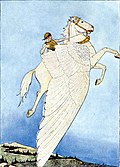 Bellerophon riding Pegasus (1914)

,_piatto_con_chimera_e_bellerofonte_su_pegaso,_350-300_ac_ca._(depositi_M._Naz._romano).JPG)
.jpg)
.jpg)


Footnotes
References
- ^ Tzetzes, Chiliades 7.810 (TE2.149); Scholia on Pindar, Olympian Ode 13.66
- ^ Assunçâo, Teodoro Renno (1997). "Le mythe iliadique de Bellérophon". Gaia: Revue Interdisciplinaire Sur la Grèce Archaïque. 1: 41–66. doi:10.3406/gaia.1997.1332.
- ^ Kerenyi 1959, p. 75.
- ^ Iliad vi.155–203.
- ^ Roman, Luke; Roman, Monica (2010). Encyclopedia of Greek and Roman Mythology. Infobase Publishing. p. 103. ISBN 978-1-4381-2639-5.
- ^ Breuil, Jean-Luc (1989). "ΚΡΑΤΟΣ et sa famille chez Homère: étude sémantique". In: Études homériques. Séminaire de recherche sous la direction de Michel Casevitz. Lyon: Maison de l'Orient et de la Méditerranée Jean Pouilloux. p. 41. (Travaux de la Maison de l'Orient, 17.)
- ^ Sauge, André (2005). "Remarques sur quelques aspects linguistiques de l'épopée homérique et sur leurs conséquences pour l'époque de fixation du texte (Seconde Partie)". Gaia: Revue Interdisciplinaire Sur la Grèce Archaïque. 9: 103–135. doi:10.3406/gaia.2005.1476.
- ^ a b Kirk 1990, p. 178
- ^ Scholion zu Homer, p.155
- ^ Kerenyi 1959, p. 79
- ^ Le mirage grec. l'Orient du mythe et de l'épopée. Institut des sciences et techniques de l'Antiquité. Vol. 756. 2000. doi:10.3406/ista.2000.2506. ISBN 0-291-32283-2.
- ^ Tzetzes ad Lycophron, 17; Eustathius on Homer p. 632.
- ^ Graves, Robert (24 April 2012) [1955]. The Greek Myths. Penguin Classics Deluxe Edition. Penguin. ISBN 9781101580509. Retrieved 31 March 2025.
- ^
Shipley, Joseph Twadell (1 July 2001) [1984]. "guhen". The Origins of English Words: A Discursive Dictionary of Indo-European Roots. Baltimore: The Johns Hopkins University Press. p. 140. ISBN 9780801896439. Retrieved 31 March 2025.
Bellerophon, name given to Hipponous, son of Glaucus, king or Ephyre, as 'slayer of monsters'; he had killed the Chimaera.
- ^ Hyginus, Fabulae 157
- ^ Apollodorus, 1.9.3
- ^ Apollodorus, 1.9.3 & 2.3.1
- ^ Homer, Iliad 6.196–197; Apollodorus, 2.3.1
- ^ a b Strabo, Geographica 12.8.5 & 13.4.16
- ^ Homer, Iliad 6.206–210
- ^ Homer, Iliad 6.197–205
- ^ Diodorus Siculus, 5.79.3
- ^ Pseudo-Clement, Recognitions 10.21
- ^ Apollodorus, 2.3.2; Tzetzes ad Lycophron, 17
- ^ Scholia ad Homer, Iliad 6.192
- ^ Scholia ad Pindar, Olympian Ode 13.82b
- ^ ?Scholia ad Homer, Iliad 6.155
- ^ Stephanus of Byzantium, s.v. Hydissos
- ^ By some accounts, Bellerophon's father was really Poseidon. Kerenyi 1959 p. 78 suggests that "sea-green" Glaucus is a double for Poseidon, god of the sea, who looms behind many of the elements in Bellerophon's myth, not least as the sire of Pegasus and of Chrysaor, but also as the protector of Bellerophon.
- ^ Kerenyi 1959 p. 80.
- ^ See Joseph Campbell, The Hero with a Thousand Faces, chapter 1, "Separation".
- ^ Carpenter, Rhys (1950). "Argeiphontes: A Suggestion". American Journal of Archaeology. 54 (3): 177–183. doi:10.2307/500295. JSTOR 500295. S2CID 191378610.
- ^ Katz, J. (1998). "How to be a Dragon in Indo-European: Hittite illuyankas and its Linguistic and Cultural Congeners in Latin, Greek, and Germanic". In Jasanoff; Melchert; Oliver (eds.). Mír Curad. Studies in Honor of Calvert Watkins. Innsbruck. pp. 317–334. ISBN 3851246675.
{{cite book}}: CS1 maint: location missing publisher (link) - ^ The suggestion, made by Kerenyi and others, makes the name "Bellerophontes" the "killer of Belleros", just as Hermes Argeiphontes is "Hermes the killer of Argus". Carpenter[32] makes a carefully argued case for Bellerophontes as the "bane-slayer" of the "bane to mankind" in Iliad II.329, derived from a rare Greek word έλλερον elleron, explained by the grammarians as κακόν kakón, "evil". This έλλερον is connected by Katz[33] with a Hesychius gloss ελυες elyes "water animal", and an Indo-European word for "snake", or "dragon", cognate to English eel, also found in Hittite Illuyanka, which would make Bellerophon the dragon slayer of Indo-European myth, represented by Indra slaying Vrtra in Indo-Aryan, and by Thor slaying the Midgard Serpent in Germanic. Robert Graves in The Greek Myths rev. ed. 1960 suggested a translation "bearing darts".
- ^ In Iliad vi.
- ^ Euripides' tragedies Stheneboia and Bellerophontes are lost.
- ^ This mytheme is most familiar in the Biblical narrative of Joseph and Potiphar's wife. Robert Graves also notes the parallel in the Egyptian Tale of Two Brothers and in the desire of Athamas' wife for Phrixus (Graves 1960, 70.2, 75.1).
- ^ The tablets "on which he had traced a number of devices with a deadly meaning" constitute the only apparent reference to writing in the Iliad. Such a letter is termed a "bellerophontic" letter; one such figures in a subplot of Shakespeare's Hamlet, bringing offstage death to Rosencrantz and Guildenstern. Such a letter figures in the earlier story of Sargon of Akkad.
- ^ Kerenyi 1959, quoting Apollodorus Mythographus, 2.7.4.
- ^ Description of Greece 2.4.6.
- ^ Pseudo-Nonnus, On Gregory of Nazianzus 1; Tzetzes ad Lycophron, 17; Eustathius On Homer's Iliad 6.494.40
- ^ Kerenyi 1959.
- ^ Hesiod, Theogony 319 ff.; Apollodorus, 2.3.2; Pindar, Olympian Odes 13.63 ff.; Pausanias, 2.4.1; Hyginus, Fabulae 157; John Tzetzes, On Lycophron.
- ^ Robert Graves, 75.d; Plutarch, On the Virtues of Women.
- ^ Finkelberg, Margalit (1991). "Royal succession in heroic Greece". The Classical Quarterly. New Series. 41 (2): 303–316. doi:10.1017/s0009838800004481. JSTOR 638900. S2CID 170683301.
- ^ The inheritance of kingship through the king's daughter, with many heroic instances, is discussed by Finkelberg;[45] compare Orion and Merope.
- ^ Isander is struck down by Ares in battle with the Solymi (Iliad xvi).
- ^ Homer, Iliad, 6. 197–205
- ^ Oxford Classical Mythology Online. "Chapter 25: Myths of Local Heroes and Heroines". Classical Mythology, Seventh Edition. Oxford University Press USA. Archived from the original on July 15, 2011. Retrieved April 26, 2010.
- ^ In Diodorus Siculus's Bibliotheca historica 5.79.3: she is referred to as Deidamia and made the wife of Evander, son of Sarpedon the elder, and by her, father of Sarpedon the younger.
- ^ Tzetzes on Aristophanes' Frogs 1051
- ^ Euripides, Stheneboea hypothesis [=P. Oxy. 2455]; scholia on Aristophanes' Peace 141
- ^ Parallels are in the myths of Icarus and Phaeton.
- ^ Homer (1924). The Iliad. Translated by Murray, A.T. Cambridge, Massachusetts: Harvard University Press. Vol. I (book 6, lines 202–204). Retrieved 2020-06-11.
- ^ Pindar, Olympian Odes, xiii.87–90, and Isthmian Odes, vii.44; Bibliotheke ii.3.2; Homer, Iliad vi.155–203 and xvi.328; Ovid, Metamorphoses ix.646.
- ^ Riedweg, Christoph (1990). "The 'atheistic' fragment from Euripides' Bellerophontes (286 N²)". Illinois Classical Studies. 15 (1): 39–53. ISSN 0363-1923.
- ^ Johnston, George Burke (1955). "Jonson's 'Perseus upon Pegasus'". The Review of English Studies. New Series. 6 (21): 65–67. doi:10.1093/res/VI.21.65.
Further reading
- Graves, Robert, 1960. The Greek Myths, revised edition (Harmondsworth: Penguin)
- Homer, Iliad, book vi.155–203
- Kerenyi, Karl, 1959. The Heroes of the Greeks (London: Thames and Hudson)
- Kirk, G. S., 1990. The Iliad: A Commentary Volume II: books 5-8. (Cambridge: Cambridge University Press)
- Scholia to Lycophron's Alexandra, marginal notes by Isaak and Ioannis Tzetzes and others from the Greek edition of Eduard Scheer (Weidmann 1881). Online version at the Topos Text Project.. Greek text available on Archive.org
