








Trollius
| Trollius | |
|---|---|

| |
| Trollius europaeus | |
Scientific classification 
| |
| Kingdom: | Plantae |
| Clade: | Tracheophytes |
| Clade: | Angiosperms |
| Clade: | Eudicots |
| Order: | Ranunculales |
| Family: | Ranunculaceae |
| Subfamily: | Ranunculoideae |
| Tribe: | Adonideae |
| Genus: | Trollius L. |
| Species | |
|
About 30, including: | |
| Synonyms | |
| |
Trollius is a genus of about 30 species of flowering plants closely related to Ranunculus, in the family Ranunculaceae. The common name of some species is globeflower[1] or globe flower. The generic name is derived from the Swiss-German word "Trollblume", meaning a rounded flower.[2] Native to the cool temperate regions of the Northern Hemisphere, with the greatest diversity of species in Asia, species of the genus Trollius usually grow in heavy, wet clay soils.[3]
Description
Species of the genus Trollius are mostly herbaceous, fibrous rooted perennials with bright yellow, orange or lilac coloured flowers. The name "globe flower" refers to the petals of T. europaeus and T. × cultorum which are curved over the top of the flower, forming a globe. But T. pumilus has flatter flowers, and T. chinensis has open flowers with prominent stamens.[4]
Ecology
All species of the genus Trollius are poisonous to cattle and other livestock when fresh, but their acrid taste means they are usually left uneaten. They are, however, used as food plants by the larvae of some Lepidoptera species including silver-ground carpet.
Research on Trollius europaeus indicates that its closed, globe-shaped flower form may have evolved as a defense mechanism against the over-exploitation by its seed-eating fly pollinators. These seed-eating fly pollinators, coming from the genus Chiastocheta, lay eggs within the flowers where their larve consume some of the developing seeds while adults facilitate pollination. This creates a specialized and stable mutualistic interaction.[5]
Cultivation
Some species of the genus Trollius are popular ornamental flowers in horticulture, with several cultivars selected for large and brightly coloured flowers. The hybrid T. × cultorum[6] in particular is a source of several garden cultivars, including 'Superbus', which has gained the Royal Horticultural Society's Award of Garden Merit.[7][8]
Image gallery
-
 Trollius laxus
 -
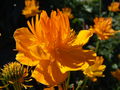 Trollius species
 -
 Trollius in the south-west of Buryatia, Russia
 -

-


References
- ^ NRCS. "Trollius". PLANTS Database. United States Department of Agriculture (USDA). Retrieved 12 December 2015.
- ^ Gledhill D. 1985. The Names of Plants. Cambridge University Press. ISBN 0521366755
- ^ "A New Species from South Siberia". Novataxa. 30 January 2019. Retrieved 11 February 2019.
- ^ RHS A-Z Encyclopedia of Garden Plants. United Kingdom: Dorling Kindersley. 2008. p. 1136. ISBN 978-1405332965.
- ^ Louca, Stilianos; Ibanez, Sébastien; Piau, Didier; Després, Laurence (2012-03-07). "Specialized nursery pollination mutualisms as evolutionary traps stabilized by antagonistic traits". Journal of Theoretical Biology. 296: 65–83. doi:10.1016/j.jtbi.2011.11.028. ISSN 0022-5193.
- ^ "Missouri Botanical Garden". Retrieved 27 April 2013.
- ^ "RHS Plant Selector - Trollius × cultorum 'Superbus'". Retrieved 7 June 2013.
- ^ "AGM Plants - Ornamental" (PDF). Royal Horticultural Society. July 2017. p. 103. Retrieved 25 December 2018.