








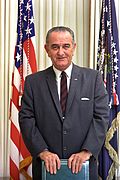
Luther H. Hodges
Luther Hodges | |
|---|---|
 | |
| 15th United States Secretary of Commerce | |
| In office January 21, 1961 – January 15, 1965 | |
| President | John F. Kennedy Lyndon B. Johnson |
| Preceded by | Frederick H. Mueller |
| Succeeded by | John T. Connor |
| 64th Governor of North Carolina | |
| In office November 7, 1954 – January 5, 1961 | |
| Lieutenant | Luther E. Barnhardt |
| Preceded by | William B. Umstead |
| Succeeded by | Terry Sanford |
| 22nd Lieutenant Governor of North Carolina | |
| In office January 8, 1953 – November 7, 1954 | |
| Governor | William B. Umstead |
| Preceded by | Hoyt Patrick Taylor |
| Succeeded by | Luther E. Barnhardt |
| Personal details | |
| Born | Luther Hartwell Hodges March 9, 1898 Cascade, Virginia, U.S. |
| Died | October 6, 1974 (aged 76) |
| Party | Democratic |
| Spouses | |
| Children | 3 (including Luther H. Hodges Jr.) |
| Education | University of North Carolina, Chapel Hill (BA) |
| Military service | |
| Allegiance | United States |
| Branch/service | United States Army |
| Battles/wars | World War I |
Luther Hartwell Hodges (March 9, 1898 – October 6, 1974) was an American businessman and politician. After a career in textile manufacturing, he entered public service, gaining some state appointments. Elected as lieutenant governor of North Carolina in 1952, he succeeded to the Governor's office in 1954 after the death of the incumbent. He was elected in 1956 to a full four-year term, serving in total as the 64th governor of the state of North Carolina from 1954 to 1961.
Biography
Hodges was born in Cascade,[1] Pittsylvania County, Virginia, on March 9, 1898. At the age of two, he moved with his family to Spray (which later merged with two other towns to become Eden, North Carolina). After growing up there, he lived much of his life in Rockingham County, North Carolina.
Hodges left for the University of North Carolina at Chapel Hill at age 17, where he was a member of the Dialectic and Philanthropic Societies, and moved back to Eden after graduation. He went to work at Carolina Cotton and Woolen Mills in Leaksville. On June 24, 1922, he married Marthe Elizabeth Blakeney in Monroe, North Carolina.[2] In 1923, he helped form the Leaksville Rotary Club, which later became known as the Eden Rotary.
Carolina Cotton was later purchased by Marshall Field. Hodges continued to work for the company, working his way up from millworker to executive positions, until he retired to enter politics. In the 1940s, he gained gubernatorial appointments to the state Board of Education and the Highway and Public Works Commission. In 1945, he served as a consultant to the U.S. Secretary of Agriculture and to the U.S. Army in occupied Germany.[citation needed] He retired in 1950 and returned to North Carolina.[3]

Governor
Hodges ran for office as lieutenant governor as a Democrat in 1952 and was elected. He succeeded to the position of governor in November 1954 upon the death of Governor William B. Umstead in office. In 1956, Hodges was elected on his own account to a full four-year term as governor. Because North Carolina had a one-term limit for governors at that time, Hodges had the longest continuous tenure in the office until the state constitution was changed and Jim Hunt was elected to a second term in 1980.
During his time in office, Governor Hodges championed what he called "business progressivism."[4] His modernization efforts included the new Department of Administration to streamline state government; industrial recruitment programs to diversify North Carolina's economy beyond agriculture and textiles; upgrading roads and utilities; and most important, creating the nationally famous Research Triangle Park in 1959, which linked advanced academic research and inventive young entrepreneurs.To promote better education, Hodges increased funding for public schools and raised teacher salaries. He expanded the state's community college system and encouraged the University of North Carolina system.[5] However, Hodges faced resistance from rural conservatives who opposed increased state spending and federal involvement. Thanks to his business background and moderate approach on racial issues (he supported "separate but equal" rather than integration) he built coalitions across traditional political lines. [6][7] For this work, Hodges is credited with leading North Carolina's dramatic transformation from one of the most impoverished states in the Union to one of its most prosperous.[8]
Civil rights
In 1959, Hodges became involved in the Kissing Case, where two young African-American boys (one aged 9, and one aged 7) had been convicted of assault and molestation because a white girl (aged 8) had kissed them each on the cheek. They had been sentenced to the state reformatory. A range of activists, civil rights organizations, Eleanor Roosevelt and President Eisenhower, in addition to the international press, pressured Hodges for clemency. After three months Hodges pardoned them, but refused to apologize.[9]: 118 [10] Former First Lady Eleanor Roosevelt "led an international campaign on their behalf."[9]: 118 [11]: 118
Secretary of Commerce
In 1961 he was appointed as United States Secretary of Commerce under Presidents John F. Kennedy and Lyndon B. Johnson, serving until 1965.[12]
Later years
He returned to Chapel Hill, North Carolina and served as chairman of Research Triangle Park, a major facility established during his tenure as governor. In 1967, he served a one-year term as president of Rotary International.>[13]
He died on October 6, 1974, in Chapel Hill, North Carolina, and is buried at the Overlook Cemetery in Eden, North Carolina. A monument was erected in his honor near a water fountain in Eden's Freedom Park.
Legacy
Hodges's son, Luther H. Hodges Jr., was a prominent banking executive and United States Deputy Secretary of Commerce.
See also
References
- ^ NNDB
- ^ "Monroe's Only First Lady". The Enquirer-Journal. Monroe, North Carolina. September 1974. Retrieved January 8, 2025.
- ^ Barkin, Dan (August 2021). "A Tale of Two Legacies". Business North Carolina. pp. 8–9.
- ^ Luther H. Hodges Jr, Businessman in the statehouse: Six years as governor of North Carolina (UNC Press Books, 2018)
- ^ Mac McCorkle, "History and the 'New Economy' Narrative: The Case of Research Triangle Park and North Carolina's Economic Development." Journal of the Historical Society 12.4 (2012): 479-525.
- ^ William A. Link, North Carolina: Change and Tradition in a Southern State (2018) pp.. 369-378,
- ^ Neal R. Peirce, The Border South States (1975) pp.140–150.
- ^ Audretsch, David B. (2015). Everything in Its Place: Entrepreneurship and the Strategic Management of Cities, Regions, and States. Oxford: Oxford University Press. p. 105. ISBN 9780199351275.
- ^ a b Allida M. Black (1996), "Championing Civil Rights", Casting Her Own Shadow: Eleanor Roosevelt and the Shaping of Postwar Liberalism, Columbia University Press, retrieved January 19, 2017
- ^ Sue Sturgis (April 25, 2014), "Remembering Southern Black freedom fighter Mabel Williams", Facing South, Institute of Southern Studies, retrieved January 19, 2017
- ^ Allida M. Black (1996). Casting Her Own Shadow: Eleanor Roosevelt and the Shaping of Postwar Liberalism. Columbia University Press. ISBN 978-0231104050.
- ^ Lawrence Kestenbaum, ed. (nd), "Hodges, Luther Hartwell (1898-1974) — also known as Luther H. Hodges", Political Graveyard, retrieved January 19, 2017
- ^ "Gallery of past presidents". Rotary International. Archived from the original on 22 January 2012. Retrieved 22 December 2011.


| |||||||||||||||||||||||||||
| |||||||||||||||||||||||||||

| International | |
|---|---|
| National | |
| People | |
| Other | |
