






File:Margaret-Preston-Mosman-Bridge-1927.jpg
Summary
| Description |
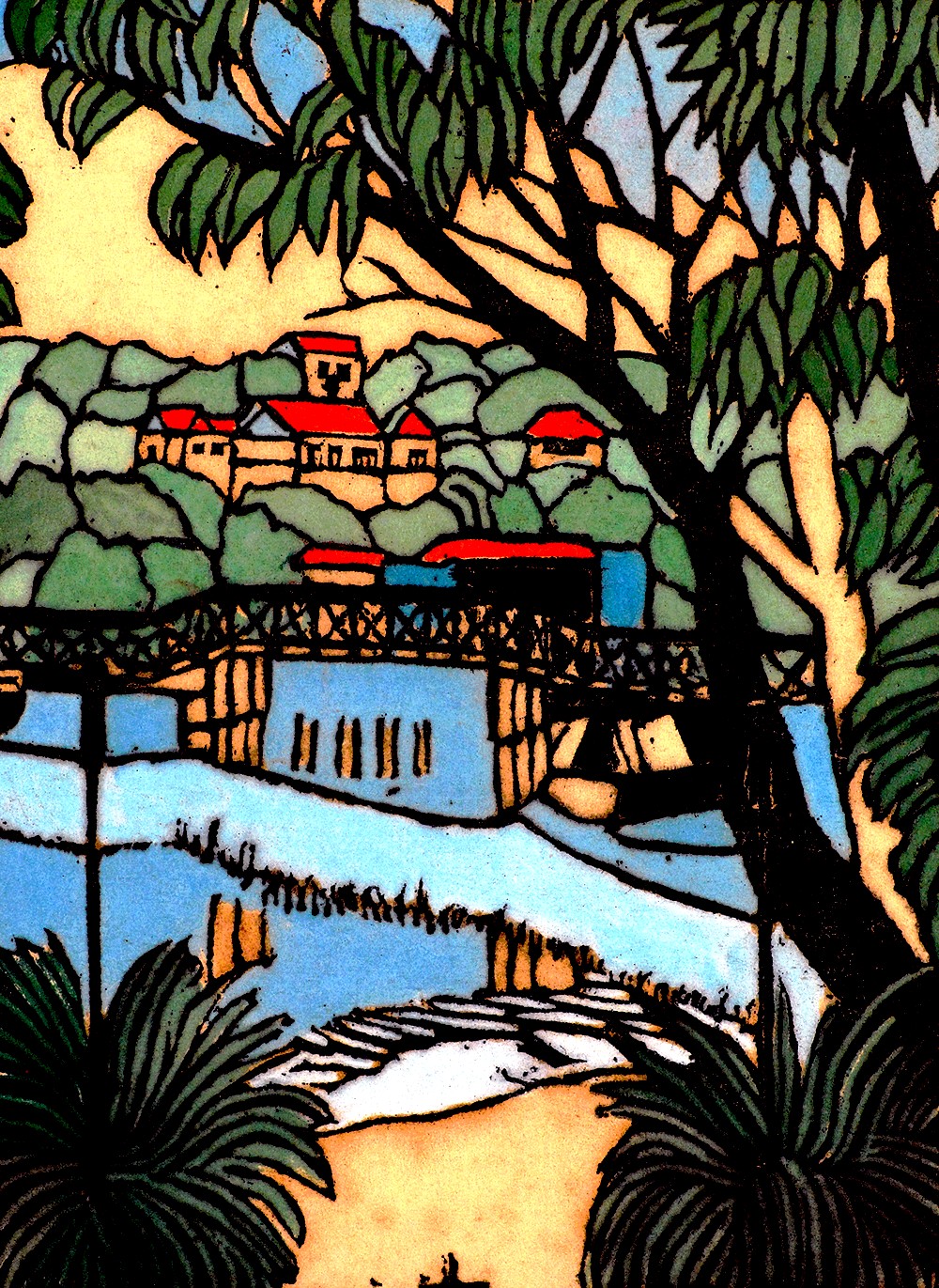
English: Mosman Bridge.
Hand coloured wood block print 25cm x 18.5cm. Mosman is the specific subject of a number of Margaret Preston’s important paintings and prints from the 1920s until the 1950s, and is also the backdrop for hundreds of other works including those images we are so familiar with – Australian flora and bird life, still life arrangements and interiors and urban harbour views. The wood block prints, Mosman Bridge (1925) and Wooden Bridge (1927) were made during her residence at the flat “Glenorie” in Musgrave Street at Mosman Bay which afforded generous harbour views. These works are an important addition to The Balnaves Gift and the Mosman Art Collection. Margaret Preston has remained one of the most celebrated of Australia’s artists. She is a central figure in a group of early twentieth century modernists whose exuberant, cosmopolitan paintings and prints represent not only one of the most distinctive and innovative periods in Australian art, but whose works have been seen, since their time of production, as quintessentially Sydney images. Born in 1875 in Port Adelaide, Preston was educated at Fort Street High School. Her formal art training was distinguished by her instruction under many major Australian artists. Her art tuition began at aged twelve, studying under William Lister Lister. In Victoria she studied under Fredrick McCubbin, and with Bernard Hall, and later under H.P. Gill and Hans Heysen. Teaching would also feature prominently at various points in Preston’s career and she was an influential instructor. Among her students were the notable artists Bessie Davidson, Gladys Reynell and also Stella Bowen. Margaret Preston came to fame as a major Australian artist from the time she and husband Bill Preston made Mosman their home in early 1920. Preston was based for much of her long career in Mosman, indeed virtually all of the artist’s most significant paintings and prints were produced in a variety of Mosman residences. Margaret Preston was vociferous in her advocacy for an Australian visual aesthetic and was widely known within the Mosman community, acting as the adjudicator in 1952 for the Mosman Art Prize which she awarded to artist Grace Cossington Smith. She lived locally – with the exception of seven years in Berowra in the 1930s – until her death in 1963. Mosman Art Gallery. |
| Date | |
| Source |
http://mosmanartgallery.org.au/collection/margaret-preston-0 http://mosmanartgallery.org.au/collection/margaret-preston |
| Author | Margaret Preston |
Licensing
|
This is a faithful photographic reproduction of a two-dimensional, public domain work of art. The work of art itself is in the public domain in its source country for the following reason:
It is also in the public domain in the United States for the following reason:
The official position taken by the Wikimedia Foundation is that "faithful reproductions of two-dimensional public domain works of art are public domain".
This photographic reproduction is therefore also considered to be in the public domain in the United States. In other jurisdictions, re-use of this content may be restricted; see Reuse of PD-Art photographs for details.
| |||||||||||||||||||||||




File history
Click on a date/time to view the file as it appeared at that time.
| Date/Time | Thumbnail | Dimensions | User | Comment | |
|---|---|---|---|---|---|
| current | 14:55, 28 May 2020 | | 1,000 × 1,371 (622 KB) | Poli.Pav | Uploaded a work by Margaret Preston from http://mosmanartgallery.org.au/collection/margaret-preston-0 http://mosmanartgallery.org.au/collection/margaret-preston with UploadWizard |
File usage
The following page uses this file:
Global file usage
The following other wikis use this file:
- Usage on ca.wikipedia.org
