








File:The Humiliation of Draupadi.jpg
Summary
| Description |
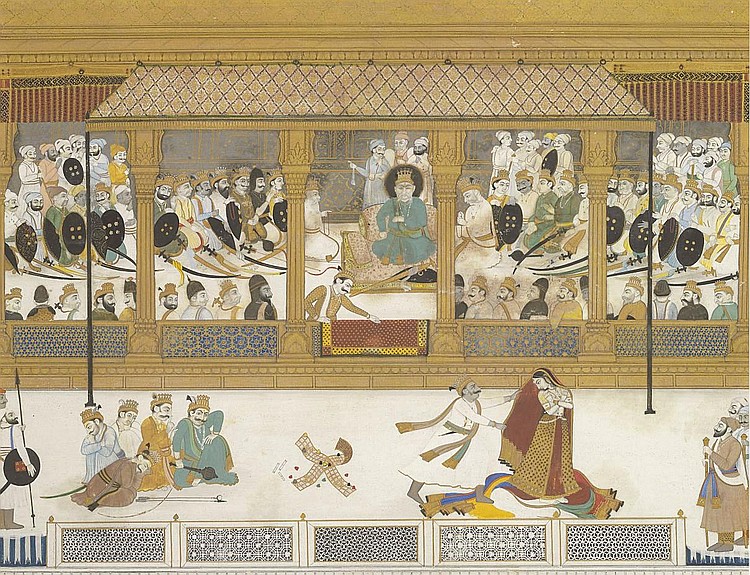
English: An Illustration from the Mahabharata: The Shakuni the king of Gandhar and the price of Hastinapur had a plan of the game dice.They need to win the game to insert Draupadi the kulavadu of Hastinapur.
With the blind king Dhritarashtra flanked by the Kauravs seated in a golden pavilion, the Pandavas at left in the foreground with heads bowed in shame as their wife is stripped of her garments, Krishna's miracle illustrated by the multiple lengths of cloth at her feet Opaque pigments with gold on wasli 9¼ x 11¾ in. (30.4 x 29.8 cm.), framed Notes: Property from a private collection, Michigan Draupadi's cheer-haran, literally meaning stripping of one's clothes, marks a definitive moment in the story of Mahabharata. Her husbands, the Pandavas are tricked by their cousins, the Kauravas, into a fixed game of dice in which they lose their all their wealth and kingdom. Yudhishthira, the eldest and most-respected Pandava, is then goaded into gambling away each brother. Still the Kauravas are not satisfied by this humiliation, so they taunt Yudhishthira further into betting his wife. Against the protests of the family elders, who argue a woman cannot be put at stake, Yudhishthira puts Draupadi as a bet for the next round. When the Kauravas win, the eldest one Duryodhana, commands his younger brother Dushasana to forcefully bring her to the gathering. Dushasana drags her into the court by her hair. Drunk with power, Dushasana tries to strip Draupadi of her sari. Seeing her husbands unable or unwilling to help her, Draupadi prays to Lord Krishna to protect her. As Dushasana unwraps layers and layers of her sari, it keeps getting extended. Finally, a tired Dushasana backs off without being able to remove her clothing. Given this final insult that Draupadi faced, the younger Pandavas break their silence and vow to avenge these and further humiliations, which culminates in the epic battle, the Mahabharata. |
| Date | between 1830 and 1840 |
| Source | http://www.artfact.com/auction-lot/an-illustration-from-the-mahabharata:-the-humili-860-c-0e4ee3d51b |
| Author | Unknown author |
Licensing

|
This work is in the public domain in India because its term of copyright has expired or it is ineligible for copyright.
The Indian Copyright Act applies in India to works first published in India. According to the Indian Copyright Act, 1957, as amended up to Act No. 27 of 2012 (Chapter V, Section 25):
 You must also include a United States public domain tag to indicate why this work is in the public domain in the United States. You must also include a United States public domain tag to indicate why this work is in the public domain in the United States.
|
 |
File history
Click on a date/time to view the file as it appeared at that time.
| Date/Time | Thumbnail | Dimensions | User | Comment | |
|---|---|---|---|---|---|
| current | 13:27, 21 September 2013 | | 750 × 575 (220 KB) | శ్రీధర్ బాబు | User created page with UploadWizard |
File usage
The following 2 pages use this file:
Global file usage
The following other wikis use this file:
- Usage on id.wikipedia.org
